Teks Konple Dokiman an
Teks ki soti nan dokiman orijinal la pou endeksasyon.
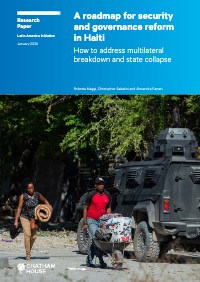
Research
Paper A roadmap for security
and governance reform
in Haiti
How to address multilateral
breakdown and state collapse
Roberta Maggi, Christopher Sabatini and Alexandra Farsari
Latin America Initiative
January 2026
Chatham House, the Royal Institute of International
Affairs, is a world-leading policy institute based in London.
Our mission is to help governments and societies to build
a secure, sustainable, prosperous and just world.
A roadmap for security and governance reform in Haiti
How to address multilateral breakdown and state collapse 1 Chatham House
Summary
—This paper proposes a three-year roadmap that can help to start addressing Haiti’s
interlinked security and governance crises. It outlines a sequence of reforms that
Haiti’s transitional administration – in whatever shape this remains – and any
future elected government should develop in cooperation with the UN, other
multilateral partners and a potential voluntary coalition of external governments.
The proposed measures are needed to curb gang rule and violence, enable
humanitarian access, strengthen the judicial system, and professionalize
and rationalize the country’s chaotic security sector.
—The urgent need for on-the-ground stabilization measures and more effective
international support is underlined by the severity and extended duration
of the country’s political, security and humanitarian challenges. Haiti still
has no elected president or legislature. Since the assassination of President
Jovenel Moïse on 7 July 2021, executive power has essentially been exercised
by unelected transitional figures – notably, since 2024, by a Transitional
Presidential Council (TPC). With the TPC’s time-limited mandate set to expire
on 7 February 2026, and with the security situation too unstable to permit the
holding of elections that should have delivered the TPC’s successor, Haiti faces
a worsening of its political vacuum at a moment when legitimate, capable
and accountable government is more critically needed than ever.
—A weak or non-existent state, combined with the lack of a government that
can command popular legitimacy, has accelerated the collapse of security
and strengthened the hold of armed gangs and militias. These groups and their
associates now control large areas of Port-au-Prince and key transport corridors.
Kidnappings, extortion and targeted killings are often used as tools of economic
predation and political leverage.
—The multilateral response has struggled to match the pace and complexity of these
challenges. Since 2022 the UN Security Council (UNSC) has relied on a sequence
of ad hoc measures – initially the use of sanctions targeting gang leaders and
their enablers,
1
followed in October 2023 by the creation of a Multinational
Security Support (MSS) mission requiring voluntary contributions from member
states for financing and providing equipment and security forces. However, that
mission failed to generate sufficient funding and troops to re-establish stability
and development in Haiti. In response, in September 2025 the UNSC approved
a resolution establishing a new operation, the Gang Suppression Force (GSF),
that supersedes the MSS. Like its predecessor, the GSF will require voluntary
contributions to pay for troops; but unlike the MSS, the new effort will count
on UN support for logistics and operational oversight.
2
1 United Nations Security Council (2022), ‘Resolution 2653 (2022)’, adopted 21 October 2022,
https://main.un.org/securitycouncil/en/content/sres2653-2022.
2 Mohor, D. (2025), ‘Haiti in-depth: The new Gang Suppression Force and what it means for Haitians’,
The New Humanitarian, 3 December 2025, https://www.thenewhumanitarian.org/analysis/2025/12/03/
haiti-depth-new-gang-suppression-force-what-it-means-haiti.
2 Chatham HouseA roadmap for security and governance reform in Haiti
How to address multilateral breakdown and state collapse
—In light of these developments, this paper sets out what the authors believe are
realistic options for transforming today’s ad hoc, emergency-focused responses
into a coherent strategy for security and governance reform. The paper assesses
options for: implementing security and state reform; facilitating disarmament,
demobilization and reintegration (DDR) of gangs and associated armed actors;
reclaiming territory and key infrastructure from illicit groups; rebuilding
communities and restoring public trust in government and security providers;
and enabling the justice system to respond effectively and appropriately to the
activities of gang leaders and their political and economic sponsors.
—The paper’s top-line, priority recommendations are as follows:
—Any comprehensive, Haitian-owned security reform process must begin
with a time-bound strategic vision. In the first instance, a technocratic
planning commission should be established, tasked with drafting a clear and
concise document that Haitian and international decision-makers, security
practitioners and communities can use as a shared set of guiding principles.
—Another crucial preliminary step is to conduct a structural review of
existing Haitian security sector institutions: the Haitian National Police
(HNP), the Haitian Armed Forces (FADH), the National Intelligence Agency
(ANI) and the country’s correctional services. This review should clarify
each institution’s role, identify overlaps in agencies’ remits and activities,
and resolve institutional inefficiencies across the four domains: policing,
defence, intelligence and corrections.
—In the absence of a functioning legislature, Haiti is unable to modernize the
legal framework governing private security, asset forfeiture, procurement,
arms control and the use of force. In the near term (0–12 months), efforts
should therefore focus on issuing targeted interim regulations – decrees,
internal regulations and memorandums of understanding – on a limited
number of issues critical to Haiti’s security. These regulations should
be explicitly framed as transitional in nature, however.
—Rebuilding the legitimacy of the security services requires a system-wide
approach to integrity, ethics and professional conduct, rather than episodic
purges of delinquent or partisan personnel. Haitian authorities and their
international partners should define common eligibility and conduct criteria
for personnel across the police, defence, intelligence and correctional
services. Guidance should initially be accompanied by the introduction
of independent vetting of security sector personnel and contractors,
and by reforms on the use of force by Haiti’s security services.
—The TPC (or its interim successor) and any future elected government
will need to move quickly to reassert control over key transportation hubs.
In the near term, the priority must be to improve security and access
at ports (for example, Cap-Haïtien and Port-au-Prince) and land crossings
(such as Ouanaminthe and Malpasse). Pilot schemes should be introduced
at these sites, so that customs officers, HNP personnel, immigration officials,
Anti-Corruption Unit (ULCC) staff and prosecutors can work side by side
on interdictions of weapons, narcotics and other illicit goods.
A roadmap for security and governance reform in Haiti
How to address multilateral breakdown and state collapse 3 Chatham House
—Efforts to dismantle gangs and reduce their hold on the country should focus
not only on armed groups themselves, but also on facilitators and enablers who
control logistics, financing and access to state services. Operations at ports, fuel
depots and customs posts, along with management of public works contracts,
all provide opportunities for mid-level criminal elements in Haiti’s conflict
economy to shield themselves and their networks from scrutiny while enabling
gang coalitions to operate. Addressing this culture of impunity would improve
security and reliability of basic service provision.
Background
The assassination of President Jovenel Moïse on 7 July 2021 marked the tipping
point in a long-running governance crisis in Haiti, and deepened the country’s
constitutional vacuum. In April 2024, a Transitional Presidential Council (TPC)
was sworn in to restore security and organize overdue elections, but it inherited
an eroded state apparatus and limited territorial control. Even today, Haiti still has
no elected president or legislature, and executive power is exercised by unelected
transitional figures.
This vacuum of governance and government legitimacy has accelerated the collapse
of security. Armed gangs and militias now control large areas of Port-au-Prince –
the Haitian capital – and major transport corridors. These groups often use
kidnappings, extortion and targeted killings as tools of predation and political
leverage. Their hold over infrastructure and neighbourhoods allows them to act
as de facto governing authorities: imposing rules, offering selective protection
to residents and businesses, and negotiating with the political and economic
elites. Vigilante movements have emerged in response to this situation, adding
yet another layer of violence to Haiti’s security crisis.
The multilateral response has struggled to match the pace and complexity of Haiti’s
challenges. In 2022 the UN Security Council (UNSC) adopted a sanctions regime
targeting gang leaders and their enablers.
3
A year later, in October 2023, the UNSC
authorized a Multinational Security Support (MSS) mission
4
– made up principally
of non-UN, Kenyan-led security forces – to assist the Haitian National Police (HNP)
and establish sufficiently secure conditions for elections to be held. Those conditions
have not been met, however. Security is still tenuous in the extreme. International
engagement with Haiti has for too long remained cautious and dependent on
voluntary contributions in funding and forces. All the while, gangs have evolved
into more entrenched economic actors and are increasingly asserting themselves
politically too.
3 United Nations Security Council (2022), ‘Resolution 2653 (2022)’, adopted 21 October 2022,
https://main.un.org/securitycouncil/en/content/sres2653-2022.
4 The MSS was authorized by UN Security Council Resolution 2699. See United Nations Security Council (2023),
‘Resolution 2699 (2023)’, adopted 2 October 2023, https://docs.un.org/en/s/res/2699(2023).
4 Chatham HouseA roadmap for security and governance reform in Haiti
How to address multilateral breakdown and state collapse
This paper is published at a moment when Haiti stands on the cusp of a period of
heightened uncertainty. An attempt to mobilize UN member states under a new 2025
resolution
5
means that the MSS – widely acknowledged as unsuccessful – has been
superseded by the Gang Suppression Force (GSF). The GSF, unlike its predecessor,
is designed to be supported through UN-managed funding mechanisms for its
operations and logistics, allowing for more direct and sustained international action.
At the same time, significant political change is looming as the end of the TPC’s
mandate on 7 February 2026 approaches. Amid all this potential for turbulence, the
UN and its international partners face the challenges of planning for the restoration
of constitutional order through elections, and of mobilizing international funding
and forces to support the new GSF security commitments.
Publication of this paper is deliberately timed to inform policy discussions between
Haitian authorities and their international partners in the run-up to the expiry of the
TPC’s mandate, and in the initial months thereafter. Rather than set out a fixed
blueprint, the paper outlines a set of analytically grounded options for reaching the
first phase of stabilization, and presents a detailed, three-year roadmap designed
to be a Haitian-led endeavour. The presented options draw on the findings from
a forthcoming, longer research paper – based in part on focus groups and interviews
with security experts, multilateral officials, diplomats, and members of Haitian civil
society and government – that is due to be published for limited circulation in
mid-2026. In addition to briefly analysing gang dynamics in Haiti, and their impact
on the broader social and state security infrastructure, we aim in this shorter summary
document to sketch out options for transforming today’s emergency responses into
a coherent strategy and foundation for security and governance reform.
Haitian citizens and community leaders consistently identify insecurity as the
primary barrier to sustaining livelihoods.
6
This is unsurprising: violence and the
threat of violence shape people’s everyday mobility, access to employment and
ability to carry out basic economic and social activities. To understand this reality
5 Stepansky, J. (2025), ‘UN Security Council approves ‘Gang Suppression Force’ for Haiti’, Al Jazeera,
30 September 2025, https://www.aljazeera.com/news/2025/9/30/un-security-council-approves-gang-
suppression-force-for-haiti.
6 Between August and October 2025, Chatham House held several key informant interviews and focus group
discussions with Haitian experts and civil society leaders based in Haiti, with the objectives of unpacking
the key barriers to citizens’ ability to sustain livelihoods and of identifying the root causes of the present-day
crisis in Haiti.
Haitian citizens and community leaders consistently
identify insecurity as the primary barrier to
sustaining livelihoods: violence and the threat of
violence shape people’s everyday mobility, access
to employment and ability to carry out basic
economic and social activities.
A roadmap for security and governance reform in Haiti
How to address multilateral breakdown and state collapse 5 Chatham House
it is necessary to begin at the non-state level – that is, with the system of gangs
and their associates, as these actors have effective control over key territory and
thus most impact on ordinary citizens’ safety and freedom of movement.
In Haiti, the provision of security is transacted through a dense marketplace
in which public authority is fragmented and protection is priced, brokered and
frequently weaponized. The reorganization and consolidation of large gang
coalitions and the systematic outsourcing of protection by households, firms
and even public bodies to security groups – including private security agencies
and gangs – have resulted in effect in the monetization of the public’s access
to roads, ports and basic services. In this marketplace, security functions more
as a negotiable commodity than as a public good enjoyed by all.
In the ecosystem of Haitian gangs, the central actor operating at present is the
Viv Ansanm coalition. Formed in September 2023 through the fusion of former
rivals G9 and G-Pèp, it has emerged as the primary price-setter in Port-au-Prince’s
parallel economy. The coalition controls or heavily influences an estimated
80 per cent or more of the metropolitan area and its immediate periphery,
a dominance repeatedly demonstrated through coordinated attacks on prisons,
police stations, transportation hubs, the international airport, and fuel and
port facilities.
Viv Ansanm taxes movement, rations services and adjudicates in disputes. These
de facto powers allow it to determine the selective distribution of food, cash and
‘public order’ instrumental in consolidating its local legitimacy while stabilizing rent
streams from corridor tolls and logistics chains.
7
Recent human rights reporting
underscores the heavy toll this model takes on civilians: many of those recruited
or coerced into working for gangs are reported to be children, while evidence
suggests women and girls in gang-controlled neighbourhoods face sexual violence,
exploitation and forced pregnancy.
8
The coercive power of Haitian armed groups rests increasingly on a combination
of military-grade weaponry, commercial drones and siege-style operations.
Reporting by the UN Office on Drugs and Crime (UNODC) points to frequent use
of assault and battle rifles, alongside a growing fleet of commercially available
drones, by armed non-state actors. Gangs have reportedly deployed drones for
intelligence, surveillance and reconnaissance, and for real-time coordination
of attacks, including on prison facilities.
9
This combination of capabilities and tactics
has raised the risks and costs associated with ground operations by the HNP and
the MSS mission, in turn increasing private demand for armed convoys and static
protection services.
7 United Nations Security Council (2025), ‘VIV ANSANM’, 8 July 2025, https://main.un.org/securitycouncil/en/
content/viv-ansanm.
8 Amnesty International (2025), ‘Haiti: Children suffering gang recruitment, attacks and sexual violence amid
escalating crisis – new report’, 12 February 2025, https://www.amnesty.org/en/latest/news/2025/02/haiti-
children-suffering-gang-recruitment-attacks-sexual-violence.
9 United Nations Office on Drugs and Crime (2023), Haiti’s criminal markets: mapping trends in firearms and drugs
trafficking, https://www.unodc.org/documents/data-and-analysis/toc/Haiti_assessment_UNODC.pdf.
6 Chatham HouseA roadmap for security and governance reform in Haiti
How to address multilateral breakdown and state collapse
Tactically, gang coalitions have moved from the use of fragmented hit-and-run
attacks towards more deliberate siege warfare and urban envelopment. The January
2025 attacks on the commune of Kenscoff near Port-au-Prince,
10
for instance,
illustrated the more organized, offensive approach gang coalitions are deploying
to seize territory; this approach includes multi-axis advances (involving, worryingly,
the apparent deployment of minors in lookout functions) to cut off access routes
and service nodes, and the systematic burning or overrunning of police outposts.
Beyond the capital and its environs, similar territorial advances in Haiti’s central
region, particularly in Artibonite, have disrupted agricultural production and food
supply chains of national importance,
11
underscoring the direct link between gang
expansion, territorial control and worsening food insecurity.
Policy recommendations: a sequenced
roadmap towards reform
The recommendations that follow draw on our above-mentioned research – to be
presented in the forthcoming longer paper – detailing the organization, political
economy and strategies of Haitian criminal gangs and mapping the country’s
broader ‘security marketplace’. That document will also analyse in greater depth
the institutional capacity, professionalism, organization, top-level political support,
international backing, and political and economic connections of Haitian state
security forces – including the HNP, the Haitian Armed Forces (FADH), and judicial
and corrections systems.
What follows below is a summary set of recommendations for strengthening,
professionalizing and managing Haiti’s security institutions in the short and medium
term (meaning 0–3 years). This ‘roadmap’ proposes timeframes for each policy
element, in recognition of the importance of sequencing. We have also deliberately
proposed objectives that both acknowledge the disruptive role of potential ‘spoilers’
(such as gangs, their associates and other vested interests) and accurately reflect
what international engagement can realistically achieve. (Note: the proposed timings
are approximate, with the sequencing and starting dates of different steps contingent
on the commencement or completion of earlier steps. Roughly speaking, however,
we envisage the entire roadmap covering a period of three or so years following the
end of the TPC’s mandate.)
Foundational principles
A first principle underpinning the plan detailed below is that any international/
multilateral interventions must be led by Haitians. International partners have
an important role to play in providing technical expertise, convening space,
monitoring and financial support. But broad-based Haitian ownership of the
10 United Nations Security Council (2025), ‘VIV ANSANM’, https://main.un.org/securitycouncil/fr/content/
viv-ansanm.
11 See the ReliefWeb infographic on food security in Haiti. ReliefWeb (2025), ‘Haiti: 5.7 million people face high
levels of acute food insecurity as gang violence tightens its grip across the country – IPC Acute Food Insecurity
Snapshot | September 2025 – June 2026’, 13 October 2025, https://reliefweb.int/report/haiti/haiti-57-million-
people-face-high-levels-acute-food-insecurity-gang-violence-tightens-its-grip-across-country-ipc-acute-food-
insecurity-snapshot-september-2025-june-2026.
A roadmap for security and governance reform in Haiti
How to address multilateral breakdown and state collapse 7 Chatham House
process is essential. Participation and consultation need to be actively sought
not only from Haitian security institutions and civil authorities, but also from
civil society, human rights actors, women’s organizations, youth organizations
and communities affected by violence. The process needs to be supported
by clear accountability standards and recognition of the rights and obligations
of different stakeholders.
Second, compliance with international humanitarian law and international human
rights principles needs to be fundamentally embedded throughout the security
reform process, rather than bolted on at the margins.
Third, our roadmap prioritizes early, visible gains in security and compliance
at ‘revenue concentrators’ such as ports, fuel depots, key road corridors and
critical warehouses. It treats progress in these areas as a confidence-building
step that can improve relations between Haitian citizens, law enforcement
and Haiti’s civil agencies. Although such measures alone will not transform the
system, a small number of well-chosen pilot schemes focusing on the interdiction
of illicit activities and goods, and on enhancement of ordinary citizens’ mobility,
can in fact demonstrate that the state is capable of protecting movement and
contesting rent-seeking behaviour. Such pilot programmes can also build the state’s
own capacity – provided they are backed by prosecutorial follow-through and
basic oversight.
Finally, achieving follow-through by the justice sector will be crucial for building
the rule of law, reducing impunity, and creating social peace and trust. Arrests,
joint operations and seizures of weapons and illicit goods will only shift the
incentives of armed groups and their associates if interdictions regularly lead
to legal cases against the higher-level facilitators and enablers of gang violence –
not just armed groups’ foot soldiers – and are accompanied by credible responses
to abuses allegedly committed by state agents. This implies a need to establish
differentiated channels for addressing, respectively, alleged violations by public
officials and criminality by gang coalitions. At the same time, it is critical that
there should be no amnesty for grave abuses, regardless of the category of actor
involved. Transitional justice-type mechanisms may be appropriate for certain
categories of state abuse; however, gang atrocities will require robust criminal
accountability and survivor-centred support, not an equivalence between state
and non-state violence.
There are, to be sure, severe gaps in judicial and penitentiary capacity. These will
present obstacles to providing a fast, sustainable resolution of local violence and
insecurity. For this reason, priority should be given to investment in building
law courts and humane, safe prisons, and to paying judicial officials fair
International partners have an important role
to play in providing technical expertise, convening
space, monitoring and financial support. But
broad-based Haitian ownership of the reform
process is essential.
8 Chatham HouseA roadmap for security and governance reform in Haiti
How to address multilateral breakdown and state collapse
salaries. One option for filling the operational vacuum while courthouses and
judicial infrastructure are being rebuilt could be to use mobile courts that can
travel to communities to conduct investigations and trials, a practice employed
in Chile in the 1990s.
A Haitian-owned security and justice strategy (initial five months)
Any process for bringing change in Haiti needs to start with development of
a strategic vision. Ideally, that process should produce a concise document that
decision-makers, security practitioners and communities can use as a set of guiding
principles. Although institution-focused, our proposed roadmap is intended
to complement broader policy and development work to address the political,
economic and criminal enablers of insecurity, including corruption, organized
crime and impunity.
In the near term, the priority focus for Haitian policymakers engaging with the
international community should be on designing a reform strategy, in cooperation
with Haitian stakeholders, and ensuring its implementation. First, a time-bound,
technocratic strategic planning commission should be established by the transitional
or interim authorities following the end of the TPC’s mandate, in consultation
with the prime minister’s office and relevant ministries (justice, interior, defence,
economy). This commission should comprise Haitian practitioners and technocrats
drawn from the law enforcement, defence, justice, corrections and customs
authorities, as well as from public administration. The commission should be
supported, in an advisory capacity, by a limited number of security sector reform
experts and international partners.
Eligibility criteria (experience, integrity, technical expertise) should be defined
in advance, and the process for nominating appointees to the commission should
be overseen by an independent Haitian body (such as the ombudsperson’s office
or a designated judicial or auditing institution); again, international partners should
play only an advisory role. External partners such as the UN Integrated Office in Haiti
(BINUH) could be mandated to observe the nomination process to check that agreed
criteria are applied, but should not select members themselves.
Once created, the strategic planning commission should institutionalize structures
for providing feedback to, and receiving feedback from, society. The commission
should be required to hold regular consultations nationwide with civil society,
including with women’s organizations, human rights groups, youth representatives,
business associations and displaced communities. Given constraints on mobility
in many parts of Haiti, in-person consultations may not always be feasible. Remote
formats should be made available where needed; these could include the use
of written submissions, radio call-ins, reporting by trusted local intermediaries,
and partnerships with national civil society networks. These consultations should
provide a core part of the evidence base needed to inform strategic planning.
The output of this process should be a national security and justice sector reform
strategy that establishes overarching objectives and priority reforms for the following
three to five years. The strategy should be complemented by an action plan covering
practical implementation steps, and by clear metrics for monitoring and evaluation
of progress over the implementation period.
A roadmap for security and governance reform in Haiti
How to address multilateral breakdown and state collapse 9 Chatham House
The focus of medium-term efforts (following adoption of the strategy and its
action plan) should be on implementation and review. Annual public reviews of
the strategy and action plan should be led by designated Haitian institutions and
based on international best practice. These exercises can be used to assess progress
and adjust priorities as results and circumstances dictate. Where appropriate,
external partners with recognized monitoring and evaluation expertise – such
as UNODC – can support the design and independence of these review mechanisms,
in collaboration with the Haitian leadership.
Returning to the principle that reforms should be Haitian-led, it will be important
that international partners align their security and justice programming with the
work of Haitian institutions, rather than vice versa. External stakeholders should
adapt their metrics and objectives to those enshrined in the Haitian strategy. Put
another way, the imposition of separate, donor-driven metrics should be avoided.
A timeline and benchmarks for achieving and monitoring policy advances should
be mutually agreed between Haitian authorities and international partners.
Clarifying roles across Haiti’s security sector agencies (year 1)
As mentioned, the overlapping remits and ill-defined roles of Haiti’s multiple
institutional security actors – the HNP, FADH, National Intelligence Agency (ANI)
and correctional services – present significant challenges for governance and security.
A crucial part of the national strategy should therefore be a structural review of
existing Haitian security sector institutions, and the identification of all mandate
overlaps, inconsistencies or inefficiencies to be resolved in the years to come.
Mapping and basic demarcation of the responsibilities and permitted scope of
operations of each service should be a focus of effort in the near term (0–12 months).
Haitian executive authorities should produce, by consensus, a detailed organizational
architecture setting out the roles of, and relationships between, security institutions
at both national and departmental levels. In the authors’ opinion, this structure
should (a) confirm that the HNP should lead on public order, investigations and
everyday policing; (b) define the FADH’s role as limited to perimeter security,
logistics, engineering support and border surveillance (and specifically excluding
routine policing and crowd management); (c) clarify the intended function and
oversight of the ANI, and of the intelligence units within the HNP and FADH; and
(d) specify which ministry or oversight body is responsible for correctional services
(and for compliance with international standards
12
on detention, detainees,
rehabilitation and coordination with law courts).
The national strategy document can be used as an interim means of minimally
codifying key features of a revamped Haitian security architecture – including,
inter alia, role demarcation and minimum standards of accountability. When
institutionally feasible, however, this semi-formal definition of roles and
responsibilities should be more fully underpinned by legislation. These steps are
12 These should include the Nelson Mandela Rules, Bangkok Rules and Tokyo Rules, as well as the Optional Protocol
to the Convention against Torture and Other Cruel, Inhuman or Degrading Treatment or Punishment (OPCAT).
10 Chatham HouseA roadmap for security and governance reform in Haiti
How to address multilateral breakdown and state collapse
crucial for laying the groundwork for professionalization of Haiti’s security services
and for disarmament, demobilization and reintegration (DDR) of gang members
and associated armed actors.
Oversight of new roles and operations (years 2–3)
Once the structure of the new security institutions has been established and reform
and training are under way, robust oversight will be necessary over the medium term
(subsequent two years). All security and justice sector agencies and services should
begin to institutionalize human rights compliance mechanisms to prevent and/or
punish abuses by personnel in these services. Mechanisms will need to include
training on human rights, detainee rights and the use of force, internal monitoring
of alleged rights violations by security service personnel, and transparent public
reporting on serious incidents (such as deaths in custody, use of lethal force, mass
escapes) and associated disciplinary measures taken. In parallel, the HNP should
strengthen its general inspectorate and professional standards units, while the
Ministry of Justice and other relevant bodies should reactivate and/or increase
resources for external oversight committees that have historically remained dormant
or existed largely in name only. Such safeguards are necessary to reduce political
interference in police management and accountability processes.
Depending on the security architecture that is agreed, Haitian leaders should look
to establish interoperable planning cells where HNP officers, FADH personnel,
intelligence representatives and corrections officials can coordinate operations
in accordance with their respective mandates. Cooperation of this kind should be
underpinned by clear decision-making protocols and accompanied by a standing
system of liaison with prosecutors and relevant government ministries.
Establishing a ‘statute package’ for security and justice
(years 1–3)
Issuing targeted interim regulations (year 1)
In the absence of a functioning legislature, Haiti cannot modernize the legal
framework governing private security actors, asset forfeiture, public procurement
and security sector contracts, arms control and the use of force. Yet given the
transitional administration’s failure to deliver conditions to enable the holding
of elections, and given the continued uncertainty about when Haiti’s political
vacuum may end, merely waiting for parliamentary elections is not an option when
it comes to ensuring security sector legislation proceeds. High-risk domains such
as private security and port oversight require interim controls now, regardless
of whether draft laws are being prepared for potential later adoption.
All security and justice sector agencies and
services should begin to institutionalize human
rights compliance mechanisms to prevent and/or
punish abuses by personnel in these services.
A roadmap for security and governance reform in Haiti
How to address multilateral breakdown and state collapse 11 Chatham House
In the near term, policy efforts should focus on issuing targeted interim regulations –
decrees, internal regulations and memorandums of understanding – on a small
number of issues critical for Haiti’s security. These measures should be explicitly
framed as transitional. They should include sunset clauses requiring each
regulation’s legislative reconfirmation or replacement within a defined period
after Haiti’s parliament reconvenes. The interim measures should also consider
the transnational nature of the security threats Haiti faces, including: the likely
continued presence of foreign private security actors operating in or from Haiti
on behalf of private entities and the government; and the likely continued presence
of domestic gangs and extra-Haitian criminal groups, some of which may use
emerging technologies such as aerial drones and digital platforms for, respectively,
coordination and propaganda.
The interim regulations should establish at least a basic accountability framework
for private security companies, including a mandatory registry of firms and
guards, elementary vetting and incident-reporting obligations, a prohibition on
‘moonlighting’ by HNP personnel, and clear reporting lines to HNP oversight units.
The regulations should also introduce interim operational protocols on the use
of force by members of the HNP, FADH and, where relevant, armed international
GSF support units. Such protocols should be aligned with international principles
of necessity, proportionality and accountability, and backed by mandatory incident
reporting and internal review for all lethal-force incidents.
Ports, land crossings and customs posts should standardize inspection, chain-of-
custody and reporting procedures for arms and ammunition, require prosecutors
to be notified of major seizures, and mandate digitized logging of such cases,
in coordination with the interdiction pilot schemes proposed below (see ‘Interdiction
and sanctions pilot schemes’).
Finally, interim regulations should define minimum transparency thresholds for
emergency procurement in the security and justice sectors, particularly where this
involves purchases of security equipment or contracts at ports, fuel depots and
logistics nodes.
Drafting and passing laws (years 2–3)
In the medium term, building on both the national strategy and the interim
regulations, elected Haitian legislators will need to focus on drafting a concise
‘security and justice statute package’ composed of a limited number of priority laws.
This package would ideally include: a comprehensive private security company
law codifying licensing, vetting, training, reporting, sanctions and oversight; a law
on asset forfeiture and beneficial ownership targeted at high-risk sectors such
as ports, fuel trade and customs-linked logistics companies; a modernized police
law that sets out use-of-force rules, internal accountability mechanisms, disciplinary
procedures, and protections for whistle-blowers; and targeted amendments to the
criminal and criminal-procedure codes to enable the effective functioning of
specialized judicial roles, strengthen witness protection, and support case-building
against alleged facilitators of gang crime and related abuses.
12 Chatham HouseA roadmap for security and governance reform in Haiti
How to address multilateral breakdown and state collapse
The process for drafting this statute package should be socially and sectorally
inclusive, with structured consultations involving legal professionals, civil society
organizations and representatives of the sectors that will be regulated, so that
the resulting texts are technically sound, politically viable and shared. Given past
legislative bottlenecks, this one- to two-year horizon should be understood as an
indicative target for a prioritized package rather than as a firm prescription.
Rebuilding coercive institutions, vetting and intelligence
The next set of priorities concerns how coercive power is exercised. Without credible
vetting, or professionalization of security services and intelligence practices, the
above-mentioned reforms in strategy and law will remain symbolic. The focus here
should be on three interlinked areas:
—System-wide vetting and use-of-force reform for members of the HNP, FADH
and correctional services;
—Vetting and professionalization of personnel in citizen-facing functions; and
—An intelligence architecture that supports joint operations and justice.
System-wide vetting and use-of-force reform (year 1)
Moving towards a more legitimate security apparatus requires a system-wide
approach to integrity and professional conduct. In the near term, this means
laying the technical and institutional groundwork for a credible vetting process
covering both new recruits and existing personnel. Haitian authorities should first
define, through a joint process led by the HNP inspectorate and relevant civilian
oversight bodies, a common set of criteria for eligibility and conduct for persons
holding or applying for uniformed or custodial positions in the HNP, FADH and
correctional system. These criteria should cover integrity, disciplinary history
and basic interpersonal skills needed for public-facing roles.
In parallel, Haitian authorities should establish verified rosters of all personnel
in these institutions, indicating each person’s rank, current and past postings, and
any pending disciplinary or judicial files. This process should build on existing
Haitian administrative records while drawing, where useful, on lessons and data
from previous international support for personnel screening processes in Haiti.
A precondition for any screening effort should be the systematic updating and
verification of personnel files. At the same time, use-of-force policies across the HNP,
FADH and correctional services should be harmonized, building on the interim
protocols proposed above, and brought into line with international standards and
Haiti’s legal obligations. This harmonization should include mandatory reporting
of all use-of-force incidents, and internal review mechanisms for cases involving
injury or death.
Vetting and professionalizing personnel in citizen-facing roles (years 2–3)
Medium-term efforts can then focus on implementation of vetting and on
consolidation of a culture of accountable use of force. Independent vetting should
be conducted across the HNP, FADH and correctional system. The process should
A roadmap for security and governance reform in Haiti
How to address multilateral breakdown and state collapse 13 Chatham House
apply common criteria to both serving personnel and new recruits, and should draw
on criminal, financial and personal history checks, as well as on carefully managed
peer input where appropriate.
Clear criteria for the exclusion of individuals from security sector roles need to be
defined in advance. Such criteria should include past or present involvement in grave
human rights violations, organized crime or serious corruption. For persons who
do not meet minimum standards, authorities should develop ‘off-ramp’ pathways
into non-security public administration or civilian employment to limit incentives
for spoiler behaviour or further drift into criminal networks.
Basic professionalization of citizen-facing functions should prioritize community-
oriented training modules for frontline personnel – such as officers in patrol units,
crowd-control teams and prison wings – who have frequent public contact. The
emphasis of training should be on de-escalation of potentially violent situations,
trauma awareness, and the practical application of basic human rights principles
in day-to-day policing and custodial work.
Intelligence reform and the HNP–GSF interface (year 1)
In the near term, reform should focus on rationalizing, rather than multiplying,
existing intelligence service structures. Instead of creating new agencies, Haitian
authorities should clarify the mandates of those that already exist and organize
basic coordination between them.
Haiti’s National Intelligence Agency (ANI), which is currently in disarray, should
be tasked with strategic analysis and early-warning functions. HNP units should
concentrate on operational and criminal intelligence. The FADH should focus
on border and perimeter threats. This functional demarcation needs to be
backed by simple, written arrangements that spell out how these entities should
communicate and to whom they report.
In parallel, Haitian institutions and the GSF leadership should agree on minimum
intelligence-sharing protocols for counter-gang operations, specifying what
information should be shared, through which channels, with which safeguards
for sources, and how suspected infiltration is to be handled.
Shrinking the coercive marketplace: mobility, illicit economies
and DDR
The next pillar of our proposed roadmap centres on the security marketplace itself:
the corridors and chokepoints where illicit activities flourish; the financial and
logistical circuits that sustain gangs; and the human capital – including children
and adolescents – that armed groups rely on.
Instead of creating new agencies, Haitian
authorities should clarify the mandates of those
that already exist and organize basic coordination
between them.
14 Chatham HouseA roadmap for security and governance reform in Haiti
How to address multilateral breakdown and state collapse
Mobility and humanitarian access (years 1–2)
Insecurity in Haiti is experienced first and foremost as a crisis of movement: the
inability of citizens and residents to reach school, work, markets or clinics without
paying a toll or risking violence. Humanitarian organizations face similar constraints
in moving staff, medical supplies and food into the neighbourhoods where needs are
greatest. Any reform effort must therefore treat mobility and humanitarian access
as early priorities, not secondary benefits of broader stabilization.
In the near term (0–12 months), Haitian authorities should work with local
communities in Port-au-Prince and at least one secondary city to map priority routes
and locations, including school paths, market access roads, links to health facilities,
main public transport lines and key sites for displaced populations. In parallel,
authorities should consult humanitarian agencies and local non-governmental
organizations to identify supply routes from ports and land crossings to major
hospitals, warehouses and high-need neighbourhoods.
On the basis of this joint mapping, the authorities can designate an initial set
of protected corridors and safe zones around schools, clinics, markets and key
health facilities, with clear geographic boundaries and time bands – for example,
school opening and closing hours and the scheduled movements of humanitarian
convoys. Joint HNP–GSF teams should be assigned to these routes under written
rules of engagement that align with the GSF mandate, with visible identification
of HNP–GSF personnel and explicit liaison responsibilities with communities and
humanitarian actors, to ensure that the presence of such units facilitates rather than
politicizes access to protected corridors and safe zones. Clear protocols should also
guide humanitarian organizations negotiating access in gang-controlled areas; these
measures should draw on comparative experience
13
to avoid ad hoc arrangements
that risk undermining neutrality (such as paying off gang leaders), and should favour
structured engagement models that preserve the independence and accountability
of state security officials and agencies. To support this effort, simple reporting
channels – hotlines, SMS or WhatsApp numbers, and trusted local focal points –
should be set up so that residents and humanitarian partners can report blockages,
shootings, kidnappings or extortion attempts in real time.
Medium-term efforts should focus on consolidating and adjusting this first set
of protected corridors and safe zones. Incident data and community feedback
should be reviewed on a regular basis at local level to refine deployments, adjust
patrol patterns and, where performance allows, gradually expand the network
of protected routes.
Corridor status – whether open or disrupted – should be communicated publicly
through community liaisons, radio and social media so that citizens, service
providers and relief actors can plan their movements and see in concrete terms
where the state is delivering.
13 Different options for engaging gangs to secure safe access have been explored in the academic literature.
See, for instance, Lucchi, E. and Schuberth, M. (2023), ‘Negotiating humanitarian space with criminal armed
groups in urban Latin America’, Disasters, 47(3), pp. 700–24, https://onlinelibrary.wiley.com/doi/10.1111/
disa.12569; and Schuberth, M. (2017), ‘To engage or not to engage Haiti’s urban armed groups? Safe access
in disaster-stricken and conflict-affected cities’, Environment and Urbanization, 29(2), pp. 425–42,
https://doi.org/10.1177/0956247817716398.
A roadmap for security and governance reform in Haiti
How to address multilateral breakdown and state collapse 15 Chatham House
Interdiction and sanctions pilot schemes (years 1–3)
In the near term (0–12 months), Haitian authorities should select one or two
key ports – for example, Cap-Haïtien and Port-au-Prince – and one or two land
crossings such as Ouanaminthe and Malpasse as pilot sites where customs officers,
HNP personnel, immigration officials, Anti-Corruption Unit (ULCC) staff and
prosecutors can work side by side on interdictions of illegal goods, including
weapons, food, fuel and narcotics. For these sites, standard operating procedures
should be drafted and adopted to regulate how inspections are conducted, how
evidence is recorded and stored, and which actors must be notified when a major
seizure occurs. The pilot programme should also cover major customs posts.
As part of this process, individuals and entities should be systematically checked
against UN and key bilateral sanctions lists. Where links to listed persons or entities
are identified, coordination should be triggered with national sanctions focal points
so that criminal proceedings, asset freezes and international cooperation tools
reinforce one another rather than operating in parallel.
Targeting mid-level facilitators of gang crime (years 2–3)
Ports, fuel depots, customs posts and public works contracts all provide opportunities
for mid-level actors in Haiti’s conflict economy to shield themselves and their
networks from scrutiny while enabling gang coalitions to operate.
In the medium term, Haitian authorities should prioritize the resourcing and
activation of specialized judicial courts and procedures for dealing with financial
crimes, corruption, and sexual and gender-based violence. Authorities should
ensure the relevant systems have dedicated investigators and prosecutors, the
capacity to work effectively with oversight bodies, and meaningful protection for
witnesses and whistle-blowers. These systems should be used to bring cases not only
against highly visible gang figureheads, but against suspected mid-level facilitators
in strategic sectors – port operations, fuel distribution, customs brokerage, public
works and state-linked logistics firms – where criminal activity sustains the wider
marketplace of coercion.
Addressing facilitators of illicit activities: linking CVR, DDR and justice
(year 1)
Haiti’s urban gangs differ from the conventional armed groups for which standard
DDR was designed. In the past, generic DDR attempts (2004–07) in Haiti have failed,
leading the United Nations Stabilization Mission in Haiti (MINUSTAH) to pioneer
community violence reduction (CVR) processes in 2006.
14
CVR targeted at-risk
young people via the provision of jobs and community projects, complementing
security sector reform efforts.
15
14 Schuberth, M. (2017), ‘Disarmament, demobilization and reintegration in unconventional settings: the case
of MINUSTAH’s community violence reduction’, International Peacekeeping, Vol. 24, 2017, Issue 3, pp. 410–33,
https://www.tandfonline.com/doi/abs/10.1080/13533312.2016.1277145; and United Nations Office of Rule of Law
and Security Institutions (OROLSI), ‘Community Violence Reduction Programme’, internal technical guidance.
15 United Nations Office of Rule of Law and Security Institutions (OROLSI) (2021), OROLSI: Department of
Peace Operations, https://peacekeeping.un.org/sites/default/files/orolsi_kit_v.11.2021.pdf; and Disarmament,
Demobilization and Reintegration (DDR) Section, OROLSI (undated), COMMUNITY VIOLENCE REDUCTION: Creating
Space for Peace, https://peacekeeping.un.org/sites/default/files/ddr-and-cvr-creating-space-for-peace.pdf.
16 Chatham HouseA roadmap for security and governance reform in Haiti
How to address multilateral breakdown and state collapse
Haitian authorities, with the support of international interlocutors, should build
on these lessons through a sequenced, complementary approach to dealing with
rank-and-file members of armed gangs. Near-term triage should differentiate
the treatment of gang members according to their role and the severity of their
criminal activity: children should be treated first as victims entitled to protection
pathways; low-level adults coerced into auxiliary roles should become eligible
for tailored CVR/DDR reintegration; and serious offenders should be prioritized
for justice and accountability. In this design, the parallel security sector reforms
mentioned above can serve to address impunity systemically, disrupt patronage
networks and restore legitimate security provision.
Haiti’s gang coalitions are not amorphous entities. They are structured organizations
that rely on a large base of rank-and-file members, many of them children and
adolescents, and a smaller cadre of adult commanders, logisticians and enforcers.
Any realistic roadmap must therefore distinguish between minors and adults,
and between low-level offences and grave crimes, and must link demobilization
to credible justice pathways rather than treating DDR as a substitute for
accountability.
In the near term, the priority must be to stop or prevent harm, and to create basic
conditions for differentiated treatment. Authorities should begin by mapping the
internal structures of major gang coalitions such as Viv Ansanm, with a particular
focus on the ages and roles of gang members and on patterns of coercion
or recruitment.
On the basis of this picture, Haitian authorities should issue a clear and public
commitment that children associated with gangs will be treated first and foremost
as victims entitled to protection, in line with international juvenile-justice and
child-rights standards. In practice, that implies an immediate halt to practices that
treat children in gangs as indistinguishable from adults. It implies a need to design
basic screening procedures at the point of arrest or separation to identify minors,
assess their exposure and direct them into appropriate child-protection channels.
In parallel, Haitian justice actors need to begin adapting juvenile-justice procedures
so that the small subset of minors implicated in serious offences can be dealt with
through age-appropriate processes that respect due-process guarantees and focus
on rehabilitation rather than purely punitive responses.
For adults, near-term efforts should focus on establishing a triage framework that
links DDR and justice rather than pitting the two processes against each other.
Authorities should develop clear, publicly communicated categories that differentiate
between the following: individuals involved only in low-level or auxiliary roles,
often under economic duress; those who have played sustained roles in extortion,
kidnapping or armed enforcement; and those responsible for killings, massacres
or systematic sexual violence.
A roadmap for security and governance reform in Haiti
How to address multilateral breakdown and state collapse 17 Chatham House
Figure 1. Summary of steps in proposed roadmap for Haitian security sector reform
YEAR 1 YEAR 2 YEAR 3
Develop Haitian-owned security
and justice strategy
Establish technocratic planning and oversight
commission for Haitian security sector reform
Define eligibility criteria for
security sector personnel
Create guiding governance principles
for security reform and operations
Draft strategic vision document
Establish formal oversight of new roles and operations
Secure airport, ports and land crossings
Ensure citizen mobility and humanitarian access
Issue targeted interim regulations
Introduce system-wide vetting
and use-of-force reform
Vet and professionalize personnel in citizen-facing roles
Establish framework for HNP–GSF coordination
Boost mobility and humanitarian access
Launch pilot schemes to interdict illicit goods
Target mid-level facilitators of gang crime
Draft and pass full legislation once parliament is in place
Regulate private security companies
Clarify roles across Haiti’s security
sector agencies
Establish a ‘statute package’ for security and justice
Secure territory and enable access
Rebuild coercive institutions, vet personnel, develop intelligence sector architecture
Shrink the coercive marketplace
Foundational processesLaw and institutionalizationImplementation and oversight
Address facilitators of illicit activities
through CVR, DDR and justice sector
18 Chatham HouseA roadmap for security and governance reform in Haiti
How to address multilateral breakdown and state collapse
Why sequencing matters
The sequencing of measures proposed in our roadmap is not a technical
luxury; it follows directly from the diagnosis set out in this paper. Starting with
a Haitian-owned strategy and governance map is necessary because, in a deeply
fragmented landscape, there is otherwise no agreed reference for who is responsible
for what, or on what basis international actors should align their support. Without
this, every intervention risks becoming another isolated process overlapping
or conflicting with other measures.
Prioritizing policy attention on securing chokepoints and protecting citizens’
mobility – through trial programmes of interdiction and the establishment
of protected corridors and safe zones – would reflect the reality that key transit
locations are where money and leverage concentrate. Historically, these same nodes
and routes have been weaponized by political actors arming and deploying gangs for
electoral purposes.
16
Small, carefully designed interventions at these locations can
send signals throughout the security marketplace, but only if coupled with justice
follow-through and coordinated sanctions that reach the facilitators and enablers
of gang activity, not just easily replaceable foot soldiers.
Embedding vetting, use-of-force reform and intelligence integrity early in the
process is necessary to ensure that the same institutions tasked with contesting
gangs are not simultaneously reproducing cycles of abuse and impunity. Without
this, community trust will remain too brittle to sustain the kind of cooperation
and information flow that complex urban operations require.
Placing juvenile and adult gang members into a differentiated DDR and justice
framework would acknowledge that Haitians have experienced both predation by
gangs and abuses by state agents, and that simplistic amnesties or indiscriminate
crackdowns would entrench, rather than resolve, grievances.
Finally, treating elections as the culmination of a governance sequence – with
parliamentary reactivation at its heart – is needed to avoid the mistake of expecting
elections alone to stabilize a contested and violent environment. Elections can
16 Schuberth, M. (2015), ‘A transformation from political to criminal violence? Politics, organised crime and
the shifting functions of Haiti’s urban armed groups’, Conflict, Security & Development, 15 (2), pp. 169–96,
https://www.tandfonline.com/doi/full/10.1080/14678802.2015.1030950.
Prioritizing policy attention on securing chokepoints
and protecting citizens’ mobility – through trial
programmes of interdiction and the establishment
of protected corridors and safe zones – would reflect
the reality that key transit locations are where money
and leverage concentrate.
A roadmap for security and governance reform in Haiti
How to address multilateral breakdown and state collapse 19 Chatham House
be a governance dividend of reform, but only if they are grounded in minimum
conditions that make representation meaningful and reduce the likelihood that
armed actors will capture state institutions outright.
In short, the roadmap proposed here seeks to work with the grain of Haiti’s political
economy, not against it: adjusting incentives at the key points where power,
information and rents converge; reinforcing the institutions that can constrain the
coercive marketplace over time; and ensuring that Haitians themselves, rather
than external actors or narrow elites, shape the choices that will determine the
country’s trajectory.
20 Chatham HouseA roadmap for security and governance reform in Haiti
How to address multilateral breakdown and state collapse
About the authors
Roberta Maggi is a development practitioner and consultant specializing
in governance and security sector reform in conflict-affected and hybrid security
environments. Her work focuses on institutional reform, interim security
arrangements, community safety, and oversight and accountability across the Middle
East and North Africa. She has designed and managed security sector governance
programmes and advised international think-tanks and policy institutions on security
and governance. She is an associate fellow at the Center for Applied Research in
Partnership with the Orient (CARPO). She holds a master’s degree in international
relations/political science from the Geneva Graduate Institute and a bachelor’s
degree in international relations from King’s College London.
Dr Christopher Sabatini is senior fellow for Latin America at Chatham House.
He was formerly a lecturer in discipline in the School of International and Public
Affairs (SIPA) at Columbia University and a lecturer of practice at the London
School of Economics and Political Science.
Chris is also on the advisory board of Human Rights Watch’s Americas Division
and is an HFX Fellow at the Halifax International Security Forum.
Alexandra Farsari is a consultant and researcher for Latin American studies
at Chatham House. She holds a first-class degree in political science and international
relations from University College London, with a specialization in social data science.
Her research focuses on foreign direct investment in the resource sector of Latin
America, examining political risk, regulatory frameworks and the implications for
economic development. Her professional experience is in quantitative analysis and
business intelligence, contributing data-driven insights to policy-relevant research.
A roadmap for security and governance reform in Haiti
How to address multilateral breakdown and state collapse 21 Chatham House
Acknowledgments
The authors wish to thank Alis Martin for her stewardship of the project throughout
its life cycle, and the wider Chatham House network of experts on governance,
security and peacebuilding in and beyond Haiti for their strategic guidance and
peer review. We would like to give a special thanks to Chatham House’s publishing
department which worked double time to make sure this paper was published before
the 7 February 2026 dissolution of the TPC in Haiti.
All rights reserved. No part of this publication may be reproduced or transmitted in any form or by any means,
electronic or mechanical including photocopying, recording or any information storage or retrieval system,
without the prior written permission of the copyright holder. Please direct all enquiries to the publishers.
Chatham House does not express opinions of its own. The opinions expressed in this publication
are the responsibility of the author(s).
Copyright © The Royal Institute of International Affairs, 2026
Cover image: Residents walk past a police patrol near Bernard Mevs Hospital in Port-au-Prince, December 2024.
Photo credit: Copyright © Clarens Siffroy/AFP/Getty Images
ISBN 978 1 78413 670 3
DOI 10.55317/9781784136703
Cite this paper: Maggi, R., Sabatini, C. and Farsari, A. (2026), A roadmap for security and governance reform
in Haiti: How to address multilateral breakdown and state collapse, Research Paper, London: Royal Institute
of International Affairs, https://doi.org/10.55317/9781784136703.
This publication is printed on FSC-certified paper.
designbysoapbox.com
The Royal Institute of International Affairs�
Chatham House
10 St James’s Square, London SW1Y 4LE
T +44 (0)20 7957 5700
contact@chathamhouse.org | chathamhouse.org
Charity Registration Number: 208223
Independent thinking since 1920