Texte extrait du document original pour l'indexation.
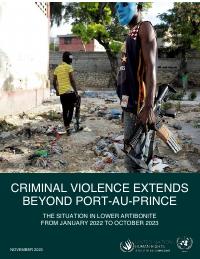
CRIMINAL VIOLENCE EXTENDS
BEYOND PORT-AU-PRINCE
THE SITUATION IN LOWER ARTIBONITE
FROM JANUARY 2022 TO OCTO BER 2023
NOVEMBER 2023
NOVEMBER 2023
Cover : © Dagbubi Enrico / Paris Match via Getty Images
3
TABLE OF CONTENTS
I. Executive summary ........................................................................................ 5
Recommendations ......................................................................................... 7
II. Methodology .................................................................................................. 8
III. Context ......................................................................................................... 9
Past violence ............................................................................................... 10
Recent violence ........................................................................................... 10
IV. Perpetrators ............................................................................................... 12
Alliances ...................................................................................................... 15
Sponsors...................................................................................................... 17
V. Human rights abuses .................................................................................. 18
Murder and injury ......................................................................................... 18
Kidnappings ................................................................................................. 19
Sexual violence ............................................................................................ 20
Attacks on infrastructure .............................................................................. 25
Popular violence .......................................................................................... 26
VI. Responses from the authorities and the United Nations ....................... 28
Police ........................................................................................................... 28
Justice system ............................................................................................. 30
Humanitarian response ................................................................................ 31
VII. Conclusions .............................................................................................. 33
VIII. Recommendations ................................................................................... 34
Fight against gang violence ......................................................................... 34
Fight against impunity .................................................................................. 34
Assistance for victims of gang violence, including sexual violence .............. 35
IV. Appendix I : table of the main criminal groups in the lower artibonite region
........................................................................................................................ 36
V. Appendix II : legal framework ...................................................................... 37
4
EXTENSION OF GANG ACTIVITY IN TO
ARTIBONITE
5
I. EXECUTIVE SUMMARY
The story of Darleine illustrates the ordeal currently experienced by the inhabitants of the Lower
Artibonite region. Murders, kidnappings, rapes, attacks on agricultural property and public
transport vehicles have become part of their daily lives. Between January 2022 and October 2023,
more than 1,690 people were killed, injured or kidnapped
1
in these rural localities, some 100 km
north of the capital, Port-au-Prince. These violations have accelerated sharply since July 2022.
Violence is steadily spreading outside the capital, Port-au-Prince
2
. At least 20 criminal groups,
including gangs and vigilante groups, are active in this part of the country. Extremely violent, they
do not hesitate to execute members of the local population during attacks on villages considered
to be "rivals", and to burn abductees to force their families to pay ransoms. In addition, sexual
violence is used as a weapon against women and even young children.
The gangs, and those who support them, have also made farmers and the properties they work
on prime targets. Ransom payments, theft of crops and livestock, and destruction of irrigation
canals have forced over 22,000 people to flee their villages and seek refuge in the region's urban
centers
3
. These displacements have already led to the reduction of cultivated land and the
indebtedness of many farmers and traders unable to repay their loans. The aggravating effects of
this situation are already being felt in Lower Artibonite, where by September 2023, over 45% of
the population was living in a situation of acute food insecurity.
The largest and most violent criminal groups are supported by gangs belonging to the G-Pèp
coalition, in particular Village de Dieu. Thanks to these alliances, the G-Pèp coalition has succeeded
not only in isolating National Highway #1 and the main waterfront towns over a distance of more
1
Between January 1, 2022 and October 31, 2023, 350 people were killed, 226 injured and 1,118 abducted. The vast majority of
victims were men (70%), followed by women (29%) and children (1%).
2
Between January 1, 2022 and October 31, 2023, almost 9,000 people were killed, injured or kidnapped in the Ouest
department, which includes the Port-au-Prince metropolitan area.
3
International Organization for Migration (IOM) (June 2023). "Haiti - Fact sheet on the displacement situation in Artibonite -
Round 2 (June 12 - 19, 2023)", available at: https://dtm.iom.int/fr/reports/haiti-fiche-dinformation-sur-la-situation-de-
deplacement-dans-lartibonite-round-2-12-19, last visited: September 11, 2023
Darleine was a 22-year-old woman living in Lower Artibonite. In March 2023, she took the
bus to Petite Rivière de l'Artibonite. On the way, her bus was attacked by the Gran Grif
gang. Darleine was kidnapped and held captive for over two weeks. During her captivity,
she was repeatedly beaten, burned and raped. A few weeks after her release, unable to
overcome the trauma of her abduction and the sexual violence she had suffered, she
hanged herself in her bedroom.
6
than 80 kilometers north of the metropolitan area, but also in controlling the crossing points to
and from the northern regions. This territorial hold undoubtedly favours the illicit circulation of
arms and drugs.
The recent report by the United Nations panel of experts
4
, set up to support the sanctions
committee on Haiti, as well as the recent financial sanctions imposed by several countries in the
region against 39 Haitian personalities, including three politically active men in Artibonite, have
also highlighted the possible protection afforded to these criminal groups.
In the face of rising violence and increasing human rights abuses, the response of police and
judicial authorities has been inadequate and inconsistent. Although police operations were carried
out at the end of 2022 and during October 2023 in certain communes of Bas-Artibonite, they failed
to contain the criminal groups in the medium and long term. Citing a lack of operational resources,
some Haitian National Police (HNP) officers in Artibonite feel unable to prevent the expansion of
these gangs. Others are relying on self-defence groups to carry out violent actions against villagers
living in areas under the influence of these same gangs.
The justice sector has not achieved more convincing results. Magistrates have opened
investigations and arrested a few gang members, but this has not led to any judgments or to a
weakening of the gangs' capacities. On the contrary, symptomatically, one of the best-known gang
leaders, Kokorat San Ras, was illegally released in March 2023 by the former Government
Commissioner of Gonaïves. Both have been on the run ever since.
In addition to the structural difficulties encountered by police and justice officials, the fact that
they have also been targeted by gangs has led them to adopt a wait-and-see posture. In 2022 and
2023, attacks on police stations, officers and courts increased. At least eight police officers,
including those in Liancourt in January 2023, were killed by members of these criminal groups.
Ultimately, the lack of effective response from the police and judicial authorities contributed to
the resurgence of popular lynching practices perpetrated against gang members, or alleged gang
members, as was happening in the rest of the country.
For their part, humanitarian actors and service providers also faced numerous challenges in
responding rapidly to the needs of populations affected by the violence. Due in part to access and
security problems, humanitarian agencies were only able to provide extremely minimal assistance
and limited services in Bas-Artibonite. Community and rural associations, in particular those
dealing with victims of sexual violence, have become involved in advocating respect for women's
rights and have tried to facilitate their referral to service providers, despite their lack of financial
and operational resources.
4
" Letter dated 15 September 2023 from the Panel of Experts established pursuant to Security Council resolution 2653 (2022)
addressed to the President of the Security Council ", disponible sur : https://www.securitycouncilreport.org/atf/cf/%7B65BFC
F9B-6D27-4E9C-8CD3-CF6E4FF96FF9%7D/s-2023-647.pdf , dernière visite : 26 Novembre 2023
7
Recommendations
1. The spread of violence outside the Port-au-Prince metropolitan area calls for the
reinforcement of police forces and the deployment as quickly as possible of the
multinational security support mission, under conditions that comply with international
human rights norms and standards, as adopted by UN Security Council resolution 2699
(2023). However, this will not be enough.
2. In view of the deterioration of the human rights situation throughout the country, it is
essential that, in compliance with resolution 2653 (2022), the United Nations Security
Council updates the list of persons and entities targeted by sanctions for having supported,
prepared, given the order to commit or committed acts contrary to international human
rights law.
3. These measures must also be accompanied by far-reaching action on the part of the
Haitian authorities, who must fulfill their international obligations and respect their human
rights commitments. For example, it is urgent that police and justice officials receive the
necessary support and have their status upgraded, including an increase in their salaries,
to enable them to protect the population and swiftly prosecute the perpetrators of crimes,
as well as those who support and finance them. At the same time, police and judicial
personnel implicated in human rights violations and acts of corruption must be punished
as quickly as possible by their institutions and judged in accordance with national and
international law.
4. Finally, it is essential that international actors, working alongside the Haitian authorities,
adapt their methods of assistance to the population, insofar as the violence is spreading in
a rural environment with a weak presence of State services. While the humanitarian
assistance provided by UN agencies and international non-governmental organizations is
vital for the populations directly affected by the violence, it will not address the factors at
the root of the violence. Other initiatives are needed, both to strengthen the resilience of
farmers prey to violence, and to provide rural communities with the capacity to prevent
violence by setting up non-violent conflict resolution mechanisms.
8
II. METHODOLOGY
This report is submitted under the mandate of the United Nations Integrated Office in Haiti
(BINUH), established by UN Security Council resolutions 2476 (2019), 2547 (2020), 2600
(2021), 2645 (2022) and 2692 (2023) to support the Government of Haiti in its efforts to
combat human rights violations and abuses and fulfill its international obligations.
The Human Rights Service (HRS) of BINUH and the Office of the United Nations High
Commissioner for Human Rights (OHCHR) conducted 95 interviews with victims and witnesses
of incidents occurring from January 2022 onwards in the Artibonite department, as well as
with service providers, community organizations, national and international non-
governmental organizations, and representatives of the Haitian administration, in order to
verify the human rights violations and abuses documented in this report.
Interviews with victims and witnesses were conducted individually and confidentially so as not
to compromise their safety. Victims' names have been changed to preserve their identity and
that of their families. Other details concerning the name, location or any other information
that could lead to the identification of sources have also been changed to protect victims and
sources.
The allegations received were verified and corroborated by the testimony of independent and
credible sources. The team used the "reasonable grounds to believe" criterion to establish the
facts and the human rights violations and abuses.
Given the security situation in Artibonite, the human rights team deployed in the field had
limited access to certain locations or interlocutors. This was a major challenge in gathering
information.
9
III. CONTEXT
Located some 100 kilometers north of the capital Port-au-Prince, the Artibonite plain (or Lower
Artibonite), with its large irrigated area supplied by the Artibonite and Estère rivers, has been
one of Haiti's main agricultural regions since the mid-1950s. To this day, what remains of the
country's rice production is concentrated in this region.
The rural areas of the Artibonite valley are inhabited by landowners, but also by landless
peasants from the North-West, the Central Plateau (Hinche Basin) and the South-East. The
town of Pont-Sondé, with its large market, various depots and credit unions, is the main center
of commercial activity in the Artibonite valley.
This region, which is likely to exert political and economic pressure on the capital and the
country as a whole, has seen various forms of violence in its history. It has also been at the
origin of protest movements that have destabilized the powers that be, in particular in 1986
against Duvalier, and again in 2004 against Aristide.
Gros Morne, a commune in the Artibonite departement
Source : United Nations
10
5
Levy, M. (2001). "Land conflicts and agrarian reform in the Artibonite plain (Haiti)," Cahiers des Amériques latines [Online],
36|2001, online August 3, 2017, available at: https://journals.openedition.org/cal/6591, last accessed September 2, 2023
6
Gilles, A. (2008). "État, conflit et violence en Haïti. Une étude dans la région de l'Artibonite", Centre d'études sur le
développement des cultures et des sociétés (CEDS), Haiti.
7
For further details, see Office of the United Nations High Commissioner for Human Rights (OHCHR) and Bureau des Avocats
Internationaux (July 2020). "Reversing Post-Raboteau Massacre Trial Impunity", available at:
https://uprdoc.ohchr.org/uprweb/downloadfile.aspx?filename=9624&file=Annexe9, last visit: September 6, 2023
8
For more details, see: Resolution of the Inter-American Court of Human Rights of November 20, 2015. "Case Yvon Neptune vs
Haiti. Supervision of execution of arrest", available at:
https://www.corteidh.or.cr/docs/casos/articulos/seriec_180_fr.doc, last visit: September 6, 2023
Past violence
The Artibonite plain has thus been the scene of sometimes extremely violent land conflicts. In
the 1950s, irrigation works, by adding value to the valley's land, significantly altered land tenure
issues, paving the way for numerous tensions, dispossessions and illegal appropriations related
to agricultural properties. This led to bloody confrontations in 1957, 1971-1975, 1986, 1991
and 1994. Agrarian reform, which began in 1995, helped to reduce this violence in rural areas
5
.
In the late 1990s and early 2000s, another type of violence, which some analysts have
described as "infrapolitical"
6
, emerged in Artibonite, as in the rest of the country. One of the
main aims of this violence was to weaken the State, by creating a situation of almost permanent
insecurity. Most of the violence took place in the underprivileged and marginalized
neighborhoods of Gonaïves and Saint Marc, as in the massacres of "Raboteau" in 1994
(Gonaïves)
7
and "La Scierie" (Saint Marc) in 2003
8
.
The populations of these districts were then used as instruments in the hands of political and
economic actors in their desire to oppose the rules of the rule of law. The deployment of United
Nations Stabilization Mission in Haiti (MINUSTAH) forces in Gonaïves and Saint Marc in 2004,
in support of the Haitian National Police (HNP), helped to curb the outward forms of this
violence, but failed to address its socio-economic causes.
Recent violence
During the 2015 legislative election campaign, new gangs emerged under the impetus of
candidates wishing to use them to win votes. The withdrawal of MINUSTAH troops from
Gonaïves from 2017 onwards, and the inability of the police authorities to take over, only
accentuated this phenomenon. It was between 2015 and 2017 that gangs such as Gran Grif
and Kokorat San Ras emerged. However, unlike in the previous decade, gang members began
to move into the rural areas of Bas-Artibonite, which had previously been more or less spared.
This shift of violence away from urban areas and towards rural areas has considerably altered
local dynamics, as the representation of the State and public services in rural areas is very weak.
Faced with the rise in crime, local people have opted for a community-based response. For
example, following the creation of the Gran Grif gang, residents of the Jean Denis locality
organized themselves into a self-defense group to repel raids by gang members in their area.
11
9
These "notables" commissions are informal structures made up of members of the population who are respected by their
communities for their civic behavior and moral values, as well as for their leadership skills.
The period from 2017 to 2020 saw a rise in insecurity. However, a certain lull was observed
from January 2021, following the death of Gran Grif gang leader Odma Louissaint. This was
followed by the establishment of a commission of "notables"
9
to restore stability to the area,
which led to a temporary decrease in criminal activity, at least until early 2022.
12
10
See List of criminal groups in Lower Artibonite. Appendix I.
11
For more information see, among others : Moritz Schuberth (2015). « The Challenge of Community-Based Armed Groups:
Towards a Conceptualization of Militias, Gangs, and Vigilantes », Contemporary Security Policy, 36:2, 296-320, available at :
https://www.tandfonline.com/doi/abs/10.1080/13523260.2015.1061756, last accessed : 25 août 2023, et Schuberth, M. (2023).
« Violence against civilians and the legitimacy of community-based armed groups in Kenya and Haiti ». In Militias, States and
Violence against Civilians (pp. 123-144). Routledge, available at :
https://www.taylorfrancis.com/chapters/edit/10.4324/9781003223917-6/violence-civilians-legitimacy-community-based-
armed-groups-kenya-haiti-moritz-schuberth, last accessed : 25 août 2023
12
It is important to note, however, that the members of Kokorat San Ras are not based in La Croix Périsse, where they commit
most of their acts, but have a rear base in the town of Gonaïves, to which they retreat in the evenings.
13
See map on page 3.
IV. PERPETRATORS
Criminal groups and areas of influence
At least 20 criminal groups, including gangs and vigilante groups, are currently active in the
Artibonite department, more specifically in the southern part of Lower Artibonite
10
. Some
analyses tend to distinguish between criminal gangs and vigilante groups, highlighting the
causes of their emergence
11
. Self-defense groups are thus described as a community response
to gang attacks.
The facts show, however, that both actors are extremely brutal towards the local population.
Without being mutually exclusive, their modes of action are specific to the rural environment
(crop theft, ambushes near markets and attacks on agricultural infrastructure), while
borrowing tactics employed by gangs in the Port-au-Prince metropolitan area (murder,
kidnapping for ransom and sexual violence).
While some of these groups are confined to operating in specific localities and rarely leave
them, others have recently taken advantage of both a strengthening of their operational
capabilities and a lack of police response, to extend their field of action.
For example, the Kokorat San Ras group, which between 2018 and 2021 concentrated its
activities in the Ti Bwadòm locality (commune of Gros Morne), gradually moved into the La
Croix Périsse area (commune of Estère), from January 2022
12
. Similarly, the Gran Grif gang,
which was initially active in Savien (commune of Petite Rivière de l'Artibonite), began in 2021
to extend its zone of influence to the localities of Moreau Dwèt, Moreau Pey and Patchwal
(commune of Petite Rivière de l'Artibonite), Pont Sondé (commune of Saint Marc) and
Desarmes and Deschapelles (commune of Verrettes)
13
.
13
14
In the following video, members of the Kokorat San Ras gang show off their weapons:
https://www.youtube.com/watch?v=YZdDLkfZwJ8, last visit: September 6, 2023
Composition and operational methods of criminal groups
Number
The total number of members of criminal groups is extremely difficult to establish. However,
based on local sources, the Human Rights Service (HRS) has been able to gather non-exhaustive
information on some of them.
The Kokorat San Ras and Ti Grif groups each have around thirty members, while the Gran Grif
group is said to number around one hundred. The Coalition of Jean Denis is said to number
around fifty. As for the Raboteau and Descahos gangs, present in the commune of Gonaïves,
they are said to number around one hundred people between them. In total, according to HRS
estimates, the number of members of criminal groups is close to 750, including those
associated with self-defense groups.
Composition
The vast majority of criminal groups are made up of men. However, testimonies from victims
have made it possible to establish the presence of women among them. While most of them
perform domestic tasks, a small number are involved in crimes such as transporting stolen
goods, kidnapping and sexual assault. For the time being, the HRS has not yet documented the
presence of children in the ranks of the criminal groups operating in Artibonite.
Weapons
Not all gangs have the same level of weaponry, with some being better armed than others.
According to information gathered by the HRS, at least five gangs (Descahos, Gran Grif, Kokorat
San Ras, Raboteau and Ti Grif) have semi-automatic rifles of the AR 15, M1, M4, M16, T65 and
Galil types, as well as pistols they buy with ransoms from kidnappings and/or hijacking of
goods
14
. Self-defense groups, for their part, generally possess bladed weapons (notably
machetes and knives) and a few rifles recovered during confrontations with gangs.
14
Firearms and ammunition in gang possession are generally purchased from the Village de Dieu
gang and other intermediaries in the Port-au-Prince metropolitan area. Individuals living
outside the country are also said to be able to bring weapons into Artibonite by sea or land.
Recent actions by self-defense groups to prevent the supply of weapons to criminal groups
have exposed some of these networks.
On February 8, 2023, members of the Coalition of Jean Denis self-defense group intercepted a
vehicle coming from Port-au-Prince in the Patchwal area (Petite Rivière de l'Artibonite), having
been tipped off by informants. The vehicle was carrying several crates of arms and ammunition
destined for the Gran Grif gang. The Coalition of Jean Denis seized the crates and executed the
two men aboard the vehicle. A few hours later, in retaliation, the Gran Grif gang moved into
this locality, killing six people and kidnapping three others.
Means of transport
Means of transport also vary according to the group and its targets. For example, the Gran Grif
gang owns several cars and motorcycles to move its members over long distances and set up
ambushes. The Kokorat San Ras gang also uses cars to leave the commune of Gonaïves and
travel to La Croix Périsse to carry out their attacks. Due to their relatively limited areas of
influence, self-defense groups, with the exception of the Coalition of Jean Denis, which owns
motorcycles, generally travel on foot, using back roads.
15
Alliances
In order to increase their operational capabilities, criminal groups have developed alliances
with each other, but also with police personnel, based on converging interests. Ephemeral,
short-lived or long-lasting, these alliances require a certain level of organization in order for
these different actors to operate in concert.
Local alliances
For example, the HRS was able to establish that the Gran Grif gang has allied itself with the Ti
Grif gang in the locality of Palmiste (commune of Petite Rivière de l'Artibonite) with the aim of
carrying out attacks against the local population and setting up ambushes on National Road 1.
Similarly, HRS has gathered information indicating that members of Kokorat San Ras have links
with the Raboteau gang, enabling them to retreat to the city of Gonaïves in the evenings. As
for Jean Denis' coalition, it relies on support from self-defense groups in the communes of
Liancourt, Petite Rivière de l'Artibonite and Verrettes, to oppose the Gran Grif gang.
Some vigilante groups also have links with units of the Haitian National Police (HNP). For
example, in April 2023, the Kapenyen vigilante group (close to La Croix Périsse, commune of
Estère), accompanied by HNP personnel led by a police commissioner from Gonaïves, set fire
to around a hundred houses in the village of Joanis (commune of Estère). Other self-defense
groups regularly share information with police officers and help them patrol the main roads in
Bas-Artibonite, notably those of Desarmes, La Chapelle and Verrettes.
Members of the Gran Grif gang
Source : Gazette Haiti
16
15
The Bwa kalé movement, meaning "eradicate" in Haitian Creole, is a "popular justice" movement that took on unprecedented
proportions in certain neighborhoods of Port-au-Prince in April 2023, in response to an increase in kidnappings. People in these
neighborhoods took to the streets armed with machetes, sticks and stones to kill all individuals affiliated or presumed to be
affiliated to gangs (see section V.g. "Popular violence").
16
The "G9 en Famille et Alliés", led by former policeman Jimmy Chérizier, aka "Barbecue", is one of the two largest gang
coalitions operating in the Port-au-Prince metropolitan area. The other is known as "G-Pèp". In October 2022, the Security
Council sanctioned Jimmy Chérizier, as leader of the gang "G9 en Famille et Alliés" See:
https://www.un.org/securitycouncil/content/jimmy-cherizier, last visit: November 15, 2023.
Links with gangs in the metropolitan area
Criminal alliances are not confined to the region. Indeed, close links exist between gangs in the
Artibonite and those in the metropolitan area. For several years now, relations have been
established between the Gran Grif gang and the Village de Dieu gang. Arnel Joseph, the former
leader of the Village de Dieu gang (from 2014 to 2017), was himself originally from Savien, the
stronghold of the Gran Grif gang. After his escape from Croix-des-Bouquets prison in December
2021, he took refuge in the commune of Marchand Dessalines (Lower Artibonite), before being
killed a few months later.
More recently, many members of the Village de Dieu gang moved to Savien to escape the
lynchings committed in the capital as part of the popular movement known as "Bwa kalé"
15
. To
leave Port-au-Prince and reach the Artibonite, these individuals first used rowboats to travel
by sea to Port Lafiteau, a small port town opposite the Canaan area (north of the capital), then
by public transport to Savien, via the Plateau Central region. In April 2023, 18 members of the
Village de Dieu gang, who were following this route, were caught and lynched by the local
population in the commune of Petite Rivière de l'Artibonite.
Alliances between the Canaan gang, whose leader hails from the commune of Petite Rivière de
l'Artibonite, and those of Kokorat San Ras and Gran Grif have also been documented. For
example, in February 2023, a member of the Canaan gang, wanted for kidnapping and criminal
conspiracy, was killed in l’Estère, during exchanges of fire between members of Kokorat San
Ras and the HNP. This suggests that, in times of confrontation, the Canaan gang sends members
to reinforce the capabilities of the Kokorat San Ras group.
These various supports and alliances between Port-au-Prince gangs (Village de Dieu and
Canaan) and Artibonite gangs (Gran Grif and Kokorat San Ras) demonstrate a strategy by the
G-Pèp coalition
16
, at the instigation of the Village de Dieu gang leader, to extend its influence
in the Artibonite region. Thanks to its control of the communes north of the capital and its links
with criminal groups in Artibonite, the G-Pèp coalition has succeeded in isolating the main
towns along the coast for over 80 kilometers, notably the northern part of Croix-des-Bouquets,
Cabaret, Arcahaie, Montrouis and Saint Marc. At present, it is no longer possible to access these
towns, or Gonaïves, by road.
17
17
Voir, entre autres, Insight Crime (22 février 2019). « Haiti Police, Senator Implicated in US Arms Trafficking Case », disponible
sur : https://insightcrime.org/news/analysis/us-haiti-arms-trafficking-case-raises-questions-answers/, dernière visite : 30 août
2023
18
Government of Canada (June 16, 2023). "Minister Joly held a ministerial meeting on Haiti with international partners",
available at: https://www.canada.ca/fr/affaires-mondiales/nouvelles/2023/06/la-ministre-joly-a-tenu-une-reunion-
ministerielle-sur-haiti-avec-des-partenaires-internationaux.html, last visited: September 5, 2023(July 5, 2023), and "Regulations
Amending the Haiti Special Economic Measures Regulations: SOR/2023-126", available at: https://gazette.gc.ca/rp-
pr/p2/2023/2023-07-05/html/sor-dors126-fra.html, last visited: September 6, 2023
19
Haiti-related sanctions imposed by the Government of Canada are available at: https://www.international.gc.ca/world-
monde/international_relations-relations_internationales/sanctions/haiti.aspx?lang=fra, last visited: August 22, 2023
20
Government of Canada (November 4, 2022). "Canada imposes sanctions on Haitian political elites", available at:
https://www.canada.ca/fr/affaires-mondiales/nouvelles/2022/11/le-canada-impose-des-sanctions-a-des-elites-politiques-
haitiennes.html, last visited: August 25, 2023
21
U.S. Department of the Treasury (4 novembre 2022). « Treasury Sanctions Corrupt Haitian Politicians for Narcotics Trafficking
», disponible sur: https://home.treasury.gov/news/press-releases/jy1080 (dernière visite : 27 octobre 2023)
Sponsors
According to several analyses, criminal groups in Artibonite receive support for their activities
from extremely influential political and economic players. The latter in turn rely on these gangs
to create instability, satisfy their political ambitions, control sectors of the economy and
facilitate illicit trafficking by controlling main roads
17
.
In September 2023, the report of the Panel of Experts, created by UN Security Council
resolution 2653 (2022), highlighted specific links between certain Haitian politicians and/or
financial players, on the one hand, and gangs, on the other. In the case of Artibonite, they
established that Prophane Victor, former Member of Parliament for Petite Rivière de
l'Artibonite, and Youri Latortue, former President of the Senate between 2017 and 2018, had
respectively financed and armed the Gran Grif and Raboteau gangs to commit atrocities.
These two politicians, along with Gracia Delva, former Senator for Artibonite, have also been
financially sanctioned by other countries, including the United States and Canada
18
. Youri
Latortue, for example, was sanctioned in November 2022 by Canada, under the Special
Economic Measures Act
19
, for using his "status as a former or current public office holder to
protect and enable the illegal activities of armed criminal gangs, including money laundering
and other corrupt acts"
20
. He has also been sanctioned by the United States of America
21
. As
for Prophane Victor and Gracia Delva, both were sanctioned in June 2023 by Canada under the
same Special Economic Measures Act.
To a lesser extent, some self-defense groups, such as Jean Denis' coalition, reportedly receive
financial support from the Haitian diaspora originating from Lower Artibonite to fight rival
gangs.
18
22
Between January 1, 2022 and October 31, 2023, there were at least 350 murder victims, 226 injury victims and 1,118 kidnap
victims in Artibonite.
V. HUMAN RIGHTS ABUSES
A climate of fear reigns in Lower Artibonite, where murders, sexual violence, theft, destruction
of property and other abuses are committed against the population on an almost daily basis.
Data gathered by the HRS indicate that the human rights situation has deteriorated sharply
since the beginning of 2022, with a clear acceleration since the second half of 2022. Between
January 2022 and October 2023, at least 1,694
22
people were killed, injured or abducted in the
Artibonite department, more than 80% of them between January and October 2023. The vast
majority of victims were men (70%), followed by women (29%) and children (1%).
Murder and injury
The investigation established at least two main categories of murder and injury involving
criminal groups, firstly during attacks on "rival" villages, and secondly during attacks on roads.
During attacks on “rival” villages
The first category concerns executions committed during
attacks on "rival" villages. Between January 2022 and October
2023, at least 110 such attacks were documented in 17
Artibonite localities, resulting in the death and injury of over
292 people.
Generally speaking, during these attacks, gang members
display extreme brutality when killing their victims. Some of
the victims have been decapitated.
As the data collected by the HRS on the victims of these attacks shows, no social category is
spared, including the most vulnerable groups. This was notably the case on October 25, 2022,
when an 80-year-old man and an 83-year-old woman were executed inside their homes by the
Gran Grif gang, during an attack on the locality of Petite Rivière de l'Artibonite.
During attacks on roads
In addition to attacks on villages, there are also daylight attacks on the busiest roads in Lower
Artibonite, such as those through Moreau Dwèt (Liancourt) and Carrefour Paye et Patchwal
(Petite Rivière de l'Artibonite). Erecting barricades or hiding on the sides of these roads, gang
In July 2022, Marc, a young
man returning from a
relative's funeral in the Jean
Denis locality, was pulled
from a bus, then executed
and beheaded by members
of the Jean Denis coalition,
who accused him of being
an informer for the Gran Grif
gang.
19
23
687 men, 428 women and three children
members have developed a modus operandi that enables
them to target large numbers of people, without taking too
many risks, as these roads are not secured by the HNP.
More than 85 victims were killed or injured in this way
between January 2022 and October 2023. Some of them were
shot at while in public transport vehicles trying to escape from
gangs. Others, accused of being informers or family members
of rival groups, were specifically targeted, forcibly removed
from vehicles and executed on the spot.
Kidnappings
Like the criminal trends documented in the Port-au-Prince
metropolitan area, kidnapping has become a preferred
method of action for some Artibonite gangs. More than 1,118
people
23
were kidnapped between January 2022 and October
2023.
The HRS investigation indicates that more than 75% of
kidnappings were committed during attacks on public
transport vehicles, along National Road 1 and National Road 3, specifically in the localities of La
Croix Périsse (commune l'Estère) and Ti Bwadòm (commune Gros Morne) for the Kokorat San
Ras gang, and Carrefour Paye (commune Petite Rivière de l'Artibonite) for the Gran Grif gang.
These three localities are strategic locations for these criminal groups, insofar as the local
population and merchants have no alternative but to travel through them to the markets and
major towns in the region.
Since the beginning of 2023, however, a new trend seems to be emerging, with an increasing
number of kidnappings committed during incursions into villages. Entering residences or public
buildings, certain groups are now forcibly taking inhabitants from their homes. For example,
on February 13, 2023, 19 people (13 men and 6 women) were kidnapped by the Gran Grif gang
during an attack on the locality of Deschapelles (commune of Verrettes).
According to the testimonies of several kidnapping victims, particularly those kidnapped by the
Gran Grif gang, the time spent as a hostage, which sometimes lasted several weeks, was
extremely violent. Members of this gang do not hesitate to abuse their victims with baseball
bats or burn them with plastic wax to force their families to pay ransoms to free them. People
showing outward signs of social success are particularly targeted, as gang members assume
they have more money than others and demand higher sums for their release.
On July 14, 2023, more than
50 members of the Gran
Grif gang carried out an
attack on the town of
Liancourt. On that day, the
population was preparing to
celebrate its patron saint's
day. Early in the morning,
armed with assault rifles,
they first executed five
members of the town's self-
defense group. Then, they
shot at the merchants who
had set up shop near the
church. In all, five people (5
men) were killed and 15
others (5 men - 10 women)
were wounded. Before
leaving town, the gang set
fire to all the shops.
20
24
Women commonly known as "Madan Sara" are merchants who play an important role in the Haitian economy. These women
transport a significant proportion of agricultural produce from the fields to public markets, where they sell it in small shops or
as street vendors. Their activities help to feed a large number of Haitians. For further details, see Bulletin international du
Comité québécois femmes et développement (CQFD) (April 26, 2023). "Moi, femme Madan Sara en temps de crise en Haïti",
available at: https://aqoci.qc.ca/moi-femme-madan-sara-en-temps-de-crise-en-haiti/, last visited: August 24, 2023
During these abductions, women and girls are also likely to be
subjected to acts of sexual violence (see section on sexual
violence). In addition, the HRS has also been informed of
situations where victims have been killed because their
families did not have the means to pay their ransom. This was
the case in April 2023, in the locality of Palmiste (Petite Rivière
de l'Artibonite), when the Ti Grif gang executed four men who
had been held hostage for over a month. Their families had
been unable to raise the money required for their release.
Disastrous psychosocial and financial consequences
The psychological consequences of kidnapping are manifold.
Fear of using public transport to leave their village or to go to
markets, and persistent nightmares are regularly cited by
victims as the after-effects of kidnapping. In certain
circumstances, these after-effects are so profound that they
can lead to suicide. A case in point is Darleine, a 22-year-old
woman who was abducted by the Gran Grif gang in March
2023 in the commune of Liancourt. During her captivity, which
lasted over two weeks, she was repeatedly beaten, burned and
raped. A few weeks after her release, unable to overcome the
trauma of her abduction and the sexual violence she had
suffered, she hanged herself in her bedroom.
These traumas are compounded by equally disastrous financial
consequences. Victims' families often have to go into debt to
banks or lenders before they can be released. Similarly, itinerant women traders (known as
"Madan Sara"
24
), who regularly use the roads to reach the markets, almost always lose their
capital and their goods during the kidnappings. As a result, they can no longer repay the loans
they have taken out to pay for these goods, and many see their property seized after their
release. This situation pushes them further into debt and accentuates the strong economic
inequalities between men and women in Haiti.
Sexual violence
Like the gangs operating in the capital, criminal groups in Artibonite use sexual violence,
including rape, as a weapon to spread fear and punish local populations living in "rival" villages.
Marie, a 38-year-old traveling
saleswoman and mother of a
10-year-old daughter, has been
kidnapped twice. Her first
kidnapping took place in
October 2022 by members of
the Canaan gang, who stole all
her goods before releasing her
the same day. A month later,
she was abducted a second
time in the commune of
Liancourt. "I was kidnapped by
the Gran Grif gang. They kept
me for seven days with other
people. Every morning, while
we were being held, the guards
forced us to call our parents to
recharge their phones via
Moncash, otherwise we'd be
beaten up. I prayed to God that
these thugs wouldn't rape me.
When they negotiated the
ransom with my family, I was
hit eight times with a baseball
bat. On the third, I felt my
pelvis move inside my body.
Since my release, I've had a
menstrual disorder". Marie was
freed after her parents paid
over US$3,500, more than 20
times the minimum income for
a Haitian.
21
They also use sexual violence against kidnapped women and girls to force their families to pay
a ransom.
However, such sexual violence is largely under-reported. According to medical care providers
interviewed by the HRS, victims of criminal groups rarely come to their health centers, due to
fear of reprisals, the long distances involved on insecure roads and the social stigma attached
to such violence. Mistrust of the police and the justice system also explains why victims do not
report these cases.
Sexual violence during attacks
Since the beginning of 2023, the HRS has seen the emergence of a new practice in attacks on
"rival" villages or public transport vehicles. Now, gangs such as Gran Grif, Kokorat San Ras and
Ti Grif are using sexual violence against local populations. For example, on August 4, 2023,
during an attack on the town of Liancourt, in addition to killing five people and destroying
homes, Gran Grif gang members broke into the homes of several families and gang-raped
children. Among the victims were three minors, aged between 12 and 14, who were sexually
abused in front of their families.
Similarly, in May 2023, during an attack on six transport vehicles travelling on National Road 1,
in the locality of Carrefour Paye (commune of Petite Rivière de l'Artibonite), members of the
same gang forced all the passengers, including 15 women, to get out of the vehicles. At
gunpoint, they forced the women to the side of the road, where they were beaten and raped
in front of the rest of the passengers. After raping them, the gang members let them go and
kidnapped the men.
Until now, this practice had not been documented by the HRS in Lower Artibonite, unlike in the
Port-au-Prince metropolitan area. In this respect, the support given by the Village de Dieu and
Canaan gangs to the Artibonite gangs could explain this mimicry and augur an increase, in the
near future, in acts of gender-based violence, particularly sexual violence, during attacks on
villages and vehicles.
During kidnappings
Very few women dare to talk about the sexual violence they have suffered in captivity.
However, according to local sources working on this issue, young women are particularly
targeted and sexually abused during their abduction and confinement.
For example, on November 30, 2022, members of the Kokorat San Ras gang abducted 60
people, including 13 women, from four minibuses in the locality of Ti Bwadòm (commune of
Gros Morne). After forcing all the passengers out of the vehicles, the gang members tore off
the women's clothes and raped them in front of everyone. They were then forced to walk naked
for miles to the gang's base. They remained in captivity for over a week, during which time they
were repeatedly raped.
22
25
ODVA is a public entity under the Ministry of Agriculture, Natural Resources and Rural Development, responsible for the
administrative, technical and financial aspects of development projects in the region, including construction work, land
registration and exploitation, and the promotion of agricultural activities.
Destruction of private and agricultural property
Destruction of homes
Since July 2022, the HRS has documented more than 300 homes destroyed in attacks on the
population. The localities of Liancourt, Moreau, Moreau-Dwèt and Petite Rivière de l'Artibonite
were by far the worst affected.
According to victims' testimonies, the gangs are often in possession of petrol cans, which they
use to set fire to residents' property and belongings, and in certain circumstances even heavy
machinery; the aim being to destroy people's livelihoods in retaliation.
On July 16, 2022, the Gran Grif gang carried out an attack on the locality of Barrière Léon
(commune of Petite Rivière de l'Artibonite). During the attack, more than a dozen houses were
destroyed using a tractor they had stolen from the Organisme de développement de la Vallée
de l'Artibonite (ODVA)
25
. During the incident, six residents (5 men and 1 woman) were shot
dead, three of whom were decapitated.
In addition to the destruction perpetrated by gangs, the HRS also documented destruction
involving HNP personnel, under the control of a police commissioner based at the Gonaïves
police station. During the months of May and June 2023, in the locality of Joanis (commune of
Petite Rivière de l'Artibonite), a series of police operations, accompanied by a self-defence
group from Kapenyen (commune of Estère), vandalized and burned at least a hundred homes,
under the pretext of searching for members of the Kokorat San Rat gang, who incidentally do
not reside in the area. One of the aims of this destruction was to drive out the residents and
take control of the area. Following this incident, over 370 families were forced to move and
seek refuge in the towns of Gonaïves, Gros Morne and Saint Marc.
23
Attacks on agricultural property
Lower Artibonite is one of the country's leading agricultural regions. For decades, the fertility
of its land attracted a great deal of interest. Gangs and those who support them have made
farmers and the properties they work on prime targets. Their attacks have taken many forms.
One such form is the occupation of fields, notably in the commune of Petite Rivière de
l'Artibonite, and the forcing farmers to pay a hefty "tax" to gain access to them. For example,
on August 12, 2023, heavily armed members of the Grand Grif group, allied with the Ti Grif
group, burst into the Laverdure area, 2nd communal section of Petite Rivière de l'Artibonite,
and set an ultimatum for farmers to pay a hefty sum so that they could continue cultivating
their 300 hectares of land.
Those who dare to protest are beaten and killed, or their crops and livestock stolen, as
documented in the localities of Delonge and Moreau Dwèt (Liancourt), Borel, Jumelle, Mirault
and Savien (Petite Rivière de l'Artibonite).
Several sources have also reported attacks on agricultural infrastructure, in particular irrigation
systems. In a struggle for control of the localities of Deschappeles, Liancourt and Marchand-
Dessalines, the Gran Grif gang has been accused for over a year of obstructing, with rubble and
One of many houses destroyed on October 22, during an attack by members of the Grand Grif
gang on the town center of the Petit Rivière de l'Artibonite commune.
Source : Human Rights Service of BINUH/OHCHR
24
26
See in particular: Ayipobost (March 2023). "Artibonite: les agriculteurs forcés d'abandonner leurs terres face aux gangs
armés", available at: https://ayibopost.com/les-gangs-plantations-artibonite/, last accessed August 24, 2023.
27
International Organization for Migration (IOM) (June 2023). "Haiti - Fact sheet on the displacement situation in Artibonite -
Round 2 (June 12 - 19, 2023)", available at: https://dtm.iom.int/fr/reports/haiti-fiche-dinformation-sur-la-situation-de-
deplacement-dans-lartibonite-round-2-12-19, last visited: September 11, 2023
28
Ibid.
29
World Food Programme (WFP) (April 2023) "Haïti | Avril 2023 - Analyse des dynamiques de surfaces agricoles en Artibonite
(contre-saison)", available at: https://reliefweb.int/report/haiti/haiti-avril-2023-analyse-des-dynamiques-de-surfaces-agricoles-
en-artibonite-contre-saison, last visited: 6 September 2023
30
Integrated Framework for Food Security Classifications (September 2023), "Haiti: IPC analysis of acute food insecurity, August
2023 - June 2024", available at: https://reliefweb.int/report/haiti/haiti-ipc-analyse-de-linsecurite-alimentaire-aigue-aout-2023-
juin-2024-publie-20-septembre-2023, last accessed: October 19, 2023. For a more in-depth look at the impact of violence on
food insecurity in Haiti. Michelle Ferenz, "The nexus of instability and food insecurity in Haiti", The Global Network Against Food
Crises, May 2022.
earth, the irrigation canals feeding crops in the area under the influence of Jean Denis'
coalition. These acts first caused the canals to dry up and silt up, then led to the loss of crops
26
.
Forced population movements, farmer indebtedness and food insecurity
One of the consequences of the destruction of homes and attacks on agricultural property has
been the forced displacement of farmers and their families. Having lost their means of
subsistence, they have had to leave their villages and land to move closer to urban centers,
living in extremely precarious conditions with acquaintances or renting makeshift dwellings.
During an assessment of the displacement situation in Artibonite, carried out by the
International Organization for Migration (IOM) in June 2023, over 22,000 displaced people
were identified, more than half of whom were children
27
. Over 93% of these displaced persons
were hosted by host families, while the remainder were housed in seven makeshift sites in the
communes of Gros Morne, Petite Rivière de l'Artibonite, Saint-Marc and Verrettes
28
.
For its part, in April 2023, the World Food Program (WFP) reported a reduction of almost 5,000
hectares of crops in three communes of Lower Artibonite due to the forced displacement of
the agricultural workforce
29
.
In addition to the problem of displacement, farmers are also heavily indebted. With their assets
and crops stolen and/or destroyed, and their incomes reduced, they are no longer in a position
to feed their families or repay the loans they have taken out with agricultural cooperatives or
private lenders for the purchase of agricultural inputs, particularly fertilizers.
Available analyses already indicate the aggravating effects of this violence on food insecurity.
In September 2023, according to the WFP, over 45% of the population living in Artibonite was
acutely food insecure (IPC Phase 3 or higher)
30
.
25
31
Between August 22 and mid-October 2022, thousands of people demonstrated across the country against insecurity,
inflation, shortages and high fuel prices, as well as against several government policies. On September 12, 2022, when the
government announced the end of fuel subsidies, the movement intensified and moved into a phase known as "Peyi lock et
deshoukaj" ("Locked country and civil unrest", in Haitian Creole), when protests became more violent, with barricades
preventing the delivery of basic necessities and paralyzing all services and economic activities across the country.
Attacks on infrastructure
Attacks on judicial and police institutions
For several months now, the targeting of administrative buildings, particularly those housing
the judiciary and the police, has also been part of a deliberate tactic by gangs to weaken state
institutions in Artibonite.
On September 14 and October 10 2022, when thousands of people were demonstrating in the
streets of Gonaïves against the high cost of living and the price of fuel
31
, the Raboteau gang
took advantage of this chaotic situation and the passivity of the police to attack a complex of
buildings housing justice officials. The Court of First Instance, the Public Prosecutor's Office,
the Land Court, the Court of Peace for the southern section of Gonaïves and the Gonaïves Court
of Appeal were all impacted. After forcing their way into the premises, the gang members
ransacked the equipment and burned virtually all the files inside.
Alongside these attacks on justice buildings, gangs also targeted police stations and police
officers. A total of 18 such incidents were recorded between January 2022 and October 2023.
Four police stations were attacked and at least eight policemen were killed.
The most significant attack took place on January 25, 2023, in the commune of Liancourt. On
this day, the Gran Grif gang first carried out three separate attacks, separated by a few hours,
on the Liancourt police station. Three police officers and six gang members were killed in the
exchange of fire. Then, the gang ambushed a group of officers from the Departmental Unit for
Order Maintenance (UDMO) who had come to reinforce the station, in the Croix Moreau
locality (commune of Liancourt). Having almost run out of ammunition, four UDMO officers
had to retreat to a nearby clinic. For several hours, they were repeatedly attacked by gang
members before being executed. The incident caused considerable tension within the police
force.
Attacks on other public and private infrastructures
The violence that spread through the city of Gonaïves during September and October 2022,
instigated by the Raboteau gang, also affected private businesses, schools and even churches.
A total of 16 private and public buildings were ransacked and looted.
The premises of humanitarian organizations and some United Nations agencies were also
targeted. IOM, WFP, Unicef and several NGOs had their warehouses looted and set on fire,
26
32
See, among others: Human Rights Watch (August 2023). "Living a nightmare. Faced with a worsening crisis, the situation in
Haiti requires an urgent response based on human rights", available at:
https://www.hrw.org/sites/default/files/media_2023/08/haiti0823fr%20web_1.pdf, last accessed: September 6, 2023
33
For more information, see: Office of the United Nations High Commissioner for Human Rights (OHCHR) and United Nations
Stabilization Mission in Haiti (MINUSTAH) (February 2013). "Files of the month. Phénomène des lynchages : une 'justice
populaire' qui mine la société haïtienne", available at: https://minustah.unmissions.org/les-dossiers-du-mois-n%C2%B07-
ph%C3%A9nom%C3%A8ne-de-lynchages-une-%C2%AB-justice-populaire-%C2%BB-qui-mine-la-soci%C3%A9t%C3%A9, last
accessed: August 5, 2023
34
Between January and September 2023, at least 380 people were lynched, including 370 men, 10 women and two boys.
Source: BINUH Human Rights Service and OHCHR in Haiti.
losing their stocks of food and non-food items destined for populations in need of emergency
assistance.
Popular violence
In correlation with the rise in violence
perpetrated by criminal groups, lynchings
and murders committed by members of
the public have been on the increase in the
Artibonite region since April 2023, as has
also been the case in the capital and other
regions of the country, as part of the "Bwa
kalé" movement.
Although this mob violence is not a new
phenomenon in Haiti, some analysts see it
as a response to a dysfunctional police and
judicial system and the impunity enjoyed
by members of criminal groups
32
.
Travelling in groups of 15 to 20 people,
residents set up barricades in their locality
and systematically question people they
don't know. If these people are suspected
of being gang members or informers, they
are systematically killed on the spot with
sticks and stones, and then burned.
The number of people killed as a result of
these abuses has reached extremely
worrying proportions, compared with recent decades. While in 2022, a total of 63 lynchings
were recorded across the country
33
, in the first ten months of 2023, the number has already
reached 418, 11% of them in Lower Artibonite
34
.
Residents of the commune of Liancourt have
placed a container across a road leading to the
commune of Liancourt, to prevent gang members
from invading the area.
Source : The Human Rights Service of
BINUH/OHCHR
27
In the past, lynchings could be mitigated or even controlled by local, police or judicial
authorities. This is no longer the case, given that these institutions are virtually no longer
functional or present in the areas where they occur. What's more, far from mitigating this
violence, local authorities are asking the population to identify any individuals who are
"foreigners" to the locality, and anyone taking in "foreigners" to register them with the town
hall. In some respects, this fuels a climate of suspicion within a social fabric already weakened
by gang violence.
28
35
As part of this operation, UTAG (based in Port-au-Prince) was temporarily deployed in Artibonite.
VI. RESPONSES FROM THE
AUTHORITIES AND THE UNITED
NATIONS
Police
Overall, over the past two years, the HNP's response to the rising violence of criminal groups
in Artibonite has been inadequate and inconsistent. Citing a lack of operational resources, in
June 2023 the HNP's regional directorate, at a meeting with the HRS, said it was unable to curb
the expansion of gangs.
Police operations
However, at the end of 2022, following the attack on the Petite Rivière de l'Artibonite police
station by the Gran Grif group (October 2022), the HNP carried out operations to regain control
of the area. The UDMO and the Temporary Anti-Gang Unit (UTAG) intervened
35
. Operations
were also organized against the Kokorat San Ras group.
While these interventions had the effect of displacing these groups and disrupting their actions
in the short term, they did not weaken them in the medium or long term. For example,
following these operations, members of Korat San Ras left the locality of Ti Bwadòm, only to
reappear around a month later in the locality of La Croix Périsse (Estère commune).
At the beginning of January 2023, there was also a change in the groups close to G-Pèp. Having
acquired new weapons and ammunition from the Village de Dieu gang, they intensified their
attacks on the local population, as well as on police officers. On January 25, 2023, seven
policemen were killed during a confrontation in Liancourt. This incident caused deep
discontent within the police force. Not only did some Artibonite police officers protest against
their hierarchy and go on strike, but several days of demonstrations followed in the Port-au-
Prince metropolitan area. Some police officers even attempted to invade the international
airport runway and the Prime Minister's residence.
In response, on January 27, the Prime Minister, in a message to the nation, condemned gang
violence and pledged that the government would assume its responsibilities towards the
families of the victims and address the concerns of disgruntled police officers. On the same
29
36
On October 29, 2023, Ti Grif gang leader [C.K.] was killed during a police operation led by UTAG.
day, the Director General of the HNP announced the launch of an anti-gang operation called
"Tornado 1".
This operation involved the long-term deployment of specialized units in Artibonite, such as
the UTAG (Unité Temporaire Anti-Gang) in Verrettes. While this deployment may have
prevented the expansion of criminal groups into the Plateau Central region, it did not achieve
substantial results in the fight against violence in Lower Artibonite
36
.
In June 2023, at a meeting with the HRS, HNP officials in Artibonite, despite the presence of
these various units, felt that they did not have the operational and human resources needed
to restore order and dismantle gangs. As a result, the police were content to simply patrol the
main roads in the Artibonite valley and position themselves at strategic crossroads throughout
the day. At the end of August 2023, the Director of the Artibonite Departmental Police was
replaced. He had been appointed in January 2023, following the attack on police officers in
Liancourt, his predecessor having been suspended from his duties and assigned to the HNP
General Directorate.
Police officers in a town in the Artibonite region, April 27, 2023
Source : Facebook of the HNP
30
37
"Haiti: Extradition to the United States of Jhon Peter Fleronvil, member of the "Kokorat San Ras" gang, available at
https://realiteinfo.com/haiti-extradition-vers-les-etats-unis-du-nomme-jhon-peter-fleronvil-membre-du-gang-kokorat-san-ras/,
last visit November 26, 2023
Investigations
In an extremely volatile context, the judicial police have launched several investigations into
gang abuses and made arrests, although the number is difficult to establish. For example,
former gang leader Kokorat San Ras [W.R.], accused of kidnapping and criminal conspiracy, was
arrested in 2019. However, he was illegally released in early 2023. Also among the gang
members arrested is [J.B.] alias "Aboulò" a prominent member of the Raboteau gang, but also
a member of the "Ayiti An Aksyon" political party, led by Youri Latortue. He was arrested in May
2023, along with three other people, for murder and criminal conspiracy, as well as for his
involvement in the burning down of the premises of the Gonaïves Court of First Instance in
September 2022. Similarly, at the end of November 2023, the HNP announced the extradition
to the United States of a member of Kokorat san Ras for his alleged involvement in the
kidnapping of four American citizens in the Artibonite department in July 2022. He was arrested
in September 2022
37
.
Alongside these arrests, the police also made a number of weapons seizures. At least 149
firearms, including 43 assault rifles, and more than 2,270 rounds of ammunition were seized in
2023.
Nevertheless, overall, these police investigations, arrests and seizures have had virtually no
impact on the activities of criminal groups in Lower Artibonite. No investigations have been
opened into sexual violence involving gang members.
Justice system
For many years, the justice system in Artibonite has lacked the resources needed to carry out
investigations and prosecutions. The deterioration in the security situation over the last two
years has only weakened it further, preventing judicial authorities from travelling safely to the
scene of incidents.
Attacks on the premises of the courts and public prosecutor's offices in Gonaïves in September
and October 2022 exacerbated their precarious situation, as the little equipment still at their
disposal and the files they were working on were destroyed.
The impact of the violence on the jurisdiction of Saint-Marc must also be highlighted. The town
of Saint Marc is surrounded by criminal groups, and it is virtually impossible to reach by road.
As a result, the number of magistrates has been cut de facto in half, as some of them, living in
the towns of Gonaïves, Marchands Dessalines or Verrettes, can no longer travel to the court in
complete safety to deal with their cases.
31
The fact remains that insecurity and a lack of operational resources alone cannot explain the
rampant impunity for gang abuses. Suspected acts of corruption have also undermined the
integrity and independence of magistrates. For example, on May 8, 2023, the Government
Commissioner of Gonaïves was placed on leave after illegally releasing former gang leader
Kokorat San Ras. An arrest warrant was immediately issued for the magistrate, who has since
been on the run, as has the gang leader. The head of the Gonaives prison registry was also
arrested on June 29, 2023, for his involvement in the irregular release of the prisoner.
Humanitarian response
Emergency assistance
The criminal activities of gangs have considerably affected the access and capacity of UN
agencies to provide emergency assistance to populations affected by violence in Lower
Artibonite. The consequences of the attacks on their premises and warehouses at the end of
2022 have also forced them to reduce their aid overall.
Thus, although humanitarian agencies such as UNICEF, WFP and OCHA reinforced their
presence in Artibonite at the beginning of 2023, limited assistance was distributed to
vulnerable populations. As of August 30, 2023, the WFP was one of the few agencies able to
provide food assistance to around 3,250 families living in or having fled localities affected by
violence in Lower Artibonite. The WFP also continued to supply meals to six school canteens
attended by 2,150 children, out of the 14 initially targeted. It is important to point out that for
this school canteen program, the WFP buys from local small-scale farmers in order to maintain
or increase their incomes.
However, apart from purchasing from local producers, the HRS has not been informed of any
other resilience program to support farmers in resuming economic activity after being forced
to flee their agricultural properties.
Responses to sexual violence
Impunity remains the norm for acts of sexual violence committed by gangs. The police and the
judiciary are not in a position to respond, due to structural and conjectural problems such as
insufficient resources and a lack of awareness and training in handling this type of case. As a
result, most victims do not report the sexual abuse they have suffered and try to return to a
normal life, as a protection mechanism for themselves and their loved ones, rather than taking
legal action.
On the medical and psychosocial fronts, very few actors are in a position to provide an
adequate response. Moreover, only a limited number of people who have been victims of
criminal groups approach these actors, due to fear of being stigmatized by their families and
32
communities, lack of information on available services, lack of financial means to travel and
access difficulties linked to the presence of gangs on the roads.
In Lower Artibonite, the area most affected by sexual violence involving criminal groups, only
the NGO "Fédération des femmes engagées du Bas-Artibonite", working out of Saint Marc, can
accommodate a few survivors in its offices for a period of no more than a week. Under the
coordination of the Ministry for the Status of Women and Women's Rights, this NGO can also
cover the cost of short-term accommodation with host families and offer various assistance
services to victims, such as referrals to poorly-equipped health centers and legal support.
In Upper Artibonite, there are two clinics, supported by the medical NGO, Médecins Sans
Frontières, and run by two local organizations, the "Organisation des femmes en action de Gros
Morne" (Gros Morne commune) and the "Plateforme fanm Saint Michel" (Saint Michel de
l'Attalaye commune). These clinics provide emergency medical care and have the capacity to
offer accommodation for around twenty survivors of gender-based violence, for up to three
months. However, these centers are located far from the hotbeds of violence and only
exceptionally receive gang victims.
Given the small number of service providers and their remoteness, rural women's associations
are heavily involved in advocating respect for women's rights. On community radio stations,
they regularly inform listeners of the services available to survivors and facilitate their referral
themselves. However, the impact of their efforts is limited by their lack of financial resources
and the travel difficulties associated with gang violence.
33
VII. CONCLUSIONS
Inexorably, violence and abuse by criminal groups against the population, particularly murder,
kidnapping and sexual violence, continue to spread outside Port-au-Prince. The situation in
Lower Artibonite is a striking example. The consequences are disastrous for the populations
affected, but have provoked far too little reaction from national authorities and international
actors. The longer it takes to deploy a specialized international force, the more robust the
response will have to be.
In the meantime, gangs are gaining strength and forging alliances that enable them to control
parts of the territory and strategic road routes to develop their criminal economy and facilitate
the illicit circulation of arms and drugs. On the other hand, the police and judiciary are
weakened by a lack of operational means and human resources, as well as by the corruption
that corrodes these institutions.
Impunity continues to reign. Very few initiatives have been taken to investigate and prosecute
gang members and their sponsors, despite the financial sanctions and travel bans imposed by
several states on at least 28 individuals belonging to the country's political and economic elites
and suspected of having used their status to protect and enable the illegal activities of these
gangs.
It remains that, as the current dynamics in the Lower Artibonite region demonstrate,
particularly around the issue of agricultural property, a police and judicial response will not be
enough to protect the human rights of the population. Other initiatives must be taken to
support the operation of social services in rural and urban areas, the resilience of farmers in
the face of shocks, and the establishment of community-based, non-violent conflict resolution
mechanisms.
34
VIII. RECOMMENDATIONS
Fight against gang violence
• To the international community: keep Haiti on the international agenda, continue to
support the Haitian National Police, and support the rapid deployment of a
multinational security support mission in accordance with human rights norms and
standards, as adopted by UN Security Council resolution 2699 (2023).
• To the Security Council of the United Nations: update the list of persons and entities
subject to sanctions for supporting, preparing, ordering or committing acts contrary to
international human rights law, in accordance with resolution 2653 (2022).
• To the states of the region: strengthen and increase inspections of Haiti-bound
shipments on their territory, including at seaports and airports.
• To the Haitian government: with the support of the countries in the region and the
technical backing of the international community, combat smuggling and the illicit flow
of arms, munitions and drugs.
• To the Haitian government: upgrade the status of Haitian police officers, notably by
increasing their salaries, and provide them with adequate resources to respond to the
violence of criminal groups.
• To the Haitian government : with the support of the international community, restore
basic social services and projects enabling people to enjoy essential social, economic
and cultural rights, including education, health and work.
• To the international community: support rural community initiatives to prevent the
expansion of criminal groups through non-violent, non-judicial mechanisms.
Fight against impunity
• To the Haitian government and the Superior council of the judiciary: rehabilitate the
court premises in Gonaïves, which have been destroyed, and provide magistrates with
adequate resources to carry out legal proceedings.
35
• To the Haitian government: speed up the implementation of the vetting process within
the police force, dismiss police officers who fail to comply with the Haitian National
Police's code of conduct, and try any police officers involved in criminal law violations
in accordance with international human rights standards.
• To the Superior council of the judiciary: speed up the process of certifying Haitian
magistrates in accordance with their ethical obligations, and offering them the
possibility of appealing against decisions not to certify them.
• To the Haitian government: with the support of the international community, support
the establishment of specialized judicial poles to fight corruption and crimes, including
those involving sexual violence, and also prosecute individuals and entities sanctioned
by the Security Council.
Assistance for victims of gang violence, including sexual violence
• To the international community: strengthen the coordination of humanitarian aid and
allocate more funds to national actors to support humanitarian aid, including initiatives
to protect and combat sexual violence.
• To the international community: support the establishment of gender-sensitive food
system resilience programs for farmers and itinerant traders affected by crop and asset
losses, and protect them from indebtedness.
• To the Haitian government: with the support of the international community,
strengthen the availability, accessibility and quality of medical and psychosocial care
systems for survivors of sexual violence, and build the capacity and awareness of the
police and judiciary to combat impunity for sexual violence and the stigmatization of
victims.
36
38
When initials are indicated, the HRS has the names of the leaders of the criminal groups.
39
The Human Rights Service has identified at least 13 other small self-defense brigades in the localities of Kapenyen (commune
of Estère), Chandelle and Deslandes (commune of Liancourt), Borel, Jumelle, Patchwal and Pont Sondé (commune of Petite
Rivière de l'Artibonite) and Desarmes and Deschapelles (commune of Verrettes). Each of these brigades has between 30 and 40
members.
IV. APPENDIX I : TABLE OF THE MAIN
CRIMINAL GROUPS IN LOWER
ARTIBONITE
Name of
criminal group
Leader of criminal
group
38
Zones of influence Approximate
number of
members
Self defense
brigade Jean
Denis Coalition
[J.B.M.], alias « Ti
Mepri »
Jean Denis and Baraj (Petite
Rivière de l’Artibonite commune)
50
Descahos Gang [P.P.] Descahos (Gonaïves commune) 50
Gran Grif Gang [L.E.] Savien (Petite Rivière de
l’Artibonite commune)
100
Kokorat Sans
Ras Gang
Alias « Meyer »
(name unknown)
La Croix Périsse (l’Estère
commune)
30
Raboteau Gang [W.F.], alias « Ti
Will »
Raboteau (Gonaïves commune) 50
Ti Grif Gang [C.K.], alias «
Izolan »
Moreau Dwèt (Liancourt
commune)
30
Thirteen other
self-defense
groups
39
----
l’Estère, Liancourt, Petite Rivière
de l’Artibonite and Verrettes
communes
30-40 par
groupe
37
V. APPENDIX II : LEGAL FRAMEWORK
Two legal frameworks apply to deal with sexual violence and other human rights violations and
abuses committed by police and criminal groups, namely gangs and vigilante groups in Haiti.
I. International human rights law
Haiti acceded to the International Convention on the Elimination of All Forms of Racial
Discrimination in 1972, the Convention on the Elimination of All Forms of Discrimination against
Women in 1981, the International Covenant on Civil and Political Rights in 1991, the
Convention on the Rights of the Child in 1995, the Convention on the Rights of Persons with
Disabilities in 2009 and the International Covenant on Economic, Social and Cultural Rights in
2013. Under article 276 of the Constitution of the Republic of Haiti, international treaties or
agreements, once ratified in the manner provided for by the Constitution, form part of the
country's legislation.
According to the Declaration on the Elimination of Violence against Women, States Parties
must develop prevention strategies and all legal, political, administrative and cultural measures
conducive to the protection of women against violence. In addition, the Declaration requires
States to allocate sufficient resources and adopt effective measures to ensure that victims of
gender-based violence, in particular sexual violence, have access to comprehensive medical
treatment, mental health care and psychosocial support. In the same spirit, the Convention on
the Rights of the Child requires States Parties to strive to ensure that no child is deprived of his
or her right of access to health care.
At regional level, Haiti also ratified the American Convention on Human Rights in 1977, the
Inter-American Convention on the Prevention, Punishment and Eradication of Violence Against
Women (Convention of Belém do Pará) in 1997, and the Statute of the Inter-American Court
of Human Rights in 1998. The latter has jurisdiction over all cases concerning the interpretation
or application of the American Convention on Human Rights.
In particular, Articles 4, 5, 7 and 11 of the American Convention on Human Rights recognize
the inherent right of every person to life, physical and moral integrity, personal freedom, honor
and dignity. Articles 3, 4, 5, 6 and 7 of the Convention of Belém do Pará reaffirm the right of all
women to the recognition, enjoyment, exercise and protection of their rights, including the
right to respect for their lives and their physical, mental and moral integrity, for which the
signatory states undertake to adopt all appropriate means to prevent, punish and eradicate all
forms of violence against women.
38
Article 6 of the International Covenant on Civil and Political Rights recognizes the right of all
human beings to life, and obliges States to protect this right by law. General Comment No. 36
of the Human Rights Committee (CCPR/C/GC/36) also recalls that the right to life is a right that
should not be interpreted narrowly. It encompasses the right of persons to be free from acts
and omissions intended to cause, or expected to cause, their unnatural or premature death,
and to live in dignity. Thus, States parties must also guarantee the right to life and exercise due
diligence to protect human life against any harm from persons or entities whose conduct is not
attributable to the State.
The International Covenant on Economic, Social and Cultural Rights, in its preamble, recognizes
that, in accordance with the Universal Declaration of Human Rights, the ideal of free human
beings enjoying freedom from fear and want can only be achieved if conditions are created
whereby everyone may enjoy his economic, social and cultural rights, as well as his civil and
political rights. Thus, Article 2 requires States to take steps, individually and through
international assistance and cooperation, especially economic and technical, to the maximum
of their available resources, with a view to achieving progressively the full realization of the
rights recognized in the Covenant by all appropriate means, including particularly the adoption
of legislative measures. In particular, Articles 6, 9, 10, 11, 12, 13, 14 and 15 of the Covenant
explicitly recognize the rights of everyone to work, to social security, to an adequate standard
of living for himself and his family (including adequate food, clothing and housing), to the
highest attainable standard of physical and mental health, to education, to take part in cultural
life and to enjoy the benefits of scientific progress and its applications.
Under international human rights law, states have an obligation to respect, protect, promote
and fulfill the human rights of all persons within their territory and subject to their jurisdiction.
According to a group of independent UN human rights experts, states have an obligation to
respect, monitor and prevent human rights violations committed by non-state armed actors .
In their statement issued in February 2021, the experts call on States to investigate
appropriately all allegations of human rights violations committed by armed non-state actors,
prosecute and punish the perpetrators of such violations, and ensure adequate reparation and
redress for victims, in full compliance with international human rights law and standards. The
group of experts stresses that States are also obliged to provide reparations and other
appropriate forms of assistance to victims, in cases of direct or indirect responsibility for abuses
committed by armed non-state actors, particularly in cases where armed non-state actors are
unable or unwilling to assume their responsibilities in this regard. States have an obligation to
adopt a gender-sensitive approach and to ensure that these recommendations are
implemented taking into account the increased risk of abuse against women and children, in
particular for sexual and gender-based crimes.
If resource constraints make it impossible for a State to comply fully with its obligations under
international law, it has the obligation to justify that all necessary measures have been
adopted, on the one hand, to respect, protect and fulfill civil and political rights and, on the
other hand, to utilize its available resources to the maximum extent possible in order to realize
economic, social and cultural rights, without lowering the level of environmental protection.
39
II. Haitian law
According to Article 19 of the 1987 Constitution of the Republic of Haiti, "the State has the
imperative obligation to guarantee the right to life, health and respect for the human person
to all citizens without distinction, in accordance with the Universal Declaration of Human
Rights".
Title II of the Haitian Penal Code protects the rights to life, physical, mental and moral integrity,
as well as the right to property of all persons. Murder, assassination, injury, rape, kidnapping
and theft or destruction of property are classified as crimes. The penalty for these crimes is
forced labor for life. However, the code specifies that those sentenced to forced labor will be
employed in public works. In practice, the penalty of public works was replaced by life
imprisonment after the end of the Duvalier regime in 1986.
In particular, articles 278, 279 and 281 of the Haitian Penal Code stipulate that anyone who
commits the crime of rape, anyone who is guilty of any other sexual assault, committed or
attempted with violence, threats, surprise or psychological pressure on the person of either
sex, or anyone who encourages prostitution or other forms of sexual exploitation, is punished
by imprisonment for six months to life.