Texte Intégral du Document
Texte extrait du document original pour l'indexation.
1 Any comments or questions? Please contact us at info@acaps.orgThematic Report
19 May 2025
CRISIS OVERVIEW
Since 30 March, clashes between armed gangs and Haiti’s multinational security mission
(MSS) have increased in the cities of Mirebalais and Saint d’Eau in the Centre department.
By 22 April, the clashes had killed at least 76 people. As of 16 May, at least 51,400 people had
been newly displaced from Mirebalais district
(OCHA 22/04/2025; Health Cluster/PAHO 24/04/2025).
During the attacks – characterised by armed clashes, lootings, and killings – gangs also
facilitated the escape of over 500 inmates from prison, including individuals suspected of arms
trafficking. The attacks have severely disrupted essential services, resulting in the closure of
the main hospital and several schools in the area
(OCHA 22/04/2025). The violence has likely
continued to affect more people, but until 18 May, up-to-date information remained limited.
Between 30 March and 16 May, most of the IDPs from urban Mirebalais moved towards the
communes of Boucan Carré (24 %), Hinche (21 %), Lascahobas (17 %), and Savanette (11%),
also within the Centre department. On 22 April, around 76% of IDPs were staying with relatives
and in nearby areas
(OCHA 16/05/2025; OCHA 22/04/2025; Health Cluster/PAHO 24/04/2025).
On 25 April, the MSS carried out an operation in Mirebalais to regain control of the communes
of Saut d’Eau and Mirebalais. By 30 April, Mirebalais remained under the control of the armed
gangs
(UNICEF 03/05/2025; OCHA 22/04/2025; The Haitian Times 11/04/2025; France 24 31/03/2025). As
of 18 May, there was no information indicating that the MSS had regained control in Mirebalais.
Prior to the attacks, the Haitian authorities already lacked the capacity to respond to people’s
needs and provide security, leaving the local police and organisations highly dependent on
international aid and funding
(ICG 19/03/2025). The situation is aggravated by the suspension of
foreign assistance from the US, which contributed around 59% (USD 207 million) of the total
USD 294.5 million committed to Haiti’s 2024 Humanitarian Needs and Response Plan
(OCHA
accessed 30/04/2025)
. For more information, see ACAPS’ report on the impact of the US aid suspension
in Haiti
.
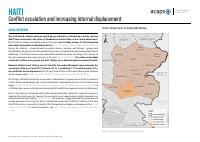
Centre department, including Mirebalais
Source: ACAPS using OCHA (accessed 09/05/2025)
HAITI
Conflict escalation and increasing internal displacement
Thematic Report | 19 May 2025 2
ANTICIPATED SCOPE AND SCALE
• There is a high risk of violence spreading towards other communes and areas of Centre
department, as armed groups seek to consolidate control over regions near the border
with the Dominican Republic. Since April 2025 threats of attacks on the commune of
Hinche have circulated on social media
(ACLED 08/05/2025; Miami Herald 14/04/2025). Threats
and insecurity are likely to keep displacing people not only towards Boucan Carré, Hinche,
Lascahobas, and Savanette communes in Centre department but also towards other
departments.
• Movement and cross-border displacement towards other countries are also likely to
increase, particularly through irregular routes. The Dominican Republic has suspended
visa renewal and issuance for Haitians since October 2023, preventing from regular
Haitian migration to the Dominican Republic
(AI 28/08/2024; AP 15/09/2023; Fragomen
30/04/2024).
This has led many Haitians to use irregular and unsafe routes or try to move
towards other countries such as Chile, Colombia, Ecuador, Mexico, and the US
(El País
02/12/2024; EFE 21/06/2024)
. During this journey, they are exposed to protection risks, such
as sexual assault, exploitation, extortion, other physical violence, and death.
• There is a rising concern that armed gangs may target critical infrastructure such as
the hydroelectric Péligre Dam, which is located 15 kilometres away from Mirebalais and
generates electricity for much of the country. According to local news reports, the dam
has been shut down since May 13, although no official confirmation or details on the
impact have been released. Control over the dam could significantly disrupt the national
power supply, heighten protection risks, and hinder the delivery of humanitarian aid
(Rezonodwes 15/05/2025; Alterpress 15/05/2025; ACLEDnews 08/05/2025).
• The country is expected to experience heavy rain between June–October, the typical
rainy season. This is likely to worsen health needs through the spread of waterborne
diseases
(NOAA 05/03/2010; WFP 04/04/2025). IDPs in temporary or makeshift shelters are
likely to be more exposed to diseases and the impact of the rainy season.
• Violence and clashes may keep increasing in coming months in advance of elections that
are expected to occur in November 2025, given significant public and gang opposition
to the transitional government. On 3 May and 13 May, protesters marched up in Port-au-
Prince demanding an end to persistent gang violence in Mirebalais and calling on the
country’s prime minister and transitional presidential council to resign
(Barrons 16/05/2025;
AP 04/05/2025). Civil unrest is likely as protests rise with violent responses and clashes
that put IDPs and other civilians at risk.
ABOUT THIS REPORT
Aim
This report aims to analyse the humanitarian impact of the rising internal displacement in
Haiti’s Centre Department, driven by escalating insecurity there since 30 March 2025. While
it provides an overview of the national context, the report particularly focuses on Centre
department, where the highest concentration of population movements has been recorded.
Displacement across Haiti has been escalating since 2024. For more information, see
ACAPS’
full report on increasing displacement in the Grand Sud region (October 2024). and an analysis
of the impact of the USAID suspension
on the country for additional context.
Methodology
This report is based on a secondary data review of publicly available sources and is limited
by the lack of up-to-date information on recent developments and key sectoral needs since
early May.
HUMANITARIAN ACCESS CONSTRAINTS
• Insecurity constrains access to several areas of the country, including Centre department.
Gangs continue to control the main roads linking the Metropolitan Area of Port-au-Prince
(ZMPAP) to the rest of the country. The situation has deteriorated in Centre department,
further complicating transport to Nord department and leading to a significant increase
in in supply costs for all goods, including those that humanitarian organisations need
(LogCluster 08/05/2025 and 11/04/2025). During April authorities were limiting humanitarian
movement on sections of the road connecting Hinche to Belladère, Lascahobas, and
Mirebalais because of insecurity. Roads are the only way to access Mirebalais as the
closest airport is in Port-au-Prince. There is limited information on the restoration
of access through roads. Until 12 May, armed gangs controlled the road on which the
Mirebalais University Hospital is located
(MSF 12/05/2025; UNICEF 03/05/2025).
• Unstable telephone networks and power cuts are usual across the country but also
increase when clashes affect network infrastructure, limiting communication and
hampering humanitarian response coordination
(OCHA 22/04/2025). The authorities who
lead the nutrition and health sectors report that one of the major response constraints
in Mirebelais and Saut d’Eau is inadequate access to information and inefficient data-
sharing
(UNICEF 03/05/2025).
• The expected rainy and cyclone season in the coming months can further affect access
by blocking already disrupted roads. This could limit the aid response and put people at
risk of food insecurity and other needs.
Thematic Report | 19 May 2025 3
• Organisations such as Médecins Sans Frontiéres have reduced their presence and
operations in some areas of Haiti, mostly in Port-au-Prince, because of attacks on their
hospital and the lack of security guarantees for workers
(MSF 08/04/2025).
• Several local radio states have stopped the transmission of news because of direct
attacks and insecurity, which impedes people that rely on radio to find updated
information. This also limits humanitarian response access to local sources. In late April,
armed gangs took over a radio station in Mirebalais. Armed gangs have also been using
social media to broadcast their videos and messages as well as to recruit new members
(ACLED 08/05/2025; LeNational 03/05/2025; Ayibopost 02/05/2025) .
• Since 28 April, additional attacks in Artibonite department have also displaced 13,000 more
people or close to 3,200 households
(OCHA 02/05/2025). In Kenscoff, Ouest department,
armed attacks between 18–20 April displaced nearly 1,000 people, with many moving to
newly established IDP sites
(IOM 24/04/2025).The increasing violence across various parts
of the country could exceed the humanitarian aid capacity to respond. This combined
with road blockages and insecurity in the Centre department could force responders to
prioritise other areas.
CRISIS DRIVERS
The attacks in Mirebalais were launched by the Viv Ansanm coalition on the Mirebalais
district in the Centre Department, which have been the main cause of displacement
(OCHA
22/04/2025; Haitian Times 11/04/2025; CI 19/02/2025)
. Viv Ansamn (Living Together) is Haiti’s
main armed gang coalition, and it is believed that it was formed in 2023, partly to oppose
the deployment of the UN MSS. The unification of armed groups has helped them expand
their control of territory and strategic infrastructure, increasing their financial and political
influence against the transitional government
(Insight Crime 25/11/2024).
The localised violence in Mirebalais is part of a broader pattern across Haiti, where gang
activity has been the primary driver of mass displacement. Since 2021, armed gangs have
intensified their operations to expand territorial control since the assassination of President
Jovenel Moïse
(OCHA 22/04/2025; The Haitian Times 11/04/2025; ICG 19/02/2025).
Another recurrent cause of displacement is Haiti’s exposure to climate hazards, such as
earthquakes, hurricanes, and floods, which cause severe destruction in towns, as well as
food insecurity when droughts, floods, and civil unrest result in a lack of sufficient food and
clean water
(OCHA 22/04/2025; Archynewsy 06/05/2025). Currently, the North-East department
is facing severe floods, which are likely to cause displacement
(OCHA 10/05/2025). In 2024,
floods in the South department affected 3,558 families and around 117,000 IDPs present in
the department
(OCHA 15/11/2025). Haiti is highly vulnerable to environmental hazards, with
severe impacts observed on an annual basis.
CRISIS IMPACT
Displacement
By 29 April, armed clashes in Mirebalais alone had displaced over 51,000 people, including
approximately 27,000 children
(UNICEF 03/05/2025). Clashes and violence make information-
gathering difficult, meaning data on the needs of IDPs – particularly those in rural areas –
remains limited. The coming rainy season is expected to affect them further.
The recent escalation of conflict has worsened an already critical displacement crisis in
Haiti. Since January 2025, gang-related violence has newly displaced more than 130,000
individuals. Most of the displaced population resides with host families or across over
228 active displacement sites countrywide, 97 of which have been newly created in Centre
department
(Health Cluster/PAHO 24/04/2025; CCCM Cluster 28/04/2025). By mid-April, there were
over 1 million displaced persons in Haiti, many of whom had been displaced since the surge
of violence in 2021
(IOM 14/01/2025 and 15/05/2025).
Shelter
By 29 April, more than 12,500 IDPs (24%) of the people displaced in Mirebalais were stranded
across 95 spontaneous sites across Centre department, exposing them to overcrowded
conditions with higher risks of contracting communicable diseases
(UNICEF 03/05/2025). There
is no specific definition of spontaneous sites, but they often can be tents or public buildings,
including schools, that are temporarily available for IDPs but not necessarily equipped with
everything they need, such as sufficient sanitation facilities.
Most IDPs across Haiti tend to stay with relatives, rather than in temporary sites. That said,
according to the Shelter Cluster, the number of sites nearly doubled from 119 in March
to 228 in April, mostly because of displacements caused by armed attacks in Centre
department (97 of the 121 newly created sites are in this department). Despite the increasing
number of sites, the number of IDPs staying in them in the department increased by only
10%, which could indicate that many have decided to stay with host families or are on the
move
(IOM 28/04/2025; CCCM Cluster 28/04/2025). There is no information on the current state
of spontaneous sites, but they are likely to be made with tarpaulins and timber, making them
vulnerable to the impact of the coming rainy season.
According to OCHA, some host families in Hinche and Boucan Carré are providing shelter
and sharing their limited resources, including food, with up to 30 people, including children.
This situation also increases humanitarian needs host communities
(UNICEF 03/05/2025). By
2024, 39% of households Centre department lived in a makeshift shelters
(REACH 12/10/2024).
Thematic Report | 19 May 2025 4
Protection
There is a high risk of increased child recruitment, further violence, and other protection risks
among people displaced from Mirebalais and Saut d’Eau, but little information is available.
Some children assessed in Hinche and Boucan Carré communes in Centre department have
reported witnessing the recruitment of other children by armed groups, fuelling concerns for
their own safety
(UNICEF 03/05/2025). There are no recent reports of gender-based violence, but
women and children’s groups have repeatedly mentioned coming across different situations
of gender-based violence, including rape, in the context of camps. Displaced women and
girls are sometimes sexually exploited in exchange for assistance or access to toilets
(IOM
28/04/2025; AI 12/02/2025)
.
Health
Waterborne diseases
From 29 December 2024 to 15 April 2025, 1,487 suspected cholera cases were reported
countrywide
(Health Cluster/PAHO 24/04/2025). From March, there were increasing alerts of
suspected cholera cases in Ouest and Centre departments
(UNICEF 09/05/2025). The actual
number of cases is likely much higher given overcrowded shelters and a lack of access to
health facilities. The risk of diseases is heightened in the Centre department because, as of
2024, 37% of households used unprotected spring water as their source of water, and 7%
used surface water
(REACH 12/10/2024).
Cholera, malaria, and other waterborne diseases are likely to proliferate during the rainy
season from June–November. IDPs in makeshift shelters, with overcrowded conditions and
little access to hygiene and sanitation, are more likely to contract vector-borne diseases.
Attacks on health facilities also limit timely medical care, increasing the likelihood of
complications. The Hôpital Universitaire de Mirebalais had been closed since the attacks on
31 March and until early April, forcing IDPs and residents to seek care at alternative facilities,
including Hôpital Sainte Thérèse de Hinche and Hôpital Albert Schweitzer in Artibonite,
which have reported being overstretched given the increased demand
(EFE 25/04/2025).
Healthcare access
Many people in Haiti avoid going to hospitals because of violence and clashes in the streets,
particularly in the ZMPAP, but also in places where violence is escalating, such as Centre
department). People suffering from serious illnesses – strokes, acute infections, chronic
complications – are at risk of being diagnosed late or not at all because of lack of access
to healthcare, progression to severe forms of disease, interrupted treatment, and increased
drug resistance for some diseases. They often die at home without ever receiving the medical
assistance that could have saved their lives
(Rezo Nódwes 27/04/2025).
There is limited access to prenatal and postnatal care countrywide. Some people are forced
to walk two hours or more to access essential healthcare services, which poses a great
maternal mortality risk
(MSF 30/04/2025). Boucan Carré commune in Centre department has
also received a large influx of IDPs, and the number of births recorded at the Boucan Carré
hospital (St. Michel) more than doubled in April compared to March, rising from 13 to 32 – a
significant increase given that in Haiti, approximately 63% of women tend to deliver outside
of a healthcare facility and only resort to hospitals if they do not have access to a ‘matron’ or
experience complications. The hospital has reported limited capacities in terms of qualified
staffing and equipment
(UNICEF 03/05/2025; MSF 07/04/2024; Raymondville et al. 23/08/2020). Haiti is
experiencing a severe shortage of medical staff as many qualified workers decide to migrate
because of the insecurity and lack of work opportunities in the country. This increases in
areas with an escalation of conflict, such as Centre department
(MSF 07/04/2025).
Education
Since 30 March, all schools in Mirebalais have been closed. Education has been and is
expected to remain disrupted, as numerous schools are currently being used to shelter IDPs
(OCHA 22/04/2025). Until 29 April, UNICEF had identified at least 42 schools used as shelters
in Centre department
(UNICEF 03/05/2025). Since 2021, widespread violence across parts of
Haiti and an climate and environmental hazards have severely affected access to education
(UNICEF 28/02/2025and 30/04/2025). The prolonged absence from schooling heightens children’s
exposure to recruitment by armed groups, exploitation, abuse, and other protection risks.
Food security
As of April 2025, around 50 % of the population of Centre department (305,400 people)
were facing Crisis (IPC Phase 3) and 131,470 Urgence (IPC Phase 4)
(IPC 14/04/2025). The
overall violence in Haiti has caused the closure of markets, destroyed crops and cattle,
and made many people dependent on humanitarian aid, which is also scarce because of
insecurity
(WFP 05/05/2025). In April 2025, nearly half (around 5.7 million) of the population
countrywide faced high levels of acute food insecurity, classified as Crisis (IPC Phase 3) or
worse conditions. Among them, over 8,400 people living in displacement camps near Port-
au-Prince were experiencing Catastrophe (IPC Phase 5) hunger. An additional 2.1 million
people, representing 19% of the analysed population countrywide, were in Emergency (IPC
Phase 4) conditions, facing critical food insecurity, while 3.6 million people (32%) were in IPC
3
(IPC 14/04/2025).
Thematic Report | 19 May 2025 5
According to a WFP study, which took a sample of 116 households per department and
120 households per commune in the ZMPP, more than eight out of ten households have
experienced moderate or severe hunger on the Household Hunger Scale; 67% of households
eat only one meal a day or even go whole days without eating. This figure rises to 73% among
IDPs. IDPs lack the means and resources to cope with the impact of insecurity. It has been
found that 89% of IDPs countrywide have insufficient food consumption (poor and borderline),
which is 20% more than the consumption of nondisplaced people
(WFP 31/03/2025).
AGGRAVATING FACTORS
Returns
Between 2024 and 15 April 2025, 540,800 people on the move were deported from the
Dominican Republic to Haiti; of the deported people, 72.4% were men, 19.7% women, 4.7%
boys, and 3.5% girls
(Health Cluster/PAHO 24/04/2025). Only in April, around 20,000 Haitians
were returned from the Dominican Republic – many taken to Belladère in Centre department,
which, also considering the escalation of conflict, lacks the capacity to receive a large
influx of deportees and refugees. Since 22 April, IOM has been reporting an average of 15
pregnant women and 15 lactating mothers daily at the Belladère and Ouanaminthe border
crossings
(UN 30/04/2025). Deportees are more vulnerable to the consequences of violence
and displacement, as they lack the means to recover, and many have no support networks
when they return to Haiti.
The Dominican Republic has established several measures against migrants and refugees
from Haiti, one of which is the building of a wall on the border between both countries. At
the same time, since April 2025, the Government has deployed 9,500 soldiers to the border
to impede irregular migration and said it will deploy 750 immigration agents throughout the
Dominican Republic to identify people with irregular status and deport them back to Haiti
(DW
07/04/2025)
. Dominican consulates in Haiti have not issued visas for almost two years, having
been closed since 2023.
Inflation
In Centre department, food prices have generally been increasing, driven by factors such
as the security crisis, limited access to essential roads, and increased food insecurity. The
combination of the limited availability of goods, a weakened economy, and widespread crop
destruction has contributed to rising food prices. Market assessments have been primarily
done in the capital city, mostly in Delmas (part of the ZMPP). Essential commodities have
experienced notable increases, with the prices for staples such as rice and sugar rising
between 8–20% and for wheat flour increasing by approximately 13%. That said, the rise
is likely to be similar in the rest of the country
(WFP 31/03/2025). People, particularly IDPs,
lack the means to afford the higher food prices, which makes them more vulnerable to food
insecurity and limits their accessibility to medicine and essential items.
Rainy season
Haiti’s rainy season goes from April–June and from August–October. Although forecasts
indicate an average rainy season in 2025, with a mild risk of heavy rainfall in Sud department,
there are risks of waterborne diseases and people having less coping capacities because of
violence and food insecurity
(IRI accessed 06/05/2024; WFP 17/04/2025). The rainy season will
also severely affect IDPs living in makeshift and spontaneous shelters because they are
likely to be more exposed to floods and diseases. The impact could also force them to be
displaced again.
Between December 2024 and February 2025, the country experienced heavy rainfall that
exceeded 200% of normal levels, causing floods and damage. Despite this, crop conditions
have remained favourable
(WFP 17/04/2025). Until 10 May, some parts of the country, such as
Nord-Est department, were experiencing heavy rainfall and floods, and over 3,000 families
have been affected, which could overstretch humanitarian aid capacity and also cause
displacement
(OCHA 09/05/2025).
Political crisis and upcoming elections
Haiti is expected to hold elections on 15 November 2025, but there is uncertainty and tension
around a change in government. Haiti has not had any elected representatives since January
2023 and has not held elections since 2016. The most recently elected president, Jovenel
Moïse, was assassinated in July 2021. Since then, interim leaders have been appointed,
but the absence of a stable, elected government has contributed to a deteriorating security
situation, with armed gangs gaining control over large portions of the national territory
(Le Monde 31/01/2025; Reuters 29/01/2025; BBC 19/09/2024). The current administration faces
corruption accusations which have caused social tension and discontent
(Reuters 02/10/2024).
The electoral period may aggravate violence among armed gangs competing for territorial
control, likely resulting in heightened internal displacement. This instability could hinder
voter participation because of fear of retaliation from armed gangs and forced displacement.
In the longer term, this could lead to more years of increasing humanitarian needs and
displacement.
Thematic Report | 19 May 2025 6
HUMANITARIAN RESPONSE
• OCHA and UNICEF have been developing a multisectoral assessment and have deployed
in Hinche and Boucan Carré – where a large concentration of IDPs have been registered
– to support coordination, conduct needs assessments, and initiate the response
(UNICEF
03/05/2025)
.
• Until February 2025, there were 27 humanitarian responders in Centre department. In
May, it was unclear if they remained active
(OCHA 09/05/2025). Insecurity and clashes pose
a great risk to the continuation of projects and operations in the department.
• The US funding suspension has reduced the capacity of the humanitarian response. In
2024, the US provided around 65% (USD 190.6 million) of the total USD 295.5 million
committed to Haiti’s 2024 Humanitarian Needs and Response Plan
(OCHA accessed
06/05/2025)
. UNICEF reports a funding gap of 92% ($249 million) (UNICEF 09/05/2025).
• By 16 April, the Regional Humanitarian Pooled Fund for Latin America and the Caribbean
(RHPF LAC) had allocated $4 million in funds to respond to the needs of IDPs in Port-au-
Prince and Grand’Anse, although there are no reports of allocation to Centre department
from the RHPF LAC
(OCHA 16/04/2025).