Texte Intégral du Document
Texte extrait du document original pour l'indexation.
KEY FIGURES
Briefing Note
1 November 2022
1 Any comments or questions? Please contact us at info@acaps.org CRISIS OVERVIEW
Haiti is currently facing a deteriorating humanitarian situation. A combination
of sociopolitical unrest and insecurity, fuel shortages, and a long-term declining
economy has resulted in significant humanitarian needs for the population. As
at 26 September 2022, the UN had estimated at least 1.5 million people directly
impacted by the escalation in social unrest
(UN 26/09/2022). Humanitarian
providers also face access constraints and operational challenges in assisting
affected communities.
Since July 2022, social protests against the high cost of living, disparities
in fuel distribution, and insecurity have taken place across several cities,
including Port-au-Prince, with people demanding the resignation of President
Ariel Henry
(Al Jazeera 22/08/2022; OCHA 23/09/2022). The protests have included
barricaded roads, looting, and the destruction of infrastructure. Police officers
have used tear gas and live bullets against protesters, paralysing activity in
major provincial cities
(OCHA 23/09/2022; ACLED 13/10/2022). At the same time,
gang violence has been disrupting activity across Haiti’s three main oil
terminals
(France 24 21/07/2022).
Since September, protests and gang violence have escalated. Armed gangs
have blocked the entrance to Varreux port, the key fuel terminal in the country,
in response to the Government’s announcement of cutting fuel subsidies
(OCHA 23/09/2022; Reuters 20/10/2022). The incident has resulted in gasoline
and diesel shortages, limiting transportation, disrupting the supply chain of
basic goods (such as food and water), and interrupting the provision of health
services
(Reuters 20/10/2022; MSF 21/10/2022; Al Jazeera 27/09/2022). There have
also been reports of human rights abuses, including an alarming increase
in rape cases, such as gang rape and other forms of sexual violence
(IOM
20/10/2022)
. Major information gaps remain regarding protection needs for the
affected population.
On 2 October, after more than three years of no reported cholera cases in
the country, the Haitian national authorities confirmed two cases in Mirebalais
in the greater Port-au-Prince area (WHO 12/10/2022). As at 19 October, there
were 115 confirmed and 964 suspected cases nationwide, including 188
hospitalised suspected cases and at least 33 deaths
(USAID accessed 24/10/2022;
OCHA 19/10/2022; PAHO 14/10/2022; WHO 14/10/2022)
. These figures are a sharp
increase from the 33 confirmed and 319 suspected cases on 11 October
(PAHO 12/10/2022). The most affected areas are in Ouest department, with
273 suspected cholera cases in Cité Soleil and 216 in Port au-Prince. Gang
violence also severely affects both areas
(Reuters 20/10/2022; OCHA 19/10/2022).
In Centre department, there are 14 suspected cases: four in Artibonite and two
in Nippes. As at 17 October, 42% of suspected cases involved children under
ten years of age. Up-to-date information is not available.
A combination of factors hindering access to food has led nearly half (around
4.7 million) of the Haitian population to experience Crisis (IPC Phase 3) or
worse levels of acute food insecurity and require urgent food assistance
(IPC
14/10/2022)
. At least 19,200 people in Cité Soleil are experiencing Catastrophe
(IPC Phase 5) food insecurity levels, meaning a risk of death from starvation
(OCHA 19/10/2022).
National response capacity
• Ministry of Public Health and Population of Haiti National
• Public Health Laboratory and cholera treatment centres
• Direction nationale de l’eaue et de l’ässainissement
International response capacity
• UN agencies (PAHO, WHO, UNICEF, IOM, WFP, UNDP)
• INGOs (Médecins Sans Frontières, OXFAM, Catholic Relief Services, Viva
Rio, Solidarités international, Caritas International)
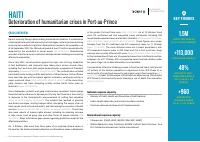
HAITI
Deterioration of humanitarian crises in Port-au-Prince
1.5M
AFFECTED PEOPLE
AS AT 26 SEPTEMBER
+113,000
DISPLACED PEOPLE
48%
ACUTELY FOOD-
INSECURE PEOPLE
(IPC PHASE 3 OR
WORSE)
+960
SUSPECTED
CHOLERA CASES
AS AT 19 OCTOBER
Briefing Note | 1 November 2022 2
Timeline of key events in 2022 ANTICIPATED SCOPE AND SCALE
As the situation of political turmoil and gang violence evolves in Haiti, particularly in the
Port-au-Prince metropolitan area (PAPMA), access to essential services remains difficult for
affected people
(The Guardian 06/10/2022; TWP 03/10/2022). Further demonstrations may increase
the spread of cholera and prevent affected people from receiving treatment
(OCHA 23/09/2022).
As people contract cholera through contaminated water and food sources, a lack of access to
basic services in the country will likely challenge mitigation efforts.
On 21 October, the UN SC affirmed its support for President Henry by establishing a sanction
regime on Haiti “imposing a targeted arms embargo, travel ban and asset freeze upon
individuals and entities who are responsible for or complicit in actions that threaten the peace,
security or stability of the country”. On 15 October, after the President requested international
military assistance, the US and Canada sent armoured vehicles and other supplies to support
the police in fighting gangs
(NPR 16/10/2022; Al Jazeera 16/10/2022). This gesture is likely to create
a violent reaction from armed gangs in the coming days and weeks since they seek to remove
the President and expand their control. Should this scenario materialise, it will further affect
the protection needs of civilians
(UN SC 21/10/2022; Reuters 20/10/2022).
Insecurity and a lack of fuel affect epidemiological surveillance systems, preventing the
timely detection of new cholera cases
(PAHO 12/10/2022). Related figures are likely higher than
reported.
HUMANITARIAN CONSTRAINTS
• Main roads falling under gang control has severely hindered humanitarian assistance
from reaching vulnerable populations. The gang violence crisis has persistently chal-
lenged access to healthcare, basic hygiene and sanitation services, and food for people
in the affected communities
(UNICEF 26/08/2022 and 14/10/2022; BBC 26/07/2022). Cité Soleil,
one of the areas most affected by the cholera outbreak, is also under the control of armed
gangs who have blocked critical humanitarian assistance, the movement of supplies, and
the country’s main fuel terminal located in the area
(TWP 03/10/2022; The Guardian 06/10/2022).
• Fuel has only been accessible through the black market
(TWP 03/10/2022). Fuel shortages
and electricity supply issues have shut hospitals down and halted the operations of ambu-
lance services and clean water distribution trucks. Insecurity and a lack of transportation
have made it challenging for patients and health personnel to access hospitals and health
services
(PAHO 12/10/2022).
• As at 27 September, 30% of the antennae operated by Digicel, the largest mobile phone
provider in Haiti, were out of fuel
(Reuters 20/10/2022). The situation is likely affecting com-
munication channels. Further disruptions could lead to information gaps and constrain
humanitarian operations.
Sources:
Reuters 18/10/2022; BBC 15/07/2022; WHO 12/10/2022; OCHA 19/10/2022; OCHA 30/05/2022
Briefing Note | 1 November 2022 3
HUMANITARIAN NEEDS Food: as at 14 October, 48% (around 4.7 million) of the population in Haiti were acutely food-
insecure (IPC Phase 3 or worse) and required urgent food assistance. This number is a marked
increase from 4.3 million people in 2021
(IPC 14/10/2022). In Cité Soleil, 19,200 people (5%) are
experiencing Catastrophe (IPC Phase 5) food insecurity levels
(OCHA 19/10/2022).
The deterioration of the food security situation is the result of the combination of violence and
social protest movements paralysing the country, the sharp decline in the national economic
situation, fuel shortages, and inflation. Market supplies are disrupted, reducing the availability
of food and essential items. People’s access to food is also decreasing as prices increase
(OCHA 19/10/2022). Haitians experienced below-average rainfall in 2021, leading to poor
harvests that, combined with the impact of recurring climate hazards (such as flooding and
earthquakes), worsen the situation
(VOA 23/03/2022).
WASH: a lack of access to clean water risks the expansion of the outbreak to other areas of
Haiti
(PAHO 14/10/2022). Over 35% of Haiti’s population has no access to basic drinking water
services, and 65% have limited or no access to sanitation services. Only 28% of people in Haiti
have access to basic sanitation, and only roughly 58% have access to basic water sources
(USAID accessed 27/10/2022). Fuel shortages worsen the situation as they affect the provision of
safe water via water trucks. These shortages have resulted in many municipal water pumps
being out of service
(PAHO 12/10/2022; TWP 03/10/2022). There is a lack of effective WASH
services and infection prevention and control measures to mitigate the further spread of
cholera and other waterborne diseases. Aside from insufficient WASH supplies and materials,
there is also a lack of personnel to support the adequate provision of WASH services
(PAHO
12/10/2022)
.
Cité Soleil particularly has an acute waste issue, with residents exposed to contaminated
waters from the improper disposal of toxic waste and a lack of waste management for
drainage canals
(OHCHR 07/07/2022). People living in the area often suffer from preventable
chronic illnesses because of exposure to toxic water and waste. In areas under armed gang
control, such as Cité Soleil, cases of waterborne diseases are likely under-reported
(The
Guardian 06/10/2022)
.
Health: fuel and electricity shortages and the control of oil terminals by armed gangs have
shut some hospitals down or forced them to reduce their services since they depend on
generators to operate
(PAHO 12/10/2022; MSF 21/10/2022; France 24 21/07/2022). As a result, around
29,000 pregnant women and their newborns, as well as 10,000 people suffering from obstetric
complications, are at risk of not receiving the critical care required, made worse if they contract
cholera
(OCHA 19/10/2022).
Briefing Note | 1 November 2022 4
Health centres are facing an acute shortage of supplies, such as cholera kits, oral cholera
vaccines, and resources to respond to the outbreak. There is a need for life-saving medicine
and health supplies, such as oral rehydration salts, Ringer’s lactate solutions, reagents, cholera
beds, intravenous sets, and appropriate antibiotics
(PAHO 12/10/2022). An increasing number of
countries reporting cholera outbreaks in 2022 has led to a global shortage of critical supplies
needed for cholera response.
Prior to the cholera outbreak, 15% of health institutions in PAPMA were closed or non-
functional because of insecurity and a lack of resources
(UNICEF 14/10/2022). Only 4% of
the population in Cité Soleil rely on public health institutions for healthcare because of the
prevalent insecurity situation affecting people’s mobility and their inability to afford health
services
(UNICEF 14/10/2022 and 05/08/2022).
Nutrition: almost 100,000 children under five years of age suffering from severe acute
malnutrition are particularly vulnerable to the cholera outbreak. Roughly one in four children
in Haiti – one in five in Cité Soleil – are reported to be chronically malnourished
(UNICEF
14/10/2022)
. An estimated 20% of children under five years of age in Cité Soleil are experiencing
severe or moderate forms of acute malnutrition, higher than the WHO emergency threshold of
15%
(UNICEF 05/08/2022).
Rising food prices and pre-existing socioeconomic inequalities causing food insecurity
among households in Cité Soleil are the main drivers of high malnutrition rates among children
(UNICEF 05/08/2022). As the cholera outbreak significantly affects children under five years of
age in Cité Soleil, the malnutrition situation will likely worsen
(OCHA 02/12/2021).
Shelter: according to UNICEF, as at 7 October, gang violence had displaced an estimated
20,000 people, including roughly 8,200 children. Prior to the escalation of conflict in October,
an assessment conducted between June and August 2022 by IOM found more than 113,000
IDPs, of whom 96,000 were displaced due to insecurity in Port-Au-Prince
(IOM 28/10/2022).
Many are sheltering with their relatives and host families, while others have fled to provincial
towns
(UNICEF 07/10/2022). Between 1–14 October, over 560 people were displaced within
Port-au-Prince, and over 640 people were reported in other neighbourhoods
(IOM 20/10/2022
and 17/10/2022)
. There is a lack of up-to-date information on the impact of the current crises
on shelter needs. According to the UN, between 8–17 July, when the protests began on the
anniversary of the assassination of the previous president, around 3,000 people were forced
to flee their homes, including hundreds of unaccompanied children. At least 140 houses were
destroyed or burnt down mainly in PAPMA
(UNICEF 16/08/2022; BBC 26/07/2022; OCHA 23/09/2022).
Education: as at 7 October, insecurity and the cholera outbreak had affected roughly 2.4
million children across Haiti as schools could not reopen despite the academic year beginning
on 3 October. An assessment conducted in June by UNICEF and the Ministry of Education and
Vocational Training found that gang violence had partially or completely closed more than 200
schools in Port-au-Prince. Armed gangs occupied almost 25% of schools, further reducing
access to education for children. Between mid-September and early October, armed gangs
attacked and looted 27 more schools. Some of the displaced population are temporarily
sheltering in school buildings, further affecting education for children in those areas
(UNICEF
07/10/2022)
.
Prior to the current insecurity escalation, 70% of Haitians were able to access primary
schooling, while only 15% were able to access secondary education. Roughly 75% of schools
in Haiti did not have access to electricity, and over 50% did not have access to adequate water
or sanitation
(PR Newswire 04/10/2022).
CONTEXTUAL INFORMATION
Gang violence and insecurity
Gang violence has worsened across Haiti since the assassination of President Jovenel Moïse
on 7 July 2021, creating a political power vacuum
(BBC 15/07/2022). Two gang coalitions called
G9 and G-Pèp frequently fight for control over certain areas in and around PAPMA, including
Cité Soleil
(Reuters 18/10/2022; HRW 22/07/2022). The Varreux fuel terminal is also located in Cité
Soleil
(BBC 15/07/2022).
Since April 2022, violent clashes between armed gangs have been increasing in PAPMA, with
the majority of territorial clashes happening over neighbourhoods in the communes of Cité
Soleil, Croix-des-Bouquets, and Tabarre
(OCHA 30/05/2022). Roughly 60% of PAPMA is currently
under the control or influence of armed gangs
(IOM 20/10/2022; OCHA 19/10/2022). Insecurity
has been significantly affecting residents of these areas, particularly during the protests in
July. According to the UN, between 8–17 July 2022, over 471 people were killed, injured, or
unaccounted for as a result of insecurity
(BBC 26/07/2022; UNICEF 16/08/2022; FP 19/09/2022).
Inflation and poverty
Inflation, which was more than 30% as at 26 October, is aggravating the crisis (Concern
25/10/2022)
. The cost of petrol has doubled (UN 14/10/2022). The southwest region has seen
the prices of some food products double since the beginning of the year, and the southern
peninsula has had the highest rates of malnutrition in the country
(France 24 21/07/2022; FEWS
NET 30/09/2022)
. The cost of staple food has increased because of high transportation costs
and widespread insecurity. The prices of the most consumed items, such as rice, beans,
maize, vegetable oil, and wheat flour, have increased along with fuel prices, affecting poor and
middle-income households
(FEWS NET 03/10/2022 and 30/09/2022).
Briefing Note | 1 November 2022 5
Haiti is one of the poorest countries in the world and the poorest in the Latin American and
Caribbean region. A combination of pre-existing socioeconomic issues and the impact of
COVID-19 resulted in a poverty rate of 52.4% in 2021, an increase from 51% in 2020
(WB accessed
27/10/2022)
. Cité Soleil, one of the communes most affected by the current cholera outbreak, is
a densely populated neighbourhood with roughly 400,000 residents and is considered Haiti’s
poorest slum
(OHCHR 07/07/2022).
Conflict and displacement
Internal displacement has increased because of the direct and indirect effects of insecurity
(IOM 20/10/2022; OCHA 19/10/2022). The increase in violence in April led to civilians becoming
the target of killings, kidnappings, and other extreme forms of violence, forcing people to flee
their homes
(OCHA 30/05/2022). Though displacement related to the surge of gang violence in
April has decreased, with returns being observed at the end of May 2022, the current wave of
gang violence and political instability, combined with a declining economy and lack of access
to essential services, is likely to result in further displacement. Insecurity and instability create
access constraints for humanitarian organisations to establish comprehensive displacement
figures.
The current displacement figures add to the 835 households displaced by the August 2021
earthquake who are reported to still be living in IDP sites. People living in IDP sites are isolated
and inaccessible because of the presence of armed gangs and prevalent insecurity. There is a
lack of potable water in IDP sites, with some sites being completely cut off from water supply
for prolonged periods
(OCHA 23/09/2022 and 02/12/2021). The irregularity of water supply, a lack
of waste management and health services at IDP sites, and overcrowding are likely to hinder
any mitigation efforts for the cholera outbreak.
AGGRAVATING FACTORS
Climate hazards
Globally, Haiti is one of the most vulnerable countries to climate hazards, such as earthquakes,
hurricanes, and floods
(WB accessed 27/10/2022). It is a majorly coastal country located within a
hurricane belt, meaning much of it is exposed to and affected by tropical storms and extreme weather
events. The hurricane season in Haiti is between June–November
(USAID 24/05/2022).
With recurring hazards, Haiti has been unable to recover from infrastructure damage in many
areas, resulting in a persistent lack of access to basic services for affected populations.
Damage to health facilities in earthquake-affected areas, which have not received adequate
repairs, further limits people’s access to health services
(OCHA 02/12/2021).
Cholera is contracted through food and water sources with cholera bacterium contamination.
The destruction of health and WASH facilities, combined with climate hazards and violence
resulting in constraints in accessing services, compound the impact of the outbreak of the
disease. The initial cholera outbreak in Haiti occurred after the 2010 earthquake when UN
mission personnel sent to support the response were discovered dumping contaminated
sewage into a river
(Reuters 22/10/2020). That cholera epidemic lasted until January 2019,
resulting in an estimated 10,000 deaths and affecting 820,000 people
(TWP 18/08/2016; The
Guardian 06/10/2022)
.
Map of suspected cholera cases in Haiti as at 30 October
Source: MSPP 31/10/2022