Deskripsyon Konple
Premye bilten mVAM sa a prezante rezilta yon sondaj sou entènèt ki gen 10 kesyon PAM VAM te fè atravè RIWI an franse ak kreyòl, li rive jwenn moun o aza nan zòn metwopoliten Pòtoprens (Kafou, Site Solèy, Delma, Pòtoprens, Tabak, Petyonvil) ak komin ki antoure yo (Kwadèboukè ak Kenskòf) soti 20 me rive 9 jen 2016, ak 991 repons. Sondaj la te fèt pou mezire pèsepsyon sekirite alimantè urban, paske evalyasyon enpak sechrès ki te deja egziste yo te konsantre sèlman sou zòn riral yo nan yon peyi kote plis pase mwatye popilasyon an ap viv nan sant urban, nan yon kontèks enflasyon rapid ak enstabilite politik.
Chomaj se difikilte ki pi rapòte souvan pou pòv yo nan tout komin, an akò ak yon to chomaj urban 40 pousan ak plis pase 60 pousan chomaj jèn (Bank Mondyal 2014); elektrisite ak swa ensekirite oswa pri manje te vin an dezyèm ak twazyèm plas prèske toupatou. Prèske tout moun ki reponn yo rapòte pri manje k ap monte sou twa mwa anvan yo (mas-me 2016), an akò ak done ofisyèl CNSA, epi yo pèsevwa sitiyasyon sekirite a kòm ki pa chanje oswa k ap vin pi mal nan yon kontèks manifestasyon politik ki pafwa vyolan, ak krim ki gen rapò ak gang konsantre nan Site Solèy epi vòl pi gaye nan tout vil la.
Pifò moun ki reponn yo rapòte ke kalite lavi pòv yo nan katye yo te vin pi mal sou menm peryòd la. Echantiyon an te panche jèn, gason ak edike, kidonk rezilta yo dekri pèsepsyon olye yon tablo estatistikman reprezantatif; PAM note ke pandan aksè entènèt ap grandi, sondaj konsa ta ka vin yon zouti viab pou siveyans sekirite alimantè.
Teks Konple Dokiman an
Teks ki soti nan dokiman orijinal la pou endeksasyon.
mVAM Bulletin 1 - June 2016
Fighting
Fighting
Hunger
Hunger
Worldwide
Worldwide
HAITI
TitleSecurity Perceptions in Metropolitan Port-au-Prince
Food
and Surrounding Communes
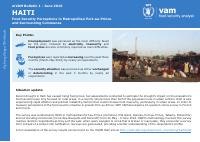
Key Points:
Unemployment was perceived as the main difficulty faced
by the poor, followed by electricity. Insecurity and
food prices are also commonly reported as main difficulties.
Food prices were reported as increasing over the past three
months (March-May 2016) by nearly all respondents.
The security situation was perceived as either unchanged
or deteriorating in the past 3 months by nearly all
respondents.
WFP/Catherine Clark
Situation update:
Recent drought in Haiti has caused rising food prices, but assessments conducted to estimate the drought’s impact on the population’s
food security have only focused on rural areas, in a country where more than half of the population lives in urban centers. Haiti is also
experiencing rapid inflation and political instability, factors that could increase food insecurity, particularly in urban areas. In order to
measure perceptions of the food security situation in greater Port-au-Prince, WFP VAM developed a 10-question online survey in French
and Creole.
The survey was conducted by RIWI in metropolitan Port-au-Prince (Carrefour, Cité Soleil, Delmas, Port-au-Prince, Tabarre, Pétionville)
and surrounding communes (Croix-des-Bouquets and Kenscoff) from 20 May - 9 June 2016. RIWI’s methodology involves The survey
reaches random respondents as they surf the web: when users navigate to a link that is broken or inaccurate, they encounter a survey
form instead of a broken link notification. Surveys are geolocated, providing a better understanding of the respondent’s profile.
A full visualization of the survey results can be found on the mVAM Haiti site at http://vam.wfp.org/sites/mvam_monitoring/haiti.html
�HAITI
Bulletin 1 - June 2016
METHODOLOGY AND SURVEY RESPONSES
Fig. 1: Areas of metropolitan Port-au-Prince
covered by the online survey
Sample size by Commune
Carrefour
Cite Soleil
Croix-Des-Bouquets
Delmas
Kenscoff
Petion-Ville
Port-au-Prince
Tabarre
Grand Total
110
19
90
234
20
186
276
56
991
The sample size of 991 responses includes both complete
(518) and partial responses (473), i.e. respondents
answered at least demographic and urban challenge
questions. Very few responses were received from Cité
Soleil or Kenscoff.
Since a sample generated through an online survey
would not be representative of the general population,
respondents were asked to provide general perceptions
of food security related issues in their neighborhoods.
The sample is mostly male, young, and well-educated.
Research is ongoing to see if this study’s results
correlate with statistically representative data currently
being collected through a household survey.
Respondents were mostly young, male, and well-educated:
AGE
GENDER
EDUCATION
LANGUAGE CHOICE
47%
18-25
72%
Male
54%
University
57%
French
34%
26-35
28%
Female
22%
Secondary School
43%
Creole
11%
36-45
18%
Professional Training
5%
46-55
3%
Primary School
3%
Over 56
2%
None
Source: WFP/mVAM 2016
Respondents could choose to do
the survey in French or Creole
�HAITI
Bulletin 1 - June 2016
FOOD PRICES
Fig. 2:
Perceptions of change in food
prices over the last 3 months
Change in the last three months
Price of Spaghetti
Throughout the communes, food prices
were reported to have increased over
the past three months (March-May 2016)
by most respondents. Official CNSA data
also shows increases in local staple food
prices, tempered only by stable imported
rice prices.
Across metropolitan Port-au-Prince, the
price of a plate of spaghetti, a common
street food, was most frequently reported
as 50-75 gourdes, but in the wealthier
communes of Delmas and Pétionville, the
most commonly reported price range went
higher, 50-100 gourdes.
WFP
Source: WFP/mVAM 2016
CRIME AND SECURITY
Security situation reported as deteriorating or unchanged over the past three months
(March - May 2016)
Fig. 3:
Perceptions of change in security
situation over the last 3 months
Since mid-2015, the security situation throughout metropolitan Port-au-Prince and surrounding communes
has been affected by increasing political demonstrations that sometimes turn violent. Crime is also a concern
in metropolitan Port-au-Prince, though it is underreported. Reported violent crime is predominantly gangrelated and robbery-related. Gang-related violent crime is centralized, mostly in specific areas such as Cité
Soleil, whereas robberies occur throughout the city.
Fig. 4: Percentage of respondents reporting Key Urban Challenges in metropolitan Port-au-Prince, by commune
Commune
Security
Perception
Carrefour
Deteriorated
36
40
37
39
30
30
35
39
Improved
19
10
13
19
38
22
20
28
No change
44
50
49
41
30
46
44
32
Source: WFP/mVAM 2016
Cite Soleil Croix-Des- Delmas
Bouquets
Kenscoff Petion-Ville Port-auPrince
Tabarre
Source: WFP/mVAM 2016
�HAITI
Bulletin 1 - June 2016
KEY URBAN CHALLENGES FACED BY THE POOR
Fig. 5: Perceived Key Urban Challenges in metropolitan Port-au-Prince
Respondents were asked to identify the two main difficulties faced by the poor.
Unemployment was the most commonly reported difficulty in all communes,
which is in line with the high unemployment rate of 40% and the youth
unemployment rate of over 60% in urban Haiti (World Bank 2014).
Electricity, and either insecurity or food prices, were the second and third most
commonly reported difficulties in all communes except for Cité Soleil, Kenskoff and
Port-au-Prince.
Source: WFP/mVAM 2016
Health in Cité Soleil appears along with unemployment and insecurity in the top
three difficulties, rather than food prices or electricity (though the sample size is
small). Flooding also appears in responses after two rainy months, though less
frequently, but it may become a larger problem during the hurricane season, which
runs from June through November. In Port-au-Prince commune, water and
sanitation was the third most commonly selected difficulty.
The main difficulties reported reflect a lack of access to basic services found in poor
areas of metropolitan Port-au-Prince. Between 30% and 40% of the “quartiers”
of Cité Soleil, Petionville, Delmas and Tabarre are missing at least four of the
basic services of health, education, public institutions, police, fireman, banks and
markets (IOM and Community Resource Centres 2015).
Fig. 6: Percentage of respondents reporting Key Urban Challenges in metropolitan Port-au-Prince, by commune
Commune
Urban Challenge
WFP/Catherine Clark
Carrefour Cite Soleil Croix-DesBouquets
Delmas
Kenscoff
Petion-Ville Port-au- Tabarre
Prince
Electricity
32%
10%
34%
32%
20%
23%
30%
30%
Flooding
4%
21%
8%
2%
25%
6%
5%
10%
Food Price
23%
21%
15%
17%
20%
24%
19%
28%
Health
16%
26%
11%
12%
10%
17%
17%
14%
Housing
10%
10%
7%
14%
10%
13%
14%
12%
Insecurity
16%
31%
18%
20%
25%
18%
15%
12%
School
13%
10%
14%
11%
15%
11%
13%
10%
Transport
17%
0%
17%
12%
5%
11%
9%
12%
Unemployment
37%
47%
41%
34%
35%
34%
33%
33%
Water
11%
15%
13%
13%
5%
11%
21%
12%
�HAITI
Bulletin 1 - June 2016
PERCEIVED CHANGES IN QUALITY OF LIFE
Fig. 7:
Perceptions of change quality of life for
the poor, over the past three months
Poverty
When asked how the quality of life
had evolved for poor people living in
their neighbourhoods over the past
three months (March-May 2016), the
majority of respondents answered
“deteriorated”.
Source: WFP/mVAM 2016
WFP/Catherine Clark
Fig. 8: Sample online survey question. Respondents could complete the survey in French or Creole.
METHODOLOGY
This mVAM bulletin is based on data collected from
20 May - 9 June 2016, using a specially designed online
survey. The survey reaches random respondents as
they surf the web: when users navigate to a link that
is broken or inaccurate, they encounter a survey form
instead of a broken link notification.
The exponential growth of global internet access means
that in a few years, such surveys could become a
widespread and viable tool for measuring food security.
Source: WFP/mVAM 2016
For further information please contact:
Wendy Bigham wendy.bigham@wfp.org
mVAM resources:
Arif Husain arif.husain@wfp.org
Website: http://vam.wfp.org/sites/mvam_monitoring/
Jean-Martin Bauer jean-martin.bauer@wfp.org
Blog: mVAM.org
Anne-Claire Mouilliez anne-claire.mouilliez@wfp.org
Toolkit: http://resources.vam.wfp.org/mVAM
�