Teks ki soti nan dokiman orijinal la pou endeksasyon.
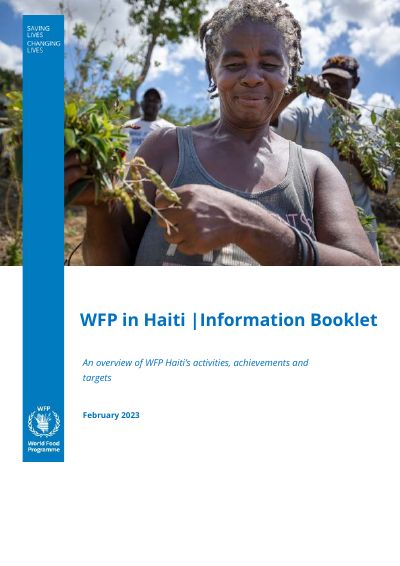
WFP in Haiti |Information Booklet
An overview of WFP Haiti’s activities, achievements and
targets
February 2023
�Table of Content
1. Executive summary
2. Emergency response in Haiti
3. WFP as the main implementer of policy and social
protection activities in Haiti
4. School feeding programme in Haiti and its
transition to home-grown school feeding
5. Resilience activities in Haiti
6. Micro-insurance activities in Haiti
7. Contingency stock in Haiti
8. Supply chain and logistics in Haiti
9. The United Nations Humanitarian Air Service
(UNHAS)
10. Thanks to WFP’s donors
February 2023
�Executive summary
WFP has been in Haiti since 1969, providing humanitarian assistance
during emergencies, and supporting development through long-term
solutions to end hunger, address undernutrition and strengthen national
social protection, education and food systems. To reach its goal of Zero
Hunger, WFP implemented some of its flagship programmes such as homegrown school feeding, and has supported the Government of Haiti through
policy development and capacity building.
In addition, WFP’s robust logistics and supply chain capacities, including
the United Nations Humanitarian Air Service, allows it to reach people in
need in hard-to-reach areas and to support other UN agencies and NGOs
present in Haiti.
The latest Integrated Food Security Phase Classification (IPC) covering
September 2022 to February 2023, highlights that almost half the
population in Haiti, or 4.7 million people, are acutely food insecure
(IPC 3+). Close to 1.8 million are now in Emergency phase (IPC 4), an
increase of nearly half a million since the previous analysis, and 19,200
people are facing catastrophic hunger (ICP 5), a first in Haiti and in the
Latin America and the Caribbean region. Food security trends show a
steady deterioration of the food security situation since 2016.
In 2022, WFP supported 1.8 million people in Haiti, and aims to support 2.5
million people in 2023. The country office needs USD 155.2 million to be
able to implement its operations in the next six months (February 2023 –
July 2023).
February 2023
�WFP’s emergency response in Haiti
Through its emergency programmes, WFP
by violence, and safeguard logistics routes.
provides
Additionally, on 27 October, a Corporate
unconditional
food
and
cash
assistance to vulnerable households and
ensures contingency stocks and preparedness
measures are put in place to respond to
shocks.
Scale-Up Emergency was activated for Haiti.
As part of WFP’s rapid responses, 325,378
hot meals were distributed
across four
departments in 2022, to assist with:
In 2022, WFP supported 722,665 people with
• Armed-group violence, leading to urban
5,381 mt of food, 325,378 hot meals, and USD
displacement and month-long internally-
22.9 million of cash-based transfers. WFP’s
displaced people crisis in the Metropolitan
goal in 2023 is to reach 1.47 million people,
area of Port au Prince;
representing 80% of people facing emergency
• Mass repatriations requiring a hot meal
level of food insecurity, with 15,198 mt of food
response in the North-East, Center and
and USD 86,7 million.
West departments;
Almost half the population in Haiti, or 4.7
million people, are acutely food insecure
and in need of food assistance, of which
19,200 people are facing catastrophic hunger,
a first in Haiti and in the Latin America and the
Caribbean region.
In urban areas, WFP assists beneficiaires with
cash transfers, and in semi-urban and rural
areas with in-kind and cash-based transfers.
Cash-based transfers aim to cover around 70
percent of the improved food basket, while
the food rations are calculated to meet a
• Cholera response in the Artibonite and
West
departments,
including
the
Metropolitan Area of Port au Prince.
Additionally, a second helicopter was
contracted in 2022 and most of its flying
time was dedicated to supporting the
cholera response.
WFP’s
emergency
activities
were
underfunded in 2022, and WFP could only
reach 60 percent of its initial target of 1.2
million people due to the funding shortfalls
and complex emergency.
household’s needs for one month.
The security situation in Haiti has worsened
throughout the year, especially after the
beginning of the complex crisis in September
2022, and accessing beneficiaries has become
more challenging. WFP Haiti created an Access
Beneficiaries without IDs can
still access WFP programmes
by registering on SCOPE,
WFP’s proprietary beneficiary
management platform.
They retrieve assistance with a SCOPE card,
which is used to verify the recipient’s identity.
unit to enable access to populations affected
February 2023
�WFP as the main implementer of policy and social
protection activities in Haiti
Social protection programmes are the set of
partner, to carry out the social safety net included
policies and programmes aimed at preventing or
in the NSPPP. The program will also improve
protecting
health
all
people
against
poverty,
vulnerability, and social exclusion throughout
their
lifecycles,
with
a
particular
emphasis
towards vulnerable groups.
WFP
supported
the
Government
in
the
and Promotion Policy (NSPPP), adopted in June
2020. This policy
provides the institutional
framework
future
all
nutrition
outcomes
for
the
WFP is tasked with designing and operationalizing
the ASPIRE safety net while building government
development of the National Social Protection
for
and
households and promote financial inclusion.
social
protection
initiatives. Since its adoption, WFP has been
working with the Government on a roadmap for
its gradual implementation. WFP also supported
the development of the National School Feeding
Policy.
capacity to take over the programme in 2024.
So far, WFP has successfully supported the
Ministry of Social Affairs in delivering the ASPIRE
programme, resulting in the enrollment of more
than 23,000 households and delivery of transfers
to
approximately
25,000
people
in
2022,
contributing to families meeting their food needs
and healthy diets.
Since 2017 WFP Haiti has invested USD 16.3
WFP is equally supporting the SIMAST (Ministry of
Social Affairs and Labour’s Information System), a
social registry developed in 2013 used to assess
vulnerability
and
target
programmes. It covers 74
social
assistance
communes
and
million
in
formulation,
capacity
design
of
strengthening,
policy
safety
and
nets,
development of information systems.
ASPIRE project coverage as of February 15, 2023
550,000 households (of which 100,000 registered
in 2022), amounting to 2.5 million people, or 28%
of the total population. WFP is supporting its
continued
geographical
expansion,
and
the
Government’s goal in 2023 is to increase that
figure to 37% of the total population registered in
the SIMAST.
Both the NSPPP and the SIMAST support the
ASPIRE (Adaptive Social Protection for Increased
Resilience), programme, a nationally led social
protection programme. USD 75 million was
awarded by the World Bank to the Haitian
Government, with WFP as a key implementing
February 2023
�WFP’s school feeding programme in Haiti and its
transition to home-grown school feeding
School meals are a priority in Haiti: in a
WFP’s objective is to increase that number to
country where close to 45% of the population
182,000 school children fed through the
needs urgent food assistance, a daily meal at
HGSF programme in 2023, and to reach
school is a simple way to ensure
100% by 2030, in line with the national policy
that
children receive at least one nutritious
meal every day. School meals help keep
children
in
school,
and
improve
their
completion rate, so that they become healthy,
productive
adults,
contributing
to
their
country’s development, and breaking the
intergenerational
cycle
of
hunger,
malnutrition and poverty. WFP aims to reach
460,000 school children in 2023.
for school feeding (PNAS).
WFP works with over 70 OPAs (Organisations
de Producteurs Agricoles) to source food from
smallholder farmers. In 2022, over 2000 mt
of local products were bought (or USD 2.3
million). WFP also provides capacity-building
to the OPAs, and helps them improve the
quality of their products, subsidizes the setup of processing facilities and provides them
WFP’s goal is to switch from a traditional
with control equipment. In partnership with
school feeding programme (SF), through
the Ministry of Agriculture, WFP also
which most goods are imported, to a home-
provides technical trainings on storage and
grown school feeding programme (HGSF),
grain
through which all the goods (except oil) are
reduction of post-harvest losses. Finally, WFP
locally sourced.
provides training on response to calls for
Through the HGSF WFP supports (i) the
Haitian economy through local purchases; (ii)
conservation,
tenders,
access of smallholder farmers to markets.
for children 5 to 10 years old:
children benefitting from WFP’s assistance
rice or bulgur)
programme
in
5
departments:
Artibonite, Grand’Anse, Nippes, Ouest, and
Sud.
contracting
38-42 % of the recommended daily food intake
- 120g of cereals (enriched
HGSF
and
Standard meal ration
As of December 2022, 96,500 of the school
(or 28%) were eating food bought via the
and
control
improve access to markets.
the diversification of schoolchildren’s diet;
and (iii) local farming by strengthening the
negotiation
quality
- 30g of pulses (peas, lentils
or black beans)
- 10g of vegetable oil
- 3g of salt
to
�Additionally,
WFP
uses
schools
as
a
platform to improve gender norms and
promote the equality of women and men
and girls and boys.
Other
training
complementary
on
literacy,
activities
include
and
water,
on
sanitation and hygiene practices, the setup
of hand-washing stations
and the
construction and rehabilitation of latrines in
the
Grand’Anse,
Nord
and
Nord-Est
departments.
WFP is also sensitive to the environmental
impact of its programmes, and in 2022, the
Clean Cooking project introduced heat
retention bags (HRB), gas stoves and clean
cooking training to school cooks. The HRB
are produced entirely locally and create
livelihood opportunities; 2,800 HRB were
ordered and will be distributed to 1,400
cooks and 400 schools in 8 regions in 2023.
February 2023
�WFP’s resilience activities in Haiti
Due to Haiti’s exposure to rapid-onset
community-led soil and water conservation
shocks and stressors resulting from natural
activities, including providing agricultural
hazards, as well as the socio-political and
inputs, technical and financial assistance to
economic instability, WFP is reinforcing the
actors, and animals throughout the food
resilience
of
Haitians
through Asset
value chain. Yet, WFP’s resilience projects
creation
and
Livelihood
programmes.
enable access to basic social services,
to
stimulate
These
programmes
aim
support
market
dynamics
and
communities in some of the most vulnerable
contribute to conflict-reduction turmoil
areas of Haiti by mitigating, adapting, and
through the rehabilitation of rural roads,
recovering
installation
from
seasonal
shocks
and
of
potable
water
abduction
recurring hazards, while also working to
points and shock-related solutions such as
improve
micro-insurance assistance and creation
their
long-term
food
security,
of temporary jobs based on conditional-
livelihoods and community resilience.
In 2022, WFP directly supported around
112,950
people
through
its
resilience
cash
remuneration
to
programmes’
participation.
activities and aims to increase its assistance
Throughout the definition, design, delivery
to 250,000 in 2023.
and documentation for
Participants receive conditional cash while
they
build,
rehabilitate
or
improve
productive or protective community assets,
as well as tools, inputs and technical
assistance. In 2022, they participated in 80day cycles and received a cash-based
transfer of around USD 100 per month to
cover their food gap and meet basic needs.
WFP delivers complementary activities in
the same zones, prioritising a gender and
nutrition sensitive approach with a social
scale-up
of its
resilience programming, WFP adopts the
Three-Pronged approach to guarantee that
programmes are planned to bring together a
plethora of actors through a participatory
process and respond to local needs,
therefore boosting community ownership
and acceptance of climate adaptation and
risk management measures.
Assets created or rehabilitated in 2022
97 km of rural roads rehabilitated
53 km of irrigation canals rehabilitated to
enhance 2,250 hectares of agricultural land
behavioral communication change lens.
WFP invests in three main pillars. The local
ecosystem is strengthened through disaster
28 mt of seeds distributed and 4 mills for
food transformation established
risk
75,000 trees’ cutting planted
reduction
solutions,
while
environmental-related
reinforcing
agriculture and livestock through
local
24,950 smallholder farmers supported
through micro-insurance coverage
February 2023
�WFP’s micro-insurance activities in Haiti
The
objectives of introducing risk financing
through a risk transfer mechanism,
allowing
actions in Haiti are to: (i) design microinsurance
participants to protect their productive investments,
products that are integrated in resilience building
better reduce their vulnerability when faced with
strategies promoting productivity that are easily
risks such as excess rain and rain deficit, while
scalable; (ii) introduce insurance components that
understanding and adopting the use of new and well
can be linked to other financial services and tools
designed financial risk mitigation tools within their
(formal and informal); (iii) guarantee a critical mass
communities.
through a smart subsidy approach, aggregation and
distribution schemes; (iv) complement other WFP
Haiti
interventions
aiming
at
reinforcing
smallholder farmers’ capacities at the home-grown
school feeding level; and (v) explore integration
with macro level solutions - such as the coverage
of The Caribbean Catastrophe Risk Insurance Facility
- and Forecast Based Financing (FbF).
To
help
build
farmers’ adaptive capacity and
reduce their exposure to climate-related risks in
department of Grand Anse, the selected cooperatives
provided agricultural insurance participants with
technical assistance and knowledge risk mitigation
and financial education. In the Sud department,
support
includes
the
implementation
of
environmental protection activities, such as soil and
In October 2022, WFP Haiti in partnership with local
water conservation works and reforestation activities.
companies, the Alternative Insurance Company
(AIC), weather risk management sytems (WRMS)
(technical
provider)
and
Scor
Re
(reinsurer),
launched an index micro-insurance pilot, covering
beneficiaries for one year, from October 2022 to
September 2023. A total of 4,990 smallholder
farmers households (24,950 beneficiaries),
of
which 51% are women, are protected against two
major climate risks, excess rain and rain deficit, in
the departments of Grand Anse and Sud. Over 1,000
farmers are existing asset creation beneficiaries
based in the Sud, whereas the remaining 3,900 in
Grand’Anse are part of the largest smallholder
farmers’ network, and a Federation of Agriculture
Cooperative. The pilot scale up target is to cover up
to 10,000 smallholder farmer households (50,000
beneficiaries) by 2024.
The cover aims to improve the resilience of
farmer households and their cropping activity
February 2023
�WFP’s contingency stock in Haiti
The contingency stock is a key tool that
WFP’s
WFP uses to ensure that crisis-affected
purchases. As a first step in 2023, while
populations in Haiti can meet their
82% of in-kind commodities will be
basic food needs in times of crisis.
funded by USAID/BHA, WFP aims to
Having
locally
pre-positioned
commodities
goal
is
purchase
to
increase
the
rest
local
of
its
available in country allows WFP to
contingency stock with other donor
respond to sudden-onset disasters and
funds. The local purchases will be
crises to meet
the needs of affected
contracted through local suppliers and
populations quickly, while additional
WFP is putting in place Food Supplier
assistance is planned and prepared for
Agreements to be able to fast-track the
in later weeks, if needed.
purchasing process. WFP will solely
Fully stocked, the contingency stock
trigger the local option if and when
needed. This will allow the stock to be
allows WFP to feed up to 300,000
more agile and to save costs. WFP is
people
still looking for a donor to fund the local
with
unconditional
food
assistance, including 50 kg of rice, 12.5
kg of beans, and 3.68 kg of oil per
household
for
one
month.
This
purchases.
Following
the
looting
of
WFP
represents 81% (1,693 Kcals per person/
warehouses in Haiti, part of the food will
day) of daily caloric needs.
be stored in the Dominican Republic as
a mitigation measure.
To distribute the emergency rations,
WFP utilizes its own fleet of trucks (25 all
Percentage of locally vs internationally
purchased food for the contingency stock
-terrain 4x4 trucks) to access the most
difficult secondary and tertiary roads, its
cooperating
partners, and commercial
transporters for main road routes.
In 2022 the contingency stock was fully
funded
by
USAID/BHA
with
in-kind
commodities stored across Haiti.
Locally purchased
Internationally purchased
February 2023
�WFP’s Supply Chain and Logistics in Haiti
Supply Chain and Logistics capacities are key to delivering
WFP’s humanitarian assistance in the fastest, most
Bilateral services provided in 2022
efficient and cost-effective way possible.
In Haiti, WFP has 25 trucks, 2 helicopters, 1 fixed-wings
and has access to maritime transport to support its
operations, as well as other UN agencies, NGOs and
governments entities’ through bilateral service provision. In
2022, 129 services were provided to 35 partners, compared
to 86 services were rendered to 19 partners in 2021.
The provision of fuel was most demanded service in 2022
due to recurring fuel shortages in the country. In 2022,
122,248 gallons of fuel were provided to 34 partners. Since
the beginning of the cholera outbreak on 2 October 2022,
WFP supported humanitarian and health partners through
the provision of 73,000 gallons of fuel to 21 partners, with
critical support from USAID/BHA.
WFP contracted an exclusive maritime service with a local
company in August 2021 to support the earthquake
response, and contracted its own vessel between April and
September 2022, as maritime transport is critical to reach
the provinces to circumvent armed group controlled areas.
After a three-month suspension due to the complex crisis
that started in September 2022, WFP resumed the maritime
transport services offered to the humanitarian community.
WFP is working to set up regular maritime routes that
would link Port-au-Prince to Artibonite, Nord-Ouest (north-
*
* WFP supports the Ministry of Health, thanks to funding
from the World Bank, and stores and transports medical
products worth USD 3 millions in 6 departments.
Additionally, an Access unit was created in 2022 to
enable access to populations affected by the violence,
and safeguard logistics routes.
WFP is also setting up a humanitarian corridor with the
Dominican Republic, as well as part of its contingency
stock, to be able to quickly dispatch humanitarian aid by
land and sea to support its emergency response.
WFP has 2 warehouses in Port au Prince and Cap
Haitian, totalling 20,000 mt storage capacity, and a new
storage facility is under construction in Miragoane. WFP
also has 9,000 mt of mobile storage capacities in case
of emergency.
west) and Grand Sud (south).
February 2023
�WFP’s United Nations Humanitarian Air Service
Operating in Haiti since November 2019, the
United Nations Humanitarian Air Service
(UNHAS) supports the humanitarian and
development community to reach and assist
the most vulnerable populations in remote
areas, in addition to providing medical
lifesaving equipment and evacuations.
With port and road access severely limited,
Key 2022 figures
Flights
1,827
Number of passengers 12,836
Partners supported
152 (of which 77
NGOs)
Cargo
218,364 kg
Destinations
46
especially since the complex crisis started on
of cargo were dedicated to the crisis
September 12th, the UNHAS air services are
response that started on September 12th,
absolutely
2022.
crucial
for all humanitarian
organizations and diplomatic missions to
have a safe, reliable and timely means of
transport in the country and keep providing
immediate support to vulnerable populations
who are facing difficulties in accessing their
livelihoods or get vital supplies.
As of January 16th, 2023, 786
In 2022, WFP acquired a third asset, and
now has a fixed-wing and two MI-17
helicopters. UNHAS continues to play a
crucial role for the cholera response,
which it supported through 25 dedicated
flights, and by transporting 75 mt of
flights
transporting 4,972 people and 195,599 kg
medical supplies, medical equipment and
teams as well as humanitarians in 2022.
February 2023
�Thanks to the Generous
Support from our Partners
REPUBLIQUE D'HAÏTI
Contact: Jean-Martin Bauer, Country Director
jean-martin.bauer@wfp.org
Jurian Steegh, Head of External Relations and Reporting
jurian.steeghs@wfp.org
Further information: Haiti | World Food Programme (wfp.org)
February 2023
�