Teks Konple Dokiman an
Teks ki soti nan dokiman orijinal la pou endeksasyon.
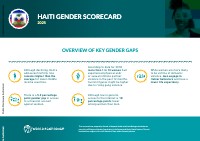
OVERVIEW OF KEY GENDER GAPS
This scorecard was prepared by Daniela A. Maquera Sardón and Paola Buitrago-Hernández as
part of the LCR Regional Gender Coordination in the Poverty and Equity Global Practice. The tool
benefited from support of the LAC Statistical Team within the same practice.
HAITI GENDER SCORECARD
2025
Although declining, Haiti’s
adolescent fertility rate
remains higher than the
average for lower-middle
income countries.
There is a 5.3 percentage
point gender gap in access
to a financial account
against women.
According to data for 2018,
more than 1 in 10 women had
experienced physical and/
or sexual intimate partner
violence in the past 12 months.
Current figures might be higher
due to rising gang violence.
Although low in general,
access to the internet is 18
percentage points lower
among women than men.
While women are more likely
to be victims of domestic
violence, men engage in
riskier behaviors and have a
lower life expectancy.
Public Disclosure Authorized
Public Disclosure Authorized
Public Disclosure Authorized
Public Disclosure Authorized
GENDER EQUALITY IN HAITI COMPARED TO ITS REGIONAL, STRUCTURAL AND
ASPIRATIONAL PEERS
The indicators below align with the objectives of the WB Gender Strategy 2024-2030. The table shows comparable data for the most recent year
(within the period 2015 to 2023) and trends for the available years starting from 2010.
Comparators for Benchmarking (all consider the latest data point available for the period 2015-2023) :
• Regional: average for the LAC region.
• Structural: average for the country’s income-level group (high, upper-middle, lower-middle, or low income).
• Aspirational: average of the top 5 countries in the Global Gender Gap Index 2024 (Iceland, Finland, Norway, New Zealand, and Sweden).
Topic Indicator Country
Benchmarks
Country’s trend
Country’s status
relative to LAC
Regional
(LAC)
Structural
(LMC)
Aspirational
Foundational Well-being: Human Capital and
Gender-Based Violence
STEM fields
Female graduates from tertiary education
in STEM programs (%)
NA 11.9
†
NA 14
Male graduates from tertiary education in
STEM programs (%)
NA 31.2
†
NA 40.3
School-
to-work
transition
Share of youth not in education,
employment or training, female (% of
female youth population ages 15-24)
NA 25.4 34 6.4
2010201420182022
Share of youth not in education,
employment or training, male (% of male
youth population ages 15-24)
NA 13.2 11.8 6.9
2010201420182022
Topic Indicator Country
Benchmarks
Country’s trend
Country’s status
relative to LAC
Regional
(LAC)
Structural
(LMC)
Aspirational
Foundational Well-being: Human Capital and
Gender-Based Violence
School
dropout
Lower secondary completion rate, female
(% of relevant age group)
NA 76 69.3 98.2
Lower secondary completion rate, male (%
of relevant age group)
NA 71.7 68.6 99.7
Teenage
pregnancy
Adolescent fertility rate (births per 1,000
women ages 15-19)
50.6
[2022]
51.7 42 4.2
2010201420182022
Violence
against
women and
girls
Proportion of women subjected to physical
and/or sexual violence in the last 12
months (% of ever-partnered women ages
15-49)
12*
[2018]
8.2
†
NA 5
2010201420182022
Economic Opportunities
and Participation
More and
better jobs
Vulnerable employment (contributing
family and own account), female
(% of female employment) (modeled ILO
estimate)
80.3
[2022]
32.8 70.9 7.9
2010201420182022
Vulnerable employment (contributing
family and own account), male (% of male
employment) (modeled ILO estimate)
68.6
[2022]
33 62.8 12
2010201420182022
Topic Indicator Country
Benchmarks
Country’s trend
Country’s status
relative to LAC
Regional
(LAC)
Structural
(LMC)
Aspirational
Economic Opportunities and Participation
Ownership
and control
of productive
assets
Account ownership at a financial institution
or with a mobile-money-service provider,
female (% of population ages 15+)
30
[2017]
70.1 59.2 99.7
2010201420182022
Account ownership at a financial institution
or with a mobile-money-service provider,
male (% of population ages 15+)
35.3
[2017]
77 65.5 99.3
2010201420182022
Digital
inclusion
Internet access from any device and
location, female (% of population ages
15+)
25*
[2018]
76.9
†
NA 97.8
2010201420182022
Internet access from any device and
location, male (% of population ages 15+)
43*
[2018]
78
†
NA 98.2
2010201420182022
Time spent
on unpaid
household
work
Proportion of time spent on unpaid
domestic and care work, female
(% of 24-hour day)
NA NA NA 14.1
Proportion of time spent on unpaid
domestic and care work, male
(% of 24-hour day)
NA NA NA 10.7
Topic Indicator Country
Benchmarks
Country’s trend
Country’s status
relative to LAC
Regional
(LAC)
Structural
(LMC)
Aspirational
Female Leadership
Women in
management
Female share of employment in senior and
middle management (%)
NA 39.6
†
NA 37.7
Women
entrepreneurs
Firms with female participation in
ownership (% of firms)
NA 47.4 30.8 46.5
Sources: Data extracted on December 18, 2024, from the WBG World Development Indicators (WDI) and Gender Statistics databases, unless otherwise specified. The symbol (*) indicates any of the following complementary sources: STEM-related data is sourced from the UNESCO Database,
digital access data from the Gallup World Poll 2023, and Violence Against Women and Girls data from the World Health Organization (WHO).
NA indicates data is not available for specific countries or peer groups.
Notes: LAC average includes the 42 countries (all income levels) in Latin America and the Caribbean, as classified by The World Bank Group. When regional averages were unavailable, weighted averages were constructed (denoted with the symbol †) using population data of relevant age groups
from the WDI and for the countries with available data on the corresponding indicator. These represent 90-99% of the respective age population in the LAC region.
The country’s status is assessed using a Traffic Light System: yellow if the country is within a ±3 percentage-point range of the regional average; green or red if the country scores 3 percentage points higher or lower than the regional average, depending on the expected trend for the specified
indicator. A missing traffic light indicates that comparisons could not be made due to insufficient data.
For FY25, income groups are defined according to 2023 gross national income (GNI) per capita (in USD), calculated using the World Bank Atlas method:
HIC: high-income group aggregate; economies with a GNI per capita higher than $14,005.
UMC: upper middle-income group aggregate; economies with a GNI per capita between $4,516 and $14,005.
LMC: lower middle-income group aggregate; economies with a GNI per capita between $1,146 and $4,515.
LIC: low-income group aggregate; economies with a GNI per capita of $1,145 or less.
THE POVERTY AND GENDER NEXUS IN LATIN AMERICA AND THE CARIBBEAN
Female and male poverty rates
(USD 6.85 per day 2017 PPP) by age group, circa 2023
During productive
and reproductive
ages, women
are more likely
to live in poor
households than
men.
Source: The numbers presented in the graph are based on the regional data harmonization effort known as the Socio-economic Database for Latin America and the Caribbean (SEDLAC) - a joint effort of the World
Bank and CEDLAS from the National University of La Plata (Argentina). The LAC aggregate is based on 16 countries for which harmonized, income-based microdata for the years 2022 or 2023 were available.
Countries included are: Argentina (urban only), Bolivia, Brazil, Chile, Colombia, Costa Rica, the Dominican Republic, Ecuador, El Salvador, Guatemala, Honduras, Mexico, Panama, Paraguay, Peru, and Uruguay. For
some countries, the data is preliminary.
0
5
10
15
20
25
30
0-4 5-910-1415-1920-2425-2930-3435-3940-4445-4950-5455-5960-6465-6970-74 75+
%
TURNING RESEARCH AND EVIDENCE INTO ACTION
1 There are more gender gaps in LAC beyond the ones presented here. However, this scorecard focuses on the priority areas identified by the Regional Gender Action Plan FY21-FY25.
Below are persistent gender gaps
1
in LAC and corresponding evidence-based interventions that can help close them.
Women in STEM Fields School-to-Work Transition
Women are underrepresented in STEM
graduate programs and careers
Young women are more likely than young
men to be out of employment, not in
education or training
Evidence-based solutions Evidence-based solutions
• Address gender biases in teaching and build a ‘science identity’ for girls.
• Expose young girls to female mentors and role models in STEM.
• Fund female students and researchers through scholarships, postdocs, and internships
to retain women in STEM careers.
Find the policy note on this topic for more solutions and examples of WB-supported
operations here.
• Promote women’s participation in non-traditional skills training programs by
subsidizing attendance costs.
• Supplement in-classroom training with on-the-job internships.
• Strengthen labor intermediation with local and private entities for better training and
targeting of vulnerable women.
Find the policy note on this topic for more solutions and examples of WB-supported
operations here.
Boys’ School Dropout Teenage Pregnancy
Fewer boys complete lower secondary
school than girls
Girls from lower socio-economic status face
higher risk of teenage pregnancy
Evidence-based solutions Evidence-based solutions
• Inform boys on wage returns to secondary education to raise interest to stay in school.
• Offer financial incentives like CCT or vouchers conditional to school attendance and
academic progress.
• Train teachers on how to identify at-risk students and offer remedial learning to those
falling behind.
Find the policy note on this topic for more solutions and examples of WB-supported
operations here.
• Offer peer-to-peer sexual and reproductive health education.
• Include goal-setting and critical thinking activities in life skills trainings.
• Avoid teen mothers’ school dropout through CCT programs.
Find the policy note on this topic for more solutions and examples of WB-supported
operations here.
Violence Against Women and Girls More and Better Jobs
On average, 1 in 3 women
are subjected to violence
In most LAC countries, the average woman
has a vulnerable job
Evidence-based solutions Evidence-based solutions
• Supplement economic empowerment programs with activities like community activism
and school-based interventions to prevent dating violence.
• Create and ensure safe spaces in schools and public transport.
• Develop intersectoral response as well as phone and internet helplines to improve the
prevention and detection of gender-based violence.
Find the policy note on this topic for more solutions and examples of WB-supported
operations here.
• Offer certification in non-traditional sectors, combined with on-the-job training.
• Guarantee parental leave and equal pay for equal work between men and women.
• Adopt workplace strategies that promote the recruitment of women such as quotas in
short lists and gender-inclusive language in job postings.
Find the policy note on this topic for more solutions and examples of WB-supported
operations here.
Ownership and Control of Productive Assets Women Entrepreneurs
Women are less likely to own and control
assets than men
Women tend to segregate in less profitable
sectors
Evidence-based solutions Evidence-based solutions
• Formalize joint titling and registration of property rights for female heads of
households.
• Simplify procedures for women’s access to housing.
• Train land administration staff on gender-equitable governance.
Find the policy note on this topic for more solutions and examples of WB-supported
operations here.
• Combine business training with increased women’s access to grants and lending
assistance.
• Match female entrepreneurs to male role models and mentors.
• Expand women’s credit access using alternative forms of collateral.
Find the policy note on this topic for more solutions and examples of WB-supported
operations here.
Time Spent on Unpaid Household Work Digital inclusion
Women spend significantly more time on
unpaid domestic and care work than men
Women face specific barriers to accessing
the internet
Evidence-based solutions Promising approaches
• Expand the supply of good-quality childcare services that meet families’ needs
(location, times, ages served).
• Subsidize childcare services to increase mothers’ labor participation and earnings.
• Complement paternity or parental leave policies with parenting guidance for fathers
offered via virtual workshops and SMS messages.
Find the policy note on this topic for more solutions and examples of WB-supported
operations here.
• Expand digital infrastructure to address women’s specific needs in access, affordability
and usage.
• Develop digital skills for girls and adult women through hands-on exposure to
technology and practical trainings.
• Promote women’s use of digital financial services through payments, social assistance,
or agricultural transfers.
Find the policy note on this topic for more solutions and examples of WB-supported
operations here.
Gender data gaps
Gender data are limited: often incomplete,
methodologically inaccurate, or completely
lacking.
Evidence-based solutions
• Mainstream the adoption of international best practices in the production of gender
data.
• Leverage existing engagements with National Statistical Offices regionally.
COUNTRY RESOURCES
Legislative and regulatory framework
• Haiti WBL – brief on laws and regulations affecting women’s economic opportunities
Gender strategic framework
• Haiti Country Partnership Framework FY16-19 (2017)
• Haiti Systematic Country Diagnostic Update: Pathways to Responding to Recurrent Crises and Chronic Fragility (2022)
• USAID/Haiti Strategic Framework Gender Analysis (2020)
• Country Gender Assessment - Haiti’s untapped potential: An assessment of the barriers to gender equality (2023)
Country-specific data and analysis
• Haiti WB Gender Landscape
• Gender-Based Violence Country Profile: Haiti
• Taking the Pulse of the Caribbean – Monitoring the Welfare of Caribbean Households During the Covid-19 Pandemic: Results from LAC High Frequency Phone Surveys (2022)
• COVID-19: Impacts, Attitudes, and Safety Nets in Haiti - CARE (2021)
• How Behavioral Science can Nudge Pregnant Women to Attend Prenatal Care in Haiti (2019)
• Haiti Country Profile – Gender Equality Observatory, ECLAC
• Haiti Fact Sheet – UN WOMEN