Teks Konple Dokiman an
Teks ki soti nan dokiman orijinal la pou endeksasyon.
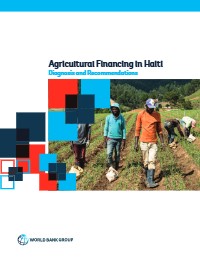
Agricultural Financing in Haiti
Diagnosis and Recommendations
FINANCEMENT AGRICOLE EN HAÏTI
© 2019 The World Bank Group
1818 H Street NW
Washington, DC 20433
Telephone: 202-473-1000
Internet: www.worldbank.org
All rights reserved.
This volume is a product of the staff and external authors of the World Bank Group. The World Bank
Group refers to the member institutions of the World Bank Group: The World Bank (International
Bank for Reconstruction and Development); International Finance Corporation (IFC); and
Multilateral Investment Guarantee Agency (MIGA), which are separate and distinct legal entities
each organized under its respective Articles of Agreement. We encourage use for educational and
non-commercial purposes.
The findings, interpretations, and conclusions expressed in this volume do not necessarily reflect
the views of the Directors or Executive Directors of the respective institutions of the World Bank
Group or the governments they represent. The World Bank Group does not guarantee the accuracy
of the data included in this work.
Rights and Permissions
The material in this publication is copyrighted. Copying and/or transmitting portions or all of
this work without permission may be a violation of applicable law. The World Bank encourages
dissemination of its work and will normally grant permission to reproduce portions of the work
promptly.
All queries on rights and licenses, including subsidiary rights, should be addressed to the Office
of the Publisher, The World Bank Group, 1818 H Street NW, Washington, DC 20433, USA;
fax: 202-522-2422; e-mail: pubrights@worldbank.org.
This publication was prepared with support of the Financial Sector Reform and Strengthening Initiative,
FIRST, which is managed by the World Bank.
Photo Credits: World Bank Photo Library and Shutterstock.com
TABLE OF CONTENTS
Table of Contents
II
Abbreviations and Acronyms.................................................................................V
Acknowledgments...................................................................................................IX
Introduction and Executive Summary....................................................................1
The Agricultural Sector in Haiti............................................................................11
Agriculture: A Decisive Sector in the Haitian Economy............................................. 11
The Multipurpose Family Farm: The Basis of Agricultural Production
in Haiti....................................................................................................................................12
Agricultural Production: Local Market-oriented, but Insufficient to
Meet Demand.......................................................................................................................15
Export Production: A Small and Declining Share of Agricultural Production......17
Agricultural Value Chains: Reliance on Highly Competitive Networks
of Mostly Informal Buyers. ...............................................................................................19
Private Initiatives in the Agricultural Sector...............................................................23
Financial Inclusion in Rural Haiti..........................................................................27
Overview of Financial Inclusion in Haiti........................................................................27
The Rural Population, Financial Inclusion and Indebtedness.................................. 32
Main Reasons Cited for Lack of Accounts in Financial Institutions...................... 33
Financial Offerings for the Agricultural Sector.................................................35
Limited Supply of Financial Services to the Agricultural Sector............................35
Marginal Involvement of the Banking Sector in Agriculture.................................... 35
Microfinance and Savings and Credit Cooperatives Sector....................................39
Public Intervention in the Agriculture Sector.....................................................51
Policy and Regulatory Framework Issues....................................................................51
Public Intervention Instruments for Agricultural Financing.................................... 53
Innovative Project Mechanisms. ....................................................................................60
Private Sector and Agricultural Finance.......................................................................65
AGRICULTURAL FINANCING IN HAITI IIII
Recommendations to Promote the Financing of the Agricultural Sector......69
Evaluate Public Interventions in Agricultural Sector Financing............................ 69
Complete/Adapt the Legal and Regulatory Framework..........................................70
Enhance the “Financing of Agriculture” Approach...................................................... 71
Better Risk Management of Financial Institutions.................................................... 72
Strengthen Agricultural Sector Demand......................................................................75
Bibliography.............................................................................................................77
Endnotes..................................................................................................................79
AGRICULTURAL FINANCING IN HAITI III
TABLE OF CONTENTS
LIST OF BOXES
Box 1: Diversity of Agricultural Activities according to Agro-ecological
Environment.............................................................................................................13
Box 2: Increasing Poultry Farming.......................................................................17
Box 3: The Madan Sara: An Essential Player in Marketing Agricultural
Products in Haiti.....................................................................................................20
Box 4: The Legal and Regulatory Framework for Microfinance
and CECs..................................................................................................................40
Box 5: Mutual Solidarity Fund..............................................................................41
Box 6: Examples of Farm Credit Profitability..................................................... 47
Box 7: Excerpts from the PSNSSANH.................................................................52
Box 8: BNC Lajancash...........................................................................................55
Box 9: Negative Effect of Caps on Interest Rates............................................ 59
Box 10: Example of FAPAH Coverage..................................................................62
LIST OF FIGURES
Figure 1: Household Agricultural Production Activity........................................ 13
Figure 2: Marketing Circuit for Products of Animal Origin.............................. 23
Figure 3: Main Obstacles to the Development of Agricultural Holdings........ 24
Figure 4: Composition of Haiti’s Population, 2017 ........................................... 27
Figure 5: Number of Financial Products used by Adults in Haiti..................... 29
Figure 6: Formal and Informal Savings by Gender, Geographical
Area and Income......................................................................................................31
Figure 7: Money Transfers by Gender and Geographic Area............................. 31
Figure 8: Credit and Indebtedness Levels of Haitian Adults............................ 33
Figure 9: Main Reasons for Not Holding an Account......................................... 33
Figure 10: Limitations to the Development of Agrifinance.............................. 53
Figure 11: Perennial Farm Insurance Program................................................... 75
LIST OF MAPS
Map 1: Production Areas of Major Crops.............................................................. 12
Map 2: Density of Financial Institutions............................................................. 36
AGRICULTURAL FINANCING IN HAITIAGRICULTURAL FINANCING IN HAITI IV
LIST OF TABLES
Table 1: Overview of Agricultural Areas and Average Production
per Farm and Crop Type..........................................................................................14
Table 2: Areas Planted and Raw Product Crop Producers................................ 16
Table 3: Access to Accounts in Haiti and Comparator Countries................... 28
Table 4: Access to Financial Products and Services by Geographical
Area and Income Level (%).....................................................................................30
Table 5: Accessibility of Service Points............................................................... 34
Table 6: Indications of Financial Sector Commitments to Agriculture
in Haiti......................................................................................................................37
Table 7: Evolution of Bank Credit to the Agricultural Sector...........................38
Table 8: Synthetic Data about the Microfinance Sector and CECs
in Haiti, 2017..........................................................................................................42
Table 9: Evolution of Data on the Sector since 2007........................................ 43
Table 10: Portfolio Quality of MFIs .....................................................................44
Table 11: Commitments of the Microfinance Sector to Agriculture .............. 45
Table 12: FDI: Special Programs...........................................................................57
Table 13: BRH: Results of Incentives...................................................................60
AGRICULTURAL FINANCING IN HAITIAGRICULTURAL FINANCING IN HAITI V
ABBREVIATIONS AND ACRONYMS
Abbreviations and Acronyms
V
AFD French Development Agency
AIC Alternative Insurance Company
ANACAPH National Association of Haitian Credit Unions
ANEM National Association of Mango Exporters (Association
Nationale des Exportateurs de Mangues)
ANIMH National Association of Microfinance Institutions in Haiti
ASREC Crop Insurance (Assurance Récolte )
ATM Automated Teller Machine
BCA Crédit Agricole Bureau (Bureau de Crédit Agricole)
BIC Credit Information Office
BNC National Bank of Credit (Banque Nationale de Crédit)
BRH Bank of the Republic of Haiti, Haiti’s Central Bank
(Banque de la République d’Haïti)
BUH Bank of the Haitian Union
CARICOM Caribbean Community
CEC Savings and Credit Cooperative (Caisse d’Épargne et de Crédit)
CET Common External Tariffs
CFI Investment Facilitation Center
CNC National Council of Cooperatives
CTG Technical Management Advisor (Conseiller Technique en Gestion)
DDA Departmental Directorates of Agriculture
DGI Directorate General of Taxes
AGRICULTURAL FINANCING IN HAITI VIVIVI
DID Desjardins International Development (Développement
International Desjardins)
DIGCP General Directorate of Credit Unions (Caisses Populaires)
DR Dominican Republic
FAPAH Haitian Agricultural Loan Insurance Fund
(Fonds d’assurance-prêt agricole Haïtien)
FDI Industrial Development Fund (Fonds de développement
Industriel)
FECCANO Federation of Cocoa Cooperatives of the North
FI/IF Financial Institution (Institution Financière)
FRICS Rural Solidarity Investment and Credit Fund
FSV Cofinancing Fund for Agricultural Extension Services (Fonds
de Cofinancement des Services de Vulgarisation Agricole)
GDP Gross Domestic Product
HTG Haitian Gourde
ICCO International Cocoa Organization
IDA International Development Association
IDB Inter-American Development Bank
IFAD International Fund for Agricultural Development
IFC International Finance Corporation
KNFP National Council of People’s Financing (Konsey Nasyonal
Finansman Popile)
KOFIP Collective of Popular Financing
LAC Latin America and the Caribbean
LLC/SA Limited Liability Company (Société Anonyme)
MARNDR Ministry of Agriculture (Ministère de l’Agriculture)
MCN National Microcredit (Microcrédit National)
Mds/B Billions (Milliards)
MEF Ministry of Economy and Finance
MFI Microfinance Institution
AGRICULTURAL FINANCING IN HAITI VII
ABBREVIATIONS AND ACRONYMS
MUSO Mutual Solidarity Groups (Mutuelles de solidarité)
NFIS National Financial Inclusion Strategy
NGO Non-governmental Organization
OPA Professional Agricultural Organizations
PAR Portfolio at Risk (Portefeuille à Risque)
PE Small Business (Petite Entreprise)
PGF Portfolio Guarantee Fund
PNSSANH National Program and Food and Nutrition Security Strategy of
Haiti (Programme National et Stratégie de sécurité
Alimentaire et Nutritionnelle d’Haïti)
PSDH Strategic Development Plan of Haiti
PSNSSANH Food and Nutrition Security Policy and Strategy in Haiti
RESEPAG Strengthening Public Agricultural Services Project
(Projet de Renforcement des Services Publics Agricoles)
RGA General Census of Agriculture (Recensement général de
l’agriculture)
ROA Return on Assets (Rendement des actifs )
ROE Return on Equity (Rendement des fonds propres)
SAE Business Support Service
SFD Digital Financial Services
SME Small and Medium Enterprise
SNIF National Strategy for Financial Inclusion (Stratégie Nationale
d’Inclusion Financière)
SYFAAH Financing and Agricultural Insurance System
(Système de Financement et d’Assurances Agricoles)
TEG Effective Interest Rate (Taux d’intérêt Effectif)
TPE Very Small Enterprise
UNEP United Nations Environment Programme
USAID United States Agency for International Development
USSD Unstructured Supplementary Service Data
VSB Very Small Business
VIII
IX
ACKNOWLEDGMENTS
Acknowledgments
The present report “Agricultural Financing in Haiti–Diagnosis and Recommen-
dations” builds on the results of a mission that was carried out in the context
of the program for “Increasing Access to Financial Services in Haiti”, supported
by the Financial Sector Reform and Strengthening (FIRST) Initiative.
This report was prepared by Nathalie Assouline (World Bank Consultant) and
Tenin Fatimata Dicko (Financial Sector Specialist, World Bank), who carried out
a diagnostic mission to Haiti from August 8 to 18, 2018 and who drafted this doc-
ument. Their work was coordinated by Juan Buchenau (Senior Financial Sector
Specialist) from the World Bank Group’s (WBG) Finance, Competitiveness and
Innovation Global Practice who was the responsible task team leader.
The team would like to express its deep appreciation to the Haitian authorities,
in particular the Central Bank of Haiti (Banque de la République d’Haïti)
(BRH) and, especially, to Governor Jean Baden Dubois and Board Member
Fritz Duroseau, for their cooperation and collaboration during the prepara-
tion and implementation of the diagnostic, as well as for the feedback they
provided regarding the results. In addition, the team would like to thank the
other Haitian authorities who supported this effort, and the financial entities,
smallholder farmers, MSMEs and “Madan Sarah”, who provided insights into
the supply and demand of financial services in Haiti’s rural areas.
We would also like to thank Diego Arias Carballo (Lead Agriculture Econo-
mist), Maria Eileen Pagura, and Caroline Cerruti (both Senior Financial Sector
Specialists) and Rachel Sberro (Financial Sector Specialist), all from the World
Bank, for their valuable comments on the report. A special thank you goes to
Lauren Messina for translating from French into English, Barbara Balaj for
editing, and Aichin Jones and Circle Graphics for providing design, layout, and
production services.
X
INTRODUCTION AND EXECUTIVE SUMMARY 1
Introduction and
Executive Summary
1
The Bank of the Republic of Haiti (BRH) has requested the World Bank’s
intervention in analyzing the context of agricultural financing and making
recommendations to improve the access of agricultural producers and
enterprises to appropriate financial services. This diagnosis is part of the
World Bank’s technical assistance to the Haitian authorities regarding financial
inclusion and financial sector development. Two other reports produced by the
World Bank complement this paper, and include: a report about the demand for
financial services in Haiti (Haiti Financial Capability and Inclusion Survey, 2018)
which is being published, and a diagnostic report concerning the savings and
credit cooperatives (Financial Cooperatives in Haiti—A Diagnostic Review of
the Sector and its Regulatory and Supervisory Framework, 2017).
The Haitian agricultural sector plays an important social and economic
role in the country. It employs nearly 50 percent of the population and con-
tributes to one-quarter of the gross domestic product (GDP). Production is
mainly rain fed, and over the last ten years the growth rate has been around
2 percent. Several factors explain this poor performance, particularly the low
use of inputs, large parcel fragmentation, low mechanization, high exposure
to production risks, and market risks. As a result, only 45–50 percent of the
country’s food requirements are covered. Haiti is highly dependent on food
imports, and imports 17 to 20 times more agricultural products than it exports.
As for exports, they are dominated by mango, coffee, cocoa and vetiver.
However, these exports lack competitiveness on international markets.
Farmers, numbering just over 1 million Haitians, face low incomes of between
$ 100 and $ 200 per hectare (ha), limiting their ability to make productive
investments. In addition, their access to formal financial services, particularly
to credit, remains very limited and expensive. In fact, only 16.7 percent of rural
populations have an account in a financial institution compared to 37.6 percent
in urban areas, and only 3 percent have a loan. Yet, indebtedness is significant
in rural areas, with nearly 64 percent of the rural population in debt. In addition,
37 percent of indebted rural people are estimated to have an equivalent debt
of 2 to 12 months of income, and 23 percent have a debt equivalent to more than
12 months of income. In this context, it is essentially informal lending that makes
it possible to finance the various needs of these populations.
AGRICULTURAL FINANCING IN HAITI 2
Several factors contribute to limiting farmers’
access to formal financial services in general and
credit in particular. These factors include: the level
of organization of most sectors, which remains low
with a high proportion of informal actors; lack of
adequate collateral (low mechanization of produc-
tion and fragmentation of land); weak agricultural
and rural infrastructure including irrigation infra-
structure, roads and lack of local storage solutions;
and the low level of financial education. Accord-
ing to the Financial Capability Survey (World Bank
2018), 78 percent of people with low levels of
financial education live in rural areas.
The supply of financial services in Haiti comes
from a multitude of public and private actors,
financial and non-financial, formal and informal;
however, only a small number of them serve the
agricultural sector. The agricultural sector receives
a small proportion of formal credit (0.78 percent of
outstanding loans recorded on the Credit Information
Office (BIC) database as of September 30, 2018), and
the financial services offered are not very diversified.
Banking statistics produced by the BRH show a
commitment to the agricultural sector of Haitian
Gourdes (HTG) 636.4 million (US$ 7.5 million
equivalent), involving mainly three banks (Sogebank,
Unibank and the Bank of the Haitian Union, BUH).
The strategy of the two main banks involved in agri-
cultural credit is to intervene in this area via their
microfinance subsidiaries (Sogebank with Sogesol,
and Unibank with Microcredit National, MCN)
through market segmentation. As for the microfi-
nance sector, that is, the financial institutions sec-
tor serving low-income households and micro and
small enterprises, it is comprised of institutions
such as Limited Liability Companies (LLCs) and
mutual funds, and savings and credit coopera-
tives (CEC). In 2017, these institutions spent about
14 percent of their portfolio financing the agri-
cultural sector. The institutions most involved in
agricultural finance are microfinance liability com-
panies (SA) and microfinance subsidiaries of banks.
Some institutions (Sogesol, MCN) have developed
in-house expertise and a methodology adapted to
agricultural financing, to which they devote part
of their portfolio (between 19 and 22 percent).
With a smaller scope, agricultural financing ini-
tiatives are led by networks of cooperatives and
Mutual Solidarity Groups (MUSO). Farmers rely
on informal financing from “Madan Sara” who
are mostly informal women traders, some of whom
pre-finance producers to ensure their supply of
the crops, as well as large traders who lend (cash
advances) to farmers, producers and to the Madan
Sara at rates of 10 to 20 percent on a crop, to be
returned most often in kind.
The supply of loans and financial services to agri-
cultural producers by formal financial institu-
tions in Haiti is severely constrained by a number
of factors. These factors include: (i) an aversion
by banks to assume the significant risks incurred
(production, market), that are not mitigated by
appropriate measures and arrangements (insurance/
guarantees); (ii) a lack of in-house expertise to
investigate this type of demand, and assess the risks
given the largely informal nature of these activities;
(iii) the costs and complexity of this type of financ-
ing; and (iv) the small number of farms of a certain
size. In addition, microfinance institutions (MFIs)
face specific constraints in developing a financing
offer adapted to the agricultural sector, including:
(i) access to the resource at an affordable cost and for
adequate periods of time; (ii) the low profitability of
this type of credit despite the interest rates which are
considered high; (iii) a lack of technical capacity and
expertise in agricultural finance; (iv) the insufficiency
of a proximity network (non-bank agents/agents/
digital finance); and (v) regulatory constraints pre-
venting SA microfinance institutions from collecting
deposits and issuing means of payment.
To overcome this shortfall in private sector financ-
ing, public instruments have been put in place to
support the financing of the agricultural sector,
but their effectiveness could be improved. Public
intervention in agricultural and rural financing in
AGRICULTURAL FINANCING IN HAITI 3INTRODUCTION AND EXECUTIVE SUMMARY
Haiti has existed for some time. Indeed, it has been
the subject of various initiatives that took the form
of: (a) direct financing instruments (Le Bureau de
crédit Agricole [BCA], la Banque ANtionale de
crédit [BNC] and le Fonds de développement Indus-
triel [FDI]) and instruments of FDI; and (b) BRH
refinancing facilities at concessional rates, as well
as regulatory incentives.
• Le Bureau de crédit Agricole (BCA) is one of the
oldest established instruments; however, only one-
third of its portfolio is devoted to the agricultural
sector. BCA management reports that the institu-
tion faces serious human resource weaknesses with
aging staff and a lack of technical expertise in agri-
cultural finance. The concessional loans offered
has benefited civil servants rather than farmers and
has a 30 percent delay rate. The new BCA manage-
ment is considering a two-part stimulus strategy.
The first part is based on technical management
advisors (CTGs) specializing in farm business
financing and targeting well-structured farm busi-
nesses seeking a relatively high amount of loan.
The second part works through a positioning on the
small credit market, specifically through the cre-
ation and support of 160 Mutual Solidarity Groups,
which would represent nearly 5,125 family farms.
This strategy aims to mitigate the weakness of
internal technical capabilities by seeking chan-
nels for the distribution of credit. The question of
the relevance of committing public funds to such
a strategy arises because, on the one hand, there
are public and private financial institutions in Haiti
capable of performing this type of credit. On the
other hand, though, the multiplication of interme-
diaries generates additional needs for strengthening
expertise and controlling the use of funding that is
not guaranteed.
• The National Bank of Credit (BNC), a public bank,
has not been very involved in the financing of the
agricultural sector, despite its strengths. Among
others, its strengths include BNC’s ability to access
public resources, its important network of agencies
(40) and its recent commitment to digital finance
(Lajancash mobile banking service, which has
more than 305 agents).
The Industrial Development Fund (FDI), a public
instrument under the umbrella of the BRH,
maintains advantages for agricultural financing
in the country—subject to a clarification of its
mandate and a strengthening of its capacities.
Indeed, the direct fundraising activity by the FDI on
behalf of ministries and/or departmental programs
appears to be underperforming. This activity should
be evaluated to examine its relevance, as well as
its potential counterproductive effects (clientelism,
distortion of competition with financial institutions
[FIs], etc;). The share of the agricultural sector in
the FDI portfolio remains limited, but it is of better
quality than the overall portfolio. Reservations
must also be expressed about the positioning of the
BRH in the FDI, with the BRH playing both the
role of supervisor and regulator of the institution, as
a single financier and also directly involved in the
credit decision (administrator to the credit commit-
tee). Recommendations for strengthening and clari-
fying governance were formulated as part of the
transfer of FAPAH to the FDI that is currently being
implemented. On the other hand, at the operational
level, its limited resources and the diversity of its
terms and conditions of intervention between those
of direct financier (regular funds), the Governmen-
tal financier (special programs) and guarantee fund
could harm its effectiveness and efficiency. Because
of its mission to support the productive sector, FDI
could play a greater role in developing financing for
the agricultural sector in Haiti, subject to clarifica-
tion of its mandate and the involvement of BRH.
Projects are underway with the World Bank and the
EIB to provide resources (including for agricultural
financing) and to strengthen the capacity of the FDI
and clarify its governance over the coming years.
In March 2019, the FDI takeover of the
Haitian Agricultural Loan Insurance Fund
(FAPAAH) initiated under the Financing and
AGRICULTURAL FINANCING IN HAITI 4
Agricultural Insurance System (SYFAAH) Project
is an additional opportunity to commit the insti-
tution to agricultural financing, in particular, by
encouraging its refocusing around a refinancing
mission and portfolio guarantee to encourage finan-
cial institutions to sustainably finance the agricul-
tural sector. The FDI is supported with three years of
technical assistance from the Frankfurt Institute to
strengthen its governance. The BRH also supports
the institution in relation to improved governance.
The FDI is also subject to internal audit as part of the
audit program of the BRH’s Internal Audit Unit. In
addition, the BRH has allocated specialized human
resources, including for budget control. In addition,
the BRH is committed to a regular supervision of
the Fund in the same way as the other institutions
it regulates.
The BRH is involved in the development of agri-
cultural finance as part of its monetary policy
aimed at ensuring long-term macroeconomic
stability. The desired results include: a reduction in
foreign exchange outflows related to food imports;
an increase in agricultural and agribusiness exports;
and a reduction in the country’s vulnerability to
external shocks, including price shocks. It has put
in place incentives that include the exemption from
reserve requirements for bank resources for agri-
cultural credit and two financing facilities—one
for export channels and the other, very recently,
for agricultural finance. The latter, whose terms are
defined in Circular 113, covers all actors in the agri-
cultural value chain. An assessment of the impact
of these measures on agricultural financing would
be useful in assessing the relevance and the need to
maintain, adapt or even develop them. The impact
is defined in terms of types of agricultural activities
financed and the affected segments, as well as in
terms of access for all types of financial institutions.
At this stage, microfinance SAs (not yet super-
vised) seem to be a category of financial institution
not yet taken into account. However, according to
the data, they are among the most involved in the
financing of agricultural production. In addition
to specific incentives, BRH’s overarching role is
to develop appropriate financial sector regulation
and supervision of all FI categories in order to pro-
mote healthy competition between FIs (fairness to
the regulation) as well as to allow for the secure
development (prudential and regulatory constraints
and effective supervision) of financial services and
products by all FIs.
Several development partners have also funded
innovative programs for the development of
agricultural finance, but their long-term sus-
tainability and deployment remains a challenge.
The program that most marks the Haitian landscape
in terms of agricultural financing is the “System of
Financing and Agricultural Insurance” (SYFAAH)
Project financed by the Canadian Cooperation
1
and
implemented by Desjardins International, with
contributions from the Swiss and the French govern-
ments.
2
SYFAAH has developed a comprehensive
approach to strengthening expertise and reducing
risk in developing agricultural finance, albeit on a
small scale and with limited replicability. One of the
project’s instruments, the Guarantee Fund (Agricul-
tural Loan Insurance Fund, FAPAAH), is an impor-
tant asset whose sustainability should be ensured by
its transfer to the FDI. However, the current pricing
structure does not cover the operational costs of the
fund. As for the “improvement of the management
of agricultural activity” component through the
Technical Management Consultants (CTG), it ends
with the conclusion of SYFAAH. Due to the lack of
a host structure that is able to cover the operating
costs of the GTCs, this part of the project ended
in December 2018. The public agricultural advi-
sory service is unable to integrate them due to a
lack of funding. Structures such as BCA, BNC and
FDI were able to integrate some of the GTCs. The
crop insurance pilot (ASREC), was implemented
within the project. It used an average yield index,
but was limited in scope and faced an environment
that was not conducive to large-scale deployment.
The initiative was conceived as an experiment to
demonstrate the feasibility of such coverage in the
AGRICULTURAL FINANCING IN HAITI 5INTRODUCTION AND EXECUTIVE SUMMARY
country. Thus, the commitment of the insurance
companies has been weak. The premium paid by
the rice farmers also does not rely on a sustainable
economic model because it corresponds to pure risk
only, without including the administrative costs that
are insured by the project and the reinsurance costs
(not foreseen in the device given its small size).
Migrating the SYFAAH crop insurance program
from the project mode to a commercial mode for
the sustainability of the program by Haitian actors
also contributes to making this program difficult.
In addition, several minimum, commercial and
facilitating conditions identified by the project
initiator for commercial pilot migration have not
been met.
The development and sustainability of an agri-
cultural insurance program in Haiti faces many
challenges, including: (i) the lack of a well-defined
legal and regulatory framework; (ii) the unavail-
ability of a series of agro-meteorological data over a
period of at least 10–15 years; (iii) the lack of appro-
priate distribution channels to reach producers;
(iv) the low level of financial education of the pro-
ducers; and (v) the consequent public financial
support, often translated by commercial premium
subsidies, as well as lack of the collection and man-
agement of performance data.
The World Bank Group supports the Haitian
agricultural sector through numerous projects.
In particular, these include the Resilient Productive
Landscapes Project, which promotes sustainable
land management, and the Strengthening Public
Agricultural Services Project (RESEPAG II), which
has established a co-financing mechanism for sub-
projects. It is called the Co-financing Fund for Agri-
cultural Extension Services (FSV) and includes a
voucher system to acquire the agricultural goods and
services needed for the adoption of technical pack-
ages from approved suppliers. It is suggested that
FIs be involved in establishing these co-financing
mechanisms in order to facilitate the liaison of pro-
ducers to banks and MFIs / CEC. These FIs will not
only be able to manage the disbursement of these
subsidies, but will also assist producers in the devel-
opment of business plans and the mobilization of the
counterparts through the implementation of savings
programs and the granting of credit. In addition, the
Climate Investment and Growth Project supports
the use of new technologies, including blockchain
for the traceability of payments within the value
chain; payments via mobile money within the chain;
and the digitalization of the securities register. This
project should also contribute to improving access
to financial services for project beneficiaries.
On the basis of this diagnosis, recommendations
aim to respond to the main constraints identified
in order to promote sustainable financing of the
agricultural sector by Haitian financial institutions
(Table on pages 6–8). These recommendations focus
on the supply of agricultural finance, while also recog-
nizing the essential role of general agricultural support
policies. It is proposed to rethink the public interven-
tion system Figure on page 9) so that it can mobilized
and be complementarily to the private sector through :
• an appropriate regulation and supervision,
• the promotion of a solvent demand through sup-
port to agricultural production techniques and
farm management.
• a review of the role of public institutions so that
they can contribute to reducing risks, to facilitat-
ing the refinancing of all types of institutions, as
well as to provide support for the development of
digital finance.
AGRICULTURAL FINANCING IN HAITI 6
Summary of Recommendations
Evaluate public financing interventions for the agricultural sector in order to redesign the public
interventions system for a significant impact: It is about improving coordination, clarifying the policy
framework and overhauling instruments and public finance incentives for agricultural financing.
Descriptions of Actions PriorityDeadlineResponsible
Establish a technical unit to coordinate / monitor the various
measures and instruments used to support agricultural
finance. The unit will be comprised of representatives from
the Ministry of Finance, the Ministry of Agriculture, the
Caravane, the BRH and the professional associations of
banks, the CEC and MFIs.
H ST BRH
Conduct an in-depth evaluation of the different mechanisms
and rethink the complementary roles that public institutions
can play in promoting private sector agricultural finance:
• The BNC can play a role in the refinancing of MFIs /
CECs and the direct financing of certain productive
segments (agribusiness) and priority sectors.
• The BCA can support and strengthen producer
organizations to strengthen the demand side aspects in
association with the Ministry’s agricultural officers.
• The FDI can support the implementation of the partial
portfolio guarantee according to the good practices, as
well as the refinancing of the MFIs/CEC.
• The BRH, in its role as supervisor of FIs, can support the
evolution of regulations for better adaptation. It can also
support the implementation of incentives that would be
monitored and evaluated to ensure they do not generate
market distortions between public and private sectors and
between different types of FIs.
H ST/MT BRH
Government
Conduct a study on the determinants of the interest rate
according to targeted customer segments. Define the
appropriate measures to be implemented to reduce the cost
of credit for the clients of the MFIs and CECs without
jeopardizing their durability.
M MT BRH
Complete the legal and regulatory framework of the financial sector:
Adopt the draft laws on microfinance (after revision), insurance, electronic money, the decree of
application for the register of personal security, and proceed to the revision of the law on CECs to
improve their professionalization and secure their activities.
Update bills that have been submitted for adoption for more
than two years to reflect recent developments.
H ST BRH
AGRICULTURAL FINANCING IN HAITI 7INTRODUCTION AND EXECUTIVE SUMMARY
Descriptions of Actions PriorityDeadlineResponsible
Revise the regulatory framework on CECs to enhance
security and encourage initiatives in the provision of
financial services to rural and remote populations, including
compliance of unauthorized CECs and/or activities.
Introduce revisions in the areas of minimum capital,
governance, capital, transparency and guidance for CFI
members. Give the BRH the exclusive role of registration,
authorization and liquidation of CECs, as well as the
ability to impose financial penalties, revise prudential
regulations in order to put more emphasis on the quality
of risk management and regulate exchange management;
and improve accounting and auditing rules. Establish a
certification process for external auditors and maintain a list
of certified auditors)
a
.
H ST/MT BRH
Establish/reinforce the risk-based supervision system
for MFIs and CECs, adapted to all categories (including
subsidiaries of banking groups and microfinance SA.
M MT BRH
Enrich the “agricultural financing” approach with the “financial inclusion of rural populations”.
A rural finance approach that is broader than agricultural credit would reach a wider range of populations.
As such, it aims to diversify the supply of financial services (savings, credit, payments, electronic money,
money transfers, and so on) to contribute to better financial inclusion of rural populations.
Support the development of e-money services and the use
of non-bank agents through digitization of state payments to
rural populations, as well as payments within value chains of
agricultural products (especially exports).
M ST/MT BRH
Ministry of
Finance
Public
Treasury
Strengthen the technical and financial capacities of financial
institutions to enable them to take advantage of the
development of electronic money by integrating into digital
finance and developing their network of agents.
M MT Projects
Technical
Partners
FIs
Provide technical assistance to financial institutions to adapt
and develop a diversified supply of financial products for
agricultural and rural finance.
H ST Projects
Technical
Partners
FIs
Revise the regulations to allow for the adoption of a wider
range of financial services, in particular the collection of
deposits and the provision of payment methods (especially
digital) for non-bank affiliated MFIs.
H ST BRH
AGRICULTURAL FINANCING IN HAITI 8
Descriptions of Actions PriorityDeadlineResponsible
Improve the availability and use of risk management tools for financial institutions.
Evaluate and adapt the planned partial guarantee scheme
within the FDI, ensuring compliance with good practices.
H ST BRH
FDI
Establish the prerequisites for the development of a
sustainable national agricultural insurance program including:
a public-private partnership with incentives for both demand
(producers) and supply (insurance companies).
H MT BRH
Government
Insurance
companies
Strengthen demand from the agricultural sector through support for agricultural production
techniques, farm management and financial education.
Refocus the interventions of the Ministry of Agriculture on
technical support for producers and assistance to farmers’
organizations, agricultural groups and cooperatives.
H ST/MT Ministry of
Agriculture
Rethink the BCA system, given its limited resources and
expertise. Focus its intervention on the Council to improve
the solvency of the projects, as well as the support needed
to obtain better access to financing for the organizations of
producers.
H ST Ministry of
Agriculture
Strengthen the capacities of agricultural cooperatives (for
example, governance, operational management, financial
management, improvement of agricultural practices,
preparation and dissemination of data sheets, and so on)
through technical assistance projects.
H ST/MT Ministry of
Agriculture
Establish financial education modules that contribute to the
increased adoption of formal financial products and services,
including those pertaining to digital finance.
H ST BRH
Support the professionalization of Madan Sara through the
establishment of a collective/association.
M MT Ministry of
Commerce
Source: WB mission
Note: BCA = Crédit Agricole Bureau; BNC = National Bank of Credit; BRH = Bank of the Republic of Haiti; CEC = Savings and Credit
Cooperatives; CFI = Investment Facilitation Center; FI = financial institution; FDI = Industrial Development Fund; MFI = microfinance
institution; H = High priority; M = Medium priority; MT = Mid-term; ST = Short-term.
a
For more detailed recommendations see “Financial Cooperatives in Haiti - A Diagnostic Review of the Sector and its Regulatory and
Supervisory Framework”, World Bank, 2019a.
AGRICULTURAL FINANCING IN HAITI 9INTRODUCTION AND EXECUTIVE SUMMARY
Regulation and supervision
Today: Public "duplicate" interventions that compete with the private financing offer
Guarantees
Direct financing BCA BNC
Refinancing
BRH
FDI
Rethinking Public Intervention in Agricultural and Rural Finance
Vision: Complementary public initiatives that mobilize private financing
Promote a
solvent demand
MARND: agricultural accompaniment
BCA: Business Management Support
Mobilize the offer of
private financing
FDI: risk management and refinancing
BNC: refinancing and support for digital finance
Ensure proper regulation and supervision
BRH: Regulations and supervision of FIs
Source: WB field survey.
10
THE AGRICULTURAL SECTOR IN HAITI 11
The Agricultural Sector in Haiti
11
Agriculture: A Decisive Sector in the Haitian Economy
Agriculture occupies an important place in the Haitian economy, contribut-
ing about 20 percent of the country’s GDP, occupying more than 50 per-
cent of the active population, and constituting the main source of income for
rural populations. The country has a variety of ecosystems and microclimates,
enabling the cultivation of a variety of crops throughout the year, as well as pro-
duction over three agricultural seasons per year. (Map 1). The main food crops
include rice, maize, sorghum, beans, peas, sweet potatoes, yam, cassava and plan-
tains. The cash crops include mainly mango, cocoa and vetiver, with attempts at
coffee production.
The agricultural sector is vulnerable to climate shocks, with the attendant
prospect of declining yields for all crops. Haitian agriculture is mostly rain-fed,
and it is vulnerable to hurricanes, tropical storms, floods and droughts. According
to the International Fund for Agricultural Development (IFAD) (2012), since the
18th century, 140 hazards have affected Haiti. Of these hazards, 84 percent are
hydro-meteorological phenomena and droughts (CIRAD 2016). A major disas-
ter affects Haiti every 5 to 7 years, and an internationally recognized disaster
every 2 years. Added to this is the deterioration of the environment (water soils,
forests). The area cultivated has increased to the point of exceeding by 20 to
30 percent (MARNDR (2010) those areas suitable for agriculture
3
. According to
the Ministry of Agriculture (MARNDR) (2011), about 85 percent of the country’s
watersheds are degraded or have been transformed very rapidly, causing fre-
quent flooding in the country. Soil erosion is estimated at about 12,000 hectares
(ha) per year MARNDR (2011). The United Nations Development Programme
(UNDP-HT 2015) and Tufts University (Bueno and others 2008) estimate that
the cost of climate change vis-à-vis the agricultural sector in in Haiti could be
equal to 10 percent of this year’s GDP by the year 2025
4
. They also point to
declining yield prospects for all crops, and up to an 87 percent decline by 2100
for bean cultivation.
The growth of agricultural production in Haiti is constrained by low
productivity. During the last ten years, the average annual growth rate of the
agricultural sector has been around 2 percent. According to FAOSTAT (2014),
AGRICULTURAL FINANCING IN HAITI 12
Map 1: Production Areas of Major Crops
Source: CIRAD (2016).
km50250
Sources : CNIGS 2012
MARNDR RGA 2009
Réalisation : Septembre 2015
Dense agroforestry-yam & breadfruit
Dense agroforestry-yam, banana, breadfruit & avocado
Agroforestry and intensive yam production
Agroforestry & diverse crops
Agroforestry-yam and cassava
Groundnut, maize & manioc
Beans & maize (Mountains)
Beans & maize (deforested mountains)
Intensive rice
Rice & maize
Maize (spring & autumn) & Sorghum
Maize, beans, sorghum & pigeon peas
Maize, sorghum & pigeon peas+Mesophilic forest
Intensive banana production (Arcahaie, Cabaret, Plaine du Nord)
Banana (Léogâne, Plaine du Nord)
Banana & diverses roots and tuber crops
Horticulture (mountains)
Sorghum (arid zone)
Limited agriculture, pigeon peas
Urban areas
Main Uses of Soil
the yield per hectare in Haiti is 900 to 1,000 kilo-
grams (kgs), whereas in the Dominican Republic it
is 3,500 to 5,000 kg/ha. Several factors contribute
to this performance gap. Among other things, these
include: (i) a low recourse to the use of agricul-
tural equipment (with about 500 tractors in Haiti,
unlike neighboring Dominican Republic which
has more than 20,000) (Docteur and Claude 2014);
(ii) the low use of fertilizers by Haitian producers
(35,000 tons of fertilizer, or 15 times less than the
neighboring country); (iii) weak agricultural and
rural infrastructure, including irrigation infrastruc-
ture and roads (the irrigated area is about 75,000 ha
or about 7 percent of lowland land, and the road
network, estimated at 3,400 kms, [80 percent] is in
a poor state) (MARNDR 2011); and (iv) the frag-
mentation of agricultural areas. The Multipurpose Family Farm:
The Basis of Agricultural
Production in Haiti
The diversity of agro-ecological environments
in Haiti allows the vast majority of farmers to
diversify agricultural activities to minimize risks,
particularly those related to climate. In fact, an
agricultural household cultivates about five crops
and combines their farming activity with mainly
livestock (World Bank 2014). (Figure 1 and Box 1).
The average agricultural areas exploited are
small and the parcels are fragmented (Table 1).
According to the last general census of agriculture
(2012), Haiti has 1,018,951 farms with an average
of less than 1.5 ha (MARNDR 2010) of land (an
average of 0.77 squares, spread over an average of
AGRICULTURAL FINANCING IN HAITI 13THE AGRICULTURAL SECTOR IN HAITI
Figure 1: Household Agricultural Production Activity
Source: World Bank (2014a).
Staple foods
Livestock
Cash crops
Agroforestry
Fishery
0 10 20 30 40 50 60 70 80 90 100
In dry and semi-arid zones: maize-sorghum-pigeon pea combination with variants (unknown peas,
peanuts, cassavas and sweet potatoes), and fruit trees (mangos, coconuts, cashews and tamarinds).
In humid and semi-humid plains and plateaus: basic combinations of maize-sorghum-sweet potato-
manioc-congo pea and banana in the wettest plains; cane-to-sugar in some well-drained areas; and fruit
species (mango trees, avocados, citrus and breadfruits).
In the irrigated plains: cereals, mainly rice and maize, plantains and a wide range of vegetable crops.
In humid and very humid mountain areas: maize-bean-sweet potato association with a coffee system in
some places (in decline for a few years due to diseases) in association with banana trees.
In higher elevation zones: market gardening crops (however, their extension and development are closely
linked to the existence of pathways that make these areas more or less accessible).
In all environments: livestock is often associated with agricultural production activities. Goats mainly in
dry areas; cattle and pigs in wetlands; pigs in humid and very humid mountain areas.
Box 1: Diversity of Agricultural Activities according to Agro-ecological
Environment
Source : Chancy, M., 2017
AGRICULTURAL FINANCING IN HAITI 14
1.8 parcels) (Republic of Haiti 2018). Half of the
farms exploit less than 0.5 squares. Eighty-two per-
cent of plots are cultivated by farms, and directly by
the owner. Sharecropping, most often of the “half-
and-half” type, occurs on only 8.2 percent of the
parcels grown. According to the General Census of
Agriculture, the legal status of the majority of plots
cultivated, that is, 52.8 percent, is by purchase title,
whereas only 38.6 percent of plots are obtained
by inheritance. The remaining land (8.6 percent)
is either jointly cultivated or owned by the state
or church. Women as heads of households operate
257,670 farms, that is, 25.3 percent of the farms
recorded throughout the country, occupying an area
of 193,944 ha, that is, a smaller average area.
The growth of the agricultural sector will come
from farmers engaged in family farming and,
in particular, from the farms growing the most
in surface area and with the means to invest in
the intensification of agriculture (Republic of
Haiti 2018). Thus, the 52 percent of farmers with
more than 0.5 squares (0.65 ha) are the engines of
agricultural growth. These farms are also market-
oriented, whereas the smaller farms are geared toward
self-consumption. The General Census of Agriculture
(RGA) estimates that 40 percent of farms are oriented
toward self-consumption and 60 percent toward the
market (that is, the sale of production).
“Thus, the typical farmer at the center of PSNS-
SANH’s agricultural growth strategy is characterized
as follows:
They have between 0.5 and 3 square hectares;
• They typically raise a cow or pig, 2 goats and
13 hens or other poultry;
• There are 25 to 55 years old;
• They cultivate their plots themselves and, if
necessary, increase their acreage by share
cropping or by cultivating, without authoriza-
tion or counterpart, [utilizing] the plots of absent
owners;
• They cultivate plots . . . [for] which they obtained
the majority through purchases;
• They are dynamic and market most of their
production;
• But they do not have a high level of education,
limiting the joint management of resources through
the associative or cooperative environment.”
Table 1: Overview of Agricultural Areas and Average Production per Farm
and Crop Type
Productions
Number
of Farms
Involved
Surface
Cultivated
(ha)
Average
Surface
(ha)
Number of
Seasons
Average
Annual
Production
(Metric tons,
(MT)
Average
Production/
Operation
(TM)
Average
Annual
Imports
(TM)
Annual
Exports
(TM estimated)
Rice + 130,000+75,000 0.58 3 irrigated 136,097 1.05 479,988 10–15,000
Maize 733,698 393,076 0.53 3 pluvial 307,824 0.42 18,000 10,000
Sorghum 316,939 126,774 0,40 108,880 0.34 — —
Haricot 406,757 247,064 0.61 3 98,427 0.24 18,575 —
Congo Peas 475,118 108,629 0.23 63,762 0.13 — —
Unknown peas 150,638 34,331 0.23 31,521 0.21 — —
Source: Chancy, M., 2017
Note: TM= metric ton.
AGRICULTURAL FINANCING IN HAITI 15THE AGRICULTURAL SECTOR IN HAITI
Agricultural Production: Local
Market-oriented, but Insufficient
to Meet Demand
Agricultural production is mainly for the local
market. According to the General Census of
Agriculture (2012), 38 percent of the sown areas
is dedicated to cereals (maize, rice, sorghum),
28 percent to protein crops (beans, Congo peas,
unknown peas and peanuts) and 19 percent to food
(bananas, cassavas, potatoes, yams). The study on
the agricultural sector conducted by CIRAD in
2016 (Table 2) indicates that bananas, roots and
tubers (food), legumes (beans, peas, cowpeas
and groundnuts), cereals (maize, rice and sorghum)
and livestock are important sources of income for
farmers.
Despite concentration on the local market,
agricultural sector production accounts for only
45 percent of the population’s food needs, thus
creating a significant dependence on imports.
By including all agricultural and derived products,
Haiti imports 17 to 20 times more agricultural and
derived products than it exports, totaling more
than a billion dollars. These imports of food prod-
ucts and derivatives account for 30 percent of the
country’s imports (CIRAD 2016).
Today, between 45% to 50% of the food con-
sumed in the country comes from domestic
production. For some sectors, imports predom-
inate, for example: rice (75% imported), sugar
(90%) wheat (100%), dairy products (75%),
oil (95%), eggs (70%), industrial chicken or
broiler (85%). But for other sectors, domestic
production is very competitive, for example:
beef (locally produced 95%), goat meat
(100%), peas and maize (80%), sorghum/
pitimi (99%), fish (50%), fruits and vegetables
(75%). These competitive national products
must be considered strategic and must there-
fore be protected (Chancy 2017).
In addition, “There are high growth rates for imported
products such as palm oil or broiler chickens, home-
grown products such as sweet potatoes, legumes
and to a lesser extent cassava and sorghum. These
products can be considered as potential vectors
of a strategy to support the agricultural sector.”
(CIRAD 2016)
Livestock farming, although widespread, does
not have the necessary infrastructure for the
processing and marketing of dairy products;
however, there is local demand for these prod-
ucts, which is being met by imports. Livestock
(cattle, goats, pigs and poultry) satisfy most of the
country’s demand, except for the demand for eggs,
dairy products and industrial poultry meat. These
are also part of the country’s important food imports.
More than 90 percent of the meat produced in Haiti
comes from small family farms (cattle farming is
practiced on about 450,000 farms, and goat and
sheep farming on 600,000 farms). The low avail-
ability of grain and fodder, especially during the
dry season, makes the cost of commercial farming
prohibitive. As a result, intensive livestock units
have developed very little (PSN SSANH, June
2018). This activity is important in the Haitian agri-
cultural production system because it is both a way
of saving for producers and a source of income.
In addition, the production and marketing of dairy
products is at a very early stage. “Locally produced
milk is generally not processed, is self-consumed
or is sold raw, and only covers 20 percent of cur-
rent consumption needs” due to a lack of adequate
infrastructure and sufficient processing companies.
To date, the importance of food imports reflects a
national policy more favorable to imports than to
increased domestic production. Food imports have
tripled since 1995 and are following the increase
in the urban population (also tripled over the same
period). This increase in agricultural imports results
not only from the increase in the urban population, but
also from political choices (particularly tariffs) that
AGRICULTURAL FINANCING IN HAITI 16
Table 2: Areas Planted and Raw Product Crop Producers
Number
of
hectares
surveyed
Yield
Tons/hectares
Price
(approx.)
USD/ton
Gross
farmer
product in
millions
USD
Fig-Banana and Banana-Plantain 97533 6,5 350 222
Haricots (butter, bean, black, red)247064 0,6 900 133
Livestock – cattle (1103528) 131
Maize 393076 0,8 405 127
Livestock – Pigs (1093687) 109
Yams 59186 3,5 400 S3
Potatoes 65942 3,6 340 81
Rice 75859 2,2 440 73
Charcoal and fuel wood — 72
Livestock – goats (2104960) 62
Avocados (2096506) 315 53
Sweet cassava 40685 3,6 350 51
Congo Peas 108629 0,6 610 40
Trees* (1522211) 300 37
Sorghum 126774 0,9 310 35
Bitter Cassava 33980 3,5 240 29
Coffee 25000 0,35 3200 28
Peanuts 50403 0,5 950 24
Sugar Cane 31911 40 18 23
Unknown Peas 34331 0,7 600 14
Mango (392000) 420 13
Cocoa 4967 0,65 3500 11
Livestock–Sheep 9
Cabbage 7286 3 330 7
Livestock–Chickens 5
Estimation – other Agricultural Sectors 90
Total 1563
Source: CIRAD, 2016
* (in parenthesis): number of trees or heads (livestock)
[... middle sections omitted for long document ...]
AGRICULTURAL FINANCING IN HAITI 75RECOMMENDATIONS TO PROMOTE THE FINANCING OF THE AGRICULTURAL SECTOR
ards, as well as guarantees for other causes of default.
When the insurance is linked to credit, and there are
indemnifications, these can be used directly for the
repayment in case of default. However, often there
are calls for the guarantee when all the recourse for
collection are exhausted, causing costs and delays.
When the producer does not use credit, insurance
can also be part of a social safety net program, as
is the case in Kenya with the National Livestock
Insurance Program (KLIP). The KLIP is imple
mented through a public partnership between the
Government of Kenya and the private sector. As
part of the KLIP, the government acquires annual
drought insurance coverage with private insurance
companies on behalf of vulnerable pastoralists. The
government then fully subsidizes the premium for
vulnerable pastoral households. Although livestock
insurance is purchased by the government, insur
ance companies pay claims directly to beneficiaries
in the event of a drought-triggered payment. Pay
ments are made to beneficiaries’ bank accounts or
their mobile money accounts. Strengthen Agricultural
Sector Demand
Background
The level of structuring among producer organiza
tions is low, and value chains operate mainly on
informal exchanges with very informal indebted
ness in rural areas.
It is suggested to develop initiatives to strengthen
the solvency of demand through better super
vision and technical assistance and advice to
agricultural cooperatives.
Recommendations
• Refocus the intervention of the Ministry of Agri
culture on technical support for producers and
assistance to farmers’ organizations, agricultural
groups and cooperatives.
• Rethink the BCA system, given its limited
resources and expertise. Focus its interventions on
counseling to improve the solvency of projects and
support for better access to funding for producer
Sustainable agriculture insurance
Product design & pricing
Financial education
Claim management
Data (agriculture,
weather, etc.)
Monitoring & evaluation
Public sector financial
support
Institutional and operational framework
Legal and regulatory framework
Figure 11: Perennial Farm Insurance Program
Source: World Bank Disaster Risk Finance Program (2018).
AGRICULTURAL FINANCING IN HAITI 76
organizations. The BCA will work closely with
the agricultural officers of the Ministry of Agri
culture.
• Strengthen the capacities of cooperatives (for
example, governance, operational management,
financial management, improvement of agricul
tural practices, preparation and dissemination
of data sheets, and so on) through technical assis
tance projects.
• Create financial education modules that contribute
to a better adoption of formal financial products
and services, including digital finance.
• Co-financing initiatives in the projects represent an
opportunity to facilitate the mobilization of credit
from the FIs. It is suggested that the FIs be involved
in co-financing from the beginning in order to build
a relationship between them and the beneficia
ries of the project. It would help to motivate them
to grant credits to finance a part of the activities.
This involvement of FIs may consist of, among
other things, entrusting the management of grants,
including evaluation and disbursement, to benefi
ciaries. They could also set up savings programs
to enable beneficiaries to mobilize their counter
parts. Finally, they could advise in the preparation
of business plans, and so on.
• Support the professionalization of Madan
Sara through the establishment of a collective/
association. Given their proximity to producers,
Madan Sara will be able to play a role in facili
tating their access to financing.
BIBLIOGRAPHY 77
BRH. 2018. Le secteur de la microfinance en Haïti
BRH. 2018. Rapports annuels et statistiques 3
ième
trim
CGAP. 2108. Digicel mobile money (MonCash) case Study
CHANCY, M. 2017. Évaluation du potentiel de filières porteuses du secteur
de la production, agricole, de l’élevage et de la pêche. Proposition d’un cadre
incitatif au financement des filières agricoles compétitives en Haïti. Synthèse
CIRAD. 2016. Une étude exhaustive et stratégique du secteur agricole/rural
haïtien et des investissements publics requis pour son développement
Convergences. 2017. Baromètre de la microfinance : La microfinance fonctionne-t-
elle encore
DID; FADQDI; IICA. 2017. Étude de faisabilité de la migration du programme
d’assurance récolte (ASREC) en mode commercial.
Docteur, H., Claude B. 2014. Proposition de mise en place de la Banque Nationale
de Développement Agricole
FAO. 2013. Cadre de Programme Pays (2013–2016) Haïti
IMF. 2015. Selected Issues Haiti
INCAH-Haïti : http://www.incah-haiti.gouv.ht/realisations
MARNDR. 2010. Haïti plan national d’investissement agricole pour la crois-
sance du secteur agricole. Annexe 8, crédit rural, formulation des mécanismes
de financement agricole/rural dans le contexte post-séisme en Haïti, avril 2010,
21 pages.
MARNDR. 2010. Recensement général de l’agriculture
MARNDR. 2011. Politique de développement agricole 2010–2025
McKinsey Global Institute (2016). Digital finance for all: Powering inclusive
growth in emerging economies.
PNUE.2016. Étude sur les filières agricoles et le verdissement de l’économie dans
le Département du Sud
Primature, République d’Haïti. 2018. Politique et Stratégies Nationales de Sou-
veraineté et Sécurité Alimentaires et de Nutrition en Haïti (PSN SSANH)
Bibliography
AGRICULTURAL FINANCING IN HAITI 78
SYFAAH (2013) Étude cadre légal pour le crédit
agricole
Technoserve. 2014. Unlocking Credit for Haiti’s
Smallholder Mango Producers
The MIX. 2016 Global Outreach & Financial Perfor-
mance Benchmark Report.
USAID. 2010. Issue brief, land tenure and property
rights in Haiti-the importance of land tenure and
property rights issues and post-earthquake recovery
in Haiti
USAID, DAI. 2018. Recensement de l’industrie de
la microfinance en Haïti finance inclusive
World Bank. 2014a. Rural development in Haiti –
Challenges and opportunities
World Bank. 2014b. “Interest Rate Caps around
the World Still Popular, but a Blunt Instrument”,
Samuel Munzele Maimbo, Claudia Alejandra Hen-
riquez Gallegos
World Bank. 2019a. Financial Cooperatives in
Haiti – A Diagnostic Review of the Sector and its
Regulatory and Supervisory Framework
World Bank. 2019b. Financial Capability and
Inclusion in Haiti: a result of demand-side
survey
Endnotes
79
1. Under the supervision of the BRH.
2. This includes the Swiss Confederation and the French Development
Agency (AFD).
3. The Republic of Haiti has an area of 27,750 square kilometers (kms2) of
which 7,700 square kilometers (km2) (or 29 percent of the territory) is
exploitable for agricultural purposes.
4. Projected GDP in 2025 would be US$ 4.38 billion, and the cost of climate
change in 2025 would be equivalent to US$ 438 million for the agricultural
sector (Bueno and others 2008).
5. The average yield at the national level is about 225 kg per hectare, while at
the world level it is 600 kg/ha of coffee and between 750 and 1500 kg/ha in
the Latin America and Caribbean region.
6. INCAH-Haiti. See: http://www.incah-haiti.gouv.ht/realisations
7. A private company under Haitian law, created in January 2014 by the
Clinton Giustra Entreprise Partnership Fund.
8. This franchise brand is created and owned by a Haitian NGO called
Veterimed.
9. GRET is a French NGO
10. The financial account in this report concerns checking and savings
accounts or the mobile wallet. The holder of a formal financial account
(“financially included”) is defined in the survey on Financial Capability
and Inclusion in Haiti as the percentage of respondents reporting having
an account (by themselves or with another person) in a bank or other type
of financial institution (microfinance or decentralized financial system), or
having personally used a mobile wallet in the past 12 months.
11. Traditional operators are money transfer companies.
12. On average, the size of a farm is 0.95 ha, generating income of up to
US$ 300 per ha under the best conditions, and most often between US$ 100
and US$ 200.
13. The level of financial literacy was measured through a test on finan-
cial concepts administered to survey participants. The seven questions
ENDNOTES
AGRICULTURAL FINANCING IN HAITI 80
included topics such as interest rates, inflation,
risk diversification, insurance, and more. The
score is based on the number of correct answers
provided. It ranges from 0 to 7, with 0 indicat-
ing respondents who did not answer all the
questions correctly, whereas a score of 7 indi-
cates respondents who answered all questions
correctly.
14. This includes 5 private banks: Banque de l’union
haïtienne, Capital Bank, Sogebank, Sogebel,
and Unibank.
15. According to BRH statistics as of June 30,
2018.
16. This is according to the data transmitted at the
end of July 2018 to the BRH (which does not
provide the amounts of credit granted).
17. See Chapter 5, Public Devices and Incentives.
18. Since 2011, the FRICS has been acting as an
“arm” of the KNFP for credit activities with the
POs and the MUSOs and partly in funding the
KOFIP but its loan outstandings are extremely
low (HTG 6 million at the end of July 2018)
with a total loan allocation since 2011 of HTG
44 million.
19. SIDI is a French investment and international
development company linked to the network of
the NGO Catholic Committee against Hunger
and for Development (CCFD).
20. See Box 5.
21. See Chapter 5, Public Provisions and
Incentives.
22. Data about the number of SMEs in the process-
ing and marketing of local agricultural produc-
tion sector is not available.
23. The Federation of “Le Levier” credit unions
was created on June 30, 2007.
24. According to the BRH, 59 CECs are approved
by the BRH and the National Council of
Cooperatives (CNC) at the end of July 2017,
including more than thirty of the “Le Levier”
federation and another recently created associ-
ation known as “The Member”. With 11 CECs,
founding members, this new federation organ-
ized its constituent assembly in January 2017
while waiting to be legally recognized by the
competent authorities. (BRH 2018).
25. The ANIMH includes the MFIs Sogesol, MCN,
MCC, ACME, Fonkoze, FINCA, and FAHF.
26. The KNFP includes RSFP (Network of MUSO),
KOFIP, FAHF, AVEC, and RODEP.
27. One carreau is equivalent to about 1.29 ha
28. However, Fonkoze has an authorization allow-
ing it to collect deposits.
29. Available funds of US$ 120,000 were used
as a 75 percent guarantee at 0 percent on the
4th loan.
30. “Voltigeurs” is a Haitian term for the people
collecting the mangos.
31. See Chapter 5 for a presentation of SYFAAH.
32. See Chapter 5 for a presentation of FAPAH and
Crop Insurance.
33. Socolavim and CAPOSOSMA in Artibonite,
CPRCM in the Southeast
34. To receive the deposits, the Fund will have to
be constituted in the form of a bank.
35. The latest funding received from the state of
HTG 15 million dates from September 2008.
36. MARNDR (2010). Annex 8, Rural Credit,
Formulation of Agricultural/Rural Financing
Mechanisms in the Post-Earthquake Context in
Haiti.
37. There are only 20 employees.
38. As of August 2018.
39. Created by a Decree of 26 March 1981, the FDI
is a specialized institution of the BRH, but with
operational and financial autonomy. The institu-
tion is headed by a Director General appointed
by the Board of Directors of the BRH. The
FDI’s financial structure consists of a capital
contribution of 19 percent, profits accumulated
by the institution of 12 percent, and a debt of
69 percent.
AGRICULTURAL FINANCING IN HAITI 81ENDNOTES
40. Managed by the Central Policy Statement, the
last amendment of which dates from 2005.
41. As of the end of July 2018, the FDI managed
total assets of HTG 6 billion (US$87 million)
with a credit portfolio of HTG 4.5 billion (US$ ).
42. Although the FDI is looking for more possibili-
ties to intervene in the selection of files because
of the repayment problems encountered.
43. Approximately HTG 80 million in 3 brackets,
repayable over 3 years at a rate of 12 percent.
44. According to an interview, but the data was not
communicated.
45. Swiss Agency for Development Cooperation
(SDC) and the French Development Agency
(AFD).
46. Matching grant combining grants and personal
contributions.
47. See more detailed recommendations in “Finan-
cial Cooperatives in Haiti—A Diagnostic
Review of the Sector and its Regulatory and
Supervisory Framework” report, World Bank,
December 2017.
48. At the international level, a recent World
Bank study of 60 FGPs for SMEs shows that
the average fees charged by the FGPs amount
to 2.4 percent, with a minimum of 1 percent
and a maximum of 3 percent. World Bank
(2016).
49. The study shows that the average leverage rate
is 3.3. In Africa, the average leverage amounted
to 1.7.
82
TABLE OF CONTENTS 3
FINANCEMENT AGRICOLE EN HAÏTI