Teks Konple Dokiman an
Teks ki soti nan dokiman orijinal la pou endeksasyon.
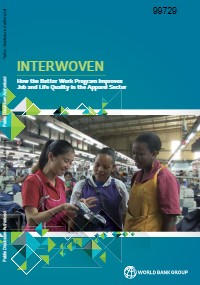
INTERWOVEN
How the Better Work Program Improves
Job and Life Quality in the Apparel Sector
9234-Gender Equality_1514333_CH00_FM.indd 1 9/23/15 4:00 PM
Public Disclosure Authorized
Public Disclosure Authorized
Public Disclosure Authorized
Public Disclosure Authorized
© 2015 International Bank for Reconstruction and Development / The World Bank
1818 H Street NW
Washington, D.C. 20433
Telephone: 202-473-1000
Internet: www.worldbank.org
This work is a product of the staff of The World Bank Group with external contributions. The findings, interpretations,
and conclusions expressed in this work do not necessarily reflect the views of The World Bank, its Board of Executive
Directors, or the governments they represent. The World Bank does not guarantee the accuracy of the data included in
this work. The boundaries, colors, denominations, and other information shown on any map in this work do not imply any
judgment on the part of The World Bank concerning the legal status of any territory or the endorsement or acceptance of
such boundaries. Nothing herein shall constitute or be considered to be a limitation upon or waiver of the privileges and
immunities of The World Bank, all of which are specifically reserved.
Rights and Permissions
The material in this work is subject to copyright. Because The World Bank encourages dissemination
of its knowledge, this work may be reproduced, in whole or in part, for noncommercial
purposes as long as full attribution to this work is given.
Any queries on rights and licenses, including subsidiary rights, should be addressed to World Bank
Publications, The World Bank Group, 1818 H Street NW, Washington, D.C. 20433, USA; fax:
202-522-2625; e-mail: pubrights@worldbank.org.
Design: Greg Wlosinski, The World Bank, General Services: Printing & Multimedia
Photo credits:
Cover photo: Manager checking quality of jeans with workers, Maseru, Lesotho. Photographer Jean-Pierre Pellissier
ES, pg. iii: Two workers in front of a factory, Maseru, Lesotho. Photographer Jean-Pierre Pellissier
Chapter 1, pg. 1: Worker looking across factory floor, Maseru, Lesotho. Photographer Jean-Pierre Pellissier
Chapter 2, pg. 9: Worker sewing a shirt, Bình Dương, Vietnam, Photographer Nguyen Nguyen Nhu Trang
Chapter 3, pg. 17: Worker working on jeans, Maseru, Lesotho. Photographer Jean-Pierre Pellissier
Chapter 4, pg. 31: Worker speaking with management, Bình Dương, Vietnam, Photographer Nguyen Nguyen Nhu Trang
Chapter 5, pg. 55: Workers leaving factory, Maseru, Lesotho. Photographer Jean-Pierre Pellissier
Chapter 6, pg. 71: Workers packing products, Vietnam. Bình Dương, Vietnam, Photographer Nguyen Nguyen Nhu Trang
Chapter 7, pg. 83: Worker inside a factory, Maseru, Lesotho. Photographer Jean-Pierre Pellissier
Chapter 8, pg. 91:
�Workers walking their children to factory kindergarten, Bình Dương, Vietnam, Photographer Nguyen
Nguyen Nhu Trang
9234-Gender Equality_1514333_CH00_FM.indd 2 9/23/15 4:00 PM
iii
Contents
About the Authors . . . . . . . . . . . . . . . . . . . . . . . . . . . . . . . . . . . . . . . . . . . . . . . . . . . . . . . . . . . . . . . . . . . v
Acknowledgements . . . . . . . . . . . . . . . . . . . . . . . . . . . . . . . . . . . . . . . . . . . . . . . . . . . . . . . . . . . . . . . . . . vii
Abbreviations . . . . . . . . . . . . . . . . . . . . . . . . . . . . . . . . . . . . . . . . . . . . . . . . . . . . . . . . . . . . . . . . . . . . . . . ix
Foreword . . . . . . . . . . . . . . . . . . . . . . . . . . . . . . . . . . . . . . . . . . . . . . . . . . . . . . . . . . . . . . . . . . . . . . . . . . . xi
Executive Summary . . . . . . . . . . . . . . . . . . . . . . . . . . . . . . . . . . . . . . . . . . . . . . . . . . . . . . . . . . . . . . . . . . xiii
The W
orld Needs More—and Better—Jobs . . . . . . . . . . . . . . . . . . . . . . . . . . . . . . . . . . . . . . . . .
xiii
How the Global Appar
el Value Chain Works
. . . . . . . . . . . . . . . . . . . . . . . . . . . . . . . . . . . . . . . . xiii
Bet
ter Work: Stakeholders Working Together to Improve Job Quality . . . . . . . . . . . . . . . . .
xv
W
orking Conditions Inside Factories: Safer, Healthier, and More Collegial
Work Environments
. . . . . . . . . . . . . . . . . . . . . . . . . . . . . . . . . . . . . . . . . . . . . . . . . . . . . . . . . . . . . xv
Be
yond Factory Walls: Workers Live Better Lives . . . . . . . . . . . . . . . . . . . . . . . . . . . . . . . . . . .
xvi
Mo
ving Forward . . . . . . . . . . . . . . . . . . . . . . . . . . . . . . . . . . . . . . . . . . . . . . . . . . . . . . . . . . . . . . . .
xvii
Chapter 1: Introduction . . . . . . . . . . . . . . . . . . . . . . . . . . . . . . . . . . . . . . . . . . . . . . . . . . . . . . . . . . . 1
Globalization and Job Quality . . . . . . . . . . . . . . . . . . . . . . . . . . . . . . . . . . . . . . . . . . . . . . . . . . . . 1
Back
ground of the Apparel Sector . . . . . . . . . . . . . . . . . . . . . . . . . . . . . . . . . . . . . . . . . . . . . . . .
2
Bet
ter Work: An Innovative Model for Addressing Poor Working Conditions
. . . . . . . . . . . . 4
Overvie
w of the Report Structure
. . . . . . . . . . . . . . . . . . . . . . . . . . . . . . . . . . . . . . . . . . . . . . . . . 7
Ref
erences
. . . . . . . . . . . . . . . . . . . . . . . . . . . . . . . . . . . . . . . . . . . . . . . . . . . . . . . . . . . . . . . . . . . . . 7
Chapter 2: Apparel Sector Workers . . . . . . . . . . . . . . . . . . . . . . . . . . . . . . . . . . . . . . . . . . . . . . 9
Who Are Garment Workers? . . . . . . . . . . . . . . . . . . . . . . . . . . . . . . . . . . . . . . . . . . . . . . . . . . . . . 10
Wh
y Are Most Garment and Textile Workers Women? . . . . . . . . . . . . . . . . . . . . . . . . . . . . . . .
11
Wha
t Does It Mean to Workers to Have “Job Quality”?
. . . . . . . . . . . . . . . . . . . . . . . . . . . . . . . 14
Ref
erences
. . . . . . . . . . . . . . . . . . . . . . . . . . . . . . . . . . . . . . . . . . . . . . . . . . . . . . . . . . . . . . . . . . . . . 16
Chapter 3: The Genesis and Evolution of Better Work . . . . . . . . . . . . . . . . . . . . . . . . . . . 17
Genesis of Better Work: The Cambodian Garment Industry and Better
Factories Cambodia . . . . . . . . . . . . . . . . . . . . . . . . . . . . . . . . . . . . . . . . . . . . . . . . . . . . . . . . . . . . . 18
Bet
ter Work Today
. . . . . . . . . . . . . . . . . . . . . . . . . . . . . . . . . . . . . . . . . . . . . . . . . . . . . . . . . . . . . . 22
Wh
y Better Work Works
. . . . . . . . . . . . . . . . . . . . . . . . . . . . . . . . . . . . . . . . . . . . . . . . . . . . . . . . . 26
R
eferences
. . . . . . . . . . . . . . . . . . . . . . . . . . . . . . . . . . . . . . . . . . . . . . . . . . . . . . . . . . . . . . . . . . . . . 29
Chapter 4: Improvements in Factory Working Conditions . . . . . . . . . . . . . . . . . . . . . . . 31
Initial Factory Working Conditions . . . . . . . . . . . . . . . . . . . . . . . . . . . . . . . . . . . . . . . . . . . . . . . . 32
Impac
ts of Better Work on Working Conditions inside Factories: Evidence from
Compliance Data . . . . . . . . . . . . . . . . . . . . . . . . . . . . . . . . . . . . . . . . . . . . . . . . . . . . . . . . . . . . . . .
35
T
he Better Factories Cambodia Program
. . . . . . . . . . . . . . . . . . . . . . . . . . . . . . . . . . . . . . . . . . . 38
Bey
ond Compliance
. . . . . . . . . . . . . . . . . . . . . . . . . . . . . . . . . . . . . . . . . . . . . . . . . . . . . . . . . . . . . 45
A C
omparison of Men’s and Women’s Feedback on Changes in Working Conditions
. . . . . 49
R
eferences
. . . . . . . . . . . . . . . . . . . . . . . . . . . . . . . . . . . . . . . . . . . . . . . . . . . . . . . . . . . . . . . . . . . . . 52
9234-Gender Equality_1514333_CH00_FM.indd 3 9/23/15 4:00 PM
iv
iv | Interwoven: How the Better Work Program Improves Job and Life Quality in the Apparel Sector
Chapter 5: Improvements in Workers’ Lives Outside Factories . . . . . . . . . . . . . . . . . .
55
Well-Being and Poverty Reduction . . . . . . . . . . . . . . . . . . . . . . . . . . . . . . . . . . . . . . . . . . . . . . . . 57
C
ommunication Skills and Family Lives . . . . . . . . . . . . . . . . . . . . . . . . . . . . . . . . . . . . . . . . . . . .
61
Decision on Childr
en’s Education . . . . . . . . . . . . . . . . . . . . . . . . . . . . . . . . . . . . . . . . . . . . . . . . .
61
Gender E
quality and Women’s Agency . . . . . . . . . . . . . . . . . . . . . . . . . . . . . . . . . . . . . . . . . . . .
63
R
eferences
. . . . . . . . . . . . . . . . . . . . . . . . . . . . . . . . . . . . . . . . . . . . . . . . . . . . . . . . . . . . . . . . . . . . . 68
Chapter 6: Improvements in Working Conditions and Firm and Industry
Performance . . . . . . . . . . . . . . . . . . . . . . . . . . . . . . . . . . . . . . . . . . . . . . . . . . . . . . . . . . . . . . . . . . . . . . 71
Working Conditions and Firm Performance . . . . . . . . . . . . . . . . . . . . . . . . . . . . . . . . . . . . . . . . 73
Human R
esource Management Policies and Firm Performance . . . . . . . . . . . . . . . . . . . . . . .
73
E
vidence from Better Work . . . . . . . . . . . . . . . . . . . . . . . . . . . . . . . . . . . . . . . . . . . . . . . . . . . . . .
76
R
eferences
. . . . . . . . . . . . . . . . . . . . . . . . . . . . . . . . . . . . . . . . . . . . . . . . . . . . . . . . . . . . . . . . . . . . . 81
Chapter 7: Expansion to Other Factories . . . . . . . . . . . . . . . . . . . . . . . . . . . . . . . . . . . . . . . . . 83
In Search of Spillover Effects . . . . . . . . . . . . . . . . . . . . . . . . . . . . . . . . . . . . . . . . . . . . . . . . . . . . . 84
Incen
tivizing Government Action . . . . . . . . . . . . . . . . . . . . . . . . . . . . . . . . . . . . . . . . . . . . . . . . .
84
Mandating v
ersus Voluntary Subscription
. . . . . . . . . . . . . . . . . . . . . . . . . . . . . . . . . . . . . . . . . . 85
Ref
erences
. . . . . . . . . . . . . . . . . . . . . . . . . . . . . . . . . . . . . . . . . . . . . . . . . . . . . . . . . . . . . . . . . . . . . 88
Chapter 8: Policy Implications of the Quest for Better Jobs . . . . . . . . . . . . . . . . . . . . . 91
Conclusions about the Better Work Program . . . . . . . . . . . . . . . . . . . . . . . . . . . . . . . . . . . . . . . 91
Rec
ommendations Moving Forward
. . . . . . . . . . . . . . . . . . . . . . . . . . . . . . . . . . . . . . . . . . . . . . . 93
Kno
wledge Gaps and Suggestions for Future Research
. . . . . . . . . . . . . . . . . . . . . . . . . . . . . . 97
R
eferences
. . . . . . . . . . . . . . . . . . . . . . . . . . . . . . . . . . . . . . . . . . . . . . . . . . . . . . . . . . . . . . . . . . . . . 98
Appendix A: Data Analy
sis Outputs . . . . . . . . . . . . . . . . . . . . . . . . . . . . . . . . . . . . . . . . . . . . . . . . . . . .
99
Appendix B: Organiza
tions and Initiatives Working to Improve Working Conditions . . . . . . . . . .
109
Appendix C: Methodology f
or Conducting Qualitative and Quantitative Data Gathering
. . . . . . . 113
Appendix D: List of Job Qualit
y Characteristics . . . . . . . . . . . . . . . . . . . . . . . . . . . . . . . . . . . . . . . . . .
119
Appendix E: Baseline S
ynthesis Report Profiles
. . . . . . . . . . . . . . . . . . . . . . . . . . . . . . . . . . . . . . . . . . 121
Appendix F: Applica
tion of SWIFT’s Survey-to-Survey Imputation Method to the Better
Work Program in Cambodia
. . . . . . . . . . . . . . . . . . . . . . . . . . . . . . . . . . . . . . . . . . . . . . . . . . . . . . . . . . . 123
Appendix G: Gra
vity Model
. . . . . . . . . . . . . . . . . . . . . . . . . . . . . . . . . . . . . . . . . . . . . . . . . . . . . . . . . . . . 127
9234-Gender Equality_1514333_CH00_FM.indd 4 9/23/15 4:00 PM
v
About the Authors
Aphichoke (Andy) Kotikula is a senior economist
in the Gender Cross Cutting Solution Area of the
World Bank Group, based in Washington, D.C.,
and has been in this position since 2013. He
holds a PhD and MA in economics from Johns
Hopkins University, and a bachelor’s degree in
economics from Chulalongkorn University. Previ-
ously, he was a poverty economist for the South
Asia region. Kotikula has worked on a range of
issues in the areas of gender equality and poverty
measurement.
Milad Pournik is a consultant for the Gender Cross
Cutting Solution Area of the World Bank Group.
Previously, he has consulted for Management
Systems International. He also served as research
associate with the Global Gender Program at
George Washington University. Milad has pub-
lished several papers including on women in peace
and security, women’s political leadership, and
CSOs supporting women. He received a master’s
degree in Global Policy from the LBJ School of
Public Affairs at University of Texas, Austin, and a
master’s in economics and international relations
from the University of St. Andrews in Scotland.
Raymond Robertson is the Roy and Helen Ryu
Professor of Economics and Government at the
Bush School of Government and Public Service,
Texas A&M University. His research focuses on
the union of international, labor, and develop-
ment economics. He has published in American
Economic Review, Review of Economics and
Statistics, Journal of International Economics,
Review of International Economics, Journal
of Development Economics, and others. He
serves on the advisory board at the Center for
Global Development and was a member of the
U.S. State Department’s Advisory Committee
on International Economic Policy (ACIEP). He
is currently the chair of the U.S. Department of
Labor’s National Advisory Committee on Labor
Provisions of Free Trade Agreement (NAC). His
current work focuses on the effects of the ILO’s
Better Work program in Cambodia and other
countries, as well as other issues relating to the
effects of globalization on workers. He received his
PhD from the University of Texas after spending
a year in Mexico as a Fulbright scholar.
9234-Gender Equality_1514333_CH00_FM.indd 5 9/23/15 4:00 PM
9234-Gender Equality_1514333_CH00_FM.indd 6 9/23/15 4:00 PM
vii
Acknowledgements
This report is the work of the World Bank Group’s
Gender Cross Cutting Solution Area. The task was
led by Aphichoke Kotikula (GCGDR) and Carlos
Sobrado (GPVDR). The report was prepared under
the guidance of Caren Grown (Senior Director,
Gender CCSA). The main contributors to the writ-
ing and analyses are Raymond Robertson (Texas
A&M University) and Milad Pournik (GCGDR).
The team is also grateful to several others—Elisa
Gamberoni (GTCDR), Javier Arias-Vazquez,
Tomoyuki Sho, Florencia Paz (GCGDR), Nguyen
Viet Cuong (National Economics University, Viet-
nam), Kelly Pike (York University), and Christian
Ferrada (Central Bank of Chile and University of
Chile)—for important contributions to specific
sections and analyses. Additional support and
comments were provided by Benedicte Leroy
De La Briere, Lucia Hanmer, Maria Soledad
Requejo, Jeffrey Daniel Eisenbraun, Amy Luin-
stra, Kevin Kolbin, Ros Harvey, and Sarah West.
We also thank Pisey Khin and Nguyen Nguyen
Nhu Trang (and their teams) for coordinating
surveys in Cambodia and Vietnam. The Better
Work country offices in Cambodia, Lesotho,
and Vietnam helped facilitate field research and
provided us with valuable contextual information.
We want to recognize in particular the support
of Esther Germans and Camilla Roman (BFC),
Kristina Kurths (BW Lesotho), Hong Ha Nguyen
and David Williams (BW Vietnam), and Dan Rees
(BW director).
The team acknowledges Gladys López-Acevedo
(SARCE), Thomas Farole (GCJDR), Kim Eliot
(CGD), and Arianna Rossi (ILO) for their work
in conducting peer reviews; and the World Bank
Group staff members and others for useful
review comments and input. Communications
coordination has been led by Sarah Jackson-Han
(GCGDR) and administrative support has been
provided by Ngozi Kalu-Mba and Mame Fatou
Niasse (GCGDR). Funding for this study was
provided by the World Bank-Netherland Partner-
ship Program (BNPP).
9234-Gender Equality_1514333_CH00_FM.indd 7 9/23/15 4:00 PM
9234-Gender Equality_1514333_CH00_FM.indd 8 9/23/15 4:00 PM
ix
Abbreviations
AGOA African Growth and Opportunity
Act
BFC Better Factories Cambodia
BSR Business for Social Responsibility (HERproject)
BTTA
Bilateral Textile Trade Agreement
BW Better Work
CCC Clean Clothes Campaign
CP compliance point
CPI consumer price index
CSR corporate social responsibility
CSES Cambodia Socio-Economic Survey
DOL (U.S.) Department of Labor
DPF Development Policy Financing
EA enterprise advisor
EICC Electronic Industry Citizenship Coalition
EPZ
Export Processing Zone
ETI Ethical Trading Initiative
FACB freedom of association and collective bargaining
FDI
foreign direct investment
FGD focus group discussion
FLA Fair Labor Association
FT
A
free trade agreement
FWF Fair Wear Foundation
GAP Global Action Program on Child Labor Issues
GA
TT
General Agreement on Tariffs
and Trade
GDP gross domestic product
GMAC Garment Manufacturers’ Association of Cambodia
GSCP
Global Social Compliance Programme
GTSF
Global Trade Supplier Finance
IFC International Finance Corporation
IFI International Financial Institution
ILO International Labour Organization
IMS Information Management System
HRM human resource management
LNDC Lesotho National Development Corporation
MCC
Millennium Challenge Corporation
MFA Multi-Fibre Arrangement
MI multiple-imputation
MOLISA Ministry of Labour—Invalids and Social Affairs (V
ietnam)
MNC multinational corporation
NGO nongovernmental organization
OSH occupational safety and health
PA
C
project advisory committee
PICC Performance Improvement Consultative Committee
PPE
personal protective equipment
PPP public-private partnership
R&D research and development
SHRM strategic human resource management
SWIFT
Survey of Well-being via Instant and
Frequent Tracking
TFP total-factor productivity
TTWU Tailors and Textile Workers Union
TUBWME Tufts University Better Work
Monitoring and Evaluation
UN United Nations
VCCI Vietnam Chamber of Commerce and Industries
V
GCL
Vietnam General Confederation of Labour
WDR
World Development Report
WRAP Worldwide Responsible Accredited
Production
WTO World Trade Organization
9234-Gender Equality_1514333_CH00_FM.indd 9 9/23/15 4:00 PM
9234-Gender Equality_1514333_CH00_FM.indd 10 9/23/15 4:00 PM
xi
Our 2013 World Development Report shed new
light on the transformational role of jobs in rais-
ing living standards, boosting productivity, and
promoting social cohesion. Jobs, it argued, are
thus “what we earn, what we do, and even who
we are.” At this juncture, the world faces a jobs
crisis. More than a billion people of working
age—mostly women—are absent from the labor
force, while another 200 million are unemployed,
most of them young. Some 600 million new jobs
are needed by 2030 simply to keep employment
rates constant. But as the 2013 WDR made clear,
not every job helps lift people out of poverty,
improves wellbeing, and benefits the broader
community. Not every job raises aspirations along
with living standards, spurring meaningful invest-
ment in the next generation. Yet what the world
needs most is “good jobs,” defined by a worker
in this study as “a job that makes me want to go
to work every morning when I wake up.”
Creating more good jobs for millions of pre-
dominantly female garment workers in develop-
ing countries is the mission of Better Work, an
IFC-ILO-industry partnership launched in 2001.
While the garment industry often provides a vital
first step out of poverty—and an alternative to
low-skilled agriculture and service work—it has
long been associated with low wages, long hours,
discrimination, abuse, and a variety of conditions
that put workers’ health and safety at risk. Better
Work trains local monitors to make unannounced
inspections and bring factories into compliance
with national laws and international standards
through auditing and advisory and training ser-
vices. As of 2014, according to Better Work, the
program had helped improve working conditions
for more than 1 million workers in more than
1,000 factories across eight countries.
This study set out to understand how exactly
such improvements occur, whether better working
conditions help empower female garment workers
in factories and beyond, and whether and how
improved conditions affect profits. Its findings
are encouraging. Qualitative and quantitative
study shows a correlation between better working
conditions and improved performance, reduced
turnover, and a more robust bottom line. For
example, Nalt Enterprise, a Better Work factory
in Vietnam, estimates that it takes up to three
months for a new textile worker to reach full
productivity—and that a 10 percent reduction
in staff turnover would save 8.5 percent of total
annual wage costs. Workers also reported a sig-
nificant spillover outside factory walls: Trained in
communication, nondiscrimination, and dispute
resolution at work, they were better at managing
stress and overcoming traditional gender biases
at home—with spouses reporting that they now
shared not just household chores and responsibili-
ties but planning and decision-making as well.
Creating more good jobs and tackling persis-
tent gender gaps are development imperatives if
we are to achieve our overarching goals: ending
extreme poverty and boosting shared growth. A
progressive, efficient tax system benefits no one
without jobs to produce revenue and growth, just
as public services and state-of-the-art infrastruc-
ture fall short if they are accessible and useful to
only half the population. This report highlights
important links between better work and better
lives for women and men, and better, more inclu-
sive and sustainable growth. We hope and expect
it will spur further study and informed action.
Nigel Twose, Senior Director, Jobs
Caren Grown, Senior Director, Gender
Foreword
9234-Gender Equality_1514333_CH00_FM.indd 11 9/23/15 4:00 PM
9234-Gender Equality_1514333_CH00_FM.indd 12 9/23/15 4:00 PM
xiii
Executive Summary
The World Needs More—and
Better—Jobs
One of the first steps that many countries have
taken in the past hundred years to begin their
development process is to produce apparel. The
apparel sector is labor-intensive, which makes it
an appealing industry for many countries as they
seek to create jobs for their citizens. At the same
time, this is a global industry, and buyers have
become increasingly concerned about the working
conditions of apparel workers. The sector has a
reputation for low quality jobs. Low wages, long
hours, high temperatures, excessive noise, poor
air quality, unsanitary environments, and abuse
(both verbal and physical) often characterize
working conditions in apparel factories in many
developing countries.
Despite these risks, the apparel sector has an
unusually high development potential because
apparel workers tend to be women whose alter-
native options for employment are likely to be
in the low-skilled agriculture and service sectors.
Working in apparel can provide women with
greater economic opportunities that enhance their
agency. Therefore, for millions of poor unskilled
workers, jobs in apparel manufacturing can be a
first step toward escaping poverty. The challenge
is to improve job quality in the apparel sector
and thereby increase the chances that these jobs
will both advance gender equality and reduce
poverty. Drawing on a wide literature and some
field studies conducted by our research team,
we seek to answer three questions: (1) How
can working conditions in the apparel sector be
improved? (2) Do improvements in job quality
affect gender inequality, improve worker welfare,
and help alleviate poverty? and (3) Do improve-
ments in job quality boost firm performance?
How the Global Apparel Value
Chain Works
The current structure of the global apparel trade
involves many stakeholders (see Figure ES.1),
all of whom have some stake in both improving
9234-Gender Equality_1514333_CH00_FM.indd 13 9/23/15 4:00 PM
xiv | Interwoven: How the Better Work Program Improves Job and Life Quality in the Apparel Sector
working conditions in factories and improving
the performance of factories.
• Buyers design products and bring them to
markets. Maximizing profits is their priority criterion when choosing suppliers to produce their products. However, they also consider many other factors such as reliability, timeli- ness, and quality of products. In addition, buyers also have an incentive to improve working conditions in developing countries when they face reputation risk.
•
Factory management or producers in
developing countries may resist improving
working conditions due to concerns about costs. If, however, such improvements lead to an increase in workers’ productivity, management may consider making the necessary changes. If the value of worker productivity increases more than the cost of the investment aimed at improving working conditions, then improving working condi- tions can increase factory profits.
•
Workers have a clear stake in improving
working conditions—both improvements in ambient conditions, such as temperature, air quality, and so on, and in workplace
Buyers
Workers Factories
• Reliable sourcing • Reputation
Cost efective audits•
• Working conditions
• Jobs and income
• Gender equality
• Competitiveness
• Jobs
• Enforcement capacity
• Access to markets
• HR management
• Productivity gain
Government
Figure ES.1: All stakeholders in the apparel value chain stand to gain from Better Work (BW)
How Workers Describe Job Quality
Defining job quality is important but difficult because jobs have many different char-
acteristics like pay and working conditions. This study aims to understand how work-
ers themselves see the key characteristics that shape job quality. Our field research in
four countries (Cambodia, Kenya, Lesotho, and Vietnam) finds that job quality means
largely the same thing. Certain economic characteristics such as good pay and benefits
are prominent in workers’ minds, but so too are social dimensions such as respectful
relations with managers and supervisors and work-life balance (facilitated by having
reasonable work hours).
9234-Gender Equality_1514333_CH00_FM.indd 14 9/23/15 4:00 PM
Executive Summary | xv
communication. Better working conditions
improve workers’ quality of life and may
also increase their productivity and learning.
•
Governments and the international commu-
nity have an incentive to improve working conditions. Aside from the concern that governments might have for their working population, governments also benefit by attracting foreign investment and boosting exports.
Better Work: Stakeholders Working
Together to Improve Job Quality
In the past, people have tried to address concerns
about working conditions in a confrontational
way by pitting producers against workers or pit-
ting buyers against governments. In this regard,
one of the innovations of the Better Work (BW)
Program is to find common ground where all of
the stakeholders can build upon their common
values and goals in order to improve working
conditions.
The Better Work Program has its roots in
the Better Factories Cambodia (BFC) program,
established in 2001 as a follow-on from the 1999
U.S.-Cambodia Bilateral Trade Agreement. The
free trade agreement (FTA) was the first to link
improved labor conditions with greater market
access. The BFC program benefitted all the key
stakeholders by improving work conditions,
supporting the growth of the apparel sector in
Cambodia (benefitting all local stakeholders),
and boosting developed world buyers’ reputa-
tion by sourcing from ethical workplaces. BFC
has also helped to cushion the negative effects
of external changes to the trading environment
in the apparel sector (the end of the Multi-Fibre
Arrangement quota system in 2005 and the global
financial crisis in 2008–09). The program has
grown substantially; as of December 2014, BW
has reached over a million workers in more than
1,000 factories across eight countries (Bangladesh,
Cambodia, Haiti, Indonesia, Jordan, Lesotho,
Nicaragua, and Vietnam).
How the Better Work Program Works
The very first step of the Better Work program
when it starts working with an apparel factory is
the assessment stage. The Better Work program
trains local monitors to go into the factories on
unannounced visits and assess working conditions.
One of the goals of the Better Work Program is
to bring the factories into compliance, not only
with national laws, but also with international
labor standards. BW is unique because its model
not only entails auditing, but also advisory and
training services. While different training modules
are offered across different BW countries, they
all aim to build the capacity of key stakehold-
ers to improve working conditions and factory
productivity.
Starting in 2015, BW is piloting a new operating
model by offering advisory and training services
prior to carrying out assessments. This change
seeks to foster engagement with factories first
and to help them initiate reforms prior to the
formal assessment process. It also should help
to feature BW’s advisory and training services
more prominently and ensure that BW is known
as more than simply an auditing exercise.
Working Conditions Inside
Factories: Safer, Healthier, and More
Collegial Work Environments
Factories in BW programs have seen improvement
in working conditions. Over time, BW factories
exhibit improved compliance with key national
and international standards. These standards
include safety, fire prevention, protective gears,
accurate compensation, discrimination, and
so forth. Workers themselves also report that
factories are safer. In a follow-up survey after
the introduction of the BW Program in Lesotho,
workers reported occupational health and safety
(OSH) as the area with the most improvement
and attributed such an improvement to changes
in workers’ awareness and factory policies. In
addition, improved working conditions benefit
male and female workers equally.
The BW Program promotes behavioral change
of workers and factory management through
training and advisory services. The BW advisory
services help to create Performance Improvement
Consultative Committees (PICCs) in factories.
Data from Cambodia, Lesotho, and Vietnam
suggest that the creation of PICCs is particularly
valuable (see box entitled “New Tool” below). In
terms of training, the workers and managers we
surveyed often expressed how they were able to
use the knowledge gained through BW training
9234-Gender Equality_1514333_CH00_FM.indd 15 9/23/15 4:00 PM
xvi | Interwoven: How the Better Work Program Improves Job and Life Quality in the Apparel Sector
to create safer, healthier, and more collaborative
work environments.
But Will These Improvements in
Working Conditions Last?
Research in Cambodia suggests that such improve-
ments are sustainable. A more detailed look into
the data shows that (1) once investments are
made to improve work conditions they are rarely
reversed; (2) reputation-sensitive buyers make a
difference as reflected by the fact that the factories
they source from tend to be in greater compliance
with national and international labor standards;
and (3) important limitations still exist and the
BW program has not proven to be a panacea for
all of the garment sector’s problems.
Firms Are More Productive
Apparel factories may be hesitant to improve
working conditions due to the initial investment
required. However, research from this study has
shown that improvements in working conditions
can actually contribute to factory performance.
As communication improves, workers and the
management are better able to resolve disputes
and therefore improve the performance of the
factories. Profits, productivity, and survival all
tend to move in a positive direction when work-
ing conditions improve as staff turnover and
absenteeism decrease. In Vietnam, Better Work
factories, which pay higher wages and invested
in improving working conditions and complying
with labor standards, have comparable profits to
non-BW factories.
The benefits of involvement with the Better
Work program extend beyond the factory level
to the country level. In this regard, the impacts on
the economies of apparel-producing countries can
be substantial. Comparing export data across the
world, participating in the Better Work program
is associated with significant increases in apparel
exports—both to the world generally and to the
United States in particular. This relationship holds
true after controlling for relevant factors that may
affect apparel trade.
Beyond Factory Walls: Workers Live
Better Lives
For workers, the benefits of working in the apparel
sector in general and to participate in the BW
New Tool: Performance Improvement Consultative Committees (PICCs)
One of the innovations of the BW Program has been the formulation of Performance
Improvement Consultative Committees (PICC). PICCs are groups made up of an equal
number of both management and union/worker representatives who meet regularly to
help resolve disputes within the factory and also try and improve performance of the
factory in a collaborative way. In Lesotho, workers can raise their specific health and
safety concerns through PICCs, which are heard by union and non-union worker repre-
sentatives, management representatives, and an enterprise adviser from Better Work.
Success of PICCs:
•
The PICCs proved to be useful avenues in which to bring up problems, and to resolve
them more effectively than previous mechanisms.
•
The PICCs not only helped improve industrial relations, but also helped to strengthen trade unions overall.
• In the case of Vietnam, the success of the PICC model was such that it compelled the government to introduce a new labor code that obligated employers to conduct social dialogue in the workplace.
9234-Gender Equality_1514333_CH00_FM.indd 16 9/23/15 4:00 PM
Executive Summary | xvii
Program in particular, extend beyond factory
walls. Participants are gaining lessons from the
Better Work experience and training. And they are
taking those lessons back home, improving the
lives of their families as well. In Lesotho, workers
often attributed BW training in financial literacy
to improving their lives. Workers from Cambodia,
Vietnam, and Lesotho reported that improved
communication at home and decreased stress
levels at work have contributed to their higher
level of satisfaction with their family lives. Better
communication in the households also enables
families to make better decisions. In Cambodia,
children whose mothers work in the apparel sec-
tor are more likely to attend school.
Implications for Gender Equality
Apparel jobs can help women gain more equality.
Working in urban areas, in the formal sector, and
in fast-paced and demanding work in garment
industries can act as an agent of change in breaking
old norms, such as the norm of women bearing
the burden of household chores. In Vietnam and
Cambodia—men and women alike—mention
that the division of labor at home is equal. These
norms have evolved; workers acknowledge that
the equal arrangement they are experiencing now
is different from their parents’ generation. Another
measurement of gender equality is women’s
agency in household decision-making, whether
women take part in household decision-making
or whether major decisions in the households
are made jointly. In Cambodia, most married
workers report that they make major decisions
(such as about children’s schooling and finances)
with their spouses. Interestingly, the longer they
work in the apparel industry, the more likely they
are to share joint decision-making power within
their households.
While working in the apparel sector can help
women exercise greater agency, programs such as
BW also have a role to play in promoting greater
gender equality. In this regard, communication
skills learned through BW training can be key in
changing parochial norms. Equipped with com-
munication skills, women in the apparel sector
negotiate new roles inside their home and in society.
In most cases, quantitative results (in Cam-
bodia) and qualitative findings (in Cambodia,
Lesotho, and Vietnam) confirm that women and
men receive equal pay for equal work. In this
regard, the use of productivity targets and piece-
rate remunerations may help explain the wage
equality. Data from Cambodia also suggest that
women earn more, but accumulate less wealth.
In Cambodia, on average, women earn more
than men; this difference can be explained in
part by the fact that women tend to work longer
hours than men (56 versus 54 hours per week).
However, female workers do not appear to own
more assets. This may be explained by the fact
that female workers often mention using extra
money to support relatives or children’s education.
Moving Forward
The BW program is not without flaws. How-
ever, it is a step forward and it has contributed
significantly to improve working conditions in
BW factories. It provides a quadruple win: to
workers in terms of working conditions and
overall welfare, to factory management in terms
of factory performance, to countries in terms
of increased exports, and to buyers, in terms of
reputational gains.
How can workers in other parts of the world
experience better job quality? The issues raised
by workers in other countries, such as Kenya,
are concerns that a program such as BW is well
equipped to address. In addition, improvements
in working conditions may spread to other
factories, either endogenously (on their own) or
exogenously (being mandated or incentivized
from other actors).
How Can Programs Such as BW Be
Expanded?
One might wonder why factories have not imple-
mented such human resource management (HRM)
techniques on their own, if there are so many
benefits to factories’ productivity. Evidence of
spillover effects—that factories will learn from
other factories about HRM due to incentives
related to improve productivity—has been mixed.
Instead, active and creative policies are needed
to scale up the scope of BW programs. Evidence
has shown that incentives to governments of
apparel-exporting countries can improve work-
ing conditions in textile and garment factories.
A prime example is the creation of the Better
9234-Gender Equality_1514333_CH00_FM.indd 17 9/23/15 4:00 PM
xviii | Interwoven: How the Better Work Program Improves Job and Life Quality in the Apparel Sector
Factories Cambodia Program. Finally, in order to
ensure the sustainability of BW programs, local
stakeholders need to gradually take ownership
of program implementation.
How Can Programs Such as BW Be
Improved?
While Better Work is not a panacea for all of the
problems in developing countries or the apparel
sector in particular, several lessons can be learned
from the program’s experience.
•
First, the relationship between workers and
management is a crucial aspect of working conditions and improving this relationship is not costly to implement. Across the sample of workers surveyed for this study, workers universally valued having a “good relation- ship with management.” Improving the rela- tionship between workers and management therefore represents a cost-effective way to improve job quality and motivate workers. In particular, training courses for managers can be designed with experience from countries that have been exposed to foreign direct investment (FDI) for some time. This can help prevent entrenched animosity between foreign managers and local workers, which can be difficult to remedy at a later stage. Mechanisms designed to promote healthy worker-management relations, such as the PICCs established by BW, have proven to be effective and can be used as a model for future programming.
•
Second, one of the key findings from the
mechanism design literature is that trans- parency tends to improve behavior. This not only encourages the employer and potential clients to address key areas in which they are failing their workers, but also empow- ers workers in that they can see that their concerns are being heard.
•
Third, actively involving workers at all
stages of the program cycle (development, implementation, and monitoring) is critical.
As they are on the frontlines, their concep- tions of job quality should ultimately be driving program aims. Data reviewed in our study finds that workers consistently cite occupational safety and health (OSH) as a significant area of concern. Although programs such as BW have contributed to making improvements in this area, more work remains to be done to ensure that basic health and safety standards are achieved for workers. Clearly, changes in working condi- tions, especially with respect to safety and health, cannot come from efforts by factory management alone. It also needs cooperation from workers to change their behaviors. In this regard, advisory and training services can help to shift the mindset away from “com- pliance for audits” to “self-improvement.”
•
Fourth, the benefits of certain program
features may extend beyond improving job quality to positively impacting workers’ quality of life. Thus, future programming needs to carefully consider the needs of workers beyond their immediate workplaces. In this way, programs can expand their reach and tailor the content of training modules to help improve workplace productivity and enable workers to live healthier, happier, and more fulfilling personal lives. Stakeholders can also capitalize on life skills training to advance social change, particularly con- cerning gender equality. Our primary data revealed a particular area of concern that future efforts would do well to address: the lack of access to finance for apparel workers. Financial products need to be adapted to better meet the specific needs and circum- stances of apparel workers.
•
Fifth, convincing employers that improving
job quality benefits their bottom lines as much as it does their reputations is critical. While this evidence exists to some extent, further business-related research demonstrat- ing the positive effects that improved HR policies can have on productivity would be
9234-Gender Equality_1514333_CH00_FM.indd 18 9/24/15 2:40 PM
Executive Summary | xix
of great value. In this regard, collecting bet-
ter data for monitoring working conditions
should be a priority.
•
Finally, in the case of the BW Program, pro-
active efforts are needed to expand its reach. Specifically, programs may need to publicize key success stories and come up with cre- ative incentives to increase participation. Two possible avenues for promoting better job quality are: (1) to link improvements in working conditions with trade agreements
and (2) to leverage development finance in support of initiatives to improve working conditions. Although the BW program is focused on the apparel sector, our findings suggest that many other labor-intensive manufacturing sectors can also benefit from similar interventions. In any program seeking to improve job quality, program sustainability needs to be carefully planned to ensure sustained success in achieving program goals.
9234-Gender Equality_1514333_CH00_FM.indd 19 9/23/15 4:00 PM
9234-Gender Equality_1514333_CH00_FM.indd 20 9/23/15 4:00 PM
[... middle sections omitted for long document ...]
124 | Interwoven: How the Better Work Program Improves Job and Life Quality in the Apparel Sector
Robustness of the Model
Because the sample size in the CSES 2012 data is quite
limited for urban Phnom Penh households with at least
one textile worker, it was decided to compare the model
with two different models and compare their projection
performances subsequently.
5
Those three models are:
(1) urban Phnom Penh households with at least one
textile worker; (2) urban households with at least one
textile worker; and (3) urban households. For the third
model, the strategy was to develop the consumption
model using all urban households but apply the selected
model only to urban Phnom Penh households with at
least one textile worker. The performances of the three
models were then tested by comparing the predicted
and observed poverty rates, as discussed below.
To further test the robustness of the urban Phnom
Penh model, two additional checks were also conducted.
First, to test the stability of the model, the car owner-
ship variable was dropped out of the model, and the
coefficients of the remaining variables were compared
with those in the original model. This was done because
there had been a concern that the car ownership variable
may have picked up a disproportionately large effect
from a small number of households with very high
consumption per capita. Even after dropping the car
ownership variable, the coefficients of other variables
were quite stable.
Second, a test for overfitting was undertaken because
the performance of the selected model outside the
sample may be vulnerable to overfitting problems,
when the sample size used for developing the model is
5
Textile worker is defined as those who work in the Textiles and Apparel
Industry (Q15/C06b, >1200 & <1500) as an employee (Q15/C08, =1) and
aged between 15 and 64. For details, also see the KH_ DescTextileWorkers
Draft1Revised_150213.docx and KH_DescTextileWorkersDraft2Revised_
150213. docx files.
Table F.1: Model for Urban Phnom Penh Households with at Least One Textile Worker
Dependent variable: Log of per capita household consumption
Variable description Coefficient Std. Err. t |Prob|>t
Own asset: car (1/0) 0.48809 0.18115 2.69 0.01
Own asset: motorcycle (1/0) 0.19667 0.04570 4.30 0.00
Own asset: television (1/0) 0.24672 0.09835 2.51 0.01
Own asset: washing machine (1/0) 0.42655 0.05659 7.54 0.00
Floor: earth, clay –0.11375 0.05079 –2.24 0.03
Household size –0.08253 0.00791 –10.43 0.00
Lighting: publicly provided electricity 0.11272 0.04545 2.48 0.01
Ratio of children below 15 in household –0.30950 0.10230 –3.03 0.00
Wall: concrete, brick, stone 0.17080 0.04382 3.90 0.00
Constant 9.17196 0.08372 109.55 0.00
Adj. R–squared: 0.5860
Source: CSES 2012 data.
Table F.2: Sample Size and Observed
Poverty Rate
Model
Sample
size (N)
Observed
poverty
rate
Urban Phnom Penh
households with at least
one textile worker
157 8.3
Urban households with
at least one textile
worker
204 8.5
Urban households model
applied to:
Urban households with
at least one textile
worker
1436/157 8.5
Source: CSES 2012 data.
9234-Gender Equality_1514333_CHBM.indd 124 9/3/15 2:14 PM
Appendix F: Application of SWIFT’s Survey-to-Survey Imputation Method | 125
very small. The results of 10-fold cross-validation sug-
gested, however, that the exactly same set of variables
would have been chosen when had the model with the
smallest root mean square error (RMSE) been selected.
6
This result demonstrates that the urban Phnom Penh
model is free from overfitting issues as well.
Model Performance
To test their poverty prediction performances, the
estimated model parameters were first applied back
to the CSES 2012 data (with consumption data
converted into missing). For the urban Phnom Penh
household with textile workers model, the difference
between the predicted and observed rates is about one
percentage point.
6
The selected model was checked for the potential problem of over- or
under-fitting by applying the k-fold cross-validation method. See by way of
comparison, Garth et al. 2013.
Table F.3: Model for Urban Phnom Penh Households with at Least One Textile
Worker, Including and Excluding the Car Ownership Variable
Dependent variable: Log of per capita household consumption
Own asset: car included Own asset: car excluded
Variable
description Coefficient Std. Err. t |Prob|>t Coefficient Std. Err. t |Prob|>t
Own asset: car
(1/0)
0.48809 0.18115 2.69 0.01 Dropped
Own asset:
motorcycle
(1/0)
0.19667 0.04570 4.30 0.00 0.20735 0.04575 4.53 0.00
Own asset:
television (1/0)
0.24672 0.09835 2.51 0.01 0.25770 0.10044 2.57 0.01
Own asset:
washing
machine (1/0)
0.42655 0.05659 7.54 0.00 0.48008 0.07614 6.31 0.00
Floor: earth,
clay
–0.11375 0.05079 –2.24 0.03 –0.11750 0.05515 –2.13 0.04
Household size –0.08253 0.00791 –10.43 0.00 –0.08107 0.00774 –10.47 0.00
Lighting:
publicly
provided
electricity
0.11272 0.04545 2.48 0.01 0.10936 0.04781 2.29 0.02
Ratio of
children below
15 in household
–0.30950 0.10230 –3.03 0.00 –0.28915 0.11216 –2.58 0.01
Wall: concrete,
brick, stone
0.17080 0.04382 3.90 0.00 0.18814 0.04915 3.83 0.00
Constant 9.17196 0.08372 109.55 0.00 9.14938 0.08934 102.41 0.00
Adj. R–
squared:
0.5860 0.5407
Source: CSES 2012 data.
Table F.4: Predicted and Observed
2012/13 Poverty Rates
Model Predicted Observed
Urban Phnom Penh
households with at
least one textile worker
9.5 8.3
Source: CSES 2012 data.
9234-Gender Equality_1514333_CHBM.indd 125 9/3/15 2:14 PM
126 | Interwoven: How the Better Work Program Improves Job and Life Quality in the Apparel Sector
Next, to predict the poverty incidence of the
households to which the garment workers surveyed-
respondents belong, the estimated urban Phnom Penh
model parameters were applied to the garment workers
data. The predicted poverty rate becomes 4.8 percent
for the sample of the garment workers survey data.
Caveat
A key assumption that must hold is that the typical
household consumption behavior identified by the
selected model has not changed substantially between
the CSES 2012 survey and the garment workers 2015
survey. One potential issue is that the concept of
household in the garment workers survey is not the
same as that in the CSES survey, as the CSES 2012 data
indicate that no room-sharing workers are counted as a
household. In fact, the summary statistics of the selected
model show unusual patterns.
7
While the percentage
of asset ownership is consistently lower in the garment
worker survey than in 2012 CSES for all items, housing
characteristics such as floor materials, wall materials,
and lighting sources all indicate improvement. Fur-
thermore, the household size and the children ratio are
substantially lower in the garment worker survey than
in 2012 CSES. All these results would rather suggest
that the garment workers data were collected using a
sample frame different from the CSES 2012 surveys.
In any case, it must be careful when making any
generalization beyond the given sample, as the garment
workers survey is not based upon a probability-based
sampling.
References
CSES (Cambodia Socio-Economic Survey). 2012. Phnom
Penh: National Institute of Statistics—Ministry of
Planning.
James, Gareth, Daniela Witten, Trevor Hastie, and Rob-
ert Tibshirani. 2013. An Introduction to Statistical
Learning, with Application in R. New York: Springer.
Rubin, Donald B. 1987. Multiple Imputation for
Nonresponse in Surveys. New York: John Wiley.
7
Mean is a household-weighted mean.
Table F.5: Predicted 2015 Poverty Rates
Model
Predicted
(2015)
Observed
(2012/13)
Urban Phnom Penh
households with at least
one textile worker
4.8 8.3
Source: CSES 2012 data and garment workers survey 2015.
Table F.6: Summary Statistics for the Model for Urban Phnom Penh Households with
at Least One Textile Worker
CSES 2012 (2012/13) Garment workers (2015)
Label Obs Mean Min Max Obs Mean Min Max
Own asset: car (1/0) 157 0.02663 0 1 565 0.01239 0 1
Own asset: motorcycle (1/0) 157 0.87449 0 1 565 0.36637 0 1
Own asset: television (1/0) 157 0.94645 0 1 565 0.45310 0 1
Own asset: washing machine (1/0) 157 0.03558 0 1 565 0.01239 0 1
Floor: earth, clay 157 0.02155 0 1 565 0.00531 0 1
Household size 157 4.85086 1 14 565 3.38407 1 10
Lighting: publicly provided electricity 157 0.98230 0 1 565 1.00000 1 1
Ratio of children below 15 in
household
157 0.18172 0 0.67 565 0.06024 0 1
Wall: concrete, brick, stone 157 0.37717 0 1 565 0.92743 0 1
Source: CSES 2012 data.
9234-Gender Equality_1514333_CHBM.indd 126 9/3/15 2:14 PM
127
Appendix G: Gravity Model
The gravity model is now considered to be an impor-
tant part of the empirical analysis of trade flows. The
basic idea behind the gravity model is that trade flows
between country pairs can largely be explained by the
size of, and the distance between, the two countries.
The gravity model’s empirical relevance became under-
stood in the 1970s and was followed by theoretical
foundations (see Anderson 2011 for a review of the
theoretical development of the gravity model).
The gravity model has been applied to many impor-
tant questions in international economics, including the
analysis of trade policies. Rose (2004) used the gravity
model to make the controversial suggestion that the
WTO did not increase trade flows among members.
Subsequent research by Subramanian and Wei (2007)
and Baier and Bergstrand (2007) and others built on
Anderson and van Wincoop (2003) to revise the gravity
methodology to show how trade agreements contribute
substantially to trade flows. Readers interested in fur-
ther details about the gravity model are referred to the
references below, and especially Bergstrand and Egger
(2009) who review some of the more recent contribu-
tions to the gravity model literature.
The gravity model applied in this paper is a very
simplified version of the gravity model that appears
in at least hundreds of papers in the literature. The
first main simplification is that the data focus on both
global pair-wise trade flows and just U.S. imports. The
second is that the data focus on apparel rather than
total trade flows. The third main simplification is that
the data use dummy variables to capture the effect of
the Better Work program, as explained in the text.
The primitive gravity model equation we use is as
follows.
trade
ijt
= b
0
+ b
1
dist
ij
+ b
2
GDP
it
+ b
3
GDP
jt
+ BX
ijt
+ e
ijt
Trade is the bilateral (apparel) trade between coun-
tries i and j. The variable dist represents the distance
between countries i and j. The GDP terms represent
the gross domestic product of each country. The
variable X includes a range of other variables, which
may include country controls, multilateral resistance
controls (Anderson and van Wincoop 2003), shared
border, language, being landlocked, and so on. In our
exercise, we also add variables to capture the exporter’s
production characteristics (such as the amount of
imported inputs).
References
Anderson, James E. 2011. “The Gravity Model,” Annual
Review of Economics, Annual Reviews, vol. 3(1),
pages 133–160.
Anderson, James, and van Wincoop, Eric. 2003.
“Gravity with Gravitas: A Solution to the Border
Puzzle,” American Economic Review, Vol. 93, No. 1,
pp. 170–92.
Baier, Scott L. and Jeffrey H. Bergstrand. 2007. “Do
free trade agreements actually increase members’
international trade?” Journal of International Eco-
nomics, 71(1), 72–95.
Bergstrand, Jeffrey H. and Egger, Peter. 2009. “Grav-
ity Equations and Economic Frictions in the World
Economy,” in Daniel Bernhofen, Rodney Falvey,
David Greenaway and Udo Krieckemeier, eds.,
Palgrave Handbook of International Trade, Palgrave
Macmillan Press.
Rose, Andrew K. 2004. “Do We Really Know That
The WTO Increases Trade?,” American Economic
Review, v94(1, Mar.), 98–114.
Subramanian, Arvind and Wei, Shang-Jin. 2007. “The
WTO promotes trade, strongly but unevenly,” Jour-
nal of International Economics, Elsevier, vol. 72(1),
pages 151–175, May.
9234-Gender Equality_1514333_CHBM.indd 127 9/3/15 2:14 PM
9234-Gender Equality_1514333_CHBM.indd 128 9/3/15 2:14 PM