Teks Konple Dokiman an
Teks ki soti nan dokiman orijinal la pou endeksasyon.
Home ▶ Research & Analysis
KEY TAKEAWAYS
Haiti’s gangs are evolving into transnational criminal organizations, threatening U.S. and
regional security.
For Haiti to move beyond its crises, its gang problem must be addressed first.
The U.S. should lead a coordinated regional effort to choke off the resources sustaining
gang power.
Thursday, March 13, 2025/ READ TIME: 9 minutes
BY: Kirk Randolph; Nicolás Devia-Valbuena; Louiceus Ozias
Search
Share This Print the Page
How to BreakHow to Break
Gangs’ Grip onGangs’ Grip on
HaitiHaiti
Since the assassination of President Jovenel Moïse in 2021, Haiti has spiraled into
chaos, with gangs tightening their grip on nearly every aspect of daily life. Once a
fragile but functioning state, the country now finds its capital, Port-au-Prince, almost
entirely controlled by gangs — and their influence is spreading. A new U.N. report
warns that the situation is more dire than ever, as armed groups extend their control
into new territories, displacing communities and deepening the country’s
humanitarian crisis. As of January over one million people are displaced, the majority
of them children, major roads are impassable, and “5.4 million Haitians – nearly half
the population – do not have enough to eat.”
Meanwhile, Haiti’s police force is underfunded and overwhelmed, with limited ability
to enforce the law, leaving citizens with nowhere to turn. With little to no faith in the
police or judiciary, Haitians have turned to a desperate response. Under the banner of
the Bwa Kale movement, citizens have resorted to resorted to vigilantism, targeting
and executing suspected gang members to reclaim some measure of security.
The unchecked rise of criminal networks in Haiti is not an isolated crisis — it poses a
growing threat to the broader region. Indeed, these gangs are evolving from localized
criminal groups to transnational criminal organizations. The same smuggling routes
that bring weapons into Haiti facilitate the flow of drugs and illicit goods to the United
Haiti’s gang crisis risks fueling further
migration surges, straining regional
governments and deepening security
challenges for the U.S.”
“
States and the Caribbean. Metastasizing gang power spills over in the forms of
human and arms trafficking and financial crimes that undermine stability across the
hemisphere. Left unaddressed, Haiti’s gang crisis risks fueling further migration
surges, straining regional governments and deepening security challenges for the
U.S. and its partners. A proactive strategy is necessary to stabilize Haiti, contain the
spread of organized crime and maintain regional security.
While the international response to date has rightly focused on reinforcing Haitian
sovereignty — supporting the country’s institutions and policymakers in reclaiming
control — more can be done immediately to weaken the gangs that have supplanted
the state in western Haiti. The United States, Canada, the European Union and the
United Nations have imposed sanctions, but these efforts remain too limited.
Sanctions should be expanded alongside stronger action to disrupt illicit financial
flows, cut off weapons supplies and pursue extraditions and legal measures against
key actors.
These are actions that Haiti’s international allies can take now without waiting for
slow-moving diplomatic processes. A more aggressive approach that chokes off the
resources sustaining gang power would alleviate immediate suffering and create the
conditions necessary for Haiti to rebuild its institutions. The long-term recovery of the
Haitian state depends on restoring its authority, but first, the grip of organized crime
must be broken.
International actors have recognized the link between violent criminal gangs and
private interests as one of the most important causes of the endemic fragility of
Haitian institutions. Several reports and studies have identified how some of Haiti’s
political and economic elites have created and financed gangs in order to mobilize —
or coerce — in times of political convenience, such as elections or in protests against
A Disorganized Puzzle of Sanction Regimes
political rivals. In exchange, gangs receive financial resources and protection from law
enforcement.
The U.N. Security Council established a sanctions regime for Haiti in October 2022,
imposing a travel ban, asset freeze and targeted arms embargo against individuals
“[e]ngaging in, directly or indirectly, or supporting criminal activities and violence
involving armed groups and criminal networks.” Since then, other countries such as
the United States, Canada, the Dominican Republic and others like the European
Union have imposed their own sets of bilateral sanctions. Today, around 45 Haitian
nationals have been sanctioned by one or more countries or international
organizations. This includes prominent figures such as former president Michel
Martelly; a number of former Haitian congresspeople such as Prophane Victor,
Joseph Lambert and Youri Latortue; and renowned businessmen Gilbert Bigio,
Reynold Deeb and Sherif Abdallah.
Still, the international sanctions regime on Haiti is a disorganized and uncoordinated
set of puzzle pieces that sometimes overlap while leaving huge gaps in other places.
For instance, despite a series of damming reports by the U.N. Panel of Experts
involving a number of prominent Haitian politicians and businesspeople, the Security
Council has only sanctioned seven individuals, most of them renowned gang
members such as Jimmy “Barbecue” Cherizier and Vitel’Homme Innocent. Their
criminal enterprises have mostly been housed in the black markets and are thus
largely unaffected by the sanctions.
Other prominent Haitians have been sanctioned by Canada — which has sanctioned
15 individuals — but not by the U.S. or the European Union, illustrating how the lack of
coordination allows criminal actors to continue to operate relatively unimpeded within
Haiti by exploiting the gap between these parallel sanction frameworks. Russia and
China have not imposed any bilateral sanctions and further blocked the Security
Council from acting on the recommendations of the U.N. Panel of Experts and
sanctions committee.
Before expanding the reach of the current regime of sanctions, which could further
damage Haiti’s struggling economy, international partners should work toward
harmonizing their targeted sanctions policies in order to create a united front against
these nefarious individuals. Partners should also work with the diaspora and Haitian
leaders to inform the public on these efforts, increase awareness of their expected
effect and expose sanctioned individuals and their criminal networks.
Beyond sanctions, U.S. and international partners have a different set of more direct
instruments to effectively disrupt Haitian gangs. On one hand, the United States’
network of extradition agreements with most regional countries is a mechanism for
accountability in the American justice system for Haitian elites guilty of criminal
offenses and can have a positive effect on the rule of law in Haiti. On the other hand,
stronger security cooperation with neighboring CARICOM members and key
countries such as Colombia and Mexico can disrupt weapons and drug trafficking
routes that have fueled the rise of gang violence in Haiti.
Haiti’s security crisis is sustained by the unchecked flow of arms, drugs and human
trafficking, facilitated by smuggling networks that stretch across the Caribbean.
Criminal groups exploit weak coastal defenses, porous borders and gaps in
enforcement to transport contraband that fuels gang violence and corruption. These
networks do not operate in isolation — their reach extends beyond Haiti, contributing
to broader regional instability. The U.S. and its allies should take more decisive action
to disrupt these supply chains and hold the actors behind them accountable.
Fragmented Enforcement and the Gaps Criminal
Networks Exploit
Disrupting the networks sustaining Haiti’s gangs requires a coherent, interagency
task force that integrates existing U.S. enforcement tools. Efforts to track weapons
traffickers, interdict shipments at sea and prosecute key actors remain fragmented
across multiple agencies, limiting their effectiveness. A dedicated task force should
centralize these efforts, coordinating between U.S. law enforcement agencies, U.S.-
led regional security groupings like the U.S. Joint Interagency Task Force-South
(JIATF-S) and the Caribbean Basin Security Initiative (CBSI), and the U.N. Multinational
Security Support (MSS) mission. This structure would allow for intelligence-sharing
across domains, linking efforts to target arms traffickers on U.S. soil, interdict
shipments at sea and dismantle smuggling networks in Haiti.
A significant number of firearms fueling Haiti’s gang violence originate from the
United States, with many trafficked through Florida’s ports. A GAO report found that
73% of traced firearms recovered in the Caribbean between 2018 and 2022 came
from the U.S., underscoring how gaps in export oversight allow legally purchased
weapons to reach criminal networks. Law enforcement should ensure traffickers
cannot exploit the U.S. system with impunity, prioritizing efforts to track, intercept and
prosecute those enabling the flow of illegal arms.
JIATF-S plays a key role in counter-narcotics operations in the Caribbean but has not
been equipped to focus on arms interdiction. As Canadian naval officer Patrice
Deschenes has argued, expanding its mandate to include weapons trafficking would
allow for a more comprehensive approach to cutting off the supply chains sustaining
Haiti’s gangs. Additional naval and aerial surveillance capacity should be allocated to
interdict illicit shipments, with stronger intelligence-sharing between JIATF-S and
regional partners.
The CBSI should also be leveraged to facilitate intelligence-sharing between the U.S.
and key regional actors, particularly the Dominican Republic, the Bahamas and
Jamaica. Integrating MSS operations with interdiction efforts at sea would close gaps
between law enforcement and military coordination, ensuring that information about
smuggling networks is acted upon in real time.
The MSS mission has shown that international partners are willing to assist but need
clarity on their role, the resources required, and how their contributions will provide a
net benefit to Haiti and the region. To date, that has been hampered in large part due
to extreme dysfunction in coordination between Haitian and international security
stakeholders. A task force that brings together U.S. interdiction and prosecution
efforts with broader international coordination would provide the structure needed to
align resources, intelligence and enforcement strategies.
This framework would attract additional support, ensuring that naval, intelligence and
financial assets are deployed effectively to disrupt trafficking networks and hold key
actors accountable. Once established, this task force could then be linked to the MSS,
closing critical gaps between enforcement operations and on-the-ground security
efforts in Haiti. Strengthening coordination in this way would improve the
effectiveness of MSS operations and Haiti’s police, creating the conditions necessary
to weaken gang control and restore security.
A more coherent approach to interdiction is long overdue and the infrastructure to act
already exists. What’s needed is a unified effort to use it effectively.
Haiti’s collapse is not inevitable. The resources to disrupt the criminal networks
sustaining the country’s instability already exist, but enforcement remains disjointed,
slow-moving and often reactive. While sanctions have been imposed and
international partners have taken steps to provide security assistance, these efforts
are too fragmented to dismantle the infrastructure that enables gang rule. The U.S.
and its allies should move beyond piecemeal interventions and commit to a sustained
Conclusion
strategy that targets the financial, logistical and territorial control of these criminal
groups.
A coordinated task force linking U.S. law enforcement, maritime interdiction and
international security efforts would create the kind of pressure needed to disrupt
arms and drug trafficking while holding key actors accountable. The challenge is not a
lack of tools but a failure to use them effectively. Without a more aggressive
approach, gangs will continue to tighten their grip, making any effort to restore Haiti’s
governance an increasingly distant prospect.
Louiceus Ozias is an analyst with USIP’s Haiti Program.
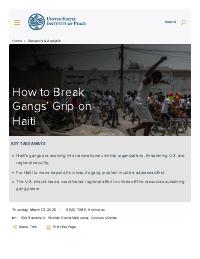
PHOTO: Members of the G9 gang protest over the assassination of President Jovenel Moïse, in Port-
au-Prince, Haiti, July 26, 2021. (Victor Moriyama/The New York Times)
The views expressed in this publication are those of the author(s).
PUBLICATION TYPE: Analysis
Kirk Randolph
Program Officer, Latin America Program
Nicolás Devia-Valbuena
Program Analyst
ABOUT THE AUTHORS
Ki Sa Siksè Politik Etazini ta Dwe Sanble an Ayiti?
À quoi ressemble le succès de la politique américaine en Haïti?
RELATED RESEARCH & ANALYSIS
What Does U.S. Policy Success Look Like in Haiti?
Haiti’s Security Crisis: The Multinational Mission’s Role and What Comes Next
View All Research & Analysis
COUNTRIES
Haiti
USIP has a variety of newsletters and announcements with the latest analysis, publications
and events.
STAY INFORMED
2301 Constitution Avenue NW, Washington, DC 20037
Tel: +1.202.457.1700
About USIP
Countries & Regions
Research & Analysis
Gandhi-King Global Academy
Legal and Privacy Information | FOIA InquiriesThe United States Institute of Peace
Sign up!
Connect Press Projects
The Olive Branch Blog