Teks Konple Dokiman an
Teks ki soti nan dokiman orijinal la pou endeksasyon.
Home ▶ Research & Analysis
KEY TAKEAWAYS
Haiti’s diaspora needs to coordinate on key policy priorities to help stabilize the country.
Remittances should be complemented with targeted investments in sectors that advance
reconstruction.
Haiti can also benefit from the expertise of its diaspora to build public administration
capacity.
Wednesday, July 17, 2024/ READ TIME: 9 minutes
BY: Esnold Jure; Georges Fauriol
Search
Share This Print the Page
Meeting theMeeting the
Moment: The RoleMoment: The Role
of the Diaspora inof the Diaspora in
Haiti’s FutureHaiti’s Future
Lire en français
In early July, Haitian Prime Minister Gary Conille made his first visit to Washington,
where he sought to mobilize the Haitian diaspora to be more active in restoring Haiti’s
governance, security and development, as he pushed back against the “Haiti fatigue”
that afflicts official Washington. Haiti’s diaspora is an important asset to multinational
efforts to address the crises the country faces today and could be a critical factor in
building a sustainable and prosperous future.
But to achieve this, diaspora leaders need to prioritize sustainable initiatives capable
of playing a decisive role in bringing relief to Haiti. The U.S.-Haitian diaspora can be a
game-changer if:
It unites behind a set of core policies and initiatives;
Makes effective use of existing community engagement, political networking and a rich
cultural heritage;
Leverages skills and expertise in a manner that enhances Haiti’s shattered educational,
healthcare and governance infrastructure;
Finds creative ways to supplement the existing flow of remittances with targeted
economic investments; and
Identifies mechanisms that more directly engage the diaspora in supporting Haiti’s
beleaguered government institutions.
Haitians living abroad never hide their fondness for their homeland and constantly
seek ways to help. With roughly 1.2 million people, the U.S.-Haitian diaspora
community is diverse and excels in many fields, including academia, business,
An Untapped Resource
entertainment and government while contributing up to 30 percent to Haiti’s national
income through remittances.
Unlike most other established diaspora communities in the U.S., though, the Haitian
diaspora is much less organized and lacks a unified voice and strategic focus,
impeding its ability to leverage its inherent power. This becomes even more
noticeable when it comes to advocating for U.S.-Haiti policy, where the diaspora’s
political influence appears limited in contrast with other Caribbean diaspora
communities — notably Cuban and Dominican — that play active roles in shaping
policy engagement in those countries. Their success is not only due to an active
mobilization but becomes amplified through sectoral alliances (business and trade
groups, the arts or outreach to think tanks). With an accurate appraisal of its
capabilities, strategic utilization of its resources, and a commitment to long-term
solutions, the Haitian diaspora can shift the current paradigm.
As a preliminary step to greater engagement by the diaspora, there needs to be an
accurate assessment of the socio-economic and political landscape of the community.
Last year, a collective led by the Haitian American Foundation for Democracy
surveyed members of the diaspora to collect data as the basis to create a roadmap
for the community’s enhanced engagement. This work could be further built upon
and carried out more holistically, not only to account for the community’s social and
political state of play but also to capture its assets and potential to influence.
The second step, and perhaps the most crucial at this stage, would be to conduct a
large and targeted outreach to meet with key diaspora groups and communities to
build a policy agenda. This could be the foundation for a baseline set of top priorities,
in effect a form of consensus views that the Haitian diaspora would pursue across
local and national channels in the U.S. and within Haiti. Without being overly
Measure it Better to Leverage it Better
prescriptive, there are a number of initiatives currently on the table that could use
more focus and emphasis.
For example, the Global Fragility Act (GFA), which includes Haiti as one of its priority
countries, not only lays out a long-term focus for assistance but provides the
framework for actively listening to Haitian voices. The diaspora should be one of
those groups of voices and it should also help to channel voices from Haiti and insist
they receive a proper hearing in policy circles.
There are also key pieces of Haiti-related legislation, such as the Haiti Criminal
Collusion Transparency Act and the HOPE/HELP Acts, that will help fight corruption
and spark economic renewal. The diaspora could help build a broad constituency for
these acts and for Haiti in general. The success of such an endeavor would help map
out the wishes of the Haitian diaspora while being a decisive step in the advocacy
effort vis-a-vis governmental stakeholders and other key decision-makers.
Because of the broad spectrum of opinions and visions within the diaspora, uniting
behind and championing a set of actionable policies could be challenging.
Nonetheless, it would be an attempt to focus on macro-level issues with the potential
to have meaningful policy impact. Such an initiative would require proper
Because of the broad spectrum of opinions
and visions within the diaspora, uniting
behind and championing a set of
actionable policies could be challenging.”
“
coordination to facilitate substantive engagement with stakeholders. Several ideas
come to mind in this regard:
A facilitation process could take the form of a diaspora committee, an idea already
under consideration by the Ayiti Diaspora Collective, a collaborative of U.S.- and
Haitian-based organizations. Jamaica’s Global Jamaica Diaspora Council could be a
prime source of inspiration as it is a successful effort to mobilize a diaspora to support a
national agenda and it regroups and connects the Jamaican diaspora globally to the
home population.
The recent Biden administration initiative to launch the Presidential Advisory Council on
African Diaspora Engagement provides another model for a Haitian diaspora
committee.
Drawing from these kinds of initiatives, a Haitian diaspora initiative could be composed
of representatives across key sectors with access to the U.S. and Haitian governments
and key civil society constituencies.
Anchored by the core concept of institutional resilience, these efforts could
productively merge with the existing if not yet operationalized Global Fragility Act.
With its 10-year timeframe, this would provide a representative, transparent and
credible avenue for U.S.-Haiti collaboration, fostering responsible governance and
engaged citizenry, which are central components of the GFA. And, on an even bigger
scale, the same might apply to even more ambitious proposals such as the
Louverture Investment Plan aimed at rebuilding Haiti.
The United States is not the only place where the Haitian diaspora should take steps
to ensure that its voice is heard. The same applies to engagement in Haiti —
becoming more civically and economically active actors are pre-conditions for a
diaspora that is more relevant in supporting Haiti’s path toward stability and progress.
Haiti Needs More from the Diaspora than Remittances
The impact of the diaspora is felt in Haiti primarily through its contribution in
remittances, much of which is almost exclusively linked to meeting personal and
family needs. While the need to support relatives increases as Haiti’s economic and
social environment continues to decline, it is not a sustainable way to contribute to
the country. Consequently, the Haitian diaspora needs a more targeted mode of
engagement. Through direct investment and by enabling greater capital flows into
key economic sectors, the diaspora can play an active role in Haiti’s economic
reconstruction while ensuring a more relevant participation in the country’s future.
There is also an opportunity to have an impact through transferable diaspora
expertise. Yet, unless this is channeled through coordinated mechanisms, it runs the
danger of being ineffective — or worse, perceived in Haiti as intrusive and
uninformed. There are multiple existing channels that should be put to good use, from
large diaspora organizations such as the National Alliance for the Advancement of
Haitian Professionals to the Haitian American Foundation for Democracy, as well as
business constituencies anchored by chambers of commerce.
The previously mentioned notion of a diaspora committee could be instrumental in
synchronizing specific diaspora resources and skills, transparently, with both U.S.
governmental initiatives (such as the GFA) and equally important, with Haitian
The United States is not the only place
where the Haitian diaspora should take
steps to ensure that its voice is heard. The
same applies to engagement in Haiti.”
“
partners. The latter needs to include linkages to Haiti’s transitional Presidential
Council and its pressing needs across a spectrum of issues. For starters, this could
include security, economic recovery, commitments toward a national conference, and
targeted governance needs associated with constitutional and electoral questions.
In ensuring effective utilization of diaspora expert skill sets, one could envision the
possibility of a hybrid Haitian civil society-public sector coordination mechanism,
matching nationwide and localized community-level needs with diaspora committee
expertise and a resource data bank.
More can also be done at the governmental level, despite previous efforts to give the
diaspora a more prominent role. Though its contribution is hard to pin down, the
Ministry of Haitians Living Abroad, created in 1994 and currently combined with the
Ministry of Foreign Affairs and Religious Affairs, is nonetheless a demonstration of the
willingness to integrate the diaspora community. A key provision of the constitutional
reform sponsored by former parliamentarian Jerry Tardieu is the promise of a seat in
the Haitian parliament. Hence, an important step for the diaspora includes
consolidating a more meaningful representation at the governmental level as well as
claiming and exercising voting rights granted by the amended 1987 constitution.
Concurrently, Haiti can also benefit from the expertise of its diaspora to facilitate
capacity-building throughout Haiti’s public administration. In 2014, the Haitian
Embassy in Washington launched a fellowship program where young Haitian
Americans were placed within different ministries in Haiti to learn and enhance the
work of those institutions. A similar but more targeted endeavor could include close
collaboration between Haiti’s administration, embassies and a diaspora committee
that strategically select and place expertise into Haitian institutions.
The Diaspora Can Be the X factor for Haiti
The temptation to find quick results at the expense of durable solutions is
inescapable — particularly when Haiti is in crisis. Diaspora leaders must prioritize
long-term efforts for long-term impacts. Just as other diaspora communities are
playing pivotal roles in shaping U.S. diplomacy, Haiti’s diaspora can also play a
decisive role in bringing relief and prosperity to Haiti. By coordinating and uniting its
members behind a set of policies, making more effective use of their strengths and
building on existing achievements, the diaspora can be a game-changer for Haiti.
Ultimately, as national and international actors seek to address Haiti’s layers of crises,
it is incumbent upon the Haitian diaspora to contribute to ensuring stability, creating
opportunities — and perhaps most importantly, committing to never let Haiti atrophy
again.
Esnold Jure is a policy analyst and a senior fellow at Haiti Policy House.
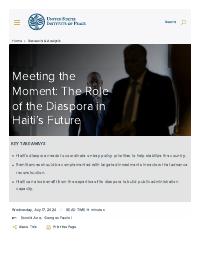
PHOTO: Prime Minister Garry Conille of Haiti arrives to meet with members of Congress at the Capitol
in Washington, Tuesday, July 2, 2024. (Tierney L. Cross/The New York Times)
The views expressed in this publication are those of the author(s).
PUBLICATION TYPE: Analysis
How to Break Gangs’ Grip on Haiti
RELATED RESEARCH & ANALYSIS
Ki Sa Siksè Politik Etazini ta Dwe Sanble an Ayiti?
À quoi ressemble le succès de la politique américaine en Haïti?
What Does U.S. Policy Success Look Like in Haiti?
View All Research & Analysis
COUNTRIES
Haiti
USIP has a variety of newsletters and announcements with the latest analysis, publications
and events.
STAY INFORMED
2301 Constitution Avenue NW, Washington, DC 20037
Tel: +1.202.457.1700
About USIP
Countries & Regions
Research & Analysis
Gandhi-King Global Academy
Legal and Privacy Information | FOIA InquiriesThe United States Institute of Peace
Sign up!
Connect Press Projects
The Olive Branch Blog