
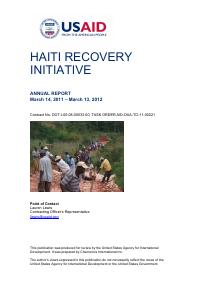
Haiti Recovery Initiative: Rapò Anyèl, Mas 2011 rive Mas 2012
Rezime — Rapò anyèl Haiti Recovery Initiative USAID/OTI pou dezyèm ane kontra li, ke Chemonics te aplike.
Dekouve Enpotan
- Li retni yon kontra 53 milyon dola ameriken sou 18 mwa yo bay Chemonics an mas 2011 pou Haiti Recovery Initiative II.
- USAID/OTI kòmanse travay an Ayiti an janvye 2010 nan kad repons apre tranblemanntè a.
- Li te vize pou pèmèt kolektivite ak òganizasyon kominotè nan koridò devlopman yo absòbe envestisman ameriken sou pi long tèm.
Deskripsyon Konple
Rapò anyèl Haiti Recovery Initiative USAID/OTI pou dezyèm ane kontra li, ke Chemonics te aplike. Transition Initiatives yo travay ak ti sibvansyon politik olye gwo pwojè long, epi rapò a anrejistre sou kisa yon kontra US$53 milyon pou dizwit mwa konsa te depanse.
Teks Konple Dokiman an
Teks ki soti nan dokiman orijinal la pou endeksasyon.
HAITI RECOVERY
INITIATIVE
ANNUAL REPORT
March 14, 2011 – March 13, 2012
Contract No. DOT-I-00-08-00033-00, TASK ORDER AID-OAA-TO-11-00021
Point of Contact
Lauren Lewis
Contracting Officer’s Representative
llewis@usaid.gov
This publication was produced for review by the United States Agency for International
Development. It was prepared by Chemonics International Inc.
The author’s views expressed in this publication do not necessarily reflect the views of the
United States Agency for International Development or the United States Government.
CONTENTS
Acronyms i
Program Description 1
Program Operations 2
I. Country Situation 3
II. HRI Highlights 4
A. HRI Grant Activity Summary 4
B. HRI Grant Activity Highlights 5
C. Progress Towards Objectives 12
III. Activity Implementation and Appraisal and Problems Encountered 14
A. Summary of Activity Implementation and Appraisal 14
B. Problems Encountered and Proposed Remedial Actions 15
ACRONYMS
BAC Municipal Agriculture Office (Bureau Agricole Communal)
BPA Blanket Purchase Agreement
CFPR Vocational Training Center of Reform (Centre de Formation Professionnelle
de la Réforme)
CHIBAS Center for Research on Bio-energy and Sustainable Agriculture (Centre
Haïtien sur la Bio-énergie et l'Agriculture Soutenable)
CIP Caracol Industrial Park
COSMHA Community Open Street Map Haiti (Communaute Open Street Map Haiti)
CTEAD Technical Center of Agricultural Entrepreneurship and Development (Centre
Technique d’Entreprenariat Agricole et de Développement)
CTP Presidential Technical Council (Conseil Technique Présidentiel)
DDGS direct delivery of goods and services
DGI General Directorate of Taxes (Direction Générale des Impots)
DPC Directorate of Civil Protection (Direction de la Protection Civile)
ENDK News You Need to Know (Enfomasyon Nou Dwe Konen)
FEFBA Federation of Women of Bas-Artibonite (Fédération des Femmes du Bas-
Artibonite)
GIS Geographic Information Systems
GoH Government of Haiti
GUC grants under contract
HRI Haiti Recovery Initiative
ICS Initiative of Civil Society
IDB Inter-American Development Bank
IDP internally displaced persons
IOM International Organization for Migration
IHRC Interim Haiti Reconstruction Committee
INDEPCO National Institute for the Development and Promotion of Sewing (Institut
National pour le Développement et la Promotion de la Couture)
INFP National Institute of Vocational Training (Institut National de la Formation
Professionnelle)
MSPP Ministry of Public Health and Population (Ministère de la Santé Publique et
de la Population)
NGO non-governmental organization
OTI Office of Transition Initiatives
PNH Haitian National Police (Police Nationale d'Haiti)
PU-AMI First Emergency-International Medical Aid (Première Urgence - Aide
Médicale Internationale)
SGBV Sexual/Gender-Based Violence
STTA short term technical assistance
i
TAP Transition Activities Pool
USG United States Government
UTE Technical Execution Unit (Unité Technique d’Exécution)
YWCA Young Women’s Christian Association
ii
PROGRAM DESCRIPTION
Background –The five-year United States Government (USG) Haiti Strategy released in January
2011 identifies two objectives: 1) to catalyze economic growth through investments in agriculture,
energy, and infrastructure; and 2) to ensure long-term stability through investments in public
institutions. The USAID/OTI Haiti Recovery Initiative (HRI) advances this effort by supporting
diverse activities in key development corridors, Port-au-Prince, St. Marc, and Cap Haitian. Focusing
energies in four areas, or “pillars,” the HRI program strives to promote economic growth and stability
throughout Haiti. The pillars are: infrastructure and energy, food and economic security, health and
other basic services, and governance and the rule of law.
USAID/OTI initiated its program in Haiti in January 2010 as part of the post-earthquake response.
The first phase of the HRI (now known as HRI-I) supported short- and medium-term activities aimed
at stabilizing Haiti through support for community revitalization, improved governance, and economic
growth. In March 2011, OTI awarded Chemonics a new $53 million, 18-month contract to continue
this work under the program, now known as Haiti Recovery Initiative II (but also referred to as HRI).
Through this effort, OTI strives to prepare local governments and community-based organizations
throughout USAID’s three growth corridors and USAID/OTI target communities for longer-term
USG investment.
To achieve these objectives, HRI is implementing grants, short-term technical assistance (STTA), and
procurement according to the following strategy:
1) Supporting a limited number of historically volatile neighborhoods in the greater Port au
Prince area (with an initial focus on Belair and Martissant) focusing on neighborhood renewal
and internally displaced persons (IDP) return incentives.
2) Enabling local governments and viable community-based organizations in the development
corridors to prepare for and better absorb long-term USG investment.
3) Building the capacity of the Government of Haiti (GOH) to govern effectively in key sectors.
HRI’s work is not sector specific, but is rather responsive to a range of emerging issues that are
relevant to Haiti’s economic growth and stability. As with the first phase of the program, all HRI
activities fit into the following broad-based programmatic areas:
• Enabling the Government of Haiti to Function
• Community Stabilization
• Supporting Dialogue on Relief and Recovery (Increasing Citizen Engagement)
HAITI RECOVERY INITIATIVE ANNUAL REPORT 2011-2012 1
PROGRAM OPERATIONS
Staffing – During the current reporting period, HRI was fully staffed. As of the end of the reporting
period, HRI was recruiting for the expatriate Senior Grants and Subcontracts Manager position for the
Saint Marc Office. Furthermore, discussions were underway about strategically restructuring the
organizational chart to better respond to the changing needs of the program, to bridge the gap between
program development and program implementation, as well as to better support the Saint Marc and
Cap Haitian field offices. At the end of the reporting period, total staff across the project’s three
offices was approximately 113. These positions include expatriates, Haitian professionals, Haitian
support staff, and Haitian and expatriate short-term technical specialists. Of the 113 staff members, 95
are either Haitian or from the Diaspora which makes HRI 84 percent Haitian staffed.
Office Space/Set-Up – During the year, HRI changed offices in the Port-au-Prince office order to
accommodate a growing staff for HRI-II. The project moved from a two story house to a three story
building in the same area of Petion-Ville with the capacity to house more offices and desks and with
ample parking space for over 10 cars.
HAITI RECOVERY INITIATIVE ANNUAL REPORT 2011-2012 2
I. COUNTRY SITUATION
Haiti remained relatively stable over the past year. According to a United Nations Office for the
Coordination of Humanitarian Affairs (OCHA) article on the second anniversary of the earthquake,
the result of a sustained and colossal humanitarian operation in response to the earthquake and the
cholera epidemic has yielded remarkable results and continues to save lives. As of January 2012,
almost one million people had left IDP camps. The collapse of 70,000 buildings generated 10 million
cubic meters of debris, 50 percent of which has now been removed. Transitional shelters have been
provided to 420,000 people. Schools and hospitals have been rebuilt, and more children are being
educated today than before the earthquake. A joint national contingency plan, developed with the
international community for the first time, has been replicated in all 10 departments in Haiti should
another major natural disaster strike the country.
Political Situation – The most important political event was the election of President Michel Joseph
Martelly, who took office on May 14, 2011. There was some tension surrounding his presidency due
to accusations of him not being a Haitian citizen, but he eventually submitted documentation to prove
otherwise. Another significant political event was the ratification of Prime Minister Gary Conille by
both chambers of Parliament, which was then followed by his resignation February 24, 2012 due to a
tumultuous relationship with the President. By the end of the reporting period, no new Prime Minister
was nominated. Furthermore, in January 2012, 16 elected Mayors were suddenly displaced until the
next elections by a presidential decree, one of which was the Mayor of St Marc. Despite the tense
political environment during the current reporting period the HRI program continued to support all
branches of government by providing technical assistance to key ministries and municipalities. In
particular, in St Marc, the HRI team faced a difficult transition with the newly placed Mayor who was
not as collaborative as the former Mayor with whom the program had developed a strong relationship.
Health Crisis – Since the beginning of the cholera epidemic, health partners have scaled up human
and material capacities to support the Ministry of Public Health and Population (MSPP). Thousands
of hospital beds were set up, tons of medication, soap and water-purification tablets were distributed,
and thousands of community members were trained in hygiene promotion. This resulted in a steady
decrease in fatality rates, from 2.4 percent in November 2010 to 1.3 percent as of October 2011.
Continued containment is still required to curb the cholera epidemic that has so far killed 7,000 people
and infected 500,000 Haitians (Source: Ministry of Public Health and Population). At the end of this
reporting period the MSPP launched a vaccination program against the cholera virus in the Artibonite
region and in populated neighborhoods of the Port-au-Prince metropolitan area. The HRI program
will continue to monitor this health crisis, specifically as it relates to target communities, and as it
impacts the perception of the GOH’s ability to provide crucial leadership.
Security Situation – The security situation throughout Haiti remained relatively stable but had the
potential to deteriorate at any given time throughout the year due to tensions related to the slow pace
of recovery, internally displaced persons (IDP) resettlement and relocation, and the formation of a
new government. A notable security-related development in the last quarter was the illegal
mobilization of former members of the Haitian Army, who were demanding that the government
restore the military as they felt the military was unconstitutionally dissolved. This movement has
created tension between the former military soldiers and the Haitian Government. For the moment the
demonstrations by the former military are peaceful, but there is fear that any potential confrontation
with the Haitian National Police (PNH) could jeopardize the stability currently in place. HRI
continues to develop and implement integrated programming in strategic communities which have the
potential to derail the recovery effort if left unaddressed.
HAITI RECOVERY INITIATIVE ANNUAL REPORT 2011-2012 3
II. HRI HIGHLIGHTS
A. HRI Grant Activity Summary
As of March 13, 2012, HRI committed funds for 156 activities under the Transition Activities Pool
(TAP), totaling $24,726,233 – 127 activities were grants under contract (GUC), 7 short term technical
assistance (STTA), and 22 activities were direct disposition of goods and services (DDGS). HRI has
distributed $22,520,495of these committed funds, with $15,724,932 going to “Community
Stabilization,” $4,316,660 for “Enabling the GOH to Function,” and $2,478,903 for “Increasing
Citizen Engagement” (see Graph 1). Of these activities, “Community Stabilization” continues to be
HRI’s largest component with approximately 73 percent of all program funding for 107 number of
activities being earmarked for this component, followed by “Enabling the GOH to Function” with
almost 17 percent of committed funds for 32 number of activities, and “Increasing Citizen
Engagement” with slightly over 10 percent funding for 17 number of activities (see Graph 2).
Graph 1: Amount Disbursed vs. Total Activity Amount
Graph 2: TAP Committed by Component*
HAITI RECOVERY INITIATIVE ANNUAL REPORT 2011-2012 5
As the country was no longer in an immediate post-earthquake environment, the program goals
shifted with HRI to a focus on the four pillars 1 of the USG Haiti Strategy toward renewal and
economic opportunity. Furthermore, a new stable government was in place in May 2011 with plans
for change and for private and public sector investments into the economic and social development of
the country. The programmatic focus remained on community stabilization activities with a
concentration on neighborhood renewal and return of IDPs in target neighborhoods, as well as peri-
urban upgrading, light infrastructure work and economic livelihoods in all three US government
corridors. The HRI program also continued to place an emphasis on supporting local and central
government entities to govern effectively by building their capacity in decentralization, urban
planning, economic growth and improved communication with citizens.
B. HRI Grant Activity Highlights
1) Enabling the Government of Haiti to Function
Supporting the Office of the President and other national GoH entities- As part of its
programming to enable the government of Haiti to function,
HRI is supporting the office of the President and other
national GoH entities with infrastructure support, short-term
technical assistance, and communications capacity-building.
During this reporting period, HRI supported the Office of the
President through the rehabilitation of the Palace Wall
(PAP042), the installation of temporary facilities on the
grounds of the destroyed national palace (PAP037), and the
rehabilitation of Gymnasium Vincent (PAP033), the only Palace Modular Building
indoor public sports facility in Haiti, and an early priority of the
Martelly administration. The rehabilitation of the National Palace wall was completed on March 1 and
contributed to promoting qualitative change in the National Palace’s work environment. As a result of
this work, the president, his advisors, administrative staff, and other government representatives were
able to work within adequately secured premises. Work on the palace facilities included three new
free-standing modular buildings for a total of approximately 7,480 square feet of administrative space
and one free-standing modular building measuring about 3,050 square feet which will be used as the
Salle des Conseils (Council of Ministers), for press conferences and meetings. The rehabilitation work
on the Gymnasium includes strengthening and bracing the roof, reinforcing the foundation, columns,
beams, and walls, and repairing the mechanical, electrical, and plumbing systems. The work on both
projects is advancing rapidly, and the President recently complimented HRI on the advancement of
both projects. The estimated completion date for the Gymnasium is late May, and for the palace
facilities is early June.
Technical Assistance to the President’s Technical Council- HRI is also providing support to
national entities of the GoH in the form of technical assistance. HRI is providing Haiti’s Office of the
President with three presidential advisors (PAP043, 044 and 061) for assignments of six months each
in the areas of judicial reform, health policy and strategy development, and national budget planning.
These consultants provided critical input to the president and the Presidential Technical Council
(CTP) that shaped national strategies in their respective sectors. HRI is supporting Haiti’s tax office,
the Direction Generale des Impots (DGI), with a five-month consultancy in order to support the DGI’s
efforts to boost fiscal revenue by effectively communicating with taxpayers, as well as a local expert
and communications firm responsible for developing a comprehensive communications campaign
(PAP038). These strategic short-term consultancies are designed to address critical gaps in technical
expertise during the government’s transitional phase, and will focus on transferring knowledge and
capacity to the Government to undertake key tasks in these areas.
1
: A-Infrastructure and Energy, B-Food and economic security, C-Health and Other basic services, D-governance and rule of
law.
HAITI RECOVERY INITIATIVE ANNUAL REPORT 2011-2012 6
Support to the Haitian parliament - The HRI program provided
critical infrastructure support to the Haitian Legislature through the
installation of 22,000 square feet of temporary structures by the
Port-au-Prince bay, composed of three two-story buildings
(PAP006). The site includes a chamber where the entire parliament
can meet, and includes landscaping, two 500-kilowatt generators
for backup power, and smaller equipment such as outdoor lighting
units, smoke detectors, fire extinguishers. HRI completed the
installation of the temporary structures with the addition of plants President and Prime Minister at
on the parliament grounds, the installation of benches and the Parliament Inauguration
rehabilitation of the sidewalks around the building (PAP053). The
official inauguration of the parliament structures, in the presence of President Martelly, US
Ambassador Merten, Prime Minister Conille and the Presidents of both chambers took place on
November 21, 2011. Both chambers of the Parliament were expected to move to their new quarters
rapidly. However, at the end of this reporting period, they had still not moved into the new facilities
due to several delays, including concerns about the number of private bathrooms, and a desire to
connect additional structures to building’s plumbing system. When the Parliament moves, it will mark
the first time that both houses (senators and deputies) will be able to conduct government business
under the same roof since the January 2010 earthquake destroyed their former locale.
Support to the Northern Growth Corridor- In addition
to providing support to national GoH entities in Port-au-
Prince, HRI also provided strategic assistance to
municipalities in HRI’s target areas in the Northern
Corridor, the five communes most affected by the
Industrial park. This support has included the
rehabilitation of the Limonade Cultural Center (CAP003)
through the provision of a roof, a podium, the painting of
the walls, the installation of the electrical and sound
system (including speakers and microphones), the
provision of latrines, 300 chairs, four fans, and a A community meeting being held at the
generator. In addition, HRI procured a multifunction completed Limonade cultural center
photocopier and printer, and four computers (with Internet
connection) for the library to serve as a small service center. This equipment will allow the center to
generate future revenue to maintain the sustainability of the site. The center’s importance stems from
the fact that it will allow for the organization of town hall meetings, which have shown to be the best
mechanism to inform the population about the Caracol Industrial Park (CIP) and allow for productive
exchanges between citizens, organized groups, local authorities, and the project’s promoters. It has
also sent a tangible message to the local population that positive changes are coming along with the
park.
Additionally, HRI is providing for the rehabilitation of Limonade’s central plaza (CAP004), by
installing a fountain and pump, paving internal pathways at the park, restoring the podium, and
installing lamp posts and electricity. This support to the Municipality of Limonade is designed to
create a safe communal space for social and cultural interactions, and to encourage community
participation in other community interactions and events related to the park. These rehabilitation
efforts also strengthen the credibility of local authorities of the North as the leaders of decentralization
efforts, foster public support, help build momentum around the CIP, and improve the perception of
and trust in local government to provide services and opportunities in the area. Similar activities are
being planned in the other four target municipalities around the Park.
Supporting GoH municipalities in HRI target areas around Cap Haitian-. In Northern Haiti, HRI
worked to support municipalities around the CIP with critical support in administrative capacity
HAITI RECOVERY INITIATIVE ANNUAL REPORT 2011-2012 7
building and communications strategy support. Five administrative support specialists began their six-
month assignments in February of 2012; one each in Caracol, Trou du Nord, Limonade, Fort Liberte,
and Terrier Rouge (CAP031 to CAP035). The premise of the administrative assistance is to support
mayors as they transition from working on day-to-day issues associated with small towns to
participating in critical decisions that will affect long-term development in their region with the
arrival of the CIP. HRI received a glowing letter of appreciation from the mayor of Limonade for the
administrative support provided to the municipality.
2) Community Stabilization
Supporting sewing training opportunities in preparation of the opening of the Caracol
Industrial Park- Two activities began during this reporting period, which are critical to stabilizing
communities through increasing workforce readiness and access to economic opportunities for the
opening of the Caracol Industrial Park in late 2012. The first is the rehabilitation of a building in
Trou du Nord which will serve as a training center for garment manufacturing and industrial
workforce environment training (CAP050). HRI is rehabilitating the 446 square-meter, two floor
building owned by the Parish of St Jean Baptiste to be used by the Institut National pour le
Développement et la Promotion de la Couture (INDEPCO), a Haitian sewing organization. Once
complete, the building will be available to conduct trainings for 120 students at a time. In
collaboration with the Unite Technique d’Execution (UTE), the second important activity is HRI’s
provision of a three month training program, commencing in March 2012 (PAP058), for sewing jobs
with a focus on future opportunities at the Industrial Park.
Providing Solar lighting to stabilize communities- HRI supported the procurement and installation
of solar lamps throughout HRI’s three development corridors. In Cap Haitien, HRI is installing 33
solar street lamps along the city’s boulevard to reduce insecurity and theft, increase commercial
activity and enhance the Boulevard’s nighttime image (CAP029). HRI is placing 334 highway lamps
along the National road #6, from Limonade to Fort Liberté, in order to reduce traffic accidents and to
improve the overall safety of the road (CAP020/021). In Trou du Nord HRI is placing 33 solar lamps
at strategic intersections to reduce the risk of gender-based violence and insecurity through the
municipality (CAP022). Installation of lights has begun in all three locations.
In St Marc, HRI is partnering with the municipality and community-based organizations to install 80
solar powered lamps at key intersections as a key tool against nighttime insecurity for the 260,000
residents of the city (STM029). Crimes against women, motorcycle taxi drivers and merchants are
common occurrences during darkness hours in St Marc and the solar lamps will combat these risks. In
addition, it is expected that these lamps will provide places for students to study and for merchants to
conduct business at night thus improving the economy of these various neighborhoods. As of this
reporting period, installation had not yet begun in Saint Marc and was scheduled to begin in June of
2012.
In Port au Prince, in addition to the 50 lamps installed in Martissant and Bel Air (PAP031), HRI is
installing 50 lamps in each of HRI’s target Pétion Ville neighborhoods of Nerette and Morne Hercule
to promote public safety (PAP058/059). These solar street lights will enhance existing HRI
investment in these areas and promote the attractiveness and functionality of these neighborhoods,
providing incentives for the return of internally displaced people (IDPs). As of this reporting period,
installation had not yet begun in the Petion Ville neighborhoods and was scheduled to begin in June of
2012.
Using a blanket purchase agreement (BPA) with a local energy company, HRI used its purchasing
power to save on the costs of solar lamps and installation across the three growth corridors.
Supporting urban renewal and functionality in Saint Marc- A major component of HRI’s St Marc
strategy is to address a broad range of urban renewal issues in order to improve the city’s overall
image and functionality and create conditions that will encourage economic growth. One such
HAITI RECOVERY INITIATIVE ANNUAL REPORT 2011-2012 8
initiative was HRI’s support of the procurement and installation of 700 street signs in Saint Marc’s
downtown area (STM021). Large signs will also be placed in front of the city’s major neighborhoods.
HRI is also engaged in a public safety campaign in partnership with the Inter-American Bank (IDB)
which involves training and providing safety equipment for crossing guards who will be responsible
for monitoring the 60 primary schools along the 80km stretch of National road # 1 between St Marc
and Port au Prince (STM025). HRI is also providing a training course for 5,000 motorcycle taxi
drivers who, upon completion of the training receive their license and a safety helmet designed for
tropical weather. Additionally, HRI is supporting the IDB’s existing advertising campaign by funding
billboards and 150,000 copies of a safety-focused issue of the comic strip newspaper “Chimen
Lakay”. Both activities are expected to be completed in July.
In partnership with Communaute OpenStreetMap Haiti (COSMHA), during the year HRI started a
three-month Geographic Information Systems (GIS) training for 30 youth which will result in the
creation of high-quality detailed maps of the corridor and the city of St Marc (STM020). Engaging
young people from St Marc and mapping the area will make the development corridor more easily
accessible for upcoming longer term development initiatives. COSMHA also assisted in creating a
chapter of OpenStreetMap in the St Marc area to continue with the mapping activities as new
demands arise.
IDP Relocation- Partnering with IOM, HRI has
facilitated the relocation of over 1,300 IDP families that
were living in the Place St Pierre and Place Boyer tent
camps in Pétion-Ville. This project was the first large
scale, successful IDP relocation effort in the country, and
served as a model for the government’s national program.
With leadership from the municipality of Pétion Ville, the
relocations were achieved through providing choices to
the IDPs of rental assistance, yellow house repair, or
installation of a transitional shelter (PAP010). IOM
continues to pursue monitoring visits in the different The head of a household on
relocation zones to ensure that the IDPs actually returned Place Saint Pierre dismantling their tent
to their respective locations; and obtain their perception of
the relocation process, so that this information may be used on future programming. Out of all
families who were living in the two camps, 96% of IDP families selected the rental grant option,
while 3% selected the T-shelter option, and 1% selected the yellow house repair option. While
monitoring visits to verify whether families are residing in their new residences are still ongoing, as of
January 31, 2012 a total of 1,202 families out of 1,304 total monitoring visits conducted were verified
to be living in their new residences in a host community. HRI has also started rehabilitating Place St
Pierre (PAP069), one of the two plazas, following the relocation, a key sign in showing the population
that life is returning to normal after the earthquake.
Providing temporary shelters to vulnerable families in Martissant and Bel Air (PAP064) -
During the year, HRI implemented a large-scale initiative to provide temporary shelter for 480
displaced families of HRI’s target neighborhoods of Martissant and Bel Air, in partnership with
Premiere Urgence - Aide Medicale Internationale (PU-AMI). PU-AMI is expected to complete the
assembly and installation of 480 shelters, and 58 latrines in the target areas. HRI is conducting close
engineering and environmental oversight to ensure the quality of the work completed by PU-AMI.
Empowering Young Women - In Port-au-Prince, in partnership with the Young Womens’ Christian
Association (YWCA/Haiti), HRI completed a series of 8 workshops for 75 women from HRI’s target
neighborhoods of Petionville- Morne Lazare, Morne Hercule, and Nerette, and is currently completing
a second series of eight workshops (PAP063).These workshops focused on womens’ empowerment
issues such as leadership, entrepreneurship, human rights, and sexual and gender-based violence.
They sought to engage young women who were victims of the earthquake in an uplifting activity,
HAITI RECOVERY INITIATIVE ANNUAL REPORT 2011-2012 9
empowering them by raising their awareness of their rights and available resources, motivate them to
actively engage in their community’s recovery, and how to contribute to their financial independence.
Creating Livelihood Opportunities in Corridors- In the commune of St Marc, HRI is supporting
the Bureau Agricole Communal (BAC) with the revitalization of an area in the fourth section of Saint
Marc called Bois Leta, through an intensive reforestation and community awareness campaign
(STM012). Bois Leta is a source of significant agricultural output into the city of St. Marc where there
is a population influx as economic opportunities outside the city diminish. Through training area
farmers on up-to-date irrigation techniques, reforestation, and a community awareness campaign, this
activity is unlocking greater employment options in the area. The project’s reforestation goals have
already been surpassed, and the intervention is expected to increase livelihood opportunities in the
commune through improved yield of agricultural crops- an important goal of USAID’s economic
development strategy- as well as through strengthening the local BAC government entity.
In the Northern Corridor, HRI is providing farmers with a sustainable solution to increase their
capacity to support themselves and their families, working with the Centre Technique
d’Entreprenariat Agricole et de Développement (CTEAD), a local agricultural organization based in
Cap Haitien (CAP027). This activity served as a pilot project to provide a three-month training to 75
students and to foster the development of at least 50 micro farms in the northern development corridor
towns of Caracol, Fort Liberté, Trou du Nord, and
Limonade. While the training was still ongoing as
of the current reporting period, the activity has
already resulted in increased agricultural
production in the north, as the trainees have begun
incorporating the proper techniques for irrigation,
soil preparation and cultivation learned during the
trainings. These interventions will help the area
keep up with the new demands on food supply
related to the impending Caracol Industrial Park.
Vocational Training Programs – HRI also
partnered with “Institut Nationale de la Formation
Professionnelle” (INFP) to provide vocational and CTEAD Agricultural Training
entrepreneurial training in Heavy Equipment to 85
women and men (46 women) (PAP034). The training equipped students with technical skills which
are and will continue to be in high demand as major reconstruction efforts get underway. All
participants successfully completed the course and received their certificates on January 30th. In
addition to the opportunities available for the participants, this will also allow the Heavy Equipment
Industry in Haiti increased opportunity to recruit locally, as opposed to having to bring qualified
applicants from the Dominican Republic to fill available jobs.
At a time when there is a resurgence in the construction
of new hotels in Haiti, as evidenced by the fact that 763
new hotel rooms are scheduled to be operational by 2014,
HRI supported the GoH by providing equipment and
materials needed for the re-opening of the Hospitality
Management school, which will allow 131 students to
resume their classes and graduate (PAP032). In Reopened Hospitality Management School
appreciation for the work, the institution agreed to
provide seven scholarships to students from HRI targeted
neighborhoods of Martissant and Belair, thus providing
new skills in a growing industry. The school has
HAITI RECOVERY INITIATIVE ANNUAL REPORT 2011-2012 10
agreements with several local hotels and restaurants for internships for their students and is working
on establishing a placement program with hotels such as the soon to open Oasis. The official launch
of the school was held on January 31st.
HRI also developed an activity with the Centre de Formation Professionnelle de la Reforme (CFPR),
a vocational training institute recognized by the Ministry of Education, to provide training in Para
seismic masonry to 200 vulnerable men and women from Bel Air and Martissant (PAP065). This
training will significantly improve their quality of life by equipping them with a specific job skill set,
basic literacy and the opportunity to earn a steady income. In addition to receiving a certificate upon
completion of the three month course, CFPR would assist trainees with job placement services. The
kick-off meeting for this activity was held in February, and recruitment efforts were underway to
select beneficiaries.
Human rights and sexual/gender-based violence
(SGBV) prevention - HRI continues to promote human
rights and gender-based violence prevention in Port-au-
Prince and USAID growth corridors. For example, HRI is
providing continued support for SGBV prevention efforts
for women and girls living in the St. Marc community by
assisting the Women’s Federation of Bas Artibonite
(FEFBA) Women's Shelter program to continue assisting
women and girls who are victims of sexual violence and to
support the organization’s awareness raising efforts
(STM003).
A female beneficiary receives counseling
Sports activities and civil protection training for and legal support from FEFBA
vulnerable youth- In Cap Haitien, HRI supported 20 days
of sports activities and civil protection and first aid training, in partnership with the Direction de la
Protection Civile (DPC), the Haitian National Protection Agency. The activity engaged 720
vulnerable youth participants from three key communities in the North in a 20-day sports activity,
human rights and first aid training program (CAP016). The program received extremely positive press
from the local media and local communities.
Development of a Bio-fuel Value Chain and Agricultural by Products in St. Marc – As a follow-
on to two previous activities under the first phase of HRI to establish a nursery for 700,000 Jatropha
Curcas seedlings and prepare marginal lands for planting, HRI is working in partnership with the
Center for Research on Bio-energy and Sustainable Agriculture (CHIBAS) to create economic
opportunities for the development of this crop in St. Marc and the Lower Artibonite area (STM005).
Jatropha Curcas is a multi-purpose crop that can contribute to environmental rehabilitation (including
reforestation and soil conservation) and the extension of agriculture to deforested marginal lands, in
addition to providing an alternative source of energy. Specifically, this activity employed 1,502
individuals (including 50% from the IDP community) to finish the land preparation and plant the
700,000 seedlings procured under a previous activity on 520 hectares in the Lower Gros Morne area
of the commune of St Marc. Support to CHIBAS and the Municipality of St. Marc is expected not
only to provide temporary employment opportunities and to help revitalize agriculture in St. Marc, but
also to contribute to developing a value chain for bio-fuels and agricultural by-products in order to
meet Haiti's growing energy needs and support its long-term development.
3) Increasing Citizen Engagement
Internews Support to ENDK Programming, Audience Research and Media Capacity Building -
This activity, which is scheduled to end in mid-May, 2012, strengthened local media in providing
news and information which responded to the needs of the earthquake-affected Haitian population, by
funding Internews' media assistance programming in Haiti for a period of ten months (PAP022).
HAITI RECOVERY INITIATIVE ANNUAL REPORT 2011-2012 11
Specifically, HRI funded the continued production of the established daily radio news program
“Enfomasyon Nou Dwe Konen” (ENDK), the collection of actionable audience research to inform
programming, and build the capacity of local media outlets’ management and journalists to produce
programming similar to Internews’ ENDK program. By the end of March, this activity resulted in the
production of media programming similar to ENDK by five (5) partner stations, which represents a
significant success in changing the landscape of media programming in Haiti. This activity increased
the capacity of 15 local media outlets to produce higher quality news programming and supported the
transition of Internews’ research unit into a viable commercial entity which is now registered as an
independent company in Haiti. Internews will transition all ENDK programming to local entities in
June of 2012.
Initiative of Civil Society: Monitoring of the Laws of Finance and Budget Advocacy for a Focus
on Results- As the new Martelly government is striving to put in place a new budget, HRI has
engaged the Initiative of Civil Society (ICS), which has a history of demanding government
accountability on budget issues, to facilitate dialogue on the strengths and weaknesses of the National
Budget for 2011-2012, and to disseminate information on current GoH spending to the media and
citizens. To this end, they are currently engaging in a 6-month project with the aim of promoting
dialogue to achieve a more rational, more rigorous and effective national budget in order to increase
citizen involvement in the reconstruction by improving GoH transparency, and to increase the
public’s knowledge of how public funds are being used (PAP068). HRI is providing logistical and
communication support to ICS, and procuring materials for the dialogue sessions. As a result of this
activity, citizens and journalists will be better informed about public finances, and the government
will have access to information which will better allocate its resources toward basic services,
reconstruction, reducing inequalities and promoting growth and employment.
Communications Training - In order to enhance the capacity of
community organizations and improve relationships between the
private, community and public sectors, HRI is holding discussion
sessions in Fort Liberté, Caracol, Limonade and Trou du Nord for six
months, in order to forge positive relationships and collaborate on
innovative project ideas (CAP018). This activity is designed to
demonstrate the value in soliciting diverse perspectives in order to
mitigate conflicts and address major changes in the region that will
come with the Caracol Industrial Park. The program is already
beginning to facilitate dialogue between community groups and the Circle of Change Training
municipalities, and is helping participants become effective in Caracol
participants in the reconstruction effort. Through discussions, the communities produce innovative
ideas for the development of their communities, develop a sense of accountability and responsibility,
and learn to lead their own Circle of Change groups in their communities in order to directly impact
the development of northern corridor towns.
Focus Groups/ Baseline Surveys - In St Marc, Cap Haitien, and Port-au-Prince, during the current
reporting period HRI began conducting baseline surveys and focus groups which are providing
quantitative and qualitative data to help inform both HRI’s programming, and the Haiti USAID
Mission’s future activities. In Saint Marc, HRI engaged the Haitian firm Dagmar to conduct a
quantitative survey in four communal sections of Saint Marc. In Cap Haitien, HRI engaged the
Haitian firm BRIDES to conduct a similar survey in both Cap Haitien and HRI’s five target
municipalities outside of Cap Haitien; the survey report was being finalized as of the end of this
reporting period. In Port-au-Prince, HRI engaged the Haitian organization New Haiti Institute to
conduct focus groups in HRI’s target neighborhoods of Martissant and Bel Air. The final report from
the Port-au-Prince focus groups was submitted during this reporting period, and a presentation was
conducted by the New Haiti Institute at the HRI office in Port-au-Prince. These surveys are already
helping to shape future HRI programming.
HAITI RECOVERY INITIATIVE ANNUAL REPORT 2011-2012 12
Support to Sustainable development in the North -
During the current reporting period HRI continued to
support a GoH-driven communications campaign in
partnership with the Ministry of Finance’s Unité
Technique d’Exécution (UTE) around the development
of the CIP in the commune of Caracol in northeast
Haiti (CAP001/013). The goal of this campaign is to
provide the population that will be affected by the park
with crucial information on what to expect in the near
future, and how they can take advantage of this new
economic opportunity. The communications campaign
ramped up during the August-October reporting period,
as numerous communications products were produced, A communications kiosk
in Caracol, Northern Haiti
including a website, Creole language leaflets, park
brochures (in Creole, French, and English), radio spots, billboards, and information kiosks located in
the communities of Caracol, Limonade, and Terrier Rouge, staffed with local community
representatives. With HRI support, UTE also held four town hall meetings in northern communities to
inform and engage local populations about the development of the park. A new activity was just
launched with the UTE at the beginning of March for the production and dissemination of additional
communication tools such as videos, billboards, radio spots and media events addressing pressing
issues as well as important milestones related to the development of the CIP. HRI also supported the
USG in urban planning efforts, involving local communities, to help the region prepare for the
upcoming changes (CAP046) These efforts will assist the GoH in managing expectations of citizens
in terms of job opportunities, actions to mitigate negative environmental impact and attracting
potential investors.
Increasing communication between employers and job-seekers - On September 3rd, 4th, and 5th,
2011, HRI supported the organization of the first annual “Jobs and Training Fair” in Haiti, bringing
Haitian companies together with the work force and the local community (PAP017). Approximately
3,000 potential job seekers attended the fair, which allowed companies to communicate with the job-
seeking population to present the set of skills and
qualifications they were seeking in potential
employees, and allowed job-seekers to ask questions
and to directly apply for relevant job openings. The
event also featured key training sessions on vocational
training and career orientation, such as CV-writing
and interview skills. Feedback received from
participants confirmed that the event gave hope to
thousands of young Haitian professionals and students
frustrated by the lack of local job opportunities.
Participants visiting various booths at the
C. Progress towards Objectives First Annual Haiti Job Fair
The second phase of HRI began just as the USG was changing the focus of its efforts in Haiti from
preventing a post-disaster descent into chaos and collapse, to laying the foundation for future growth
and development. In January 2011, the new Post-Earthquake USG Haiti Strategy, “Toward Renewal
and Economic Opportunity”, was published with the objectives of catalyzing economic growth along
three growth corridors and ensuring long-term stability through investments in public institutions.
Given that many USAID projects were not online at project start-up, HRI was tasked with the crucial
role of “tip of the spear” for the USG’s strategy, using its three project components to fill crucial and
emerging needs while laying the foundation for long-term success. This required HRI to remain
flexible enough to respond to urgent priorities across USG pillars, pilot new and innovative
approaches in the post-earthquake environment, and form strong partnerships with local organizations
designed to form the basis of future USG investment. As described with specific examples elsewhere
in this report, HRI was successful in taking on these significant challenges.
HAITI RECOVERY INITIATIVE ANNUAL REPORT 2011-2012 13
As part of an effort to promote stability, HRI capitalized on momentum stemming from a peaceful
election and transition of power by providing critical support to the new Martelly administration. The
project supported several early signature projects, designed to demonstrate to the population that
progress was underway. Activities include the highly visible Gymnasium Vincent rehabilitation, IDP
relocation and the rehabilitation of former tent camps, and provision of temporary structures at the
National Palace and to the Parliament. In addition, HRI provided key human resources to the new
president, including renowned experts in health policy, judicial reform, and national budget planning,
as part of an advisory council. These efforts were key to helping the USG establish a strong working
relationship with the new Haitian government and to helping the new government show the
population that the country’s situation was beginning to improve.
As part of an effort to promote future economic development, HRI implemented a wide variety of
activities across all three development corridors to catalyze growth and help communities begin to
help themselves. These efforts included vocational training for vulnerable community members in
heavy equipment operation, garment production, hospitality and agriculture, as well as rehabilitation
of key public infrastructure, such as public plazas, lighting, and roads. The project also played a key
role in one of the signature post-recovery investment initiatives, the Caracol Industrial Park. HRI
supported local mayors and their towns in the areas surrounding the park and urban planners from the
American Institute of Architects to help the national government capitalize on this new multi-million
dollar investment.
The activities mentioned above represent only a small percentage of the 156 activities that began in
the first project year of this second phase of HRI. This sampling of activities demonstrates that the
OTI small grants mechanism and approach have proven to be crucial in a post-disaster environment
where conditions change rapidly. A flexible program such as HRI has shown to be essential to
faciliate the transition. While much work is left to be done, the project has proven its value in
responding rapidly to urgent needs of the USG, the Government of Haiti, and the communities in
which HRI is active.
HAITI RECOVERY INITIATIVE ANNUAL REPORT 2011-2012 14
III. ACTIVITY IMPLEMENTATION AND PROBLEMS ENCOUNTERED
A. Summary of Activity Implementation and Appraisal
In June 2011, the program held a strategic review session to assess the current project and the future
areas of focus for the project. The team identified four major themes, listed below:
1. Celebrate and build on successes of the HRI over the past several months;
2. Discuss the GOH’s 100-day plan, the long-term USG strategy and the draft OTI strategy for
Haiti;
3. Build the new HRI II team, integrating new members and strengthening the links between the
three offices;
4. Propose ideas for neighborhood selection in the Port-au-Prince corridor and for OTI
contributions to more effective local governance and citizen participation in St Marc and Cap
Haïtien.
The participants recognized the successes of HRI I but also expressed the desire to be more strategic
and intentional in planning activities, whereas HRI I activities tended to be quick responses to
emergency needs. Regarding the 100-day plan, HRI and OTI identified several areas of collaboration
with the GoH, including IDP resettlement, neighborhood renewal, decentralization, strategic
communication, and support to basic services. The participants also acknowledged the increased team
size from HRI I to HRI II, so this meeting included teambuilding activities and discussion of the OTI
“Four Corners” management model.
During their discussion of Port-au-Prince neighborhood selection, the participants discussed the
following criteria: commitment and capacity of the mayor; presence of grassroots organization(s) in
the neighborhood with a willingness to work closely with HRI; the neighborhood’s vulnerability to
natural disasters; its vulnerability to political destabilization and/or insecurity and violence; track
record as a neighborhood where HRI has already worked successfully; and potential for having a
significant impact, including in adjacent/nearby areas. With these criteria in mind, the priority areas
discussed were Carrefour-Feuilles, Bas-Delmas/Mi-Delmas, Fort National, Nerette/Morne
Hercule/Morne Lazarre, Maïs Gaté, Ravine Pintade, Solino, Bas Canapé Vert, Nazon, Morne
L’Hôpital, Carrefour, Cité Soleil, Croix-des-Bouquets. Bel Air/Martissant had already been identified
as a priority area so the team would pick a couple of other areas from the list above.
The team also discussed ideas for activities in Cap Haitien and St. Marc. Activities in Cap Haitien
included strategic communications around the industrial park, solar powered traffic lights and lamps,
and trainings for agro-business, among many others. Suggested St. Marc activities included
beautification of St. Marc, communications campaigns about the government, and human rights
promotion.
B. Problems Encountered and Proposed Remedial Actions
Land Title Documentation - During this reporting period, HRI continued to face challenges
obtaining adequate land title documentation for many of the infrastructure activities currently
underway or under development. Lessons learned from previous HRI activities have proven that land
title is a sensitive issue that must be adequately documented in order to mitigate future risk associated
with any infrastructure activity. HRI is continuing to engage a local lawyer who reviews
documentation submitted, to ensure that documentation is legally sound, and to provide risk
assessments based on local law. HRI is also engaging the lawyer to expedite the process of obtaining
complex documentation from the Haitian Government, which had previously proven challenging due
to the extensive bureaucracy of Haitian land title departments and the unwillingness of the former
Minister of Finance to approve further land for use related to the CIP. Furthermore, HRI is working
HAITI RECOVERY INITIATIVE ANNUAL REPORT 2011-2012 15
with an interlocutor identified by the U.S. State Department for obtaining land title documents on the
proposed site of the Caracol training center in Northern Haiti.
Beneficiary Selection - Beneficiary selection has become a focus of the HRI program, to pilot new
strategies which effectively engage vulnerable community members from HRI’s target areas. As HRI
moves away from cash for work and focuses on more strategic interventions with a more defined
target group of beneficiaries, HRI has engaged in several trial methods of beneficiary selection,
prioritizing a selection process which often takes as long, if not longer, than the training or activity
itself. HRI has gleaned lessons learned from partner organizations such as Premiere Urgence and
IOM, and has also learned through trial and error what works and what does not with selecting
beneficiaries for training and other activities where beneficiaries stand to gain an economic benefit
from participation. HRI’s Senior Monitoring and Evaluation Officer has served as the champion of the
beneficiary selection process and has led the information sharing process across HRI’s three offices.
Recruitment – The HRI program continued during the reporting period to face difficulties with
recruitment of qualified expatriate and local staff to fill vacancies, which placed a strain on the
project’s resources. The difficulties with recruitment were primarily due to a limited talent pool
available for shorter term projects and the unique skill sets associated with OTI projects. To address
these recruitment challenges, HRI re-launched key recruits and intensified recruitment through
informal networks in Haiti and abroad, such as reaching out to the Diaspora through trade journals,
listservs, Websites, and even Facebook. These additional efforts were successful, as all key positions
were filled in all offices at the end of the reporting period.
Engaging the GoH – During this reporting period, HRI’s efforts to support diverse entities of the
Government of Haiti were difficult due to the delay in the installation of a prime minister, which in
turn delayed the appointment of many key ministers with whom HRI could work. In order to address
these challenges and to achieve its objective of supporting the Government of Haiti to function despite
this delay, HRI was able to concentrate support in the interim on the Office of the President, the
Interim Haiti Reconstruction Committee (IHRC), and other non-ministry offices of the GoH prior to
the installation of a new government. On October 5, 2011, Mr. Gary Conille was approved and
installed as Prime Minister by the Haitian Parliament and all Ministers were appointed. This
positively affected HRI programming as GoH responsiveness, participation and leadership is essential
to HRI’s ability to design and implement programming. However, Mr. Conille resigned in February
2012 leaving the government without a Prime Minister for several months. Many of the project’s GoH
counterparts were not sure of their future status, which made them reluctant to make decisions for
several months. In addition, a new Director General was appointed at the head of the Direction
Générale des Impots (DGI) in January. This transition took place with minimal impact to the project.
At the local government level, the end of the mandates of the Mayors in January coupled with delays
in organizing elections have led to sudden changes in the leadership of several municipalities as
several Mayors were replaced by Presidential decrees. In St Marc, an Interim Mayor was suddenly
appointed to replace the former Mayor with whom HRI had developed a collaborative relationship.
Working with the new Mayor was a serious challenge as he resented the ousted Mayor and was
generally more aggressive and rigid toward the project, almost leading USAID to stop future activities
with the Municipality. After several meetings with the Mayor in the presence of USAID
representatives, including the Deputy Mission Director, relations with the Municipality improved but
still have not reached the targeted level of collaboration for effective work with the Municipality.
HAITI RECOVERY INITIATIVE ANNUAL REPORT 2011-2012 16
Kijan pou site
United States Agency for International Development (USAID); Chemonics International, Haiti Recovery Initiative: Rapò Anyèl, Mas 2011 rive Mas 2012, konsilte atravè HaitiDocs, https://www.haitidocs.org/doc/usaid-oti-2012-haiti-recovery-initiative-annual-report