
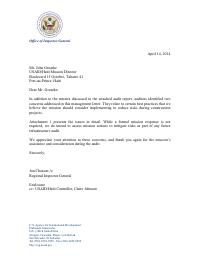
Lèt rekòmandasyon bay direktè misyon USAID/Ayiti a, 14 avril 2014 (rapò 1-521-14-007-P)
Rezime — Lèt rekòmandasyon bay direktè misyon USAID/Ayiti a, 14 avril 2014. Dokiman an gen 4 paj.
Dekouve Enpotan
- Lèt rekòmandasyon bay direktè misyon USAID/Ayiti a, 14 avril 2014.
- Gade rezime anglè a.
Deskripsyon Konple
Lèt rekòmandasyon bay direktè misyon USAID/Ayiti a, 14 avril 2014. Dokiman an gen 4 paj. Gade rezime anglè a pou detay.
Teks Konple Dokiman an
Teks ki soti nan dokiman orijinal la pou endeksasyon.
Office of Inspector General
April 14, 2014
Mr. John Groarke
USAID/Haiti Mission Director
Boulevard 15 Octobre, Tabarre 41
Port-au-Prince, Haiti
Dear Mr. Groarke:
In addition to the matters discussed in the attached audit report, auditors identified two
concerns addressed in this management letter. They relate to certain best practices that we
believe the mission should consider implementing to reduce risks during construction
projects.
Attachment 1 presents the issues in detail. While a formal mission response is not
required, we do intend to assess mission actions to mitigate risks as part of any future
infrastructure audit.
We appreciate your attention to these concerns, and thank you again for the mission’s
assistance and consideration during the audit.
Sincerely,
Jon Chasson /s/
Regional Inspector General
Enclosure
cc: USAID/Haiti Controller, Claire Johnson
U.S. Agency for International Development
Embajada Americana
Urb. y Blvd Santa Elena
Antiguo Cuscatlan, Depto. La Libertad
San Salvador, El Salvador
Tel (503) 2501-2999 - Fax (503) 2228-5459
http://oig.usaid.gov
Attachment
Page 1 of 3
Concern 1. Testing of Materials
Needs Improvement
USAID/Haiti executed construction contracts with CEMEX and THOR Construction Inc. and
required both contractors to develop their own quality control plans. However, CEMEX and
THOR’s quality control plans did not provide clear instructions for testing materials. Neither
company’s quality control plan listed certified independent laboratories to perform the tests or
provided the frequency with which to conduct them. As a result, testing was sporadic and did
not provide effective quality control. Testing shortcomings were most evident in concrete and
reinforcing bar (a steel bar embedded in a concrete structure to support tension loads, allowing
a building to withstand environmental conditions).
•
Concrete testing. For DLA 1.5, CEMEX used its own laboratory to conduct the concrete
tests. CEMEX was not only the construction contractor, but also the supplier of the concrete.
The construction management contractor, PHS Group Inc., conducted periodic, random
tests of the concrete. However, the test results differed from those obtained by CEMEX’s
laboratories. For Caracol-EKAM, THOR did not test the concrete it used, depending instead
on its suppliers to do the testing. The construction management contractor, CEEPCO
Contracting LLC, did random testing using a certified laboratory.
•
Reinforcing bar testing. Because Haiti has no facilities to perform reinforcing bar tests, the
contractors relied on their foreign suppliers for testing. For DLA 1.5, neither CEMEX nor
PHS obtained any samples or performed any tests on the reinforcing bars used. For
Caracol-EKAM, CEEPCO, the construction management contractor, obtained samples but
did not send them out for testing (in Miami) until August 2013, after our site visits.
The mission noted there is no specific requirement to test the cement at an independent
laboratory, and it buys certified steel. While there are no specific requirements following best
practices from other missions and agencies would require additional testing using an
independent, certified laboratory—versus depending on test results from suppliers from foreign
company that do not have the same controls that the United States does—would provide
greater quality assurance and prevent the use of substandard material in USAID-funded
construction projects. USAID emphasizes sustainability, and substandard material could
jeopardize the integrity of the structures.
For future construction projects, the mission should require contractors to use certified
laboratories to test materials indicating the minimum frequency of testing for all materials,
independent of the supplier’s tests.
Concern 2. Key Construction
Clauses Should Be Included in
Future Contracts
Best practices call for building safeguards into construction contracts. To help mitigate loss to
the U.S. Government in the event that a contractor fails to fulfill its obligations, contracts should
include the following:
Attachment
Page 2 of 3
•
A performance bond, a guarantee that a contractor obtains from a bank or an insurance
company to pay the customer (in this case USAID)— if the contractor does not complete a
project satisfactorily.
•
A payment bond, obtained in the same manner as a performance bond and guarantees that
the contractor will pay the labor and material costs to its subcontractors.
•
A provision for liquidated damages, requires the construction contractor to pay the
government an estimated daily rate for each day of delay.
•
A retainage, an amount withheld until all contract requirements have been met or until the
contracting officer is satisfied with the work.
The Federal Acquisition Regulation (FAR) provides guidance on practices that contracting
officers may use to limit risk of nonperformance for construction contracts. For example,
FAR 28.102-1 states that construction contracts issued by the federal government must be
backed by performance and payment bonds, although this requirement may be waived for work
in foreign countries. FAR 11.501 states that “the contracting officer must consider the potential
impact on pricing, competition, and contract administration before using a liquidated damages
clause,” and FAR 52.232-5 states that “if satisfactory progress has not been made, the
contracting officer may retain a maximum of 10 percent of the amount of the payment until
satisfactory progress is achieved.”
The construction contracts with THOR and CEMEX did not include all of these safeguards, as
noted below:
•
Although CEMEX obtained bonds for 100 percent of its award, it had not increased the bond
amounts to reflect the increase in award amount in January 2013.
•
Because THOR had difficulty obtaining a performance bond for the large value of its award,
the mission agreed to reduce the bond requirement to 50 percent (for the first phase), with
the expectation that THOR would complete 50 percent of the 750 houses in Caracol-EKAM.
However, THOR had not met this condition, nor was the bond increased in a timely manner
when the award amount increased.
•
THOR’s current performance and payment bond values are 50 percent of the old award
value; they have not been modified to reflect the May 2013 increase in award amounts.
Furthermore, the contracts with THOR and CEMEX did not include a daily rate for liquidated
damages or the provision for a retainage. Mission staff explained that liquidated damages and
retainages, while commonly required for private sector construction projects, are not necessarily
feasible for foreign assistance projects because the loss to USAID would be difficult to calculate.
However, the U.S. Army Corps of Engineers, which has extensive construction experience in
foreign countries, always includes these provisions to protect the U.S. Government’s interests.
We noted that another USAID construction project included the daily rate of liquidated damages
and retainage clause for even smaller works. Furthermore, one of the awards to CEEPCO for
new settlements contained an estimated daily rate to be paid for each day the contractor was
delayed, as well as provisions related to liquidated damages.
Attachment
Page 3 of 3
According to the mission’s contracting officer, USAID has few policies and procedures for
construction contracts, most of them at the discretion of the contracting officer. We believe that
the mission would benefit from clear procedures and policies for handling these types of
contracts to reduce USAID’s risk of losses from its contractors.
The mission should consider developing a mission policy on construction contracts that requires
contracting officials to (1) follow specific procedures for determining relevant clauses to include,
(2) document all determinations for including or excluding construction clauses and provisions,
(3) include a daily rate if the liquidated damages clause is used, and (4) promptly modify
performance and payment bonds to reflect changes in award amounts.
Kijan pou site
USAID Office of Inspector General, Lèt rekòmandasyon bay direktè misyon USAID/Ayiti a, 14 avril 2014 (rapò 1-521-14-007-P), https://oig.usaid.gov/sites/default/files/2018-06/1-521-14-007-p_letter.pdf