
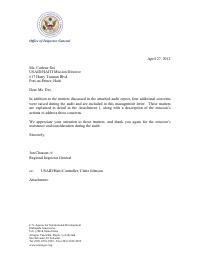
Lèt jesyon sou lòt pwoblèm odit USAID Ayiti te idantifye
Rezime — Li prezante kat lòt pwoblèm yon odit USAID Ayiti te idantifye ak repons misyon an. Yo konplete rapò odit la epi yo trete feblès jesyon ak kontwòl ki mande koreksyon.
Dekouve Enpotan
- Yo te soulve kat lòt pwoblèm jesyon.
- Lèt la anrejistre repons USAID Ayiti pou chak pwoblèm.
- Mezi korektif ak responsablite swivi yo dokimante.
Teks Konple Dokiman an
Teks ki soti nan dokiman orijinal la pou endeksasyon.
Office of Inspector General
April 27, 2012
Ms. Carlene Dei
USAID/HAITI Mission Director
#17 Harry Truman Blvd.
Port-au-Prince, Haiti
Dear Ms. Dei,
In addition to the matters discussed in the attached audit report, four additional concerns
were raised during the audit and are included in this management letter. These matters
are explained in detail in the Attachment 1, along with a description of the mission’s
actions to address these concerns.
We appreciate your attention to these matters, and thank you again for the mission’s
assistance and consideration during the audit.
Sincerely,
Jon Chasson /s/
Regional Inspector General
cc: USAID/Haiti Controller, Claire Johnson
Attachment:
U.S. Agency for International Development
Embajada Americana
Urb. y Blvd Santa Elena
Antiguo Cuscatlan, Depto. La Libertad
San Salvador, El Salvador
Tel (503) 2501-2999 - Fax (503) 2228-5459
www.usaid.gov/oig
Concern 1: Revised Scope May
Not Fit Under Umbrella Contract
USAID/Haiti awarded Chemonics the WINNER contract under an IQC1 for Integrated Water and
Coastal Resources Management. According to the IQC, contractors should be able to respond
rapidly to requests from USAID missions for technical assistance with all aspects of integrated
water and coastal resources management, including sustainable fisheries and aquaculture. The
IQC outlines illustrative tasks including agricultural and food security activities which includes
soil and water conservation and irrigation and drainage management. The IQC includes a
clause that enables the government to make unilateral changes to the contract during
performance, so long as those changes fall within the contract’s scope.
According to Federal Acquisition Regulation 16.505(a)(2), “orders shall be within the scope” of
an indefinite delivery contract. USAID’s own guidance—supplemental guidance to Automated
Directives System (ADS) 302, “Indefinite Quantity Contract (IQC): Task Order Work Statement
Development Checklist”—states that the task order must fit within the scope of the IQC
statement of work.
The initial purpose of the contract was for Chemonics to implement sustainable natural resource
management activities at the scale and density needed to reduce environmental, infrastructural,
and economic vulnerability, primarily in the Cul de Sac, Cabaret, and Gonaïves/La Quinte
watersheds. While the contract awarded to Chemonics focused on watershed related activities
it also included some agriculture related activities on hillsides and in the lowlands.
In January 2011, USAID issued its new strategy for Haiti. This new strategy focused on
stimulating economic activity and enhancing the delivery of basic services in three designated
development corridors. USAID/Haiti revised its approach for assistance to Haiti and modified its
contract with Chemonics to reflect these changes. USAID/Haiti shifted the overall focus of
WINNER from sustainable natural resource management activities in targeted watershed areas
to agricultural and food security activities. Thus, the current contract may not comply with
federal contracting regulations because USAID/Haiti did not consult with the COTR responsible
for the IQC to determine whether the change in the contract fits within the scope of the IQC.
In response to our concern, the mission subsequently obtained a positive determination from
the IQC COTR that the current contract is consistent with the IQC. We believe that this was an
appropriate response and no further action is needed.
Concern 2: Contract Did Not
Define Contract Deliverables
Federal Acquisition Regulation (FAR) 16.306 states that a cost-plus-fixed-fee contract is a cost
reimbursement contract that provides for payment to the contractor of a negotiated fee that is
fixed at the inception of the contract. A cost-plus-fixed-fee contract may take one of two basic
1
An Indefinite Quantity Contract (IQC) is an umbrella contract that allows USAID missions to use the
services of prequalified contractors through a limited competitive bidding process or by sole-sourcing,
thereby expediting the award-making process. The awards, called task orders, can be for any value.
1
forms—completion or term. According to FAR 16.306(d)(1), a cost-plus-fixed-fee completion
award:
describes the scope of work by stating a definite goal or target and specifying an
end product. This form of contract normally requires the contractor to complete
and deliver the specified end product, e.g., a final report of research
accomplishing the goal or target within the estimated cost, if possible, as a
condition for payment of the entire fixed fee.
USAID guidance2 states that if end products or deliverables are required under the contract,
they should be clearly and firmly defined in the technical requirements of the award, and the
criteria for acceptance given.
Although USAID/Haiti awarded Chemonics a cost-plus-fixed-fee completion contract, the
contract did not include clearly defined deliverables or acceptance criteria for the deliverables.
Rather, USAID/Haiti’s contract states that deliverables or milestones will be identified in the
Chemonics annual work plans and that the performance targets proposed in the contractor’s
technical proposal submitted to USAID on May 19, 2009, would be incorporated in the first year
annual work plan. However, USAID/Haiti did not modify the contract to add defined
deliverables.
Because the FAR requires completion of the deliverable as a condition of payment of the entire
fee, the WINNER contract could leave USAID/Haiti with no basis for determining what to pay
Chemonics at the end of the contract
In response to our concern, mission officials indicated that they plan to issue a modification
addressing contract deliverables in early April 2012. We believe this is an appropriate response
to our concern, and we will continue to monitor this issue.
Concern Three: Use of Imported
Seeds
The U.N. papers also promote farmer seed systems3 and participatory plant breeding,4 allowing
farmers to increase variety and limit the cost of production by preserving some independence
from the commercial seed sector. Farmer seed systems ensure the free flow of genetic
materials, thus contributing to the development of locally appropriate seeds and to the diversity
of crops. One report5 states that local varieties of seeds fare better under low-input conditions,
resist local stresses, provide other outputs (such as straw for animal fodder), have stable yields
at low risk over time, and taste or cook better. In addition, the USAID report on seed system
security recognizes the importance of Haiti’s informal seed sector, which provides some 98
percent of the seed farmers sow. The report states that, although there is not much dynamism
2
USAID’s Guidebook for Managers and Cognizant Technical Officers on Acquisition and Assistance,
November 1998.
3
Seed systems through which farmers traditionally save, exchange, and sell seeds, often informally.
4
Arrangement in which farmers are treated as partners by researchers who work directly with them often
combining traditional seeds with modern varieties; most of the testing takes place on the farm.
5
GRAIN, “Seed aid, agribusiness and the food crisis,” October 28, 2008 (accessed on Feb. 13, 2012),
http://www.grain.org/article/entries/683-seed-aid-agribusiness-and-the-food-crisis.
2
in Haitian seed systems, there is clearly potential to build on informal channels for producing
and disseminating varieties and seed in Haiti.
As part of the program, Chemonics is supplying farmers with both local and imported seeds; in
one location. High-priced imported seeds promote dependency, require high-priced inputs and
do not support the best practices for farmer seed systems. In addition, there have been
protests against the introduction of patented seeds. In June 2010, approximately 10,000 Haitian
farmers protested against Monsanto’s donation of corn seed to the program, believing that
reliance on patented seed will erode Haitian farmers’ food sovereignty and self-reliance. In
addition, the hybrid corn and other vegetable seeds provided by Monsanto are treated with
chemical pesticides that require special handling to avoid toxic contamination.
The U.N. papers point out that the use of high-priced inputs—imported hybrid seeds, chemical
pesticides, and fertilizers—can create a cycle of poverty for poor farmers. In a country such as
Haiti, which is cited as the poorest country in the Western hemisphere, and where 78 percent of
the population lives on less than $2 per day,6 this would appear to be a very real danger.
In response to our concern, the mission noted that the new WINNER work plan includes
activities for strengthening local seed farmer producers in order to improve the quality and
constancy of locally sourced seeds. We believe that this is an appropriate response to our
concern.
Concern Four: Support for Biofuels
U.N. papers warn about growing crops for production of biofuels. Dangers cited include (1)
concentration of land and the development of large-scale agricultural exploitations at the
expense of indigenous peoples, (2) increased risk of competition for cropland and water,
threatening biodiversity, and (3) economic development based on the expansion of cash crops,
inflating food prices.
A WINNER-sponsored evaluation of the Jatropha shrub found that although it has some biofuel
uses, the shrub should be used primarily for protecting eroded hillsides. The evaluation noted
that Jatropha is well suited to protecting hillsides because it (1) can be grown on degraded land,
(2) is not grazed by livestock, (3) will not be cut down for firewood because it is unsuitable, (4)
has a lifespan of more than 30 years, and (5) once established can survive long drought
periods.
However, the program is emphasizing Jatropha for biofuel production instead of simply using
the shrub for hillside stabilization. USAID WINNER’s 2010-2011 work plans include establishing
partnership agreements between biofuel manufacturers and Jatropha producer organizations.
The experimental Jatropha plots funded by WINNER tested different varieties—some edible—
for determining oil yields. In addition, the first FY 2011 quarterly report highlighted efforts
including planting 50 hectares of Jatropha in the Cul de Sac plain and in Cabaret for the
production of biodiesel. WINNER staff conducted field visits in October and observed that the
Jatropha plants in the Cul de Sac are already bearing fruit. An additional 40,000 Jatropha
plants had been planted on 15 hectares beginning in January 2011.
6
United States Institute of Peace Special Report, “ Haiti after the Donor’s Conference – a way forward”,
September 2009
3
The WINNER program did not fully integrate practices for food security into its agricultural
activities because the program strives to increase yields and economic growth by 2014.
However, these short-term gains can have negative long-term effects.
Jatropha trials are in progress in the Gonaïves and Cul de Sac watersheds.
(Photos by the Office of Inspector General, July 26 and August 5, 2011)
The mission stated that Jatropha is not included in the new USAID agriculture strategy. We
believe that this is an appropriate response to our concern.
4
Kijan pou site
USAID Office of Inspector General, 2012, Lèt jesyon sou lòt pwoblèm odit USAID Ayiti te idantifye, https://oig.usaid.gov/sites/default/files/2018-06/1-521-12-003-p_letter.pdf