Teks Konple Dokiman an
Teks ki soti nan dokiman orijinal la pou endeksasyon.
Six Lessons for Seed Sector
Development in Fragile States
ii
Activity Title: Feed the Future Global Supporting Seed Systems for Development
activity
Activity start date and end date: Aug 24, 2018 – Dec 22, 2023
Cooperative agreement number: 7200AA18LE00004
Document title: Six Lessons for Seed Sector Development in Fragile States
Publication date: October 2023
Citation: Longley, C. et al. 2023. Six Lessons for Seed Sector Development
in Fragile States. A Feed the Future Global Supporting Seed
Systems for Development activity (S34D) report.
Author’s name: Catherine Longley, Gerrit-Jan Uffelen, Abishkar Subedi, Tony
Ngalamu, Mulemia Maina, Marcia Croft, Noel Templer, Eliud
Birachi, J.C. Rubyogo, and Robin Buruchara
Sponsoring USAID office: LOC Unit, Federal Center Plaza (SA-44)/M/CFO/CMP
Technical office: USAID/RFS/CA
AOR name: Daniel Thomson
Activity Goal: Strengthened interface and collaboration between development and
relief to resilient and market-based seed systems
Language of document: English
Submitted on behalf of: Catholic Relief Services
Submitted by: Jason Sullivan, Chief of Party S34D activity
Catholic Relief Services
228 West Lexington Street, Baltimore, MD 21201
Jason.Sullivan@crs.org
iii
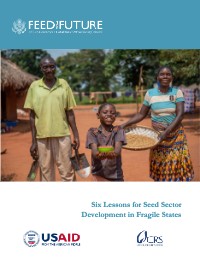
Cover page photo credit: Moses Sawasawa
DISCLAIMER
This report was made possible by the generous support from the American people through the U.S.
Government's Feed the Future initiative and the United States Agency for International Development
through Cooperative Agreement 7200AA18LE00004. The contents are the responsibility of Catholic Relief
Services and do not necessarily reflect the views of USAID or the United States Government.
Feed the Future Consortium Partners in the Feed the Future Global Supporting Seed Systems for
Development activity:
iv
TABLE OF CONTENTS
Acronyms and abbreviations ............................................................................................................................................. v
Executive summary............................................................................................................................................................. 1
1. Introduction..................................................................................................................................................................... 2
2. The six lessons ................................................................................................................................................................ 3
2.1 A clear strategic vision and a structured, coordinated, multi-stakeholder approach is essential to work
effectively towards the long-term goal of seed sector development ...................................................................... 3
2.2 Private sector growth requires seed law and/or seed system governance ...................................................... 4
2.3 Crop and varietal diversity should be maintained and promoted .................................................................... 6
2.4 Crop research is essential and requires collaborations ....................................................................................... 6
2.5 Models for farmer-based seed production must be carefully considered ....................................................... 7
2.6 Informal traders play a crucial role and must be incorporated into gender-sensitive seed sector
development .................................................................................................................................................................... 9
3. Programming prerequisites ........................................................................................................................................... 9
3.1 Long-term, sustained donor commitment and shock-responsive financing mechanisms ........................... 9
3.2 Capacity development and partnerships ............................................................................................................ 10
3.3 Gender-sensitive programming and design ....................................................................................................... 10
3.4 Conflict-sensitive and inclusive approaches ...................................................................................................... 11
4. Concluding remarks ..................................................................................................................................................... 11
References .......................................................................................................................................................................... 13
v
ACRONYMS AND ABBREVIATIONS
AVRDC World Vegetable Center
CGIAR Somali Agricultural Technical Group
CIPDSA Commission Intersectorielle de Production et Distribution de Semences Améliorées
(Intersectoral Commission for the Production and Distribution of Improved Seeds)
COPROSEM Conseil Provincial Semencier (Provincial Seed Councils)
DFID Department for International Development
DRC Democratic Republic of the Congo
EGS Early Generation Seed
FAO Food and Agriculture Organization
FNS-REPRO Food and Nutrition Security Resilience Program
MAFS Ministry of Agriculture and Food Security
NGO Non-governmental Organization
ORE Organization for the Rehabilitation of the Environment
QDS Quality Declared Seed
SATG Somali Agricultural Technical Group
USAID United States Agency for International Development
WUR Wageningen University & Research
1
EXECUTIVE SUMMARY
Existing models for seed sector development are not viable in fragile states due to insecurity and ongoing
political and economic instability. In fragile settings, the formal seed system is either weak or non-existent;
farmers necessarily rely on the informal seed system to acquire seed for planting; and external support to
farmers tends to focus on the intermediate seed system, through emergency seed provisioning and
community-based seed production. The scale of emergency seed provisioning often acts as a barrier to more
sustainable, long-term, market-based seed sector development and has been seen to result in a seed sector
that is both distorted by and dependent on relief aid. The question persists of how humanitarian and
development actors and the private sector can work together to enhance and build resilience within the three
different yet integrated seed systems. Based on case studies in Haiti, Democratic Republic of the Congo and
South Sudan, combined with literature review and first-hand experience, six lessons for seed sector
development in fragile states have been identified:
1. A clear strategic vision for long-term seed sector development (including formal, informal, and
intermediate seed systems) is necessary to support a structured, coordinated, multi-stakeholder
approach.
2. The establishment and growth of the private seed sector requires seed laws and/or alternative forms
of seed system governance and regulatory capacity.
3. Crop and varietal diversity is a key feature of resilience and should be maintained and promoted
through formal, informal, and intermediate seed systems.
4. Collaborations between crop researchers and other actors (e.g., universities, national, and
international agricultural research centers, NGOs, farmers) both within and outside the country are
necessary for the identification, maintenance, development, and (re-)introduction of appropriate
modern varieties.
5. Models for farmer-based seed production must be carefully considered to avoid becoming dependent
on sales to the relief seed market and to ensure that they are sustainable and contribute to the
broader vision for seed sector development.
6. The role of knowledgeable and experienced informal seed traders (often women) must be
acknowledged and incorporated into seed sector development in a gender-sensitive manner.
The following four programming prerequisites are also necessary:
a. Long-term, sustained donor commitment and shock-responsive financing mechanisms;
b. Capacity development and partnerships among different entities, including public-private
partnerships and collaboration across the humanitarian-development-peacebuilding nexus;
c. Gender-sensitive design and programming; and
d. Conflict-sensitive and inclusive approaches, including evidence-based adaptive program
management.
2
1. INTRODUCTION
Fragile states
1 present a particular challenge for seed sector development. Donor-funded seed interventions
tend to prioritize emergency programs that aim to support farmers with access to seed in the short term, but
these programs often do little to support the emergence of sustainable seed systems in the long term. Existing
models for seed sector development are not viable in fragile states due to insecurity and ongoing political and
economic instability. The formal seed system is either weak or non-existent in fragile states, and farmers
necessarily rely on the informal seed system to acquire seed for planting (Box 1). Support to farmers tends to
focus on emergency seed provisioning and community-based seed production, both of which can be
considered as part of the intermediate seed system (Box 1). The scale of emergency seed provisioning in
fragile states, however, often acts as a barrier to more sustainable, long-term, market-based seed sector
development (Tripp and Rohrbach, 2001) and has been seen to result in a seed sector that is both distorted by
and dependent on relief aid (Longley, 2023; Agri Experience, 2022). The question persists of how
international, government, and non-government humanitarian and development actors and the private sector
can work together in fragile states to enhance and build resilience within formal, informal, and intermediate
seed systems
2 for improved food and livelihood security for rural populations.
This briefing paper provides six lessons and four programming prerequisites to help guide donors, policy
makers, program designers, and technical advisers working to support seed sector development in fragile
states. The findings emerge from case studies conducted in Haiti, Democratic Republic of the Congo (DRC),
and South Sudan
3, combined with insights from the literature and first-hand experience of the authors. Each
of these countries is characterized by political instability, weak governance, insecurity due to violence and/or
conflict, frequent natural disasters, population displacement, and persistently high levels of food and nutrition
insecurity. Agricultural production provides the main source of livelihood for a large proportion of the
population, yet production levels remain comparatively low. Aid agencies working in the agricultural sector
commonly provide seed or access to seed on a seasonal basis, yet it is recognized that longer-term, more
sustainable, market-based development is also needed to build more resilient seed systems and make
appropriate modern varieties available to enhance productivity. The following six lessons and four
programming prerequisites offer guidance in this regard.
1 The term ‘fragile state’ is generally used to refer to countries where the legitimacy or authority of the government is in
question, and the state itself is either unable or unwilling to adequately assure the provision of security and basic services
to a significant portion of its population (ILO, 2016). The definition by the United States Agency for International
Development (USAID) of fragile states includes a broad range of failing, failed, and recovering states. More recent
discourse tends to take a less state-centric perspective by referring to ‘fragile settings’ or ‘fragile situations’ (Bosetti et al.,
2016; Bolling et al., 2019; Hussein, 2017).
2 Unless specifically stated otherwise, the term “seed system” is used to refer to all three aspects of seed systems (formal,
informal, and intermediate). Similarly, the “seed sector” includes all three sub-types of seed systems.
3 The Haiti case study was undertaken as a desk study, based on remote interviews and literature review (Croft, 2022).
The DRC case studies involved two parts: (a) in-person interviews with key seed system actors and stakeholders,
combined with a literature review and data results from a survey of informal traders (Templer et al., 2022); and (b)
remote interviews with private seed companies (Agri Experience, 2022). The South Sudan case study was undertaken in
collaboration with the FAO Food and Nutrition Security Resilience Program (FNS-REPRO), based on in-person
interviews with seed system actors and stakeholders, combined with documentation review and a series of multi-
stakeholder workshops at local, state, and national levels (Subedi et al., 2023a).
3
Box 1. Understanding the three seed system types
2. THE SIX LESSONS
2.1 A clear strategic vision and a structured, coordinated, multi-stakeholder approach
is essential to work effectively towards the long-term goal of seed sector development
The absence of common agreement about the long-term goals and lack of well-orchestrated action and
coordination are perhaps the two biggest challenges for seed sector development in fragile states. With many
different aid actors and approaches, combined with weak government structures and weak governance, it is
not uncommon to find situations where some agencies are promoting a potentially sustainable, commercially
oriented seed system whilst other agencies working in the same area are distributing free seed to farmers,
thereby undermining potential seed sales by emerging agro-dealers and commercial seed providers. Not only
is it necessary to have a clear strategic vision and coordinated approaches at the overall sectoral level but also
coordinated interventions at the local level. This will help to ensure that different agencies and organizations
are working towards the same goals, to the same technical standards and processes, and to promote the
efficient use of limited funding and capacity resources through collaborative links and partnerships. Different
mechanisms for coordination were identified in each of the case studies.
In Haiti and DRC, coordination and regulatory functions are combined, involving both state and various
non-state actors (including the private sector) in what might be referred to as a hybrid governance mechanism
(Meagher et al, 2014). In Haiti, this was conceived at the national level under the Ministry of Agriculture
4,
whereas, in DRC, it operates at the provincial level. DRC’s multi-stakeholder provincial seed councils (conseil
4 The establishment of the Intersectoral Commission for the Production and Distribution of Improved Seeds
(Commission Intersectorielle de Production et Distribution de Semences Améliorées, CIPDSA) in 1995 under the
Ministry of Agriculture was an important milestone in the Haitian government’s coordination and regulation of the seed
sector (Croft, 2021). CIPDSA included ministry representatives, farmer organizations, NGOs, and private sector
representatives as well as critical funding from the European Union and technical support from FAO. Unfortunately,
CIPDSA collapsed in 2002 due to financial mismanagement (CIAT et al., 2010).
The formal seed system is a deliberately constructed system that supports the development, production, and
distribution of seed of verified varieties that meets established quality standards through plant breeding, variety
release, seed quality control and assurance (which is often mandated to occur through certification), and the sale of
seed through registered outlets. The system is governed by national seed laws, policies, and regulatory controls. The
formal seed system usually involves a limited range of crops with higher commercial value.
The intermediate seed system – sometimes referred to as the semi-formal seed system – is increasingly
recognized as the organized production and distribution of quality seed of either modern or local varieties by either
individual farmers or groups of farmers, often supported by NGOs or donor-funded projects. The crops involved
tend to be those that are not sufficiently produced by the formal seed system, especially self-pollinating crops. The
system is subject to lower levels of quality assurance, sometimes involving quality declared seed (QDS). In this
briefing paper, emergency seed provisioning by relief agencies is also considered as part of the intermediate seed
system.
The informal seed system – also referred to as the farmer or local seed system – includes methods that farmers
and traders produce, select, manage, disseminate, and procure seed; from their own harvest, through gifts, barter or
sale among friends, neighbors, and relatives, and through local markets. Varieties in the informal system may be
variants of modern varieties originally sourced from the formal system or they may be landrace varieties developed
over time through farmer selection. The system is guided by local technical knowledge and standards and mediated
by local social structures and cultural norms.
Source: Adapted from Westengen et al. (2023)
4
provincial semencier, COPROSEM) were established with support from various international aid projects
and not only provide strategic direction and coordination but also play a role in developing local seed laws
and policies, as described in 2.2 Private sector growth requires seed law and/or seed system governance. A
Seed Strategy for North and South Kivu has been developed, and several stakeholder meetings have taken
place, attended by public and private entities as well as relief agencies (Agri Experience, 2022).
In South Sudan, a National Seed Hub was created in 2022, spearheaded by the University of Juba and
Wageningen University and Research (WUR)
5, to provide a neutral and independent platform for information
sharing, capturing good practice, joint learning, and the development of policy briefs and calls to action.
6 The
South Sudan Seed Hub is a multi-stakeholder partnership that brings together seed actors and stakeholders
dedicated to building a robust, inclusive, sustainable, and resilient seed sector in South Sudan. To date, the
South Sudan Seed Hub has held a multi-stakeholder event
7 to endorse their overall approach and published
two policy briefs, including a detailed and well-structured call to action for transforming the seed sector in
South Sudan.
8 Another multi-stakeholder event is currently being planned that will move forward with the
call for action by consulting stakeholders to develop a national seed policy and regulatory framework with a
particular focus on guiding the transition from seed relief to seed sector development.
Effective coordination requires a detailed understanding of the existing seed systems (including formal,
intermediate, and informal seed systems)
9, the actors and institutions involved, as well as consensus towards
the way forward in addressing challenges and the need for development. Decisions must be made as to which
pathways should be followed to achieve agreed long-term goals, and how short-term emergency interventions
can be designed to support rather than hinder the achievement of these goals. Recognition within the aid
communities of the need to work together within the humanitarian-development-peace nexus offers a means
by which collective outcomes can be pursued.
2.2 Private sector growth requires seed law and/or seed system governance
In all three case study countries, the overwhelming challenge for private sector growth was the lack of seed
laws and regulatory capacity. Without seed laws, professional private sector companies wishing to produce
high quality seed cannot effectively compete against unqualified and unscrupulous seed producers and traders
who take advantage of the profits to be made through tenders from relief agencies for emergency seed
distribution (Fintrac Inc, 2019; Agri Experience, 2022). The poor quality of seed then reduces farmer demand
for improved varieties, creating a vicious cycle of underinvestment in seed production, marketing, and
distribution (ibid). In Haiti, support from FAO, regional bodies, and key donors has been instrumental in
5 WUR is one of the partners of FNS-REPRO. The Seed Hub is jointly facilitated by the University of Juba and WUR in
collaboration with the Ministry of Agriculture and Food Security (MAFS), the Directorate of Agricultural Research, and
the Integrated Seed Sector Development Africa program.
6 See https://issdafrica.org/2023/04/05/south-sudan-building-a-robust-inclusive-sustainable-and-resilient-seed-sector/.
7 The first Seed Hub event involved 51 national and international seed professionals representing government, national
and international research institutes, educational organisations, development and humanitarian actors (FAO in
particular), NGOs, seed companies, civil society, policy makers, and donors.
8 See https://issdafrica.org/wp-content/uploads/2023/04/WCDI-23-252_CallToAction-SeedSector10Pathways-
SouthSudan.pdf.
9 A recent paper by Westengen et al. (2023) argues that the complementarities between the formal, intermediate, and
informal seed systems are such that a new agenda for seed system development is taking root. The paper usefully
presents a more holistic conceptualization of seed systems (based on functions and context) and provides signposts to
guide efforts to develop resilient and inclusive seed systems.
5
developing draft policies but, until these policies can be passed by parliament
10, they cannot be legally
enacted.
Even where seed laws exist, if the regulatory bodies do not have the capacity to approve new varieties, verify
seed quality standards, and legally prohibit unscrupulous seed producers and traders from putting low quality
or counterfeit seed into the market, then this also presents similar challenges. Supplying low quality or
counterfeit seed is possibly worse than supplying no seed at all because it leads farmers to distrust any
commercial seed (Agri Experience, 2022). Depending on the capacity of the private sector, it might be
possible for private seed companies to step up to play a role in seed certification and regulation. In some
countries, some of the certification services are contracted out to third parties (which can be private sector),
with the regulatory body taking responsibility for training, authorizing, and then auditing the results of the
third parties.
11
In the DRC, multi-stakeholder Conseil Provincial Semencier (Provincial Seed Councils or COPROSEMs)
have emerged in some provinces in response to the lack of governing and regulatory structures. COPROSEM
draws representatives from the public and private sectors and is mandated to coordinate seed sector activities
at a provincial level (Agri Experience, 2022; Templer et al., 2022). In some cases, COPROSEM has played a
role in the seed relief market, coordinating with the Food Security Cluster and drawing on their direct links
with private seed companies. As a platform, COPROSEM allows seed industry players to identify the priority
issues constraining the industry and develops plans for their resolution. In the case of South Kivu Province,
three policy issues that have been considered for action include: a) putting into practice a QDS standard; b)
making the exemption process for seed importers widely applicable and not dependent on a Kinshasa-based
approval process; and c) simplifying the process of a new variety registration in the national variety catalogue
(Fintrac Inc, 2019).
In the absence of seed laws and regulatory bodies in South Sudan, it has been proposed that seed systems
governance should begin by developing sets of principles to guide donors and seed actors, including training
and resource packages (Subedi et al., 2023a). It is important that such principles should also encompass “do
no harm” in relation to broader seed sector development and especially the development of the private sector
(van Uffelen et al., 2023). It is necessary to transform the prevailing relief seed aid model in South Sudan to
allow for genuine, demand-driven private sector development that responds to farmer seed demand rather
than the demands of relief seed markets. Such an approach necessarily entails creating demand by making
farmers aware of the crops and varieties available from the private seed sector and ensuring that the quality of
seed is such that farmers are not discouraged by poor-performing seed.
Private sector seed companies are an essential component of the formal seed system. Yet it is also important
to understand that the private sector cannot supply seed of all crops and that there is also a role for the
intermediate seed system and the informal seed system. Seed of some self-pollinating crops, for example, can
be appropriate for farmer-based seed production through the intermediate seed system (see 2.5 Models for
farmer-based seed production must be carefully considered). The informal seed system plays an essential role
in maintaining the diversity of crops and varieties and ensuring that farmers can access seed through social
networks and local markets (see 2.6 Informal traders play a crucial role and must be incorporated into
gender-sensitive seed sector development). It is necessary for seed laws and regulatory systems to recognize
and support all three seed systems, enabling farmers to access good quality and affordable seed of appropriate
varieties, according to the local context and preferences. Seed system policies and governance should also
apply an appropriate gender lens (Puskur, 2021) and recognize the different roles of women in seed sector
10 In Haiti, parliament was not operating at the time of the case study data collection (September 2021), making it
impossible for the seed law to be passed, despite having been validated with the support of FAO.
11 This occurs, to varying degrees, in South Africa, Zambia, Kenya, and Rwanda.
6
development (Subedi et al., 2023b). In cases where the national government is unable to generate and
implement seed laws and regulatory systems, the hybrid governance systems elaborated above can be
effective. An agreement among aid agencies and seed sector actors on principled approaches might provide
an effective starting point in working towards seed system governance.
2.3 Crop and varietal diversity should be maintained and promoted
Crop and varietal diversity is a key feature of seed system resilience (McGuire and Sperling, 2013; Longley et
al., 2023, forthcoming). In cases where varieties provided through emergency seed interventions meet local
preferences and are adopted by farmers, this effectively strengthens the resilience of local cropping systems
by broadening the range of varieties cultivated, thus reducing the risk of crop failure, and helping to ensure
that seed will be available the following season. Much has been written about the dangers of introducing seed
of untested new varieties as part of emergency interventions (e.g., FAO, 2010; Sperling, 2001). Identifying and
introducing appropriate new varieties must be done in a participatory manner under the guidance of crop
experts as part of longer-term interventions that allow diverse farmer types to test new varieties for
themselves. Farmers must then be able to acquire quality seed of their preferred new varieties on a sustainable
basis, whether through informal, intermediate, or formal seed systems.
Local varieties (also known as farmer varieties and including landraces) are an essential component of varietal
diversity. Though they may have lower yields, they are well-adapted to local conditions, have better eating
qualities, and are often more resilient than higher-yielding imported varieties. The value of local varieties
should be recognized and promoted by aid practitioners and technical experts within policy and programming
(Subedi et al., 2023a). As such, new varieties should be intended to complement, not to replace, local varieties.
For some crops, women act as custodians of local varieties, yet diversity losses are known to occur as a result
of conflict, population displacement, and replacement by new varieties (see, for example, Subedi et al.,
2023b).
12
2.4 Crop research is essential and requires collaborations
The importance of varietal diversity has been highlighted above. One way in which varietal diversity can be
enhanced is through the regular introduction of new varieties that are appropriate to the local agro-ecology
and also meet market demand and/or farmer preferences (provided that they are not intended to replace local
varieties). For resilient cropping systems, new varieties must also have some resistance to local pests and
diseases as well as tolerance to current and future climate variability. Varietal development and crop research
are important components of the seed sector, both to identify existing modern varieties that are suitable for
introduction (e.g., from neighboring countries), and to develop new varieties through plant breeding
methods, often using germplasm from local, adapted varieties. Farmers have a role to play in testing, selecting
and multiplying new varieties, and these efforts can be facilitated by NGOs that work directly with farmers
and also have strong links with crop researchers.
Institutional capacity for formal plant breeding and crop research is generally extremely weak in fragile states,
whether in national agricultural research institutes or universities. Individual trained plant breeders and
researchers – who tend to be very few in number – are often unable to carry out their work within the
country due to insecurity, institutional collapse, and/or lack of public sector funding. As such, formal plant
breeding in fragile states poses significant challenges, resulting in a small number, if any, of new varieties. This
limits opportunities for the private seed sector to develop seed businesses and limits the choice of varieties
available to farmers. In such contexts, the selection and registration of popular local varieties through
12 The introduction of community-level gene banks that conserve, produce, and exchange local crops and varieties in
areas where their risk of loss is high, linked with a national gene bank, is potentially a worthwhile investment.
7
participatory variety selection can play a significant role in filling the gaps in formal plant breeding and
making varieties available for multiplication by private seed companies, local seed businesses, or farmer
groups. Such a strategy needs support from donors, policy-makers, the national agricultural research system,
and resilience-building and development seed intervention programs.
In many cases, the international agricultural research centers of the Consultative Group on International
Agricultural Research (CGIAR) have provided support for crop research in fragile states, either working as a
consortium or individually. CGIAR also plays a key role in providing publicly-available germplasm and
varieties into seed systems. In the cases of Haiti and Somalia, despite the collapse of the national agricultural
research system, trained plant breeders from the country have been able to establish their own organizations
to identify and multiply appropriate new varieties.
13 The role of CGIAR centers, outside universities, and
neighboring national agricultural research systems has been critical in supporting these efforts, as well as in
supporting capacity development for crop research within the national agricultural research centers and in-
country universities.
It is not uncommon for crop researchers to collaborate with NGOs that work directly with male and female
farmers. For example, NGO-supported farmer field schools – when carefully designed – can play an
important role in testing new varieties and providing feedback to researchers. Where NGOs wish to support
farmer seed production, it is advisable to liaise with crop researchers to identify appropriate varieties for
multiplication
14 and to locate the necessary high-quality parent seed (Early Generation Seed [EGS]
15) for
multiplication.
2.5 Models for farmer-based seed production must be carefully considered
Seed production by organized farmer groups is commonly found across fragile states, usually supported by
donor-funded interventions that aim to increase the local availability of seed and generate income for
smallholder farmers. In many cases, these schemes are part of broader efforts to replace imported seed aid
with good quality, locally produced seed of locally adapted varieties. Some schemes focus on the
multiplication of improved varieties in an effort to promote particular varieties among farmers and thus
increase smallholder production. Some stakeholders might argue that organized seed production by
smallholder farmer groups can support long-term, sustainable seed sector development. The extent to which
this argument is justified depends on the models used to design such schemes as well as the crops and
varieties being multiplied, as described in the paragraphs below.
Multiple models exist, from contract growers to cooperatives and farmer associations, each with various
arrangements for the supply of parent seed, quality control, and seed sales. Groups might multiply seed of
local varieties or modern varieties, though the supply of quality parent seed (EGS) for modern varieties is
13 In Haiti, Organization for the Rehabilitation of the Environment (ORE) is a local NGO that was established by a
professional crop breeder and is thought to be the only organization that is regularly testing and screening new varieties
through links with CG centers and American universities. Similarly, the Somali Agricultural Technical Group (SATG)
has worked with CG centers, AVRDC, various universities, and the Kenyan Agricultural Research Institute to
successfully identify and re-introduce varieties of mungbean and maize that had been lost. See
https://satg.org/agriculture/
14 It is essential that the testing of new varieties and the identification of varieties for multiplication are done in an
inclusive manner, involving both male and female farmers, old and young.
15EGS refers to the generations of seed that are necessary to produce certified seed or some types of Quality Declared
Seed. EGS includes breeder seed, pre-basic seed, and basic seed, with each generation becoming proportionately larger
in volume based upon the crop's seed multiplication rate.
8
often a challenge due to the limited capacity within the formal seed system.
16 Seed quality might be monitored
and verified by the group members themselves, by the supporting NGO, by a private sector seed company
(mainly for their own contract growers), or by local-level agricultural officers or seed authorities (if they exist).
Unless legal frameworks for QDS are present, or similar standards exist as part of seed system governance
arrangements, it is likely that different agencies will apply different seed quality criteria. With the exception of
contract growers, the sustainability of farmer-based seed producer groups depends on their ability to sell the
seed that they produce – this not only requires groups to be able to produce good quality seed but also to be
able to market and sell their seed. Farmer groups often lack capacity and the necessary external linkages for
marketing and sales; these aspects might be best handled by an intermediary, or by linking with another seed
enterprise.
If farmer seed multiplication groups are expected to sell their seed to other farmers, then it is essential to
understand the nature of farmer seed demand and to be able to identify which crops and varieties are likely to
be viable for farmer-based seed enterprises. Farmers are more likely to purchase seed of commercially
oriented crops than subsistence-oriented crops, especially if the seeds of these crops are particularly difficult
to process and store (e.g., soybean, some vegetables, and legumes that are prone to pest attack in storage).
The seed of crops with high seeding rates and low multiplication rates (e.g., legumes) are likely to have higher
demand than crops with low seeding rates and high multiplication rates (e.g., grains). Seed of new, locally
adapted varieties that exhibit farmers’ preferred characteristics will be in high demand for a few seasons, but
once the variety has been widely adopted and is available through the farmer seed system, then fewer farmers
will need to purchase it. Farmer seed production groups that focus on crops and varieties that are in demand
by farmers and are able to change the varieties on offer according to changes in demand are more likely to be
financially viable over time.
In a few cases, farmer-based seed production groups have successfully transitioned to become commercial
seed companies. In many cases, seed produced by farmer groups is purchased by the supporting NGOs or
other institutional buyers for on-going relief seed distributions. In some cases, however, farmer groups do not
have the necessary links with institutional buyers and/or lack the internal structures and processes required by
NGO procurement policies, forcing them to rely on intermediaries or wholesalers who might then sell the
seed to institutional buyers or retailers. The sustainability of community seed producer groups is a key
challenge in non-fragile settings (FAO & ICRISAT, 2015) and, in fragile contexts, smallholder seed producer
groups are rarely able to sustain themselves through seed sales to farmers once support from NGOs comes
to an end (Longley et al., 2023). In the case of DRC (Central Kasai Province), the agri-multiplier model was
designed to provide certified seed to smallholder farmers, thus linking the formal seed system to farmers.
However, the sale price required by the agri-multipliers in order to cover their costs is simply too high for
farmers to afford. As a result, the agri-multipliers primarily sell their seed to institutional buyers – NGOs
17,
the FAO, and the government (Walters et al., 2023).
In general, the dependence of farmer-based seed producer groups on sales to the relief seed market raises
questions as to their long-term sustainability. It might be argued that the relief seed market provides an
opportunity to build necessary farmer seed production capacity and constitutes a necessary stage in the
longer-term evolution of intermediate or semi-formal seed systems. On the other hand, it can also be argued
that the relief seed market creates dysfunctional, unsustainable seed systems that are unable to respond to
small farmer demand. Which argument is true will depend on the scale, longevity, and design of donor-
funded seed interventions (Longley et al., 2023), including the ability to objectively audit and evaluate donor
16 Moreover, breeders are unlikely to provide high-quality EGS without having access contracts and a clear
understanding on its multiplication and dissemination. Multiplying groups may not be aware of the need to replenish
EGS after 3 seasons, and many will keep multiplying beyond this, even when the original purity and vigor is lost.
17 Agri-multipliers are reported to be well-connected with NGO procurement departments.
9
interventions to ensure that they are effectively supporting an overall seed sector development strategy. It is
therefore necessary to consider very carefully the models used for farmer-based seed producer groups in
relation to sustainability and the broader vision for seed sector development.
2.6 Informal traders play a crucial role and must be incorporated into gender-
sensitive seed sector development
Informal traders play a very important role in informal seed systems in general, and in fragile settings in
particular (Sperling and McGuire, 2010; Sperling et al., 2020). In Haiti, the DRC, and Southern Somalia, there
are some small-scale informal traders – often women – who differentiate seed and grain both at source and in
their management practices, and seed is sold at a premium in local markets (Croft, 2022; Templer et al., 2022;
Walters et al., 2023; Longley et al., 2001). It is increasingly recognized that informal traders need to be
incorporated into seed sector development (and acknowledged in seed laws and regulatory systems)
18, but
there is still relatively little programming experience as to what this might look like in practice. There is
potential for informal traders to play a role in the dissemination of improved varieties, and two different
models for this are currently being tested in DRC (Onyango et al., 2022). There is also potential to enhance
the quality of the seed that traders sell by building their capacity for sourcing and managing seed of local
varieties.
19
Many informal traders who deal in seed are women, and it is crucial to understand the gender dynamics of
informal seed markets so that equitable support and gender-sensitive seed governance mechanisms can be
designed. In Haiti, female traders (known as Madam Saras) play a pivotal role in the informal seed system, yet
gender-sensitive approaches to seed system development are not common, and the draft seed law does not
appear to have been reviewed from a gender lens (Croft, 2022). In the DRC, although most traders dealing in
beans and cassava (both as grain and seed/planting material) are women, they lack access to capital and
business skills training, and a lower proportion of women are actively trading seed/planting material, as
compared to their male counterparts (Templer et al., 2022). These results clearly show that ignoring the
gendered dynamics of women’s roles in the informal seed system would jeopardize the future inclusive
development of these systems (Croft, 2022; Subedi et al., 2023b).
3. PROGRAMMING PREREQUISITES
The following four programming prerequisites are considered to be essential for successful seed sector
development in fragile states:
3.1 Long-term, sustained donor commitment and shock-responsive financing
mechanisms
Seed sector development requires sustained donor commitment, ideally through strategic and collaborative
donor arrangements to ensure holistic, well-designed, and principled support that avoids duplication and
gaps. It has been argued that the type of integrated systems approach that is proposed above necessitates a
transformation in the current aid architecture for protracted crises (Bakker et al., 2021). At a minimum, long-
term, shock-responsive financing mechanisms are needed both at the sectoral level for coordination,
governance, and capacity building, and also at the project level to provide support to seed system actors,
including private sector actors. There are various options for shock-responsive financing mechanisms within
18 Whilst it is necessary for the role of informal traders to be acknowledged, this does not imply that they should also
adhere to the registration processes and assurance for quality standards that are required by formal sector actors.
19 There are various ways in which this might be done, but attempts to ‘formalize’ informal seed systems (e.g., by
imposing formal sector quality assurance) should be avoided.
10
long-term development or resilience funds. These include internal risk facilities
20, contingency funding, and
crisis modifiers
21 (Rohwerder, 2017). These financing mechanisms necessarily go hand-in-hand with evidence-
based adaptive programming approaches, allowing implementing partners to pivot from developmental to
emergency programming when necessary (Peters and Pichon, 2017).
3.2 Capacity development and partnerships
Various types of capacity development are required for seed sector development in fragile states. One
capacity challenge that is often underestimated is the change in mindset and programming modalities required
by both individuals and agencies to coordinate, collaborate, and partner with others across the humanitarian-
development-peacebuilding nexus. Personnel from NGOs and other agencies that are accustomed to working
in an emergency or humanitarian mode often find it difficult to adapt their mindsets to take on a more
resilience-oriented or developmental perspective. Such agencies also often lack the specialized technical
capacity needed to fully understand and strengthen seed systems. Similarly, technical seed sector specialists
and crop researchers may not fully understand how the humanitarian system operates in fragile states.
Weak government structures and challenges to private sector development have already been highlighted.
Whilst it may or may not be possible or appropriate to build government institutional capacity, the capacity of
individual government officers, technical staff, and private sector specialists can be enhanced, e.g., through
on-the-job training, temporary placements with partner organizations, or study visits and opportunities for
working with public and private sector organizations in neighboring countries. In each of the case studies,
there were examples of particular champions for seed sector development who possessed a highly specialized
technical knowledge and had the leadership skills, energy, and determination necessary to provide a driving
force for seed sector development; such champions should be supported where appropriate.
Each of the case studies also had successful examples of public-private partnerships, e.g., with universities;
national and international agricultural research centers; government departments and offices at national,
provincial, and local levels; national, regional, and international companies; UN agencies, international and
local NGOs; and agro-input dealers, private traders, and farmers.
As noted above, sub-regional partnerships, especially with neighboring countries' national agricultural
research systems, are also important in accessing new varieties to make available to the private sector. In this
regard, sub-regional partnerships should also be extended to the level of private seed companies, enabling
them access EGS from neighboring countries for varieties that have been tested and shown to be adapted
and appropriate to farmers’ needs and preferences.
3.3 Gender-sensitive programming and design
As highlighted above, women play a key role in informal seed systems: as producers and providers of seed, as
custodians of local varieties, and as specialized seed traders. There is sound evidence that gender-related
issues influence farmers’ crop and varietal preferences, access to and use of seeds and related knowledge, as
well as outcomes in terms of seed availability, seed quality, seed affordability, and control over seed use
(Subedi et al., 2023). It is necessary to understand not only the different roles of women and men within seed
20 The Internal Risk Facility of the United Kingdom’s Department for International Development (DFID) provides
trigger-based, predictable funding for early emergency response within multi-year programs, e.g., Somalia.
21 Three types of crisis modifier mechanisms have been described by the literature. In one type, an agreed percentage of
an overall development budget can be used for emergency relief under a pre-approved budget reallocation mechanism
(Levine et al., 2019, cited by Rohwerder, 2017). In another type, emergency funds can be injected through existing
development programs to quickly address humanitarian needs (USAID, 2017). A third type of crisis modifier effectively
acts as a contingency fund (Lung, 2020). Further details about crisis modifiers can be found in Peters and Pichon (2017).
11
systems – particularly so in protracted crisis contexts – but also their existing resilience capacities and how
gender shapes seed security and seed management practices for different crops. Gender-sensitive design and
programming can lead to stronger, more resilient seed systems as well as providing direct benefits to women
by recognizing their preferences, interests, and aspirations and by overcoming barriers to seed access (Puskur,
2021). Targeted support for women (whether as farmers or as seed entrepreneurs) through seed system
development can also contribute to empowerment outcomes for women (Subedi et al., 2023; Puskur, 2021).
3.4 Conflict-sensitive and inclusive approaches
Any intervention conducted in fragile and conflict-affected countries has the potential to do harm by
inadvertently amplifying existing tensions, inequalities, and grievances. A conflict-sensitive approach entails
understanding the context in which an intervention is implemented so that it can be designed and
implemented in ways that minimize any potential negative consequences and maximize its positive effects on
conflict dynamics (USAID, 2022; Darwish, 2023). Conflict sensitivity involves a continued analysis of conflict
dynamics in the operational context; an understanding of the potential and actual impact of interventions on
conflict dynamics; and the adjustment of operational and programming choices in an adaptive manner to
reduce conflict risks, and where possible, promote positive connections both between and among groups
(Darwish, 2023). Adaptive program management
22 is necessary to allow for operational and programming
adjustments to ensure conflict sensitivity and inclusivity.
Working within the seed sector, positive connections can be promoted at various levels, e.g., among farmers
from different population groups
23 or among the different stakeholders involved in hybrid governance
models such as COPROSEM. By adopting a social cohesion approach, seed system interventions
implemented as part of nexus programming can potentially, in small ways, contribute to peacebuilding by
preventing conflict and lowering tensions by fostering cooperation and trust between different actors and
stakeholders (Sperling et al., 2022). Such interventions must be based on conflict analysis
24 that is both
gender-sensitive and inclusive, incorporating a multi-faceted understanding of vulnerability that includes
ethnicity, powerlessness, residence status (i.e., whether internally displaced persons, returnees, etc.), gender,
youth, and disability. Working with private sector seed companies, it is important to be aware of potential
tensions due to international/national ownership, as well as ethnic or political affiliations.
Security considerations and area-based approaches are also relevant to conflict-sensitive approaches. In the
DRC, for example, new models and partnership arrangements were tested in stable areas to determine their
feasibility elsewhere (Bommart, 2021).
4. CONCLUDING REMARKS
The six lessons and four programming prerequisites presented in this paper are intended to help guide
donors, policy makers, program designers, and technical advisors working in the humanitarian and
development spheres to devise seed sector development strategies appropriate to fragile states and fragile
settings. Current programming approaches focus mainly on the intermediate seed system (i.e., emergency seed
22 Adaptive program management is a built-in strategy to continuously learn, iterate, and adapt to enhance program
relevance and effectiveness throughout the program cycle (Desai et al., 2018 cited by Bolling et al., nd).
23 See, for example, work by MercyCorps in Nigeria on building social cohesion between internally displaced persons
and host communities through a seed outgrower scheme: https://nigeria.mercycorps.org/blog/helping-crisis-affected-
populations-thrive. Another example would be working with farmers and herders to support seed systems development
for the production of high-quality fodder or forage for livestock.
24 A conflict analysis tool has been developed to understand seed systems in conflict-affected areas of fragile states and
help aid agencies to identify practical entry points to design appropriate interventions and whether these might be tied to
peacebuilding efforts. See https://issdafrica.org/wp-content/uploads/2022/07/CAT_Final_English.pdf.
12
provisioning and community-based seed production), often using programming modalities and models that
create dependency on the relief aid system, both on the part of private sector seed companies and farmers.
This situation does little to build resilience within the seed sector. In contrast, there has been insufficient
attention given to long-term support for the development of both the formal and informal seed systems, and
the repeated direct distribution of relief seed hinders the emergence of a market-based private seed sector
driven by farmer demand.
Working within fragile settings, seed systems must be resilient, i.e., able to adapt and transform to withstand
the shocks and stressors that characterize such contexts. Within the humanitarian sector, the concept of
resilience has prompted a new way of thinking about aid in crisis contexts, one in which humanitarian,
development, and peacebuilding efforts are brought together in interconnected, context-specific, multi-agency
interventions. Such an approach, in theory, makes it possible to support emergency needs in the short term
whilst also promoting broader seed sector development in the long term. However, this requires strong
coordination, collaboration, and strategic integration which, in practice, is a challenge. The on-going global
and local dialogues on food systems transformation
25 and the food systems resilience agenda in protracted
food crisis contexts (Bakker et al., 2021) might offer scope and opportunity for overcoming this challenge, as
seed systems are a critically important sub-system of the food system.
25 See https://www.unfoodsystemshub.org/en and https://summitdialogues.org/.
13
REFERENCES
Agri Experience (2022). Report on Formal Seed Sector Key Informant Interviews in the Democratic
Republic of the Congo. A Feed the Future Global Supporting Seed Systems for Development activity (S34D)
report. https://www.crs.org/sites/default/files/pa00zz4p.pdf
Bolling, Rojan, Jacqueline Vrancken and Arthur Rempel (2019). ‘Aid transitions Quick-scan 1: Typologies for
agricultural development in fragile settings’. Aid transitions in fragility and protracted crisis settings Project.
The Broker Food & Business Knowledge Platform: Community of Practice on food security & stability.
Bolling, Rojan, Kim van Wijk and Yannicke Goris (no date). Adaptive programme management in fragile and
complex settings. The Broker Practice Note, commissioned by the Food & Business Knowledge Platform.
https://knowledge4food.net/wp-content/uploads/2019/02/190205_Practice-
note_AdaptiveProgrammeManagement.pdf
Bommart, Diane (2021). Adapting Market Systems Development in Conflict Affected Areas. ÉLAN RDC,
Adam Smith International.
Bosetti, Louise, Alexandra Ivanovic and Menaal Munshey (2016). Fragility, Risk, and Resilience: A Review of
Existing Frameworks. United Nations University Centre for Policy Research Background Paper.
CIAT, CRS, SNS-MARDNR, UEA, FAO, World Concern, Save the Children, ACDI/VOCA, Save the
Children and World Vision, 2010. Seed System Security Assessment, Haiti. A study funded by the United
States Agency for International Development, Office of Foreign Disaster Assistance. (USAID/ODFA)
August 2010. Arusha, Tanzania: International Center for Tropical Agriculture.
Croft, Marcia, (2021). Seed Systems in Fragile States - Haiti Case Study. A Feed the Future Global Supporting
Seed Systems for Development (S34D) activity report. https://www.crs.org/sites/default/files/seed-systems-
haiti-case-study.pdf
Darwish, S. (2023). Integrating Conflict Sensitivity into Food Security Programs. Washington, DC:
Implementer-Led Design, Evidence, Analysis and Learning (IDEAL) Activity.
Desai, Harsh, Gabriele Maneo, Erica Pellfolk and Annika Schlingheider (2018). Managing to adapt. Analysing
adaptive management for planning, monitoring, evaluation, and learning. Oxfam research report.
https://www.alnap.org/system/files/content/resource/files/main/rr-managing-to-adapt-pmel-220318-
en.pdf
FAO (2010). Seeds in Emergencies: A technical handbook. FAO Plant Production and Protection Paper 202.
Rome: FAO.
FAO & ICRISAT (2015). Community Seed Produc on, by Ojiewo CO, Kugbei S, Bishaw Z & Rubyogo JC,
eds. Workshop Proceedings, 9-11 December 2013. FAO, Rome & ICRISAT, Addis Ababa. 176 pp.
https://oar.icrisat.org/8854/1/2014-453%20CPE%20173%20Community%20Seed%20Production.pdf
Fintrac Inc. (2019). Seedclir: Democratic Republic of the Congo. Feed The Future Enabling Environment for
Food Security Project, USAID.
https://www.agrilinks.org/sites/default/files/resources/drc_seedclir_country_report_final.pdf
Hussein, Karim (2017). Fostering inclusive rural transformation in fragile states and situations. IFAD
Research Series 08. International Fund for Agricultural Development (IFAD).
14
International Labour Office (ILO) (2016). Selected definitions and characteristics of ‘fragile states’ by key
international actors. Prepared by the Fragile States and Disaster Response Group (FSDR), Development and
Investment Branch (DEVINVEST). https://www.ilo.org/wcmsp5/groups/public/---
ed_emp/documents/terminology/wcms_504528.pdf
Levine, S., Kusnierek, A., & Sida, L. (2019). Early response and resilience investments: The case of drought in
eastern Ethiopia in 2015–16. HPG Report, Overseas Development Institute.
https://cdn.odi.org/media/documents/12815.pdf
Longley, Catherine et al. (2023, forthcoming). A conceptual framework for seed system resilience. [Working
Draft]
Longley, Catherine, 2023. Emergency Seed Interventions, Subsidies and Seed System Development. A Feed
the Future Global Supporting Seed Systems for Development activity brief.
Longley, Catherine, Richard Jones, Mohamed Hussein Ahmed and Patrick Audi (2001). Seed Sector Study of
Southern Somalia. Final report submitted to EC Somalia Unit. ODI and ICRISAT.
https://odi.org/en/publications/seed-sector-study-of-southern-sudan/
Longley, Catherine, Edward Walters and Omeno Suji (2023). Participatory impact assessment of selected
emergency seed interventions: Synthesis report. A Feed the Future Global Supporting Seed Systems for
Development (S34D) activity report.
Lung, Felix (2020). How donors can use crisis modifiers to fund response activities after health shocks:
Literature review. Oxford Policy Management.
Maina, Mulemia, Michael Kibebe and Ronald Misigo (2022). Report on Key Informant Interviews Held With
Formal Seed Sector Stakeholders in the Democratic Republic of Congo. A Feed the Future Global
Supporting Seed Systems for Development (S34D) activity report.
McGuire, Shawn and Louise Sperling (2013). ‘Making seed systems more resilient to stress’ Global
Environmental Change, Volume 23, Issue 3, June 2013, Pages 644-653.
Meagher, Kate, Tom De Herdt and Kristof Titeca (2014). Unravelling public authority: Paths of hybrid
governance in Africa. IS Academy Human Security in Fragile States Research Brief #10. London School of
Economics, The Justice and Security Research Programme, University of Antwerp Institute of Development
Policy and Management.
Onyango, Patricia, Noel Templer, Eileen B Nchanji, Jean Claude Rubyogo (2022) ‘Can Informal Traders
Drive Seed Security? A Case of Eastern DRC’s Bean and Cassava Business’. S34D Feed the Future Global
Supporting Seed Systems for Development. Available at https://agrilinks.org/post/can-informal-traders-
drive-seed-security-case-eastern-drcs-bean-and-cassava-business
Peters, Katie and Florence Pichon (2017). Crisis Modifiers: A Solution for a More Flexible Development–
Humanitarian System? Evaluative learning for resilience. Lessons from the BRACED experience in the Sahel.
Overseas Development Institute. https://cdn.odi.org/media/documents/11861.pdf
Puskur, Ranjitha (2021). Toward seed systems that bring benefits and empowerment for women. CGIAR
Gender Platform Evidence Explainer. Nairobi, Kenya: CGIAR Gender Platform.
https://hdl.handle.net/10568/114803
15
Rohwerder, Brigitte (2017). Flexibility in funding mechanisms to respond to shocks. GSDRC Helpdesk
Research Report. https://assets.publishing.service.gov.uk/media/59b7ec37ed915d19636fef39/1412-
Flexibility-in-funding-mechanisms-to-respond-to-shocks.pdf
Sperling, Louise (ed) (2001). Targeted Seed Aid and Seed System Interventions: Strengthening Small Farmer
Seed Systems in East and Central Africa. Proceedings of a workshop held in Kampala, Uganda, 21–24 June
2000.
Sperling, Louise and Shawn McGuire (2010) ‘Understanding and strengthening informal seed markets’. Expl
Agric., volume 46 (2), pp. 119–136. Cambridge University Press.
Sperling Louise, Patrick Gallagher, Shawn McGuire, Julie March and Noel Templer (2020), ‘Informal Seed
Traders: The Backbone of Seed Business and African Smallholder Seed Supply’ Sustainability 12, 7074;
doi:10.3390/su12177074.
Sperling, Louise; Charles ‘Ted’ Holmquist; Wilfred Ouko; Andrea Mottram & Abby Love (2022). Seed
Systems in Conflict-Affected Areas: Context Analysis Tool. Version 1. Produced by Mercy Corps and
SeedSystem as part of the ISSD Africa activity. https://issdafrica.org/wp-
content/uploads/2022/07/CAT_Final_English.pdf
Subedi, Abishkar, Gerrit-Jan van Uffelen and Tony Ngalamu (2023a). Contextual Analysis of South Sudan’s
Seed Sector and Pathways for Building Seed Sector Resilience. South Sudan Country Case Study. Feed the
Future Global Supporting Seed Systems for Development Activity (S34D) and Food and Nutrition Security
Resilience Program (FNS-REPRO).
Subedi, A.; Ngalamu, T.; Van Uffelen, G.J.; Vernooy, R. (2023b). The roles of women in seed-sector
development in South Sudan. Policy Brief No. 83. Wageningen Centre for Development Innovation,
Wageningen, the Netherlands; Bioversity International, Rome, Italy. 10 p.
https://cgspace.cgiar.org/handle/10568/131208
Templer, N., Birachi, E., and Rubyogo, J.C. (2022). Seed and Market Systems of the Eastern DRC: A Fragile
State Case Study. A Feed the Future Global Supporting Seed Systems for Development activity (S34D)
report. https://www.crs.org/sites/default/files/seed-market-systems-easterdrc.pdf
Tripp, Robert and David Rohrbach (2001). ‘Policies for African seed enterprise development’ Food Policy
26:147-161. Available at: http://www.icrisat.org/PDF/PoliciesforAfrican-599.pdf
van Uffelen, Gerrit-Jan, Charleen Malkowsky Rojan Bolling and Bart de Steenhuijsen Piters (2021). ‘Building
Resilient Local Food Systems in Protracted Crises: Recommendations for Operationalizing an Integrated
Food System Resilience Approach’ Background Paper, 15 September 2021.
https://www.nlfoodpartnership.com/documents/264/Building_Resilient_Food_Systems_in_Protracted_Cri
ses_-_Background_Paper_KOXIT8k.pdf
van Uffelen, Gerrit-Jan, Marja Thijssen, Tony Ngalamu, Abishkar Subedi, Salah Jubarah, Victor Silvano
Bennett, Kate Longley, Ronnie Vernooy and Maurice Mogga (2023). Call to action: Priorities and
partnerships for a robust, inclusive, sustainable and resilient seed sector in South Sudan.
USAID (2017). Shock Responsive Programming and Adaptive Mechanisms. USAID Approaches and Tools
https://usaidlearninglab.org/sites/default/files/resource/files/shock_responsive_programming_guidance_c
ompliant.pdf
USAID (2022). Programming Considerations for Humanitarian-Development-Peace Coherence: A Note for
USAID’s Implementing Partners.
16
Walters, E., Suji, O., Bisimwa, E., Bonkena, P. and Longley C. (2023). Participatory Impact Assessment of
CRS Ditekemena Emergency Seed Interventions in Kasai Central Province, Democratic Republic of the
Congo. A Feed the Future Global Supporting Seed Systems for Development activity (S34D) report.
Westengen, Ola T., Sarah Paule Dalle and Teshome Hunduma Mulesa (2023). ‘Navigating toward resilient
and inclusive seed systems’. Proceedings of the National Academy of Sciences of the United States of America (PNAS)
Vol. 120 No. 14 e2218777120. https://doi.org/10.1073/pnas.2218777120