Teks Konple Dokiman an
Teks ki soti nan dokiman orijinal la pou endeksasyon.
1
USAID/HAITI/HAUP-CEMARCH-2023 FINAL REPORT
Activity Title: Haiti Agricultural University Partnership (HAUP): Center for Mitigation, Adaptation, and
Resilience to Climate-Change in Haiti (CEMARCH)
Cooperative Agreement Number: #72052121LA00001
C/AOR: Réginald Toussaint, Project Development Specialist, Office of Economic Growth & Agricultural
Development
Quarter: July 1 2023 – September 30, 2023
Fiscal Year: FY 2023
Date Submitted: October 20 2023, Edited version submitted Nov 22 2023
Project Start Date: October 1, 2021
Project End Date: September 30, 2026
Approved by :
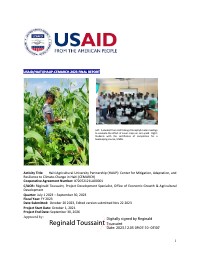
Left: A student from AUV taking chlorophyll meter readings
to evaluate the effect of cover crops on corn yield. Right:
Students with the certificates of completion for a
beekeeping course, UNDH.
2
TABLE OF CONTENTS
Item Page
Table of contents 2
Acronyms 3
A. Project Description 4
Objectives 4
B. Summary and Key Achievement Highlights (this is also in French as Annex 6) 5
C. Key Achievements 8
D. Collaborations and Synergistic Results 18
E. Continuous Learning and Adaptation and Challenges 20
F. Planned Activities, by Objective 21
G. Annexes 22
I – Indicator Table 23
II – Budget, Q4 and Annual – snapshots 31
III – Communications and Success Stories 32
IV - Environmental Mitigation and Monitoring Report, if applicable 34
V - Quarterly Shock Response Contingency Planning Report, if applicable 34
VI - Summary of Key Achievements Highlights in French 35
VII – Additional Documents 37
3
ACRONYMS
ATP
AUC
Agriculture Technology Park
American University of the Caribbean (Les Cayes)
BFS/ARP Bureau of Food Security / Agricultural Research and Policy
CE Center of Excellence
CEMARCH
CHCL
COP
CLA
CLAS
Center of Excellence on Mitigation, Adaptation, and Resilience to Climate-
Change in Haiti
Campus Henri Christophe de Limonade (UEH) (Cap Haitian)
Community of Practice
Collaborating, Learning, and Adapting
Collaborating, Learning, Adapting and Sharing
CRDD Rural Sustainable Development Centre
CSA Climate Smart Agriculture
FAMV
FTF
FTFMS
Faculté d’Agronomie et de Médecine Vétérinaire (Port-au-Prince)
Feed the Future
Feed the Future Monitoring System
FY Fiscal Year
GFSS Global Food Security Strategy
HAU
HG
IEE
IL
Haitian Agriculture Universities
Haiti Government
Initial Environmental Evaluation
Feed the Future Innovation Lab
KSU
M&E
Kansas State University
Monitoring and Evaluation
MARNDR
MEL
MELP
MS
NARS
Ministry of Agriculture, Natural Resources and Rural Development
Monitoring, Evaluation, and Learning
Monitoring, Evaluation, Learning, and Plan
Masters of Science
National Agricultural Research Systems
MENFP Haitian Ministry of National Education and Vocational Training
NGO
NORD
Non-Governmental Organizations
Université Chrétienne du Nord d’Haïti (UCNH) (Cap Haitian)
PIRS Performance Indicator Reference Sheet
PITT Performance Indicator Tracking Table
PMP Performance Management Plan
PPP
PPR
RF
Public Private Partnerships
Performance Plan and Report
Results Framework
SIIL Sustainable Intensification Innovation Lab
TA
T&I
Technical Assistance
Technology and Innovation
ToC
ToT
UNDH
UniQ
Theory of Change
Training of Trainers
University Notre Dame of Haiti (Les Cayes)
University Quisqueya (Port-au-Prince)
USAID United States Agency for International Development
USG United States Government
4
A. Project Description
Background
The Haiti Agricultural University Partnership (HAUP): Center for Mitigation, Adaptation, and Resilience to
Climate-Change in Haiti (CEMARCH) initiative was developed to provide training for agricultural
professionals and others involved in agriculture, and to train new individuals in agricultural practices. This
training will produce agricultural professionals better able to adapt to Haitian crop and animal production
systems in a changing climate. They will also be able to understand the role climate plays on Haitian soil
resources, water supplies, and their interaction. This will be accomplished through three Objectives: 1)
curriculum development through funded BS scholarships, MS degrees, and short term learning
opportunities, 2) research and extension growth, and revenue generation, via agricultural technology
parks (to include laboratories or other facilities), and, 3) partnerships with agricultural organizations who
have an in-country mission to combat climate change and improve the lives of Haitians via novel and
improved crop and animal production systems. Project partners are Kansas State University-Sustainable
Intensification Innovation Lab (SIIL), the University of Quisqueya, Faculté d’Agronomie et de Médecine
Vétérinaire (FAMV), Campus Henri Christophe de Limonade (UEH) (CHCL), Université Chrétienne du Nord
d’Haïti (UCNH) (NORD), American University of the Caribbean (AUC), and the University Notre Dame of
Haiti (UNDH). These universities represent the south, north and west departments of Haiti.
By focusing on Haitian institutions, CEMARCH provides needed assistance to a consortium of universities,
research institutions, governmental and non-governmental organizations (NGO) and the private sector to
develop a network of mutual support and exchange programs. The anchor university (University of
Quisqueya) leads a consortium of Haitian Agricultural Universities (HAUs) and their associated research
institutions to collectively address agricultural challenges such as climate mitigation, adaptation,
resilience and producing nutritious and safe food, while sustaining natural resources (Climate Smart
Agriculture, CSA). The center (CEMARCH– Center for Mitigation, Adaptation, and Resilience to Climate-
Change in Haiti) focuses on building institutional and human capacity (through both short-term
certifications and long-term degrees) so that Haiti is able to identify and seek solutions to its agricultural
problems.
Objectives
The overall objective of the Haiti Agricultural University Partnership (HAUP) is to build the institutional
and human capacity in the agriculture sector to advance agriculture-led inclusive economic growth in a
changing climate. Specifically, the project will:
1. Increase institutional and human capacity and social capital of local universities to better meet
the demands of the agricultural economy and workforce needs. This includes curriculum
development, training opportunities for young Haitian professionals (long-term and short-term
certifications) and capacity building opportunities for Haitian faculty with enhanced research,
education, outreach, and leadership skills.
2. Strengthen the capacity of local universities to provide research and extension services to farmers
and the private sector that have the potential to generate revenue.
3. Create linkages between universities, research centers and producers to ensure that targeted
smallholder farmers have access to adapted technologies to increase food security. This is
5
occurring through the establishment of technology parks to showcase high-potential CSA
technologies, and implementation of strategies to sustainably intensify smallholder production
systems.
B. Summary and Key Achievement Highlights (also in French as Annex 6) - max 2 pages
Bulleted list of Key Achievement Highlights:
Objective 1 – Increasing human and institutional capacity:
● Four of six universities have completed and are operating virtual classrooms, and they are now
being used for teaching, workshops and training. The installation of these virtual classrooms
allows students from all over Haiti to have education from universities across the country. This
provides a wider range of educational material to students and others taking various courses.
● Across all six universities, 104 students are benefitting for CEMARCH scholarships, as they pursue
various agricultural degrees at their universities. Every university has increased enrolled numbers
of students in the agricultural sciences. These students are taking classes and participating in
various CEMARCH-ATP research projects. Having the economic support of these scholarships is
direct capacity building for student learning and their future career development, as the students
can remain enrolled in school without worry about payment for that education.
● FAMV has interviewed and accepted 15 students into their Agroecology MS program. These
students were selected from applicants for every CEMARCH university. This program will provide
an in-Haiti quality MS degree for students, allowing them to then move into careers in agricultural
management, hopefully in Haiti. The program starts in November, 2023.
6
Objective 2. Strengthen the capacity of local universities to provide research and extension service:
● Significant improvements to infrastructure have been made, and in 2022-2023 facilities are
beginning to be used for research and extension activities. For example, both AUC and UNDH have
repaired and stocked fishponds that were damaged and inoperable, following the 2021 earthquake.
Research projects at the fishponds will vary with each university but include feed strategies (new
sources of feed), species selection (tilapia versus other species), and pond management (pond
fertilization, etc). Additionally, CHCL, UCNH and FAMV are all rebuilding and renovating
greenhouses, animal pens, and other facilities at both the ATPs and universities. Specific examples
of this include new irrigation at FAMV, renovated and newly covered greenhouses at UCNH, rebuilt
housing for goats and poultry at CHCL, and improved animal pens at AUC. These infrastructure
improvements allow program development and teaching for local citizens, and (in some cases) the
possibility of sustainability through revenue generation. To date, a total of 174 farmers have
attended field days or workshops arranged by CEMARCH universities.
Left: Students at UNDH participating in a
beekeeping certificate course, June 2-4, 2023.
Part of this course was taught using the virtual
classroom, as shown.
Right: Students at CHCL-Limonade
studying proper soil-mix preparation
and seeding of plants. June 3, 2023
7
Objective 3. Create linkages between universities, research centers and producers to ensure that
targeted smallholder farmers have access to adapted technologies to increase food security.
● Almost all of the CEMARCH universities have created active partnerships with NGOs or other
commercial entities. Of special importance are partnerships with other Haitian institutions that have
a long history of service to Haitian growers, enabling CEMARCH to better educate growers about new
technologies. Specific examples include partnerships with MFK (Meds and Foods for Kids) (CHCL and
UCNH), Accesso (Quisqueya), ORE- Organization for the Rehabilitation of the Environment (AUC), and
the bioenergy company Cosmos Solutions (AUC). Details on the activities with each of these groups
can be found later in this report (page 19).
● The ATPs are starting to offer training and extension programs for area farmers, with most designed
to help growers improve crop production and develop climate smart practices. This is an important
implementation because it is a direct link to capacity building with Haitian growers. Examples of this
include recent trainings on cover crops in corn production, and best methods for banana plant
reproduction via stem fragmentation.
Left – the renovated
fishpond at UNDH,
and, right,
renovated livestock
housing for goat
research at CHCL-
Limonade.
8
Training and extension opportunities for farmers: Left – banana propagation (UCNH), and,
Middle and right - cover crops for corn with farmer attendees (AUC)
C. Activity Implementation Progress – 4-10 pages
Quarter 4 Achievements (2023):
Since the Quarter 4 report is merged in the annual report, here is a section that specifically outline
Quarter 4 activities (July 1 to Sept 30, 2023), by Objective:
Objective 1 – Increasing human and institutional capacity:
In Quarter 4 two more universities (CHCL-Limonade and UCNH) hosted their ATP openings. These were
large and celebratory affairs, with citizens from the area and other dignitaries invited for the openings
and tours of the research areas. These openings position each ATP to become a resource center for
agricultural research and extension activities for area growers, showcasing developed technologies.
Dr. Vara Prasad, Project Director of
SIIL, Kansas State, speaks at the UCNH
ATP opening.
9
Also, in this quarter one MS degree was fully developed and advertised, and FAMV began the process of
interviewing candidates from all the universities for this program. Continued unrest led to CEMARCH
developing a contingency plan, and when enrollment starts in November, 2023 it is likely that the cohort
of MS students will stay at their home schools, conducting research at that location, with courses supplied
using the virtual classrooms. The FAMV MS program is in Agroecology, and as such courses will focus on
soil and water science, crop production, and other areas of field and crop management. These courses
will be supported by basic coursework in statistics, plant physiology and soils. One course (Soil Fertility)
is already developed and has been offered to the universities for use. With the exception of Quisqueya
three students have been selected for the MS program at FAMV, from each of the other universities (AUC,
UCNH, Notre Dame and CHCL). Thus, 12 students from each of the four CEMARCH universities, with an
additional 3 from FAMV.
The MS program will contribute to the overall success of CEMARCH because it is helping to produce
trained graduate students who will (hopefully) stay to teach at their home university, or move into roles
in the Haitian agricultural sector. Retainment of faculty at Haitian universities is an issue, and these
graduates should help to ease that problem.
Completed in this fourth quarter, four of six universities now have fully developed virtual classrooms, with
a fifth university (FAMV) in the process of constructing that classroom. These classrooms now have the
capability to deliver educational content (be it courses or extension training) to Haitians across the
country. This will ensure that educational initiatives can continue even if security issues prevent travel.
Specifics about each are provided here:
A banner in Cap Haitian announcing
the opening of the CHCL-Limonade
ATP.
10
Table 1. Details for each installed virtual classroom. Each classroom has servicing and repair visits
guaranteed for one year.
Partners
Virtual
classroom
size
Quantity of
computers Others materials
Universite Notre
Dame d'Haiti
(UNDH/UDERS-
Cayes) 125 m2
11(10
laptops + 1
PC)
Projector, Digital Whiteboard, Camera, Laptop Tables,
Surveillance Cameras, Internet System, Student Chairs, Air
Conditioner.
Universite
Chretienne du
Nord d'Haiti
(UCNH) 100 m2 10 laptops
Projector, Digital Whiteboard, Camera, Laptop Tables,
Surveillance Cameras, Internet System, Student Chairs, Air
Conditioner.
Campus Henry
Chritophe de
Limonade (CHCL-
UEH) 130 m2 14 PCs
Projector, Digital Whiteboard, Camera, Laptop Tables,
Surveillance Cameras, Internet System, Student Chairs, Air
Conditioner.
American
University of the
Caribbean (AUC) 110 m2 10 laptops Projector, numeric board, computer tables and shelves
Objective 2. Strengthen the capacity of local universities to provide research and extension service:
Universities are beginning to implement research and extension plans and studies at their ATPs, with a
significant increase in such projects in Quarter 4. CEMARCH is strengthening research and extension
capacity by: 1) providing initial funding so that faculty can develop and teach short-courses (examples
given here), 2) developing the virtual classrooms for innovative teaching, and, 3) providing expertise and
advice for research and demonstration projects at each ATP. Recent examples include a training held for
students at UCNH. Hosted by CEMARCH PI Dr. Robert Brunet, the topic was ‘Banana Diseases and Pest
Control Management Conference’. This was taught both live, and using the CEMARCH virtual classroom.
Other activities in Quarter 4 include farmer activities at AUC with a cover crop course, and apiculture and
seedling preparation classes at Notre Dame. These courses were more extension-based in their
presentations, but they also provide training for students, some of whom will conduct research in these
areas.
Objective 3. Create linkages between universities, research centers and producers to ensure that targeted
smallholder farmers have access to adapted technologies to increase food security.
In Quarter 4, a first scientific conference was held at CHCL-Limonade, and CEMARCH was a participant in
the activity. Titled ‘Institute for the Sustainable Development of the Regions (IDDR)’ the meeting was held
on Sept 27
th
at CHCL (with a virtual option as well), and featured presentations by various groups, including
The Water Resilience Centre, The Centre for Social Innovation (CIS), The Centre for Gender Integration
(CIG), The Centre d'Appui aux Politiques Publiques (CAPP), The Centre for Technological Innovation (CIT),
and CEMARCH. The overall objective of this conference was to further partnerships to : 1) strengthen
capacities, knowledge and skills in Haiti, 2) learn which interventions work quickly and can be replicated,
and, 3) carry out actions aimed at informing and raising awareness, training, and facilitating projects for
11
citizens. This achievement will enable CEMARCH to collaborate more fully with multiple organizations
and universities. It also was our first scientific conference in Haiti in which CEMARCH participated.
Also in Quarter 4, two additional agreements were formalized between NGOs or commercial partners.
These were between MFK (Medicine and Food for Kids) and CHCL-Limonade and UCNH. Focused on
peanuts, the partnership will include training for BS students and short courses for area farmers. These
activities directly fit the Feed the Future mandate for activities to improve livelihoods and reduce hunger.
Specific objectives are: 1) Disseminate information about aflatoxin in peanuts and other crops grown in
Haiti; to train students from UCNH and CHCL-UEH on ways to manage aflatoxin from the farm to consumer
with food safety as the major consideration, 2) Ensure in the immediate future, students will be able to
disseminate the findings and train others in the communities about aflatoxins and peanut production
management (training the trainers model), 3) Participate in the MFK laboratory testing for aflatoxin,
understand and be able to perform quality tests (aflatoxin and moisture) on contaminated peanuts, and
4) Learn how to train farmers on peanut best management practices through the established MFK farmer
training and champions program. These collaborations will build university capacity because they will
train students in agronomic practices (practical skill training), and it will enable the universities to continue
to work with peanut growers in their regions.
Such agreements contribute to the overall Objective of CEMARCH to create linkages between
universities (such as the one above between CHCL and UCNH) and partners, providing farmers and others
with specific agricultural training. Linkages with groups such as MFK are especially beneficial, as this 20-
year old group has a well-established presence in Haiti, which will add to program sustainability.
Screen shot of the publicity given to
the first scientific meeting of the
Institute for Sustainable Regional
Development, in which CEMARCH is a
partner.
12
Key annual (2023) achievements, by Objective:
Objective 1: Curriculum development, training opportunities for young Haitian professionals (long-term
and short-term certifications) and capacity building opportunities for Haitian faculty with enhanced
research, education, outreach, and leadership skills. This includes the BS and MS degrees.
The first cohort of BS students were enrolled at every university in 2023. Table 2 (below) indicates the
various numbers, by university. For this Table we are using the following definitions: New = the individual
received U.S. Government-supported long-term training for the first time during the reporting year, and
Continuing = the individual received U.S. Government-supported long-term training in the previous year
and continued to receive it in the reporting year. For this report all students will be classed as ‘New’.
Table 2. Numbers of undergraduate CEMARCH scholarship students enrolled at CEMARCH universities,
their gender, and enrollment status, Fall semester, 2022.
University Female Male New Continuing* TOTAL
Number in Each Category
AUC 6 9 15 0 15
CHCL 10 20 30 0 30
Quisqueya 3 2 5 0 5
FAMV 7 7 14 0 14
UNDH 8 12 20 0 20
UCNH 8 12 20 0 20
TOTAL 42 62 104 0 104
These scholarships are a key achievement for each student, as they allow them to attend a Haitian ag
university without worry about payment for their education. It also places them into a curriculum track
that will provide internships, practical training and the opportunity for career placement. For CEMARCH,
it allows us to develop trained agricultural professionals for Haitian ag universities, the ag private sector,
and other Haitian agencies that may employ such graduates. They also may serve as a source of future
students for the MS programs that are also a part of CEMARCH.
The virtual classrooms and their development and value for CEMARCH were discussed previously in the
Q4 achievements, and so they will not be repeated here. Similarly, since the selection of candidates for
FAMV occurred in Q4 that achievement was also discussed there.
Objective 2: Strengthen the capacity of local universities to provide research and extension services to
farmers and the private sector that have the potential to generate revenue.
In this funding year various universities are getting their research and extension activities up and working,
and some are generating revenue. CEMARCH staff and Anchor University staff are working with each
university to develop specific research and extension goals for each university. Nor occurring in Q4, but
a recent (Oct, 2023) meeting was held for each university to present research goals and plans, and this
was used as a template for the future workplan. These plans, in combination with improved facilities
(both field and lab, all outlined elsewhere) will help each university develop research and extension
agendas, which will then be used to drive farmer engagement.
13
Likely the most successful example of that is the sales center at AUC, which generates revenue from its’
vegetable and honeybee facilities. By May, 2023, the first harvest of honey was sold at the Mini-Sale
Shop, earning a total of twenty thousand (20,000.00) gourdes (140.00 USD) from the harvest of less than
10% of the hives. These activities contribute to the overall objective by creating such revenue, but the
beekeeping is also used in extension and teaching activities. Both AUC and UNDH hosted beekeeping
workshops in this year, with certificates provided at the conclusion of the courses.
At UCNH, students (5
th
year BS students) are studying yield of Chili pepper (Capsicum annuum) as affected
by mulch type (mulching with white plastic or dry straw), and peppers will be sold for revenue generation.
They are also examining the adaptability of the Congo pea (Cajanus cajan L.) under both ridge and flat
tillage. Finally, UCNH has a large area of southern pea which will be used as fodder for their animal
production areas. These activities all represent the connections of the project: research to study new
production techniques, with that research done by students, and products grown sold or used in revenue
generating enterprises.
Despite significant safety issues at their campus FAMV is also proceeding with research and extension
projects. These are: feeding strategies for rabbits and goats using plantain, hoopvine and banana leaves.
This project is supervised by a PhD student, with participation by 4 of the scholarship BS students. The
goal of this project is to increase the availability of local feed for rabbits and goats in small farms, helping
to ensure sustainability for these farmers. Revenue is generated by rabbit processing.
Attendees at the UNDH beekeeping
short course, June, 2023.
UCNH student presenting his pepper
mulch research to visitors, October,
2023.
14
A separate project at FAMV evaluates gravity-fed irrigation practices on plantain (Musa paradisiaca) yield.
This project is intended to improve farmer income and food security through the development of
production techniques likely to provide better productivity of plantain-based cropping systems. Two
CEMARCH BS scholarship students are working on this project. This project is possible because CEMARCH
funds allowed the installation of a proper irrigation system.
The final two projects underway at FAMV are: 1) use of prickly pear (Opuntia ficus indica) as food
resources and raw materials in the agri-food industry. Prickly pear is being explored both as a human and
animal food. Its’ drought tolerance and wide range of adaptation could be a tool to help to counteract
the effects of climate change. Five scholarship BS students are involved with this project.
And last is a study which evaluates the impacts of climate change on water resources in the Fer-à-Cheval
River watershed, Center Department. This study will evaluate the availability of surface and underground
water as affected by climate change using modeling. The work will utilize the installed GIS facility, part of
the education component of CEMARCH, at FAMV. The to-be-developed GIS modeling course will also be
used for this project. Although these projects have not yet provided data they are motioned here as they
are examples of the capacity building going on at FAMV, and reflect the infrastructure improvements
through the installation of the GIS facility, to be completed in November, 2023.
Agroforestry is a focus at CHCL, and they have installed research plots with coffee and cocoa as the
understory crop, with leguminous trees as the overstory crop. The intent of this study is to examine the
impact of the legume tree crop on N supply and functioning in the coffee and cocoa production. To
protected research they have fenced in 10,000 square meters of land, which will enable them to do field
research without free-ranging animal feeding, which is a continual issue. There is already an established
peanut trial at this location, evaluating planting dates for best methods to avoid drought effects, and
ensure quality peanut production.
Installation of the new irrigation
system at the ATP at FAMV.
15
Activities at Quisqueya have been slower to begin, but with the recent signing of a research/extension
agreement with Acceso progress is now being made. There are four distinct projects being conducted: 1)
characterization of soils of the area, with results eventually used to generate a soil map for use with a
hand held cell phone application, 2) the ‘Protein of the Future’ project, exploring the use of jatropha as
animal feed for poultry and fish, 3) the ‘Innovation in Extension’ project, which seeks to develop an entire
package of services (seed, variety selection, planting aid, and other crop management advice) for climate-
sensitive management of crops for Haitian farmers, and, 4) continued long-term peanut work, examining
new cultivars for disease resistance in a Haitian climate.
Objective 3: Create linkages between universities, research centers and producers to ensure that targeted
smallholder farmers have access to adapted technologies to increase food security in the Resilience Focus
Zones. This will be accomplished through the establishment of technology parks to showcase high-
potential CSA technologies and strategies to sustainably intensify smallholder production systems.
It should be noted that there is some overlap with Objective 2, and some of the details provided in
Objective 2 (for various projects) would fit under this Objective as well. Partnerships formed and activities
conducted for research and extension, and revenue generation, often take place at the various university
ATPs. We will not discuss projects already mentioned in this report in this section. Instead, we will focus
on other projects, short courses and extension activities taking place at the ATPs not discussed previously.
Peanut date-of-planting study at CHCL
ATP, October, 2023.
Peanut research from Quisqueya
University being conducted with
partner Acceso.
16
In 2022 to 2023 the following extension activities or other events occurred at each university (in addition
to others discussed previously in Objective 2):
● At AUC, trainings were held for 24 farmers to demonstrate and explain the use of cover crops for
corn production. This training focused on intercropping with the green manure crop Canavalia
ensiformis. This project has also been used for undergraduate BS research projects. Three
training sessions have been held on waste management, using by products for biofertilizer and
biogas production (31 attendees). A beekeeping workshop was also held, with a focus on
detection and control of varroa mite in bee colonies (38 attendees).
● At CHCL, 46 farmers from the North and Northeast departments attended a workshop held to
discuss agroecology and conservation agriculture. Such activities are a continued focus of the
CHCL ATP, with an emphasis on conservation in drought-affected areas, too. On the animal side,
CHCL has renovated and improved housing for goats, rabbits and poultry, and is examining the
zootechnical performance of traditional goat species when crossed with improved breeds. For
chickens, they have already raised several crops, with the birds used in student training courses
to demonstrate best management in feeding and housing for broilers.
● University of Notre Dame has numerous crop studies in place, and they have hosted a farmer
training on nursery techniques for plant production (32 participants). This short course focused
on production of nursery plants and trees, with a focus on their use for soil protection. Additional
cropping work that has been installed includes pineapples and papaya, both a part of agroforestry
studies. The fishponds damaged in the earthquake have been completely rebuilt, and tilapia
installed.
● The University of Quisqueya has not yet held trainings or other extension activities, as their
desired location at Mirebalais has been destabilized by some recent gang activity. However,
research is ongoing at the site, and work with soil characterization, peanut variety evaluations,
and jatropha selections for animal feed are progressing.
Left, farmers attending the cover
crop-corn workshop at AUC, and,
right, student explaining the trial to
farmers.
17
● FAMV hosted several trainings and extension activities including technical training for 30 farmers
that covered the newly installed irrigation system, and use of improved animal genetics for
breeding. They also gave a short-course in on-site water management, attended by students,
farmers and technical staff, and another short course that covered best methods for composting
● UCNH recently completed a training on diseases
of banana (14 students), a training that was both live and
virtual, using their installed virtual laboratory for part of the teaching. They also held a short course for
area farmers (20 attendees) in the FIP technique (called Miniset), where the creation of new banana
seedlings from stem fragments is taught. This is a vegetative propagation method that results in
vegetative plant material that is clean of diseases or other pathogens. This technique was repeated with
yam and other tuber crops, using a similar technique called PIF.
Student (MS) at Quisqueya University
performing soil texture analyses as a
part of work to describe the soils of
the region.
Attendees at the farmers technical
training, FAMV.
18
D. Collaboration and Synergistic Results (1 to 2 pages)
Partnerships are outlined in this Table, with the university, partner and planned or completed activities
listed. At this time only partnerships that have a signed agreement in place are included in this list.
University Partner – Description of that Partner Activities Planned
AUC ORE – Organization for the
Rehabilitation of the Environment
Avocado characterization, Corn
breeding and corn seed production
Plant propagation/Tissue culture la
renovation. To date, equipment has
been purchased for the tissue culture
work in avocado.
AUC Cosmos Solutions Organic Waste Management, Biogas,
Biofertilizer – have conducted two
different workshops in biogas
production and waste management –
31 attendees for the August (biogas)
workshop and 29 for the July (waste
cycling and management) workshop.
Quisqueya University Acceso Work is underway with studies on
proteins of the future (jatropha),
peanut breeding trials, and innovation
in Extension services.
CHCL-Limonade CRDD of Terrier-Rouge The CRDD will serve as a research
demonstration site, and CHCL will also
work with the CRDD for program
development with students at the Ag
Technology school (high school) next
to the CRDD. Only the agreement has
been signed at this time, and a
proposal for work projects has been
submitted.
CHCL-Limonade MFK (Medicine and Food for Kids) Will collaborate with MFK (and UCNH)
for work with farmer groups on best
agronomic practices to conserve soil
Left – Area farmers
learning clean vegetative
reproduction of banana
for seedling production
(Miniset). Right – UCNH
students learning how to
propagate tuber crops
(PIF).
19
moisture and prevent soil erosion in
peanut production. MFK will work
with students on aflatoxin detection
methods, and other training to
demonstrate how to reduce aflatoxin
in peanut. Representatives from MFL
attended the recent (Sept 17) meeting
on ‘Institute for the Sustainable
Development of the Regions (IDDR)’
UCNH Centre de formation en
aménagement intégré des mornes
(CEFAIM)
Will partner with UCNH for research
and extension projects in watershed
management and conservation. This
agreement has been signed.
UCNH MFK (Medicine and Food for Kids) Will collaborate with MFK (and CHCL)
for work with farmer groups on best
agronomic practices to conserve soil
moisture and prevent soil erosion in
peanut production. This agreement
has been signed.
Notre Dame (UNDH) ORE Will work with ORE and local farmers
on beekeeping courses and nursery
plant production. ORE assisted with a
April 2023 (Q3, 20 farmers)
beekeeping short course, and with a
May, 2023 (Q3, 7 students) nursery
production shortcourse.
FAMV Centre Haitien pour la Promotion de
l’Agriculture et la Protection de
l’Environnement (CEHPAPE) / Ing-
Agr Jean-Camille BISSERETH
Will work with FAMV on a variety of
projects, including production of
biofertilizers and biopesticides (rapid
compost in 15 days and nutrient
solution, entomopathogenic
microorganisms, microorganisms
acting as biofertilizers)
Production of edible mushrooms
production of black soldier fly larvae
(having 45 to 65% unicellular proteins)
as a substitute for soy flour in the diet
of monogastrics. The first compost
workshop was held in Q4, with 30
farmers in attendance.
FAMV Lèt agogo - a program that supports
production and processing of
farmer’s milk. Also supports the
farmer in technical improvement for
enhanced milk production.
Improvement of the milk processing
plant on the FAMV campus in order to
increase its capacity for teaching,
research, extension, and innovation.
This agreement has been signed, with
no projects as yet.
20
E. Continuous Learning and Adaptation, and Implementation Challenges (1-2 pages)
Key challenges or problems encountered during the 2023 year were as follows: 1) safety issues in Haiti
that prevented travel to locations in Port au Prince, and prevented those two universities in Port au Prince
from hosting their ATP openings, and 2) continual communication issues with the Head (University Dean)
of the Anchor University. Travel to Les Cayes is also aggravated (for US staff) because one must fly through
Port au Prince to get to Les Cayes, and that is a safety issue. Overall, however, things are greatly improved
since the fall of 2022/winter 2023 and travel throughout Haiti, to the various universities is occurring.
Adaptations are as follows. First, a safety and security plan for the Anchor University staff was created,
and approved by USAID. This plan moved to a ‘work at home’ strategy for the Anchor University staff,
with adjustments made as safety improves. Second, with the virtual classrooms up and functioning many
trainings and meetings can now be accomplished virtually. Third, participation in the weekly safety
meetings has provided guidance for best travel methods, and in the coming year we will plan a trip to Port
au Prince (to Quisqueya and FAMV). Last, as students begin their MS degrees (at FAMV) in November,
2023 the first semesters of those degrees will be virtual, with students remaining at their home institution
to begin the graduate degrees. If safety improves students can move to FAMV (or Quisqueya, once that
program opens) if they choose. However, planning and virtual classroom developments has resulted in
degrees for which coursework can be 100% virtual, if needed.
Implementation challenges have largely been overcome. The sole university that appears to have issues
with implementation is Quisqueya, and we are working through that with a series of timelines and set
start dates (for example, they must have MS students selected by the end of November, 2023). If
Quisqueya cannot deliver implementation in the 2023-2024 year we will reassign budget funds to other
universities, and FAMV will supervise additional graduate students. However, the situation does seem to
be improving, and the PI is being more responsive.
Overall, our greatest weakness is documentation of implementation. Despite numerous meetings, calls
and emails, universities are simply failing to provide correct documentation for all their events. This
includes signed attendance sheets, copies of programs or materials used, and photographic
documentation. Proper data collection – including gender, role/position/job of the attendees, age and
other such critical information is often missing, or an attempt is made to collect the data after the event.
The six universities simply do not realize how important this information is to USAID and KSU, and we
continue to work with them to impart this. Resolution will occur through the hiring of a MEL specialist
who will be Haitian and who will reside in Haiti. This will be a great help to our current
MEL/Communications staff member who simply has far too much to do. The new MEL staff member will
travel to each university at least once a month, and collect detailed information about activities at each
university. They will be the lead for collection of all MEL data, and will create the storage and reporting
sites so that the data is correctly stored, sorted and analyzed.
Actual or Anticipated Impacts to Activity Results: At this time, we do not anticipate any long-term actual
impacts to our activities. Despite the continued challenges of working in Haiti the universities are getting
it done, and progress is being made.
Issues Related to Budget and/or Expenditures, or Staffing: No issues at this time. Two small issues are
being rectified: 1) we need to get the plates for the two vehicles that were transferred to this project
from USAID (all paperwork in finally completed and approved), and, 2) KSU needs to follow-up and make
sure that the COP contract for 2023-2024 will be approved and signed by all concerned parties. The 2022-
21
2023 contract ended on Sept 30
th
and the new one is not yet completed. There are sufficient funds to
hire the additional MEL staff member, as described previously in this section.
F. Planned Activities, by Objective (1-2 pages)
Objective 1. Increase institutional and human capacity and social capital of local universities to better
meet the demands of the agricultural economy and workforce needs. This includes curriculum
development, training opportunities for young Haitian professionals (long-term and short-term
certifications) and capacity building opportunities for Haitian faculty with enhanced research, education,
outreach, and leadership skills.
● Complete and offer at least one virtual class per university, with an emphasis on those for the
MS degrees. These classes would then be available to every university, via the virtual classrooms.
Completed by February, 2024.
● Each university will offer at least two short-term trainings or workshops in areas of their
choosing, but all will center on some type of best practice for Haitian agriculture in a changing
climate.
● The first cohort of MS students (15 students) will enroll at FAMV in November, 2023. Some type
of opening celebration (virtual or live, depending on safety) will occur by April, 2024. The second
cohort will start at Quisqueya in January, 2024.
● The Haitian Cop and Soil Science Society will be inaugurated by December, 2023, with the first
set of officers selected from Haitian crop and soil science professionals. The first meeting of the
Society will be held in late spring, 2024.
● By December 2023 two of four trips will be planned for Haitian professionals to travel to the US,
for week long (approximately) learning opportunities. The remaining two trips will be planned
by February, 0204. The trips will occur some time between April and August, 2024. Trips will be:
1) fish health and fishpond management (likely to Auburn University), 2) soil testing and
interpretation/lab tours (like to the University of Georgia), 3) IPM methods for banana diseases
(University of Florida), and, 4) beekeeping and hive management (location TBD).
● At least three universities will have improved virtual libraries, with greater access to scientific
materials, by September, 2024.
Objective 2. Strengthen the capacity of local universities to provide research and extension services to
farmers and the private sector that have the potential to generate revenue.
● The remaining two universities will officially open their ATPs (with an event) by February, 2024.
● Each university will offer at least two extension events in areas of their choosing, but all will center
on some type of best practice for Haitian agriculture in a changing climate.
● Two more universities will have developed a process or harvested material that can be used to
help provide revenue generation.
● Each university will have at least 3 research projects (on-going or installed in 2023-2024) that
showcases a new or innovate climate mitigation practice for Haitian growers.
● Every university will have correct signage (following all branding/marking as outlined in that plan)
in place at ATPs and any other CEMARCH facilities (virtual classrooms, etc) by January, 2024.
Objective 3. Create linkages between universities, research centers and producers to ensure that
targeted smallholder farmers have access to adapted technologies to increase food security in the
Resilience Focus Zones. This will be accomplished through the establishment of technology parks to
22
showcase high-potential CSA technologies and strategies to sustainably intensify smallholder production
systems.
● If the universities only have one identified outside partner they should identify, develop
research/extension plans with and sign agreement paperwork with that partner by April, 2024.
● Every university should work to further identify partners that represent women and youth as a
significant part of their leadership and/or membership.
● Each university will offer at least two events specifically for farmers in areas of their choosing, but
all will center on some type of best practice for Haitian agriculture in a changing climate.
● By December 2023 every university will have written their sustainability plan.
G. Annexes
I. Annex 1 - Indicator Table
The table of indicators has been developed and approved from USAID-Haiti. For this Yearly indicators that
apply to all of 2023 are included. Indicator targets will be provided in a simplified table using a color
scheme highlighting indicators in red if target is not met or on track, yellow to signal that it is in danger of
not being met, and green for indicators met. In addition, explanations will be provided for why targets
exceeded and/or targets were unmet.
For size, this Table starts on the following page.
23
Annex I – Indicator Table
Indicator
Result Measured
by Indicator
Type of
Indicator
Data Source Frequency
Unit of
Measure
Progress to Date/Plans
1.1 Number of
institutions
collaborated with
HAUPs due to CE
MARCH
involvement
Improved
collaboration
between local
institutions
Performance
/ Custom
Type of application:
Memorandum of
Understanding (MoU).
Each university will
have one.
Reported
annually
Number COMPLETED – MOUs are
on file.
1.2 Indicator
EG.3.2-2 Number
of individuals who
have received USG
supported degree-
granting
agricultural sector
productivity or
food security
training
Improved degree-
attainment for
agricultural and
technical students
Performance
/ Standard
Activity training
records for short
courses, trainings or
other shorter-term
education than the BS
or MS degrees.
Signed agreements by
the BS and MS
scholarship students,
available on file.
Reported
annually
Number In total 105 BS students
are enrolled at the 6
universities that are a
part of CEMARCH.
Interviews for the MS
program at FAMV are
completed, and 15
students enroll in that
program in November,
2023.
1.3 Indicator
EG.3.2 Number of
individuals
participating in
USG food security
short-term training
programs
Improved
knowledge around
topics of food
security
Performance
/ Standard
Enrollment numbers
for each short course,
training module, or
other educational
program (not to
include academic
coursework, which is
counted above in 1.2.
Reported
annually
Number Five of our six
universities have hosted
a training, workshop or
field day. They have all
included a wide range of
participants including
farmers, students, local
citizens and government
representatives.
24
Indicator
Result Measured
by Indicator
Type of
Indicator
Data Source Frequency
Unit of
Measure
Progress to Date/Plans
1.4 Number of
trainings/lecture
series facilitated by
CEMARCH for
students and staff
capacity building
Improved technical
knowledge for
university
members
Performance
/ Custom
Numbers of
developed short
courses, training
modules, or other
educational programs
(not to include
academic coursework,
which is counted
above in 1.2).
Reported
quarterly
Number Five of our six
universities have hosted
a training, workshop or
field day. They have all
included a wide range of
participants including
farmers, students, local
citizens and government
representatives.
1.5 Indicator
CBLD-9 Percent of
USG-assisted
organizations with
improved
performance
Improved
organizational
capacity
Performance
/ Standard
Implementing
partners that have
been allocated USG
funding to work with
local organizations to
strengthen their
organizational
capacity for increased
performance.
Reported
annually
Percent Every university has
improved their capacity,
when compared to that
documented in the
baseline report. The
baseline report indicates
that universities did not
have virtual classrooms,
nor did they have
functioning agricultural
technical parks (ATP)
with irrigation,
constructed plant growth
facilities, or animal pens.
Land was available, but it
was not well developed
for research and
extension projects.
Additionally, each
university added a
technical staff person
with the skill set to
25
Indicator
Result Measured
by Indicator
Type of
Indicator
Data Source Frequency
Unit of
Measure
Progress to Date/Plans
manage the ATP.
Examples of this capacity
building also included
virtual classrooms, with
four of the six
universities having and
operable virtual
classroom, and in several
cases courses (described
elsewhere) offered as
distance options.
Additional capacity
building has occurred
through the financial
side, as every university
has learned to manage
their CEMARCH funding,
and in most cases a
financial staff member
has been added to the
university staff. Anchor
university and KSU
training has enable those
staff members to
manage their budget,
prepare quarterly
reports, and purchase
supplies (and sometimes
equipment) as needed.
26
Indicator
Result Measured
by Indicator
Type of
Indicator
Data Source Frequency
Unit of
Measure
Progress to Date/Plans
2.1 Number of
institutions
collaborated with
HAUPs due to
CEMARCH
involvement that
results in revenue
generation.
Improved
sustainability of
the program
through program-
generated income
Performance
/ Custom
Type of application:
Memorandum of
Understanding (MoU).
Reported
annually
and semi-
annually
Number Every university now has
at least one documented
partner (most have two).
Most either have a
revenue generating
operation in place (ex:
funds from sale of honey
or animals), or plans are
in place to do this.
2.2 Number of
scientific
conference hosted
and/or co-hosted
by CEMARCH
Improved capacity
building and
collaborations
Performance
/ Custom
Numbers of attendees
at conferences, and
overall numbers of
conferences, data
obtained from the
organizers.
Reported
quarterly
Number On Sept 27th 2023 a
scientific conference was
held at CHCL-Limonade.
Titled ‘Institute for the
Sustainable Development
of the Regions (IDDR)’
the meeting featured
presentations by
representatives of
partner groups, including
The Water Resilience
Centre, The Centre for
Social Innovation (CIS),
The Centre for Gender
Integration (CIG), The
Centre d'Appui aux
Politiques Publiques
(CAPP), The Centre for
Technological Innovation
(CIT), and CEMARCH.
The overall objective of
this conference was to
27
Indicator
Result Measured
by Indicator
Type of
Indicator
Data Source Frequency
Unit of
Measure
Progress to Date/Plans
further partnerships to :
1) strengthen our
capacities, knowledge
and skills, 2) Learn which
interventions work
quickly and can be
replicated, and, 3) carry
out actions aimed at
informing and raising
awareness, training, and
facilitating projects for
citizens.
In this coming year the
Haitian Crop and Soil
Science Society will be
formed, with a first
meeting planned for
summer of 2024.
2.3 Number of
facilities developed
and/or improved
for value-added
services.
Improved means of
production for
farmers'
agricultural
products
Performance
/ Custom
Number of viable
commercial entities,
reported by the
associated university,
and supplemental
information from
CEMARCH/USAID.
Reported
quarterly
Number A substantial number of
facilities have been
improved or created,
including virtual
classrooms, installed
irrigation/water wells,
purchase of needed
tractors, tillage
equipment and
generators, and
improvement/renovation
of animal pens and
28
Indicator
Result Measured
by Indicator
Type of
Indicator
Data Source Frequency
Unit of
Measure
Progress to Date/Plans
ponds. Four of six ATPs
hosted openings, and all
ATPs are functioning.
2.4 Number of
partner institutions
providing services
for revenue
generation, (e.g.,
Soils Testing Lab,
improved plant
genetics,
marketing)
Improved
specialization of
knowledge
between
institutions and
partnerships
Performance
/ Custom
The universities, their
partners, and
supplemental
information from
CEMARCH.
Reported
quarterly
Number One university partner is
generating revenue
(AUC) from their market
stand, while four others
have projects underway
that will contribute
revenue. This will occur
through the sale of
animals, animal
products, nursery plants,
and vegetables. One
university (Notre Dame)
has been approached
about providing its’
virtual classroom for
others to use, as a fee-
based service.
3.1 Number of
established
Agricultural
Technology Parks
(ATPs)
Improved access to
agricultural
extension
knowledge for the
region
Performance
/ Custom
Number of ATPs, as
provided by the
participating
universities/CEMARC
H.
Reported
quarterly
Number Every university has a
working ATP, with four of
six having hosted a
‘grand opening’ event.
29
Indicator
Result Measured
by Indicator
Type of
Indicator
Data Source Frequency
Unit of
Measure
Progress to Date/Plans
3.2 Number of
farmers with
access to improved
technologies made
available by an
NGO, private
sector
development, or
through CEMARCH
ATPs
Improved
accessibility to
novel technologies
for local farmers
Performance
/ Custom
Number of farmers
utilizing a developed
technology. This could
include downloads,
soil samples
run/analyzed, or
number of times a
web site is accessed.
Reported
quarterly
Number Every university (except
Quisqueya) has hosted at
least one field day or
short course for area
growers, with education
provided on areas such
as improved crop
production techniques,
or varietal improvement.
Best management
techniques for irrigation
and animal management
have also been offered as
short courses. Numbers
of farmers are
documented in the IPTT
Table.
3.3 Number of
farmers with
access to extension
services through
visits to and use of
information
supplied by the
CEMARCH
Agricultural
Technology Parks
(ATPs)
Improved
accessibility to
research parks for
local farmers
Performance
/ Custom
Number of farmers
who utilize extension
information from
private extension
services.
Reported
quarterly
Number Every university (except
Quisqueya) has hosted at
least one field day or
short course for area
growers, with education
provided on areas such
as improved crop
production techniques,
or varietal improvement.
Best management
techniques for irrigation
and animal management
have also been offered as
short courses. Numbers
30
Indicator
Result Measured
by Indicator
Type of
Indicator
Data Source Frequency
Unit of
Measure
Progress to Date/Plans
are documented in the
IPTT.
3.4 Number of
extension
materials produced
by CEMARCH
Improved methods
of disseminating
information
Performance
/ Custom
Numbers of created
publications, by type,
and accompanying
download/use
statistics.
Reported
quarterly
Number Universities are offering
extension-based short
courses and trainings (ex:
a banana disease
workshop) but CEMARCH
staff needs to better
work with each
university to then create
extension materials
(handouts, information
sheets, web sites of
information). This is a
key area to improve in
2023-2024.
3.5 Number of
entities conducting
research and/or
demonstrations in
agricultural
technology parks
Improved
collaboration
between local
farming research
institutions
Performance
/ Custom
Numbers of students,
university faculty,
extension personnel,
others (private
sector).
Reported
quarterly
Number Every ATP is conducting
research, some with area
partners. Students are
heavily involved in most
projects.
31
II. Annex 2 – Budget and Financials for Quarter 4 and for the Year (2022)
Quarter 4 Simple Budget Table
Annual Simple Budget Table (2022)
32
III. Annex 3 - Communications and Success Stories
A success story about the beehives at AUC is attached. A second success story, about the virtual
classrooms, has also been written, and it is working its’ way through the USAID editorial process.
Additional communications during this time include press releases (in French, Creole and English), Twitter
posts, Facebook video recordings (by the universities) and other press materials.
33
CEMARCH press release about the
first cohort of BS scholarship students.
34
Newsletter from AUC with articles about CEMARCH:
file:///C:/Users/Beth%20Guertal/Desktop/AUC%20Magazine,%20XI%20e%CC%81dition.pdf
Articles in the Haitian Press about CEMARCH:
Link here: https://lenouvelliste.com/article/242206/lancement-du-parc-technologique-agricole-de-lauc-
aux-cayes
An additional article link here: https://lenouvelliste.com/article/243525/lusaid-et-luniversite-du-kansas-
lancent-des-parcs-technologiques-agricoles-dans-le-nord
IV. Annex 4 - Environmental Mitigation and Monitoring Report, if applicable
Nothing added for this Yearly Report (2023). A completed IEE exist at the Mission, and it will likely suffice
for this project. It has been recently noted that we may need some additional training to fully cover the
IEE, such as proper pesticide use and storage or other special applications within the ATP or a diagnostic
laboratory (MSDS sheets, chemical disposal and storage). In this 2023-2024 we will assay that need, and
conduct training as needed for the ATP and/or laboratory managers.
V. Annex 5 - Quarterly Shock Response Contingency Planning Report, if applicable
Nothing added for this Yearly Report (2023).
35
VI. Annex 6 - Summary of Key Achievements Highlights in French – this is an exact translation of
Section B of this report.
Liste des principales réalisations du projet HAUP-CEMARCH pour la période juillet-septembre 2023 :
Objectif 1 - Renforcer les capacités humaines et institutionnelles :
● Quatre des six universités ont achevé et mis en service des salles de classe virtuelles qui sont
désormais utilisées pour l'enseignement, les ateliers et la formation. L'installation de ces salles
de classe virtuelles permet aux étudiants de partout dans le pays de bénéficier d'un
enseignement dispensé par ces universités partenaires . Les étudiants et les autres personnes qui
suivent certains cours disposent ainsi d'un plus large éventail de matériel pédagogique.
● Dans les six universités, 104 étudiants bénéficient des bourses d'études offertes par CEMARCH,
alors qu’ils poursuivent des études agricoles dans leurs universités respectives. Chaque université
a augmenté le nombre d'étudiants inscrits en sciences agricoles. Ces étudiants suivent des cours
et participent à divers projets de recherche dans les parcs technologiques agricoles (ATP)
deCEMARCH. Ce soutien économique via ces bourses constitue un renforcement direct des
capacités, car les étudiants peuvent rester inscrits à l'université sans avoir à se soucier du
paiement de leur éducation.
● La FAMV a interviewé et accepté 15 étudiants dans son programme de maîtrise en agroécologie
Ces étudiants ont été sélectionnés parmi les candidats de chaque institution universitaire
partenaire du CEMARCH. Ce programme fournira un diplôme de master de qualité en Haïti pour
les étudiants en leur permettant ensuite de faire carrière dans la gestion agricole, si possible en
Haïti. Le programme débutera en novembre 2023.
À gauche : Étudiants boursiers de
l'UNDH participant à un cours de
certificat d'apiculture, du 2 au 4 juin
2023. Une partie de ce cours a été
dispensée à l'aide de la classe
virtuelle, comme indiqué.
36
Objectif 2. Renforcer la capacité des universités locales à fournir des services de recherche et de
vulgarisation :
● Des améliorations significatives ont été apportées aux infrastructures et, en 2022-2023, les
installations commencent à être utilisées pour des activités de recherche et de vulgarisation. Par
exemple, l’AUC et l'UNDH ont réparé et approvisionné des étangs enpoissons qui avaient été
endommagés et rendus inutilisables à la suite du tremblement de terre de 2021. En outre, le CHCL,
l'UCNH et la FAMV sont tous en train de reconstruire et de rénover des serres, des enclos pour
animaux et d'autres installations dans les ATP et les universités. Ces améliorations en termes
d’'infrastructure permettent le développement de programmes et l'enseignement pour les citoyens
locaux, et (dans certains cas) la possibilité d'une durabilité par la génération de revenus.
Objectif 3. Créer des liens entre les universités, les centres de recherche et les producteurs afin de
garantir que les petits exploitants ciblés aient accès à des technologies adaptées pour accroître la
sécurité alimentaire.
● Presque toutes les universités du CEMARCH ont créé des partenariats actifs avec des ONG ou d'autres
entités locales. Les partenariats avec d'autres institutions ou organisations haïtiennes qui ont une
longue histoire de service aux cultivateurs haïtiens sont particulièrement importants, car ils
A droite : Les étudiants boursiers du
CHCL-Limonade étudient la
préparation d'un mélange de terre
adéquat et l'ensemencement de
plantes. 3 juin 2023
À gauche,
l'étang à
poissons
rénové à
l'UNDH et, à
droite, les
bâtiments
d'élevage
rénovés pour
la recherche
sur les chèvres
au CHCL-
Limonade.
37
permettent au CEMARCH de mieux former les cultivateurs aux nouvelles technologies. Des
exemples spécifiques incluent des partenariats avec MFK (Meds and Foods for Kids) et le Centre Rural
de Développement Durable (CRDD) (CHCL /UCNH), Accesso (Quisqueya), ORE - Organisation pour la
Réhabilitation de l'Environnement (AUC), et la Société de Bioénergie Cosmos Solutions (AUC).
● Les ATP commencent à proposer des programmes de formation et de vulgarisation aux agriculteurs
de la région, la plupart d'entre eux étant conçus pour les aider à améliorer la production agricole et
à développer des pratiques intelligentes face au climat. Il s'agit d'une mise en œuvre importante,
car elle constitue un lien direct avec le renforcement des capacités des cultivateurs haïtiens. Parmi
les exemples, on peut citer les formations récentes sur les cultures de couverture dans la production
de maïs et les techniques et méthodes de reproduction des bananiers par la fragmentation des tiges.
Possibilités de formation et de vulgarisation pour les agriculteurs : À gauche - propagation de la
banane (UCNH), et au milieu et à droite - cultures de couverture pour le maïs avec la participation
des agriculteurs (AUC).
VII. Annex 7 - Additional Documents
1. Nothing added for the Yearly Report (2023).