Teks Konple Dokiman an
Teks ki soti nan dokiman orijinal la pou endeksasyon.
AVANSE FINAL REPORT
Appui à la Valorisation du Potentiel Agricole du Nord,
Pour la Sécurité Économique et Environnementale
(AVANSE)
April 2013 – January 2020
USAID.GOV AVANSE FINAL REPORT | ii
FINAL REPORT
Appui A la Valorisation du Potentiel Agricole du Nord,
pour la Sécurité Économique et Environnementale
(AVANSE)
Program Title: Appui à la Valorisation du Potentiel Agricole du Nord, pour la Sécurité
Économique et Environnementale (AVANSE)
Sponsoring USAID Office: USAID/Haiti
Contract Number: AID–521–C–13–00006
Contractor: DAI Global, LLC
Date of Publication: January 2020
Author: DAI Global, LLC
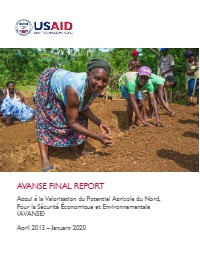
Cover Photo: Grison Garde, North Haiti. The USAID/AVANSE Jardin Lakay (Home Garden) program
trained women to raise vegetables for their families in small gardens near their homes.
The authors’ views expressed in this publication do not necessarily reflect the views of the United States Agency for International
Development or the United States Government.
iii | AVANSE FINAL REPORT USAID.GOV
TABLE OF CONTENTS
ABBREVIATIONS AND ACRONYMS V
OVERVIEW 1
OBJECTIVE AND SCOPE 1
TECHNICAL APPROACH 1
MAJOR OUTCOMES AND A CCOMPLISHMENTS 1
LESSONS LEARNED & RECOMMENDATIONS 4
IR 1: AGRICULTURAL PRODUCTIVITY INCREASED 7
RICE 7
CACAO 10
PLANTAIN 14
IR 2: WATERSHED STABILITY IMPROVED 17
MAJOR OUTCOMES AND ACCOMPLISHMENTS 17
LESSONS LEARNED AND RECOMMENDATIONS 18
IR3: AGRICULTURAL MARKETS STRENGTHENED 20
MAJOR OUTCOMES AND A CCOMPLISHMENTS 20
LESSONS LEARNED AND RECOMMENDATIONS 24
INFRASTRUCTURE 25
MAJOR OUTCOMES AND ACCOMPLISHMENTS 25
LESSONS LEARNED AND RECOMMENDATIONS 26
CROSS CUTTING 28
MONITORING AND EVALU ATION 28
ENVIRONMENTAL COMPLIANCE 28
COMMUNICATIONS 30
YOUTH AND WOMEN’S EM POWERMENT 31
ADDENDUM TO FINAL REPORT 32
509 SANITATION 35
ANNEX 1: IPTT 38
USAID.GOV AVANSE FINAL REPORT | iv
TABLES AND FIGURES
TABLES
TABLE 1: INDICATORS, TARGETS, AND LOP RESULTS FOR IR3 20
TABLE 2: INDICATORS BY FY AND LIFE OF PROJECT TOTALS FY 2014-FY 2019 – IR 3 23
FIGURES
FIGURE 1: TOTAL ANNUAL RAINFALL FOR CAP HAITIEN OVER 47 YEARS 8
FIGURE 2: ANNUAL CACAO EXPORTS 10
FIGURE 3: AVANSE NATURAL RESOURCES MANAGEMENT AND LOCAL COMMUNITY -BASED
ORGANIZATION MOPEJ MEMBERS APPLYING IMPROVED SOIL CONSERVATION TECHNIQUES
TO HILLSIDES IN THE JASSA WATERSHED 16
FIGURE 4: INSIDE CLES'S RICE PROCESSING FACILITY 19
FIGURE 5: CHALOPIN IRRIGATION SYSTEM SEEN FROM ABOVE 24
FIGURE 6: COMMERCIAL BANANA FARM ESTABLISHED WITH AVANSE SUPPORT 31
v | AVANSE FINAL REPORT USAID.GOV
ABBREVIATIONS AND AC RONYMS
APFL Association des Producteurs de la Ferme La Chapelle/La Chapelle Farmers’ Association
AVANSE Appui à la Valorisation du Potentiel Agricole du Nord, pour la Sécurité Économique et
Environnementale/Support for the Promotion of the Agricultural Potential of the North, for
Economic and Environmental Security
AU Auburn University
BRGM Bureau de Recherches Géologiques et Minières/ French Geological Survey
CLES Collectif de Lutte contre l’Exclusion Sociale/Collective Fight Against Social Exclusion
CPCN Northern Cacao Producers Cooperative
DR Dominican Republic
EC Environmental Compliance
EMMP Environmental Mitigation and Monitoring Plan
FFS Farmer Field School
GOH Government of Haiti
ha Hectare
HTG Haitian Gourde (currency)
IR Intermediate Result
kg Kilogram
LOP Life of Project
M&E Monitoring and Evaluation
MARNDR Ministère de l'Agriculture, des Ressources Naturelles et du Développement Rural/Ministry of
Agriculture, Natural Resources, and Rural Development
MT Metric Ton
NGO Non-Governmental Organization
NRM Natural Resource Management
PEA Project Environmental Assessment
PERSUAP Pesticide Evaluation Report and Safer Use Action Plan
PHS Post-Harvest Survey
PIF Production Intensive par Fragmentation/Intensive Production via Fragmentation
PISA Produit des Iles S.A. (A Northern Haitian cacao processor and exporter)
SIBA Système d’Incitation via les Bons d’Achat/System of Incentives through Vouchers
SIMA Système d’Information sur les Marches Agricoles/Agricultural Market Information System
SRA Système de Riziculture Améliorée/System of Rice Improvement
SRI Le Système Rizicole Intensive/Intensive Rice-Production System
UCNH University of Northern Haiti
UEH National University of Haiti
UPBH L’Union des Producteurs de Banane d’Haïti/Union of Haitian Banana Producers
USAID United States Agency for International Development
WUA Water User Associations
1 | AVANSE FINAL REPORT USAID.GOV
OVERVIEW
OBJECTIVE AND SCOPE
The $85.8 million, seven-year Appui à la Valorisation du Potentiel Agricole du Nord, pour la Sécurité
Économique et Environnementale (AVANSE) project, started in April 2013, with the specific objective of
increasing agricultural incomes in Haiti’s Northern Corridor. Prior to the project, farmers’ average
income in that area was restricted by limited access to technology and services and inefficient
agricultural production practices. AVANSE aimed to increase farmers’ income by achieving the following
outcomes in the rice, cacao, and plantain value chains: 1) agricultural productivity increased, 2)
watershed stability above selected plains improved, 3) agricultural markets strengthened, and 4) capacity
of local organizations strengthened. Over the course of the last seven years, AVANSE has realized all of
these goals and achieved its targets, except for strengthening the capacity of local organizations, which
was removed from the project goals following a scope of work modification in 2015.
TECHNICAL APPROACH
A value chain approach—guided by the core tenets of local ownership of solutions, increased use of
technologies, market-led interventions, gender mainstreaming, and active collaboration with local
institutions—informed AVANSE’s interventions. As appropriate, AVANSE employed a farmer field
school (FFS) approach to extend and disseminate improved agricultural production practices. FFS is a
participatory approach, which allows farmers to test and adapt improved techniques to their particular
circumstances. A parallel focus on market-based solutions enabled innovative inclusive, profitable public-
private partnerships to be forged between agribusinesses, farmer associations, and producer groups. The
gender mainstreaming approach contributed to 26 percent of the project beneficiaries being women and
22 female-owned agribusinesses being established or upgraded. Collaboration with local institutions,
particularly local universities and the regional branches of the Ministry of Agriculture, facilitated the
sustainability of AVANSE’s varied, widespread, and high-impact interventions.
MAJOR OUTCOMES AND A CCOMPLISHMENTS
During the life of the project, AVANSE made significant contributions to transformative, positive change
in the agriculture sector in the Northern Corridor of Haiti. Not only did average farmers’ yields and
income more than double, but 32 improved technologies were introduced and used by more than
50,000 farmers, and over 30 small, medium, and large agribusinesses were assisted and strengthened.
The major outcomes and achievements of the AVANSE project follow. Detailed outcomes and
achievements for each component are presented in the various subsections of this final report, and
additional detail is available in the previous annual and quarterly reports.
• Farmers’ income increased. Average agricultural income for beneficiary households more than
doubled: from $443 in 2013 to $960 in 2019.
• Agriculture yields significantly increased. Annual plantain yields increased from the baseline
value of 6 metric tons (MT) in 2013 to 18 MT in 2019. Single crop rice yields increased from
USAID.GOV AVANSE FINAL REPORT | 2
2.5 MT in 2013 to 6 MT in 2018, and annual cacao yields increased from 319kg/ha in 2013 to
455 kg/ha in 2019.
• Greater utilization of improved practices/technologies by farmers leading to increased
yields. Thirty-two different techniques or technologies were disseminated across the
Northern Corridor and applied by 51,455 farmers on 27,930 ha.
• Increased export sales of cacao from the North. In 2013, a particular bad year for Haitian
cacao production, AVANSE calculated a baseline value of $942,360 (427 MT) in export cacao
sales. In 2019 export sales were estimated at $6,899,937 (8,630 MT). AVANSE’s efforts to
increase total production and its assistance to growers and exporters had helped them to
expand total exports and their percentage of sales into the premium markets for fermented,
organic, and fair-trade cacao and contributed to this positive trend.
• Market system change in cacao sector. AVANSE’s assistance has expanded the capabilities
of all three major cacao exporters in the Northern Corridor to export fermented cacao,
leading to greater revenue for the sector and for farmers.
• High-demand and essential agricultural services developed and established locally.
AVANSE applied market-based solutions to remove inefficiencies in supply chain by enabling
small suppliers to import fertilizer in bulk; to introduce and increase the availability of clean,
high-yield rice seed and plantain planting materials; and to deliver irrigation, cultivation, and
harvesting services to remote agricultural lands.
• Greater access to irrigation. Two irrigation systems were rehabilitated and constructed,
including 7.2 km of masonry canals, to irrigate 430 hectares. Approximately 200 irrigation
pumps were subsidized to allow the provision of irrigation water to at least 660 hectares
annually. Ten three-wheeled motorcycles and 20 irrigation pumps given to the Ministry of
Agriculture to encourage local entrepreneurs to provide irrigation services to remote
agricultural lands.
• Hillsides stabilized. More than 6 million trees and crop plants were distributed, contributing
not only to soil conservation and erosion prevention by stabilizing slopes above selected plains,
but also contributing to household food security and increased income for farmers.
• Three key public-private partnerships forged. AVANSE’s funds were used catalytically to
leverage private sector (agri-enterprises) investments to benefit farmers, for example through
expanding farmer’s access to the higher-value organic and fermented cacao markets and
through enabling increased farmer engagement with a local agro-processor rice firm.
• Small and medium enterprises strengthened. Twenty-two enterprises, 13 of which are
female-owned, upgraded through investment in value-added processing that transform
unprocessed commodities into market goods with higher value, boosting job creation, and
generating greater revenues for local enterprises.
• Youth and women (agri-preneurs) eagerly engaging in commercial, agricultural
activities. Youth and gender mainstreaming in AVANSE activities contributed to 1,207
3 | AVANSE FINAL REPORT USAID.GOV
formerly unemployed and/or underemployed youth and 22 female-led agribusinesses starting
to generate income from their agriculture activities.
USAID.GOV AVANSE FINAL REPORT | 4
5 | AVANSE FINAL REPORT USAID.GOV
LESSONS LEARNED & RECOMMENDA TIONS
Lasting change in the way farmers produce.
Farmers and others including universities and the
Ministry of Agriculture have accepted the improved
production practices AVANSE promoted. In addition,
there has been a lasting change in farmers’ practices
and in how agriculture, especially rice production, is
taught in the local universities. However, in some
cases, farmers found some technology packages,
namely the System of Rice Intensification (SRI), too
demanding, and farmers did not adopt the entire
system. Consequently, we recommend gradual or
stepwise introduction of technology packages.
AVANSE recommends future projects work with
farmers to tailor new technologies to farmers’
particular agro-ecological conditions and financial
resources. This tailored approach, along with introducing agronomy students to new technologies and
providing them with field experience, will help increase the overall adoption rate of new and improved
technologies.
Collaborating with farmers on adapting technologies to their specific circumstances yields
encouraging results. Techniques adapted by farmers to their circumstances are likely to yield more
sustainable results than those given to them in a top-down approach. This accounts for the success of
the Farmer Field School approach, which uses a participatory method allowing farmers to test and to
adapt technology to their circumstances. For example, in the cacao value chain, changing from large
nurseries delivering in bulk to small community nurseries, as recommended by farmers, reduced cacao
seedling mortality. Local rice seed production, as opposed to imported seed, contributed to lower costs
and increased production. Locally produced, clean plantain plantlets eliminated the problem of
transporting, often low quality, plantain suckers from other regions. The recommendation, therefore, is
to continue collaboration with farmers, further integrating them into the extension process, in order to
identify the best solutions to farmers’ main production problems.
Working to expand innovations encourages market system change. Expansion of successful
innovations stimulates system improvements and encourages competition amongst private sector actors,
steering the private cacao sector toward more inclusive ways of doing business with farmers. For
example, all three of the main cacao exporters in the Northern Corridor have engaged in or expanded
their involvement in cacao fermentation; AVANSE’s support facilitated their shift to this higher priced
market. All of the exporters now have the capabilities to improve the quality and expand the amounts of
fermented cacao they produce, which increases their revenues. These changes in turn encouraged
exporters to engage in two other profitable specialty markets: fair-trade and organic. We recommend
continuation of these efforts to partner with the private sector in order to incorporate even more
farmers into higher value markets, and to multiply these profitable, agri-business activities.
Deepened engagement with private sector to foster inclusive economic growth. AVANSE,
through public-private partnerships and grants, made progress toward creating sustainable “win-win”
partnerships between agribusinesses and farmers’ groups and associations. Examples include the
BOX 1: EARLY TRANSPL ANTING
“Early Transplanting” is one of the five SRI
principles. This practice—transplanting young
rice seedlings about 8 to 12 days after
germination instead of the traditional 40
days—has been adopted by nearly all the rice
farmers in the Northern Corridor.
An AVANSE survey found that adopting this
simple practice alone leads to higher yields, in
the range of 20 percent increase.
USAID.GOV AVANSE FINAL REPORT | 6
Collectif de Lutte contre l’Exclusion Sociale/Collective Fight against Social Exclusion (CLES), L’Union des
Producteurs de Banane d’Haïti/Union of Haitian Banana Producers (UPBH) and Produit des Isles (PISA).
Future projects can build on these successes, by scaling up these partnerships and encouraging more
farmer involvement. Key to expanding inclusive economic growth is to work with firms that have shown
interest in fostering win-win economic opportunities for farmers.
Greater investment in irrigation and water management system is crucial. Deferred
maintenance increases the subsequent costs for rehabilitation of and repairs to irrigation systems.
Because these maintenance needs are not being addressed, the ensuing system inefficiencies and failures
have reduced water availability in most of the Northern Corridor’s irrigated perimeters. This lack of a
reliable water supply affected the uptake of the technologies AVANSE promoted, reduced farmers’
investments in improved agricultural technologies, and subsequently reduced the overall impact of
AVANSE’s programs. Going forward, more emphasis should be placed on developing the capacity of the
Ministry of Agriculture and water user associations to maintain, repair, and rehabilitate the existing
irrigation systems and expand improved water management on the major perimeters in Northern Haiti.
A flexible approach, in light of current climate realities, to facilitate resilience outcomes.
Long periods of drought and erratic rainfall negatively affected agricultural production in the Northern
Corridor throughout the duration of the AVANSE project. This trend is likely to continue. To prevent
significant losses in farmers’ livelihoods caused by climate shocks, flexibility in project design,
implementation, and even crop selection, is needed. Crop diversification and mixed farmer systems, for
example interspersing cacao with yams, plantain, vanilla, fruit, and timber trees can contribute to short-
term cash flow and a long-term increase in farmer’s revenue, and spreads the cash returns across the
year, making farmers more resilient.
Harmonization with other projects and the Ministry to maximize impact and avoid
duplication. In a bid to promote sustainability, AVANSE gradually reduced subsidies on agricultural
inputs and services. However, other projects provided these inputs and services for free, resulting in a
disincentive for collaboration with AVANSE. The recommendation is to ensure that the relevant
authorities and other projects are included in the design phase of new projects and in the annual work
planning process. While the Ministry of Agriculture was appreciative of AVANSE’s information sharing
and its incorporation of their local staff into project activities and trainings, the Ministry needs to be
encouraged to play a greater role in implementing sustainable approaches across all projects.
7 | AVANSE FINAL REPORT USAID.GOV
IR 1: AGRICULTURAL PRODUCTIVITY INCREASE D
Sixty percent of the rural population in Haiti works in agriculture, yet agricultural yields, virtually across
all value chains, are low when compared to those of neighboring counties. To increase agricultural
productivity, and by extension the agricultural income of farmers, from 2013 to 2019, AVANSE
implemented a number of extension and training activities with rice, plantain, and cacao farmers. These
activities increased Northern farmers’ use of improved technologies and practices, boosted the
commercial supply of agricultural inputs/services, built the resilience of farmers to drought, and
strengthened AVANSE’s beneficiary farmers’ knowledge and capacity in crop husbandry, integrated pest
and disease control, soil and water management, and post-harvest procedures.
RICE
MAJOR OUTCOMES AND A CCOMPLISHMENTS
INCREASE IN INCOME. Average gross margins increased from $217/hectare in 2013 to $990/hectare in
2019.
THREE-FOLD INCREASE IN YIELDS. Rice yields increased from a baseline value in 2013 of 2,561 kg/ha to
6,290kg/ha in 2018. AVANSE shared information about improved methods of rice production, provided
of machinery for threshing, land preparation and weeding, subsidized inputs (fertilizer and seed) on a
USAID.GOV AVANSE FINAL REPORT | 8
declining scale, and promoted SRI, a production methodology
that allows rice farmers to increase yields while using less
inputs.
TECHNICAL CAPACITY OF A WIDE RANGE OF
STAKEHOLDERS STRENGTHENED. Over the life of the
project (LOP), AVANSE trained 6,799 rice farmers, extension
agents, input suppliers, agricultural workers, agronomy
students, and professors from all the regional universities on
various improved rice production techniques. This wide-
ranging approach increases sustainability likelihood of
AVANSE interventions. The North and North East regions
now have ample competent professionals to guide farmers in
integrated pest management, proper pesticide application,
and improved production methods for growing healthy rice
crops with little to no technical training needed from external
experts.
LOCAL SEED PRODUCTION ESTABLISHED TO REMOVE
INEFFICIENCIES IN SUPPLY CHAIN. AVANSE trained a
selected group of farmers in the production, marketing, and
storage of quality rice seed for their own use and also for
sale. This activity helped reduce seed imported from
Dominican Republic, increased the use of high-quality seeds
by farmers, expanded the availability of high-quality seed of
local varieties, and generated extra income for farmers. The
farmers trained are now producing rice seed and selling to
agro-enterprises and other farmers across the region.
LESSONS LEARNED AND RECOMMENDATIONS
MECHANIZATION. Labor became increasingly difficult to find,
particularly at peak periods such as land preparation,
transplanting, and harvesting. While mechanized services are
available, especially close to the border from suppliers in the
Dominican Republic (DR), the lack of accessible roads
delayed the availability of these tractor services to Haitian
farmers. Nonetheless, AVANSE organized and subsidized
plowing services through an IR3 program, but competition
from the tractors available under a Haitian government
program reduced the long-term viability of these private
services. As agricultural labor becomes increasingly scarce,
our recommendation is to encourage nascent private sector
service providers to provide more plowing and harvesting
services, while pursuing better harmonization with competing
government programs.
BOX 2: MECHANIZATION
AVANSE farmer demonstrates the use of a mechanical
cultivator to Haiti's President Jovenel Moise.
Labor, especially at peak periods during
land preparation, is often unavailable or
difficult to find, inefficient, and frequently
cost prohibitive—it accounts for as much
as 40 percent of the cash costs for rice
farmers.
Access to improved equipment that is
appropriate and cost-effective for small
farms—from hand tools to mechanical
power-driven machines such as
mechanical cultivators and rice
threshers—is crucial to increasing
production and reducing inefficiencies.
AVANSE subsidized, at 75 percent,
mechanical cultivators for rapid land
preparation and provided rice threshers
to associations to help farmers to reduce
their production costs.
9 | AVANSE FINAL REPORT USAID.GOV
FLEXIBLE APPROACHES TO RESPOND TO
EXTERNAL SHOCKS. Throughout the project,
intermittent and localized droughts were a
significant challenge for rice. Farmers who planted
their rice nurseries at the traditional time either
lost their seedlings, or had to replant, Other
farmers, uncertain of the availability of water,
either avoided planting entirely, or reduced their
investment in inputs such as fertilizer. AVANSE
adapted and shifted its focus on building farmers’
resilience to the drought by informing them about
mitigation measures including growing more short
season crops that require less water than rice,
such as okra, beans, and maize. However, the
project was not allowed to work directly with
crops other than the ones stipulated in the
contract. As a result, farmers did not receive
specific training and inputs from AVANSE for these
crops, which was a missed opportunity to improve
farmer’s revenues under difficult conditions and to
strengthen their ability to recover from drought.
Going forward, a flexible approach, and perhaps
one that is crop agnostic, should be adopted
during periods of external shocks and
environmental shifts to prevent significant losses in
farmers’ livelihoods.
BOX 3: PEST MANAGEME NT
A combination of classroom and practical in-field
training on integrated pest management provided
AVANSE rice farmers and other stakeholders
with the knowledge and tools to combat apple
snails and rats, two major causes of losses in rice
production. The project developed pictorial
guides in Creole and French that helped
participants analyze, identify, and manage pest and
predators in their rice fields. Stakeholders also
now have access to “Rice Doctor,” a field
diagnostic tool from IRRI that enables farmers to
quickly identify problems in their rice crops by
answering a few simple questions.
400
600
800
1000
1200
1400
1600
1800
2000
2200
1970 1975 1980 1985 1990 1995 2000 2005 2010 2015
mm3
year
Figure 1: Total annual rainfall for Cap Haitien over 47 years (with the 10-year averages in red)
USAID.GOV AVANSE FINAL REPORT | 10
DEVELOPMENT OF GREATER CAPACITY TO CONSTRUCT AND REHABILITATE IRRIGATION SYSTEMS. A
widespread tendency to defer irrigation maintenance increases the need for rehabilitation and repairs.
When these needs are not addressed in a timely manner, they cause system inefficiencies and failures
that over time have resulted in reduced availability of water on nearly all the irrigated perimeters in
Northern Haiti. The uncertainty this created around the timing and volume of water available slowed
the uptake of SRI plus reduced the level of farmer investment. These factors reduced the overall impact
of AVANSE’s rice program. Going forward, more emphasis should be placed on working with the
Ministry of Agriculture to repair and rehabilitate the existing irrigation systems and expand improved
water management on the major perimeters and rivers in Northern Haiti.
TAILORED APPROACH TO SRI EXTENSION. While SRI uses significantly less water, both in the nursery
and during the growing season, and increases yields over farmers’ traditional practices, the adoption of
the entire SRI package without any modifications was somewhat limited. Farmers frequently made
adaptations to address the higher labor requirements of SRI at transplanting time, unreliable access to
irrigation water, or their limited financial resources. While optimum results only come from adoption of
the complete SRI package, there are still significant benefits to partial adoption. Our recommendation is
therefore to tailor the introduction of SRI using a gradual, step-wise approach, based on the
agroecological factors of the region and the farmers’ socio-economic capacities.
BOX 4: MULTIPLYING R EVENUE
WITH SRI
Skeptical of the promises of SRI, 67-year-old
Florvil Saincius tested the methodology on
the smallest and most deteriorated portion of
his rice field. The increased yields from that
first trial silenced his doubts. With each
passing year, Saincius expanded the area
under SRI and saw his production costs
gradually reduce and his rice paddy output
increase, and he became more and more
convinced of SRI’s effectiveness.
In January 2019, despite a prolonged drought,
Saincius harvested 359 50 kg bags of rice,
which he sold for 800 gourdes per bag,
earning him a total of 287,200 gourdes. After
deducting production costs for plowing,
seeds, field levelling, and transportation, he
netted 260,000 gourdes profit—10 times
more than what he was earning before
AVANSE trained him on SRI.
11 | AVANSE FINAL REPORT USAID.GOV
CACAO
Worldwide, market demand for premium cacao (whether for fermented beans, organic production, or
from specialty niche suppliers) is strong. Throughout the life of the project, AVANSE worked with
farmers and exporters to take advantage of these market opportunities and increased cacao producers’
incomes by implementing activities that: 1) increased cacao production; 2) improved cacao quality
(through fermentation and drying); and 3) certified cacao growers’ plots as fair trade and organic. Below
we present the main achievements of AVANSE’s interventions in the cacao value chain.
MAJOR OUTCOMES AND A CCOMPLISHMENTS
INCREASED INCOME. Average gross margins for cacao nearly doubled, from $205/hectare in 2013 to
$403/hectare in 2019.
INTENSIFICATION AND EXPANSION OF CACAO. More than 2.9 million cacao seedlings were grown and
transplanted with AVANSE’s assistance. These seedlings have now begun producing, and as a result, a
record quantity of cacao was harvested in 2019 (8,630 MT), despite a prolonged drought that reduced
production.
INCREASES IN YIELD. Average cacao yields went from 319 kg/ha in the baseline survey of 2013, to 322
kg/ha in the third Post Harvest Survey (PHS) in FY 2106, to 455 kg/ha in the sixth PHS in FY 2019.
AVANSE contributed to these increases by supporting farmers to produce seedlings and expand their
area planted, and to intensify their production by improving their farm management through pruning,
shade control, pest and disease management, and harvesting. Producers were supported to establish 173
nurseries to produce cacao seedlings, and 7,796 technical guides on improved production techniques
were distributed to farmers.
A SUSTAINABLE TREND: INCREASED CACAO EXPORTS. Due in part to the increased production
generated by AVANSE’s activities, cacao exports from the North increased from 427 tons in the 2013
season to 2,717 tons in the 2019 season. Cacao valued at more than $22 million has been exported
from Northern Haiti over the past six years. The numerous new cacao plantings that AVANSE
supported will help ensure that the positive trend in cacao export continues post-project.
Figure 2: Annual Cacao Exports
-
1,000,000
2,000,000
3,000,000
4,000,000
5,000,000
6,000,000
7,000,000
8,000,000
2013 2014 2015 2016 2017 2018 2019
USD
Year
USAID.GOV AVANSE FINAL REPORT | 12
GREATER ACCESS TO PREMIUM FAIR TRADE AND ORGANIC MARKETS. AVANSE helped cacao exporter
PISA and its associated cacao producers to gain fair trade certification, enabling farmers to benefit from
fair trade premiums. In addition, AVANSE worked with NOVELLA to establish a new cooperative to
represent cacao producers—the Northern Cacao Producers Cooperative (CPCN). The partnership
entailed organizing local producers into groups and certifying their cacao parcels as organic and fair
trade, which will enable CPCN to not only consolidate production and increase sales volumes, but also
benefit from enhanced purchase prices once certification is received during the first half of 2020.
ENCOURAGED EXPANSION IN THE PRODUCTION OF FERMENTED BEANS TO INCREASE FARM GATE
PRICES FOR FARMERS. Increased competition in the cacao sector was likely to increase farm gate prices
for farmers, so AVANSE worked with all three private-sector exporters in the North on expanding the
volume and the quality of fermented cacao. Fermented cacao brings higher prices on the international
market. The increase in revenues that resulted from the improvements in cacao fermentation supported
by AVANSE, led to higher incomes for both exporters and farmers. The same trend occurred in the
other premium market expansions supported by AVANSE, fair trade and organic cacao.
As a result of all these activities, by the end of the AVANSE project, 28,682 cacao farmers had used
some or all of these new and improved technologies on a total area of 16,631 ha.
REFILLING GAPS
A study conducted in Q4 FY 2019 revealed a
survival rate of 53 percent for cacao trees planted
from 2014 to 2018. Cacao seedling mortality was
largely attributed to the drought.
To intensify production, and to replace seedlings
that died, AVANSE distributed 384,010 cacao
seedlings grown from 50 AVANSE-supported local
nurseries.
Planting Moringa, a fast-growing, drought-resistant
tree that can reach up to three meters in height
during its first year, was also promoted. A total of
8,732 moringa seedlings were planted to help
shade young cacao plants from heat and the
stresses caused by drought
Box 5: Port Margot, North Haiti. Distribution of seedlings from a community nursery
13 | AVANSE FINAL REPORT USAID.GOV
LESSONS LEARNED AND RECOMMENDATIONS
PROMOTION OF IMPROVED TECHNICAL PACKAGE TO ADDRESS PRODUCTIVITY CHALLENGES.
Notwithstanding the undisputed successes of the AVANSE cacao program, and despite similarities in
climate, Haiti still lags well behind the Dominican Republic in terms of total production of beans per
tree. This is due to a variety of reasons, many of which AVANSE has started to address, and, therefore,
we recommend continued promotion of the technical package AVANSE promoted. In specific, trees that
are 60 to 70 years old need to be replaced by new plantations or, at minimum, need pruning and shade
management. Farmers need to continue to lay out new orchards with an optimum spacing while using
nurse crops for shade and income. Community nurseries (perhaps funded by the exporters) should
continue operating to replace seedlings that die due to drought or other factors.
HUSBANDRY AND MAINTE NANCE OF EXISTING ORCHARDS. Pruning and managing shade in old farms
can rapidly increase yields by up to 50 percent. To sustain the yield improvements already made through
the AVANSE program, farmers must be supported to continue to maintain their cacao orchards.
Without proper pruning and shade management, yields will decline again, and the trees will return to
being unproductive. Future projects and the Ministry of Agriculture should prioritize this activity.
INTERCROPPING TO ADAPT TO DROUGHT IN NEW ORCHARDS: Over the past four years, long
periods of drought have negatively affected cacao production in the Northern Corridor. As part of its
adaptation strategy, AVANSE distributed yams, plantain, vanilla, and moringa, plus a range of fruit and
forest trees to: i) provide shade and act as a nurse crop for the young cacao plants, ii) contribute to
some short-term cash flow before the new cacao trees come into bearing, and iii) diversify risk and
continue to provide a long-term supplement to the farmer’s revenue from fruit and timber. The mixed
cropping system is recommended because it spreads returns across the year, making cacao farmers
more resilient.
CLONAL GARDENS MAINTAINED. AVANSE had preserved some of the elite cacao lines collected and
evaluated under USAID’s DEED program. These “super trees” are kept in 13 locations throughout the
production area and, if used for seedling production in local nurseries, can lead to increases in yields of
100-200 percent. In addition, budwood from super trees grafted on existing trees can help regenerate
old orchards. We recommend expansion of the availability of these improved varieties; a wider
distribution of these improved materials can displace inferior varieties and improve the overall
production of Northern Haiti’s cacao. We also recommend that grafted material from these trees be
widely available at the appropriate time. In order to facilitate these actions, AVANSE has funded the
University of Northern Haiti (UCNH) cacao center of excellence to train grafters and maintain these
clonal gardens.
USAID.GOV AVANSE FINAL REPORT | 14
PLANTAIN
Over the past seven years, AVANSE facilitated the use and expansion of improved technologies to
intensify production of high-quality plantain in the region. The technologies promoted include high
yielding, disease-resistant plantlets, and mechanized land preparation and irrigation pumps. Despite the
challenges of drought and plant disease, the project was able to deliver some impressive results.
MAJOR OUTCOMES AND A CCOMPLISHMENTS
PLANTAINS YIELDS TRIPLED. Plantain yields went from a baseline of 6,040 kg/ha in 2013, to 9,175 kg/ha
in the third PHS in FY 2016, to an average of 18,021 kg/ha in the sixth and final PHS in FY 2019.
MARKET-BASED SOLUTIONS FOR LOCAL PRODUCTION OF IMPROVED PLANTAIN MATERIAL. Eighteen
for-profit plantain plantlet production centers, 13 of which are female-owned were established. These
centers produced disease resistant and high yielding plantlets by using the Production Intensive par
Fragmentation/Intensive Production via Fragmentation (PIF) method— which makes it possible for one
plantain stem over the course of 2 to 4 months to produce more than 100 high-quality, small plants
(plantlets). It is conservatively estimated that these centers have already produced 900,000 plantain
plantlets—enough to plant a total of 562 hectares. Owners of PIF centers have seen revenues of
640,000 HTG (approximately $7,000) over the course of just seven months of operation.
15 | AVANSE FINAL REPORT USAID.GOV
TRAINING AND PEST MANAGEMENT. AVANSE
used FFS to demonstrate the application of
good agricultural practices for increased
plantain production. Farmers worked with field
specialists to diagnose the main problems with
their plantain crop. They then received field
training on irrigation and water management,
pruning, mulching, and removal of the male
flower. In collaboration with the University of
Auburn, an extension specialist provided
AVANSE’s farmers with techniques for
identifying and limiting the spread of sigatoka, a
serious fungal disease. Over the course of the
project, AVANSE trained 9,228 farmers and
extension agents on these various improved
plantain production techniques. By the end of
the project, 6,236 plantain farmers had applied
some or all of these new and improved
technologies on a total of 4,785 hectares.
IRRIGATION PUMPS TO RESIST DROUGHT. A
subsidy program allowed farmers to purchase
186 pumps subsidized at 75 percent by
AVANSE, in order to irrigate their land and
those of others, contributing to at least 660
hectares able to be regularly irrigated. The
pumps helped mitigate the impact of the
drought, which had considerably reduced
plantain yields. In addition, AVANSE distributed
10 three-wheeled motorcycles, 20 irrigation
pumps, and 3,000 meters of flexible hoses to
the Ministry of Agriculture, which in turn
provided these machines to existing agricultural
services providers. The motorcycles, pumps,
and hoses allow the service providers to reach
remote farms with irrigation services.
INCORPORATION OF YOU TH IN
COMMERCIAL FARMING. Youth were
increasingly mainstreamed in plantain activities,
with 1,207 young farmers receiving training on
the PIF method to grow high-yielding, disease-resistant plantain. These young farmers received material
assistance and agricultural inputs from AVANSE to begin planting PIF parcels on 16.32 hectares. As many
of the young farmers were either unemployed or under-employed, this assistance enabled them to
engage in plantain production and represents a significant step toward increasing their income and
establishing new commercial farming ventures.
BOX 6: MARKET INSTRU MENTS TO
COMBAT DROUGHT
Only a limited number of farmers in Haiti’s
Northern Corridor have enough land to justify
buying their own irrigation pumps, so many
plantain growers have to just rely on rainfall, which
is increasingly erratic and limited.
To help address this constraint, AVANSE
distributed 10 three-wheeled motorcycles, 20
irrigation pumps, and 3,000 meters of flexible hose
to the Ministry of Agriculture, which in turn
provided these machines to existing agricultural
services
Farmers can now procure the irrigation services
they need at a fraction of the cost of buying a
pump, meaning that farmers have greater capacity
to manage the risk associated with the drought.
Moreover, the service providers, many of whom
are youths, have a viable means of generating an
income.
USAID.GOV AVANSE FINAL REPORT | 16
LESSONS LEARNED AND RECOMMENDATION S
DEVALUATION OF THE GOURDE COMPARED TO US D NEGATIVELY AFFECTED INCOME INDICATOR.
While some plantain farmers yields tripled, drought severely affected most of the Northern plantain
farmers. At the same time the costs of imported inputs increased sharply due to the deteriorating
USD/HTG exchange rate, and the local sales prices for plantain in HTG only increased slightly. The
exchange rate deteriorated from 45 HTG/$ in 2013 to 84.13 HTG/$ in 2019. Both the drought and the
unfavorable prices resulted in the gross margins for plantain, measured in USD, staying nearly static:
from $5,035/ha in 2013 (baseline) to $5,021/ha measured in the sixth PHS at the end of 2019.
PROVIDING PLANT MATERIALS. In the early stages of the project, plantain suckers were purchased from
commercial nurseries and distributed free of charge along with compost to beneficiaries. This approach
had several problems: it did not adequately engage the farmers, who had no personal investment in the
activity; suckers were delivered from the supplier in large quantities and often arrived at the farms
before farmers had completed land preparation or had sufficient soil moisture at their location to plant;
and the mixed varieties produced by these commercial nurseries often did not align with the farmers’
preferences. All of these factors led to inefficiencies and did not help ensure sustainability.
In 2016, AVANSE shifted away from free distributions through large nurseries to encouraging local
commercial production on a large scale of preferred varieties using the PIF method, but this did not
prove economically viable. The next step was reducing the scale and providing training and support that
allowed farmers to produce planting material using the PIF method to rapidly increase the number of
plants for their own use or to sell to immediate neighbors. This was a much more successful approach.
Consequently, we recommend promotion, continuation, and expansion of the PIF multiplication method
at a small local scale through selected farmers.
RESPONSE TO DROUGHT. The long drought periods and the erratic rainfall negatively affected plantain
production in the region. AVANSE adapted to this challenge by providing subsidized irrigation pumps,
which enabled farmers to provide supplemental irrigation during times of drought. This intervention was
combined with the promotion of good agricultural practices such as mulching to conserve soil moisture
and field training in soil and water management. All these activities helped to avoid the reduction in the
weight and size (and marketability) of the plantain bunches typically results from drought. Our
recommendation is to continue promoting subsidized pumps and soil moisture conservation techniques.
VALUE ADDITION TO HARVESTED PLANTAINS. As individual producers’ production volumes increased,
farmers were organized to aggregate the production from several farms for transport to more distant
markets. Test shipments of plantain to the larger processors in Port au Prince, such as AYABOMBE,
demonstrated that the cost of assembling a full load and transporting fresh plantain to Port au Prince
was too high, especially given the competition from closer suppliers. In response, in-kind grants were
made to three local entrepreneurs to produce papita and other plantain products in the North, and the
demand this created opened additional markets for Northern plantain producers. Our recommendation
is to continue supporting young entrepreneurs and small and medium enterprises working in plantain
value addition and facilitating their entry to profitable markets for processed products.
17 | AVANSE FINAL REPORT USAID.GOV
IR 2: WATERSHED STABILITY IMPROVED
AVANSE applied a community-based approach to its natural resource management (NRM) activities.
Working with local organizations, AVANSE identified each community’s priority needs and prepared
detailed soil and water conservation plans for their sub-watersheds. Grants to 11 community-based
organizations located in six watersheds helped protect eroded hillsides, through planting trees, reducing
erosion, and stabilizing slopes.
MAJOR OUTCOMES AND A CCOMPLISHMENTS
LOCAL SOLUTIONS APPROACH ADOPTED FOR GRE ATER IMPACT
Using the konbit
1 approach, AVANSE solved the issue of the labor force required to make long-term
investments on a hillside block. Grants were awarded to local community organizations, who, with the
support of the NRM technical team, organized the field work and arranged for the traditional meal. This
transferred the technical NRM responsibilities to the local organizations and reinforced community ties.
1
1
A konbit is a Haitian tradition, a mechanism of social solidarity found in rural areas where a group agrees to
work together to carry out various activities, particularly in agriculture. This tradition had started to disappear
until AVANSE’s NRM team encouraged farmers to reinstate it and to use it to renovate their eroded hillsides.
Figure 3: Gens de Nantes, Northeast Haiti. AVANSE Natural Resources Management and local community-based
organization MOPEJ members applying improved soil conservation techniques to hillsides in the Jassa Watershed.
2016-09-22 Photo: Audius Petit Jacques / CBO MOPEJ / AVANSE
USAID.GOV AVANSE FINAL REPORT | 18
AVANSE also supplied the up-front investment required to provide the plant materials needed to
replant an eroded hillside with mixed species. As a result, AVANSE achieved the following results:
• A measured 52 percent survival rate (490,377 trees) of trees planted, compared to the
more usual 20-30 percent.
• A reinvigoration of the traditional communal workgroup system (konbit), which had
started to disappear in many regions of Haiti.
• Treatment of a total of 2,918 hectares of hillside farmland (measured by GPS), against
the LOP target of 3,000 hectares.
• Training for 6,525 beneficiaries (4,144 men and 1,837 women) in NRM and soil
conservation, against a LOP target of 6,000.
• 5,462 beneficiaries observed applied improved technologies and receiving economic
benefits from sustainable NRM/conservation.
• A total of 2,766,370 linear meters of biomechanical structures/anti-erosion contour
structures installed on eroded hillsides.
SUSTAINABLE LIVELIHOOD APPROACH TO SOIL CONSERVATION—6 MILLION FOOD PLANTS AND
FRUIT AND FOREST TREES DISTRIBUTED.
2
AVANSE centered its soil conservation activities around
selecting and planting crops and trees that produce food, and so not only conserved soil and prevented
erosion by stabilizing slopes above selected plains but also contributed to household food security,
consumption of nutritious products, and an increased income for farmers from sales.
LESSONS LEARNED AND RECOMMENDATION S
USE OF DROUGHT RESISTANT PLANTS. The use of pineapple plants to reinforce and stabilize the
earth berms constructed along the contours across eroded slopes was very popular with farmers. The
drought-resistant pineapple plants make an effective barrier to erosion and provide farmers with a
2
They include 648,877 fruit and forest trees, 168,557 plantain suckers, 1,447,943 pineapple cuttings, 325,621 yam
plants, 1,356,863 elephant grass cuttings, 1,449,066 sugar cane cuttings, 229,000 vetiver seedlings, 6,834 kg of
maize seed, 14,655 kg of Congo pea seed, 15,634 kg of pea seed, and 36,841 acacia tree seedlings.
BOX 7: INCREASING YIELDS, MANZÈ ROSE, PERCHES
Before development of the soil conservation activities at Manzè Rose, during periods of intense
rainfall, the rice fields downstream of the slopes were often buried under mud because of soil
erosion in the upstream areas. Because of the damage this silting process caused, rice yield for
farmers downstream was approximately 1.2 MT/ha.
With AVANSE’s support, the community installed new bio-physical structures at Manzè Rose, which
reduced runoff and soil erosion. After establishment of the renovations, even in periods of intense
rains, silting was drastically reduced downstream and the average rice yield more than doubled to
approximately 3 MT/ha.
As well as the increased income from their rice, an economic analysis using data collected from
landowners in the managed hillside blocks at Manzè Rose suggested that the value of their hillside
land had doubled one year after the bio-physical structures were installed, from $600 to $1,200 per
hectare.
19 | AVANSE FINAL REPORT USAID.GOV
reliable cash crop. We recommend continued promotion and scaling up of the use of pineapples and
other climate-resilient species to stabilize hillsides along contour berms.
PROMOTION OF LOCAL O WNERSHIP AND LOCAL INVESTMENT. There is a long tradition of donor-
funded projects imposing external solutions and, in some cases, even paying hillside farmers to change
work their own land, all of which discourages ownership and reduces sustainability. AVANSE’s approach
built the capacity of local non-governmental organizations (NGOs) to work with the farmers themselves
to implement solutions. AVANSE worked with the farmers with plots downstream, and those with plots
along the slope and engaged them all in activities, providing the plant materials and hiring local woman to
prepare a midday meal (part of the traditional konbit practice). To facilitate these community actions, we
recommend the production of additional plant material for erosion control in local community
nurseries. This would not only provide an additional income source but would also help ensure that
material was available for transplanting at the optimal time.
STRATEGIC SELECTION OF CROPS FOR BOTH SHORT-TERM AND LONG-TERM ECONOMIC BENEFITS.
Rather than focusing on just reconstituting a perennial vegetative cover on eroded slopes, AVANSE
distributed a range of plants that included species valued by farmers for their immediate returns, i.e.,
those that produce food for their families, can be sold on the local market, and are generally fast
growing, such as pigeon pea, pineapple, and yams. The project intercropped these species with longer-
term perennial species that also had economic value, such as mango, cashews, and timber trees. Farmers
received immediate income from the shorter rotation crops while at the same time they could expect
to receive income from sales and food for household consumption from the perennial species at a later
date. This combination of short- and long-term economic benefits motivated farmers to protect and
maintain their tree seedlings. We recommend that future initiatives take a whole of hillside “plot-based”
approach, one that encourages adaptive, plot-specific alternatives that consider the social, economic, and
ecological conditions at that location, with all the interventions developed with and through beneficiary
participation.
USAID.GOV AVANSE FINAL REPORT | 20
IR3: AGRICULTURAL MA RKETS STRENGTHENED
AVANSE strengthened the agricultural markets in the Northern Corridor by working with private
businesses (big and small) to upgrade their facilities, which enabled them to process larger volumes of
quality products, add value to raw agricultural commodities, and sell their products into higher-priced
local and international markets. The IR3 team also operated a subsidy program for fertilizer that used
electronic vouchers, collaborated with the Ministry of Agriculture to provide farmers and traders with
reliable and timely market information, and partnered with suppliers to provide farmers with modern
inputs and technologies. These partnerships helped sustain the gains made in agricultural productivity
and farmers’ income.
Figure 4: Inside CLES's rice processing facility
MAJOR OUTCOMES AND A CCOMPLISHMENTS
Table 1: Indicators, Targets, and LOP Results for IR3
INDICATOR LOP TARGET RESULTS % CHANGE
Percent increase in value of incremental sales by cacao
farmers
150% $399,061 299%
Percent increase in value of incremental sales by rice
farmers
200% $3,809,810 1,423%
21 | AVANSE FINAL REPORT USAID.GOV
INDICATOR LOP TARGET RESULTS % CHANGE
Percent increase in value of incremental sales by
banana/plantain farmers
200% $236,925 -18%
Percent increase in value of agribusiness sales 30% $13,556,029 248%
New private sector investment $2.5 million $2,238,908 -10%
FTE jobs created 150 228 +52%
Farmers receiving market information 26,000 33,384 +28%
UPGRADING EQUIPMENT, PROCESSING TRANSFORMATION
INCREASED DRYING AND PROCESSING CAPACITY IN THE RICE & CACAO VALUE CHAINS
• With AVANSE’s support, the CLES rice processing facility was upgraded and it is now able to
dry and mill more rice—from 90MT to up to 6,000MT—per rice season, This expansion is
projected to contribute up to $4.5 million in increased agribusiness sales, 40 employees with full
time jobs, 20 percent increase in the farm gate purchase price for rice, and additional income for
up to 1,300 farmers who will benefit from 10 percent cash redistribution of CLES’s business
revenue.
• Upgrades to a fermentation center doubled exporter PISA’s fermentation capacity, from 5 MT
to 10 MT per day, helping PISA and its associated farmers benefit from a higher-priced market
segment.
• Haiti’s, largest cacao exporter, NOVELLA is now equipped to start producing fermented cacao
in 2020, thanks to AVANSE support for remodeling a 700 m
2 coffee collection depot into a
cocoa fermentation and drying center. This new infrastructure will allow NOVELLA and
thousands of cacao farmers to benefit from the higher value fermented cacao market. Prior to
AVANSE’s intervention, NOVELLA was not producing fermented cacao, and their farmers were
not receiving the benefit of the increased export prices paid for fermented beans. The new
export price could be as high as $500/MT, against the current price of $150/MT paid for
unfermented low-quality dried cacao.
• FECCANO (a federation of cacao cooperatives), with AVANSE’s support, erected four drying
tunnels, and received international expert training in how to improve the operation of their
members’ fermentation facilities, enabling them to produce better quality fermented cacao.
INCREASED TRANSFORMATION CAPACITY IN THE CACAO VALUE CHAINS. A modern “bean-to-
bar” chocolate-making facility established with small local business AGROTECH has resulted in
another market for local farmers’ cacao beans, as well as creating employment, and providing for
AGROTECH access to higher-priced markets for local cacao products.
USAID.GOV AVANSE FINAL REPORT | 22
SMALL-SIZED BUSINESSES
SUPPORTED/STRENGTHEN ED.
Eighteen small, local agro-
processing businesses, the
majority of which were female-
owned, and one blind owner of a
chocolate business received
technical assistance and modern
equipment to facilitate the
improved transformation of their
products. The equipment included
cacao roasters, cacao bean
cracking machines, small rice mills,
and a plantain slicer, in addition to
small generators to supply
electricity. These grants in kind
improved the capacity of these
firms to more rapidly transform
rice, cacao, and plantain into
goods with a higher market
value—products like rice flour,
plantain chips (papita), chocolate,
and cocoa butter, and
contributing to increased sales
and greater demand for farmers
products.
BANANA FARM AT LA CHAPELLE
ESTABLISHED. A modern 50-
hectare pilot banana farm aimed
at the export market was established in partnership with a land-owning investor (the Bonnefil family), an
association of small local farmers (the La Chappelle Farmers Association), and a major exporter from
the Dominican Republic (Banamiel). By December 2019, the 50 hectares had been planted, the farm had
30 full-time employees, and weekly harvests were as much as 1,000 bunches, which were being sold on
the local market, contributing to increased agricultural sales, nutrition, and food security. (More details
on this sub-project is in the Addendum Report)
ACCESS TO QUALITY SERVICES
INCREASED ACCESS TO AGRICULTURAL QUALITY SERVICES (INPUTS) THROUGH
ELECTRONIC VOUCHERS
SIBA: An incentive system for agricultural inputs (SIBA) that used an electronic voucher system to
provide subsidized inputs (at a declining rate) to farmers was piloted in collaboration with local partners,
input stores, and the microfinance institutions Federation Le Levier and Service Financier Fonkoze. The
system, highly appreciated by farmers and input stores, contributed to an increased availability of quality
inputs for farmers, and also strengthened the capacity of suppliers to import and deliver greater
quantities and better quality, non-counterfeit inputs to local farmers.
BOX 8: SUPPORTING
FEMALE
ENTREPRENEURSHIP
Dapheney Dolce, 23, co-
founder and CEO of Choco
Kreyol, proudly shows her
quality artisanal chocolate
produced and packaged with
machinery provided by
AVANSE. Dolce is now able
to produce in one day the
same number of chocolate
bars that she used to
produce in one week.
23 | AVANSE FINAL REPORT USAID.GOV
A pilot voucher program worked with six firms to increase access to plowing services for plantain
producers, and the project also facilitated the development of the first rental service for agricultural
equipment—by local equipment company HAYTRAC—to affiliated plowing entrepreneurs in the north.
Another series of meetings and workshops assisted key actors such as Ministry of Agriculture, Natural
Resources, and Rural Development (MARNDR), other donors, and projects to understand the benefits
of the system of e-vouchers developed by AVANSE under SIBA. The project also participated in the
development of a national strategy for incentives and subsidies for inputs.
INCREASED ACCESS TO MECHANIZED AGRICULTU RAL TOOLS. One hundred eighty-six irrigation
pumps, 18 mechanical cultivators, and 21 mechanical threshers, all subsidized at 75 percent, were
provided to farmers through a partnership with agricultural equipment supplier (Charles Fequiere). This
partnership enabled farmers to increase their productivity through the use of mechanized equipment
and enabled a Haitian business to expand its market into the North and generate greater revenues.
INSTITUTIONAL CAPACITY BUILT TO PROVIDE QUALITY EXTENSION SERVICES TO CACAO
FARMERS, COOPERATIVES, RESEARCHERS, AND EXPORTERS. The capacity of the UCNH was
strengthened to provide, on a fee basis, a wide-range of extension services to farmers and others
working across the cacao value chain. With AVANSE’s support, UCNH established the “Cacao Center
of Excellence,” the “go-to” place for agronomists, technicians, cacao growers, processors, and exporters
for information on all subjects related to cacao, whether addressing production issues, such as diseases
and best practices, or post-harvest activities such as fermentation and improved drying methods. This
Cacao Center of Excellence will continue to serve as a repository of technical information and know-
how on the technological advances introduced by AVANSE and others, thus helping to ensure the
sustainability of AVANSE’s interventions.
ACCESS TO RELIABLE MARKET INFORMATION IMPROVED. A mobile-based market information system,
SIMA, was developed by AVANSE in collaboration with MARNDR’s Department of Statistics, and the
Telecommunications Company DIGICEL. It allowed farmers to use voice or text commands to access
reliable and timely information on the prices of various agricultural crops in a range of regional markets.
AVANSE’s farmers are aware of this new system and are able to access market information, including
crop prices in different markets. The Ministry continues to collect the market information and is now
working with the EU to create a national system that empowers farmers and small-scale traders who
would otherwise lack leverage, market awareness, and decision-making power, equipping them to
bargain for better prices when selling their products.
AGRICULTURAL HAZARDOUS WASTE MANAGEMENT SE CTOR STRENGTHENED. A cost-sharing grant
provided waste management firm 509 Sanitation with highly specialized equipment, including an
incinerator and ancillary equipment, and the capabilities to safely dispose of toxic agricultural waste
(expired pesticides etc.) in compliance with international standards and best practices. This major
USAID investment aimed to transform and modernize the waste management sector in Haiti. (More
details on this sub-project is in the Addendum Report.)
USAID.GOV AVANSE FINAL REPORT | 24
Table 2: Indicators by FY and Life of Project Totals FY 2014-FY 2019 – IR 3
INDICATOR FY14
FY15 FY16 FY17 FY18 FY19 TOTAL
FY14-
FY19
LOP
TARGETS
(FY14-
FY19)
Value of
agribusiness
sales
24,828 44,000 356,115 605,395 5,603,073 6,922,618 13,556,029 11,542,996
Number of
public-private
partnerships
0 0 1 0 2 0 3 4
Number of
full-time
equivalent
(FTE) jobs
0 0 0 41 78 109 228 200
Number of
entities
receiving USG
organizational
development
assistance
780 368 32 35 13 37 1,265 1,250
LESSONS LEARNED AND RECOMMENDATIONS
COST EFFECTIVE INTERVENTION PROMOTED. AVANSE distributed 750 cacao-drying tables and 100
tarpaulins to 850 individual cacao farmers who were part of cacao direct sales groups. Drying tables
were found to be effective in both drying the cacao and in reducing mold contamination, but their high
costs and size limited their potential; the lower-cost tarpaulins represent a more replicable and
manageable alternative. Even though drying takes a bit longer with tarpaulins than with tables and the
tarpaulins have a shorter lifespan, their cost is 15 times less than a drying table. We therefore
recommend the promotion and scaling up of the use of tarpaulins as a cost-effective drying technology.
CAMPAIGN TO INFORM MORE FARMERS ABOUT MARKET INFORMATION SYSTEM. Asymmetric market
information on agricultural value chains in Haiti means that farmers lack negotiating power to bargain
with buyers when selling their produce. While AVANSE trained more than 6,000 farmers on usage of
SIMA, the mobile-based agricultural market information system, still more farmers in the region can
benefit from this project. A radio campaign informing farmers of SIMA’s advantages would help remove
asymmetric market information, empower more farmers in the region to negotiate with buyers, enabling
them to sell their produce at or closer to the market price, and thereby benefitting from increased
revenues. Another recommendation is to continue working with Digicel and MARNDR to add weather
information to the SIMA platform so that farmers can more easily adapt to climate stresses and shocks.
25 | AVANSE FINAL REPORT USAID.GOV
INFRASTRUCTURE
AVANSE rehabilitated and constructed two irrigation systems (Dubré and Chalopin), providing farmers
with increased access to irrigation water. This contributed to redressing years of low to no maintenance
of the existing irrigation systems in Northern Haiti, a neglect that had led to the systems being
dilapidated, canals blocked by debris, and a higher than usual water loss from leakages from the canals
(40-50 percent). Higher yields and, by extension, higher incomes for farmers are expected as a result of
these irrigation infrastructure improvements.
MAJOR OUTCOMES AND ACCOMPL ISHMENTS
INCREASED ACCESS TO IRRIGATION WATER FOR FARMERS IN DUBRÉ. Intake and distribution
systems and 5 kilometers of primary canal in stone masonry were rehabilitated or constructed to allow
the irrigation of 135 hectares, permitting 256 rice farmers to increase yields from 3 MT to an estimated
4 MT.
INCREASED ACCESS TO IRRIGATION WATER FOR FARMERS IN CHALOPIN. Intake and distribution
systems and 1.2 kilometers of primary canal in stone masonry were rehabilitated or constructed to
irrigate 295 hectares, allowing 244 rice farmers to increase yields from 3.5 MT to estimated 5.5 MT.
WATER USERS CAPACITY TO OPERATE AND MAINTAIN IRRIGATION SYSTEM INCREASED. A
team of experienced AVANSE community organizers worked with all the irrigation associations across
the Northern Plain and the local Ministry of Agriculture staff to provide a variety of capacity-building
events and the legal assistance needed to formalize and strengthen them. At Dubré and Chalopin,
following the selection of these sites for improvements, an intensive series of additional trainings led to
Figure 5: Chalopin Irrigation System seen from above (1. diversion structure, 2. escape canal, 3.
sedimentation basin, 4. primary canal) Photo Credit: Eric Auguste for MARNDR
1
2
2
4
2
3
2
USAID.GOV AVANSE FINAL REPORT | 26
newly elected committees, management changes, and new operating procedures. These changes
prepared the two associations for the management and maintenance of the renovated systems.
Two grants were made directly to the water user associations (WUAs) at the two irrigation
subprojects: one for a water treatment facility to serve the Dubré community and provide a source of
income for the association and another for the rehabilitation of the WUA’s office in Chalopin. These
grants helped to improve the effectiveness of the associations and increased community engagement in
WUA activities.
WATER BALANCE STUDIES - GROUNDWATER LEVEL MONITORING FOR FUTURE PROJECTS. AVANSE
launched a series of diagnostic studies on the availability of water in Haiti’s North and North East
departments to determine the water balance, which will allow future projects, and the government to
estimate the impact of any irrigation system expansions on the overall availability of water and to better
evaluate other proposed new or expanded uses of water. In conjunction with the Ministry of
Agriculture, the Bureau de Recherches Géologiques et Minières (BRGM) and the University of Haiti,
AVANSE built a groundwater model of the water balance in the Northern Plain aquifer. The field team
regularly collected data and monitored the surface water flows and the groundwater levels in the North
and North East to help build the model. This data collection effort was taken over by the USAID
Reforestation project, which will allow updating of the model.
AVANSE also performed pumping tests on existing wells in five watersheds in the North and North
East. The project identified and mapped approximately 300 individual wells and performed a total of 234
pumping tests, 229 inspections, and 239 base water level and electro-conductivity measurements.
FIRST SOIL LAB IN THE NORTHERN REGION ESTABLISHED. Through a sub-contract with Auburn
University (AU) and a grant in-kind to the National University of Haiti (UEH), AVANSE established a soil
testing laboratory at the Henri Christophe Campus in Limonade (CHCL). AU provided on-site
supervision as the equipment and supplies were installed at the CHCL laboratory, procured an atomic
absorption spectrophotometer and other analytical instruments previously unavailable in the North, and
provided training to UEH-CHCL staff on soil and water testing methodologies, laboratory management,
and administration both on site and in the United States at Auburn University’s soil laboratory. AU
experts also helped CHCL/UEH develop a program of outreach activities and a proposed fee-for-service
schedule for soil and water testing. Farmers in the region can now apply fertilizers at the rates best
suited to their crops and soil, conserving their limited resources by not buying unnecessary or
inappropriate fertilizers.
LESSONS LEARNED AND RECOMMENDATIONS
IRRIGATION SYSTEM PROCUREMENT. Finding reliable and experienced construction sub-contractors
who can build to international standards is a significant challenge in Haiti. In addition, most large firms
are Port au Prince-based and unwilling to transfer senior staff to supervise projects in the North. That
said, pre-bid conferences combined with mandatory site visits helped potential implementers understand
the specific requirements of a USAID-funded project. Consequently, we recommend continued use of
these conferences and mandatory site visits for any construction work in the Northern Corridor.
IRRIGATION SYSTEM IMPLEMENTATION. Progress on construction activities was hindered by a variety of
issues with local subcontractors. Flexibility and the ability to work collaboratively with the construction
27 | AVANSE FINAL REPORT USAID.GOV
contractors to address difficulties as they arose and make modifications accordingly was essential to the
successful and timely completion of the projects. Continual site supervision was critical to ensure that
problems were identified and addressed rapidly. We therefore recommend careful selection of
contractors with experience building to USAID standards, plus close collaboration with contractors and
continual field-based supervision as a way to help mitigate unforeseen macro-level challenges.
WATER USER ASSOCIATION ACTIVITIES. A close working relationship with the local and provincial
Ministry of Agriculture officials was key to the successful capacity-building and sustainability of local
water user associations. Identifying and electing women into positions of authority was an ongoing
challenge. Community grants to the WUAs improved the physical facilities for association activities at
Dubré and Chalopin. At Dubré, the installation of a water filtration system also created a source of
income for that association. We recommend continued close collaboration with MARNDR officials for
any irrigation rehabilitation work, as well as small community grants to WUAs whenever possible.
WATER RESOURCES MANA GEMENT. Collaboration with the BRGM and the University of Haiti led to
the production of a water balance model for the Northern Plain and the collection of a body of data that
is available for future water resource planning. Unfortunately, in the absence of a source of additional
funding for a local organization to continue updating and refining the model, the recruitment of a local
organization to take on this role was unsuccessful. A series of discussions with potential organizations
and funding sources did not result in a long-term solution. In the short term, data collection is being
continued by the USAID Reforestation Project.
USAID.GOV AVANSE FINAL REPORT | 28
CROSS CUTTING
MONITORING AND EVALUATION
MAJOR OUTCOMES AND ACCOMPLISHMENTS
Throughout the life of the project, the monitoring and evaluation (M&E) team cleaned and validated the
data provided by the rice, cacao, and plantain technical leads on key indicators. The team also assisted
the technical leads to design surveys, collect monitoring data, map project activities, and measure the
affected areas using GIS. The M&E team also conducted economic and social impact studies of the NRM,
cacao, rice, and plantain and infrastructure activities. For example, in consultation with the international
rice specialist, Dr. Erika Styger, the M&E team co-designed a survey to collect data on rice producers’
adoption and adaptation of SRI practices.
GIS and Mapping: Throughout the project, AVANSE produced a range of maps that enabled project
management and the technical team to better visualize and evaluate the project’s impact and reach. For
example, all of the organic cacao producers had their individual plots measured and geo-referenced as
part of the organic certification process, and the irrigated land parcels in Chalopin and Dubré were
mapped to verify ownership, calculate water requirements, and facilitate water management. A range of
topographic maps demonstrated the location of geo-referenced activities and measured the actual area
of a range of project activities, such as hectares put under improved technologies or NRM hillside
improvements.
LESSONS LEARNED AND RECOMMENDATIONS
DIFFICULTIES/FLAWS IN PHS INTERVIEWS. One major deficiency is that the Post Harvest Survey (PHS)
was designed based on farmers’ recall, not on actual records. Farmers may underestimate their
production and overestimate their costs in order to justify continuing assistance. Going forward, we
recommend on-site measurement and immediate recording of harvests, perhaps collecting some critical
data from a smaller statistically representative subset of the larger sample and using electronic media,
such as phones and tablets. This approach will, however, require careful planning and a significant
number of skilled enumerators or field agents.
In addition, some beneficiaries selected randomly for the post-harvest survey were not available during
the data collection period. Smallholder farmers may have moved to the cities or the Dominican Republic
to search for agricultural and/or construction jobs. A random replacement list was used to replace these
unreachable farmers. Community and FFS leaders helped enumerators locate producers who had
moved, reducing the size of this problem. We recommend continuing these two practices in the future
in order to maintain the sample size and replace absent beneficiaries.
ENVIRONMENTAL COMPLI ANCE
The environmental compliance team helped to ensure that all of AVANSE’s activities created no adverse
environmental effects. The team provided proper environmental monitoring of project activities to
ensure they were properly conducted per AVANSE’s Project Environmental Assessment (PEA) and Reg.
216. They produced training materials and carried out the day-to-day management, ongoing
29 | AVANSE FINAL REPORT USAID.GOV
environmental reviews, on-site due diligence assessments, and staff environmental compliance
awareness—as applicable—for all approved AVANSE activities, including the NRM, construction, and
agro-processing grants.
MAJOR OUTCOMES AND ACCOMPLISHMENTS
ENVIRONMENTAL MONITO RING. The environmental team worked with the technical teams to produce
Environmental Mitigation and Monitoring Plans (EMMPs) for all relevant AVANSE project activities, and
created an environmental monitoring and reporting system to track compliance with the approved
EMMPs. They also provided technical assistance for any environmental screening required by the
plantain, rice, cacao, natural resource management, irrigation, and agro-business teams. AVANSE’s
environmental monitoring and reporting system was highly regarded by USAID.
The environmental compliance (EC) team used the AVANSE Environmental Monitoring & Management
Framework to ensure the Pesticide Evaluation Report and Safer Use Action Plan directives were
integrated into the AVANSE agricultural production practices. Good agricultural practices for pesticides
and pest-specific integrated pest management information and training materials were included in
AVANSE’s agricultural production activities.
As per the PEA-directed environmental management guidelines, the EC team generated 37 specific
EMMPs for all of AVANSE’s value chain production, marketing, infrastructure, and grant-related
activities.
The EC team conducted a number of environmental compliance trainings for field technicians and value
chain, infrastructure, and agribusiness marketing staff, which helped AVANSE staff understand the
fundamentals of the EMMP’s Environmental Monitoring and Evaluation Tracking Table and assisted them
to do the necessary M&E and be in environmental compliance.
AVANSE continuously assessed the specific level of environmental compliance of the project’s five main
activity-groups: 1) the rice, banana/plantain, and cacao value chains, plus grants focused on agricultural
production; 2) watershed soil stabilization grants; 3) the voucher program (SIBA); 4) agro-processing
(rice, cacao, and banana) grants; and 5) irrigation and drainage activities, using five separate
Environmental Compliance Status Trackers.
Biodiversity Assessment of the Dubré and Chalopin irrigation systems. In 2018, USAID
provisionally approved the EMMPs for the Dubré and Chalopin irrigation rehabilitation projects, pending
an assessment of the biodiversity. AVANSE conducted a biodiversity assessment of the two irrigation
systems’ project areas to determine if any endangered and/or threatened species were present. This
rapid assessment primarily focused on reptiles and amphibians. Mitigation measures were established
and included in the EMMPs for the construction activities.
509 Sanitation. The environmental team worked with 509 Sanitation to procure specialized hazardous
waste management equipment through a grant to the company that was designed to modernize and
transform Haiti’s hazardous waste sector. Upon completion of this activity, Haiti will have a modern
facility, equipped with state-of-the-art machinery, for the safe management and disposal of a range of
hazardous wastes. (For more details, see the addendum to final report)
USAID.GOV AVANSE FINAL REPORT | 30
COMMUNICATIONS
Over the life of the project, the communications team worked to achieve two main objectives:
• Inform stakeholders about the progress and notable achievements of the project.
• Strengthen knowledge transfer regarding new and improved technologies.
The first objective was achieved through publication of periodic reports, newsletters, success stories,
and fact sheets, and hosting of inaugural events and exhibitions. Through these mediums, AVANSE
informed the client (USAID) and state, institutional, and private actors and local communities on the
project’s accomplishments. The second objective was achieved through technical publications,
guidebooks, and training materials that AVANSE used to transfer knowledge on improved agricultural
technologies to its beneficiaries (farmers, agronomy students, and farmers associations) and its key
partner (MARDNR). The communications team working with the technical staff also provided local
actors with specific information on AVANSE interventions through a regular radio program.
MAJOR OUTCOMES AND ACCOMPLISHMENTS
Over the life of the project, AVANSE’s communications team:
• Produced periodic reports including quarterly reports, success stories, and newsletters for the
client and relevant stakeholders.
• Worked with technical teams to produce Creole training materials in order to disseminate
improved practices in an easily understood manner.
• Planned and organized an inaugural ceremony for the project-financed soil testing laboratory at
Universite d’Etat d’Haiti, Campus Henry Christophe Limonade, CLES, NOVELLA, and at the
two irrigation system sites. More than 150 individuals attended the event.
• Held agricultural fairs in Cap Haitian, Limonade, and elsewhere showcasing modern agricultural
equipment, including rice threshers, irrigation pumps, and mechanical cultivators.
• Ran a weekly outreach radio program to familiarize farmers and other beneficiaries with the
objectives and purpose of the AVANSE project and the various activities it undertook.
• Assisted with quarterly and annual reports of project activities.
• Produced videos highlighting the project’s achievements.
− Cacao video- https://www.youtube.com/watch?v=BLBl11fRj9o
− UPBH video
https://drive.google.com/file/d/1iplvNjD3wyiXRxBhWp8Q9iGjj_wDLvHV/view?usp=sharing
− Plantain Video
https://www.youtube.com/watch?v=sPUcH3KbXRQ&t=13s
31 | AVANSE FINAL REPORT USAID.GOV
• Organized field events, including draft fact sheets and remarks, and ribbon cuttings attended by
high-ranking individuals including representatives of the U.S. government and senior Haitian
government officials.
YOUTH AND WOMEN ’S EMPOWERMENT
AVANSE mainstreamed youth and women in all its activities. A designated female empowerment
specialist supervised and enforced gender and youth mainstreaming in AVANSE’s activities. Youth
entrepreneurship and female empowerment were prioritized to reinforce the sustainability of AVANSE’s
interventions. AVANSE worked to strengthen the skills and knowledge of youth in improved plantain
technology, allowing 1,207 youths who were formerly unemployed or underemployed to gainfully profit
from their plantain production activities. Hundreds of young agronomy students received in-class and
field training on improved rice production methodology.
Overall, across the life of the project, 51,455 people applied improved technologies or management
practices, 13,575 (26 percent) of whom were women.
In the cacao value chain, AVANSE supported the female-led cacao cooperative CPCN, consisting of 400
female and 227 male farmers dispersed throughout seven communes, to help their members obtain
organic certification and strengthen their internal organizational capacity for good governance and
effective financial management. As part of its market-strengthening activities, AVANSE allocated more
than 50 percent of the APS agro-processing grant fund ($134,334) to female-led small and medium-sized
private businesses in order to upgrade their productivity, sales, and incomes. As part of its water user
association activities, AVANSE made association members aware of the social and economic benefits of
increasing the participation of women and helped expand the participation of women in leadership. The
Dubré and Chalopin WUAs, which had previously never had any female leadership, now have three
women in leadership roles, ensuring women’s voices are heard in the management and use of the
scheme.
Under the plantain program, Madam Saras—the female food traders who are often neglected by
agricultural development projects—were trained in strategic marketing and post-harvest handling
techniques so that they could strengthen their agribusiness and entrepreneurship skills, increase their
profits, and better satisfy their buyers. These Madam Saras also received training on how to use SIMA,
the AVANSE-supported market system information system. In 2019, 13 female-owned for-profit centers
producing clean and improved quality plantain plantlets were established with AVANSE support.
USAID.GOV AVANSE FINAL REPORT | 32
ADDENDUM TO FINAL RE PORT
Figure 6: Commercial banana farm established with AVANSE support
The AVANSE project sought to achieve a number of ambitious goals, which promised to contribute
significantly to the development of Haiti. The establishment of the 50-hectare commercial banana farm
for the export market at La Chapelle under the Union des Producteurs de Banane d’Haiti (UPBH) grant,
and that of a modern hazardous waste management facility under the 509 Sanitation grants were two of
these ambitious goals. Due to the complex nature of these grants, their implementation was delayed and
additional time, beyond the contract end date of December 2019, was needed for their completion.
Therefore, in November 2019, AVANSE requested and received a contract modification to extend
AVANSE’s period of performance by 3 months to complete the implementation of the UPBH grant and
the 509 Sanitation grant. During the three-month extension period, work at La Chapelle continued on
establishing the staffing and systems that would allow the production of container loads of export quality
bananas by late 2020. By the end of the extension period, while all the equipment for the 509 Sanitation
grant had been procured and delivered to the grantee, neither the facility upgrades, equipment
installation or the major training program that had been envisaged had occurred, so AVANSE failed to
achieve the full purpose of the extension period, as originally conceived.. Nevertheless, AVANSE’s
efforts provided several lessons regarding the challenges of leveraging private-sector investment to
achieve complex development outcomes in Haiti.
This addendum to the final report presents an overview of the original objectives of the UPBH and 509
Sanitation grants. It then presents AVANSE’s achievements in the execution of these grants. A section
on the specific problems AVANSE encountered and the resulting mitigation measures established
follows. A final section provides specific recommendations to USAID and other projects for building on
the work started by AVANSE to increase engagement with the private sector in order to crowd in
more investments from various actors to complete and expand on the work AVANSE started.
33 | AVANSE FINAL REPORT USAID.GOV
ORIGINAL OBJECTIVE
The objective of the UPBH grant was to work with the private sector and the local community to
establish a modern commercial banana plantation and packing facility on a 50-hectare pilot in order to
generate export quality bananas for the European market. This investment, made through a public-
private partnership model between USAID/AVANSE, private investor/landowner Reynold Bonnefil, and
Dominican exporter Groupo Banamiel aimed to create jobs, increase net farm revenue, and contribute
to community development. This model increases the agricultural productivity on 50 hectares of land,
shares the project benefits with local farmers, creates various opportunities for the local community,
and provides a model of a successful partnership between landowners and land users that will hopefully
encourage investment by the Haitian private sector into modern agricultural production.
MAJOR OUTCOMES AND ACCOMPLISHMENTS TO D ATE
For the last four years, AVANSE worked with the private sector, sharing the investment costs of
establishing a modern banana plantation using imported meristems, installing a modern irrigation system,
recruiting and training a labor force, and constructing and equipping a state-of-the-art modern banana
packing house at Ferme RB La Chapelle. AVANSE also formed a local farmers’ association with former
squatters, the La Chapelle Banana Producers’ Association, and has prepared them to obtain fair trade
certification. The grant was awarded to Union des Producteurs de Banane d’Haiti and in 2017 its
management was assigned to a committee that includes the landowners, the La Chapelle Farmers’
Association/Association des Producteurs de la Ferme La Chapelle (APFL), and a representative of UPBH. The
major achievements of this partnership include:
• 50 hectares of high yielding bananas meristems have been planted.
• A modern sprinkler irrigation system installed, and a farm drainage system built.
• 50 full-time and 30 part-time jobs have been created to date.
• A modern packing house built and fully equipped with state-of-the-art methods for handling
bananas, including a cable way system for mechanized transport after harvesting as well as
cleaning, sorting, grading, packaging, and storage facilities.
• The La Chapelle Farmers’ Association is registered, has received capacity building, and has
applied for Fair Trade Certification.
• Despite the long series of delays in planting and infrastructure implementation and the failure
to achieve export quality volumes for 2020, good working relations between exporter Grupo
Banamiel and the project were maintained through regular phone updates and visits. Post
project, the Ferme RB La Chapelle continues to be in touch with Grupo Banamiel and is
currently making the staff and protocol changes needed and planning to negotiate an export
contract in late 2020 for their 2021 production.
• In 2020, before the 50 hectares start to produce export quality volumes, and fair trade
certification is received, increasing volumes of fresh banana (currently 75MT) are being sold
each month on the local market to Madame Saras and via a contract with a local supplier,
contributing to increased agricultural sales, nutrition, and food security.
USAID.GOV AVANSE FINAL REPORT | 34
• The landowner collaborated with the local authority and area residents to solve their
community development challenges, including stopping recurrent floods through channel
deepening, bank protection, and river erosion control, and donation of land for a health clinic
and courthouse.
• Activities in the extension period included planning for specific 2020 goals such as medium-
term sales contracts for the 2020 production, finalizing the audit and receiving fair trade
certification and signing a contract with Banamiel for 2021.
• During the first three months of 2020, work continued on a Ferme RB La Chapelle business
plan, improvements in staffing and systems at the farm and a review of all the protocols.
CONSTRAINTS AND MITIGATION MEASURES
The failure of the grantee (UPBH) to negotiate an agreement with the existing land users, delays in
planting and establishing the farm caused by severe flooding that required significant unplanned for flood
protection work, and the illness and subsequent death of Mr. Bonnefil, the land owner, combined with
drought and political uncertainty, caused a series of significant delays that required the extension of this
grant from 15 to 48 months. These were resolved by significant investment from the Bonnefil family into
river protection, a delegation of the day-to-day management of the grant from UPBH to APFL, additional
AVANSE oversight, and the replacement of Mr. Bonnefil by his son, Patrick Bonnefil.
By the end of the project, the main objective of the partnership— a contract for banana exports signed
with Banamiel, was not achieved. Export of the first trial container to the European market was
originally scheduled for August 2019, but a failure to keep up the necessary planting schedule, and
continuing problems with the irrigation system, combined with other factors, such as the reduced cash
flow on the farm caused by the failure to plant enough area in 2018, and the general reduction in
Haytham’s economic activities, in combination with the political unrest, resulted in a failure to recruit
and bring on board in a timely manner the short and long term international staff needed to bring the
farm to export quality production. Other contributing factors included intermittent drought, equipment
breakdowns, and the sub-optimal use of fertilizer and fungicide caused by the reduced cash flow lead
directly to a marked reduction in the quality and also the quantity of the expected production. Market
specifications in terms of size and shape and volume of bananas were not met by August 2019, and so
Banamiel did not contract to buy bananas for export on a long-term contract during 2020.
From January 2020 to March 2020, the Bonnefil family continued to work on managing the pilot and
AVANSE continued to work with them on a business plan, including arranging meetings with investors
and attending some of these meetings.
AVANSE worked closely with Ferme RB La Chapelle to find new staff with experience in large-scale
banana production and marketing for the export market. A number of new management options were
identified, but the overall Haitian economy and reduced cash flow meant that recruitment of new staff
has been postponed. During the extension period, the Ferme RB La Chapelle targeted four main areas
for improvement and investment. They included: bringing the infrastructure at the farm up to
international standards, expanding the security at the farm to prevent larceny and to ensure bio-security
and disease control, improving the fertilizer and sigatoka control regimes, and identifying new market
possibilities for 2020. The farm signed a contract for weekly supply to the domestic market and started
35 | AVANSE FINAL REPORT USAID.GOV
to explore the possibilities for export into regional markets. Discussion with the Ambassador of the
Bahamas and business people from Turks and Caicos indicated potential interest in Haitian bananas, and
air cargo space is available from Cap Haitian for these markets. Export of bananas to either these islands
or to Europe via Jamaica on consignment with Banamiel could begin as production volumes of export
quality fruit improve, starting as early as August/September 2020. PARTNERS NETWORK, a global
distributor that imports food into Haiti, has also expressed interest in signing a MOU with the farm to
supply bananas to their existing clients. These sales will start to create the cash flow needed to bring in
the necessary new staff and to fund an expansion in area. Lastly, the continuing discussions with
Banamiel suggest that the original buyer, WINFRESH, is still very interested and that exports of Haitian
bananas to the fair-trade Europe market can, all things remaining constant, begin in January 2021.
RECOMMENDATIONS
AVANSE has, from initial conception to current operations, developed and tested a challenging model of
community development that incorporates a private-sector land owner and the squatters that had been
using their land, by forming them into a local farmers’ organization and helping them to collaborate to
increase productivity, generate agricultural revenues, create employment, and boost the local economy
through direct and indirect impacts on employment and via the generation of fair trade premiums to
fund sustainable community development projects. Moreover, the overall larger program is still to be
established; the available land for potential expansion of banana production in the immediate area is at
least 1,000 hectares. The long-term potential for sustainable, locally led economic development is
tremendous. Future USAID projects can build on and scale up AVANSE’s groundbreaking efforts by
working to attract expertise and support and accelerate the additional investment needed to enlarge the
program and make this pilot sustainable by:
• Supporting the Ferme RB La Chapelle to strengthen existing and establish appropriate new
management systems and acquire any additional monitoring equipment needed, including
software.
• Identifying and hiring qualified personnel to operate these systems.
• Providing technical support to assist the APFL committee and its members to determine
equitable ways to prorate profit among participants in the expanded program and to share
revenues from fair trade premiums among the community participants.
• Supporting the Ferme RB La Chapelle to obtain the maximum benefits from the Haitian
Investment Code for tax and custom privileges and from any other appropriate programs for
its expansion program.
509 SANITATION
ORIGINAL OBJECTIVE
The objective of the 509 Sanitation grants was to support a waste management company (509
Sanitation) in upgrading its capacity to safely manage and dispose of a range of hazardous wastes,
including expired agricultural chemicals. This was to be accomplished by providing the company with
modern, specialized equipment including an incinerator and ancillary equipment with the capabilities to
USAID.GOV AVANSE FINAL REPORT | 36
safely dispose of toxic waste in compliance with international standards and best practices. The grant
was also intended to support various Government of Haiti (GOH) ministries with respect to proper
legal and institutional oversight (and associated training) needed to establish the administrative and
operational rules in order to ensure the effectiveness and sustainability of the hazardous waste
management sector. Ultimately, the 509 Sanitation grants set out to transform and modernize Haiti’s
waste management sector. The genesis of the 509 Sanitation grants concept was safe disposal of expired
pesticides that AVANSE had purchased early in the project, that were not utilized and had expired. The
grants were conceived of as an environmental impact mitigation measure, which would also create a
resource that does not currently exist in Haiti; unfortunately, neither was realized.
MAJOR OUTCOMES AND ACCOMPLISHMENTS TO D ATE
From January to March 2020, AVANSE was able to complete the overseas procurement and delivery of
the state-of-the-art, modern incinerator system, which included an incinerator, muffle furnace, autoclave,
boiler, and associated safety equipment. The incinerator is capable of attaining the required temperature
(1000-1700
0C) to safely dispose of hazardous waste. This equipment, along with materials for a
hazardous waste storage and processing system, were delivered to 509 Sanitation. The upgrades that
had been planned for the infrastructure at the site did not occur in time and so AVANSE also provided
support to the grantee to develop their own preliminary design and plan for the physical and electrical
upgrades to its facilities that will be needed for installation and operation of the incinerator and
associated equipment. In the absence of a functioning facility, the training program planned for the
extension period was not able to be implemented.
CONSTRAINTS AND MITIGATION MEASURES
Time was the biggest constraint AVANSE faced in the execution of the 509 Sanitation grant. Fuel
shortages, political instability, and civil disturbances, which led to road blockages and extreme difficulties
regarding the movement of people, goods, and services, delayed construction procurement by three
months, as bidders were unable to visit the 509 Sanitation facilities to understand the scope of what
they were bidding on.
In addition, and perhaps more importantly, the procurement and installation of specialized equipment
and associated facility upgrades required extreme caution and vetting from both the field office and
home office engineers to ensure proposed upgrades met international standards and specifications.
Moreover, home office due diligence processes uncovered a number of risks to both the project and
USAID that had not been sufficiently considered. As a result, the original time planned for completing
the grants was significantly surpassed. In short, it was estimated that an additional 9-12 months would be
needed to complete the remaining, planned grants activities.
RECOMMENDATIONS
Completion of the 509 Sanitation grants represents an important step for Haiti’s journey to self-reliance
as it has the potential to transform Haiti’s hazardous waste management sector (and reduce
environmental impacts) on multiple levels: operationally, technically, and from an institutional
perspective. It also holds the potential to make a positive contribution to the sustainable development of
multiple sectors such as agriculture, health, and governance. To capitalize on this opportunity, USAID
could continue to develop grantee capacity to install and use the procured equipment. This would
37 | AVANSE FINAL REPORT USAID.GOV
include the proposed physical and electrical upgrades to 509 Sanitation’s facilities. Several ongoing
USAID/Haiti projects could implement the remaining tasks, including the Water and Sanitation project
or the USAID A&E support contract implemented by AECOM.
USAID.GOV AVANSE FINAL REPORT | 38
ANNEX 1: IPTT
(Sent separately, included in PDF)