
Rapò pou Kongrè a sou opsyon pou kontrekare destabilizasyon ann Ayiti
Rezime — Li esplike mezi Etazini pran pou diminye destabilizasyon ann Ayiti atravè dyalòg politik, sipò pou lapolis, sekirite kominotè, konba trafik zam ak sipò pou Misyon Miltinasyonal pou Sipòte Sekirite a. Mezi sa yo antre nan plan dis ane pou prevansyon konfli ak estabilite ann Ayiti.
Dekouve Enpotan
- Angajman imedya Etazini te bay sekirite priyorite kòm kondisyon pou mezi politik, ekonomik ak sosyal alontèm.
- Sipò pou rekonsilyasyon politik la te konbine konsiltasyon ak ranfòsman kapasite sosyete sivil la.
- Èd sekirite a te kouvri fòmasyon, ekipman ak enfrastrikti lapolis, polis kominotè ak ankèt transfontyè.
- Sipò yo te prevwa pou Misyon Miltinasyonal pou Sipòte Sekirite a te totalize 300 milyon dola, separe ant resous Defans ak Depatman Deta.
Teks Konple Dokiman an
Teks ki soti nan dokiman orijinal la pou endeksasyon.
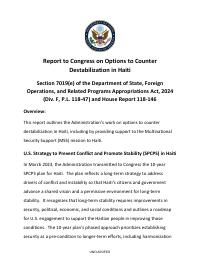
Report to Congress on Options to Counter
Destabilization in Haiti
Section 7019(e) of the Department of State, Foreign
Operations, and Related Programs Appropriations Act, 2024
(Div. F, P.L. 118-47) and House Report 118-146
Overview:
This report outlines the Administration’s work on options to counter
destabilization in Haiti, including by providing support to the Multinational
Security Support (MSS) mission to Haiti.
U.S. Strategy to Prevent Conflict and Promote Stability (SPCPS) in Haiti
In March 2023, the Administration transmitted to Congress the 10-year
SPCPS plan for Haiti. The plan reflects a long-term strategy to address
drivers of conflict and instability so that Haiti’s citizens and government
advance a shared vision and a permissive environment for long-term
stability. It recognizes that long-term stability requires improvements in
security, political, economic, and social conditions and outlines a roadmap
for U.S. engagement to support the Haitian people in improving those
conditions. The 10-year plan’s phased approach prioritizes establishing
security as a pre-condition to longer-term efforts, including harmonization
UNCLASSIFIED
Page 2 of 8
with U.S. support to MSS mission planning. The ongoing interagency efforts
detailed below reflect current U.S. efforts to advance the 10-year plan
objectives, with an immediate focus on addressing safety and security.
Support for Haitian Political Reconciliation
Since October 2022, the Department of State has implemented the
“Towards Meaningful Dialogue” program to address the prolonged political
impasse in Haiti by fostering inclusive dialogue. Program activities center on
promoting meaningful Haitian-led dialogue among core political actors and
influential groups and building civil society’s capacity to fully engage in the
process. Ongoing efforts include:
• Civil society outreach and consultations, including qualitative and
quantitative tools, such as surveys, to gather data and inform means to
integrate Haitian voices into the political process.
• Capacity-building activities for civil society leaders, such as working
directly with Haitian sub-implementers to encourage citizen
engagement and participation and promote greater inclusion of civil
society voices in consensus building.
Department officials, including the Secretary of State, Assistant Secretary for
Western Hemisphere Affairs, and Charge D’Affaires for Embassy
Port-au-Prince, have actively contributed to efforts by the Caribbean
Community (CARICOM) toward political reconciliation. On March 11, 2024,
CARICOM hosted Haitian stakeholders and international development
partners Brazil, Canada, France, Mexico, the United Nations, and the United
UNCLASSIFIED
Page 3 of 8
States to discuss the multidimensional crisis in Haiti. This meeting followed
a series of discussions that engaged a wide range of actors including Haitian
political parties, the religious community, the private sector, the diaspora,
and civil society. Haitian stakeholders committed to form a transitional
governance arrangement, through the Transitional Presidential Council
(TPC), which paves the way for a peaceful transition of power, continuity of
governance, an action plan for near-term security, and the road to free and
fair elections. It further seeks to assure that Haiti will be governed by the
rule of law. This commitment reflects hard compromises among a diverse
coalition of actors that have prioritized their countries above their
differences.
On April 25, the TPC, composed of nine members (seven voting members
and two non-voting members), was sworn in. Members include
representatives from key sectors and political parties: Fritz Jean (Montana
Group), Lesley Voltaire (Lavalas), Edgard Leblanc (Collectif), Emmanuel
Vertilaire (Pitit Desalins), Smith Augustin (EDE/RED/Compromise Historique),
Laurent St-Cyr (Private Sector), Louis Gerald Gilles (December 21), Regine
Abraham (Interfaith, observer), and Frinel Joseph (civil society, observer).
To share power between the represented political parties and sectors, the
TPC rotates the presidency every five months.
The TPC named UNICEF regional director for Latin America and the
Caribbean and former prime minister Garry Conille as interim prime minister
on May 28, 2024. The TPC and Conille named the Council of Ministers on
June 11, and the new ministers were sworn-in on June 12. The new Council
UNCLASSIFIED
Page 4 of 8
of Ministers totals 14, including four women. None of the ministers are
particularly well-known politicians. Conille, a technocrat with more than 20
years of experience working for the United Nations as a development
specialist, pledged to establish a transitional government of technocrats
with strong representation for youth and women. In early June, the TPC
reiterated its intention to complete selection of a Provisional Electoral
Council (CEP) in June. Formation of a transitional government and CEP are
key steps to move Haiti toward free and fair elections in late 2025.
Strengthening the Haitian National Police (HNP)
The Department of State provides support to the HNP to strengthen its
institutional capacity to maintain security and counter criminal activity.
Since 2021, the Department’s Bureau of International Narcotics and Law
Enforcement Affairs (INL) allocated $189 million to develop and
professionalize HNP leadership, counter gang violence, increase intelligence
and operational capabilities, combat transnational organized crime, support
community violence prevention, and improve corrections to stabilize the
security environment and restore the rule of law.
Key support elements include advisory and training, provision of equipment,
and logistical and infrastructure support. INL supports 14 embedded
subject-matter experts and two UN Police Officers to offer mentoring,
guidance, and instruction to HNP specialized units. These include:
• Counter-Gang Intervention Units – The Department of State provides
equipment, logistics, vetting, training, and mentorship to the HNP's
UNCLASSIFIED
Page 5 of 8
counter-gang intervention units.
• Police School/Academy – The Department of State provides equipment,
training, refurbishment support, and mentoring to HNP school recruits.
• Equipment – Since 2021, the United States has provided unarmored and
armored vehicles, protective equipment, and other equipment for the
HNP, helping to defray the HNP’s equipment costs so it can focus on
salaries and other resources to grow the force.
These programs equip, train, and support other HNP specialized units,
including the border and counternarcotics units, and support infrastructure
and health programs for prisons, stemming cholera outbreaks.
On March 26, 2024, with authorization from the President, the Department
notified Congress of the intent to direct the drawdown of up to $10 million
in articles and services for Haiti, which will enable the transfer of equipment
from the Department of Homeland Security, including lethal assistance (side
arms and ammunition) to the HNP and non-lethal assistance (body armor)
for the Armed Forces of Haiti, for anticrime purposes.
Citizen Security and Community Policing
The United States Agency for International Development’s (USAID’s) Haiti
Citizen Security Program is a multifaceted program focused on reducing
gang violence in Port-au-Prince through three components:
(1) strengthening the HNP’s engagement with communities;
(2) promoting community resilience to violence; and
UNCLASSIFIED
Page 6 of 8
(3) providing social services, particularly for survivors of violence.
USAID and the Department of State assist police to expand their presence in
targeted neighborhoods through this program, which strengthens strategic
communications between police and communities, works with police and
communities to identify and fund community development, and provides
equipment and small-scale rehabilitation to ensure police stations and
structures are operational in targeted neighborhoods. These efforts
supplement INL’s HNP support.
Information Sharing and Regional Security Programming, to Include
Efforts to Combat Firearms Trafficking
In July 2023, the Department of Justice named a Coordinator for Caribbean
Firearms Prosecutions to elevate attention on firearms trafficking and help
facilitate prosecutions of firearms offenses with a U.S. nexus and support
implementation of the provisions of the Bipartisan Safer Communities Act.
In November 2023, Haiti participated in the Eleventh Ministerial Meeting of
the Caribbean-U.S. Security Cooperation Dialogue. Discussions centered on
U.S.-Caribbean cooperation to address firearms trafficking, counter
transnational organized crime, strengthen maritime security, and prevent
youth crime and violence. The dialogue also included Caribbean regional
and national efforts to address trafficking in persons, irregular migration,
and recommendations for further progress. Heads of delegation
unanimously adopted the dialogue joint statement, which laid out priorities
for security cooperation for the next year, and they welcomed the
UNCLASSIFIED
Page 7 of 8
authorization, under Chapter VII of the UN Charter, of a multinational
security support (MSS) mission in Haiti.
On November 16, 2023, the U.S. Bureau of Alcohol, Tobacco, Firearms, and
Explosives (ATF) and the HNP signed a memorandum of understanding to
facilitate law enforcement information sharing through the ATF eTrace
system. Use of the eTrace system can help identify potential gun traffickers
and suspects in criminal investigations involving firearms.
On February 13, 2024, with support from the Department of State,
Homeland Security Investigations and the Haitian government signed a
memorandum of cooperation to formally establish a Haiti Transnational
Criminal Investigative Unit, which facilitates the exchange of information
between law enforcement partners in the United States and Haiti and
enhances cross-border investigative capabilities to prosecute persons
involved in transnational criminal activities.
Support for the MSS Mission
The United States plans to provide $300 million to support the MSS mission.
Of that amount, $200 million will be in-kind support from the Department of
Defense, and $100 million will come from the Department of State. Funding
from the Department of State is planned to support logistics, equipment
procurement, MSS personnel reimbursements, and staffing support,
including contracted police advisors. Department of Defense funding will
include support to establish and maintain the Life Support Area, equipment,
billeting, basing, airlift, communications, and medical support for the MSS
UNCLASSIFIED
Page 8 of 8
mission.
On April 12, 2024, with the President’s authorization, the Department of
State notified Congress of its intent to direct the drawdown of up to $60
million in articles and services for the MSS mission to Haiti. The drawdown
enables the transfer of equipment from U.S. departments and agencies, for
anti-crime and counternarcotics purposes, to countries contributing to the
MSS mission.
UNCLASSIFIED
Kijan pou site
Département d'État des États-Unis, 2025, Rapò pou Kongrè a sou opsyon pou kontrekare destabilizasyon ann Ayiti, https://state.gov/wp-content/uploads/2025/06/Report-to-Congress-on-Options-to-Counter-Destabilization-in-Haiti.pdf