Teks Konple Dokiman an
Teks ki soti nan dokiman orijinal la pou endeksasyon.
S/PV.8641
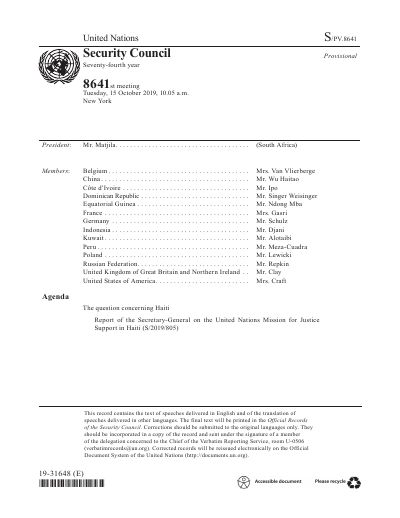
United Nations
Security Council
Provisional
Seventy-fourth year
8641
st meeting
Tuesday, 15 October 2019, 10.05 a.m.
New York
President:
Mr. Matjila. . . . . . . . . . . . . . . . . . . . . . . . . . . . . . . . . . . . . .
(South Africa)
Members:
Belgium. . . . . . . . . . . . . . . . . . . . . . . . . . . . . . . . . . . . . . .
China. . . . . . . . . . . . . . . . . . . . . . . . . . . . . . . . . . . . . . . . .
Côte d’Ivoire . . . . . . . . . . . . . . . . . . . . . . . . . . . . . . . . . . .
Dominican Republic. . . . . . . . . . . . . . . . . . . . . . . . . . . . . .
Equatorial Guinea. . . . . . . . . . . . . . . . . . . . . . . . . . . . . . .
France . . . . . . . . . . . . . . . . . . . . . . . . . . . . . . . . . . . . . . . .
Germany . . . . . . . . . . . . . . . . . . . . . . . . . . . . . . . . . . . . . .
Indonesia. . . . . . . . . . . . . . . . . . . . . . . . . . . . . . . . . . . . . .
Kuwait. . . . . . . . . . . . . . . . . . . . . . . . . . . . . . . . . . . . . . . .
Peru. . . . . . . . . . . . . . . . . . . . . . . . . . . . . . . . . . . . . . . . . .
Poland . . . . . . . . . . . . . . . . . . . . . . . . . . . . . . . . . . . . . . . .
Russian Federation. . . . . . . . . . . . . . . . . . . . . . . . . . . . . . .
United Kingdom of Great Britain and Northern Ireland . .
United States of America. . . . . . . . . . . . . . . . . . . . . . . . . .
Mrs. Van Vlierberge
Mr. Wu Haitao
Mr. Ipo
Mr. Singer Weisinger
Mr. Ndong Mba
Mrs. Gasri
Mr. Schulz
Mr. Djani
Mr. Alotaibi
Mr. Meza-Cuadra
Mr. Lewicki
Mr. Repkin
Mr. Clay
Mrs. Craft
Agenda
The question concerning Haiti
Report of the Secretary-General on the United Nations Mission for Justice
Support in Haiti (S/2019/805)
This record contains the text of speeches delivered in English and of the translation of
speeches delivered in other languages. The final text will be printed in the Official Records
of the Security Council. Corrections should be submitted to the original languages only. They
should be incorporated in a copy of the record and sent under the signature of a member
of the delegation concerned to the Chief of the Verbatim Reporting Service, room U-0506
(verbatimrecords@un.org). Corrected records will be reissued electronically on the Official
Document System of the United Nations (http://documents.un.org).
19-31648 (E)
*1931648*
�S/PV.8641
The question concerning Haiti
The meeting was called to order at 10.05 a.m.
Statement of appreciation to the Minister for
Foreign Affairs of Peru
The President: I welcome Minister Meza-Cuadra
to the meeting. It is such a great pleasure to see him here
and to congratulate him, on behalf of my colleagues, on
his appointment as Minister for Foreign Affairs of Peru.
At least there is hope for Permanent Representatives — if
they do their job very well, they are recognized and the
road ahead is bright. His appointment is an inspiration
to most Permanent Representatives. We will certainly
miss him, but he should know that he will be assigned
more responsibilities in his capital, Lima.
Adoption of the agenda
The agenda was adopted.
Report of the Secretary-General on the
United Nations Mission for Justice Support in
Haiti (S/2019/805)
The President: In accordance with rule 37 of the
Council’s provisional rules of procedure, I invite the
representative of Haiti to participate in this meeting.
In accordance with rule 39 of the Council’s
provisional rules of procedure, I invite Mr. Jean-Pierre
Lacroix, Under-Secretary-General for Peace Operations
to participate in this meeting.
In accordance with rule 39 of the Council’s
provisional rules of procedure, I also invite the
following to participate in this meeting: Her Excellency
Ms. Mona Juul, President of the Economic and Social
Council; and His Excellency Mr. Silvio Gonzato,
Chargé d’affaires ad interim of the Delegation of the
European Union to the United Nations.
begin
its
I wish to draw the attention of Council members to
document S/2019/805, which contains the report of the
Secretary-General on the United Nations Mission for
Justice Support in Haiti.
I now give the floor to Mr. Lacroix.
Mr. Lacroix (spoke in French): Fifteen years
ago, the United Nations Stabilization Mission in
2/23�
Haiti (MINUSTAH) was deployed to Haiti to support
stability in the country. Today, on the last day of the
mandate of the United Nations Mission for Justice
Support in Haiti (MINUJUSTH), and with Haitians
themselves, we are turning the page on peacekeeping
in Haiti, but we are not turning the page on United
Nations support for Haiti. The chapter that is coming
to an end has been characterized by successes shared
with the people of Haiti, the tragic earthquake and
lessons learned about what we should have done better.
On this day, we must reflect together on all the aspects
that are the foundation on which we can enter the next
phase of Haiti’s partnership with the United Nations.
In that perspective, I am delighted that His Excellency
Mr. Patrick Saint-Hilaire, Chargé d’affaires of Haiti
at the United Nations, and Her Excellency Mona Juul,
President of the Economic and Social Council, are
participating in the meeting today.
(spoke in English)
The question concerning Haiti
The Security Council will now
consideration of the item on its agenda.
15/10/2019
The current situation in Haiti certainly gives
us a lot to reflect upon. The country is facing
a significant political crisis, intertwined with
socioeconomic challenges. Those in turn affect the
security environment, which further feeds political
instability — a cycle that the country has seen one
too many times. I want to highlight the following key
elements and latest developments in the crisis.
First is institutional functioning. The President’s
fourth Government has not received confirmation in
Parliament, following two violent interruptions of
senate sessions that were expected to do so last month.
The scenes of political violence in the senate were
deplorable, and the absence of a follow-up session did
not allow for a democratic vote to determine the senate’s
position. Without a confirmed Government, key tasks of
the executive, such as the submission of the budget for
the current year, remain stalled. As legislative elections
cannot take place in the current political stalemate, the
stage is set for an institutional vacuum at the beginning
of next year, when the mandate of the members of the
Lower Chamber and at least one-third of the Senate
comes to an end.
The second aspect is national dialogue. The
President’s call on 25 September for national dialogue
and for the formation of a unity Government is viewed by
the opposition as being “too little, too late”. Opposition
groups are putting forward the President’s acceptance
of the principle of his departure as a precondition for
19-31648
�15/10/2019
The question concerning Haiti
dialogue, thereby leaving little room for negotiating
a unity Government. Mistrust is making compromise
difficult, yet the formation of such a Government may
well provide a way forward to find the lasting political
solutions that are desperately needed. It remains to be
seen whether the formal designation by the President
of former Prime Minister Evans Paul and six other
figures, on 9 October, to conduct outreach with the
opposition will create more space for problem-solving
and rapprochement.
The third aspect is security. The security situation
has deteriorated in the past month as large segments
of the population, dissatisfied with their leaders and
the socioeconomic conditions in the country, are being
mobilized in renewed demonstrations by opposition
leaders demanding change, including in the presidency.
Some among them are ready to use violence to achieve
political goals, including by attacking national
institutions and destroying public and private property.
Preliminary MINUJUSTH estimates indicate that at
least 30 people were killed during the protests between
15 September and 9 October, including 15 by police
officers; an additional 71 individuals were injured. A
rise in hate speech and the use of media to incite violence
also represent worrying trends. Notwithstanding a
demonstration in front of the MINUJUSTH logistics
base on 4 October, there have not been any direct
threats against United Nations staff or premises.
The Haitian National Police (HNP) has already
been facing its first test in managing security without
international operational support, following the
end of operations of the last formed police unit on
9 September. It has performed well, but continued
advisory support by the United Nations, as well as
material support from bilateral partners, are still
needed to boost its operational, internal oversight and
human rights capacities.
The fourth aspect is the humanitarian situation. A
struggling Haitian population is faced with additional
challenges as roadblocks and general insecurity
are paralysing normal activities and obstructing
humanitarian operations. The current situation has
affected the most vulnerable people’s access to food.
Hospitals, orphanages, civil protection units and other
emergency services have been severely impacted,
functioning with limited capacity due to fuel shortages,
lack of safe water and medicine and other essentials.
S/PV. 8641
(spoke in French)
The ability and responsibility to end the crisis,
which risks undermining the progress made in recent
years, belongs to Haitians of all political persuasions.
Only their commitment to good-faith political dialogue,
their rejection of violence and their willingness to seek
compromise can pave the way for finding solutions
to address, through reforms, the deepest political and
institutional roots of recurring instability in Haiti.
I commend the efforts, right up to the very last
day of the mission, of the Special Representative of the
Secretary-General, Helen La Lime, and MINUJUSTH
colleagues to maintain dialogue, in consultation with
international partners, with a wide range of interlocutors
in order to bring them to the table and promote Haitian
solutions to current challenges. Those efforts will have
to be continued in the context of the new configuration
of the United Nations in Haiti and beyond the resolution
of the current crisis. That will be essential to help
establish the conditions for longer-term dialogue from
which a national vision of reforms can emerge.
As we look to the future, I would also like to honour
the sacrifice of the 188 Blue Helmets — military, police
and civilian — who have given their lives in Haiti over
the past 15 years. I would also like to pay tribute to the
memory of all the victims of the tragic earthquake in
2010, which left its mark on everyone.
(spoke in English)
The current context is not ideal for ending 15 years
of peacekeeping in the country. We must, however,
look at how peacekeeping has contributed to progress
in many areas over those years, as reflected in the
handout distributed to members of the Council. That is
particularly the case regarding the rule of law. The work
undertaken to support the development of the Haitian
National Police has led to significant changes on the
ground. Between 2004 and 2019, the yearly intentional
homicide rate has been almost cut in half — a result
due in large part to an increase in the number and
effectiveness of Haitian National Police personnel.
Their number has increased from 2,500, when
MINUSTAH was deployed in 2004, to approximately
15,404 officers today — 10.5 per cent of whom are
women — thereby doubling the police-to-population
ratio. Today, all of Haiti’s 145 communes have a fulltime Haitian National Police presence, with a total of
349 functional HNP facilities, including 171 police
19-31648�3/23
�S/PV.8641
The question concerning Haiti
stations that have been constructed or refurbished
thanks to United Nations support.
There have also been improvements in the area of
justice. Key legislation has been promulgated since
2004, including on the status of the magistracy school,
the Superior Council of the Judiciary and the status
of the magistracy, the latter paving the way for the
recruitment of a corps of magistrates, including women,
supported by United Nations-backed efforts. Of course,
prison overcrowding remains a crippling issue, with a
pretrial detention rate of 65 per cent, though down from
80 per cent in 2004. But it is encouraging, for instance,
that in the jurisdiction of Port-au-Prince, the rate of
prolonged pretrial detention has decreased by 14 per
cent since October 2017.
Throughout the past 15 years, the good offices of
the Secretary-General have sought to continuously
contribute to defusing periods of political uncertainty
and tension. The community violence reduction
programmes have also proved to be a valued element of
MINUSTAH’s and MINUJUSTH’s work. By providing
short-term employment to former gang members and
disenfranchised youth, they have, for example, led to
the construction of over 100 kilometres of canals and
the rehabilitation and revegetation of 200 kilometres
of ravines.
The support provided by MINUSTAH and
MINUJUSTH in the area of human rights has
strengthened the ability of the national human
rights institution and civil society organizations to
promote and protect human rights, as well as to foster
accountability for human rights violations and redress
for victims. Those achievements do not, however, mask
the fact that Haiti continues to need the support of the
international community and of the United Nations.
While peacekeeping in Haiti has done a lot to create
an enabling environment for political and democratic
processes to take place, there is a need for more political
solutions to systemic political challenges.
The unfolding crisis, in all its dimensions, is also a
powerful reminder of the interlinkages between peace,
security and development. Lasting stability must be
anchored in sustainable development. Turning that
principle into practice has proved to be challenging
in Haiti.
4/23�
15/10/2019
(spoke in French)
In that difficult context, the closure of
MINUJUSTH does not mean that the United Nations
will leave Haiti. On the contrary, it will lead to ongoing
United Nations support for Haiti in another form.
Building on the achievements and lessons learned from
MINUSTAH and MINUJUSTH and facilitated by the
reforms undertaken by the Secretary-General within
the Organization, the transition of peacekeeping is
an opportunity to refocus the priorities of the United
Nations system in order to bring the right kind of
support at the right time for the Haitian people.
Through that transition, the capacities of the
United Nations will be adapted to meet the needs on
the ground and the political role and good offices will
be undertaken by the United Nations Integrated Office
in Haiti (BINUH), which will focus on promoting
political solutions while the country team will take
over all programme and technical support activities.
The principle of the peace, security and development
nexus has guided all our planning for the transition, by
identifying the specific priorities of the United Nations
for the coming period and by providing integrated
support for their implementation. Similarly, the new
indicators, requested by the Council and presented in
the Secretary-General’s report (S/2019/805), reflect a
stronger political orientation and include socioeconomic
objectives that are essential for Haiti’s stability, in line
with the Sustainable Development Goals.
(spoke in English)
Today, we also remember the difficult parts of
MINUSTAH’s life and legacy, and those who have
been adversely affected by it. The end of peacekeeping
does not put an end to the work of the United Nations in
eliminating cholera nor does it put an end to our efforts
to address sexual exploitation and abuse and related
paternity cases.
The sustained efforts to support the Government
of Haiti in eliminating the transmission of cholera and
alleviating the suffering of the Haitian people remain a
key focus of the United Nations, under the leadership
of the Special Envoy for Haiti, Josette Sheeran. Those
efforts have led to enormous progress. Ms. Sheeran will
make a public announcement on the results achieved
and on the requirements for follow-up actions in the
coming days.
19-31648
�15/10/2019
The question concerning Haiti
The United Nations will also continue to address
pending sexual exploitation and abuse and paternity
cases from the peacekeeping period and provide
support to the victims and their families. We will work
with national authorities and institutions in Haiti and
other Member States concerned to ensure that the rights
and dignity of the victims remain at the centre of all of
our efforts.
(spoke in French)
Considerable progress has been made in Haiti
over the past 15 years but the gains of stability remain
fragile and must be further rooted in democracy
and development. The start of BINUH’s operations
tomorrow will mark a renewed United Nations
commitment to the stability and prosperity of Haiti. I
take this opportunity to encourage the Haitian people
to continue to work closely with the United Nations in
order to preserve and strengthen the progress made and
to realize their aspirations for the future.
The President: I thank Mr. Lacroix for his briefing.
I shall now give the floor to those Council members
who wish to make statements.
Mrs. Craft (United States of America): I thank
Special Representative Lacroix for his briefing. I would
like to welcome our friend Foreign Minister MezaCuadra back to the Council.
Today is a historic day for Haiti and for the United
Nations. In so many complex circumstances, the status
quo prevails, but today is different. Today marks the
transition, after 15 years of commitment and sacrifice,
of a peacekeeping mission to a special political mission.
Our gratitude goes to the brave men and women who
served in both the United Nations Stabilization Mission
in Haiti (MINUSTAH) and United Nations Mission for
Justice Support in Haiti (MINUJUSTH) is very deep.
Their contributions have been instrumental in helping
lay Haiti’s path towards security and stability. We also
acknowledge and welcome the leadership of Helen
La Lime.
The transition of MINUJUSTH to a special
political mission demonstrates that the United Nations
can and should adapt its peacekeeping presence to
reflect evolving circumstances and in support of its
own evaluations. Given the current state of Haiti’s
political landscape, a successful transition between the
Mission and the United Nations Integrated Office in
Haiti (BINUH) is more important than ever. The United
S/PV. 8641
States is ready to support Haiti, BINUH and Ms. La
Lime — a sentiment that I am confident is shared by
the entire Council.
We commend the progress made during the
Mission’s work in Haiti, including the expanded
protection of Haitian citizens by the country’s human
rights institution and the increased capability and
capacity of civil society organizations to promote
human dignity. We are particularly pleased with the
development of the Haitian National Police, which is
now ready to shoulder Haiti’s domestic security burden.
The professionalism it has shown in the face of a
volatile security environment is both commendable and
heartening. As part of that development, we encourage
accountability through timely investigations and
prosecutions in any case where excessive force is used.
We also recognize the serious resource constraints
the Haitian National Police faces. We call on the
Government of Haiti to provide that essential
institution with the support it needs for effective work.
Beyond law enforcement, as the Secretary-General’s
report (S/2019/805) indicates, Haiti will require
continued assistance in several key areas, including the
following five domains: the organization of free and
fair elections, the continued professionalization of the
Haitian National Police, the protection of human rights,
the strengthening of the justice sector and the reduction
of violence, with particular emphasis on gang-related
violence. We expect that both the Government and
BINUH will continue working towards those goals.
More broadly, we encourage the Government of
Haiti to continue a peaceful dialogue that results in a
parliamentary Government that strengthens the rule
of law and anti-corruption institutions. Likewise,
we urge Haiti’s political, economic and civil society
stakeholders to work peacefully to address the most
pressing economic and social challenges facing
the country. We must be clear, however, that the
Government of Haiti is ultimately responsible for the
success of the new mission. That represents not merely
a new challenge but an opportunity to bring long
awaited peace and prosperity to the Haitian people. We
encourage the Government to take full advantage of
that opportunity and to engage comprehensively with
BINUH to that end.
Finally, it is vital for the internationally community,
as a whole, and Member States, bilaterally, to support
Haiti through investments and active engagement. As
19-31648�5/23
�S/PV.8641
The question concerning Haiti
we partner with other countries all over the world, the
United States is investing significant economic and
political resources in a better future for Haiti. We remain
its largest bilateral donor, with $5.2 billion committed
for humanitarian relief, reconstruction and development
assistance since 2010. We urge all members to increase
support via foreign direct investment and other means.
Together, we have done the important work of
seeing that peacekeeping mission transition into
something new. May we not tire in our efforts as we
and the Government of Haiti now strive to convert the
new political mission into tangible human advancement
for all Haitians.
The President: I now call on the Minister for
Foreign Affairs of Peru.
Mr. Meza-Cuadra (Peru) (spoke in Spanish): At
the outset, I would like to express my delegation’s
satisfaction in seeing you, Mr. President, steer the work
of the Security Council during the month of October.
Similarly, we welcome Her Excellency Ms. Mona
Juul, President of the Economic and Social Council.
We thank you, Mr. President, for convening
today’s meeting, and Mr. Jean-Pierre Lacroix for his
informative briefing. We commend the Department of
Peace Operations for supporting stability in Haiti for
more than 15 years.
Peru has a historic commitment to a safe and
prosperous Haiti. During the 13 years of the United
Nations Stabilization Mission in Haiti (MINUSTAH),
we deployed 24 military contingents, with nearly 6,000
troops, to support that brotherly country. Today, we
welcome the progress that has made it possible to reach
this juncture and advance towards peacebuilding. We
must recognize that the path is not free of obstacles.
Indeed, we are concerned about the development of
a multidimensional crisis in Haiti, given complex
political tensions, fragile institutions and economic
standstill, which exacerbate social discontent and the
complex security situation. In that regard, we believe
that it is essential to promote constructive and inclusive
national dialogue among all political actors so as to
address the root causes of the crisis. General interest in
and the legitimacy of the fight against corruption and
impunity must guide those efforts.
At the same time, we must continue to make
progress in strengthening access to justice and respect
for human rights. In that regard, we welcome the
6/23�
15/10/2019
adoption of the strategic plan for the sector and of the
Legal Aid Law, which have helped to reduce protracted
pre-trial detentions.
We call for the adoption of crucial normative
legislation to strengthen the rule of law, such as the
criminal code, the code of criminal procedure and the
budget and electoral laws. Regarding the latter, we
welcome the support provided by the United Nations
system for the early resumption of the electoral calendar.
We trust that institutional strengthening will
help towards resolving the volatile security situation,
marked by gangs and political violence. In that regard,
we must acknowledge and commend the role of the
Haitian National Police and its increased operational
capacities through the implementation of the Strategic
Plan for the Development of Haiti.
In order to preserve that progress and strengthen
the trust of the population, it is necessary for the
Haitian National Police to continue to have the
necessary resources to carry out its mandate, as well
as to strengthen human rights monitoring mechanisms
and proper training, including on sexual violence. The
Mission’s community violence reduction and weapons
management programmes and cooperation with the
Haitian National Commission for Disarmament,
Dismantlement and Reintegration Commission also
contribute to that end. We believe it key to work with
local communities, particularly young people, to
address the root causes of gang violence.
The humanitarian situation is another area of
ongoing concern, in particular Haiti’s vulnerability
to natural disasters and the risk of severe food
insecurity. In that context, the support of the United
Nations and the international community is essential,
as demonstrated by the positive results of the new
approach against cholera.
In that regard, Peru supports the role that, from
tomorrow, the United Nations Integrated Office in Haiti
is set to play in support of the efforts of the Haitian
Government in coordination with the country team. We
stress the need for close cooperation with other entities
of the system, in particular the Ad Hoc Advisory Group
on Haiti of the Economic and Social Council.
We welcome the inclusive transition process under
way, including the strategic workshop in Port-auPrince, which helped to develop the new objectives of
the Integrated Office, envisaging that the humanitarian,
19-31648
�15/10/2019
The question concerning Haiti
peace, security and development strands be mutually
supportive and reinforcing and provide a comprehensive
overview of the situation.
In that regard, we would like to congratulate
Mrs. La Lime on her appointment as Head of United
Nations Integrated Office in Haiti, while at the same
time expressing our appreciation and acknowledgement
of her work, as well as that of her predecessors at the
head of MINUJUSTH and MINUSTAH for their
dedication and valuable contribution to peace and
institutional strengthening in Haiti.
In that regard, we emphasize the importance of
continuing to work with the Haitian Government to
strengthen its understanding and ownership of those
objectives, while adjusting the role of the United
Nations in Haiti and assessing how best to continue to
support national efforts to achieve sustainable peace.
(spoke in French)
In that undertaking, Peru reaffirms its commitment
to the stability and development of Haiti. We will
continue to work together and to assist the efforts of the
United Nations system and the international community
to bring about lasting peace in the country.
(spoke in Spanish)
Finally, I would like to take this opportunity to
express my most sincere and deepest gratitude to all
my colleagues, Ambassadors and their entire teams,
whose valuable support I have counted on in our work
during my participation on the Council as Permanent
Representative of Peru. I would also like to extend that
sincere and deep gratitude to the Secretariat and all its
staff for their much-appreciated support, without which
our work in the Council would not have been possible.
I again thank you very much, Mr. President, for all the
support. I hope to see everyone soon in Peru.
The President: I congratulate the Minister for
Foreign Affairs of Peru on his appointment and wish
him well in his next post.
Mr. Singer Weisinger ((Dominican Republic)
(spoke in Spanish): We would like to thank Mr. JeanPierre Lacroix for his detailed briefing on the progress
and latest developments in Haiti. We appreciate the
presence of Her Excellency Ms. Mona Juul, President
of the Economic and Social Council, and welcome
Ambassador Meza-Cuadra.
S/PV. 8641
I would like to begin by expressing our hope that
this meeting will allow us to join forces and make
firm commitments with the common objective of
supporting the legitimate authorities of the Republic
of Haiti in their efforts towards democratic stability
and development. In particular, we trust that we will
move forward on measures to address the humanitarian
needs of the population and support the institutional
framework of the country.
This is the first time since 2004 that Haiti will
not have a peacekeeping mission. We congratulate the
United Nations Mission for Justice Support in Haiti
on its work during the years of its deployment and
commend its efforts to ensure a successful transition.
In order to ensure that it meets its goals and
contributes to stability in the Republic of Haiti, the
political mission to be deployed must have our full
support, backing and resources. Haiti is at a crucial
juncture today and the Haitian State needs our
collective assistance in order to move forward. Various
challenges, ranging from the worsening economic
situation and food insecurity to the adverse effects of
climate change and the high levels of violence, continue
to be of concern. All that could derail the efforts under
way to achieve peacebuilding and stabilization.
It is essential to take into account the security
conditions and Haiti’s ability to ensure stability on its
territory; hence, the importance of the efforts being
made to strengthen the response capacity of the Haitian
National Police through an increase in its personnel,
training on human rights and crowd control and
appropriate equipment so as to enable it to maintain
public order and respond to group and gang violence.
In that regard, we are optimistic about initiatives
such as the community violence reduction programme,
which has been successfully implemented. That is
an example of the impact of those initiatives on such
important areas as the strengthening of the rule of law
and the protection of human rights at the community
level. However, for such efforts to be successful, it is
necessary to deal with other fundamental issues, such
as the economic situation, which is becoming more
complex every day.
In that regard, we encourage all key actors in Haitian
public life to participate without delay in an inclusive
and good-faith dialogue that strengthens institutions,
overcomes individual interests and fully benefits the
Haitian people. Likewise, we call on the international
19-31648�7/23
�S/PV.8641
The question concerning Haiti
community to join those efforts and support national
initiatives to promote stability and development.
The humanitarian situation continues to be fragile
and is affected by the unpredictable weather in the
country, exacerbated by climatic phenomena such as
drought, which has weakened the ability of the most
vulnerable to meet their basic needs, for example food,
water and health-care services.
Given the existing challenges, there is a need for
an in-depth review of the appropriate strategies to
assist the Haitian people, as well as close cooperation
between the Government and its partners, in order to
achieve the successful transition to a new stage in the
United Nations presence in the country.
We wish to conclude this statement by appealing to
the international community to stand with the Haitian
people and to support the efforts of the SecretaryGeneral and his representatives in the country in pursuit
of stability and sustainable development of Haiti.
Mr. Djani (Indonesia): At the outset, I would like
to join others in welcoming home to New York our
old friend the Minister for Foreign Affairs of Peru,
His Excellency Mr. Gustavo Meza-Cuadra. I must
say that I am among those who feel proud to see one
of the finest representatives of the United Nations
attain higher offices. It is an honour for us, and I
once again congratulate him on assuming his new
high responsibility.
I should also like to thank Under-SecretaryGeneral Jean-Pierre Lacroix and Ambassador Mona
Juul, President of the Economic and Social Council,
and I welcome them to the Chamber.
It has been 15 years since the United Nations
started its peacekeeping mission in Haiti — 15 years
of struggle, tension, experience, laughter and tears.
Hundreds of Indonesia’s finest peacekeepers shared
many moments in that period, through their participation
in the United Nations Stabilization Mission in Haiti
and in the United Nations Mission for Justice Support
in Haiti (MINUJUSTH). Several other countries have
also contributed their troops, for which we are deeply
grateful. We wish to join Mr. Lacroix in paying tribute
to the 188 peacekeepers who sacrificed their lives in
the fight to achieve peace and security in Haiti over the
past 15 years.
A lot of work has been done, but of course there are
still challenges that need to be addressed. I would also
8/23�
15/10/2019
like to express our appreciation to Mr. Lacroix and his
team for producing the excellent chart in the handout
he distributed to Council members — he knows I like
numbers. I think that it shows clearly, and in one page,
what has been achieved by United Nations peacekeeping
in Haiti, not only in trying to develop the Haitian
National Police (HNP) but also in strengthening the rule
of law, and most importantly, for Indonesia and all of
us in the Chamber, in promoting and protecting human
rights, which is much needed by our Haitian colleagues.
I would therefore like to reiterate my gratitude, and I
hope that this approach will be replicated across other
issues on the Council’s agenda.
I would like to bring the following three points
to the attention of the Council. First, I should like to
talk about stability in Haiti. Indonesia commends the
Haitian National Police for its efforts and achievements
in maintaining peace and stability in Haiti. Despite all
of its limitations, there have been successful operations
leading to the arrests of gang leaders, as well as a
reduction in the levels of community violence. They
have dealt with protests and unrest nationwide and
achieved sustained progress in the second, evaluation
stage of its strategic development plan, with support
from MINUJUSTH. In future, it will be important to
address the logistical challenges facing the Haitian
National Police. The lack of equipment should be
addressed promptly. The HNP’s role in maintaining
law and order is the bedrock for Haiti’s recovery.
We share the Secretary-General’s concern about the
urgent need for the Haitian National Police to be well
resourced and better equipped to fulfil its mandate. The
acute equipment needs of the police are urgent. There
is therefore a need for the international community to
work together.
Secondly, a comprehensive national dialogue is
needed. We have already had many meetings on the issue
of development in Haiti, yet the reality on the ground is
still far from what is expected. Comprehensive dialogue
is the most feasible way to transform that setback into
the advancement of political stability in the country.
Haiti currently finds itself at a delicate point in time;
it needs an inclusive, broad-based and comprehensive
national dialogue. The challenges are real. The
development and implementation of the rule of law
in Haiti is quite important. Haiti must take bold steps
to start addressing these challenges by immediately
holding a comprehensive national dialogue.
19-31648
�15/10/2019
The question concerning Haiti
Thirdly, I would like to focus on the presence of the
United Nations in the country. The mission of the United
Nations Integrated Office in Haiti (BINUH) — which
is not the same as that of MINUJUSTH — is to continue
the important work carried out by MINUJUSTH,
albeit in a different form, but with the same essence.
BINUH’s role as a special political mission will not
have a peacekeeping element. The Government of
Haiti therefore needs to take the lead and exercise
ownership in promoting peace and stability in the
country. We also believe that the Government of
Haiti would benefit tremendously from help from the
Peacebuilding Fund as it collaborates with the United
Nations country team to support and accelerate the
transition to a non-peacekeeping presence. It is clear
that Haiti is a litmus test for the success of the United
Nations in making the transition from peacekeeping to
peacebuilding to sustainable development.
We would also like to draw the Council’s attention
to the new benchmarks set for BINUH. We believe that
the fulfilment of those benchmarks is not BINUH’s
responsibility alone: both BINUH and the United Nations
country team serve as catalysts for improvements in
Haiti. The Government and people of Haiti should have
full ownership in and take responsibility for fulfilling
these benchmarks.
S/PV. 8641
promoting human rights. These efforts followed the
work carried out since 2004 by the United Nations
Stabilization Mission in Haiti and were pursued
with constant commitment from all MINUJUSTH
teams, which should be commended. In this respect,
I wish to commend Ms. Helen La Lime for her work
and congratulate her on being appointed Head of
BINUH yesterday.
We must be clear about the gravity of the crisis
that has been afflicting Haiti for more than a year. The
report of the Secretary-General (S/2019/805) accurately
reflects the many dimensions of this worrisome crisis.
The country’s political institutions are no longer
functioning, owing in particular to the absence of the
Government, and Haiti is facing a constitutional crisis
with the postponement of legislative elections. The
violence is widespread. Corruption is endemic. Haitians
are being hit hard by the deteriorating economic
situation and demanding better access to basic services.
In the light of the situation, waves of protests have been
a regular occurrence since the riots of July 2018, which
has given rise to unacceptable levels of violence, which
we strongly condemn.
Mrs. Gasri (France) (spoke in French): I join others
in thanking Under-Secretary-General Jean-Pierre
Lacroix for his briefing, and I welcome the presence
among us of the Minister for Foreign Affairs of Peru,
Mr. Gustavo Meza-Cuadra, to whom we wish every
success in fulfilling his new responsibilities.
The resolution of the crisis is in the hands of
Haitians themselves, but the international community
must continue to support Haiti along this demanding
path, especially through the action of BINUH starting
tomorrow. Given the systemic difficulties in Haiti,
France believes that the solution lies in inclusive national
dialogue, with the involvement of all political, business
and civil society stakeholders. It is the responsibility
of President Jovenel Moïse to put in place measures
for genuine dialogue. The Special Representative of
the Secretary-General will have as her top priority to
contribute to this process through her good offices.
France is ready to support this dialogue together with
such other organizations as the European Union, whose
observer will speak shortly, and the International
Organization of la Francophonie.
The relationship between the United Nations
and Haiti has reached another important stage, with
the transformation of the United Nations Mission for
Justice Support in Haiti (MINUJUSTH) to the United
Nations Integrated Office in Haiti (BINUH). In this
regard, I wish to thank MINUJUSTH for the work
carried out over the past two years — often in difficult
circumstances — with a view to strengthening the rule
of law, particularly in the justice and prison-system
sectors, supporting the Haitian National Police and
BINUH should also advise the Haitian authorities
in other key areas to allow for the restoration of political
stability, including on preparing elections, promoting
human rights and providing support to the Haitian
National Police. It will carry out this work with the
support of the United Nations country team in Haiti and
by taking into account the lessons learned by the United
Nations from its presence on the ground in Haiti for
more than 25 years, especially through the Economic
and Social Council Ad Hoc Advisory Group on Haiti.
Before I close my statement, I would like to quote a
Haitian proverb: Men anpil, chay pa lou, which loosely
translates as “many hands make light work”. It is up
to all of us in the international community to lend
many hands and help lighten Haiti’s load so that it may
achieve stability and prosperity.
19-31648�9/23
�S/PV.8641
The question concerning Haiti
15/10/2019
In this regard, I welcome the presence among us of the
President of the Economic and Social Council. The
fight against corruption and impunity at the heart of
protesters’ demands must also be given top priority. By
leading this fight, Haitian politicians can re-establish a
dialogue of trust with the people.
another dramatic deterioration. We hope that President
Moïse and the opposition parties will show goodwill
and explore every route towards breaking the current
stalemate by engaging in a deep, inclusive and sincere
political dialogue. This is, first of all, what the Haitian
people expect from their political leaders.
The Security Council will remain vigilant in
relation to the situation in Haiti, which it showed in
the closed consultations it held on 3 October. In this
regard, we hope that the Council will be able to publicly
express its concerns about the current situation in the
country, its support for inclusive political dialogue
and the transition between MINUJUSTH and BINUH.
The Council will continue to take into account the
changing realities on the ground to determine the most
appropriate forms of international community support
for Haiti.
It is seriously worrisome that the elections scheduled
for 27 October have been postponed indefinitely as a
result of the persistent failure to adopt a new electoral
law and the lack of funds. In this situation, another
breakdown on the political track can be expected as
the terms of one third of the Senators and all local
elected officials will expire in January 2020, as UnderSecretary-General Lacroix mentioned earlier.
Lastly, I reaffirm that France stands by Haiti and
Haitians more than ever to face the challenges of the
current crisis and to achieve the stability and prosperity
to which they aspire.
Mr. Lewicki (Poland): First of all, let me join other
colleagues in warmly welcoming Foreign Minister
Gustavo Meza-Cuadra to the Security Council and
in expressing our deep appreciation for his and his
team’s positive contribution to the work of the Council.
Allow me also to thank Mr. Jean-Pierre Lacroix,
Under-Secretary-General for Peace Operations, for
his very informative briefing. I would also like to join
Ambassador Djani in expressing our appreciation for
the handout, which, on the one hand, reflects all the
achievements made over the past 15 years, and, on the
other hand, demonstrates the challenges faced by the
new United Nations Integrated Office in Haiti (BINUH),
starting with the ongoing development of Haitian
National Police despite the progress already made, the
rule of law, and, last but not least, safeguarding human
rights and basic freedoms. Furthermore, we pay tribute
to the almost 200 brave men and women peacekeepers
who have lost their lives while serving the Haitian
people in Haiti over the past 15 years on behalf of the
United Nations.
To say that Haiti’s situation is grim seems like a
major understatement today. The situation in almost
every area, including the social, political and financial
areas, has gone from bad to worse. Regrettably, during
the past couple of weeks, we have witnessed yet another
outbreak of violence as the security situation saw
10/23�
Today, we are ending a 15-year-long peacekeeping
presence in Haiti as the new political mission, BINUH,
takes over. In this special moment, we have to
acknowledge the positive role that was played by the
United Nations Stabilization Mission in Haiti and the
United Nations Mission for Justice Support in Haiti
(MINUJUSTH), which contributed in particular to
the transformation of the national police force and the
significant growth of its role and capabilities.
However, we are concerned that the Haitian
National Police has not been able to fully respond to
the latest outbreak of violence and conduct effective
operations against gang members, who, according to
the latest report of the Secretary-General (S/2019/805),
are now effectively in charge in certain parts of Portau-Prince. We may lose everything we have gained
in the blink of an eye without the proper funding and
continued support of the international community.
We have to bear in mind that a number of the
objectives set out in the two-year exit strategy of
MINUJUSTH, including those relating to the rule of
law and human rights, have not been fully achieved.
It is creating a very demanding environment in which
BINUH has no time to lose.
Turning to the humanitarian situation, we hope
that the Government will work closely with United
Nations agencies and all relevant international actors
to bring humanitarian aid to millions of people who
are still in dire need of humanitarian food assistance.
It is worrisome that this crisis remains constantly
underfunded. To tell the truth, this remains one of the
most underfunded humanitarian crises in the world,
and we still need to resolve it.
19-31648
�15/10/2019
The question concerning Haiti
In conclusion, the first review of BINUH in the
form of a Security Council discussion should take place
in February 2020. However, with this level of political
disengagement in Haiti, we have to be realistic about
the Security Council’s capabilities. If neither side is
ready to make significant concessions, we might not
have much to review.
Mr. Clay (United Kingdom): I thank UnderSecretary-General Lacroix for his briefing, and I would
like to join others in welcoming the Peruvian Foreign
Minister back among us once again today.
Today marks a milestone for the United Nations
engagement in Haiti — the end of United Nations
peacekeeping and a fundamental reconfiguration of
United Nations assistance. I would therefore like to
start by commending the efforts of the United Nations
personnel who have worked to support Haiti and the
Haitian people over the past 15 years, as well as, of
course, the Haitian partners of the United Nations.
With the support of the United Nations Mission for
Justice Support in Haiti (MINUJUSTH), the Haitian
National Police has assumed sole responsibility for
the provision of security, and important benchmarks
have been met with regard to pre-trial detention and
the institutionalization of human rights instruments.
However, there has also been a lack of progress in
critical areas, including in tackling impunity and
rolling out reforms in the justice sector. Just 2 of the 133
priority actions in the 2017-2021 strategic development
plan on policing have been completed to date.
More broadly, the United Kingdom, like those
around the table today, is acutely aware that the
political, security and economic situation in Haiti today
is highly volatile. The continuing political crisis give
serious cause for concern, and I would like to reiterate
the United Kingdom’s call to all parties to resolve their
differences peacefully.
MINUJUSTH and its predecessor, the United
Nations Stabilization Mission in Haiti, made important
contributions in Haiti, but external security assistance
and technical support are not capable on their own
of resolving the political and governance problems
undermining the country’s stability. The establishment
of the United Nations Integrated Office in Haiti
(BINUH) now provides an opportunity for Haiti and
the United Nations to embark on a fundamentally new
relationship — one that focuses on national ownership,
political engagement and the forging of strong
S/PV. 8641
partnerships for achieving stability and development
in Haiti.
There are three priorities that I would like to
highlight in particular. First, immediate progress
towards an inclusive national dialogue is an essential
first step towards political stability, as are concrete
measures to address impunity, corruption and human
rights violations. I urge the Haitian leadership to
be bold in taking such steps. Secondly, with support
from BINUH, Haiti and its partners should continue to
invest in the development of the Haitian National Police
at this critical time. Thirdly, I would urge for further
momentum on human rights issues, including justice
for victims, in anticipation of Haiti’s Universal Periodic
Review in the Human Rights Council in 2021.
With regard to the transition process from
MINUJUSTH to BINUH, I would like to welcome
the progress made by the United Nations with regard
to the first two phases of its reconfiguration. Given its
importance in setting the initial direction of the new
mission, as well as the working relationship between
BINUH and the United Nations country team, it is
vital that the third phase be completed in a timely
and effective manner. The co-location of the United
Nations entities should help to facilitate achievement
of this objective.
The United Kingdom also welcomes the use of
distinct core and contextual benchmarks for BINUH,
as indicated in the bottom left-hand corner of the
handout that I join others in commending. We urge that
the indicator targets and any revisions or additions to
the current benchmarks should not only be realistic and
robust, but also nationally owned.
I would like to conclude by thanking Special
Representative of the Secretary-General La Lime and
her team for their work. In this new generation of
Haitian-United Nations cooperation, I would like to
urge all actors to work together in search of bold and
creative solutions to Haiti’s challenges
Mr. Alotaibi (Kuwait) (spoke in Arabic): At the
outset, we welcome the participation at this meeting of
His Excellency Mr. Gustavo Meza-Cuadra, Minister
for Foreign Affairs of Peru, and wish him every
success as he takes up the duties inherent in his new
role. We also sincerely thank Mr. Jean-Pierre Lacroix,
Under-Secretary-General for Peace Operations, for his
invaluable briefing this morning. I also wish to thank
Ms. Helen La Lime, Special Representative of the
19-31648�11/23
�S/PV.8641
The question concerning Haiti
Secretary-General for Haiti, for her efforts undertaken
in coordination with the United Nations Mission
for Justice Support in Haiti (MINUJUSTH) and her
communications with all relevant stakeholders with a
view to moving the political process forward.
I would like to focus today on three main issues:
the political and security situation, the humanitarian
situation and the next steps to be taken. With regard
to the political and security situation, we are deeply
concerned about the current political environment in
Haiti and its adverse effect on the stability and security
of the country. According to the latest report of the
Secretary-General on MINUJUSTH (S/2019/805),
negotiations in the last few months on the confirmation
of a new Government have been unsuccessful, and a
constitutional crisis caused by the failure to organize
elections in time to renew the current legislature, whose
term expires on 13 January 2020, is looming, which
has led to the escalation of violence in the country. We
therefore call upon all parties to keep calm, observe selfrestraint and refrain from taking any steps that might
lead to renewed violence. We commend the measures
taken by the Haitian President to continue the national
dialogue in order to find a solution of the current crisis.
We also commend the Haitian National Police in its
efforts to contain the situation and maintain security.
The latest report of the Secretary-General further
identifies impunity as a core issue. Impunity impedes
progress in substantially improving governance
and accountability. In this regard, we call upon the
Haitian National Police and the judiciary to carry out
full investigations of perpetrators of State corruption
and human rights violations, thereby ensuring
accountability. Efforts to reform the judicial system
must be extended in order to restore the trust of ordinary
Haitian citizens in the country’s political and economic
elite and convince them that national recovery and
the building of their future are best obtained through
democratic and peaceful means.
With regard to the humanitarian situation in Haiti,
we are concerned that if the security situation continues
as it has it will jeopardize access to humanitarian aid
for those who need it. We note in particular the major
challenges facing hospitals in Haiti, owing to shortages
of fuel, potable water and other necessities. As Council
members are aware, these challenges also affect
orphanages, civil-protection units and other emergency
services, whose capacity is already limited. Moreover,
2.6 million people in Haiti are suffering from food
12/23�
15/10/2019
insecurity. If the current situation persists, thousands
more people will be affected. Accordingly, we welcome
the allocation of $5 million by the Central Emergency
Relief Fund to enable humanitarian actors to respond
to the emergency needs of the country resulting from
food insecurity.
In terms of the next steps, I would like to propose
measures that we believe would be useful as Haiti begins
a new chapter in its history. First of all, we stress the
need to conduct a broad and inclusive dialogue among
the Haitians in order to remove political obstacles,
revitalize the economy and restore stability in the
country. We also urge all stakeholders to set aside their
differences and personal interests and work together to
overcome the current obstacles the country is facing.
This is the only way to ensure progress towards
achieving sustainable development and fulfilling the
2030 Agenda.
We are also concerned about the failure, to date, to
confirm a new Government. We would also warn against
applying pressure to conduct elections in Haiti if the
country is not yet ready for them, because of the potential
for unintended negative effects. We know that Haiti
might need external aid given the challenges it faces.
We therefore encourage the United Nations — through
the Special Representative of the Secretary-General,
the United Nations Integrated Office in Haiti and the
United Nations country team — as well as regional and
international partners, including the Organization of
American States, to provide the necessary support to
Haiti in this decisive and very sensitive phase.
The closure of MINUJUSTH and the departing staff
means that there will be no peacekeeping operation in
Haiti for the first time since 2004. We would like to
take this opportunity to commend the women and men
of the United Nations Stabilization Mission in Haiti
and MINUJUSTH for their efforts aimed at helping
Haiti achieve political gains, develop the capacity of
the Haitian National police and create an environment
conducive to the development of the country.
In conclusion, we would once again like to express
our sincere thanks and gratitude to Ms. Helen La Lime,
Special Representative of the Secretary-General for
Haiti, the women and men of MINUJUSTH and the
United Nations country team for their tireless efforts,
dedication and contributions to stability in Haiti and the
support that they have provided in helping the country
achieve the Sustainable Development Goals.
19-31648
�15/10/2019
The question concerning Haiti
S/PV. 8641
Mr. Schulz (Germany): First of all, I would like to
thank Mr. Jean-Pierre Lacroix for his comprehensive
briefing. I would also like to extend a particularly warm
welcome to His Excellency Mr. Gustavo Meza-Cuadra,
Minister for Foreign Affairs of Peru.
we must take a regular and comprehensive look at the
security and socioeconomic situation. In that context,
we very much welcome the fact that the President of
the Economic and Social Council has joined us at this
morning’s briefing.
Today’s withdrawal of the United Nations Mission
for Justice Support in Haiti (MINUJUSTH) marks the
first time in 15 years that Haiti will not have a United
Nations peacekeeping operation present on its soil.
We would like to commend the women and men of
the United Nations Stabilization Mission in Haiti and
MINUJUSTH who dedicated their efforts and sacrifices
to contributing to the stabilization of Haiti. Today, the
United Nations is embarking on a new partnership with
the country. We enthusiastically welcome the startup of the United Nations Integrated Office in Haiti
(BINUH). We would like to emphasize the need for
BINUH to be appropriately equipped and staffed from
the time it begins its operations. A seamless transition
from MINUJUSTH to BINUH is crucial.
The transition to a non-peacekeeping United
Nations presence in Haiti comes at a moment when the
country finds itself in the midst of a multidimensional
crisis. We are deeply concerned about the recent
developments and violent events in Haiti. It goes
without saying that freedom of assembly and freedom
of expression must be respected. But all protests have
to be peaceful; collaborating with armed groups is
completely unacceptable. We strongly condemn all
actions that undermine democratic processes and the
rule of law. Any spoilers of the transition, including
criminal gangs and those who support them, need to
understand that there will be consequences and that
there will be no impunity for crimes.
Germany strongly supports the new approach to
the benchmarks, which reflects the mutually supportive
relationship between the peace and security pillar and
the development pillar of the United Nations system.
We especially welcome that two of the benchmarks
are contextual, as they reflect minimum conditions
for socioeconomic progress to sustain stability in
the country and enable progress towards sustainable
development. We welcome in particular that one of
the proposed indicators refers to increasing resilience
to climate-related threats, including through disaster
management and risk mitigation.
Haiti is one of the countries in the world most
vulnerable to the adverse effects of climate change.
For Haiti, the effects of climate change constitute a
threat multiplier, as they threaten to further destabilize
the country, create new conflicts over increasingly
diminishing resources and derail peacebuilding and
stabilization efforts. As the Security Council, we need
to include the security-related effects of climate change
into our overall assessments and decision-making. To
do so, we need a proper information base, including
a substantial risk assessment. With regard to the way
forward, we encourage BINUH and the Government of
Haiti to agree on specific targets for each indicator as
soon as possible.
Today, it is crucial that we get the transition right.
Rather than sticking mechanistically to benchmarks,
Like France, Germany would strongly support
the Council publicly expressing its concerns about the
situation in Haiti in the follow-up to today’s debate.
Ending a 15-year United Nations peacekeeping
engagement is the very opposite of business as usual and
deserves the Council’s appreciation. It also provides a
good opportunity to say something about the way ahead
and the continued United Nations commitment to Haiti
in difficult political circumstances.
We are worried about the persistent political
deadlock in Haiti and deeply disappointed with
the failure of the national authorities and political
stakeholders to find a lasting solution. We therefore
encourage the Haitian Government and opposition to
make use of international assistance by accepting offers
of mediation.
Finally, with regard to the development of the
Haitian National Police, and looking back at the
progress that has been achieved over the past 15 years,
we welcome and salute the increasing self-sufficiency
of the Haitian National Police in providing security
across the country, while also recognizing that certain
gaps still exist, as the Under-Secretary-General pointed
out in his briefing. It will be imperative to further
strengthen the capacity of the police.
In conclusion, I want to say that the past weeks
have proved how volatile and unpredictable the
situation remains. We must remain closely engaged
and be ready to adapt our response to the crisis quickly
19-31648�13/23
�S/PV.8641
The question concerning Haiti
and nimbly, including in the start-up phase of BINUH,
which we wish every success in implementing its
important mandate.
Mr. Wu Haitao (China) (spoke in Chinese): China
welcomes Mr. Meza-Cuadra, Peru’s new Minister
for Foreign Affairs, to today’s meeting. We also
listened carefully to the briefing by Under-SecretaryGeneral Lacroix.
The mandate of the United Nations Mission for
Justice Support in Haiti expires today, marking the end
of the United Nations peacekeeping mission in Haiti.
For the past 15 years United Nations peacekeepers
have diligently delivered on their mandates and made
important contributions to Haiti’s peace and stability
at great sacrifice. Eight Chinese peacekeepers have
died in the line of duty in Haiti, making the ultimate
sacrifice for peace in that country. It pains us to see that
despite the outstanding support that the United Nations
has given Haiti in maintaining peace and promoting
development, the country’s political crisis recently
escalated yet again. In his report (S/2019/805), the
Secretary-General notes the near-paralysis of Haitian
State institutions, the demonstrations and protests that
are ongoing in multiple locations and the troubling
security situation. The country’s deteriorating economy
has posed enormous challenges to people’s livelihoods
and has exacerbated the humanitarian situation.
China calls on the Haitian authorities to commit
to resolving differences properly through consultation,
strengthening the rule of law and its own development
capacities and settling the current political crisis
as soon as possible. The international community,
especially countries with significant influence on Haiti,
should step up attention to the political, economic and
humanitarian situations in Haiti and help it maintain
stability, boost economic growth, improve people’s
livelihoods and implement the 2030 Sustainable
Development Goals.
The United Nations Integrated Office in Haiti
(BINUH) will officially become operational tomorrow.
It will continue to provide support and assistance to
Haiti together with the United Nations country team.
China supports the Office’s work pursuant to resolution
2476 (2019) and supports its role in assisting the
Haitian Government in promoting political stability,
enhancing the rule of law and building a stronger police
sector. The Haitian Government should strengthen its
coordination with BINUH and work with it to ensure
14/23�
15/10/2019
that the Office starts off on the right foot. The road to
stability and development in Haiti will be long and hard.
We hope that the Haitian Government will place the
interests of the Haitian people first, step up capacitybuilding, chart a course towards greater self-reliance
and effectively assume responsibility for maintaining
national security and stability and promoting economic
and social development.
Mr. Repkin (Russian Federation) (spoke in
Russian): I would first like to join previous speakers
in welcoming the participation of the new Minister
for Foreign Affairs of Peru in the present meeting. We
wish Mr. Meza-Cuadra every success in his important
new post.
We
thank
Under-Secretary-General
JeanPierre Lacroix for presenting the final report on the
United Nations Mission for Justice Support in Haiti
(S/2019/805), which represents a milestone — the
conclusion of 15 years of a United Nations presence
in the country under Chapter VII of the Charter of
the United Nations. Throughout those years, the Blue
Helmets and Berets, as well as the civilian personnel
of the two United Nations of peacekeeping missions,
helped the Haitian people address acute issues. Starting
tomorrow, not only will Haiti’s people, political
leaders and law enforcement bodies assume greater
independence from the international community’s
provision of assistance, but they will also take on full
responsibility for the fate of their country and the
security of its citizens. However, Haiti’s Government
and society are entering a crucial phase of development
that will be no easier than the previous one. The
awareness of national responsibility inevitably ramps
up social action and encourages society to express civic
positions, and that creates the kinds of challenges that
define a mature State.
In the past few months we have been alarmed by
developments in the social and political situation,because
of which the elections planned for October will likely not
even be held this year. That is most unfortunate, since a
peaceful and inclusive electoral process is precisely what
could bring the country some long-awaited stability.
Meanwhile, as the Secretary-General’s report rightly
notes, a dire socioeconomic situation has unfolded in
Haiti, with a food crisis, a bleak humanitarian situation
and institutional paralysis. Under these circumstances,
the first order of business is approving the nomination
of the new prime minister and forming a Government
capable of achieving national reconciliation and
19-31648
�15/10/2019
The question concerning Haiti
tackling socioeconomic issues head on. We hope that
can be dealt with as soon as possible.
We believe that the prevailing disagreements
can and must be resolved through broad-based social
engagement. Unfortunately, the attempts to hold such
discussions have gone nowhere. The right to peaceful
assembly and freedom of expression and opinion is of
course indisputable, but we should not forget that those
rights should only be exercised with full respect for
national law. We also want to point out that there is
nothing new about disagreement in society, which can
be found elsewhere in the region and indeed all over the
world. We keep on saying that the only effective way
to resolve domestic disputes is through an inclusive
national dialogue, which is the only path to a viable
solution, regardless of the State at issue.
Resorting to armed force has never brought political
stability or economic development to any country. We
call on all forces of conscience in Haiti to consider that
and engage immediately in a dialogue aimed at finding
mutually acceptable solutions. We believe that no one,
neither the Haitians themselves nor the international
community, wants to see a repetition of the negative
experience that followed the withdrawal of the United
Nations in 2000.
We hope that in beginning its work tomorrow, the
special political mission will provide the host State
with the necessary advisory support. We believe that
the United Nations can only give effective support
when it there is full cooperation with the host State,
to which primary responsibility belongs. We therefore
expect that United Nations Integrated Office in Haiti
will support the development of Haiti’s national
capacity based on the priorities of Haitians themselves
and in strict compliance with its mandate under
resolution 2476 (2019), while avoiding any interference
in the country’s domestic affairs. We will be closely
monitoring its work in that regard. The attention of
both the United Nations and the Security Council will
enable the Haitian people to maintain confidence in the
support of the international community.
In conclusion, we want to assure the Council that
the Russian Federation supports Port-au-Prince and will
continue to work to ensure that the Council’s efforts
will lead to a genuine normalization of the situation in
Haiti and reinforce the country’s sovereignty and selfsufficiency.
S/PV. 8641
Mr. Ipo (Côte d’Ivoire) (spoke in French): My
delegation welcomes the participation of His Excellency
Mr. Gustavo Meza-Cuadra, Minister for Foreign Affairs
of Peru, in today’s debate on the situation in Haiti,
and on behalf of Côte d’Ivoire would like to take this
opportunity to congratulate him warmly on his recent
appointment as his country’s chief diplomat. We also
commend Mr. Jean-Pierre Lacroix, Under-SecretaryGeneral for Peace Operations, for his excellent briefing.
On 25 June (see S/PV.8559), by a vote of a majority
of its members, the Security Council decided to
establish a new special political mission in Haiti, the
United Nations Integrated Office in Haiti (BINUH),
to replace the United Nations Mission for Justice
Support in Haiti (MINUJUSTH), whose mandate
expires today, 15 October, after 15 years of a United
Nations peacekeeping presence in Haiti. My delegation
would like to pay tribute to Special Representative
of the Secretary-General La Lime and the staff of
МINUJUSTH, as well as the various United Nations
entities in Haiti. The remarkable work that has been
done, in collaboration with Haitian stakeholders, has
made possible encouraging progress with regard to the
rule of law, human rights and capacity-building for the
Haitian National Police.
Côte d’Ivoire welcomes the establishment and
official launch on 16 October of the new mission. Its main
tasks will be to assist the Government in consolidating
political stability, good governance and the rule of law
and establishing an inclusive inter-Haitian dialogue. It
will also work to support strengthening the protection
of human rights and planning and organizing free and
transparent elections. In that regard, my delegation
welcomes the constructive approach that has enabled
the identification of new targets and indicators for
measuring the progress of sustainable development
in Haiti after BINUH is deployed. We also welcome
the efforts of the Haitian Government to reduce
violence and urge it to redouble its efforts to increase
the financial and logistical resources of the Haitian
National Police, with a view to enabling it to carry out
its mission effectively.
Like the rest of the Council, my country continues
to be concerned about the situation in Haiti, with its
ongoing political crisis, socioeconomic difficulties,
soaring insecurity and an alarming humanitarian
situation. With respect to the political situation, the
open conflict between the opposition and the executive
branch has so far prevented the formation of a new
19-31648�15/23
�S/PV.8641
The question concerning Haiti
Government and has led to the indefinite postponement
of new parliamentary elections, which runs the risk of
creating a constitutional crisis after 13 January 2020.
On top of that, the Parliament’s rejection of President
Jovenel Moïse’s calls for an inclusive dialogue has
focused the Council on the magnitude of the current
crisis, which requires an urgent response.
The economic situation continues to be just as
worrying, due largely to the negative effects of the
political crisis and the business surrounding the
PetroCaribe funds. In addition to the fuel shortages
and the people’s deteriorating living conditions, which
are resulting in paralysing social protests, Haiti is
struggling to enact its 2018-2019 and 2019-2020 budget
laws in a context of insufficient external budget support.
The security situation, in which the armed-gang
activity continues, is also seriously worrying, and the
security challenges remain daunting and require urgent
action, despite the efforts of the Haitian National Police.
The humanitarian situation is also alarming.
We note that 1.3 million people are still waiting for
humanitarian assistance, while the United Nations
specialized agencies are having difficulty mobilizing
the funds needed to cover the 2019 humanitarian
response plan. Only $26.2 million of $126.2 million has
been raised so far, and if nothing is done, 39,000 children
under the age of five could face acute malnourishment.
My country reaffirms its commitment to the
peaceful settlement of disputes and emphasizes the
need for an inclusive inter-Haitian dialogue to create
the appropriate conditions to resolve the current crisis,
with the support of the international community. In that
regard, my delegation urges the stakeholders to consider
consensus-based measures to authorize the President
to govern by decree until the renewal of Parliament
after 13 January 2020, when the term of the legislature
expires.In view of the recurring social protests, which
pose a serious threat to sociopolitical stability, my
country calls for urgent multisectoral measures aimed
at restoring and strengthening the people’s confidence
in public institutions and attracting foreign investment.
It will also be important to clarify the allegations of
the mismanagement of the PetroCaribe funds and
ensure accountability.
In conclusion, Côte d’Ivoire continues to believe
that the only way out of the crisis is for the Haitians
themselves to show willingness to find consensusbased solutions through dialogue. In that regard, we call
16/23�
15/10/2019
on the international community, including the United
Nations and especially the Council, to support all the
national efforts to create the necessary conditions for
restoring lasting peace and stability in Haiti.
Ms. Van Vlierberge (Belgium) (spoke in French):
At the outset, I would like to thank Under-SecretaryGeneral Jean-Pierre Lacroix for his briefing and to
warmly welcome the Minister for Foreign Affairs of
Peru, Mr. Gustavo Meza-Cuadra, and wish him every
success in his new role.
Today is a special day for the United Nations
presence in Haiti, as we turn the page on a new chapter
with the end of the mandate of the United Nations
Mission for Justice Support in Haiti (MINUJUSTH),
after 15 years of a United Nations peacekeeping
presence there. A new chapter is being written with
the new phase of our involvement with the country in
continuing the work begun by MINUJUSTH and the
United Nations Stabilization Mission in Haiti.
That historic transition is taking place under
difficult conditions, as many of my colleagues have
already emphasized. Haiti is facing multiple challenges
in the areas of governance, the rule of law, the Haitian
National Police, the fight against corruption and the
promotion of human rights. The humanitarian situation
and food insecurity are only making it more urgent that
the Haitian authorities produce an adequate response.
Belgium condemns the recent violence and urges all
the parties to refrain from violence and to express their
views through peaceful means. We especially deplore
the recent violence against journalists.
There is an urgent need to launch an inclusive
national dialogue to address the country’s political,
social and economic challenges. The Haitian
Government has the primary responsibility to address
the factors creating instability and inequality. National
ownership and responsible political leadership will be
crucial during this time. The Haitian people’s feelings
of impunity and insecurity are their main sources of
frustration. Reforming the judicial system, eradicating
corruption and protecting and promoting human rights
are essential if the confidence of Haitian citizens in
their authorities is to be restored. In that regard, we are
paying particular attention to the judicial follow-up to
the extremely violent events that occurred in La Saline
last year. We regret that no legal proceedings have been
initiated with regard to the murders committed in the
Grand Ravine and that the legal proceedings relating
19-31648
�15/10/2019
The question concerning Haiti
to the ongoing mismanagement of funds have not yet
made it possible to see justice done for the victims. We
also deplore the fact that the elections scheduled for
October will not be held on time, which could be an
additional source of frustration for the people.
Looking ahead, I would like to reiterate our full
support for the new political mission, the United Nations
Integrated Office in Haiti (BINUH), which starts work
tomorrow. Providing BINUH with the necessary staff
and resources to carry out its mandate will be crucial.
The benchmarks proposed by the Secretary-General
will be valuable tools for monitoring the country’s
progress in key areas of the mission’s mandate. We
commend the United Nations and its partners for the
preparation of those benchmarks. Strong collaboration
between BINUH and the country team will be essential
to the mission’s sustainability and success.
To conclude, I wish to emphasize Belgium’s sincere
gratitude vis-à-vis the women and men who have served
under the banner of the United Nations in Haiti over
the past 15 years. The circumstances were arduous,
but their commitment and dedication made a positive
difference. The men and women who perished in Haiti
remain in our thoughts.
In this period of uncertainty and transition,
Belgium reiterates its staunch commitment to working
alongside the Haitian people and Government to achieve
a democratic, peaceful and secure future.
Mr. Ndong Mba (Equatorial Guinea) (spoke in
Spanish): Our delegation welcomes with great pleasure
and satisfaction His Excellency Mr. Gustavo MezaCuadra, the recently appointed Minister for Foreign
Affairs of Peru, to whom we reiterate our sincere
congratulations on having earned this mark of high
trust from his Government as a Minister of Peru. This
is a major and delicate responsibility in which we wish
him the greatest success. We are certain that the same
values with which he led his country’s delegation to
the United Nations in New York will continue to guide
him in his work, now and always, for the benefit of his
country, Latin America and the world in general. We
ask the all-powerful Lord to light his way and protect
him as he undertakes these complex and delicate tasks.
We also thank the team represented by Mr. JeanPierre Lacroix, Under-Secretary-General for Peace
Operations, who provided this morning, as always, a
clear and detailed briefing.
S/PV. 8641
The Republic of Equatorial Guinea deems this
important debate to be very relevant, as it coincides
with a turning point for the Republic of Haiti, which
has been marked by a protracted political crisis,
increased insecurity and severe economic difficulties.
This situation threatens, on an ongoing basis, the wellbeing and stability of the Haitian population in general.
Given this delicate context and bearing in mind
that we are at the end of the United Nations Mission
for Justice Support in Haiti (MINUJUSTH), we believe
that this brotherly Caribbean country is about to enter a
crucial period for its political elite, which is called upon
to redouble its efforts and give thought to the future
that it wishes for Haiti, bearing in mind the dynamic
that will characterize its new cooperation with the
United Nations.
The political situation in Haiti this year has not
been promising, but we have seen an increasingly tense
atmosphere between the Government and the various
opposition factions. The Republic of Equatorial Guinea
believes that political instability can be addressed
only through an inclusive inter-Haitian dialogue that
allows the parties to address their differences and reach
agreement on the political challenges that fuel hatred
and confrontation between the parties.
Democratic governance implies constructive
dialogue with the opposition and civil society,
including genuine accountability. The Government
must promptly form completely in order to prevent
any blockage of development programmes, and we
therefore call on all parties to set aside their differences
and private interests and work together to overcome the
increasingly worrisome situation in the country. It is
only then that our sister Republic of Haiti will be able
to ensure peace and stability and relaunch its progress
towards the implementation and achievement of the
Sustainable Development Goals in the framework of
the 2030 Agenda for Sustainable Development.
The renewed legislative power is a decisive stage in
the consolidation of democracy. We note with concern
the indefinite postponement of elections in Haiti, and
we reiterate the importance of adopting an electoral law
without delay and updating electoral lists in order to
pave the way for credible, inclusive and timely elections.
Another worrying aspect of this new phase of
State-building is the fragility of the security situation
in Haiti, which is a due not only to the absence of
institutional capacity to support the security apparatus,
19-31648�17/23
�S/PV.8641
The question concerning Haiti
but also to social conditions, which do not allow for
a dynamic leading to a virtuous circle of development
and hope. We should also note that the economic
situation is becoming increasingly complicated, which
could deepen the crisis and intensify social instability
and violence if adequate measures are not taken, as the
various statements made this morning have pointed out.
It is clear that the United Nations Integrated Office
in Haiti will begin its mission in a difficult context,
and, unfortunately, we are concerned that this unstable
situation could deteriorate in the coming months. This
will have to be taken into account in the efforts of the
new Office. The goals set by the Secretary-General for
this new special political mission are vital in order to
carry out the necessary work in Haiti.
Before concluding, I would like to take this
opportunity to commend the work of Ms. La Lime,
Special Representative of the Secretary-General. We
wish her every success in meeting this new challenge,
and we also pay warm and well-deserved tribute to all
the women and men who have served in MINUJUSTH,
which comes to a close today.
We also express our support to the people and the
Government of Haiti and hope that they will soon be
able to assume full national ownership of their country’s
destiny, stability and development.
Finally, the Republic of Equatorial Guinea
believes that the Security Council and the international
community must continue to work to ensure a genuine
normalization of the situation in Haiti and to strengthen
its institutions and its sovereignty, so that it can restore
calm and social harmony and achieve lasting and
sustainable peace.
The President: I shall now make a statement in my
capacity as the representative of South Africa.
At the outset, South Africa wishes to congratulate
Mr. Meza-Cuadra and wish him well in his high-level
assignment to lead his country’s diplomatic efforts.
Knowing him, we are certain that he will succeed in
this assignment.
Let me also welcome and congratulate Ms. Helen
La Lime, Special Representative of the SecretaryGeneral and the new Head of the United Nations
Integrated Office in Haiti (BINUH), following her
recent appointment. We assure her of our support.
18/23�
15/10/2019
I should also like to thank Under-Secretary-General
Lacroix for his briefing and detailed factual chart he
shared with the Council this morning summarizing the
situation in Haiti.
Today is a historic moment for the Government
and the people of Haiti, as this marks the first time
in 15 years that Haiti will not have a United Nations
peacekeeping operation presence. We wish to commend
the tireless efforts of the personnel of the United
Nations Stabilization Mission in Haiti and the United
Nations Mission for Justice Support in Haiti.
We would also like to commend the efforts of the
Haitian authorities, civil society, local and international
partners and the United Nations country team for their
efforts in helping Haiti navigate a difficult path.
Nonetheless, South Africa remains concerned
by the recent political developments, which have
heightened tensions in Haiti. The ongoing political
discord has given lawlessness a lifeline, which needs
to be contained if BINUH is to succeed. We call on
Haitian stakeholders to attend to the issue of forming
a Government and formalizing the appointment of
the Prime Minister as a matter of urgency. South
Africa believes these are critical steps in assuring the
international community, particularly donors, that
the Haitian stakeholders are genuinely committed to
returning their country to constitutional normalcy and
sustainable development.
It was during this month of October that Haiti
was to hold elections to the Chamber of Deputies and
the Senate. As things stand, the current mandate of
those two components of the legislature will expire on
13 January 2020. That does not leave much time before
the deadline, and what lies beyond it may trouble us
even more if the right steps are not taken to ensure
adherence to democratic principles. We appreciate the
fact that the United Nations has already made resources
available to assist in that regard and encourage the
Haitian political stakeholders to seize this opportunity.
We welcome the efforts by President Jovenel
Moïse to reach out to various stakeholders in Haiti,
including the opposition and civil society, in order to
engage in dialogue to discuss the challenges facing
Haiti, including the finalization of the appointment
of the Prime Minister, the importance of addressing
corruption and the challenging economic and social
climate. In our view, all the parties, including the
Government, opposition groups, civil society and
19-31648
�15/10/2019
The question concerning Haiti
the non-governmental organizations in Haiti should
continue to engage fully in inclusive dialogue to seek a
peaceful solution to the current challenges.
Addressing the root causes of the situation in
Haiti will also continue to be critical to supporting
the country’s efforts to achieve the Sustainable
Development Goals. That includes addressing impunity
in the context of human rights violations and corruption
by strengthening judicial and State institutions,
including the capacity of the Haitian National Police to
respond to challenges on the ground. Reform of Haiti’s
justice system in Haiti will be instrumental in building
trust among all of the people and we agree with the
assessment of the Secretary-General in his recent report
in this regard (S/2019/805). We look forward to the
work of BINUH, the United Nations country team and
international partners in supporting the implementation
of reforms to address the multidimensional challenges
facing Haitian society.
Let me conclude by stating that the current approach
of BINUH and its benchmarks represent a critical
opportunity to advance peace and security, including
by enshrining human rights and fostering sustainable
development in Haiti, which should be supported.
For those benchmarks to succeed, however, political
will and commitment from all Haitian stakeholders is
required. We should remind all that Haiti was the first
black Republic in modern history. Having been free for
more than 200 years, Haiti should now welcome and
embrace the new political mission. Haitians must close
ranks, make the necessary compromises and carve a
new pathway towards a stable, democratic, peaceful
and prosperous country.
I now resume my functions as President of
the Council.
I give the floor to the representative of Haiti.
Mr. Saint-Hilaire (Haiti) (spoke in French): At
the outset, I would like to thank you, Mr. President, for
kindly inviting me to participate in this meeting of the
Security Council in order to present the observations
of the Government of the Republic of Haiti on the
report of the Secretary-General contained in document
S/2019/805 and dated 9 October, issued pursuant to
Security Council resolution 2466 (2019).
I welcome the presence of Mr. Jean-Pierre Lacroix,
Under-Secretary-General for Peace Operations,
Ms. Mona Juul, President of the Economic and Social
S/PV. 8641
Council, and Mr. Silvio Gonzato, chargé d’affaires of
the Delegation of the European Union to the United
Nations. I thank Mr. Lacroix for his very informative
briefing and would like to ask him to convey my
warmest congratulations to Ms. Helen La Lime, Special
Representative of the Secretary-General for Haiti, on
her exemplary commitment.
(spoke in Spanish)
I also welcome and congratulate His Excellency
Mr. Gustavo Meza-Cuadra, a career diplomat, on his
appointment as Minister for Foreign Affairs of Peru,
and wish him every success in his new role.
(spoke in French)
This meeting of the Security Council comes at
a pivotal moment, after 15 years of United Nations
peacekeeping operations in Haiti and 15 years since the
reactivation of the Economic and Social Council Ad
Hoc Advisory Group on Haiti. The temptation to take
stock is extremely strong because today more than ever,
the country is facing a multidimensional crisis. For the
past few weeks protests on an enormous scale, and
sometimes marred by multiple forms of unacceptable
violence, have been going on all over the country. In
the view of many, the closure of the United Nations
peacekeeping mission is taking place at the height of the
crisis and at a delicate time of increasing uncertainty.
There can be no doubt that the United Nations
Stabilization Mission in Haiti and the United Nations
Mission in Support of Justice in Haiti (MINUJUSTH)
played a major role in the country over the past 15
years. They contributed to undeniable progress in a
number of areas, but we are still far from achieving
stability and long-term development in my country. On
behalf of President Jovenel Moïse, I would like to thank
the Security Council and the Secretariat, especially
Secretary-General António Guterres. I also want to
thank all the Member States that contributed to the
implementation of those two peacekeeping missions.
My special thanks go to all who served with dedication
in the two missions, and my thoughts go to all United
Nations personnel who perished in the earthquake of
2 January 2010.
Before I comment on the Secretary-General’s
report, I want to stress that the United Nations must
continue to comprehensively consider the root causes
of the Haitian crisis in order to contribute to the
implementation of lasting solutions. The resources
19-31648�19/23
�S/PV.8641
The question concerning Haiti
made available so far are not enough to respond to the
challenges we face. It is vital that our Organization,
inspired by the 2030 Agenda for Sustainable
Development, redouble its efforts in Haiti in line with
the priorities outlined by the national authorities. Its
actions should be based on the three pillars of peace and
security, human rights and sustainable development.
Beyond the current circumstances, the Haitian crisis is
a result of an incoherent, indifferent, grossly unequal
and exclusionary system that is incapable of capturing
and channelling the legitimate aspirations and hopes
of the Haitian people. We are a people who have been
impoverished throughout our entire history, a people
who have suffered too much and have often been
branded as rebels whereas, in reality, we have always
asked only to be able to live in human dignity.
The Government of Haiti welcomes the excellent
report of the Secretary-General and takes note of all the
concerns it expresses. The points in the report deserve
the full attention of all of Haiti’s national institutions
and major partners. The Secretary-General is reporting
on the main developments in Haiti since his previous
report (S/2019/563), and he puts a strong emphasis on
the protracted political crisis. Among other things,
he highlights the decline in agricultural production,
food insecurity and the growing difficulties facing the
national economy. In that regard, we are unanimous
in recognizing that enormous efforts will be needed
to build essential agricultural infrastructure, promote
rural development, increase agricultural production
and ensure access to food, especially for vulnerable
populations. Our President is fully aware of the delicate
political situation in the country and its negative
consequences for every aspect of national life, and
the resulting need for a inclusive, good-faith dialogue,
which is the only way will we be able to emerge from
the current crisis.
The Secretary-General painted an encouraging
picture of the progress made in the implementation of
MINUJUSTH’s mandate and the efforts of the Haitian
authorities in the areas of human rights, justice and the
strengthening of the Haitian National Police. However,
much remains to be done. Reducing community
violence is a major challenge. The Haitian National
Police is doing its best, but it needs ongoing training
and adequate resources and equipment to protect and
serve all segments of the Haitian population. We must
urgently restore State authority, without clashes or
20/23�
15/10/2019
bloodshed, in the areas that have sadly been described
as lawless.
The Secretary-General expressed concern about
the evolving food and humanitarian situation, while
acknowledging the efforts of humanitarian partners
and development agencies in support of the Haitian
Government. He also reported on the progress made
in the implementation of MINUJUSTH’s mandate,
highlighting the challenges that remain with regard to
combating community violence, strengthening public
institutions, professionalizing the Haitian National
Police, fostering justice and fighting corruption,
managing prisons, ensuring human rights, preparing
elections and planning the transition.
We particularly welcome the progress noted by
the Secretary-General in the context of the United
Nations strategy in support of the national plan for the
elimination of the cholera in Haiti. In that connection,
we strongly encourage Ms. Josette Sheeran, Special
Envoy for Haiti, to conduct the country visit that was
originally planned for 6 to 8 October as soon as possible.
The people and the Government of the Republic of
Haiti hope that the responsible support of the United
Nations under track 2 of the new approach to cholera
in Haiti will continue as planned after the closure of
MINUJUSTH with an adequate level of resources. In
that connection, we note the memorable regrets voiced
by former Secretary-General Ban Ki-moon in his
last address to the Assembly during the 2016 general
debate (see A/71/PV.8), regarding the heinous acts of
sexual exploitation and violence and the introduction of
cholera in Haiti.
The United Nations Integrated Office in Haiti
(BINUH), which will take over from MINUJUSTH
tomorrow, will be called on to provide its good
offices, offer advice and raise political awareness. The
Haitian Government will focus special attention on
the strategic objectives outlined in the report related
to the tasks assigned to BINUH. We would do well to
recognize that the new mission will begin its operations
in a national context that is characterized by major
political, economic, social, security, humanitarian and
environmental emergencies, which are compounded
by the disturbing disaffection of an overwhelming
majority of the population with public institutions and
a climate of mistrust.
The discussions held in the Council (see S/PV.8559)
at the time of the adoption of resolution 2476 (2019),
19-31648
�15/10/2019
The question concerning Haiti
which established BINUH, highlighted the importance
of acting quickly and decisively to address the root
causes of those emergencies. In the past few years,
several United Nations missions in Haiti, including
those of the Economic and Social Council Ad Hoc
Advisory Group on Haiti, have made a compelling
assessment of the main challenges facing the country.
On behalf of the Haitian Government, I would like to
commend the exceptional work done by the Ad Hoc
Advisory Group under the chairmanship of Canada. We
hope that BINUH will also collaborate closely with the
Advisory Group. Today more than ever, the problem of
the country’s long-term development looms large. I am
convinced that the United Nations can go even further
in support of Haiti’s national vision and priorities.
In conclusion, I want to convey the President’s
call to all Haitians for dialogue and unity, in which he
said that it is no accident that he and we belong to the
same country, the unique and indivisible Republic of
Haiti. Despite painful moments and difficulties in our
daily lives, he said, we all remain firmly committed
to the ideals of the founding fathers of our national
independence. Many peoples have gone through dark
times. What is most important is not how they have
been affected, but the wisdom, sense of self-sacrifice,
humility and spirit of unity they have developed in
order to chart a path to a better tomorrow. As Haitians
at home and abroad, he continued, it is our primary
responsibility to seek healthy and sustainable solutions
together, through genuine dialogue, to the problems
that undermine the political, economic, social and
environmental stability of our country, once the pearl
of the West Indies. It is up to us to set and maintain
the course, but we cannot do it without appropriate
and enhanced international support, he added, for the
mobilization of sufficient resources is critical to the
implementation of the objectives that will help us to
rebuild mutual trust and ensure the security, stability
and long-term development of our dear Haiti.
He concluded by expressing the hope that our
international partners will understand the urgent
need for a paradigm shift and enhanced support.
International support must match the realities and
genuine needs of the country and must respect the
sovereignty, independence, territorial integrity and
unity of the Republic of Haiti.
The President: I now give the floor to Ms. Juul.
S/PV. 8641
Ms. Juul: I am honoured to participate, in my
capacity as President of the Economic and Social
Council, in this open debate on the question concerning
Haiti, a clear example of the complementary work of the
Security Council and the Economic and Social Council.
The situation of Haiti has been on the agenda of
the Economic and Social Council since 1999, primarily
through the work of its Ad Hoc Advisory Group
on Haiti, which was set up in response to a Security
Council request to the Economic and Social Council,
under Article 65 of the Charter of the United Nations,
to provide recommendations on the country’s longterm development. The work has included interactions
between the Security Council and the Chair of the
Ad Hoc Advisory Group, Ambassador Marc-André
Blanchard of Canada. The Chair informally briefed
the members of the Council on the Ad Hoc Advisory
Group’s findings and recommendations following a visit
to Washington, D.C., and Haiti earlier this year. In our
view such briefings are a useful information-sharing
practice that should continue, and I would like to take
this opportunity to thank Ambassador Blanchard for
his outstanding work in that regard.
However, the Ad Hoc Advisory Group’s most
recent report, dated 20 June (E/2019/80), should sound
the alarm for the international community. It highlights
the fact that Haiti remains under significant economic
and social stress, that it has persistent humanitarian
needs and that those factors, traditionally considered to
be purely development issues, are the root cause of the
current political instability and deteriorating security
situation. The figures speak for themselves: 60 per cent
of the country’s population lives below the poverty
line; more than 40 per cent lacks access to health and
nutrition services; 2.6 million people are currently food
insecure and in need of humanitarian assistance — twice
as many as in 2018; 36 per cent of young people are
unemployed; and 85 per cent of college graduates leave
Haiti in search of better opportunities elsewhere.
The statistics regarding Haiti’s youth are of
particular concern. Stability is at risk if economic
policies and lack of educational opportunities leave
young people without jobs. Unemployment makes
young people feel disenfranchised and uncertain
of their future, which, as we know, are conditions
that can easily lead to youth falling prey to criminal
organizations and violent gangs.
19-31648�21/23
�S/PV.8641
The question concerning Haiti
Haiti is also one of the countries most vulnerable to
climate change. Its vulnerability to natural disasters adds
significant complexity to the fragility of its economic
and social situation. As we speak in this Chamber
today, Haiti is facing both physical and socioeconomic
factors that have converged to threaten its stability. The
2030 Agenda for Sustainable Development recognizes
that there can be no sustainable development without
peace and no peace without sustainable development.
To improve the lives of the people of Haiti and ensure
peace, we need to undertake major efforts to reduce
poverty and improve access to education, health care
and decent work, while also implementing climate
adaptation and mitigation strategies.
Let me turn to the question of the transition of
the United Nations presence in Haiti. We welcome the
decision of the Security Council for the United Nations
Integrated Office in Haiti to ensure collaboration
among all United Nations political, development,
humanitarian and financial entities, as well as other
local and international partners operating in Haiti. Now
more than ever, partnership among all stakeholders is
needed to effectively respond to the country’s problems.
The transition of the United Nations presence to a more
development-oriented configuration should not lead
to less engagement by the international community.
It should lead to more. We should learn from previous
transition experiences and equip the United Nations
country team with adequate resources and capacity to
do its job. With the aim of turning Haiti into a model for
future United Nations-supported transitions in complex
settings, we should redouble our joint efforts to support
the people of Haiti and to put in place the conditions for
long-term sustainable development and stability.
The need for continued collaboration between the
Economic and Social Council and the Security Council
is evident. We must work towards breaking down the
traditional silos between the peace and development
pillars of the United Nations. Only then can our
collective efforts be more coherent and effective and
address the interconnected challenges facing Haiti. We
owe that to its people.
The President: I now give the floor to the observer
of the European Union.
Mr. Gonzato (spoke in French): I thank you, Sir, for
giving me the floor in this debate on Haiti. The European
Union (EU) has always had the honour of participating
in meetings on this item. The candidate countries the
22/23�
15/10/2019
Republic of North Macedonia, Montenegro, Serbia
and Albania, and the country of the Stabilization and
Association Process and potential candidate Bosnia and
Herzegovina, as well as Ukraine and the Republic of
Moldova align themselves with this statement.
First of all, I would like to thank Mr. Lacroix,
Under-Secretary-General for Peace Operations, for his
briefing and the Permanent Representative of Haiti for
his intervention.
Since July 2018, Haiti has been in a deep
multidimensional crisis at the institutional, economic,
social, financial and security levels. The European
Union is concerned about the overall situation in the
country, which, faced with major urgent challenges,
has been waiting for almost seven months for the new
Government to be ratified. While the positions of
political actors are becoming more radical, the country
and its institutions are breaking down. At the political
level, the opposition and civil society have exerted
strong pressure since July 2018 in an attempt to force
President Moïse to resign. Other political, civil society
and business actors have demanded a genuine national
dialogue that, unfortunately, after several unsuccessful
attempts, has yet to take place. In recent weeks, the
country’s economy has stalled and the security situation
has deteriorated significantly.
The President’s recent proposal to respond to
political violence through dialogue has been rejected
by demonstrators who no longer trust the discredited
Government. For several weeks now, the President’s
public appearances have been extremely rare. His
statement on 25 September, calling for dialogue,
and his proposal on how to resolve the crisis had no
positive effect. In the light of the repeated failure of the
executive’s attempts at dialogue, since early this year
the European Union has initiated meetings with several
parliamentarians from both the moderate and the more
radical opposition. The objective was to try to identify
the bottlenecks, expectations and scope for discussion
that the opposition would be open to in order to break
the deadlock. The EU also actively participated in the
meetings of the core group on Haiti, together with the
Ambassadors of Germany, Spain and France.
As stated in the benchmarks for an exit strategy
set by the United Nations Mission for Justice Support
in Haiti (MINUJUSTH), a consensual and far-reaching
reform of the electoral system is a key element not only
in preventing further institutional crises, but also in
19-31648
�15/10/2019
The question concerning Haiti
S/PV. 8641
rebuilding a strong link between elected officials and
voters and thereby regaining the trust of the population.
The elections scheduled for 27 October have been
postponed indefinitely owing to the continued lack of
an electoral law and budget and to the current climate of
tension. Without elections, the terms of one-third of the
Senate, the entire Lower Chamber and all local elected
officials will expire in January 2020. The European
Union remains a loyal partner of the Republic of Haiti
and resolve to support the country in this period of deep
crisis, in coordination with the other partners.
continued inability, amid allegations of collusion and
other shortcomings, to control gang violence. We
therefore consider it essential to complete the work
of strengthening and professionalizing the Haitian
National Police while preserving its autonomy and
political neutrality. At the same time, we must continue
to stress the importance of reforming and strengthening
justice and the prison system, as well as of upholding
human rights. The EU is monitoring the legal followup to the extreme violence that took place in La Saline
last year.
The European Union appreciates and backs the
work of MINUJUSTH in support of the development of
the Haitian National Police (HNP), the justice system,
the rule of law and the defence and promotion of human
rights. Any State based on the rule of law that hopes
to be at least minimally effective in upholding the law
needs an effective law enforcement system that respects
human rights.
In conclusion, allow me to reiterate the European
Union’s appreciation for MINUJUSTH’s contribution
to security, conflict prevention and consolidating
democracy and the rule of law in Haiti. The real
challenge now lies in the Haitian National Police’s
lack of resources. It is essential that the police and
the Haitian judicial system be prepared and equipped
to assume all tasks currently being carried out by the
United Nations mission. It is important that the United
Nations Integrated Office in Haiti have the necessary
staff and resources to help the Government to confront
the multiple security issues, including the possibility
of reviewing its mandate if the situation continues
to deteriorate.
In that context, during the 15 years of United
Nations presence in Haiti — first through the
United Nations Stabilization Mission in Haiti, then
MINUJUSTH — much attention has been devoted to
the development and training of the Haitian National
Police. Although it is one of the few remaining
stable institutions amid a widespread institutional
crisis, the force’s size — 15,000 staff for 11 million
inhabitants, in other words three times fewer than
in Europe — equipment and intervention capacity
remain grossly insufficient. Of particular concern is
the Haitian National Police and national authorities’
Together with the United Nations and the
international community, the EU will support the
country in its efforts to secure a better future of peace,
democracy, stability and well-being for the entire
Haitian population.
The meeting rose at 12.10 p.m.
19-31648�23/23
�