Teks Konple Dokiman an
Teks ki soti nan dokiman orijinal la pou endeksasyon.
2026
www.unicef.org/appeals/haiti
© UNICEF/UNI769137/Noel
Humanitarian
Action for
Children
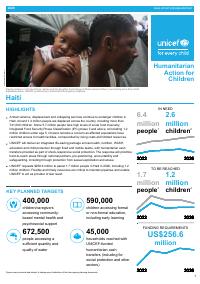
Fleeing violence in Port-au-Prince, Vanise and her daughter found refuge at Marie-Jeanne School, now hosting more than 9,000
displaced people. UNICEF is delivering a multisectoral emergency response.
Haiti
HIGHLIGHTS
IN NEED
Armed violence, displacement and collapsing services continue to endanger children in
Haiti. Around 1.4 million people are displaced across the country, including more than
741,000 children. Some 5.7 million people face high levels of acute food insecurity,
Integrated Food Security Phase Classification (IPC) phase 3 and above, at including 1.2
million children under age 5. Cholera remains a concern as affected populations have
restricted access to health facilities, compounded by rising costs and limided resources.
UNICEF will deliver an integrated life-saving package across health, nutrition, WASH,
education and child protection through fixed and mobile teams, with humanitarian cash
transfers provided as part of shock-responsive social protection. The response will prioritize
hard-to-reach areas through national partners, pre-positioning, accountability and
safeguarding, including through protection from sexual exploitation and abuse.
UNICEF requests $256.6 million to assist 1.7 million people in Haiti in 2026, including 1.2
million children. Flexible and timely resources are critical to maintain pipelines and enable
UNICEF to act as provider of last resort.
6.4
2.6
million million
people1
2022
2026
TO BE REACHED
1.7
1.2
million million
people3
KEY PLANNED TARGETS
400,000
590,000
children/caregivers
accessing communitybased mental health and
psychosocial support
children accessing formal
or non-formal education,
including early learning
672,500
45,000
people accessing a
sufficient quantity and
quality of water
households reached with
UNICEF-funded
humanitarian cash
transfers (including for
social protection and other
sectors)
Figures are provisional and subject to change upon finalization of the inter-agency planning documents.
children2
children4
2022
2026
FUNDING REQUIREMENTS
US$256.6
million
2022
2026
1
�HUMANITARIAN SITUATION AND NEEDS
The complex and protracted humanitarian crisis in Haiti is driven by escalating armed
violence, mass displacement, collapsing services, the resurgence of cholera, deepening food
insecurity and widespread malnutrition, along with recurrent climate shocks. Armed groups
control an estimated 90 per cent of metropolitan Port-au-Prince,5 while violence has spread
northwards, cutting off trade and humanitarian routes. Hundreds of thousands of Haitians,
including unaccompanied and separated children, are being returned from the Dominican
Republic,6 often without documentation or support, and face risks of homelessness, hunger,
violence, exploitation and de facto statelessness.
An estimated 1.4 million people are internally displaced, including 741,000 children (53 per
cent of those displaced), the highest figure ever recorded.7 Altogether, 5.7 million people face
acute food insecurity,8 1.2 million of them children under the age of 5.9
Access to essential services is collapsing. Only 41 per cent of health facilities with beds in
Port-au-Prince remain fully functional.10 The education system is disrupted: 1,606 schools
were closed during the 2024–2025 academic year, affecting 7,500 teachers and depriving
243,000 students of learning.11 Nearly 1.5 million children and teachers need education
support.12 Many schools shelter displaced families. At the same time, 1.3 million people
urgently need life-saving WASH services.13
The operational environment remains volatile and dangerous. Violence continues to escalate,
with rising casualties, lethal drones and an increase in kidnappings targeting civilians. Security
operations present an opportunity to support stabilization efforts, but must be conducted in a
manner that prevents civilian harm, repeated displacement and disruption to services.
Gender-based violence has surged. Between January and September 2025, more than 7,472
cases were reported, an average of 27 new cases per day. Nearly 56 per cent involved sexual
violence. Of these, 65 per cent were collective rapes committed by armed groups.14
SECTOR NEEDS
4.9 million
people in need of
health assistance18
1.2 million
people in need of
nutrition assistance19
1.3 million
children in need of
protective services20
1.5 million
children in need of
education support21
3.5 million
people in need of
WASH services22
UNICEF estimates that 30–50 per cent of armed group members are children,15 with
recruitment rising in 2025 as families lost income, shelter and basic services. The United
Nations verified 2,269 grave violations against children in 2024, including killing and maiming,
abduction, sexual violence and attacks on schools and hospitals. More than 300 cases
involved the recruitment and use of children by armed groups.16 Although releases continue
with support from child protection partners, reintegration remains hindered by insecurity,
displacement and weakened state institutions.
Meanwhile, climate shocks erode resilience. Above-average hurricane activity and flooding in
202517 destroyed infrastructure, displaced families and fuelled disease outbreaks. Combined
with violence and repeated displacement, these hazards push families beyond coping
capacity and drive children into dangerous survival mechanisms.
STORY FROM THE FIELD
When armed groups stormed Mirebalais
in March 2025, families fled in terror,
homes burned, bullets filled the air and
lives changed forever. Linda carried her
granddaughter Rose Naika, 13 months,
through the chaos, seeking safety in
Hinche. Now displaced along with 50,000
others, they sleep in overcrowded
shelters with little food or clean water.
© UNICEF/UNI792738/Joseph
Since early April, UNICEF teams have
been on the ground, bringing hope
through mobile health clinics,
vaccinations, safe water and psychosocial
care for children traumatized by violence.
More than 8,500 people have received
life-saving support, but thousands more
like Rose still wait for help, safety and a
future.
Linda brings her granddaughter, Rose Naika, 13 months, to a UNICEF-supported mobile clinic for care in May 2025.
They fled Mirebalais commune in March due to insecurity.
Read more about this story here
2
�HUMANITARIAN STRATEGY
2026 PROGRAMME TARGETS23
The UNICEF response in Haiti will prioritize life-saving assistance in
2026, in line with Humanitarian Reset principles, linking emergency
response with recovery efforts and partnering with local actors.
UNICEF will deliver integrated multisectoral assistance, strengthen
access to basic services, enhance protection and reinforce systems
for preparedness and resilience.
Health (including public health
emergencies)
Local engagement will enhance humanitarian access. UNICEF will
support local services by training and equipping front-line workers
and reinforcing institutions to sustain service provision.
Nutrition
Child protection teams will provide case management, safe referrals
and family reintegration, while integrating mental health and
psychosocial support across sectors. UNICEF will reinforce genderbased violence risk mitigation, prevention and survivor assistance,
including links to health and psychosocial services.
Joint child protection programming with education and social
protection activities will target children associated with armed
groups as well as vulnerable youth. Health and nutrition
interventions will be delivered through mobile clinics, outreach
teams and rapid response mechanisms. The priority will be maternal
and child health care, immunization, disease surveillance and
treatment of acute malnutrition. Community health workers will
receive essential supplies and UNICEF will also help strengthen
cold-chain systems.
Critical WASH interventions will ensure access to safe water
through trucking, household treatment and climate-resilient
solutions including rehabilitating networks, installing chlorination
points and supporting community-managed systems. Cholera
prevention will continue through the case-area targeted intervention
approach, WASH ‘shield’ strategies and community engagement to
contain transmission and prevent outbreaks. These interventions
will align with health interventions, including clinical case
management and support for health facilities.
Education programming will promote learning continuity and wellbeing through safe spaces, teacher training, catch-up and
accelerated learning, psychosocial support and non-formal
opportunities for out-of-school children, adolescent girls and
children with disabilities. UNICEF will support families through cash
transfers. Rehabilitation of damaged schools and investment in the
education management information system will strengthen
governance.
Humanitarian cash transfers will increase, aligned with national
social protection systems. UNICEF will support identification of
vulnerable households through government databases and help
strengthen institutional capacities to promote sustainability. Gender
equality, disability inclusion and protection from sexual exploitation
and abuse will be mainstreamed in UNICEF programmes. UNICEF
will embed safeguarding principles in risk assessments, programme
design and implementation and monitoring. U-Report and youth
clubs in priority communes will promote and reinforce youth
engagement.
UNICEF will work with authorities and partners to ensure protection
and services for children affected by cross-border displacement.
Multi-risk preparedness and anticipatory action remain priorities. As
lead or co-lead agency for the education and nutrition clusters and
the WASH sector, UNICEF will ensure coordination and provide
leadership and accountability, acting as provider of last resort to fill
critical gaps, and ensure continuity of child protection priorities
within the consolidated Protection Cluster framework.
636,524 children and women accessing primary
health care in UNICEF-supported facilities
248,434 children vaccinated against measles,
supplemental dose
613,416 children 6-59 months screened for wasting
129,638 children 6-59 months with severe wasting
admitted for treatment
391,369 primary caregivers of children 0-23 months
receiving infant and young child feeding counselling
313,095 pregnant women receiving preventative iron
supplementation
398,720 children 6-59 months receiving vitamin A
supplementation
Child protection and GBViE
400,000 children, adolescents and caregivers
accessing community-based mental health and
psychosocial support24
249,800 women, girls and boys accessing genderbased violence risk mitigation, prevention and/or
response interventions
800 children who have exited armed forces and
groups provided with protection or reintegration
support25
7,237 unaccompanied and separated children
provided with alternative care and/or reunified
2,000 children who have received individual case
management
Education
590,000 children accessing formal or non-formal
education, including early learning26
180,000 children receiving individual learning
materials
9,200 teachers and facilitators trained in basic
pedagogy and/or mental health and psychosocial
support
350,000 children accessing mental health and
psychosocial support programmes and services in
their schools/learning programmes
Water, sanitation and hygiene
672,500 people accessing a sufficient quantity and
quality of water for drinking and domestic needs
106,000 people accessing appropriate sanitation
services
550,000 people reached with critical WASH
supplies27
Social protection
45,000 households reached with UNICEF-funded
humanitarian cash transfers (including for social
protection and other sectors)28
Cross-sectoral (HCT, SBC, RCCE and
AAP)
4,000,000 people reached with timely and life-saving
information on how and where to access available
services
100,000 people sharing their concerns and asking
questions through established feedback
mechanisms
670,000 people with safe and accessible channels to
report sexual exploitation and abuse by personnel
who provide assistance to affected populations
Progress against the latest programme targets is available in the humanitarian situation reports:
https://www.unicef.org/appeals/haiti/situation-reports
This appeal is aligned with the revised Core Commitments for Children in Humanitarian Action, which
are based on global standards and norms for humanitarian action.
Programme targets are provisional and subject to change upon finalization of the inter-agency planning
documents.
3
�FUNDING REQUIREMENTS IN 2026
In 2026, UNICEF requires $256.6 million to deliver life-saving assistance to 1.7 million people in Haiti, including 1.2 million children. This
funding will sustain primary healthcare and immunization, treat child wasting, expand access to safe water and cholera prevention and
ensure safe learning environments with mental health and psychosocial support.
Resources will also enable protection for children and women at risk of violence, displacement and family separation; humanitarian cash
assistance linked to shock-responsive social protection; and accountability to affected populations, including safeguarding against sexual
exploitation and abuse. Funding will strengthen preparedness and response capacity through pre-positioned supplies, mobile teams and
contingency planning, including anticipatory action to mitigate foreseeable shocks such as major climatic disasters (e.g., Hurricane Melissa
in October 2025).
The overall requirement is aligned with the 2026 Humanitarian Needs and Response Plan for Haiti, except for nutrition, where UNICEF is
scaling up prevention interventions to address rising malnutrition. Nutrition requirements have increased by 7 per cent, from $35 million in
2025 to $37.3 million in 2026, reflecting expanded targets and higher caseloads. This includes $34.7 million under the Humanitarian Needs
and Response Plan and an additional $2.6 million to provide vitamin A, folic acid and multiple micronutrient supplements for vulnerable
children and women.
Given Haiti’s volatility and operating constraints, without flexible and timely funding 1.2 million children will be left without healthcare, safe
water, education and protection services.
19%
OTHER*
11.9%
HEALTH (INCLUDING
PUBLIC HEALTH
EMERGENCIES)
14.5%
NUTRITION
20.7%
CHILD PROTECTION
AND GBVIE
US$256.6
million
Health (including public health
emergencies)
Nutrition
30,480,00030
Child protection and GBViE
Education
53,240,00032
39,000,00033
Water, sanitation and hygiene
Social protection
Emergency preparedness
46,800,000
23,550,00034
12,000,00035
Cross-sectoral (AAP, SBC, and
PSEA)
Total
14,230,00036
18.2%
WATER, SANITATION
AND HYGIENE
15.2%
EDUCATION
2026 requirements
(US$)29
Sector
37,298,90031
256,598,900
*This includes costs from other sectors/interventions : Social protection (9.2%), Cross-sectoral (AAP,
SBC, and PSEA) (5.5%), Emergency preparedness (4.7%).
Figures are provisional and subject to change upon the finalization of the 2026 Humanitarian Needs and Response Plan.
Who to contact for further information:
Geeta Narayan
Representative, Haiti
T +509 3996 4478
gnarayan@unicef.org
Lucia Elmi
Director, Office of Emergency Programmes (EMOPS)
T +12123267448
lelmi@unicef.org
Mandeep O'Brien
Director, Public Partnerships Division (PPD)
T +1 212 326 7118
mobrien@unicef.org
4
�ENDNOTES
1. Preliminary estimates from the 2026 Humanitarian Needs and Response Plan for Haiti, prepared by the United Nations Office for the Coordination of
Humanitarian Affairs (OCHA) and humanitarian partners. Figures remain under validation as of early December 2025.
2. The 2026 inter-agency figures are still being finalized, including the estimate of children in need. UNICEF calculated the children in need figure for 2026 by
applying the percentage (41 per cent of people need) used in the 2025 Humanitarian Needs and Response Plan.
3. UNICEF estimates that 1.7 million people will be reached. This includes approximately 1.2 million children (613,416 aged 6–59 months screened for
malnutrition and 590,000 accessing formal or non-formal education), as well as 313,095 pregnant women and 200,000 men accessing safe water.
4. Children to be reached are based on the largest sectoral targets: nutrition (613,416 children aged 6–59 months screen for malnutrition); and education
(590,000 children in formal or non-formal learning).
5. Security Council, Report of the United Nations Office on Drugs and Crime pursuant to paragraph 9 of Security Council resolution 2692 (2023), S/2025/420,
27 June 2025, available at https://docs.un.org/en/S/2025/420. The figure on armed group control of Port-au-Prince is cited from Sky News news report "90% of
Port-au-Prince controlled by gangs as thousands forced into heaving displacement camps", 20 May 2025, available at https://news.sky.com/story/90-of-portau-prince-controlled-by-gangs-as-thousands-forced-into-heaving-displacement-camps-13368885.
6. International Organization for Migration (IOM), Dashboard for Monitoring Deportations and Profiles of Deported Migrants in Haiti, available at
https://dtm.iom.int/fr/node/23491.
7. IOM, Haiti: Report on the internal displacement situation in Haiti – Round 11 (September 2025), IOM, October 2025, available at
https://dtm.iom.int/reports/haiti-information-sheet-displacement-situation-haiti-round-11-september-2025?close=true.
8. Integrated Food Security Phase Classification (IPC), Haiti: Acute food insecurity situation for September 2025–February 2026 and projection for March–
June 2026, IPC, 10 October 2025, available at www.ipcinfo.org/ipc-country-analysis/details-map/en/c/1159760/?iso3=HTI.
9. Nutrition Cluster, Preliminary estimates from the 2026 Humanitarian Needs and Response Plan for Haiti.
10. OCHA, Haiti: Situation report no. 15 – Armed attacks and displacements in the Port-au-Prince Metropolitan Area, report covering 8–14 February 2025,
OCHA, 20 February 2025, available at: https://reliefweb.int/report/haiti/haiti-armed-attacks-and-displacements-metropolitan-area-port-au-prince-situationreport-15-8-14-february-2025.
11. Ministry of National Education and Vocational Training, Rapport n°2 sur la situation des écoles affectées par la crise sécuritaire en Haïti à la date du 30
avril 2025, 13 May 2025, available at: https://reliefweb.int/report/haiti/rapport-ndeg2-sur-la-situation-des-ecoles-affectees-par-la-crise-securitaire-en-haiti-ladate-du-30-avril-2025.
12. This figure reflects preliminary needs submitted by the Education Cluster for the 2026 Humanitarian Needs and Response Plan. It includes 1,456,333
school-aged children and 37,342 teachers.
13. This figure represents the preliminary needs of the WASH sector as submitted for the 2026 Humanitarian Needs and Response Plan.
14. GBV Sub-Cluster, Haiti: Snapshot sur les incidents de violences basées sur le genre (VBG), de janvier–septembre 2025, 12 November 2025, available at:
https://reliefweb.int/report/haiti/haiti-snapshot-sur-les-incidents-de-violences-basees-sur-la-genre-vbg-de-janvier-septembre-2025.
15. UNICEF, "Violence drives Haiti’s children into armed groups; up to half of all members are now children", press release, Port-au-Prince and New York, 28
May 2024, available at www.unicef.org/press-releases/violence-drives-haitis-children-armed-groups-half-all-members-are-now-children.
16. United Nations, Children and armed conflict: Report of the Secretary-General, A/79/878–S/2025/247, New York, 17 June 2025.
17. OCHA, Haiti: Hurricane Melissa – Flash update no. 5 (as of 10 November 2025), 17 November 2025, available at:
www.unocha.org/publications/report/haiti/haiti-tropical-storm-melissa-flash-update-no5-10-november-2025. Based on data from the Direction Générale de la
Protection Civile.
18. This figure represents the preliminary Health Cluster requirements submitted for the 2026 Humanitarian Needs and Response Plan, representing a 15 per
cent increase from the 2025 level.
19. This figure represents the preliminary needs of the Nutrition Cluster as submitted for the 2026 Humanitarian Needs and Response Plan. It includes
129,638 children under 5 years of age at risk of severe wasting.
20. This figure represents the preliminary child protection needs under the Protection Cluster as submitted for the Humanitarian Needs and Response Plan. It
represents a 19 per cent decrease compared with the 2025 figure (from 1.6 million to 1.3 million).
21. This figure represents the preliminary needs of the Education Cluster as submitted for the 2026 Humanitarian Needs and Response Plan. It reflects a 3 per
cent increase, compared with the 2025 figure (from 1,453,568 to 1,493,675).
22. This figure represents the preliminary needs of the WASH sector as submitted for the 2026 Humanitarian Needs and Response Plan. It reflects an 8 per
cent decrease compared with the 2025 figure (from 3,854,002 to 3,530,913).
23. The planning parameters for this 2026 appeal are based on the initial inter-agency targets established during the design phase of the Humanitarian Needs
and Response Plan. While hyper-prioritization of the Humanitarian Needs and Response Plan is ongoing, UNICEF maintains the targets noted in this 2026
Humantiarian Action for Children appeal to ensure programme predictability and avoid premature reductions in life-saving capacities. If there are major
contextual shifts, UNICEF will revise this appeal as required, including adjustments to targets and budget envelopes.
24. UNICEF plans to cover 60 per cent of child-protection related targets under the Protection Cluster in 2026. This figure is based on the preliminary targets
submitted for the Humanitarian Needs and Response Plan.
25. The target for 2026 has doubled compared with 2025 (from 400 to 800) due to an increase in MRM-reported cases of children associated with armed
forces and armed groups.
26. UNICEF plans to cover 60 per cent of the Education Cluster target in 2026. This figure is based on the preliminary Education Cluster target submitted for
the Humanitarian Needs and Response Plan.
27. The distribution of critical WASH supplies is implemented alongside hygiene promotion activities; therefore, no separate indicator is reported for hygiene
promotion.
28. The target of 45,000 households for cash transfers includes 35,000 newly displaced households and 10,000 households supported through preparedness
and anticipatory actions, aligned with the preliminary Humanitarian Needs and Response Plan planning figure.
29. The planning parameters for this 2026 appeal are based on the initial inter-agency targets established during the design phase ofthe Humanitarian Needs
and Response Plan. While hyper-prioritization of the Humanitarian Needs and Response Plan ongoing, UNICEF maintains the targets noted in this 2026
Humanitarian Action for Children appeal to ensure programme predictability and avoid premature reductions in life-saving capacities. If there are major
contextual shifts, UNICEF will revise this appeal as required, including adjustments to targets and budget envelopes.
30. Health funding requirements have increased from $26.5 million in 2025 to $30.5 million in 2026, a 15 per cent increase driven by: (i) increases in costs for
inputs, consumables and medical kits, due to port closures/slowdowns and insecurity-related logistics surcharges; and (ii) intensification of the response, with
more service delivery points (mobile teams, temporary clinics and reinforced fixed sites) to reach hard-to-access areas and displaced populations.
5
�31. Nutrition funding requirements have increased by 7 per cent, from $35 million in 2025 to $37.3 million in 2026, reflecting expanded targets and higher
caseloads in line with the 2026 Humanitarian Needs and Response Plan. This amount includes $34,679,100 aligned with the Humanitarian Needs and
Response Plan, plus an additional $2,619,800 to scale up vitamin A supplementation, folic acid and multiple micronutrient supplements.
32. The funding requirement for child protection has decreased by 9 per cent, from $58.5 million in 2025 to $53.2 million in 2026, due to a reduction in the
mental health and psychosocial support target, in line with the decrease in the provisional people in need figure for child protection in 2026. The budget
includes $24.98 million for prevention and rsponse to gender-based violence in emergencies, while targets and budgets for protection from sexual exploitation
and abuse are reflected in the cross-sectoral line item.
33. The education target has been revised from 600,000 to 590,000 children, a 2 per cent decrease compared with the 2025 appeal. Despite this adjustment,
the budget has increased by 1 per cent to accommodate higher operational costs. This revision is fully aligned with the Education Cluster’s provisional
planning under the 2026 Humanitarian Needs and Response Plan.
34. A total of 45,000 households are targeted for cash transfers, including 35,000 newly displaced households receiving $240 per month for two months and
10,000 households supported under preparedness and anticipatory response interventions.
35. Funds required for preparedness cover contingency planning, pre-positioning of emergency supplies (including for the hurricane season), capacity-building
for counterparts and emergency logistics solutions. The impact of category 5 Hurricane Melissa highlights the urgent need to scale up preparedness and
anticipatory action.
36. The cross-sectoral budget includes social and behaviour change, risk communication and community engagement and accountability to affected
populations ($11.45 million); gender equality programming ($250,000); and protection from sexual exploitation and abuse ($2.5 million).
6
�