
Matris rezilta: pwogram peyi Gouvènman Ayiti ak UNICEF, 2013-2016
Rezime — Kad rezilta ki anekse ak pwogram peyi Gouvènman Ayiti ak UNICEF pou 2013 rive 2016. Li mete chak konpozant pwogram nan anfas rezilta li yo, endikatè pwogrè kle li yo ak valè referans ak sib, ak prensipal patnè ak kad patenarya li yo, epi li mare yo ak Objektif Milenè pou Devlopman, atik ki konsène nan Konvansyon sou Dwa Timoun, priyorite nasyonal pilye refondasyon sosyal la ak rezilta UNDAF sou aksè ekitab nan sèvis sosyal debaz desantralize.
Dekouve Enpotan
- Kad rezilta ki anekse ak pwogram peyi Gouvènman Ayiti ak UNICEF pou 2013 rive 2016.
- Li mete chak konpozant pwogram nan anfas rezilta li yo, endikatè pwogrè kle li yo ak valè referans ak sib, ak prensipal patnè ak kad patenarya li yo, epi li mare yo ak Objektif Milenè pou Devlopman, atik ki konsène nan Konvansyon sou Dwa Timoun, priyorite nasyonal pilye refondasyon sosyal la ak rezilta UNDAF sou aksè ekitab nan sèvis sosyal debaz desantralize.
Deskripsyon Konple
Kad rezilta ki anekse ak pwogram peyi Gouvènman Ayiti ak UNICEF pou 2013 rive 2016. Li mete chak konpozant pwogram nan anfas rezilta li yo, endikatè pwogrè kle li yo ak valè referans ak sib, ak prensipal patnè ak kad patenarya li yo, epi li mare yo ak Objektif Milenè pou Devlopman, atik ki konsène nan Konvansyon sou Dwa Timoun, priyorite nasyonal pilye refondasyon sosyal la ak rezilta UNDAF sou aksè ekitab nan sèvis sosyal debaz desantralize.
Teks Konple Dokiman an
Teks ki soti nan dokiman orijinal la pou endeksasyon.
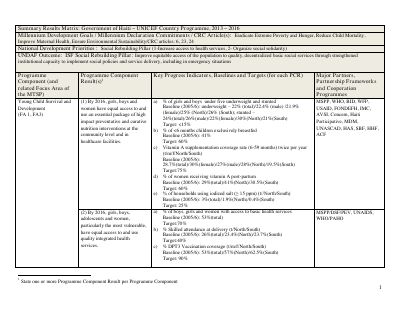
Summary Results Matrix: Government of Haiti – UNICEF Country Programme, 2013 – 2016
Millennium Development Goals / Millennium Declaration Commitments / CRC Article(s): Eradicate Extreme Poverty and Hunger, Reduce Child Mortality,
Improve Maternal Health, Ensure Environmental Sustainability/CRC articles: 6, 23, 24
National Development Priorities : Social Rebuilding Pillar (1-Increase access to health services, 2- Organize social solidarity)
UNDAF Outcome: ISF Social Rebuilding Pillar: Improve equitable access of the population to quality, decentralized basic social services through strengthened
institutional capacity to implement social policies and service delivery, including in emergency situations
Programme
Component (and
related Focus Area of
the MTSP)
Programme Component
Result(s)1
Key Progress Indicators, Baselines and Targets (for each PCR)
Major Partners,
Partnership Frameworks
and Cooperation
Programmes
Young Child Survival and
Development
(FA 1, FA3)
(1) By 2016, girls, boys and
women have equal access to and
use an essential package of high
impact preventative and curative
nutrition interventions at the
community level and in
healthcare facilities.
a)
MSPP, WHO, BID, WFP,
USAID, FONDEFH, IMC,
AVSI, Concern, Haiti
Participative, MDM,
UNASCAD, HAS, SBF, HHF,
ACF
(2) By 2016, girls, boys,
adolescents and women,
particularly the most vulnerable,
have equal access to and use
quality integrated health
services.
1
% of girls and boys under five underweight and stunted
Baseline (2005/6): underweight – 22% (total)/22.4% (male) /21.9%
(female)/25% (North)/26% (South); stunted –
24%(total)/26%(male)/22%(female)/30%(North)/21%(South)
Target: <15%
b) % of <6 months children exclusively breastfed
Baseline (2005/6): 41%
Target: 60%
c) Vitamin A supplementation coverage rate (6-59 months) twice per year
(t/m/f/North/South)
Baseline (2005/6):
28.7%(total)/30%(female)/27%(male)/28%(North)/19.5%(South)
Target:75%
d) % of women receiving vitamin A post-partum
Baseline (2005/6): 29%(total)/41%(North)/30.5%(South)
Target: 60%
e) % of households using iodized salt (≥ 15 ppm) (t//North/South)
Baseline (2005/6): 3%(total)/1.9%(North)/0.4%(South)
Target: 25%
a) % of boys, girls and women with access to basic health services
Baseline (2005/6): 53%(total)
Target:70%
b) % Skilled attendance at delivery (t/North/South)
Baseline (2005/6): 26%(total)/23.4%(North)/23.7%(South)
Target:40%
c) % DPT3 Vaccination coverage (t/m/f/North/South)
Baseline (2005/6): 53%(total)/57%(North)/62.5%(South)
Target: 90%
MSPP/DSF/PEV, UNAIDS,
WHO/PAHO
State one or more Programme Component Result per Programme Component
1
d) % of HIV+ pregnant women with HIV receiving antiretrovirals (ARVs)
to reduce mother-to-child transmission and the number of maternal
deaths
Baseline (2008): 48%
Target: 70%
e)
(3) By 2016, the most
disadvantaged children, women
and their families in rural and
poor urban environments have
sustainable access to safe water
supplies, basic sanitation and
hygiene education.
a)
% children (0-14) infected by HIV who received ARV treatment
Baseline (2008): 36%
Target: 65%
% of the population using an improved water source in urban and rural
areas
Baseline(2010): 69%(total)/85%(urban)/51%(rural)
Target: 74%(total)/75%(urban)/72%(rural)/North and South
Departments to be added upon release of the 2012 DHS
b) % of the population using improved sanitation facilities in urban and
rural areas.
Baseline (2010): 17%(total)/24%(urban)/10%(rural)
Target: 30%(total)/34%(urban)/25%(rural)/ North and South
Departments to be added upon release of the 2012 DHS
c) % of schools with adequate and gender sensitive water facilities/services
(for drinking and hygiene).
Baseline (2011): to be determined upon release of the 2012 School
WASH study.
Target: to be determined upon release of the 2012 School WASH study
d) % of schools with appropriate sanitation facilities (separated for girls and
boys).
Baseline (2011): to be determined upon release of the 2012 School
WASH study.Target: to be determined upon release of the 2012 School
WASH study
e) % of schools with handwashing facilities.
Baseline (2012): to be determined upon release of the 2012 School
WASH study.Target: to be determined upon release of the 2012 School
WASH study.
DINEPA, MSPP, MENFP,
BID, AECID, IOM, UN,
NGOs, private sector
2
Millennium Development Goals / Millennium Declaration Commitments / CRC Article(s): Achieve Universal Primary Education, Promote Gender Equality and
Empower Women and Millennium Declaration: Protecting the vulnerable/CRC Articles: 3,7, 8, 9, 10,11,19, 21, 23,25, 28, 29,31, 36,37, 39, 40
National Development Priorities: Strategic Plan 2030: Social Rebuilding Pillar (1) Strengthen higher education and vocational and technical training, 2) Increase access to
basic and secondary education 3) Organize social solidarity) Institutional Rebuilding Pillar (1)- Revise legal framework, 2) Modernize the central administration 3) Modernize
the deconcentrated administration, 4) Decentralization, 5) Reinforce civil society, 6) Reinforce justice and security administration
UNDAF Outcome: ISF Social Rebuilding Pillar: Improve equitable access of the population to quality, decentralized basic social services through strengthened
institutional capacity to implement social policies and service delivery, including in emergency situations
Programme
Component (and
related Focus Area of
the MTSP)
Programme Component
Result(s)2
Key Progress Indicators, Baselines and Targets (for each
PCR)
Major Partners, Partnership
Frameworks and Cooperation
Programmes
Learning and Protective
Environment (FA2, FA4)
(4) By 2016, Girls and boys,
including adolescents, are
protected against gender-based
violence and other forms of
violence, abuse, exploitation at
national and local levels in
conformity with human rights
standards and increased
awareness of the impact of
violence on children is
generated.
a)
MJSP, BPM, PNH, MAST, MCFDF,
IBESR, Barreau, NGO
(5) By 2016, girls and boys aged
0 to 14 years in the three poorest
quintiles benefit from education
policies that guarantee equitable
access to quality basic education
and early childhood
development opportunities.
2
# of communes with child protection services and programmes
compliant to human rights standards and sensitive to gender.
Baseline (2011): 5
Target: 34 by 2016
b) % of girls and boys including adolescents in the poorest
quintiles who possess a birth certificate
Baseline (2011): 71% (total)/70%(male)/71.4%(female)/58%
(poorest quintile)
Target: 100% by 2016
c) % of separated girls and boys including adolescents reunited
with families or placed in alternative family-based situations
Baseline (2011): 1%
Target: 30% by 2016
d) # of laws, policies, plans and protocols on gender-based
violence and other forms of violence, exploitation and abuse ,
compliant to human rights standards approved
Baseline (2012): revision/adoption of 9 policies, plans and laws
are in progress.
Target: To be identified in consultation with the government.
a) % of community-based early learning centers and/or preschools
that apply nationally established gender-sensitive quality
standards
Baseline (2012): none
Target: 60%
b) Net enrolment rate in pre-school
Baseline (2005/6): 30%
Target: 50%
c) Net enrolment rate in primary school (total/m/f/North/South)
Baseline(2005/6):
50%(total)/52%(female)/48%(male)/49%(North)/47%(South)
MENFP, GSE, UNESCO, NGOs, BID
State one or more Programme Component Result per Programme Component
3
Target: 75%
d) Gender parity ratio
Baseline (2005/6):
1.02(national)/1.07(urban)/0.98(rural)/1.11(North)/0.95(South
Target: 1.00
e) Repetition rate
Baseline (2005/6): 13%
Target: <10%
f) Drop out rate
Baseline (2005/6): 12%
Target: <10%
4
Summary Results Matrix: Government of Haiti – UNICEF Country Programme, 2013 – 2016
Millennium Development Goals / Millennium Declaration Commitments / CRC Article(s): Eradicate Extreme Poverty and Hunger, Develop a Global
Partnership; Section VI of the Millennium Declaration: Protecting the Vulnerable/CRC Articles: 13, 15, 23, 26
National Development Priorities: Strategic Plan 2030 (based on the pillars of the March 2010 Action Plan for National Recovery and Development): Territorial
Rebuilding (Expand and Develop Territories); Economic Rebuilding: (Implement an active governance for an accelerated and balanced economic growth); Social Rebuilding
(1) organize social solidarity; 2) ensure gender equality; 3) Ensure civic action development) ; Institutional Rebuilding (1)Modernize the central administration, 2) Modernize
the deconcentrated administration, 3) Decentralization, 4) Reinforce civil society
UNDAF Outcome: Objectives of the UN Integrated Strategic Framework 2013-2016(ISF): Social Rebuilding: Improve equitable access of the population to quality,
decentralized basic social services through strengthened institutional capacity to implement social policies and service delivery, including in emergency situations; Institutional
Rebuilding: Contribute to the consolidation of the democratic framework through improved rule of law, public administration reform, implementation of a consensual
legislative agenda and strengthening of the civil society; Territorial Rebuilding: Strengthen the leadership and capacity of the Government, local authorities and communities in
planning and managing land and resources to reduce risks and improve living conditions in rural and urban areas; Economic Rebuilding: Contribute to the reinforcement of
economic governance in order that the government and Hatian social actors implement a policy focused on the creation of decent work which is geographically balanced and
which takes into account gender equity and sustainable management of natural resources.
Programme Component
(and related Focus Area
of the MTSP)
Programme
Component Result(s)3
Key Progress Indicators, Baselines and Targets (for each PCR)
Major Partners, Partnership
Frameworks and
Cooperation Programmes
Institutional
Strengthening and Policy
Implementation
for
Children’s Rights:
(FA5)
6) By 2016, evidencebased policies, legislation
and budgeting including
measures for reducing
child deprivations and
disparities are
implemented.
a)
MPCE, IHSI, NGOs, MJSAC,
sectoral ministries, MEF, USAID,
CIDA, World Bank, UNFPA,
ILO, UNDP, departmental
authorities.
3
State budget allocation and expenditure by social sector
Baseline (2010-2011) 9.9% for the social sector
Target: to be determined in discussion with the Government
b) Availability of an integrated social protection system
Baseline (2012): no
Target: yes by 2016
c) # of government ministries and local authorities in the North and South
Department using DevInfo for monitoring, planning and decision-making.
Baseline (2012): 0
Target: 6 (national) 2 (departmental)
d) % children living in absolute poverty
Baseline (2005):
43%(total)/15%(urban)/58%(rural)/51%(North)/42%(South)
Target: reduction of incidence by 20% by 2016
e) Availability of quality disaggregated statistics
Baseline (2012): no updated, disaggregated statistics from DHS since
2005/6
State one or more Programme Component Result per Programme Component
5
Target: statistics disaggregated by sex, geographical areas and poverty
quintiles available from DHS, EMIS and sectoral household surveys and
through administrative data collection
6
Kijan pou site
United Nations Children's Fund (UNICEF), Matris rezilta: pwogram peyi Gouvènman Ayiti ak UNICEF, 2013-2016, https://www.unicef.org/executiveboard/
- Moun oswa enstitisyon ki gen dwa yo
- United Nations Children's Fund (UNICEF)