
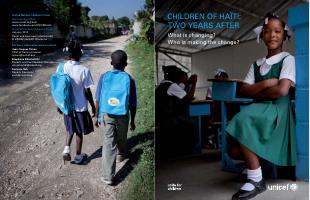
Timoun Ayiti: De Zan Apre. Kisa k'ap Chanje? Kiyès k'ap Fè Chanjman an?
Rezime — Bilan UNICEF Ayiti fè an janvye 2012 sou sitiyasyon timoun de zan apre tranblemanntè a, sou deplasman, dlo ak asenisman, edikasyon ak pwoteksyon timoun.
Dekouve Enpotan
- Li retni plis pase 550 000 moun te toujou ap abrite nan plis pase 800 sit deplasman dezan apre.
- Li site swivi deplasman OIM ki montre popilasyon kan yo bese 63 % nan yon ane.
- Li pibliye twa pi gwo move konprann sou sitiyasyon Ayiti, yon seksyon rapò ajans raman mete.
- UNICEF te mande plis pase 24 milyon dola ameriken pou pwogram Ayiti 2012 li.
Deskripsyon Konple
Bilan UNICEF Ayiti fè an janvye 2012 sou sitiyasyon timoun de zan apre tranblemanntè a, sou deplasman, dlo ak asenisman, edikasyon ak pwoteksyon timoun. Li gen yon seksyon sou twa move konprann ki pi kouran sou sitiyasyon Ayiti, yon bagay yon rapò ajans raman pibliye sou pwòp anviwonman travay li.
Teks Konple Dokiman an
Teks ki soti nan dokiman orijinal la pou endeksasyon.
United Nations Children’s Fund
Haïti Country Office
www.unicef.org/haiti
CHILDREN OF HAÏTI:
www.facebook.com/UNICEFhaiti
© United Nations Children’s Fund
TWO YEARS AFTER
January 2012
Cover and back cover photo credit What is changing?
© UNICEF/Haiti2011/Dormino
For more information please contact
Who is making the change?
Jean Jacques Simon
Chief of Communication
jsimon@unicef.org
Stephanie Kleschnitzki
Reports and Contributions Manager
skleschnitzki@unicef.org
Suzanne Suh
Reports Specialist
ssuh@unicef.org
Children of Haiti: Two Years After What is changing? Who is making the change? 1
Foreword
Sa ou plante se sa ou rekolte.
What you sow is what you [will] harvest.
Two years after the 12 January 2010 earthquake, the scars dress both acute and chronic challenges that prevent the
of disaster are still visible on the infrastructure, institutions realisation of child rights. In 2012, UNICEF will maximise
and social systems of Haïti. They are also apparent on the its powerful convening role to leverage the partnerships
bodies and in the minds of children, parents and caregi- and resources mobilised to “tend the seeds of change”
vers. But as the second anniversary of this calamitous that have already been planted, in solidarity with suppor-
event (deemed the most destructive in recent decades) ters around the world.
passes, there is also clear evidence of healing - and in
some cases, of not just recovery, but meaningful and posi- Keeping children safe, healthy and learning is a mutual
tive change that holds the key to realising the transforma- goal - one shared by parents, teachers, both private sector
tive agenda for children. and public sector partners, religious organisations (inclu-
ding the voodoo community), the new government and
Positively over 5 million cubic metres (about half) of the other duty-bearers across the nation. It is also a goal sha-
rubble, which once choked streets and alleys - has been red by states in Haïti’s close proximity and by individuals
cleared. Almost two thirds of the persons that once shel- in countries far from the Caribbean Sea. A wide range of
tered on both public and private land have moved out of actors are working together to innovate, problem solve
overcrowded camps. The education system, still inade- and generate momentum to enable these seeds to take a
quate and overstretched, has managed (against all odds) firm root and grow.
to gather data on the number and status of schools,
strengthen systems and, with strong political committ- Within this report, which targets both national and inter-
ment, expand access for more than 700,000 children. At national partners, we reflect on the question: “What is
the same time a large coalition of actors expanded protec- changing in Haïti?” and “Who is making the change?” In
tive services including sustainable interventions to better addition to reviewing UNICEF’s contribution to a selection
register, reunite and/or care for separated children. of key results achieved since the earthquake, a special se-
ries of national partner portraits showcases some of our
There is evidence of little victories everywhere, but serious most dedicated “champions for children” - duty bearers
gaps and inadequacies in Haïti’s basic governance struc- that are making transformation a reality in their own way.
tures remain. The country, overall, remains a fragile state Inspired by their commitment and words of encourage-
that requires strong and steadfast accompaniment to over- ment, UNICEF renews its pledge in 2012 to accompany
come the chronic poverty and under-development, deep them and others like them, in their progressive realisation
rural and urban disparities and weak institutions that leave of child rights, through a transformative agenda.
children vulnerable to shocks and the impact of disaster.
Each of us has a role to play. And in Haïti, it is a long term
UNICEF, in the last year of its “transitional programme” commitment.
for earthquake recovery, continues to implement a mix of
humanitarian relief, capacity development for institutional Françoise Gruloos-Ackermans
re-building and advocacy simultaneously, in order to ad- Representative
Children of Haiti: Two Years After What is changing? Who is making the change? 1
Executive Summary
The outlook at the start of 2012 appears bright. Positive of community-led total sanitation approach and the for-
progress in the public sector is matched by optimistic mation of a National Alliance for WASH in schools. With
forecasts for private sector investment, bringing a much- support from UNICEF, the Ministry of Health at the de-
needed boost to the local economy. However, more than partmental level also strengthened its capacity to respond
550,000 of the most vulnerable children, women and men to emergencies such as cholera.
continue to shelter in over 800 crowded displacement
sites, despite an ever-increasing threat of eviction. The Experienced technical experts, strong operational capacity
cholera epidemic also remains a pressing issue, following and the support of donors, based in-country and abroad
heavy rains in September and October which accelerated enabled UNICEF’s contribution to these achievements
transmission patterns and led to localised outbreaks. The and substantive results for children. Over the two years
vulnerability of the population remains high, primarily as a following the earthquake, UNICEF mobilised more than
result of stark gaps in the coverage of social services. US$ 351 million from more than 130 different sources, in-
cluding National Committees, Governments and UNICEF
Over the past two years, UNICEF Haïti made a significant Country Offices engaged in private sector fundraising.
contribution to the positive progress achieved in streng-
thening systems for delivery and regulation of social servi- In 2012, UNICEF is requesting over US$ 24 million in its
ces for children. For example, in the Education sector, UNI- 2012 Consolidated Appeal to address immediate humani-
CEF supported both upstream planning and downstream tarian needs associated with prolonged displacement, the
delivery of material incentives to over 750,000 children, cholera outbreak, and preparedness for the next hurricane
thereby diminishing the indirect costs that often serve as season and the potential for other sudden-onset emergen-
a significant barrier to education. At the same time, part- cies. UNICEF’s regular country programme also requires
nerships in the area of Child Protection strengthened the an additional US$ 30 million to support longer-term activi-
regulatory capacity of the government to protect thousan- ties that foster institutional reform, the reduction of dispa-
ds of vulnerable children in residential care. With UNICEF rities, promotion good governance, increased citizen parti-
support, over 120,000 children enjoy structured play in cipation and improved situation analysis, with a priority on
one of the 520 Child Friendly Spaces and youth leaders Nutrition, Child Protection and Education.
have taken centre stage in some of the world’s most high-
level forums. With an eye on the future, UNICEF is also integrating le-
arning from past experience. The Independent Review
In support of child survival and healthy development, of UNICEF’s Operational Response to the January 2010
UNICEF ensured the expansion of facility-based nutrition Earthquake in Haïti identified key internal, systemic fac-
services and promoted a shift towards community-based tors that influenced - positively and negatively - UNICEF’s
services as the primary delivery point for prevention and collective response during the first three months . These
treatment. In Water, Sanitation and Hygiene (WASH), ef- findings have informed UNICEF’s programmatic and ope-
forts by UNICEF and its partners emphasized the impor- rational planning and action at the country level. This has
tance of sanitation on a national level. These efforts inclu- contributed to UNICEF’s forward looking approach, shar-
ded the establishment of the first human waste disposal pening the focus on long-term recovery and development,
and treatment site for the metropolitan area, the role-out with a sustained application of lessons learned.
2 Children of Haiti: Two Years After What is changing? Who is making the change?
Contents
• Situation Update 4
• Top Three Misperceptions of the Situation in Haïti 5
• Fast Facts on UNICEF Programme Delivery 6
• What is Changing in Haïti and Who is Making the Change? 8
• Education 8
• Child Protection 10
• Nutrition 12
• Water, Sanitation and Hygiene 14
• Health 16
• Participation and Preparedness 18
• UNICEF Operational Commitments 20
• Funding Overview 22
• Looking Forward 24
• Cluster Coordination in 2011 25
• Ensuring Organisational Learning 26
• UNICEF Partners and Supporters 27
• Acronyms 28
Children of Haiti: Two Years After What is changing? Who is making the change? 3
Situation Update
At the start of a new year, Haïti appears to be turning
a corner. The country and its 4,316,000 children under
18, begin 2012 with a long-awaited new Government and
national budget. New Ministers, including those critical
to the survival and development of children, have been
appointed, bringing much-needed energy and optimism
to the scene. Reconstruction funding is slowly but surely
being released by donors (an additional US$ 4 billion was
© UNICEF/Haiti2010/Dormino
released at the end of 2011 meaning that 43 per cent of
pledges for this time period have been honoured). Com-
plementing the progress in the public sector, a positive bu-
siness forum at the end of 2011 promised an even greater
boost for the local economy, with over US$ 8 billion dollars
of investment pledged by foreign firms and investors. At
first glance, the outlook is positive. per cent. This remains above the epidemic threshold of 1
per cent set by the WHO - but has significantly decreased
Of course, the impact of the January 2010 earthquake from the 7 per cent observed during the early months,
remains highly visible on both infrastructure and social indicating a positive trend of increased access and quality
systems in the country. From a peak of over 1.6 million of services.
displaced persons, more than 550,000 individuals still
shelter in over 800 different displacement sites across the The challenge now is to mainstream cholera prevention
earthquake-affected area, representing not just a challen- and treatment programmes within the overall public health
ge to relief and recovery - but an urgent call to address de- system; adapt policies, protocols and training programmes
eper, more complex issues of urban homelessness, mar- as well as expand incentives that can encourage reten-
ginalisation and the need for more comprehensive social tion of staff mobilised during the emergency. In water and
protection systems. IOM displacement tracking indicates sanitation, actors are shifting focus from subsidization of
that the camp population decreased by 63 per cent in one chlorination campaigns towards addressing stark gaps in
year - but this is a slower pace of return than that noted in both the coverage of WASH services and in the knowled-
2010, due to the elevated vulnerability of those left behind. ge and behaviour of communities. In every sector, there
Some 77 per cent were renters before the earthquake, are efforts to pursue more proactive, rather than reactive,
meaning most have no home to return to. Providing a dan- responses that anticipate the seasonal resurgence of the
gerous push factor, IOM has noted that the number of disease in the future.
camps under threat of eviction tripled in 2011. As a result
more than 100,500 individuals live everyday with the fear Further complicating matters, two hurricanes narrowly
of being kicked out of their shelter. There is also a worri- missed Haïti this year (Irene and Emily in August) but he-
some concentration of people living in 61 “large camps” avy rains from both storms led to localised flooding and
thus elevating public health risks and underlining the need landslides that required small-scale evacuations. Both
for continuing emergency services in the short term. responses were led by local authorities including the Na-
tional Emergency Operational Centre (COUN) and emer-
Despite an overall downward trend in the cholera epi- gency coordination units in affected departments. Althou-
demic, heavy rains in September and October triggered gh national capacity for emergency response appears to
outbreaks across the country, particularly in the North, be increasing, threats on the horizon (including the next
South, and Nippes Departments, and in the Port-au-Prince hurricane season and possible further increases in food
metropolitan area. As of 8 November, the MSPP reported prices) are many in 2012, and Haïti will continue to requi-
496,337 cases of cholera and 6,797 deaths attributed to re international assistance to meet the special needs of
cholera, with an overall observed case fatality rate of 1.4 children in humanitarian action.
4 Children of Haiti: Two Years After What is changing? Who is making the change?
Top Three Misperceptions of the Situation in Haïti
“The reconstruction process is stalled. “Billions of dollars were given last year.
Haïti has too many structural issues to truly Haïti’s government can’t absorb any more money.”
recover from disaster.”
It’s unfortunate, but the reality is that the majority of relief
Rebuilding Haïti is by no means an easy task. But signifi- and recovery assistance to Haïti has actually side-tracked
cant progress has been made by committed national and national budgets completely. The Office of the Special En-
international stakeholders from both the public and priva- voy reports that only 1 per cent of relief assistance in 2010
te sectors. According to a World Bank report released in was provided directly to the Government of Haïti- and less
2011, Haïti’s GDP growth was reported at -5.05 per cent than 12 per cent of recovery assistance was channelled di-
in 2010 but this is expected to rise, when considering rectly to government using national systems. This form of
newly approved debt relief measures; infrastructure con- assistance can actually erode national capacity instead of
tracts and trade agreements. Not only is half of the rub- build it. UNICEF’s mandate is to support the Government
ble cleared (a massive accomplishment), but with support to uphold their obligations to protect and promote child
from the Inter-American Development Bank, the Europe- rights in country. Our assistance is therefore pledged
an Union, the World Bank, France, Canada, Taiwan and against national frameworks, in line with national priorities
other donors, the Ministry of Public Works is carrying out and includes direct financial assistance to central and de-
more than 100 projects on primary, secondary and tertiary partmental level authorities, in order to address specific
roads. Other on-going projects include a US$ 250 million needs of children in our negotiated country programme.
airport reconstruction; a US$ 40 million deep water port; Haitian institutions cannot address the needs of children
a US$ 40 million project to expand housing and a large and other vulnerable groups unless money flows through
scale initiative to modernise energy grid (which alone will them.
create an additional 80,000 jobs). At the “Invest in Haïti”
forum held in November 2011, President Martelly also an-
nounced the construction of an Industrial Park. The park’s “There are too many actors in Haïti,
first tenant, pledged to invest an additional US$ 78 million with no coordination or government oversight.”
in an apparel and textile plant. Reconstruction of Haïti is
not stalled. It is in full force. It is true that the majority of social services in Haïti are de-
livered by non-government actors including religious orga-
nisations, for-profit businesses and NGOs - many of them
having a long-term presence in the country. It is also true
that hundreds of new NGOs entered the country after the
earthquake, bringing much needed financial, technical and
material resources for relief and recovery. In the aftermath
of the 2010 earthquake the “Cluster Approach” provided
coordination and information management support to the
government, in order to leverage available resources in
each sector towards the most urgent of needs. Now, as
Haïti moves into a period of recovery and development,
UNICEF is supporting the process of Cluster “transition”,
which includes efforts to enhance the regulatory capacity
of government, their ability to independently coordinate
© UNICEF/Haiti2011/Dormino
international actors and manage key emergency informa-
tion management tools. Nationally-led coordination fo-
rums (called Tables Sectorielles) have been revived, and
are now leading the way in terms of policy development,
standards setting and prioritisation of action.
Children of Haiti: Two Years After What is changing? Who is making the change? 5
Fast facts on UNICEF Programme Delivery
Education
• More than 80,000 children are now learning in 193 semi-perma-
nent schools constructed by UNICEF since the earthquake
• Some 750,000 children and more than 15,000 teachers in
2,500 schools received learning and teaching materials in
support of the October 2011 Back-To-School campaign and
President Martelly’s initiative for free education
• 1,497,900 children in 5,760 schools received hygiene pro-
motion materials including soap to protect against cholera
© UNICEF/Haiti2011/Dormino
• 500 teachers in rural public schools were trained in me-
thods for preschool teaching and 360 education personnel
countrywide were trained on Education in Emergency and
Disaster Risk Reduction
• Local Education Ministries in all ten departments have con-
tingency plans endorsed by the Department of Civil Protec-
tion to better prepare and respond to emergencies
Child protection
• Over 120,000 children in nine departments benefit from structured activi-
ties and referral networks in 520 Child Friendly Spaces managed by 92
different community-based organisations supported by UNICEF
• All ten departments equipped with psychosocial rehabilitation services spe-
cialised in emergency response
• 8,780 separated children have been registered and over 2,770 reunified
with their families since the earthquake, thanks to the support of UNICEF
and the Family Tracing and Reunification network
• An additional 13,440 children living in 336 of the estimated 650 residential
care centres have been registered to provide social documentation, impro-
ved case management and family reunification where possible
• 336 residential care centers have been evaluated with standardized tools -
and a directory of all Residential Care Centres has been launched by IBESR,
with UNICEF support
• 18,000 children were screened at border points and airports since the
earthquake, by a division of the national police supported by UNICEF
• The Government of Haïti signed the Hague Convention on Inter-Country
Adoption in 2011, following targeted advocacy
© UNICEF/Haiti2011/Dormino
6 Children of Haiti: Two Years After What is changing? Who is making the change?
Nutrition
• Some 393,000 children screened and over 15,300 treated for acute mal
nutrition in 2011 in one of the 290 out-patient treatment units and/or 24
Nutrition Stabilisation Units (which address malnourished children with
complications). A recovery rate of 76 per cent and mortality rate under 2
per cent in patients indicates good quality of service
• Some 500,000 mother and baby pairs were provided with nutrition
counselling and breastfeeding coaching in the 198 Baby-Friendly Corners
established and maintained since the earthquake. Meanwhile, 40 Infant
and Young Child Feeding committees and mothers clubs were created
© UNICEF/Haiti2011/Dormino
• Over 500,000 women received iron-folic acid tablets in 2011 to prevent
anaemia
• Over 775 health professionals and healthcare providers trained in Com-
munity Management of Acute Malnutrition (CMAM) and Infant and Young
Child Feeding (IYCF)
Health
• Some 800 HIV positive pregnant women gained access to Prevention of Mother-to-
Child Transmission (PMTCT) services as UNICEF supported the establishment of 11
new PMTCT sites in under-served areas
• 149,000 pregnant women tested for HIV; 3,000 tested HIV positive and 1,875 pregnant
women with HIV placed on antiretroviral treatment with UNICEF support
• More than 15,000 vulnerable adolescents in Port-au-Prince were sensitised on HIV pre-
vention and 2,500 adolescents tested for HIV and 522 placed on antiretroviral treatment
• UNICEF supported 37 trainers and 115 service providers with enhanced knowledge and
capacity to implement PMTCT
• Almost 170,000 children were protected against vaccine preventable disease in Haïti
© UNICEF/Haiti2011/Dormino
as the routine immunisation coverage increased from 58 per cent to almost 80 per cent
between 2010 and 2011 with UNICEF support to the “RED approach”
• UNICEF provided medicine, equipment and technical support to the placement of inter-
national midwives in emergency obstetric clinics for at-risk pregnant women
• UNICEF supported the training of four trainers on the promotion of Kangaroo Mother
Care to prevent neonatal deaths
Wash
• In response to the continuing cholera outbreaks in 2011, the UNICEF WASH
programme worked through 14 partners to provide hygiene promotion and
cholera supplies for an estimated 2.2 million people
• In 2011, improved water supplies, safe sanitation and better management
and monitoring of services reached about 600,000 people in camps and
earthquake affected communities, and urban neighbourhoods to which di-
splaced people are returning
• Some 95 communities hosting 89,000 persons launched the Community-
Led Total Sanitation (CLTS) approach to expand WASH services
• Declining from a peak of 680,000 persons, some 196,000 persons in camps
© UNICEF/Haiti2011/Dormino
had access to at least 10 litres of safe water per day, supported by UNICEF
• The first human waste disposal site was established for Port-au-Prince (with
UNICEF support) and UNICEF continues to finance the desludging fleet for
the removal of liquid waste from CTCs/CTUs in Port-au-Prince and in camps
Children of Haiti: Two Years After What is changing? Who is making the change? 7
MENFP experienced the collapse of its department buildings and
Who is Making Changes? the loss of senior staff as well as teachers and education officials
in the 2010 earthquake. UNICEF played a critical role in restoring
the operational capacity of MENFP and supporting pupils to return
to school after the earthquake. Now, UNICEF remains a leading
Education partner in the education sector at both upstream and downstream
levels, including through 16 formal partnerships signed with non-
public organizations since the earthquake.
Renold Telford
Directeur de l’Enseignement Fondamental
Ministry of Education (MENFP)
“I was overwhelmed by the destruction and by the daunting
task we had before us. By planning together with UNICEF,
© UNICEF/Haiti2011/Martinez Casares
children were able to go back to school shortly after
the earthquake. The Ministry was able to move quickly
to start up schools in tents and then in semi-permanent
structures. The work was enormous. But actually,
the easy part is behind us. Now the hard work begins.”
8 Children of Haiti: Two Years After What is changing? Who is making the change?
What is Changing? What Was the Situation Before?
Strong political will is furthering the momentum. In October 2011, President
Martelly launched a new initiative for free education targeting 142,000 out-of- The education sector was fa-
school children in eight departments and 120,000 children in the West and Ar- cing huge challenges before
the earthquake. There was low
tibonite Departments for the new school year. While supporting the upstream
public expenditure in education
planning and communication around the President’s initiative, UNICEF also pro-
(approximately 5 per cent in
vided school supplies and materials for 750,000 children and more than 15,000 2007), less than 10 per cent of
teachers in 2,500 schools between October and the end of the year. Never Haïti’s education infrastructure
before have so many children in Haïti received educational materials! was government-owned, over
half of primary schools were
Education infrastructure is expanding. The Education Cluster estimates that
concentrated in the West De-
some 653 schools were repaired and 612 schools were constructed (469 of partment and approximately 23
these were safe semi-permanent education spaces) since the earthquake by sub-communes didn’t have any
all Education sector partners including the Government. UNICEF contributed education infrastructure. It is not
to this expansion, by converting some of the 225 temporary learning spaces surprising that less than half of
erected in the earthquake zone into child-friendly, anti-seismic, semi-permanent children were estimated to be
primary schools. At the end of the year, UNICEF completed 193 schools (out attending school and only one
of a target of 200), which are now hosting more than 80,000 children in four third of children enrolled actually
departments. Schools have also been fitted with improved water and sanitation completed their primary studies.
systems, school furniture and learning supplies. The 2010 earthquake further
crippled the education system,
The spotlight is widening to include Early Childhood Development. For the with almost 4,000 education
first time ever, the Ministry of Education finalised an Early Childhood Deve- establishments damaged or de-
lopment (ECD) policy framework, and defined strategies for the implementa- stroyed, disrupting schooling for
tion of quality ECD services for children aged 0-6 years, including community approximately 2.5 million stu-
approaches to ECD for vulnerable children. This process is clear evidence of dents.
the new Government’s commitment to improving the quality of education, a
commitment supported strongly by UNICEF. Preschool education will enable
children to enter primary school on time and more effectively transition from What does this mean for children?
family to school.
A growing evidence base is informing education planning. Field work for Education is every child’s right.
the first “school census” since 2003 was led by the Ministry and UNICEF provi- It is critical to the development
ded planning and data collection support, reaching 18,000 schools. Results are of children as individuals and as
set for release at the end of 2011 and the process, supported by UNICEF and productive members of society.
partners will provide a critical update on key statistics, such as the number of If all Haitian children had access
schools in the country, the number of pupils registered and the status of edu- to a quality education, their po-
cation infrastructure. tential to end the cycle of pover-
ty and contribute to the recovery
Emergency cholera prevention is being integrated in schools. Immediately of the nation would increase ex-
after the cholera outbreak in October 2010, UNICEF collaborated with the Mini- ponentially.
stry of Education to ensure that schools served as important entry-points in the
fight against cholera - instead of dangerous transmission zones. This included
the establishment of a task force, the drafting of a national prevention and re-
sponse strategy, training of education officials and the distribution of prevention
supplies to over 1,497,900 children in 5,760 schools. In 2012, UNICEF will work
to facilitate the integration of cholera prevention into national curriculums.
Children of Haiti: Two Years After What is changing? Who is making the change? 9
The network of child protection partners has never before been as
Who is Making Changes? extensive, cohesive or powerful. MOSAJ is one of the first NGOs
to work in psychosocial care after the earthquake. Clarens, who
has a son with disabilities who can neither walk nor talk, says that
when he works with vulnerable children, he is inspired by his son.
Child Protection MOSAJ is one of 92 national community-based organisations that
are currently managing child friendly spaces open in both camps
and communities, supported by UNICEF. UNICEF also signed for-
mal partnership agreements with 51 non-public organisations since
the earthquake.
Alexandre Clarens Junior
Director of the local NGO
Mouvement Social pour l’Avancement
de la Jeunesse (MOSAJ)
“I lost everything in the earthquake
- but what is important is what is in my heart.
UNICEF supports me to do what is really
important, and that’s helping these children.”
© UNICEF/Haiti2011/Dormino
10 Children of Haiti: Two Years After What is changing? Who is making the change?
What is Changing? What Was the Situation Before?
The laws are changing. Haïti has taken important new steps towards
matching international commitments. In 2011 the Government signed the Even before the earthquake,
Hague Convention on Inter-Country Adoption, which protects the rights of Haitian children were excee-
dingly vulnerable to abuse
children, birth parents, and adoptive parents by establishing minimum stan-
and exploitation. An estimated
dards for adoptions. The Government is also working to harmonise domestic
225,000 children worked as do-
adoption and trafficking laws with international standards, and a framework on mestic servants in non-family
legal reform for a Child Protection Code was adopted in 2011. households; more than 50,000
lived in residential care facilities;
Haitian Institutions have more knowledge, skills and tools to regulate the
and at least 2,700 were living on
sector. Haïti is also experiencing a never before seen regulatory capacity in
the streets of Port-au-Prince alo-
residential care. Prior to the earthquake the Government did not know how ne. Vulnerable children in these
many children were living in institutions - or where they even were. Now, with groups risk exposure to exploita-
UNICEF support, the first ever Directory of Residential Care Facilities has been tion such as trafficking, prematu-
launched by IBESR; some 336 centres have been assessed (out of an estimated re adoptions and gender-based
650 in operation); and over 13,400 children (out of an estimated 50,000 living in violence. The 2010 earthquake
residential care) have been registered. These steps (standard in other countries) heightened exposure to risks
enable the Government to accredit and better monitor institutions, and shut since it further eroded the
down those institutions that are noncompliant with minimum standards. country’s already fragile social
and child protection systems, as
More children have been reunited with their families. As of 31 September well as the capacity of parents
2011, some 8,780 separated children have been registered through the Emer- and caregivers to support their
gency Family Tracing and Reunification system and 2,770 children reunified children.
with their families, with the remainder finding interim care solutions including
residential care. The value of reunification to individual children is inestimable
and each successful case represents the combined efforts of at least eight
What does this mean for children?
different organisations.
It’s getting harder for children to be brought out of the country illegally.
All children have the right to
UNICEF played a key role in helping the Haitian National Police establish the
be protected from violence,
“Brigade de Protection des Mineurs” (BPM) in 2002 and since the earthquake, abuse and exploitation. Abuse
UNICEF has financed the expansion of agents placed at critical exit points, their can lead to death, physical injury
training, and their cooperation with NGO partners. The BPM has subsequen- and mental health challenges in
tly screened over 18,000 children at border points and international airports both the short and longer-term,
for documentation. Some 2,000 of these cases were classified as suspected impairing a child’s ability to le-
trafficking. Haïti remains a high-risk source, destination and transit country for arn and socialize and impacting
child trafficking, but bit-by-bit, the borders are tightening to protect the most their transition to adulthood.
vulnerable. Risks in Haïti are exacerbated by
deep and chronic poverty - but
Community-based child protection actors are better organised, more cohe- protection is not about money.
sive and more powerful. Never before has there been such an extensive net- It’s about the duties borne by
work of community-based actors in the area of child protection. With UNICEF parents, caregivers, teachers,
support, 92 community-based organisations are managing 520 Child Friendly police, social workers and other
Spaces and reaching a total of 120,000 children in nine departments on a daily actors to care for children.
basis. During the cholera outbreak, 82 of these partners rapidly mobilised 2,170
volunteers to disseminate cholera prevention messages and techniques, rea-
ching over 315,750 children.
Children of Haiti: Two Years After What is changing? Who is making the change? 11
FONDEFH is a local NGO which provides integrated health and nu-
Who is Making Changes? trition services at the community level. After the earthquake, UNI-
CEF helped FONDEFH to set up sites for the prevention and tre-
atment of malnutrition in camps and zones with little or no access
to services. Over the last year, with UNICEF support, FONDEFH
Nutrition expanded its coverage to departments with high malnutrition rates
among children and where no other organization is providing assi-
stance. FONDEFH is one of 16 partners that have signed partner-
ship agreements with UNICEF in the nutrition sector.
Dr. Margareth Mallet
Director General
Fondation pour le Développement
et l’Encadrement de la Famille Haïtienne
(FONDEFH)
“My motivation is to help the weakest and most
vulnerable of the Haitian people, those who are
marginalised and neglected, to help improve their
health conditions. UNICEF helped us become better
organized and helped us to reinforce our capacity.
Our organization now has a more solid structure.”
© UNICEF/Haiti2011/Martinez Casares
12 Children of Haiti: Two Years After What is changing? Who is making the change?
What is Changing? What Was the Situation Before?
There is an unprecedented expansion of preventative and curative nutri-
tion services for children and women. UNICEF supported this expansion by Even before the earthquake,
providing coordination support to increase equity in access to care - as well as malnutrition was a silent crisis
for children in Haïti. One fifth
financial, technical and material support for the establishment of 290 outpatient
of children under the age of five
treatment units and 24 inpatient Stabilisation Units for the treatment of seve-
were underweight and almost
re and acute malnutrition in children. Partners screened 393,000 children and one third suffered from chronic
achieved a recovery rate of 76 per cent and a mortality rate under 2 per cent- malnutrition. Three quarters of
indicating quality service for 15,300 children with severe acute malnutrition. In children under the age of two
addition to treatment, there has also been a massive expansion in preventative and half of all pregnant women
services, with UNICEF supporting the establishment of 177 out of 198 Baby were anaemic. Community le-
Friendly Tents and Corners for nutrition counselling. UNICEF also supported the vel management of malnutrition
over 500,000 women to receive iron-folic acid tablets to prevent anemia and for was weak or non-existent. With
the first time, vitamin A supplementation reached 70 per cent of children aged these challenges, it was not
6-59 months during National Child Health Week. The challenge now is to keep surprising that 53 per cent of
the momentum and seize all opportunities. under-five deaths in Haïti were
related to malnutrition. The 2010
There is evidence that services can be sustainable if firmly rooted in com- earthquake, cholera outbreak
munities. Recognizing the need to foster sustainability and a change in atti- and localised flooding further
tudes and behaviors around nutrition, UNICEF also supported a strategic shift elevated food insecurity; wea-
towards prioritisation of community-based programmes as the main system kened the fragile health system
and affected communities’ capa-
for delivery. With a focus on rural areas, UNICEF has scaled-up partnerships in
city to implement good health
2011 to reach over 125,000 households (650,000 individuals) with a preventa-
and hygiene practices.
tive and therapeutic nutrition package. Four partners were selected to act as
“networks of excellence” in different geographic zones to support the scale-up
(Hopital Saint-Boniface, Hopital Albert-Schweitzer, PLAN Haïti and FONDEFH).
UNICEF also supported over 500 health professionals and healthcare providers What does this mean for children?
to be trained in Community Management of Acute Malnutrition (CMAM) and
Infant and Young Child Feeding (IYCF). UNICEF also supported partners at the
Proper nutrition is essential
local level to establish and maintain at least 40 IYCF support committees and
to child survival and deve-
mother’s clubs.
lopment. It is well recognized
There is a growing willingness to prioritise the Nutrition sector. The Techni- that the period from conception
cal Committee for Nutrition, operational before the earthquake, was revived in to two years of age is the “cri-
tical window of opportunity”
2011and UNICEF has supported regular meetings led by the head of the Nutri-
during which a child’s brain and
tion Division at MSPP. Nutrition policies and training materials developed jointly
body needs adequate nutrients
by the MSPP and partners, including UNICEF’s programme and cluster, have to grow. If these basic building
been endorsed by national authorities and adopted by all nutrition partners. The blocks of life are not received
National Nutrition Policy - in the pipeline before the earthquake - was validated it can cause irreversible dama-
in April 2011. These developments mark a growing capacity of the government ge and retard a child’s physical
to raise the profile of nutrition in national planning and budgeting. and mental development for the
rest of his or her life. If Haïti is
to recover from disaster and plot
a course for sustainable deve-
lopment, it needs to ensure opti-
mal nutrition for every child.
Children of Haiti: Two Years After What is changing? Who is making the change? 13
DINEPA was established in 2009 following several years of short-
Who is Making Changes? comings and underinvestment in Haïti’s water and sanitation sec-
tor. With technical and financial support from a range of donors
including UNICEF, DINEPA completed the construction of the first
human waste disposal and treatment site (which serves as the
Water / Sanitation / Hygiene backdrop for the photo below). UNICEF co-leads the WASH Cluster
with DINEPA to support coordination, information management
and overall planning in the sector - but has also singed 89 diffe-
rent partnership agreements to scale up WASH services since the
earthquake.
Edwige Petit
Director of the Sanitation Department of the
Direction Nationale de l’Eau et de l’Assainissement
(DINEPA)
“There is still a lot of work to be done, and it will take time
- time that we don’t have. UNICEF works with children
and with the disadvantaged. The two most critical groups
© UNICEF/Haiti2011/Martinez Casares
in sanitation are children and the poor - children because
they are the best channel for passing on information about
hygiene promotion, and the poor because they have the most
urgent sanitation needs but the least capacity to care for them.”
14 Children of Haiti: Two Years After What is changing? Who is making the change?
What is Changing? What Was the Situation Before?
There is a new appreciation for the importance of sanitation and hygiene.
The 2010 sanitation emergency in displacement sites and the outbreak of cho- Even before the earthquake,
lera necessitated an acceleration of efforts by all WASH Cluster partners to pro- millions of people in Haïti la-
cked basic water and sanita-
mote proper sanitation and hygiene practices in camps, schools and communi-
tion. Sanitation coverage in both
ties, which contributed to improved knowledge and practice. A CDC-supported
rural and urban areas remains
study conducted at the end of 2010 in Port-au-Prince confirmed that knowledge extremely low, with only 17
of cholera was high and that household water treatment increased from 32 per per cent of households having
cent to 77 per cent. In 2011, UNICEF worked through 14 partners to deliver access to a sanitation facility in
cholera prevention supplies for 2.2 million people. Global Hand-washing Day, 2008. Access to an improved
celebrated on 15 October 2011 with 185 partners, furthered the momentum. water source remains a major
development challenge, with
A waste disposal and treatment site for the metropolitan area is finally only 55 per cent of the rural po-
operational. The first dedicated human waste treatment site was built in 2011 pulation having access to an im-
with technical and financial support from UNICEF and other donors. Operational proved water source. The 2010
since September 2011, the new site ensures greater environmental safety for earthquake further damaged
the disposal of human waste. UNICEF is also supporting the development of scarce infrastructure and placed
public-private partnerships to improve desludging and disposal operations. a necessary emphasis on emer-
gency response. The cholera
Emergency WASH services are being progressively replaced by inves- outbreak however, turned the
tments in return communities. In 2011, the population in camps further de- spotlight back on the underser-
clined and UNICEF’s support to maintenance of emergency services provided ved rural areas and underlined
322,000 persons with improved sanitation facilities and 196,000 persons with the need to address structural
at least 10 litres of safe water per day. (WASH Cluster estimates that there are gaps and disparities.
102 camp residents for every latrine). Meanwhile, UNICEF supported rehabilita-
tion of water schemes in 58 poor urban areas of the capital and in Petit Goave.
(WASH Cluster estimates that 445 water points have been installed or rehabi- What does this mean for children?
litated in return areas by all partners). Linking with shelter construction efforts,
some 20,000 persons in return neighbourhoods will also be supported by UNI-
CEF with improved sanitation in 2012. In rural communities, 143,000 persons One out of every thirteen chil-
are already benefitting from improved WASH services, supported by UNICEF. dren dies before the age five in
Haïti, usually as a result of pre-
UNICEF is enabling rural communities to identify and secure their own ventable disease (such as diar-
sanitation solutions. In rural areas, UNICEF is promoting community-led total rhoea) related to the lack of safe
sanitation (CLTS) to trigger greater demand for and use of sanitation facilities. water or sanitation. Lack of ac-
Instead of focusing on latrine construction, this approach enables communities cess to safe water and sanitation
to realise the benefits of eliminating open defecation (still practiced by half the can also have a devastating im-
population in rural areas). Already, 95 communities (with 89,000 persons) have pact on education, since children
launched the CLTS approach in three Departments. often skip school to collect wa-
ter or leave school to avoid unsa-
A National Alliance for WASH in Schools has been formed - the first of its nitary or unsafe facilities.
kind in Haïti. With UNICEF support, the newly formed Ministry of Education-
led Alliance will prepare a situation analysis, develop standards and launch a
national action plan to accelerate construction of WASH facilities in schools.
UNICEF has already supported partners to improve WASH facilities in 150 scho-
ols (reaching 76,800 children) in 2010, and 48 schools (for 17,616 children) in
2011, with activities on-going in another 150 schools.
Children of Haiti: Two Years After What is changing? Who is making the change? 15
With support from UNICEF and the Inter-American Development
Who is Making Changes? Bank during the October 2010 cholera outbreak, MSPP trained
personnel and performed the rapid scale-up of prevention and tre-
atment services and social mobilisation in under-served areas. In
July 2011, when heavy rains caused an unprecedented peak of
Child Health cholera cases in the North-West Department, Dr. Beaugé’s team
moved swiftly to identify and treat cases, as well as take rapid ac-
tion to mitigate and contain the outbreak. With the foundation of
previous support, the Department was able to launch an effective
emergency response.
Dr. Laurent Beaugé
Director
Ministère de la Santé Publique et de la Population (MSPP)
North-West Department
“This was the first time I had ever dealt with this type
of crisis [the cholera outbreak]. It was a baptism by fire
- to test how we would manage. UNICEF made it possible
for us to develop the competencies we now have
and provided visibility to the department and the Ministry
© UNICEF/Haiti2011/Dormino
in general. But they also respect our autonomy and allow
partners to make the decisions. Thanks to UNICEF,
we were able to keep our heads above water.”
16 Children of Haiti: Two Years After What is changing? Who is making the change?
What is Changing? What Was the Situation Before?
The health sector has increased, rapidly and effectively, their capacity to
respond to the cholera emergency. When cholera erupted in Haïti in October Before the earthquake, half
2010, there were no existing models within the health system for coping with of Haïti’s population lacked
access to medicines, and 47
an emergency on such a large scale and the epidemic overwhelmed the MSPP
per cent did not have access to
at all levels. Following a period of intense emergency response (in which UNI-
health care, due to the extre-
CEF provided technical assistance and over US$ 8 million worth of supplies mely centralised nature of the
for the health sector including 1,500 tents for treatment facilities; 11 million health system. Even when ac-
sachets of Oral Rehydration Salts and 266 cholera kits to support more 26,000 cessible, health services were
severe cholera cases and 105,000 moderate cases), UNICEF turned towards generally poor in quality due to
building national capacity to maintain prevention and treatment services. UNI- infrastructural deficiencies and
CEF worked together with the MSPP in the West, North, North-East and North- a lack of human resources. The
West Departments to develop action plans to train institutional and community 2010 earthquake caused dama-
personnel and manage services. Today, there are 16 Cholera Treatment Cen- ge to infrastructure and put an
tres; 120 smaller Cholera Treatment Units and 1,172 Community Points for Oral overwhelming focus on emer-
Rehydration maintained with financial and material support from the MSPP- gency response. The cholera
outbreak nine months later pla-
UNICEF-IDB partnership. With this strong foundation of assistance, MSPP’s
ced an additional burden on he-
Health Department is now better prepared to manage cholera and other emer-
alth facilities and personnel but
gencies, since departments have updated contingency plans; pre-positioned this time, all across the country
emergency supplies and made funds available at the local level. - especially in the most remote
of areas.
The Routine Immunisation System is up and running again. Routine immu-
nisation systems were arrested for much of 2010, but thanks to UNICEF and
partners, they are operational again. In 2011, UNICEF supported the procure-
ment of vaccines, 170 solar fridges and 700 fridge tags to monitor tempera- What does this mean for children?
tures. Most significantly however, UNICEF helped to launch the ‘Reach Every
District’ (RED) approach, providing specific financial and technical assistance to
36 communes with the lowest vaccine coverage. As a result, overall immuni- The right to life is obviously
sation coverage has increased from 58 per cent in 2005 to over 79 per cent in the most fundamental of rights
- but one in every thirteen
2011 and, in some communes targeted by the RED approach, coverage rates
children dies before the age of
have increased from as low as 0 per cent to at least 60 per cent.
five in Haïti - most due to pre-
Prevention of Mother to Child Transmission of HIV services expanded this ventable disease. Even before
year. In some of the most underserved areas, more infants are being protected the earthquake Haïti had the hi-
ghest child mortality rates in the
from mother-to-child transmission of HIV than ever before. UNICEF provided
region, losing approximately 52
technical and financial support to open 11 new sites for Prevention of Mother-
children every day. This situation
to-Child Transmission (PMTCT) of HIV in the North-West, Nippes, South and cannot continue. Haïti’s recovery
Grand-Anse departments, allowing for 800 pregnant women who tested HIV depends on children surviving
positive to begin receiving antiretroviral treatment. With UNICEF support, the and accessing the preventative
national PMTCT programme tested 149,000 pregnant women for HIV and pro- and curative services they need
vided antiretroviral treatment for 1,875 HIV positive pregnant. to grow up and become healthy
and productive citizens.
Children of Haiti: Two Years After What is changing? Who is making the change? 17
Plan International has been working with Haitian communities sin-
Who is Making Changes? ce 1973 with programmes to strengthen education, healthcare,
and the participation of children and young people in governance.
UNICEF and Plan International have worked together on youth ini-
tiatives in Haïti since 2002, reinforcing the capacity of youth groups
Participation / Preparedness to engage with state institutions. More than ever before, there is
a positive shift from organisations making decisions for children to
organisations and children working together to bring about concre-
te solutions. UNICEF works with four key non-governmental part-
ners that support youth participation, including Plan International.
Fritz Djenald Israel
Youth Engagement Program Assistant
Child and Youth Media Program, Plan International
“We’re not old enough to vote,
© UNICEF/Haiti2011/Martinez Casares
but we have a voice. Thanks to UNICEF,
national and regional networks between
youth have been built, and the capacity
of youth in Haïti has been strengthened.
Our voices are getting stronger.”
18 Children of Haiti: Two Years After What is changing? Who is making the change?
What is Changing? What Was the Situation Before?
Youth participation is now firmly on the reconstruction and recovery agen-
da. A National Youth Policy, National Sport Policy and National Civic Action In Haïti, 58 per cent of the po-
Policy Youth were launched in 2011 by the Government, providing a foundation pulation is less than 24 years
old. Only 33 per cent of rural
for the integration of youth and adolescent rights in national policies. In addi-
youth and 53 per cent of urban
tion to providing technical assistance for these efforts, UNICEF also helped to
youth attend school. Less than
form the National Youth Council, representing over 16 youth organisations, and 1per cent of youth in Haïti attend
supported a workshop under the leadership of the Youth Ministry to produce university, and 20 per cent of
national indicators to track progress on youth related issues. youth are illiterate. This genera-
tion has also grown up amidst
On a larger scale than ever seen before, Haïti’s youth are making their
political instability including
voices heard, even beyond Haïti’s borders. UNICEF used its strong conve- military coups, civil protests,
ning power in 2011 to support a series of national youth forums that allowed political crimes, an economic
hundreds of young people to exchange views and submit proposals on how to embargo, rampant corruption,
contribute to the reconstruction process. UNICEF also facilitated opportunities drug trafficking and high rates of
for youth to engage local decision makers including candidates in local elec- gang-related crime. Major hurri-
tions through town hall meetings, where youth expressed their views and re- canes and the 2010 earthquake
commendations. Events involving the Scouts and the Red Cross were also held also had a major impact on youth
in the most remote areas to raise awareness on the contribution and impact - and underlined the need for in-
young people can have on their environment. Youth voices also echoed beyond dividuals of all ages to be better
Haïti’s borders this year, as UNICEF enabled young leaders to participate in glo- prepared for emergencies.
bal forums including the Climate Change Conference in December 2010, the
High Level Meeting on Youth at the UN General Assembly in July 2011 and the
UNESCO Youth Forum in October 2011. What does this mean for children?
We now understand more about the issues affecting youth. Also for the
first time, a situation analysis on youth issues was performed, based on key Making up more than half of
recommendations produced through different networks by thousands of youth the population, it is critical that
and adolescents across the country. This analysis was shared with top go- children and young people par-
vernment officials in IBESR, MAST, the First Lady’s Office and the State Se- ticipate in decision-making pro-
cretariat for the Integration of Handicapped Persons and helped to inform the cesses that affect their lives and
National Youth Policy. the future of the nation. Youth
represent a powerful force for
Partnerships for emergency preparedness and response cover the whole change and social transforma-
of the country. UNICEF has developed a unique partnership with five interna- tion. Although there is a long
tional NGOS (ACF; ACTED; Terre des Hommes; OXFAM and Handicap Interna- way to go to address poverty
tional), each responsible for a different geographic zone of the country. In 2011, and social exclusion, with youth
partners worked together to pre-position supplies and in 2012 the focus will activism on the rise, the future
shift to training for national authorities and community leaders on preparedness for Haïti looks more promising.
and risk reduction measures - and the implementation of a rapid response if di-
saster strikes again. These partnerships compliment the objectives of the Con-
tingency Plan of the Directorate of Civil Protection (DPC) and since they focus
on remote and hard-to-reach areas they also contribute to the operationalization
of UNICEF’s equity policy.
Children of Haiti: Two Years After What is changing? Who is making the change? 19
UNICEF Operational Commitments
Underlining the critical role of UNICEF in providing life- Procurement of Essential Commodities
saving and life-sustaining supplies for children, the value and Services in 2011
of procurement in 2010 increased more than ten-fold
over previous years to US$ 64.6 million worth of goods,
complemented by US$ 22 million worth of contracts for
services (including for logistics). In 2011 the value of pro-
curements totalled over US$ 19 million, with US$ 16.5 of
contracts for services - roughly six times more than pre-
earthquake levels and 44 per cent of 2010. The decrease
since last year is a positive indicator of the transition from
a life-saving emergency response into a programme that
focuses more on supporting national actors to manage
social service delivery. Also interested in adding a boost
to the national economy, UNICEF’s procurement of goods
locally represents 64 per cent of the total for 2011.
UNICEF’s temporary “Life Line Haïti” Office in the Santo
Even with the decrease in stock value from 2010, the ma- Domingo (officially dismantled at the end of June 2011),
nagement of contracts, acquisition of goods and services; which provided invaluable support for the reception; wa-
transport, warehousing and distribution of essential com- rehousing and transport of supplies. Inside Haïti, UNICEF
modities for children was a great challenge in both years maintained a total warehousing capacity of 10,000 square
following the earthquake. Support provided from UNI- metres in eleven different locations, (including those de-
CEF’s Regional Office and Dominican Republic Country pots managed through agreements with the Interagency
Office was critical to facilitating a rapid response, as was Cluster).
© UNICEF/Haiti2011/Dormino
20 Children of Haiti: Two Years After What is changing? Who is making the change?
In addition to operational capacity - the management of ke for eight months and a peer support mechanism was
UNICEF’s technical capacity followed a similar pattern of launched to help the office to discretely address personal
scale-up and subsequent “right-sizing” as the emergency and professional challenges in the office. While UNICEF
mission transitioned to recovery. Before the earthquake, continues to operate from a temporary base at the MI-
the country office had roughly 52 staff members. The lar- NUSTAH logistics base in Port-au-Prince, renovations on
ge-scale “Surge” operation of 2010 mobilized more than a new building in nearby Petion-ville promise to decrease
400 technical professionals in all sectors including opera- staff commuting time, improve work stations and meeting
tions, administration, logistics and supply, to implement areas to encourage optimal performance.
the earthquake crisis response. The surge for the cholera
outbreak mobilized over 30 consultants with a focus on As working conditions improved in 2011, the security si-
WASH and Health professionals including nurses. Now, at tuation was also perceived to have improved, with a posi-
the close of 2011 there are approximately 255 persons tive impact on programme delivery. In 2010, the restricted
working in UNICEF Haïti. Securing technical expertise, “red zones” (which required military or police escort) of
with the requisite language and other skills in a non-family Port-au-Prince were downgraded to “yellow zones” requi-
duty station has been a big challenge - but recruitment ring notification of Security Operations Centre before en-
processes and committees have been strengthened, try and exit. The security level in all parts of Haïti (except
especially those that steer the process of national staff Port-au-Prince and Cap Haitian) was downgraded to Level
recruitment. Ensuring proper training, coaching and men- I, with Port-au-Prince and Cap Haitian at Level II. This de-
toring for new staff was also a priority, to ensure sound cision was taken by the UN Security Management Team
programme, operations and financial management. following a Structured Threat Assessment. Despite these
improvements, there was an overall upward trend in vio-
As in 2010, staff wellbeing remained important. In 2011, lent crime in Haïti including reported rapes, armed robberi-
a psychologist supported staff affected by the earthqua- es, kidnappings, and homicide during the year.
© UNICEF/Haiti2011/Dormino
Children of Haiti: Two Years After What is changing? Who is making the change? 21
Funding Overview
The Haïti earthquake was one of the worst disasters of
modern times and was above all, a children’s emergen-
cy. More than US$ 351 million was raised over a two
year time-frame in support of humanitarian action that
saved, protected and improved the lives of children
affected by disaster. This enormous response testifies
to the confidence and trust that UNICEF inspires in its
partners - and to our on-going commitment to direct
these funds towards those who need them the most.
In the immediate aftermath of the disaster, UNICEF ap-
© UNICEF/Haiti2011/Dormino
pealed for US$ 222,757,000 for humanitarian relief, later
adding US$ 127,243,000 in requirements for recovery,
disaster risk reduction and preparedness programmes. In
2010, generous contributions from around the world led to
a total of US$ 322.2 million received against the earthqua-
ke appeal as well as in advance contributions for the 2011
cholera response.
the earthquake, UNICEF Haïti has facilitated over 26 Na-
In 2011, following the mid-year review of the Consolida- tional Committee missions to Haïti and coordinated with
ted Appeals Process UNICEF requested more than US$ Committee colleagues. UNICEF Haïti also released four
60,139,336 in requirements for humanitarian action. As of “Natcom Donor Toolkits” in 2011, to support fundraising
30 November 2011, approximately US$ 29 million was re- efforts abroad.
ceived within the calendar year of 2011 for both earthqua-
ke recovery and cholera response. Over the two year timeframe, 30 governments provided
just under one third (27 per cent) - and the remaining five
Out of the consolidated figure of US$ 351.3 million re- per cent was provided by other sources including UNICEF
ceived for humanitarian action in Haïti, the top five major Country Offices engaging in private sector fundraising,
donors were as follows: United States Fund for UNICEF, inter-organisational arrangements, inter-governmental ar-
Japan Committee for UNICEF, Spanish Committee for rangements. Almost two thirds of funds (65.5 per cent)
UNICEF, UK Committee for UNICEF and the Government were provided as un-earmarked contributions which allo-
of the United States. Tables (on the facing page) offer wed UNICEF to target resources where they were needed
a breakdown of the top five donors by calendar year. In most, employing a quick and flexible response.
2011, the number one donor was the Government of Haïti,
who designated UNICEF as its primary partner in the Inter- In addition to earthquake relief and recovery and the cho-
American Development Bank supported project to scale- lera appeal, some donors chose to address the stark di-
up of cholera treatment services in under-served areas. sparities and vulnerabilities that affect children across the
country by giving longer-term development-oriented fun-
Over the two year timeframe, more than two thirds (68 ding. More than US$ 6.1 million was also raised in 2011
per cent) of funds were leveraged by 36 of UNICEF’s Na- for the Country Programme, primarily for school construc-
tional Committees, who in turn represent a wide range of tion, vaccination programmes and expansion of WASH in
donors and supporters. This unparalleled assistance un- Schools. Top five donors in terms of development-oriented
derlines the strength of UNICEF’s unique global structure funding include Spanish Committee for UNICEF; United
and the tireless work of staff outside the country to raise Kingdom Committee for UNICEF; United States Fund for
funds from the private sector, promote children’s rights UNICEF; Belgian Committee for UNICEF and Japan Com-
and secure visibility for vulnerable children in Haïti. Since mittee for UNICEF.
22 Children of Haiti: Two Years After What is changing? Who is making the change?
Funding to UNICEF Haïti by Donor Type 2010-2011 Top Five Donors in 2010 (in US$)
United States Fund for UNICEF 73,797,001
Japan Committee for UNICEF 21,254,232
United States Government 16,184,190
Canadian Government 16,154,390
Spanish Committee for UNICEF 15,610,389
Top Five Donors in 2011 (in US$)
Haïti Government 9,950,658
At the end of 2010, UNICEF spent approximately US$
and Inter-American Development Bank
151.3 million of its humanitarian and recovery contribu-
tions received since the earthquake. As of 10 December United States Fund for UNICEF 3,160,734
2011, an additional US$ 105.8 million was spent in the
Japan Committee for UNICEF 2,341,840
calendar year of 2011 and an additional US$ 3,495,297 mil-
lion was obligated for on-going activities. As of 10 Decem- French Committee for UNICEF 2,030,572
ber, approximately US$ 56.4 million has been re-phased to
Spanish Committee for UNICEF 1,533,451
support activities planned in 2012, leaving a funding gap
of US$ 54 million.
Allocations, commitments and expenditures by sector (in US$) *
Sector Expenditures in 2010 Allocations for 2011 Commitments Expenditures as
(not including amounts for 2011 of 12 Dec 2011
re-phased to 2012)
Health 14,664,011 21,190,319 19,896,725 19,210,765
Nutrition 16,050,919 11,975,652 11,418,898 11,346,810
WASH 33,781,126 17,235,253 16,414,487 15,942,736
Child Protection 19,312,990 16,524,698 16,226,296 15,075,778
Education 38,410,002 25,622,235 23,860,312 24,045,800
Partnership for Child Poverty 7,341,780 6,079,783 59,796,19
Reduction
Cross-Sectoral Costs 29,062,990 16,074,057 15,393,340 14,193,036
151,282,038 115,963,994 109,289,841 105,794,544
* All figures are in US Dollars and are on an interim basis as of 12 December 2011. Figures reported are at the programmable level excluding recovery cost, and reflect funds available for in-country
programming, not including activities supported in Dominican Republic during the first six months of the response (however income information includes allocations for these actions). This table
also does not include funds already rephrased into 2012. Certified statements will be issued for each contribution where required on an annual basis. Commitments represent planned expenditures
charged against programme budget allotments after an obligating document has been issued. Totals in the table may not be exact due to rounding.
Children of Haiti: Two Years After What is changing? Who is making the change? 23
Looking Forward
The 12 January 2010 earthquake was an unprecedented Long-term Challenges
emergency, unique in its magnitude, depth and scope.
Kay koule twompe soley
While the death toll and destruction were unmatched
men li pa twompe lapli.
in modern times, the resources (technical, material and
financial) mobilised in the wake of disaster were also A leaky house can fool the sun,
exceptional. Together they present a “once a lifetime” op- but it can’t fool the rain.
portunity to set Haïti on a course that arrests and reverses
decades of degradation and mismanagement. Clearly, it is While urgent action under the 2012 CAP is required, focu-
not shock itself that brings about positive change. Strate- sing solely on the acute stages of Haïti’s emergency wi-
gic vision; political will; strong partnerships and steadfast thout addressing the underlying poverty, deep disparities
investment are all required to address both immediate and structural faults in the country’s governance structu-
needs and long-term challenges. res - would be ultimately self-defeating. For this reason,
projects under the Consolidated Appeal represent just a
portion of UNICEF’s Country Programme. The recovery
Immediate Needs
and development track, which is based on national plans
Ou we sa ou genyen, ou pa konn sa ou rete. and compliments national priorities, has estimated budget
You know what you’ve got, gaps of US$ 30 million in 2012 - for activities that accom-
but you don’t know what’s coming. pany national authorities and communities in their efforts
to address chronic challenges in:
Despite the evidence of meaningful change in Haïti, there
are still children that are in danger of being left behind - • Institutional Reform and Re-building: with UNICEF
and some of those have urgent needs. UNICEF’s portion advocating and providing technical and financial assistan-
of the 2012 Consolidated Appeal for Haïti totals just over ce to strengthen the capacity of central-level Ministries;
US$ 24 million and prioritizes actions to support vulnera- national institutions and decentralised authorities to imple-
ble children through five key projects in Health; Nutrition; ment legislative reform, develop policy, set standards and
WASH; Education and Child Protection. These projects manage overall, the actors that uphold child rights.
aim to ensure the continuity of emergency services for • Disparity reduction: with UNICEF supporting go-
persons living in camps and work to enhance national ca- vernment and communities to narrow the gap in access
pacity to manage localised outbreaks of cholera in rural to basic social services for the most vulnerable children
areas. Projects also consider the need to better prepare throughout the country - not just in earthquake affected
for the 2012 hurricane season and the very real potential areas. (This includes the “Phase III” construction program-
for an unforeseen, sudden-onset emergency. me for permanent schools in areas that have no access
to public education infrastructure - and the “Reach Every
UNICEF’s commitment to Cluster Coordination remains District” approach for boosting immunisation coverage);
firm - for the Clusters of WASH, Education and Nutrition, • Good governance and citizen participation: with UNI-
as well as the sub-Cluster for Child Protection. However, CEF’s accompaniment of national authorities, community
all UNICEF-led Clusters have developed “transition plans” leaders and community groups in two pilot Departments
which highlight the key activities needed to build the capa- (North and South) to identify bottlenecks to the achieve-
city of national and departmental authorities to coordinate, ment of child rights. In 2012, UNICEF will support sta-
manage information and leverage resources available in keholders to address these bottlenecks - and to demand
the sector during emergencies. Each Cluster is different, increased accountability from duty bearers.
due to the unique nature of the work, the structure and • Enhanced Situation Analysis and Advocacy: with
capacity of Haitian counterpart institutions and the coali- UNICEF’s commitment to expanding the evidence base to
tion of partners that comprise the larger network. Howe- identify the most vulnerable in country and support deci-
ver, emergency coordination mechanisms are not meant sion making, planning and targeted advocacy around key
to last forever - and all should play a key role in restoring issues affecting children. (This includes supporting the
capacity for leadership by national stakeholders. Demographic and Health Survey 2011-2012, the updating
24 Children of Haiti: Two Years After What is changing? Who is making the change?
of the Situation Analysis of women and children in Haïti for the transformative agenda. Tending the seeds of chan-
and sector specific work such as the 2011 School Census, ge however, is a long-term commitment.
as well as supporting national authorities to improve their
knowledge management systems). With a strong emphasis on the three key priorities of Nutri-
tion; Child Protection and Education (which remain key not
After two years, rife with natural disaster and political just to the empowerment of individual children - but to the
stagnation, Haïti appears to be turning the corner, into a “re-fondation” and development of the nation), UNICEF
period of stability where plans can be set through consen- renews its commitment to accompany not just national
sus, influenced by the voices of children and youth, and authorities in their pursuit of the transformative agenda,
realised in partnership. With a new country programme on but this generation of Haitian children towards their reali-
the horizon in 2013, the year 2012 is a critical juncture - a sation of a more stable, prosperous and equitable nation,
unique moment to leverage partnerships and resources - a Haïti fit for children.
UNICEF’s Core Commitment to Effective Cluster Coordination
In the aftermath of the 2010 earthquake, the Cluster-lead approach provided critical coordination and information manage-
ment support to national authorities in the humanitarian context. In 2011, Clusters contributed to national contingency plan-
ning, sector innovations; policy making and standard setting; and capacity development of national authorities and communi-
ty organisations in order to facilitate the transition from emergency coordination mechanisms (see Looking Forward section).
For example, the WASH Cluster provided critical technical assistance for the development of “SIS-KLOR” - an innovative mo-
nitoring system that uses rapid SMS technology to track water quality in sites throughout the country. The WASH Cluster also
systematized camp surveys and strengthened information management to confirm needs and gaps in the sector. Improved
evidence supported the development of transition plans - such as the “Beyond Water Trucking” strategy which confirmed
water supply alternatives for more than 400 sites in the earthquake-affected area. Technical assistance supported the elabo-
ration of national procedures for excreta disposal; the establishment of the new waste treatment site and the coordination of
the cholera response with over 52 primary partners and the Health Cluster.
The Nutrition Cluster introduced an innovative nutrition protocol for cholera treatment centers, to better respond to the
special needs of more than 45,000 children under-five with cholera. This approach has been adopted as a model for other
responses, including in the Horn of Africa. Equity of access to services also improved through Cluster advocacy and there
was an increase in the implementation of minimum standards agreed by all partners (from 25 per cent to 48 per cent for
outpatient severe malnutrition care, for example), underlining the effectiveness of coordination and advocacy efforts. There
are over 64 main partners in the Nutrition Cluster.
The Education Cluster (co-led with Save the Children) meanwhile coordinated, with the Ministry of Education and Cluster
partners to conduct the country-wide cholera response that reached more than 2.8 million children in over 11,000 schools
with hygiene promotion materials (UNICEF as an Agency reached 5,760 of the total). During the outreach, the Cluster also
introduced an innovative SMS alert system (with Digicel Foundation) that sent early warning messages to 4,000 school
principals. The Education Cluster also contributed to the development of guidance on use of schools as emergency shelters;
a strategy paper on relocation and improved assessment of camp populations. Senior-level technical assistance supported
strategic planning, including for new initiatives on the abolition of school fees. There are at least 112 partners in the Cluster.
The Child Protection sub-Cluster, in turn, facilitated harmonisation of family tracing and reunification work; introduced a com-
mon approach to monitoring and reporting and produced a series of thematic maps on coverage of protective services. The
team also contributed to the development of minimum standards in the sector and adaption of training tools and guidelines
for inter-agency coordination with government.
Children of Haiti: Two Years After What is changing? Who is making the change? 25
Ensuring Organisational Learning
In its extensive work following the earthquake, UNICEF
has employed strategies to learn from this experience
and ensure continuation of approaches, systems and pro-
cesses that work while adjusting those that do not - both
in country and for future humanitarian responses. Since
2010, UNICEF has conducted several reviews and evalua-
tions, notably an Independent Review with the objective
of identifying internal systemic factors that helped or hin-
dered UNICEF’s collective organisational response in the
first three months after the earthquake. Commissioned by
the Executive Director of UNICEF, this Review provided
important feedback on global UNICEF systems and practi-
ces in responding to an emergency of this magnitude. The
review also provided actionable recommendations that
have been taken up by UNICEF in Haïti, including impro-
ving performance monitoring and promoting appropriate
risk-taking, especially in the area of supporting capacity
development of national partners.
Regarding UNICEF’s commitment to effective cluster co-
ordination, the Independent Review recognised the dif-
ficulties experienced by UNICEF in the first months and
specifically noted challenges in resourcing the Clusters
(securing longer-term, senior-level, bi-lingual professio-
© UNICEF/Haiti2011/Dormino
nals) and also in terms of properly orientating key staff
on the Cluster-lead approach (actions which might have
clarified the relationship between the roles of Clusters
and Programmes). Recommendations included a call for
UNICEF at both global and country-office levels to ensu-
re the right level of seniority and experience for Cluster
Coordinators - and to develop a cadre of highly-trained
information managers that could facilitate data collection dination among partners and harmonise approaches for
and analysis. The Haïti Country Office recruitment of se- hygiene behaviour change through definition of minimum
nior level Cluster Coordinators and mid-level information standards and guidelines. For learning on internal prepa-
management specialists was completed in late 2010 and redness, Hurricane Emily provided a real-life simulation
contracts continue in 2012, through the “transition” pe- exercise in mobilizing staff, partners, supplies, cluster and
riod which includes handover of key functions to national programme referral systems and business continuity me-
authorities. asures. Although the storm veered away from Haïti and
caused minor flooding, the 48 hours of preparedness ac-
UNICEF has conducted exercises internally and with part- tivities and decisions were analyzed in an internal review,
ners at important moments in programming and coordina- resulting in adjustments to further streamline communica-
tion to ensure timely learning that captures emerging les- tion and mobilization activities for future responses.
sons and good practices. For example, in early 2011 after
three months of responding to the cholera epidemic the UNICEF remains committed to working with diverse part-
Hygiene Working Group of the WASH Cluster conducted ners to identify new areas of learning and to ensure disse-
an exercise to identify lessons learned to improve coor- mination to high level, technical to community audiences.
26 Children of Haiti: Two Years After What is changing? Who is making the change?
UNICEF Partners and Supporters
Government
Bureau de Conseil de la Presidence, Bureau du Premier Ministre, Ministère de la Planification et de la Coopération Externe, Ministère
de la Santé Publique et de la Population, Ministère des Affaires Sociales et du Travail, Ministère de l’Education Nationale et de la Formation
Professionelle, Ministère de la Justice et de la Sécurité Publique, Ministère à la Condition Feminine et aux Droits des Femmes, Ministère
de la Jeunesse, des Sports et de l’Action Civique, Ministère des Travaux Publics et Direction Nationale de l’Eau et de l’Assainissement,
Institut du Bien Etre Social et de Recherches, Police Nationale d’Haïti - Brigade de Protection des Mineurs, Commission Intérimaire pour
la Reconstruction d’Haïti.
United Nations System
Food and Agriculture Organization (FAO), International Organisation for Migration (IOM), Office for the Coordination of Humanitarian
Affairs (OCHA), Office of the High Commissioner for Human Rights (OHCHR), Office of the High Commissioner on Refugees (UNHCR),
Office of the Special Envoy for Haïti (OSE), United Nations Department of Safety and Security (UNDSS), United Nations Development
Operations Coordination Office (UNDOCO), United Nations Development Programme (UNDP), United Nations Environment
Programme (UNEP), United Nations Educational, Scientific and Cultural Organization (UNESCO), United Nations Joint Programme
on HIV/AIDS (UNAIDS), United Nations Development Fund for Women (UNIFEM), United Nations Office for Project Services (UNOPS),
United Nations Population Fund (UNFPA), United Nations Stabilization Mission in Haïti (MINUSTAH), World Food Programme (WFP),
World Health Organization (WHO), World Meteorological Organization (WMO).
International Financial Institutions
World Bank, Inter-American Development Bank, International Monetary Fund.
NGOs and Civil Society
Action Contre la Faim, Allied Recovery International, ACTED, ADEMA, Airlines Ambassadors International, American Refugee Committee,
ARI, Artists for Peace, ASDE/Konesans, Association of Volunteers in International Service, Association Nationale des Scouts d’Haïti,
AVSI, BAEH, CARITAS, Catholic Medical Mission Board (CMMB), Catholic Relief Services, Children’s Nutrition Programme, CESVI,
Comitato Internazionale per lo Sviluppo de Popoli, CFM, Comité Olympique Haïtien, Concern Worldwide, Croix Rouge Française,
Entrepreneurs du Monde, Fondation Paul Gérin Lajoie (FPGL), Fondation Saint Boniface, Fondasyon Limye Lavi, Fondefh, FOSREF,
Foyer Escale, GJARE, Gheskio, Haven, Haïti Participative, Heartland Alliance, Hôpital St. Damien, Hôpital Albert Schweitzer, International
Medical Corps, International Rescue Committee, IDEJEN, IEDA, Inité Jen Katédral, InterAid, Institut Abellard, Love A Child, Lumière
pour Haïti, Médecins du Monde-Canada, Médecins du Monde-Suisse, Médecins Sans Frontières- Belgique, Médecins Sans Frontières-
France, Médecins Sans Frontières-Hollande, Médecins Sans Frontières-Suisse, MENTOR INITIATIVE, MIRIP, Mouvement ATD-Quart
Monde, OutReach International, Oxfam GB, Oxfam Quebec, Plan Haïti, Plan International, Pesadev, Pompiers Sans Frontières,
Progressio, Relief International, Rezo Koze Lasante, Save the Children, Scouts d’Haïti, Secours Islamique France, Solidarités, Tamise,
Terre des Hommes, Tipa Tipa, Tearfund, UNASCAD, Vision Nouvelle, World Vision, War Child Canada, Zanmi Lasanté-Partners in Health.
Surge Capacity Standby Partners
CANADEM, Ericsson, Global WASH Cluster Rapid Response Team - Action Contre la Faim, CARE International, Oxfam GB, Norwegian
Refugee Council, RedR Australia, Swedish Civil Contingencies Agency (MSB), Save the Children, Swiss Agency for Development
Cooperation (SDC), Télécoms Sans Frontières (TSF), United Kingdom Department for International Development (DFID), Veolia
Environment Response.
Donors
UNICEF received financial and material contributions from 36 National Committee; 30 Governments and 59 UNICEF Country
Offices.
National Committees: United States Fund for UNICEF, Japan Committee for UNICEF, United Kingdom Committee for UNICEF, Spanish
Committee for UNICEF, German Committee for UNICEF, Netherlands Committee for UNICEF, Canadian Committee for UNICEF, Belgian
Committee for UNICEF, French Committee for UNICEF, Danish Committee for UNICEF, Italian Committee for UNICEF, Korean Committee
for UNICEF, Hellenic National Committee, Norwegian Committee for UNICEF, Swedish Committee for UNICEF, Irish Committee
for UNICEF, Finnish Committee for UNICEF, Australian Committee for UNICEF, Hong Kong Committee for UNICEF, Swiss Committee
for UNICEF, Austrian Committee for UNICEF, Portuguese Committee for UNICEF, Polish Committee for UNICEF, Slovenia National
Committee for UNICEF, Luxembourg Committee for UNICEF, Turkish Committee for UNICEF, Hungarian National Committee for UNICEF,
New Zealand Committee for UNICEF, Czech Committee for UNICEF, Slovak Committee for UNICEF, Andorra National Committee
for UNICEF, National Committee for UNICEF of San Marino, Iceland National Committee for UNICEF, Estonian National Committee,
Israel Fund for UNICEF.
Children of Haiti: Two Years After What is changing? Who is making the change? 27
Governments: United States, Canada, Spain, Japan, Denmark, Norway, Belgium, Sweden, France, Finland, United Arab Emirates,
Russian Federation, Brazil, Netherlands, China, Luxembourg, Austria, Republic of Korea, Czech Republic (The), Bulgaria, Kuwait, Estonia,
Liechtenstein, Benin, Bahamas.
Others
United Nations Central Emergency, Response Fund (CERF), UNICEF Global, Thematic Humanitarian Funds (allocated by UNICEF HQ),
Council of Europe Development Bank, AgFund, Micronutrient Initiative (IDRC), NYSE Foundation, UN Women’s Guild, UN African
Mother’s Association.
UNICEF values of all of its partnerships and works with a wide range of community-based organisations, faith-based organisa-
tions, non-public actors and other groups and individuals, and recognizes that many of those could not be mentioned here.
Acronyms
BPM Brigade de Protection des Mineurs
CAP Consolidated Appeals Process
CCCs Core Commitments for Children in Humanitarian Action
CERF United Nations Central Emergency Response Fund
CLTS Community Led Total Sanitation
CMAM Community Management of Acute Malnutrition
COUN National Emergency Operational Center
CTC Cholera Treatment Centre
CTU Cholera Treatment Unit
DHS/MICS Demographic Health Survey/Multi-Indicator Cluster Survey
DINEPA Direction de l’Eau Potable et de l’Assainissement
ECD Early Childhood and Development
FONDEFH Fondation pour le Developpement et l’Encadrement de la Famille Haïtienne
GBV Gender-Based Violence
GMC Global Movement for Children
HRF Haïti Reconstruction Fund
IBD Inter-American Development Bank
IBESR Institut du Bien Etre Social et de Recherches
IDP Internally Displaced Person
IHRC Interim Haïti Recovery Commission
IOM International Organization for Migration
IYCF Infant and Young Child Feeding
MAST Ministère des Affaires Sociaux et Travail
MDGs Millennium Development Goals
MENFP Ministère de l’Education National et de la Formation Professionnelle
MHPSS Mental Health and Psychosocial Support
MINUSTAH United Nations Stabilisation Mission in Haïti
MOSAJ Mouvement Social pour l’Avancement de la Jeunesse
MSPP Ministère de la Santé Publique et de la Population
NGO Non Governmental Organisation
ORP Oral Rehydration Point
PMTCT Prevention of Mother-to-Child Transmission
RED Reach Every District
SAM Severe Acute Malnutrition
UNESCO United Nations Educational, Scientific and Cultural Organisation
UNFPA United Nations Population Fund
WASH Water, Sanitation and Hygiene
WFP World Food Programme
WHO World Health Organization
28 Children of Haiti: Two Years After What is changing? Who is making the change?
Children of Haiti: Two Years After What is changing? Who is making the change? 1
United Nations Children’s Fund
Haïti Country Office
www.unicef.org/haiti
CHILDREN OF HAÏTI:
www.facebook.com/UNICEFhaiti
© United Nations Children’s Fund
TWO YEARS AFTER
January 2012
Cover and back cover photo credit What is changing?
© UNICEF/Haiti2011/Dormino
For more information please contact
Who is making the change?
Jean Jacques Simon
Chief of Communication
jsimon@unicef.org
Stephanie Kleschnitzki
Reports and Contributions Manager
skleschnitzki@unicef.org
Suzanne Suh
Reports Specialist
ssuh@unicef.org
Kijan pou site
UNICEF, 2012, Timoun Ayiti: De Zan Apre. Kisa k'ap Chanje? Kiyès k'ap Fè Chanjman an?, konsilte atravè HaitiDocs, https://www.haitidocs.org/doc/unicef-2012-children-of-haiti-two-years-after