
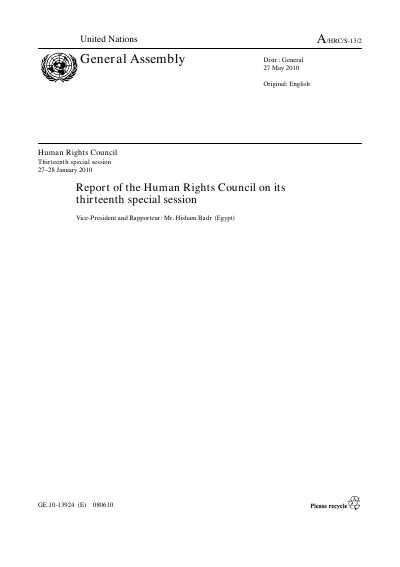
A/HRC/S-13/2: Rapò Konsèy Dwa Moun sou trèzyèm sesyon espesyal li, sou Ayiti apre tranblemanntè 12 janvye 2010 la
Rezime — Rapò trèzyèm sesyon espesyal Konsèy Dwa Moun, ki fèt 27 ak 28 janvye 2010 epi ki te konsakre a Ayiti de semenn apre tranblemanntè a. Li gen rezolisyon S-13/1 sou sipò Konsèy la bay pwosesis rekiperasyon an dapre yon apwòch ki baze sou dwa moun, ansanm ak òganizasyon travay la ak deklarasyon yo.
Dekouve Enpotan
- Konsèy Dwa Moun te fè trèzyèm sesyon espesyal li 27 ak 28 janvye 2010, de semenn apre tranblemanntè a, konsakre a Ayiti sèlman.
- Li adopte rezolisyon S-13/1, « Sipò Konsèy Dwa Moun bay pwosesis rekiperasyon an Ayiti apre tranblemanntè 12 janvye 2010 la: yon apwòch ki baze sou dwa moun ».
- Rapò a se rapò fòmèl sesyon an: rezolisyon an, òganizasyon travay la, patisipasyon, biwo a, deklarasyon yo ak desizyon sou pwojè tèks la.
- Mesye Hisham Badr (Ejip) te sèvi kòm Vis-Prezidan ak Rapòtè.
- Li pote yon kòt Asanble Jeneral, A/HRC/S-13/2, epi li rantre nan kòpis la bò kote enstriman Konsèy la sou menm semenn yo.
Teks Konple Dokiman an
Teks ki soti nan dokiman orijinal la pou endeksasyon.
A/HRC/S-13/2
United Nations
General Assembly
Distr.: General
27 May 2010
Original: English
Human Rights Council
Thirteenth special session
27–28 January 2010
Report of the Human Rights Council on its
thirteenth special session
Vice-President and Rapporteur: Mr. Hisham Badr (Egypt)
GE.10-13924 (E)
080610
A/HRC/S-13/2
Contents
Chapter
I.
II.
III.
Paragraphs
Page
Resolution adopted by the Council at its thirteenth special session ........................
3
S-13/1.
Support of the Human Rights Council for the recovery process in Haiti after the
earthquake of 12 January 2010: a human rights approach ......................................
3
Organization of work of the thirteenth special session ...........................................
1–26
6
A.
Opening and duration of the session...............................................................
6–7
6
B.
Attendance......................................................................................................
8
6
C.
Officers...........................................................................................................
9
7
D.
Organization of work......................................................................................
10–12
7
E.
Resolution and documentation .......................................................................
13–14
7
F.
Statements ......................................................................................................
15–22
7
G.
Action on the draft proposal ...........................................................................
23–26
8
Report of the Human Rights Council on its thirteenth special session ...................
27
10
List of documents issued for the thirteenth special session of the Council ......................................
11
Annex
2
GE.10-13924
A/HRC/S-13/2
I. Resolution adopted by the Council at its thirteenth special
session
S-13/1.
Support of the Human Rights Council for the recovery process in Haiti
after the earthquake of 12 January 2010: a human rights approach
The Human Rights Council,
Expressing its sincere condolences and deepest sympathy and solidarity for all
victims and their families, including all United Nations personnel, as well as for the
Government and the people of Haiti, affected by the devastating earthquake of 12 January
2010,
Reaffirming its previous outcomes on the situation of human rights in Haiti, in
particular the President’s statements, PRST/6/1 of 28 September 2007 and PRST/9/1 of 24
September 2008,
Concerned by the dire human and material losses and suffering sustained as a result
of the earthquake, and by its impact on the full enjoyment of all human rights in the
affected country,
Concerned also that the effects of the earthquake have further exacerbated existing
challenges to the full enjoyment of all human rights in Haiti, and expressing concern at the
medium- and long-term consequences of the disaster, including its social, economic and
development aspects,
Reiterating that the promotion and protection of all human rights — economic, civil,
social, political and cultural rights, including the right to development — are indispensable
elements for peace, stability and development,
Acknowledging the extraordinary situation in Haiti, particularly in Port au Prince,
Léogane and Jacmel, which requires an equally extraordinary response led by the
Government of Haiti, in collaboration with the international community,
Expressing its appreciation for the prompt response, solidarity and assistance
provided by the United Nations system, through United Nations agencies, programmes and
funds, and the United Nations Stabilization Mission in Haiti, as well as by States Members
of the United Nations, the international community, civil society, the private sector and
individuals,
Reiterating the need for the United Nations system to respond swiftly to the requests
for assistance from the affected country and to ensure that the assistance provided is timely,
adequate, effective and coherent and coordinated among all development actors, in
particular the Government of Haiti,
Underscoring the need for the long-term and sustainable support of the international
community for the Government of Haiti to promote respect for human rights, the rule of
law and good governance,
Recalling the primary responsibility and competence of the Government of Haiti
with regard to the promotion and protection of all human rights in the country,
GE.10-13924
3
A/HRC/S-13/2
Bearing in mind that the tragedy has obliterated the ongoing efforts of the
Government of Haiti to prepare the national report to be presented to the Council at the
eighth session of the Working Group on the Universal Periodic Review,
Mindful of General Assembly resolution 64/250 of 22 January 2010,
1.
Calls upon the international community to continue to ensure adequate and
coordinated support for the Government and the people of Haiti in their efforts to overcome
the challenges arising from the earthquake, keeping in mind the importance of integrating a
human rights approach;
2.
Reaffirms the sovereignty of Haiti and its territorial integrity, and stresses the
central role of the Government of Haiti in establishing national priorities for the recovery
process;
3.
Underscores the importance of a renewed and sustainable commitment to
address the existing and additional challenges to promote and protect all human rights in
Haiti, and encourages the Government of Haiti to continue its efforts to promote and protect
all human rights in the country;
4.
Expresses its concern about the present human rights situation in Haiti, in
particular the vulnerable situation of children, women, internally displaced persons, the
elderly, persons with disabilities and the wounded;
5.
Underlines the need to address the additional obstacles arising from the
devastation in such areas as access to food, adequate housing, health care, water and
sanitation, education, work and the civil registry;
6.
Emphasizes, in this context, the importance of reconstructing national
institutions and of providing cooperation, capacity-building and technical assistance to the
Government and the people of Haiti, in accordance with the needs and requests made by the
concerned country;
7.
Welcomes and further encourages the responses provided by the United
Nations system and the international community at large to assist the Government of Haiti
to promote and protect all human rights in Haiti in the aftermath of the earthquake, such as,
inter alia, those resources aimed at providing cash and food for work, as well as those
aimed at securing the full protection of the rights of all persons in vulnerable situations,
especially women and children;
8.
Underlines the importance of protecting children from any violence, injury or
abuse, maltreatment or exploitation, and of ensuring that separated or unaccompanied
children reunite with their families and that those left orphaned receive immediate attention
and necessary protection and, in this context, underscores the need for cooperation and
assistance to the Government of Haiti from all States Members of the United Nations and
relevant organs and bodies of the United Nations system, in particular, the United Nations
Children’s Fund;
9.
process;
Emphasizes the need to apply a gender-based approach to the recovery
10.
Decides to act favourably, in view of the exceptional circumstances that
confront it, upon the request of Haiti to postpone relevant deadlines related to its universal
periodic review before the Council to a date no later than December 2011;
11.
Welcomes the initiative to establish a joint protection team with the
participation of the United Nations High Commissioner for Human Rights;
4
GE.10-13924
A/HRC/S-13/2
12.
Invites the High Commissioner to identify, in collaboration with the
Government of Haiti, areas for cooperation and technical assistance with Haiti on the basis
of the expertise and the presence of the United Nations system on the ground, in particular
the Office of the High Commissioner, in collaboration with special procedures, with a view
to present suggestions in this regard to the Council at its fourteenth session.
3rd meeting
28 January 2010
Adopted without a vote.
GE.10-13924
5
A/HRC/S-13/2
II. Organization of work of the thirteenth special session
1.
Pursuant to paragraph 10 of General Assembly resolution 60/251, and in accordance
with rule 6 of the rules of procedure of the Human Rights Council as contained in the annex
to Council resolution 5/1, the Council “shall hold special sessions, when needed, at the
request of a member of the Council with the support of one third of the membership of the
Council”.
2.
In a note verbale dated 22 January 2010, addressed to the States Members of the
Council, the Permanent Mission of Brazil to the United Nations Office and other
international organizations in Geneva requested the convening of a special session of the
Council on 27 January 2010 to address the support of the Council for the recovery process
in Haiti after the earthquake of 12 January 2010: a human rights approach.
3.
The above-mentioned request was supported by 38 States Members of the Council:
Angola, Argentina, Bahrain, Bangladesh, Bolivia (Plurinational State of), Bosnia and
Herzegovina, Brazil, Burkina Faso, Chile, China, Cuba, Djibouti, Egypt, France, Gabon,
India, Italy, Japan, Jordan, Kyrgyzstan, Mexico, Nicaragua, Nigeria, Norway, Pakistan, the
Philippines, Qatar, the Republic of Korea, the Russian Federation, Saudi Arabia, Senegal,
Slovakia, Slovenia, South Africa, Ukraine, the United Kingdom of Great Britain and
Northern Ireland, the United States of America and Uruguay.
4.
In addition to the above-mentioned Member States, the request was also supported
by the following observers of the Council: Algeria, Australia, Austria, Bhutan, Cambodia,
Canada, Chad, Colombia, Costa Rica, the Dominican Republic, Ecuador, Guatemala, Haiti,
Iceland, Ireland, Israel, Kazakhstan, the Lao People’s Democratic Republic, the Libyan
Arab Jamahiriya, Luxembourg, Morocco, Palestine, Panama, Portugal, Serbia, Somalia,
Spain, Sri Lanka, Switzerland, the Syrian Arab Republic, Tunisia, Venezuela (Bolivarian
Republic of) and Viet Nam.
5.
As more than one third of the membership of the Council supported the abovementioned request, the President of the Council convened informative consultations on the
matter on 26 January 2010 and decided to convene a special session of the Council on 27
and 28 January 2010.
A.
Opening and duration of the session
6.
The Council held its thirteenth special session at the United Nations Office at
Geneva on 27 and 28 January 2010. It held three meetings during the session.
7.
B.
The thirteenth special session was opened by the President of the Council.
Attendance
8.
The special session was attended by representatives of States Members of the
Council, observer States of the Council, observers for non-Member States of the United
Nations and other observers, as well as observers for United Nations entities, specialized
agencies and related organizations, intergovernmental organizations and other entities,
national human rights institutions and non-governmental organizations.
6
GE.10-13924
A/HRC/S-13/2
C.
Officers
9.
At its first organizational meeting of the fourth cycle, on 19 June 2009, the Council
elected the following officers, who also served as officers for the thirteenth special session:
D.
President:
Alex Van Meeuwen (Belgium)
Vice-Presidents:
Andrej Logar (Slovenia)
Dyan T. Djani (Indonesia)
Carlos Portales (Chile)
Vice-President and Rapporteur:
Hisham Badr (Egypt)
Organization of work
10.
Pursuant to paragraph 124 of the annex to Council resolution 5/1, an open-ended
informative consultation was held on 26 January 2010 in preparation for the thirteenth
special session.
11.
At its 1st meeting, on 27 January 2010, the Council considered the organization of
its work, including speaking time limits, which would be three minutes for statements by
States Members of the Council and two minutes for statements by observers for nonMember States of the Council and other observers. The representatives of United Nations
agencies and experts who had been invited to participate in the session would each have up
to five minutes of speaking time. The list of speakers would be drawn up in chronological
order of registration. States Members of the Council would be given the floor first,
followed by observer States and observers for United Nations entities, specialized agencies
and related organizations, intergovernmental organizations and other entities, and observers
of national human rights institutions and non-governmental organizations.
12.
The special session was conducted in accordance with the relevant provisions
contained in Council resolution 5/1.
E.
Resolution and documentation
13.
The resolution adopted by the Council at its thirteenth special session is reproduced
in chapter I of the present report.
14.
The list of documents issued for the thirteenth special session is contained in the
annex to the present report.
F.
Statements
15.
At the 1st meeting, on 27 January 2010, the United Nations Deputy High
Commissioner for Human Rights made a statement on behalf of the High Commissioner.
16.
At the same meeting, the representative of Haiti made a statement as the concerned
country.
17.
Also at the same meeting, statements were made by the Minister for External
Relations of Brazil, Celso Amorim, and the Minister for Foreign Affairs of Bangladesh,
Dipu Moni.
18.
At the same meeting, statements were made by the independent expert on the
situation of human rights in Haiti, Michel Forst; the Representative of the SecretaryGeneral on the Human Rights of Internally Displaced Persons, Walter Kälin; a
GE.10-13924
7
A/HRC/S-13/2
representative of the Office for the Coordination of Humanitarian Affairs; and a
representative of the United Nations Children’s Fund.
19.
Also at the same meeting, statements were made by States Members of the Council:
Argentina, Bahrain, Bolivia (Plurinational State of), Chile, China, Colombia1 (on behalf of
the Group of Latin American and Caribbean States), Cuba, Egypt (on behalf of the NonAligned Movement), France, India, Indonesia, Italy, Japan, Mauritius, Mexico, the
Netherlands, Nicaragua, Nigeria (on behalf of the Group of African States), Norway,
Pakistan (on behalf of the Organization of the Islamic Conference), Qatar, the Russian
Federation, Saudi Arabia, Spain1 (on behalf of the European Union and Albania, Armenia,
Bosnia and Herzegovina, Croatia, Iceland, Montenegro, the Republic of Moldova, Serbia,
the former Yugoslav Republic of Macedonia, Turkey and Ukraine), and Uruguay.
20.
At the same meeting, Jamaica made a statement on behalf of the Caribbean
Community States represented in Geneva.
21.
At the 2nd meeting, on the same day, statements were made by the following:
(a)
States Members of the Council: Angola, Gabon, Ghana, Jordan, Kyrgyzstan,
Pakistan, Philippines, Republic of Korea, Senegal, South Africa, United Kingdom of Great
Britain and Northern Ireland, United States of America;
(b)
Observer States of the Council: Algeria, Armenia, Botswana, Colombia,
Costa Rica, Dominican Republic, Guatemala, Iceland, Iran (Islamic Republic of), Ireland,
Israel, Luxembourg, Malaysia, Morocco, New Zealand, Paraguay, Switzerland, Thailand,
Trinidad and Tobago, Turkey, Venezuela (Bolivarian Republic of).
22.
At the 3rd meeting, on 28 January 2010, statements were made by the following:
(a)
Observer States of the Council: Australia, Canada, Côte d’Ivoire, Ecuador, El
Salvador, Kuwait, Libyan Arab Jamahiriya, Nepal, Panama, Peru, Sri Lanka, Tunisia,
United Arab Emirates;
(b)
Observer for the Holy See;
(c)
Observer for the World Food Programme;
(d)
Observers for the following international organizations: African Union,
Organisation internationale de la Francophonie;
(e)
Observers for the following non-governmental organizations: Caritas
Internationalis (also on behalf of Dominicans for Justice and Peace-Order of Preachers,
Education and Development-VIDES, Franciscans International, the International Catholic
Child Bureau, the International Institute of Mary Our Help of the Salesians of Don Bosco,
the International Organization for the Right of Education and Freedom (OIDEL) and the
International Volunteerism Organization for Women), Centre on Housing Rights and
Evictions, CIVICUS-World Alliance for Citizen Participation, European Disability Forum,
Human Rights Watch, International Federation for Human Rights Leagues, International
Movement ATD Fourth World, International Save the Children Alliance, Nord-Sud XXI,
Women’s International League for Peace and Freedom.
G.
Action on the draft proposal
23.
At the 3rd meeting, on 28 January 2010, the representative of Brazil introduced draft
resolution A/HRC/S-13/L.1. The draft resolution was sponsored by Brazil and co1
8
Observer State speaking on behalf of States Members of the Council and observer States.
GE.10-13924
A/HRC/S-13/2
sponsored by Algeria, Angola, Argentina, Armenia, Austria, Bahrain, Bangladesh, Belarus,
Belgium, Bolivia (Plurinational State of), Bosnia and Herzegovina, Botswana, Bulgaria,
Burkina Faso, Chile, China, Colombia, Costa Rica, Croatia, Cuba, Cyprus, Djibouti,
Denmark, the Dominican Republic, Ecuador, Estonia, Finland, France, Gabon, Germany,
Ghana, Greece, Guatemala, Haiti, Hungary, Iceland, India, Ireland, Italy, Japan, Kenya,
Kuwait, Latvia, Lebanon, Lithuania, Luxembourg, Malta, Mexico, Morocco, Nicaragua,
Nigeria (on behalf of the Group of African States), Norway, Panama, Paraguay, Peru, the
Philippines, Poland, Portugal, Qatar, the Republic of Korea, Romania, the Russian
Federation, Saudi Arabia, Senegal, Slovakia, Slovenia, Somalia, Spain, the Syrian Arab
Republic, Trinidad and Tobago, Tunisia, Turkey, Ukraine, the United Kingdom of Great
Britain and Northern Ireland, Uruguay, Venezuela (Bolivarian Republic of), Viet Nam and
Zambia. Subsequently, Australia, Cameroon, Canada, Côte d’Ivoire, the Czech Republic,
Egypt, Iran (Islamic Republic of), Israel, Jamaica, Jordan, Kyrgyzstan, Liechtenstein,
Mozambique, the Netherlands, New Zealand, Pakistan, Serbia, South Africa, Sweden,
Switzerland, Thailand and the United States of America joined the sponsors.
24.
At the same meeting, the representative of Belgium, on behalf of the European
Union, made a statement in relation to the draft resolution.
25.
Also at the same meeting, the representative of Haiti made a statement as the
concerned country.
26.
At the same meeting, the draft resolution was adopted without a vote (for the text of
the resolution as adopted, see chapter I).
GE.10-13924
9
A/HRC/S-13/2
III. Report of the Human Rights Council on its thirteenth special
session
27.
At the 3rd meeting, on 28 January 2010, the report was adopted ad referendum and
the Rapporteur was entrusted with its finalization.
10
GE.10-13924
A/HRC/S-13/2
Annex
List of documents issued for the thirteenth special session of
the Council
Documents issued in the general series
A/HRC/S-13/1
Note verbale dated 22 January 2010 from the Permanent Mission
of Brazil to the United Nations Office and other International
Organizations in Geneva to Member States of the Human Rights
Council
A/HRC/S-13/2
Report of the Human Rights Council on its thirteenth special
session
Documents issued in the limited series
A/HRC/S-13/L.1
The support of the Human Rights Council to the Recovery Process
in Haiti after the Earthquake of January 12, 2010: a Human Rights
Approach
Documents issued in the non-governmental organizations series
GE.10-13924
A/HRC/S-13/NGO/1
Written statement submitted by Amnesty International, a nongovernmental organization in special consultative status
A/HRC/S-13/NGO/2
Joint written statement submitted by Caritas Internationalis
(International Confederation of Catholic Charities) and Franciscans
International, non-governmental organizations in general
consultative status, and International Catholic Child Bureau,
Dominicans for Justice and Peace [Order of Preachers], Istituto
Internazionale Maria Ausiliatrice delle Salesiane di Don Bosco,
International Volunteerism Organization of Women, Education and
Development-VIDES, International Organization for the Right to
Education and Freedom of Education (OIDEL), non-governmental
organizations in special consultative status
11
Kijan pou site
United Nations Human Rights Council, A/HRC/S-13/2: Rapò Konsèy Dwa Moun sou trèzyèm sesyon espesyal li, sou Ayiti apre tranblemanntè 12 janvye 2010 la, https://docs.un.org/en/A/HRC/S-13/2
- Moun oswa enstitisyon ki gen dwa yo
- United Nations Human Rights Council