Teks ki soti nan dokiman orijinal la pou endeksasyon.
United Nations S/2009/175
Security Council
Distr.: General
3 April 2009
Original: English
09-29034 (E) 150409
*0929034*
Report of the Security Council mission to Haiti
(11 to 14 March 2009)
I. Introduction
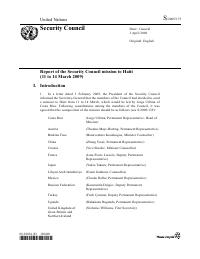
1. In a letter dated 3 February 2009, the President of the Security Council
informed the Secretary-General that the members of the Council had decided to send
a mission to Haiti from 11 to 14 March, which would be led by Jorge Urbina of
Costa Rica. Following consultations among the members of the Council, it was
agreed that the composition of the mission should be as follows (see S/2009/139):
Costa Rica (Jorge Urbina, Permanent Representative, Head of
Mission)
Austria (Thomas Mayr-Harting, Permanent Representative)
Burkina Faso (Bonaventure Koudougou, Minister Counsellor)
China (Zhang Yesui, Permanent Representative)
Croatia (Vice Skra čić, Minister Counsellor)
France (Jean-Pierre Lacroix, Deputy Permanent
Representative)
Japan (Yukio Takasu, Permanent Representative)
Libyan Arab Jamahiriya (Esam Ganbour, Counsellor)
Mexico (Claude Heller, Permanent Representative)
Russian Federation (Konstantin Dolgov, Deputy Permanent
Representative)
Turkey (Fazli Çorman, Deputy Permanent Representative)
Uganda (Ruhakana Rugunda, Permanent Representative)
United Kingdom of
Great Britain and
Northern Ireland
(Nicholas Williams, First Secretary)
S/2009/175
09-29034 2
United States of
America
(Susan Rice, Permanent Representative)
Viet Nam (Le Luong Minh, Permanent Representative)
2. The terms of reference of the mission, which were agreed on 20 February 2009
and its programme of work are contained in the annexes to the present report.
3. The mission constituted a clear demonstration of the commitment of the
Security Council to the stability of Haiti and an opportunity to call for immediate
responses and long-term solutions to the challenges facing Haiti. The challenges
include the following areas: security, political dialogue and elections, extension of
State authority, rule of law and human rights, humanitarian relief and socio-economic
development.
4. The mission left New York on 11 March and returned on 14 March. This was
the second visit of the Security Council to Haiti, the previous one having been in
2005. The mission met with the President of Haiti, René García Préval; Prime
Minister Michèle Duvivier Pierre-Louis and a number of her ministers; the
coordinator of the presidential commissions and the Chairman of the Presidential
Commission on the Constitution; the President of the Senate and the President of the
Chamber of Deputies; the President, the Treasurer and the Director-General of the
Provisional Electoral Council, the Minister of Justice and Public Security, the
Secretaries of State for Public Security and Justice and the Director-General of the
Haitian National Police; leaders of the political parties; and representatives of the
private sector and civil society. The mission also met with senior officials of the
United Nations Stabilization Mission in Haiti (MINUSTAH); the United Nations
country team; and members of the Core Group established by the Security Council
pursuant to resolution 1542 (2004). The mission attended the inauguration of the
School for Magistrates, visited the Cité Soleil area of Port-au-Prince, Fort Liberté,
the town of Ouanaminthe, on the border with the Dominican Republic, and the city
of Gonaïves. The mission also visited various MINUSTAH military and police
installations, including the military base at Camp Charlie, the maritime base in Fort
Liberté and the Chinese formed police unit in Cité Soleil.
5. The mission expressed its gratitude for the hospitality and openness of the
Haitian authorities. It was also grateful to the Permanent Representative of Haiti,
Léo Mérorès, for having accompanied the mission and for his contribution to its
success. The mission recognized the impeccable organization and close coordination
in preparation for the visit carried out by the Secretariat, especially the Department
of Peacekeeping Operations, the Special Representative of the Secretary-General,
Hédi Annabi, MINUSTAH and the United Nations country team. The mission also
expressed its gratitude to the United Nations Department of Safety and Security for
its professionalism in safeguarding the mission.
II. Key issues
Overall security situation
6. The mission found that significant progress has been made on the security
front due to the role played by MINUSTAH and the gradual strengthening of the
S/2009/175
3 09-29034
Haitian National Police. The Security Council found solid progress in establishing a
healthy police/population ratio of 1.366 police officers per 1,000 inhabitants. The
original number of Haitian National Police serving at the time of the deployment of
MINUSTAH, 3,000 members, has now tripled. In addition, recruitment and vetting
are being carried out successfully. MINUSTAH has made a decisive contribution,
together with the Haitian National Police, to the dismantling of armed gangs
responsible for much of the violence in the country. This has led to a significant
decline in criminal activities, in particular kidnappings, which had previously
undermined public confidence.
7. Several developments have affected the overall security situation, which
remains fragile in Haiti. The country has suffered serious setbacks due to the
combined effects of the food crisis, the global financial and economic crisis and the
devastating impact of the 2008 hurricane season, which has had an adverse effect on
the socio-economic situation, undermining the sustainability of security in Haiti.
Persistent poverty and youth unemployment in urban areas have created an
environment that is vulnerable to civil unrest and, possibly, renewed gang activity.
Instances of civil unrest involving violence have increased since December 2008,
with 64 demonstrations reported in February 2009, two thirds of which were
motivated by socio-economic concerns. In addition, the upcoming elections for the
renewal of one third of the Senate, the first round of which is slated for 19 April
2009, could provide a context for tension and potential protest.
8. The mission heard expressions of serious concern about the impact of drug
trafficking, which was described as one of the most destabilizing factors facing the
country currently, and its corruptive influence in Haiti. In this regard, members of
the Council fully agreed with the view expressed by several key Haitian and
international interlocutors that if serious steps are not taken to address the problem
of drug trafficking, the country’s stability will continue to be threatened.
9. The lack of capacity of the Haitian State to control its land and maritime
borders, which contributes to the ongoing illegal activity, was found to be a major
cause for concern. In this regard, the mission welcomed the start of maritime
patrolling by MINUSTAH military and police and the Haitian National Police using
the MINUSTAH patrol boats located at Port Salut, Killick and Fort Liberté, as well
as joint integrated border patrol operations, drawing on land, air and maritime
capabilities. The members of the Council recognized, however, that those activities
would need to be complemented through bilateral initiatives and cooperation,
particularly from countries in the region, since MINUSTAH has neither the mandate
nor the capability to effectively conduct interdiction operations, and Haitian
capability to assume these responsibilities has yet to be developed.
10. The mission was of the view that the continued presence of MINUSTAH
troops and police remains critical to the maintenance of a secure and stable
environment, pending further progress in developing the capacity of Haitian
authorities to maintain security and public order without external assistance.
Thought and major efforts will need to be given to a progressive transfer of
responsibility to the Haitian authorities during the process. The mission also took
note of the view expressed by several Haitian and international interlocutors that it
would be ill-advised for MINUSTAH to withdraw its forces from Haiti too soon,
that is, not until it became clear that Haiti was in a position to deal with the array of
security threats facing the country. The importance of the long-term training and
S/2009/175
09-29034 4
professionalization of the Haitian National Police in order to develop Haiti’s ability
to provide for its own security was also stressed by Haitian and international
interlocutors alike.
11. The acknowledgement that the Haitian National Police alone cannot be
expected to fight the illegal arms trade and drug trafficking has prompted calls in
some quarters for the Haitian National Police to be supplemented by a security force
capable of assuming the full range of tasks currently being conducted by the Haitian
National Police supported by MINUSTAH. In that regard, the Presidential
Commission to reflect on the strengthening of security is expected to issue its report
with recommendations on the issue in the near future.
12. A number of interlocutors expressed concern that weapons continue to
circulate in Haiti. In that regard, the mission found that the MINUSTAH community
violence reduction programme continues to play a valuable role in providing advice
to the national commission on disarmament, dismantlement and reinsertion,
focusing on key areas of the country affected by violence. The programme’s labour-
intensive projects, which aim to discourage participation in gangs and to rehabilitate
former gang members, are also critical to improving the overall security
environment.
Political dialogue and elections
13. The mission found it encouraging that the political climate had improved
considerably following the establishment of an elected Government in 2006. In that
regard, several political actors, including leaders of the opposition, acknowledged
that during President Préval’s term in office the press has enjoyed unprecedented
freedom and that members of the opposition have been free to express their opinion
without fear of persecution.
14. Despite those positive developments, the stability of Haiti’s fledgling
democratic institutions continues to be undermined by deep divisions within Haitian
society and ongoing political tensions between contending factions. The mission
was particularly concerned by the fact that despite signs of a renewed spirit of
cooperation prompted by the devastation wrought by last year’s storms and
hurricanes, relations between the executive branch and the Parliament remain
fraught, as demonstrated by continued Parliamentary summons of Government
ministers, the inability to reach agreement so far on the budget for the period 2008-
2009 and the modest progress to date on implementing the joint legislative agenda
adopted in December 2008.
15. The President and magistrates of the Provisional Electoral Council told
members of the Council that eight electoral processes will be spread out over the
next 36 months. The mission also received information on logistical support
provided by MINUSTAH to the Provisional Electoral Council and on the security
assistance provided.
16. The onset of elections for the renewal of one third of the Senate, the first
round of which is scheduled to take place next 19 April, has created further political
uncertainty. The decision taken by the Provisional Electoral Council not to accept
any of the candidates put forward by contending factions of Fanmi Lavalas, the
party of former President Jean Bertrand Aristide, has raised questions about the
S/2009/175
5 09-29034
inclusiveness of the upcoming senatorial elections. The mission was encouraged by
the commitment of Fanmi Lavalas leaders to use only legal means at their disposal
to seek a reversal of the Provisional Electoral Council decision. Some political and
civil society representatives stressed the potential for renewed social unrest. The
mission emphasized to the Provisional Electoral Council that everything possible
must be done to deal with the perception of exclusion that could be felt in sectors of
the population because of the non-participation of an important political group. The
current situation has further highlighted the need to review the electoral system and
strengthen political parties.
17. The mission was informed that several political parties have decided to opt out
of the elections due, in part, to their own financial difficulties and a lack of
confidence in the ability of the Provisional Electoral Council to organize the
elections on time. The Provisional Electoral Council reassured the mission of its
commitment to ensure that free, fair and inclusive elections be held on time.
However, a number of interlocutors expressed doubts whether other elections
scheduled in 2009 for the second third of the Senate, the entire Chamber of Deputies
and local authorities, all of which are scheduled to take place in 2009, would be held
on time.
18. The mission also found encouraging signs of a genuine willingness on the part
of the Government of Haiti, Parliament, political parties, the private sector and civil
society to engage in a constructive dialogue on issues of critical importance to the
future of the country. The recent establishment by President Préval of commissions
on education, competitiveness, information technology, the security forces and
constitutional reform, involving a broad range of stakeholders from across the
political and social spectrum, constitutes a positive step towards fostering dialogue
and consensus. However, it is vital for those commissions to produce concrete
results in order to restore public confidence in the political process.
19. The issue of constitutional reform was discussed with a wide range of
interlocutors. In that regard, there appears to be a broad recognition among Haiti’s
leadership and political class that amending certain provisions of the 1987
constitution would be required to improve the functioning of Haiti’s democratic
institutions. However, the means by which the process of amendment should be
pursued continues to be the subject of debate. A number of interlocutors expressed
concern that the electoral calendar places an excessive financial burden and political
stress on an already fragile system. Haiti’s onerous administrative structure,
restrictions on dual nationality and the balance of powers between the executive and
legislative branches of Government were also identified as key areas requiring
reform.
20. The mission was aware of the tight schedule for constitutional amendments
and acknowledged the importance of reforming the Constitution to bring about
better governance in the country. In that regard, the mission passed on a message to
be pondered by Haitian political leaders on the need to achieve the necessary
consensuses for the appropriate constitutional reform process. In the meeting with
the Chairman of the Presidential Commission on the Constitution, the mission also
expressed the need to enhance coordination between the executive branch,
Parliament and civil society in order to avoid splits and political paralysis that could
hamper the reform process in the country.
S/2009/175
09-29034 6
21. The Presidential Commission on the Constitution is expected to issue its report
in June, with the goal of allowing the legislature time to approve amendments to the
Constitution before the end of its session in September. A parliamentary commission
on constitutional reform has also been established. If approved, those amendments
would need to be ratified by the next legislature and would only enter into effect
once a new President takes office in 2011. Some politicians and constitutional
experts believe that it will be difficult to keep those deadlines, in particular since the
amendment process is contingent upon the fulfilment of the upcoming electoral
calendar. It should be noted that the renewal of one third of the Senate in the April
and June elections is crucial so that the Senate may vote on constitutional reform,
since the Senate is currently operating with a reduced membership that would not
allow the two-thirds majority necessary to approve amendments. In that regard, the
Senate has not changed its internal rules of procedure to allow a two-thirds majority
of the current 18 acting senators.
Extension of State authority
22. The development of legitimate and accountable institutions of Government
remains critical to the consolidation of stability in Haiti. Despite MINUSTAH
efforts, in collaboration with key partners, to enhance Haitian institutional capacity,
both the central Government and local administration continue to suffer from
limited capacity to deliver basic services. Health and education are among the areas
where the State’s capacity to deliver basic services is weakest, as demonstrated by
the tragic collapse of the La Promesse Evangelique school in Pétionville near Port-
au-Prince, which led to over 100 deaths, many of them children, protracted disputes
over payment of salaries to teachers and acrimonious labour actions that have
paralysed some hospitals in the capital. The mission noted with concern that the
State can provide education to only 10 per cent of registered students, which
represents a low percentage of persons of school age, while in addition, the State
controls neither the content nor the quality of private education. A number of
interlocutors also stressed the need to clarify the legal and practical arrangements
for decentralization, which could enhance the ability of local administrations to
provide services.
23. President Préval and Prime Minister Pierre-Louis, as well as political leaders,
members of the private sector and civil society, emphasized the need for a
coordinated effort to enhance governance and administrative capacity at all levels.
In that regard, further bilateral efforts will be required to supplement the assistance
being provided by MINUSTAH within the framework of a Government plan.
24. The mission was encouraged to learn that following an upgrading of the
customs data system, an intensification of road patrolling and the opening of new
checkpoints, there has been significant increase in the collection of revenue by
customs, which constitutes one third of the State’s fiscal resources. The mission was
also encouraged by the efforts of the Government of Haiti, with assistance from
MINUSTAH, the international financial institutions and donors, to prepare and
update a number of key policy texts related to border management, including an
integrated border management plan, the Haitian Customs Code and the Law on the
National Council of Integrated Border Management.
S/2009/175
7 09-29034
25. The visit by the mission to Ouanaminthe, on the north-eastern border with the
Dominican Republic, provided a stark illustration of the daunting challenges facing
the Haitian authorities in the area of border management. The members of the
Council noted the permeability of, and free movement in, the border area and noted
that little progress has been made on infrastructure. In that regard, the local
authorities drew the mission’s attention to the fact that despite the support received
from MINUSTAH, they lacked the infrastructure and equipment to effectively
manage the border with the Dominican Republic and emphasized the need to
increase the Haitian National Police presence in the area, which currently stands at
only 22 officers, bearing in mind the constraints posed by the lack of infrastructure.
26. The mission visited the MINUSTAH naval base in Fort Liberté established in
December 2008 as part of its border management programme. The mission was
briefed on the operational plan for maritime daily and night patrols together with
MINUSTAH and the Haitian National Police. The patrols are conducted with the
active participation of one Uruguayan battalion officer and eight crew members, one
United Nations police and one Haitian National Police officer, per patrols of two
boats at a time. The mission observed that the naval joint team at Fort Liberté also
takes part in a weekly coordinated border patrol by land, sea and air. The mission
was also informed that the Government of Haiti is working to make operational the
Custom Office in Fort Liberté recently rehabilitated by MINUSTAH.
Rule of law and human rights
27. Enhancement of the Haitian National Police capability remains a key
prerequisite to enable Haiti to respond to threats to its own stability without external
support. All the mission interlocutors recognized that important steps have been
taken towards the professionalization of Haitian National Police officers, the
enhancement of the Haitian National Police institutional capacity and the
development of key infrastructure. The mission was particularly encouraged by the
fact that support provided to the Haitian National Police by MINUSTAH in
collaboration with United Nations agencies and key bilateral partners, has boosted
public confidence in the Haitian National Police, as demonstrated in a recent public
opinion poll, which showed that in 2008, 58 per cent of Haitians considered that
there had been a positive change in the Haitian National Police. The fact that the
nationwide recruitment process for the twenty-second promotion, which was
launched in September 2008, has generated more than 30,000 applications is further
proof of the growing stature of the Haitian National Police in the eyes of the Haitian
population.
28. The mission was also encouraged to find that following major delays in the
recruitment of Haitian National Police cadets in 2008, efforts to train 14,000 active
duty officers by 2011, as provided for in the Haitian National Police reform plan,
appear to be back on target. In that regard, the members of the mission were
informed that the twentieth promotion of the basic Haitian National Police training
programme, comprising 702 cadets (86 of whom are female), graduated in February
2009, bringing the total number of active Haitian National Police officers to 9,247.
The twenty-first promotion, which comprises a further 483 cadets (104 of whom are
female), began training on 31 December 2008 and is scheduled to graduate in the
second half of 2009. It is essential that the Haitian authorities continue to prioritize
S/2009/175
09-29034 8
the recruitment process if the targets identified in the Haitian National Police reform
plan are to be met within the envisaged time frame.
29. The mission shared the view expressed by several interlocutors that despite the
progress made over the past five years, the Haitian National Police still lacks the
capacity to address the array of threats to Haiti’s stability, including organized crime
and drug trafficking, which are among the main threats to Haiti’s governance,
stability and development. In particular, the Haitian National Police presence along
Haiti’s land and maritime borders remains minimal, although the mission was
informed by the Haitian authorities that plans are in place for the strengthening of
the Haitian coast guard.
30. In addition to the valuable support being provided by MINUSTAH and other
key partners, the Haitian National Police will require the concerted assistance of
actors in the region with the resources and expertise needed to make an impact. In
that regard, the establishment of a working group for Latin American coordination
and cooperation with the Haitian National Police and the work of the
2x9 Consultative Group, constitute a tangible expression of the continued
commitment of Haiti’s Latin American partners to the country’s long-term
stabilization, drawing on their own successful experience in the field of police
training and reform. In the light of the politicization that the Haitian National Police
has experienced in the past after previous international training efforts, key political
actors in Haiti underscored the need for continued and long-term international
assistance to the Haitian National Police.
31. The sustainability of Haiti’s stability will also depend on the strengthening of
the other pillars of the rule-of-law system. The mission found that limited progress
has been made towards the achievement of the objectives identified in the national
plan for justice reform, including implementation of the three fundamental laws on
the independence of the judiciary. In that regard, the inauguration of the School for
Magistrates, which was held on 12 March in the presence of the mission, constituted
an important step towards the development of a professional and independent
judiciary. Nevertheless, the mission noted that further efforts are required to
implement the national plan for justice reform, including the establishment of the
Superior Council for the Judiciary, which will ultimately play a key role in
promoting the professional ethics and performance of the judiciary.
32. The situation within Haiti’s prisons, which has received comparatively little
attention from bilateral donors, remains a major cause for concern. Extreme
overcrowding in inadequate prison facilities is compounded by very high numbers
of prisoners in preventive detention. More than 87 per cent of the detainees in the
national penitentiary in Port-au-Prince are held in pre-trial detention, as are more
than 78 per cent of detainees nationwide. While there has been some progress
towards enhancing corrections capacity, drawing on bilateral support, the prison
population has continued to expand, and the facilities by the authorities’ own
estimation are not adapted to democratic norms and to the goal of rehabilitating
prisoners. The mission found that a comprehensive approach is required, namely,
one that is aimed at improving the functioning of the entire penal chain, including a
reduction in the numbers of preventive, pre-trial detentions and an improvement in
prison facilities.
33. The Haitian authorities emphasized their commitment to respecting civil and
political rights in the country, in particular freedom of expression. The mission
S/2009/175
9 09-29034
expressed concern at the limitations on economic, social and cultural rights in Haiti,
a state of affairs that has been aggravated by the humanitarian situation caused by
natural phenomena in 2008, the world food crisis and the deterioration of the
international economy.
Humanitarian situation
34. The international response to the series of storms and hurricanes that
devastated Haiti in 2008, while laudable, has been insufficient to meet the country’s
urgent humanitarian needs. The 2008 hurricanes contributed to damages worth
15 per cent of Haiti’s gross domestic product (GDP) at a time when the Government
is facing a 47 per cent decline in budget support. The $127 million flash appeal for
immediate humanitarian assistance has only received about half of the funds
requested. Given the imminent start of the rainy season in early April, the mission
found that there is an urgent requirement to meet outstanding humanitarian needs.
35. Haiti is exceedingly vulnerable to external shocks, in particular extreme
weather conditions during the yearly hurricane season. The level of vulnerability is
such that even moderate rainfall can have a major humanitarian impact. Council
members were able to see first-hand the aftermath of flooding caused by the 2008
hurricanes in the city of Gonaïves. Large portions of the city, with a population of
more than 1.5 million people, were covered in more than 1,800,000 cubic metres of
mud. In all, 250,000 persons were affected, including a toll of 466 dead in the floods
and 235 missing.
36. Because of the danger of flooding and mudslides due to environmental
degradation, watershed management and disaster risk reduction are a priority in
Haiti. Council members visited a labour-intensive project in Gonaïves aimed at
reducing environmental vulnerability through terracing, the construction of small
dikes, reshaping of riverbeds and rehabilitating canals. The project, established by
the International Labour Organization, the United Nations Development Programme
and the World Food Programme, has contributed to the creation of 21,000 temporary
jobs and provided 1,260,000 food rations. Such watershed management projects are
key to preventing further environmental degradation and humanitarian disasters,
while at the same time helping to repair rundown irrigation systems.
37. Food security continues to be a major concern in the country. Three million
people are moderately or extremely food insecure, representing nearly a third of the
country’s population. There are also isolated pockets of chronic malnutrition
affecting 210,000 persons throughout the country. The mission learned about the
difficult situation facing Haiti’s agricultural sector and received information
regarding the scope for its improvement. With more than 60 per cent of the
population engaged in farming and livestock activities, Haiti is only able to provide
45 per cent of its food needs. Landholdings are currently small and underproductive,
primarily due to reliance on low-yielding seed stocks, scant use of fertilizers,
inadequate irrigation and low levels of mechanization. In addition, because of the
country’s deforestation and vulnerability to weather conditions, productive soil
often is degraded. The mission encouraged the Haitian authorities to adopt
agricultural policies designed to boost production. Additionally, they urged the
Government of Haiti to display its commitment to establish goals that can be
attained in reasonable time frames in order to contribute to the stability of the
S/2009/175
09-29034 10
country. With the right choices and policies, agricultural production could be
substantially increased on lands already being cultivated and also expanded to new
productive lands, thereby helping increase Haiti’s food security.
Social and economic development
38. The socio-economic context has deteriorated significantly in the past year,
threatening to undermine the gains made in other areas. Haiti is ranked 146th out of
147 countries listed in the Human Development Index. Seventy-eight per cent of the
population lives on less than $2 a day, while 54 per cent of the population must
survive on less than $1 a day. It was evident to the mission that the current levels of
extreme poverty are clearly incompatible with Haiti’s long-term stability. Haitian
interlocutors emphasized the importance of continuing to work with the
international community to implement a strategy for Haiti’s reconstruction and
development.
39. As President Préval himself pointed out to the mission, impressive strides
towards the achievement of macroeconomic stability were made between 2004 and
2007. Inflation was brought down from over 40 per cent to less than 10 per cent.
During the same period, Haiti’s GDP grew from -3.4 per cent in 2003 to 3.4 per cent
in 2007, exceeding population growth for the first time in several years.
40. The combined impact of the global food and fuel crisis, the series of tropical
storms and hurricanes and the global economic downturn, however, have gravely
undermined the progress achieved in these key areas. According to the post-disaster
needs assessment conducted with the assistance of the World Bank, the European
Union and the United Nations, the 2008 storms and hurricanes resulted in some
$900 million worth of damage, the equivalent of 14.6 per cent of Haiti’s GDP.
Official estimates indicate that in 2008 GDP growth slowed to 1.3 per cent and
became negative in per capita terms after three consecutive years of positive growth.
The global financial crisis is likely to bring a further deterioration in the living
conditions of many Haitians during the coming year by reducing the scale of
remittances from abroad, which, at a scale of $1.4 billion yearly, represent a key
source of desperately needed support for many families.
41. The mission recognized the urgent need for physical security to be
accompanied by social and economic security if Haiti is to remain on the path to
lasting stability and development. In this regard, the mission took note of the fact
that the efforts of the Government to meet the country’s immediate recovery and
reconstruction needs are currently hampered by a $125 million financing gap for the
current fiscal year, although Haiti is scheduled to receive some $1.1 billion worth of
debt relief in June 2009. Noting that there had been a marked reduction in direct
budgetary to support Haiti, President Préval expressed the hope that the Government
would receive the needed $125 million at the upcoming high-level donor conference
to be convened by the Inter-American Development Bank in Washington, D.C., as
well as funding for a number of specific infrastructure projects, including the
completion of National Highway 1, the road from Nippes to the coast and the road
to Port-de-Paix. The donor conference was viewed as a major opportunity for Haiti
to obtain additional funds for its recovery and reconstruction.
42. The need for the Government to take the lead in forging a broad national
consensus around a focused plan to promote development, job creation, food
S/2009/175
11 09-29034
security and reverse environmental damage was stressed to the mission repeatedly
by Haitian and international interlocutors alike. In this regard, the mission found
that there was strong support within the Government, the private sector, the political
class and civil society for the report of Paul Collier entitled, “Haiti: from natural
catastrophe to economic security”, which sets out key elements for a practical
agenda for the country’s rapid economic transformation, including harnessing the
opportunities for rapid job growth in the textile manufacturing industry afforded by
the Haitian Hemispheric Opportunity through Partnership Encouragement II Act
(HOPE II Act), which provides Haiti with duty-free access to the United States of
America for the next 10 years.
43. Regarding current efforts to promote job creation, the mission was pleased to
learn from the Prime Minister that a number of important steps are already being
taken by the Government, with the support of key international partners to remove
the main obstacles to private investment. These include the establishment of an
inter-ministerial committee on land management, the drafting of a law on
co-ownership and efforts to identify State-owned land that could be made available
for the establishment of export zones. In that regard, during its trip to Ouanaminthe,
the mission was able to visit one of the two existing export zones in country, which
currently employs some 3,000 workers with plans for further expansion in 2009.
44. The mission was also encouraged by the private sector’s apparent willingness
to work with the Government and the international community to create jobs. At the
same time, several business leaders underscored the urgent need to improve the
business climate and attract foreign direct investment, which remains critical to
Haiti’s long-term economic growth and development. Considerable emphasis was
placed by the business community on the need to address Haiti’s poor image abroad
and portray the country in a more favourable light, given the marked improvement
in the overall security situation. In that regard, it was recalled that rates of violent
crime were actually worse in other countries in the Caribbean region. The mission
was also informed that the Presidential Commission on competitiveness is in the
process of developing a national plan on competitiveness as well as a number of
specific recommendations to the Government in preparation for the upcoming high-
level donor conference.
45. Despite these encouraging signs of an emerging consensus on the urgent need
to create jobs through a combination of public and private investment, boost
agricultural productivity and address the catastrophic state of Haiti’s environment,
the mission noted that the Government had yet to produce a focused action plan
outlining the country’s development priorities in the short, medium and long term.
The mission was informed that the Government had begun work on a document for
the upcoming donor conference, drawing on the country’s poverty reduction strategy
paper, the post-disaster needs assessment and the report of Mr. Collier, although
further efforts would be required to develop a prioritized blueprint for the country’s
lasting economic recovery, which could serve as the basis for a renewed partnership
between Haiti and the international community.
46. The mission noted that the contribution of the diaspora to Haiti’s development,
which is contingent on pending reforms to the Constitution to allow dual
citizenship, must also be reviewed.
S/2009/175
09-29034 12
Regional cooperation
47. The mission had the opportunity to meet with members of the Core Group and
was able to note the decisive role it continues to play in ensuring close coordination
between MINUSTAH and the donor and diplomatic communities to enhance the
effectiveness of the international community response.
48. The mission recognized the commitment of Latin American countries to assist
Haiti in its stabilization, socio-economic growth and regional integration. It is the
first time that the region has become fully involved in peacekeeping in Haiti through
its contribution of troops and police, and bilateral and multilateral support. In
addition, Latin American countries are increasing their participation in police
training, drawing on the successful experiences of the region in this domain.
49. The issue of South-South cooperation was raised repeatedly throughout the
mission as an area of increasing interest for Haitian authorities. Major Latin
American troop contributors to MINUSTAH were particularly involved in specific
development projects, with Argentina providing assistance in the field of
agriculture, Brazil in the construction of hydroelectric plants and Chile in
supporting the education sector. The mission also was able to visit a new heavy-fuel
electric power plant in the city of Gonaïves constructed by Venezuela (Bolivarian
Republic of) and operated by technicians from Cuba.
50. The mission was also encouraged by the signs of improved cooperation
between Haiti and the Dominican Republic. During February, President Préval
signed a decree reactivating the Haitian delegation to the Joint Haitian-Dominican
Republic Border Commission. This body was scheduled to meet at the border on
24 March to discuss its future programme of work.
51. The mission noted that the continued engagement of regional and subregional
organizations, such as the Organization of American States and the Caribbean
Community, is important to ensure Haiti’s integration into the broader Latin
American and Caribbean context and to deepen the engagement of its hemispheric
partners.
52. The Haitian authorities stressed the importance of the cooperation received
from the countries of other regional groups and the members of the mission
emphasized the value of extending it.
III. Observations
Overall security situation
53. Since the deployment of MINUSTAH, there has been an improvement in the
overall security situation, as demonstrated by declining crime rates and the public’s
growing confidence in the Haitian National Police (HNP). However, the gains made
on the security front remain fragile due in large part to the poor quality of the living
conditions of the majority of the population and underlying political tensions.
Physical security must therefore be accompanied by social and economic security if
Haiti is to achieve lasting stability. Drug trafficking continues to be a major threat to
security. Haiti cannot be left alone to tackle this problem and requires the support of
other countries in the region.
S/2009/175
13 09-29034
Political dialogue and elections
54. Haiti cannot afford another political crisis. The Government and Parliament
must cooperate with one another to lay the foundations for Haiti’s long-term
stability and development. The process of constitutional reform should lead to a
proposal that ensures the functioning of institutions and the fostering of social and
economic development. At the same time, it is vital that the Government continue to
work with political parties, the private sector and civil society to forge a broad
consensus on issues of major importance to the country’s stability and development.
Electoral reform is necessary in order to simplify the electoral system. In turn this
would help reduce the financial burden on the Government budget and enhance the
country’s stability. Every effort should be made to ensure that the electoral process
be free, fair and inclusive.
Extension of State authority
55. The control of land and maritime borders in Haiti and the provision of basic
services to the population by the Haitian authorities are the two basic aspects for
strengthening the extension of State authority. Finding solutions to the common
problems of integrated border management and border security, understood broadly
as a regional issue, represent a task in which the international community must
assist Haiti in solving common problems. Regarding the delivery of basic services,
the Government of Haiti is conditioned by its own development; the capacity of a
State is fragile when there is not a strong economy present. The Government of
Haiti should take full advantage of the international support to build its capacity to
deliver the services that its people require.
Rule of law and human rights
56. Progress has been made towards the professionalization of the Haitian
National Police, the strengthening of its institutional capacity and the development
of infrastructure, with a view to achieving the goals set out in the national Haitian
National Police reform plan. The ambitious programme requires the support and
cooperation of the international community.
57. The existence of efficient and credible judicial institutions is a prerequisite for
strengthening the rule of law in Haiti. There have been some important steps but
there are institutional challenges to be tackled. The limited capacity of the judiciary
to administer justice quickly has led to a sharp rise in the prison population, which
continues to live in overcrowded conditions and whose fundamental rights are being
violated. The Government of Haiti must execute the strategic plan for the expansion
of the country’s penitentiary system and the review of the current situation of
prisoners in preventive detention.
Humanitarian situation
58. Haiti is particularly vulnerable when it comes to hurricanes and tropical storms
from the Atlantic Ocean. Progress has been made in the area of disaster prevention
and risk reduction through ongoing efforts to regulate water basins and the
S/2009/175
09-29034 14
implementation of labour-intensive projects aimed at reducing vulnerability by
terracing, constructing small dikes, reconfiguring watercourses and renovating
canals. It continues to be essential that the Haitian authorities work closely with the
international community to facilitate the flow of necessary assistance to relief,
recovery and longer-term reconstruction and development efforts.
59. Food security is still one of the greatest concerns in the country. The
difficulties faced by the farming sector in Haiti were illustrated by figures that
indicated the low productivity in the sector, which employs more than 50 per cent of
the population. In that regard, the adoption of agricultural policies designed to boost
productivity is imperative. Additional funding is required to meet the significant
humanitarian needs that still exist in Haiti.
Social and economic development
60. Haiti suffered a number of severe setbacks in 2008. While the country faces
daunting challenges, there is every reason to be optimistic that Haiti, with the
support of its international partners, can recover from the setbacks of the past year.
Haiti urgently requires additional international assistance to meet its immediate
humanitarian, early recovery and reconstruction needs. The upcoming high-level
donor conference in Washington, D.C., will be critical in that regard.
61. At the same time, the donor conference should be seen as an opportunity to
forge a renewed partnership between Haiti and the international community, based
on a mutual commitment to create jobs, enhance food security, foster economic
development, improve the delivery of basic services and restore the environment.
Aid alone will be insufficient to place Haiti on the path to economic security. The
Government should therefore continue working with the private sector, political
parties and civil society to put in place the legislative and regulatory frameworks
required to promote private investment and take advantage of the opportunities for
rapid job creation provided by the HOPE II Act and other preferential trade
agreements. The international community has a clear stake in Haiti’s success and
will continue to accompany the process of political, economic and social
development. While the international community is willing to play a supporting
role, the primary responsibility rests first and foremost with the Haitians
themselves.
Regional cooperation
62. The Latin America and Caribbean region plays an important role in helping
Haiti insert itself fully within its broader regional context. It should be commended
for its commitment to support Haiti on its path towards greater security and
development.
United Nations role
63. Given the further progress needed before the Haitian National Police is in a
position to fully assume its responsibilities, the continued presence of MINUSTAH
currently remains essential. The eventual drawdown of MINUSTAH troops and
S/2009/175
15 09-29034
police will need to take place gradually to reflect the progressive strengthening of
Haitian institutional capacity and the changing circumstances on the ground. It is
also important to strengthen the capacity of the Haitian authorities to ensure
socio-economic stability and development for the future of the country and to
consider the role of the United Nations in this regard. While the support provided by
the United Nations remains critical, the long-term engagement of other bilateral and
multilateral partners, including regional organizations, private foundations and
non-traditional donors, will be required to ensure that Haiti remains on the path to
stability and sustainable development.
S/2009/175
09-29034 16
Annex I
Terms of reference for the Se curity Council mission to Haiti
The terms of reference are to:
(a) Reaffirm the continued support of the Security Council for the
Government and people of Haiti to rebuild their country, consolidate peace and
stability and promote recovery and sustainable development, bearing in mind the
significant setbacks that occurred in 2008;
(b) Express strong support for the United Nations Stabilization Mission in
Haiti (MINUSTAH) and the Special Representative of the Secretary-General and
their efforts to improve stability and governance in Haiti;
(c) Reiterate the importance of immediate, medium- and long-term sustained
efforts and appropriate international and regional support to consolidate peace,
stability and development in Haiti, while bearing in mind the ownership and primary
responsibility of the Government and people of Haiti;
(d) Assess the status of implementation of relevant Security Council
resolutions, in particular resolution 1840 (2008), and to review the progress made by
the Government of Haiti, with the assistance of the international community, in
particular MINUSTAH, in addressing the interconnected challenges in the areas of
security, including security sector reform; border management; institutional support
and governance, including elections and reform processes; rule of law; human
rights; and economic and social development;
(e) Urge the Government of Haiti to intensify its efforts to promote an
effective and all-inclusive political dialogue aimed at national reconciliation, good
governance and sustainable development;
(f) Review and assess the engagement of the Government of Haiti and the
cooperation of Member States, including neighbouring and regional States, in
coordination with MINUSTAH, to address cross-border illicit trafficking of persons,
drugs, arms and other illegal activities;
(g) Review the progress achieved so far and assess the state of planning and
implementation of the upcoming electoral processes;
(h) Underscore the importance of mutual commitments made by the
international community and Haiti and convey the importance of the upcoming
donor conference to be held in April 2009, as well as the need to see that all pledges
made are promptly disbursed;
(i) Evaluate and discuss with the Government of Haiti the situation and
progress in addressing the overall humanitarian situation in the country, including
the food security situation, and its implications for security, socio-economic
development and stability;
(j) Review the steps taken to establish a disaster and risk reduction strategy,
taking into account the damage to the agricultural and infrastructure sectors arising
from the hurricanes and tropical storms that struck Haiti in 2008 and the findings of
the post-disaster needs assessment conducted in that regard;
S/2009/175
17 09-29034
(k) Review and assess the level of cooperation, coordination and mutual
support between MINUSTAH and the United Nations country team and consult the
Government of Haiti and international partners in that regard, including in the area
of socio-economic development and the implementation of the national strategy for
growth and poverty reduction paper;
(l) Assess and continue to encourage the implementation of quick-impact
projects to complement security and development operations undertaken by the
Haitian authorities with the support of MINUSTAH and the country team;
(m) Underline the importance of the contribution of regional organizations
and mechanisms in the ongoing process of stabilization, reconstruction and
development of Haiti, in particular the Organization of American States, the
Caribbean Community, the 2x9 Consultative Group and the working group for Latin
American coordination and cooperation with the Haitian National Police;
(n) Reaffirm the crucial importance of advancing towards the consolidation
of stability in Haiti, with particular emphasis in the consolidation plan of the
Secretary-General, as endorsed by the Security Council;
(o) Draw insights from lessons learned in MINUSTAH, which can inform
the consideration by Council members of broader systemic and peacekeeping issues
in connection with the Council’s ongoing review of peacekeeping operations.
S/2009/175
09-29034 18
Annex II
Schedule of meetings of the Security Council mission to Haiti
Wednesday, 11 March 2009
1 p.m. Arrival in Port-au-Prince from New York
1.30 p.m. Press stake-out
3.30 p.m. Briefing by the United Nations Stabilization Mission in Haiti
5 p.m. Briefing by the United Nations country team
8 p.m. Reception hosted by the Special Representative of the Secretary-
General
Thursday, 12 March 2009
7-8 a.m. Breakfast with the Chairman of the Presidential Commission on
the Constitution and the coordinator of the presidential
commissions
9 a.m. Meeting with President René García Préval
11 a.m. Inauguration of the School of Magistrates
1 p.m. Lunch with the leadership of the National Assembly, the
Presidents of the commissions on justice and security of the
Senate and the Chamber of Deputies, and the Minister in charge
of relations with Parliament
3 p.m. Meeting with Prime Minister Michèle Duvivier Pierre-Louis and
key ministers
5 p.m. Meeting with the Core Group
6.45 p.m. Meeting with the Provisional Electoral Council
8.30 p.m. Dinner with the rule-of-law cluster: Minister of Justice and
Public Security, secretaries of State for justice and public
security, Director-General of the Haitian National Police,
Director of the Penitentiary Administration
Friday, 13 March 2009
7.15 a.m. Group 1: departure for Fort Liberté and Ouanaminthe
8 a.m. Group 2: departure for Gonaïves
1.05 p.m. Arrival in Port-au-Prince from Fort Liberté and Ouanaminthe
1.30 p.m. Lunch and military/police briefing at Camp Charlie with the
Force Commander, Police Commissioner, chiefs of military
contingents and police senior management team
S/2009/175
19 09-29034
2.30 p.m. Departure for Cité Soleil
2.50 p.m. Visit of Cité Soleil
4 p.m. Group 1: meeting with private sector representatives
Group 2: meeting with civil society representatives
7 p.m. Dinner hosted by President René García Préval
Saturday, 14 March 2009
8.30 a.m. Meeting with political party leaders/parliamentarians
11.30 a.m. Lunch at the Chinese formed police unit
12.45 p.m. Press conference
2.10 p.m. Departure from Port-au-Prince to New York