
Gwo Depans Ti Salè ann Ayiti: Estimasyon yon Salè Vital pou Ouvriye Textil nan Pòtoprens
Rezime — Yon estimasyon salè vital pou ouvriye textil nan Pòtoprens, ke Solidarity Center pibliye.
Dekouve Enpotan
- Li estime yon salè pou moun ka viv, li pa fè kòmantè sou minimòm legal la.
- Li pote sou sektè rad, pi gwo patwon fòmèl an Ayiti: konsa ekà li jwenn lan konsène pi fò nan travay fòmèl.
Deskripsyon Konple
Yon estimasyon salè vital pou ouvriye textil nan Pòtoprens, ke Solidarity Center pibliye. Sektè textil la se pi gwo anplwayè fòmèl Ayiti epi salè li fikse politikman; yon estimasyon endepandan sou sa yon travayè bezwen vre se kontrepwa sa a.
Teks Konple Dokiman an
Teks ki soti nan dokiman orijinal la pou endeksasyon.
The High Cost of Low Wages in Haiti
A Living Wage Estimate
for Garment Workers in
Port-au-Prince
APRIL 2019
Published in April 2019 by the Solidarity Center.
Acknowledgements
This report was made possible through the hard work and dedication of the Solidarity Center team in Haiti.
Author: Lauren Stewart
Editor: Kate Conradt
Design: Deepika Mehta
© Copyright by the Solidarity Center 2019
All rights reserved.
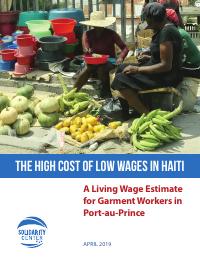
On the Cover:
Women market vendors selling produce in a community outside Port-au-Prince, Haiti. Most garment workers
purchase food from independent street and market vendors because their meager wages will not allow for
grocery store purchases. Even so, some garment workers say they can only afford to consume one meal per
day—usually lunch. Credit: Solidarity Center/Lauren Stewart
2 THE HIGH COST OF LOW WAGES IN HAITI
BACKGROUND
Haiti is in the throes of a political and economic crisis, as pervasive corruption and
poor living conditions fuel protests across the country. Much of the outrage stems
from the alleged embezzlement of nearly $2 billion in PetroCaribe funds,
a discounted Venezuelan oil program intended to finance social projects in Haiti.
More than a dozen former Haitian government officials and business owners have
been implicated in the scandal, and accusations against President Moïse have
prompted calls for his resignation. As Haitians grapple with the squandering of
funds and mounting instability, many find it increasingly difficult to make ends meet
amid soaring prices, double-digit inflation and currency depreciation. Approximately
80 percent of the workforce lacks formal employment, and wages fall far below
the high cost of living.1 Workers are toiling longer for less due to diminished
purchasing power.
The apparel industry represents one of the few sources of formal employment in
Haiti. The sector provides factory jobs to as many as 52,000 workers, the majority of
whom are women.2 Industry representatives anticipate additional job growth in the
sector due to trade incentives for companies that produce apparel in Haiti. Under
THE DAILY
U.S. legislation known as the Haitian Hemispheric Opportunity through Partnership MINIMUM WAGE
Encouragement Act of 2008 (HOPE II), qualifying exports gain duty-free access to the
U.S. market in exchange for factory adherence to international labor standards and FOR EXPORT
domestic labor law, among other criteria.3 Despite these requirements, Better Work
Haiti—an independent monitoring program that assesses factory compliance— APPAREL WORKERS
routinely reports rights abuses, including improper payment of wages and benefits,
health and safety violations, sexual harassment and repression of freedom of
IS MORE THAN
association.4 In addition to poor working conditions, many workers labor with FOUR TIMES LESS
persistent hunger due to their inability to afford enough food.
THAN THE
While Haiti has incrementally increased the minimum wage since the passage of
HOPE II, workers’ earnings remain inadequate.5 The daily minimum wage for export ESTIMATED COST
apparel workers is 420 gourdes (about $5.07),6 more than four times less than the
OF LIVING.
estimated cost of living.7 Haiti’s Superior Council on Wages—a presidentially
appointed commission composed of labor, business and government representatives—
is charged with deliberating and proposing a minimum wage increase to the
president on an annual basis. However, unions have grown increasingly frustrated
by the lack of transparency within the council, as well as with workers’ preclusion
from choosing their own labor representatives to genuinely advocate on their
behalf. Haitian unions contend that workers must be paid a living wage, which
affords a decent standard of living and enables workers to support themselves and
their families. This, in turn, generates economic prosperity, an essential step toward
resolving the ongoing crisis.
THE HIGH COST OF LOW WAGES IN HAITI 3
SURVEY METHODOLOGY
The Solidarity Center used a mixed-methods approach to estimate the cost of living
for garment workers in Port-au-Prince, Haiti. From September 2018 through March
2019, a team of three data collectors surveyed the prices of products and services
for a locally appropriate basket of goods.8 The Worker Rights Consortium originally
configured the basket of goods in 2008 when it assessed the cost of living for
garment workers in the Haitian border town of Ouanaminthe.
The three-member team surveyed prices across communities in which garment
workers are concentrated, including Delmas, La Plaine, Petionville, Tabarre, downtown
Port-au-Prince and the airport zone near the Metropolitan Industrial Park. To the
extent possible, data collectors sought five price quotes for each expense directly
from vendors and service providers.
Following the field-based data collection process, the Solidarity Center calculated
the average cost of each expense. For instances in which the price more than
doubled or decreased since the Solidarity Center’s 2014 living wage assessment,
data collectors completed a second round of surveying to ensure validity.
For further verification, the Solidarity Center triangulated the data through two focus
group discussions with 16 garment workers, who reported the prices they pay for
various expenses, in addition to providing qualitative information.
To remain consistent with the original methodology, upon which previous Solidarity
Center living wage assessments are based (2011 and 2014), the quantitative data was
used to calculate the basic monthly living expenses for a three-member household
(comprising one adult wage earner and two minor dependents, ages 8–14). However,
it is important to note that the total fertility rate in Haiti is currently estimated at 2.66
children per woman of childbearing age.9 The lack of formal employment opportunities
means that some households have only one wage earner.
The prices in the tables that follow are pro-rated to reflect the monthly allocation
of cost.
4 THE HIGH COST OF LOW WAGES IN HAITI
CATEGORIES OF EXPENSES
The basket of goods includes a range of products and services that span the
following categories of expenses: housing, energy, nutrition, clothing, health care,
education, transportation and communication, as well as funds for savings and
miscellaneous discretionary spending. A description of each category is provided
below:
Housing: Home ownership is out of reach for the great majority of garment
workers in Port-au-Prince. Focus group participants reported that they rent small,
often-substandard cement dwellings that lack indoor plumbing. Some workers
noted overcrowding in their households due to the need to share rent among
several people. Others said that they cannot afford to fully furnish their homes or
that they must purchase less expensive, used furniture.
The housing category includes rental costs for a modest, two-bedroom home with
a kitchen, a living space and a bathroom. The category includes non-potable water
(for cleaning and bathing), which must often be transported long distances on foot,
multiple times per week. The category also includes two queen-size beds and bedding,
a table with four chairs, a wardrobe, a sofa, a radio, basic cookware, dishes and cleaning
supplies. The prices for furniture and small appliances were obtained from street
vendors, since store prices typically exceed garment workers’ limited means.
Energy: Access to energy is a persistent problem—one that has worsened since
Venezuela ended its discounted oil program with Haiti. Prior to the country’s most
recent stretch of turbulence, Port-au-Prince received less than 20 hours of electricity
per day.10 The absence of PetroCaribe assistance has exacerbated fuel shortages and
led to prolonged power outages, rationing and price hikes on petroleum products.
These price increases particularly impact the cost that workers pay for transportation
and food. While the cost of electricity is also affected, many workers contribute a
negligible amount to a collective utility bill shared with neighbors, which enables them
to wire their homes to a public power network. For this reason, the energy category
only includes the cost of charcoal, the primary fuel expense of garment workers.
Approximately 90 percent of the population in Port-au-Prince uses charcoal or
firewood to prepare food.11 While propane represents another (more environmentally
sound) option for cooking fuel, most garment workers are unable to afford the
upfront cost. Instead, they must parcel fuel costs over time by purchasing small bags
of charcoal several times per week. Larger, more economical bags of charcoal are
available for purchase, but, similar to propane, workers often struggle to afford the
upfront cost of a larger bag.
THE HIGH COST OF LOW WAGES IN HAITI 5
Nutrition: The selection of foods and corresponding quantities are based on a
local diet that is adequate in terms of caloric intake (minimum 2,200 calories per
day) and basic nutritional needs, according to standards established by the United
Nations Food and Agriculture Organization.
Most garment workers are unable to afford grocery store prices and, therefore,
typically purchase food from independent street and market vendors. Data
collectors visited several of these markets to survey prices and used a scale to
determine the cost of goods for which the pound was the unit of measure.
In addition to foods purchased at local marketplaces, the nutrition category includes
the cost of potable water, as well as lunch for workers at or near the factories in
which they work. A standard lunch includes rice, beans and a small portion of
chicken. Some workers reported that lunch is sometimes the only meal that they
consume throughout the day.
Clothing: Garment expenses include three complete sets of clothing and two
pairs of shoes per year for one adult and two children. Many workers can only afford
secondhand clothing sold by street vendors.
Health Care: Employers are required by law to deduct and forward 3 percent of
workers’ base salary to the Insurance Office for Occupational Injury, Sickness and
Maternity (OFATMA). However, Better Work Haiti consistently reports widespread
noncompliance with this legal requirement. Several factories have been cited for
failure to register with OFATMA’s health and maternity services, as well as for failure
to collect and forward OFATMA contributions to the agency. As a result, many
garment workers are unable to access basic health care services at OFATMA-affiliated
facilities. Of those who do have access, many are critical of the quality of care. In
addition to OFATMA, some workers have access to government-subsidized and/or
non-governmental organization-operated medical facilities.
For instances in which workers seek specialized care at private clinics or obtain
services and supplies not covered by insurance, they are responsible for out-of-pocket
expenses, which are included in the health care category. Such expenses include
doctor visits, laboratory tests, eyeglasses, prescription drugs and over-the-counter
medications. The category also includes the cost of pregnancy and childbirth (with
one of five quotes based on a caesarean delivery). Nearly all of the focus group
participants reported that they are unable to afford dental care or eye glasses.
6 THE HIGH COST OF LOW WAGES IN HAITI
Education: Educational expenses reflect the cost of private school education
for two children (one in primary school and one in secondary school). Although
the 1987 Constitution provides for free, public education, more than 85 percent of
students attend schools run by religious or private organizations given the lack of
government resources for public education.12
The education category includes private school tuition, mandatory uniforms, books,
supplies and transportation to and from school. It is typical for parents to accompany
younger children to and from school, which increases education-related transportation
costs. For instances in which families cannot afford transportation, students must walk
to and from school—often significant distances and along congested roads.
Given that the cost of child supervision (during school hours) is indirectly included in
the education category, this assessment does not include child care expenses. If one
or both of a worker’s dependents are below primary school age, the funds allocated
for education-related costs can be allotted to child care.
Transportation: The transportation category includes shared rides (via tap
tap,13 moto taxi or commuter bus) to and from work and local marketplaces. The
category also includes roundtrip bus fare for an adult and two children to visit family
in outlying areas on an annual basis. For instances in which workers cannot afford
transportation, they must walk to and from the factory.
Communication: Based on worker feedback during the focus group discussions,
the Solidarity Center added a communication category to its 2019 living wage
assessment. The category includes the cost of a mobile phone, as well as a basic
voice and data plan.
Savings and Discretionary Spending: After calculating the cost of living
based on the categories above, an additional 10 percent is applied for savings (7.5
percent) and discretionary spending (2.5 percent). Savings represent funds set aside
for emergencies and substantial future expenses. Discretionary spending represents
occasional expenditures such as religious observances, university education and
leisure activities.
Focus group participants reported that they do not have bank accounts because their
wages are too low to generate savings—rather, they live paycheck to paycheck. When
workers need to make a substantial payment, for instance for a child’s wedding, some
participate in lending pools. These pools generally consist of relatives, friends, coworkers
and/or community members who contribute payments to a monthly fund, which one
member is able to collect in its entirety during their designated month. Others seek
additional working hours, sometimes laboring seven days per week or during night shifts,
to earn overtime pay. The government modified the law in 2018 to reduce overtime pay
to 1.5 times the normal wage (from double) for work performed during the night shift.
THE HIGH COST OF LOW WAGES IN HAITI 7
KEY FINDINGS
The Solidarity Center estimates the basic cost of living for a garment worker in
Port-au-Prince to be 45,517 gourdes (about $549.19) per month.
• Based on the standard 48-hour work week, workers must earn at least 1,750
gourdes (about $21.21) per day to adequately provide for themselves and their
families.
• The cost of living is more than four times higher than the minimum wage and
increased by 74 percent since the Solidarity Center’s last assessment in 2014.
Garment workers must • Based on the current minimum wage, workers spend more than half (55 percent)
forgo basic necessities of their take-home pay on transportation to/from work and a modest lunch to
sustain their labor.14
due to the massive
disparity between
the minimum wage RECOMMENDATIONS
and the cost of living. The Haitian government must ensure that workers earn decent wages that enable
When asked what they them to adequately support themselves and their families. When workers are able
would purchase if to meet their basic needs, a range of related societal problems are simultaneously
addressed. Payment of a living wage has the potential to create a positive multiplier
they earned sufficient
effect, leading to: reduced poverty and aid dependence; the weakening of push
income, workers most factors that contribute to dangerous migration; more robust participation in the
often said they would: formal economy; and the generation of tax revenue to fund infrastructure projects
and public services.
• BUILD OR
To realize these advances, the Solidarity Center recommends the following measures:
PURCHASE A
HOME • The Haitian government should increase the minimum wage to a living wage (est.
1,750 gourdes per day).
• DEVOTE MORE • The Haitian government should enable workers to select their representatives on
the tripartite Superior Council on Wages.
RESOURCES • The Haitian government should ensure that workers’ rights to freedom of
TO THEIR association and collective bargaining are fully respected, so that workers are
CHILDREN’S empowered to negotiate wage increases and improved working conditions with
employers.
EDUCATION
• The Haitian government should ensure that employers properly compensate
workers according to the law, including accurate payment of OFATMA and
• INVEST pension contributions.15
IN A SMALL • The Haitian government should improve OFATMA services and quality of care to
BUSINESS minimize the cost of private healthcare for garment workers.
• Employers should subsidize work-related expenses, including transportation and
lunch.
• Employers should standardize and set reasonable production quotas that
enable workers to earn a supplement to the minimum wage when they attain
established quotas.
8 THE HIGH COST OF LOW WAGES IN HAITI
BASIC COST OF LIVING IN PORT-AU-PRINCE
(September 2018–March 2019; $1: 82.88 Haitian gourdes, as of April 1, 2019)
Average Quantity/ Monthly Monthly
Unit of
HOUSING* Unit Cost Frequency of Cost Cost
Measure
(Haitian Gourdes) Replacement (Haitian Gourdes) (U.S. Dollars)
Rent (2 bedrooms, 82,000.00 year annually 5,125.00 $61.84
living room, kitchen,
and bathroom)
Water (non-potable) 11.25 5-gallon 60 506.25 $6.11
container
Household cleaning 241.43 set monthly 181.07 $2.18
supplies (disinfectant
and dish detergent)
Bedding (sheets, 882.15 queen-size set 2 sets per year 110.27 $1.33
pillows, pillowcases)
Queen-size bed 8,500.00 queen-size bed 2 beds per 106.25 $1.28
(including mattress, 10 years
frame, box spring)
Jars and pans 1,636.67 set 1 set per 2 years 51.15 $0.62
(4-6 pieces)
Table and 4 chairs 6,000.00 table 1 set per 10 years 37.50 $0.45
Dishes (including 1,178.57 set 1 set per 2 years 36.83 $0.44
glasses and cutlery)
(4-6 pieces)
Radio 2,500.00 radio 1 per 5 years 31.25 $0.38
Wardrobe (dresser) 2,500.00 wardrobe 1 per 5 years 31.25 $0.38
Other seating 1,166.67 sofa/bench 1 per 10 years 7.29 $0.09
(sofa/bench)
Lodging Subtotal 6,224.11 $75.10
Average Quantity/ Monthly Monthly
Unit of
ENERGY* Unit Cost Frequency of Cost Cost
Measure
(Haitian Gourdes) Replacement (Haitian Gourdes) (U.S. Dollars)
Charcoal for cooking 104.46 bag 1 per day 2,383.35 $28.76
Energy Subtotal 2,383.35 $28.76
THE HIGH COST OF LOW WAGES IN HAITI 9
Average Quantity/ Monthly Monthly
Unit of
NUTRITION Unit Cost Frequency of Cost Cost
Measure
(Haitian Gourdes) Replacement (Haitian Gourdes) (U.S. Dollars)
Lunch at/near factory 108.33 lunch 26.00 2,816.67 $33.98
Rice 40.00 pound 45.74 1,829.60 $22.08
Bread 25.00 roll 70.80 1,770.00 $21.36
Chicken 95.00 pound 11.70 1,111.50 $13.41
Plantains 35.00 pound 30.09 1,053.15 $12.71
Banana 140.00 pound 4.03 564.20 $6.81
Eggs 136.00 dozen 4.03 548.08 $6.61
Mango 50.00 pound 10.09 504.50 $6.09
Water (potable)* 40.00 5-gallon 16, 5-gallon 480.00 $5.79
container containers
Pigeon peas 83.00 can 5.00 415.00 $5.01
Beans 93.00 pound 4.32 401.76 $4.85
Seasoning 20.00 packet 20.00 400.00 $4.83
Coconut 95.00 pound 4.00 380.00 $4.58
Avocado 38.00 pound 9.65 366.70 $4.42
Lime 100.00 pound 3.03 303.00 $3.66
Orange 50.00 pound 6.05 302.50 $3.65
Potato 50.00 pound 6.05 302.50 $3.65
Carrot 70.00 pound 4.03 282.10 $3.40
Coffee 18.00 package 15.00 270.00 $3.26
Papaya 37.17 pound 6.05 224.86 $2.71
Pineapple 72.00 pound 3.03 218.16 $2.63
Sweet Potato 36.00 pound 6.05 217.80 $2.63
Onion 70.00 pound 3.05 213.50 $2.58
Garlic 162.00 pound 1.05 170.10 $2.05
Cabbage 26.92 pound 6.05 162.88 $1.97
Sugar 40.00 pound 4.03 161.20 $1.94
Salami 50.00 pound 3.03 151.50 $1.83
Pasta 30.00 pound 4.50 135.00 $1.63
Milk 14.50 pound 5.17 74.97 $0.90
Celery 50.00 pound 1.05 52.50 $0.63
Chayote 14.13 pound 3.05 43.08 $0.52
Oil 128.00 pound 0.26 33.28 $0.40
Salt 14.00 pound 1.00 14.00 $0.17
Nutrition Subtotal 15,974.09 $192.74
10 THE HIGH COST OF LOW WAGES IN HAITI
Average Quantity/ Monthly Monthly
Unit of
CLOTHING Unit Cost Frequency of Cost Cost
Measure
(Haitian Gourdes) Replacement (Haitian Gourdes) (U.S. Dollars)
1 Adult
Laundry costs 1,100.00 month monthly 1,100.00 $13.27
Shoes 1,300.00 pair 2 per year 216.67 $2.61
Pants/skirts 625.00 pair 3 per year 156.25 $1.89
Blouses/dress shirts 460.00 shirt 3 per year 115.00 $1.39
Rubber sandals 1,000.00 pair 1 per year 83.33 $1.01
T-shirts 300.00 shirt 3 per year 75.00 $0.90
Pajamas 500.00 set 1 per year 41.67 $0.50
Underwear 100.00 pair 3 per year 25.00 $0.30
Cap/hat 200.00 hat 1 per year 16.67 $0.20
Socks 50.00 pair 3 per year 12.50 $0.15
2 Children
Shoes 740.00 pair 2 pair per year 246.67 $2.98
per child
Shirts 300.00 shirt 3 shirts per year 150.00 $1.81
per child
Pants/skirts 250.00 pair 3 pair per year 125.00 $1.51
per child
Dresses or dress shirts 500.00 dress/dress 1 per year 83.33 $1.01
shirt per child
Rubber sandals 400.00 pair 1 pair per year 66.67 $0.80
per child
Underwear 100.00 pair 3 pair per year 50.00 $0.60
per child
Socks 50.00 pair 3 pair per year 25.00 $0.30
per child
Clothing Subtotal 2,588.75 $31.23
THE HIGH COST OF LOW WAGES IN HAITI 11
Average Quantity/ Monthly Monthly
Unit of
HEALTHCARE Unit Cost Frequency of Cost Cost
Measure
(Haitian Gourdes) Replacement (Haitian Gourdes) (U.S. Dollars)
Prescription drugs 1,000.00 month monthly 1,000.00 $12.07
Doctor visit 1,250.00 visit 3 per year 937.50 $11.31
(including 2 lab tests) per 3 people
Prenatal care/ 34,750.00 pregnancy 1 pregnancy 579.17 $6.99
maternity costs per 5 years
(9 visits, supplements, per 1 person
and delivery)
Dentist visit 2,000.00 visit 1 per year 500.00 $6.03
per 3 people
Personal hygiene 500.00 set monthly 500.00 $6.03
(soap, toothpaste,
feminine hygiene
products)
Eye glasses 8,900.00 pair 1 pair per 2 years 370.83 $4.47
per 1 person
Over-the-counter 250.00 set monthly 250.00 $3.02
medication (analgesic
and decongestant)
First-aid supplies 125.00 set monthly 125.00 $1.51
(bandages and
antiseptic)
Healthcare Subtotal 4,262.50 $51.43
Average Quantity/ Monthly Monthly
EDUCATION Unit of
Unit Cost Frequency of Cost Cost
(private school) Measure
(Haitian Gourdes) Replacement (Haitian Gourdes) (U.S. Dollars)
Primary school (1 child)
Transportation fees 75.00 round-trip 22 per month 1,650.00 $19.91
Tuition fees 1,330.00 month 10 months 1,108.33 $13.37
per year
Books and supplies 1,820.00 set annually 151.67 $1.83
Uniform 1,240.00 uniform annually 103.33 $1.25
Secondary school (1 child)
Tuition fees 1,749.99 month 12 months 1,749.99 $21.11
per year
Transportation fees 50.00 round-trip 22 per month 1,100.00 $13.27
Books and supplies 3,830.00 set annually 319.17 $3.85
Uniform 1,300.00 uniform annually 108.33 $1.31
Education Subtotal 6,290.82 $75.90
12 THE HIGH COST OF LOW WAGES IN HAITI
Average Quantity/ Monthly Monthly
Unit of
TRANSPORTATION Unit Cost Frequency of Cost Cost
Measure
(Haitian Gourdes) Replacement (Haitian Gourdes) (U.S. Dollars)
Transportation 100.00 1 round-trip 26 per month 2,600.00 $31.37
to/from factory
Transportation 50.00 1 round-trip 1 per week 216.67 $2.61
to/from market
Transportation 690.00 1 round-trip 1 per year 172.50 $2.08
to/from hometown per 3 people
Transportation Subtotal 2,989.17 $36.07
Average Quantity/ Monthly Monthly
Unit of
COMMUNICATION Unit Cost Frequency of Cost Cost
Measure
(Haitian Gourdes) Replacement (Haitian Gourdes) (U.S. Dollars)
Voice/Data plan $625.00 month monthly $625.00 $7.56
Cellular phone $1,500.00 phone 1 per 3 years $41.67 $0.50
Communication Subtotal 666.67 $8.06
Monthly Monthly
SUMMARY OF EXPENSES Cost Cost
(Haitian Gourdes) (U.S. Dollars)
Nutrition 15,974.09 $192.74
Education 6,290.82 $75.90
Housing 6,224.11 $75.10
Healthcare 4,262.50 $51.43
Clothing 2,588.75 $31.23
Transportation 2,989.17 $36.07
Energy 2,383.35 $28.76
Communications 666.67 $8.06
SUBTOTAL 41,379.45 $499.29
Savings (7.5% of Subtotal) 3,103.46 $37.45
Miscellaneous Expenses (2.5% of Subtotal) 1,034.49 $12.48
TOTAL 45,517.39 $549.22
Based on the standard 48-hour workweek, workers must earn 1,750 HTG ($21.21) per day to meet the basic cost of living.
(45,517.39 HTG) x (12 months per year / 52 weeks per year / 6 working days per week)
*Note: In keeping with the original methodology, the Solidarity Center assessment assumes that in addition to the garment worker wage earner (and
two minor dependents), a household has an additional wage earner whose income covers one-quarter of the household expenses (housing, energy
and potable water costs).
THE HIGH COST OF LOW WAGES IN HAITI 13
Endnotes
1 World Bank Group. (2015, May). Haiti: Towards a New Narrative - Systematic Country Diagnostic, available at: http://documents.worldbank.org/curated/
en/319651467986293030/pdf/97341-SCD-P150705-IDA-SecM2015-0130-IFC-SecM2015-0071-MIGA-SecM2015-0046-Box391466B-OUO-9.pdf.
2 Better Work Haiti. (2018, October). Better Work Haiti: 17th Biannual Synthesis Report Under the HOPE II Legislation, available at: https://betterwork.org/
blog/portfolio/better-work-haiti-17th-biannual-synthesis-report-under-the-hope-ii-legislation/.
3 International labor standards, or internationally recognized worker rights, as defined in HOPE II include: the right of association; the right to organize
and bargain collectively; a prohibition on the use of any form of forced or compulsory labor; a minimum age for the employment of children; and
acceptable conditions of work with respect to minimum wages, hours of work, and occupational safety and health. See, 19 U.S.C. § 2703a(d)(1)(A)(vi).
4 Better Work Haiti. (2018, October). Better Work Haiti: 17th Biannual Synthesis Report Under the HOPE II Legislation, available at: https://betterwork.org/
blog/portfolio/better-work-haiti-17th-biannual-synthesis-report-under-the-hope-ii-legislation/.
5 In 2008, the national daily minimum wage for export industries, including the apparel sector, was 70 gourdes (HTG) per day. With the passage of a
new minimum wage law in 2009 and subsequent increases proposed by the CSS, the minimum wage rose to 125 HTG in 2009, 150 HTG in 2010, 200
HTG in 2012, 225 HTG in 2014, 240 HTG in 2015, 300 HTG in 2016, 350 HTG in 2017 and 420 HTG in 2018. In March 2019, the Chamber of Deputies
voted to increase the daily minimum wage for garment workers to 750 HTG, but the Senate has yet to consider the measure and, thus, the increase
has not become law. See, United States Trade Representative. (2018). 2018 USTR Annual Report on the Implementation of the Technical Assistance
Improvement and Compliance Needs Assessment and Remediation (TAICNAR) Program and Assessment of Producer Eligibility, available at: https://ustr.
gov/sites/default/files/2018%20USTR%20Report%20Haiti%20HOPE%20II.PDF. See also, Haiti—Politic : Revised minimum wages, according to the bill
voted by the deputies. (2019, March 27). Haiti Libre, available at: www.haitilibre.com/en/news-27295-haiti-politic-revised-minimum-wages-according-
to-the-bill-voted-by-the-deputies.html.
6 The currency exchange rate is $1 to 82.88 HTG (as of April 1, 2019).
7 Arrete Fixant Le Salaire Minimum a Compter du 1 Octobre 2018. (2018, October 8). Le Moniteur, available at www.haitilibre.com/docs/moniteur-18-
salaire.pdf.
8 Field-based data collection was interrupted at various points of the process due to widespread protests across Port-au-Prince.
9 Central Intelligence Agency. (2018). The World Factbook: Haiti, available at: www.cia.gov/library/publications/the-world-factbook/geos/ha.html.
10 Export.gov. (2019, February 14). Haiti—Energy, available at: www.export.gov/article?id=Haiti-Energy.
11 U.S. Agency for International Development. (2017, March). Energy Fact Sheet, available at: www.usaid.gov/sites/default/files/documents/1862/
FINAL_Energy_Sector_Fact_Sheet_March_2017.pdf.
12 U.S. Agency for International Development. (2017, March). Education Fact Sheet, available at: www.usaid.gov/sites/default/files/documents/1862/
FINAL_EducationMarch2017.pdf.
13 Tap taps are privately-owned, covered pick-up trucks that transport passengers along designated routes.
14 Garment workers are legally required to contribute 3 percent of their base salary to OFATMA, as well as 6 percent of their base salary to the Office
of National Pension Insurance (ONA). Therefore, based on the current 420 HTG daily minimum wage, take-home pay equals 382.20 HTG. Income taxes
are not owed by employees who earn less than 120,000 HTG per year, which is the case for most garment workers. See, Better Work Haiti. (2017).
Practical Guide—Haiti Labor Code, available at: www.centrengo.org/wp-content/uploads/2017/11/Labor-Law-English.pdf
15 Employers are legally required to contribute the equivalent of 3 percent of a worker’s base salary to OFATMA and 6 percent to ONA (matching
employees’ contributions). Ibid.
14 THE HIGH COST OF LOW WAGES IN HAITI
THE HIGH COST OF LOW WAGES IN HAITI 15
1130 Connecticut Ave., NW
Suite 800
Washington, DC 20036
Stay Connected
www.solidaritycenter.org
solidaritycenter
SolidarityCntr
16 THE HIGH COST OF LOW WAGES IN HAITI
Kijan pou site
Solidarity Center, 2019, Gwo Depans Ti Salè ann Ayiti: Estimasyon yon Salè Vital pou Ouvriye Textil nan Pòtoprens, konsilte atravè HaitiDocs, https://www.haitidocs.org/doc/solidarity-center-2019-living-wage-garment-workers