Teks Konple Dokiman an
Teks ki soti nan dokiman orijinal la pou endeksasyon.
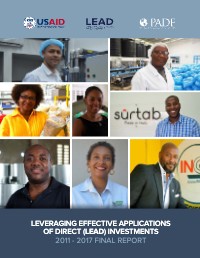
LEVERAGING EFFECTIVE APPLICATIONS
OF DIRECT (LEAD) INVESTMENTS
2011 - 2017 FINAL REPORT
LEVERAGING EFFECTIVE APPLICATIONS
OF DIRECT (LEAD) INVESTMENTS
FINAL REPORT
JULY 25, 2011 – DECEMBER 30, 2017
COOPERATIVE AGREEMENT NO. 521-A-00-11-000010-00
Prepared by
Pan American Development Foundation (PADF)
Submitted: APRIL 15, 2018
THIS PUBLICATION WAS PRODUCED BY THE PAN AMERICAN DEVELOPMENT FOUNDATION (PADF)
FOR REVIEW BY THE UNITED STATES AGENCY FOR INTERNATIONAL DEVELOPMENT (USAID)
DISCLAIMER
The contents of this report are the sole responsibility of the Pan American Development Foundation
and do not necessarily reflect the views of the United States Agency for International Development
or the United States Government.
Dear Friends,
Nadia Cherrouk
Chief of Party, LEAD & Country Director, PADF-Haiti
The Leveraging Effective Application of Direct Investments (LEAD) project was conceived at a critical juncture in Haiti’s
development. The premise was that supporting promising small- and medium-sized enterprises (SMEs) with capital and
technical assistance, and tapping into critical diaspora resources would create jobs, stimulate economic growth, unlock
private capital and send a strong signal to key actors that Haitian businesses could play a vital role in the country’s recovery
after the devastating earthquake of 2010.
Beginning in 2011 and running through 2017, the LEAD project ran several iterations of its renowned Business Plan
Competition to identify and support those SMEs which showed the most promise to create jobs, increase domestic
production, and would continue to grow in years to come. To encourage decentralization of the economy, the project
focused on the Saint Marc and Cap Haitian corridors alongside Port-au-Prince. The project also worked with various
diaspora groups to promote diaspora engagement, in the Haitian economy.
Today, we are proud to shine the spotlight on our enterprises, social development fund projects, and partnerships with
diaspora groups. These successful entrepreneurs have created over 18,000 jobs and generated more than $33 million
in sales while leveraging the project’s capital contributions with private equity, business assets, and debt funds of over
$10million. By supporting SMEs and promoting impactful diaspora engagement the project has meaningfully contributed
to Haiti’s recovery and economic growth. The 45 businesses represent a breadth of sectors and geographic regions, which
is a testament to the fact that the future of Haiti’s growth rests on a strong and diverse base of SMEs. The LEAD model,
which provides the right combination of capital and technical assistance, can spur the creation of entire clusters of private
enterprise in key value-chains and industrial hubs. This in turn will create more jobs, boost domestic production, enhance
Haiti’s competitiveness in the global economy, and generate exports. In short, if more enterprises can be supported using
the LEAD model then there will be a transformative effect on the Haitian economy.
Much of LEAD's success has been due to the tireless efforts of partner organizations and key stakeholders. I would like to
thank the Government of Haiti, particularly the Ministries of Finance, Commerce & Industry, and Haitians Living Abroad
and the Center for Facilitation of Investments for their support and collaboration and the belief in the project, and its
entrepreneurs. Our many private sector partners including AMCHAM-Haiti, and the Chambers of Commerce of the
North and North East have my gratitude for their support. My sincere thanks also go to organizations such as FAVACA,
CSL, Zafen, Yunus Social Business, EGI and SOFIHDES for helping us deliver timely and exceptional technical assistance
to our entrepreneurs. Our enterprises also benefited greatly from the network of exceptional Business Development
Service providers throughout Haiti, who worked tirelessly to help address business challenges. I remain confident that the
strengthened SME ecosystem will nurture future enterprises for many years to come.
The Haitian Diaspora’s commitment to Haiti is unwavering. Their deep love for Haiti and their passion for its development
was evident across the multiple activities we engaged in together during the course of LEAD. I would like to thank in
particular the teams at GRAHN-USA, HHTARG, HRA, NAAHP, EDEM Foundation, and the Society for Haitian Research
Inc. for their commitment to LEAD. Diaspora capital, know-how and passion remains a powerful force in support of the
economic and social development of Haiti.
I would also like to extend my deepest gratitude to the many volunteers drawn from the echelons of the business and
public sectors in Haiti, who believed in the project from its conception and generously provided their time by reviewing
business plans, sharing their sector expertise, serving on jury panels, mentoring entrepreneurs, and participating in our
events. Members of the Board of Directors of PADF from Haiti provided advice on successfully engaging the Haitian
private sector. Your pro-bono support was invaluable and I cannot thank you enough for your contribution to the project.
LEAD received exceptional support from the USAID Haiti mission. I would like to thank the LEAD AOR Mr. Isaac Michel
and the team within the Economic Growth office in particular for their guidance, knowledge of the economy and
marketplace, and their continued support.
I would like to extend my deepest gratitude to the LEAD team; your dedication, professionalism, passion, enthusiasm and
ethics were remarkable and I am proud of everything we’ve accomplished together. My thanks also go to the PADF staff
in both Haiti and Washington D.C. for their unwavering support.
Finally, I want to bring the attention back to the LEAD project participants – entrepreneurs, private sector stakeholders,
and diaspora members. What they all share in common is the ability to see opportunity amidst challenge, and a can-do
spirit that turns dreams into reality. I am proud to know them and I invite you to join us as we celebrate their success and
imagine a bright future for this beautiful country and its amazing people.
Sincerely,
Acronyms
Association des Industries d’Haïti
American Chamber of Commerce
Association Fanm Plantez Préval Renal
Business Development Services
Business Plan Competition
Cap-Haitian
Chambre de Commerce d’Industrie Haïti
Chambre de Commerce d‘Industrie et des Profes-
sions du Nord
Chambre de Commerce d‘Industrie et des Profes-
sions du Nord Est
Centre d’Etude et de Coopération International
Centre de Facilitation des Investissements
Centre Spécialisé de Leadership
Corporate Social Responsibility
Diaspora Challenge Fund
Diaspora Challenge Initiative
Space for the Development and Emancipation
of the Masses / Espace de Développement pour
l’Emancipation des Masses
Economic Growth Institute
Environmental Management Performance Report
Economic Recovery and Road Map, Government
of Haiti
Entrepreneurship, X-Factor, Credibility, Innovation,
Transparency, Exit in View
Florida Association for Volunteer Action in the
Caribbean and the Americas, Inc.
Fonds de Developpement Industriel
Full-time equivalent
Gouvernement of Haiti
Groupe de Réflexion et d’Action
pour une Haïti Nouvelle
George Washington University
Haitian-American Business Network
Hazard Analysis and Critical Control Point
Haiti Economic Lift Program
Haitian Hometown Association Resource Group
Haiti Economic Recovery and Opportunity Act
Haiti Investment Navigator
Haiti Hemispheric Opportunity
through Partnership Encouragement Act
Haiti Renewal Alliance
Hometown Associations
ADIH
AMCHAM
ASFAPPR
BDS
BPC
CAP
CCIH
CCIPN
CCIPNE
CECI
CFI
CSL
CSR
DCF
DCI
EDEM
EGI
EMPR
ERRM
EXCITE
FAVACA
FDI
FTE
GOH
GRAHN
GWU
HABNET
HACCP
HELP
HHTARG
HERO
HIN
HOPE
HRA
HTA
Inter-American Development Bank
Indicator Performance Tracking Table
International Finance Corporation (part of the
World Bank)
Informational Systems
Information Technology
LEAD Management System
Life of Program/Project
Ministry of Commerce / Ministère du Commerce
Monitoring & Evaluation
Monitoring Evaluation Accountability Learning
Ministry of Finance / Ministères des Finances
Multilateral Investment Fund
Ministry of Haitians Living Abroad / Ministère des
Haitians Vivant à l’Etranger
National Alliance for the Advancement of Haitian
Professionals
Non US Organization Pre Award Survey
Organizational Capacity Assessment Tool
Overseas Private Investment Corporation
Occupational Safety and Health Administration
Port-au-Prince, Haiti
Pan American Development Foundation
Performance Indicator Reference Sheet
Performance Measurement Plan
Public-Private Partnerships
Remittance Development Impact initiatives
Remittance Enhancement Program
Social Development Fund
Social Enterprise
Society for Haitian Research
Saint-Marc
Small and Medium Enterprises
Société Financière Haïtienne
de Développement S.A
Technical Assistance
Umbrella Environmental Management Perfor-
mance Report
U.S. Agency for International Development
World Bank
Yunus Social Business,
formerly Grameen Creative Lab
IDB
IPTT
IFC
IS
IT
LMS
LOP
MCI
M&E
MEAL
MEF
MIF
MHAVE
NAAHP
NUPAS
OCAT
OPIC
OSHA
PAP
PADF
PIRS
PMP
PPP
RDI
REP
SDF
SE
SHR
SM
SME
SOFIHDES
T.A.
UEMPR
USAID
WB
YSB
Table of contents
1 Executive summary
7 Component 1
8 SME Ecosystem
11 Business Plan Competition
14 Lessons Learned
15 Sectors
17 Cluster Effect
18 Women & Entrepreneurship
19 Social Enterprises
19 Technical Assistance
25 Results Component 1
27 Component 2
28 Diaspora Success
29 Roadshows
31 Whitepaper
33 Social Development Fund
35 Diaspora Challenge Initiative
37 Remittance Paper
37 Portal
38 Lessons Learned
39 Cross-Cutting Activities
40 Grants Management
41 Monitoring & Evaluation
42 Environmental Management
43 Communications
45 Entrepreneurs Spotlights
47 Official Visits to Grantees
49 Major LEAD Organized Events
52 Expos and Award Ceremonies
55 LEAD Key Diaspora Events
EXECUTIVE SUMMARY
Over a six-year period (July 2011 to December 2017),
the Leveraging Effective Application of Direct Investments (LEAD)
program provided access to capital and technical assistance to Haitian
small- and medium-sized enterprises, strengthened the eco-system for
private sector development in Haiti, and engaged the Haitian Diaspora
to increase the development impact of remittance flows.
$16.96
million
FUNDING
6
year
PROGRAM
3
geographic
CORRIDORSLEAD
1
Small- and medium-sized enterprises (SMEs) play a major role in most economies, particularly in developing
countries. Per data collected by the World Bank Group
1
, formal SMEs contribute up to 60 percent of total
employment and up to 40 percent of national income (GDP) in emerging economies. These numbers are even
higher when informal SMEs are included.
Overall, small firms have lower productivity growth compared to large firms
2
. Throughout the world, the single
biggest constraint to growth for SMEs is access to finance - SMEs are less likely to be able to secure bank loans
than large firms; instead, they rely on internal or “personal” funds to launch and initially run their enterprises
3
.
Another constraint to growth for this sector is access to business development services resources that can help
enterprises address important issues that limit their access to capital or ability to grow. These resources are often
needed to address common SME needs such as improved financial management systems, installation of sound
accounting systems, business plan drafting and revision, market and feasibility studies, and support to improve
general operations.
In Haiti, the impact of such global factors that limit SME growth is compounded by country-specific constraints.
Haiti is ranked as a low-income country with a population of 10.8 million and a GNI per capita of US$ 780. Haiti
ranks 181 out of a possible 190 on the Global Doing Business Index (DB) published by the World Bank. Haiti also
has a Distance to Frontier (DTF) measure of 38.24. An economy’s DTF is reflected on a scale from 0 to 100, where
0 represents the lowest performance and 100 represents the frontier. Haiti’s DTF compares unfavorably with the
regional average for Latin America & the Caribbean of 58.66 and is considerably less than that of geographical
neighbor Dominican Republic’s DTF of 60.93.
4
Haiti’s poor ranking is a direct reflection of the extraordinary challenges faced by SMEs in the country including
significant challenges in starting a business (DB rank of 189 out of 190), unreliable access to power (DB rank of
138 out of 190), difficulties in registering property (DB rank of 180 out of 190), getting access to credit (DB rank of
177 out of 190) and protecting minority investors (DB rank of 188 out of 190). These policy, infrastructure, legal
and capital constraints are compounded by the fact that Haiti remains highly prone to natural disasters due to
its geographical position that is subject to catastrophic hurricanes and earthquakes. Haiti ranked #1
5
in the world
on the Global Climate Risk Index, reflective of the devastating impacts of the earthquake of 2010 and Hurricane
Matthew in 2016.
The LEAD project, conceived as part of the post-earthquake U.S. Government’s Haiti strategy, focused on
supporting economic growth in the three development corridors of Port-au-Prince, Saint Marc and Cap
Haitian with a two-pronged approach: 1) create jobs and increase sales through sustainable business and social
enterprise development, and 2) utilize innovative mechanisms to engage the Haitian Diaspora and increase the
development impact of remittances.
LEAD utilized a Business Plan Competition (BPC) to identify promising Haitian SMEs and social enterprises in
the three corridors. The project’s “matching grant” model of investment unlocked private investment capital and
encouraged the active participation of key financial institutions in economic growth activity. Grant capital was
complemented by technical assistance to support and strengthen the SMEs. Finally, recognizing that remittances
would play a key role in supporting the Haitian economy, the project actively engaged the Haitian Diaspora to
increase the development impact of diaspora activities and capital.
1 World Bank Group, SME Finance: Improving SMEs’ access to finance and finding innovative solutions to unlock sources of capital.
2 Ayyagari, Demirgüç-Kunt and Maksimovic (2014)
3 World Bank Group, http://www.doingbusiness.org/data/exploreeconomies/haiti
4 Insert reference to World Bank Doing Business Index, Distance to Frontier
5 David Eckstein, Vera Künzel and Laura Schäfer, 2018, GLOBAL CLIMATE RISK INDEX 2018 Who Suffers Most From Extreme Weather Events? Weather-
related Loss Events in 2016 and 1997 to 2016.
2PADF
18,123
jobs
62%
11%
27%
$ 2,988,801
$ 2,954,367
$ 27,143,394
$ 33 million
in sales
9%
9%
82%
Business Plan Competition: LEAD completed four editions of its renowned BPC that attracted nearly 500
applicants from the three corridors. Each edition of the BPC involved multiple stages, including review by
sector experts, due diligence visits by financial representatives, and presentations to an independent jury. 45
winning entrepreneurs were selected across all four editions. A total of $6.7 million in LEAD grant capital
leveraged over $10 million in private matching funds/investments. These 45 enterprises have collectively
created 18,123 jobs, generated $33 million in sales, and represent various productive sectors such as agribusiness,
manufacturing, water and sanitation, food services, technology, textiles, tourism and hospitality, and recycling.
Promoting Decentralization: LEAD promoted decentralization of the Haitian economy by promoting the
BPC heavily in Saint Marc and Cap Haitian, organizing special technical assistance activities for enterprises in
those corridors, and supporting the development of the relatively underdeveloped
SME ecosystem in these areas. The emphasis on these corridors resulted in a
geographic diversity in LEAD’s portfolio with six enterprises from Saint-Marc, and
12 enterprises from Cap-Haitian receiving support.
Women and Entrepreneurship: LEAD worked to address the specific economic constraints faced by women
entrepreneurs by tailoring its outreach activities and technical assistance to their articulated needs. As a result,
women entrepreneurs make up 45 % of the total portfolio and received grant capital of $3 million which unlocked
private investment capital of $5.3 million. Of the 18,123 jobs created, 8,190 jobs are held by women. LEAD delivered
a total of 3,541 hours of training or technical assistance to women.
Social Enterprises: LEAD partnered with key local institutions such as Yunus Social Business Haiti, Zafen and
Economic Growth Initiative, to address social enterprises which would provide both an economic and social
benefit to the Haitian economy. These partner institutions have supported a total of 7 social enterprises.
Port-au-Prince Corridor
Saint-Marc Corridor
Cap-Haitian Corridor
Grants by
corridor
58%
4%
682
10,570 6,871
38%LEAD
3
Technical Assistance: LEAD had an integrated approach to delivering technical assistance, providing support to
the entire SME ecosystem as well as targeted, firm-level assistance. Throughout the BPC, LEAD offered support
to entrepreneurs to develop their business plans and improve their presentation skills. LEAD also organized
roundtables with local Business Development Service (BDS) providers to improve their capacity to meet the
business needs of Haitian SMEs. To strengthen the SME ecosystem, LEAD partnered with financial institutions
to create linkages between the financial sectors and entrepreneurs, and increase knowledge of available credit
and equity sources of capital. LEAD also organized sector-wide training sessions that addressed common needs
of multiple enterprises on key topics such as manufacturing standards, health and safety, financial management
etc. Finally, LEAD completed an in-depth assessment of each of the 45 enterprises in its portfolio and provided
access to consultants to address critical business needs of each firm. Overall, LEAD delivered a total of 10,775 of
hours of targeted and sector-wide technical assistance.
Diaspora Engagement: The Haitian Diaspora supports the country’s economy through remittances, philanthropic
initiatives and investments. Remittances from the diaspora have been rising steadily for 20 years, with data from
2016 showing Haiti received US$ 2.36 billion or over 20% of its GDP from remittances. In April 2017, the Central
Bank of Haiti suggested that by 2020 remittances could rise to US$ 2.7 billion or 29% of GDP
6
. Looking to harness the
impact of diaspora activities on the Haitian economy, LEAD engaged the Haitian Diaspora via multiple activities.
First, diaspora entrepreneurs looking to establish or grow businesses in Haiti were encouraged to participate in
the BPC. As a result 12 of the 45 winners of the BPC are from the diaspora. Secondly, LEAD organized multiple
outreach activities with diaspora groups to promote the success of diaspora entrepreneurs. LEAD partnered with
the Haitian Hometown Association Resource Group (HHTARG) to support the development of a whitepaper
titled “Haitian Diaspora Engagement & Investment in Haiti: New Findings and Recommendations.”
LEAD also launched the Social Development Fund, an innovative mechanism that adapted the BPC to fund
seven community-based projects (out of 207 applications) that could sustainably generate revenue and meet
social needs with the support of diaspora capital. Finally, LEAD also partnered with the National Association for
the Advancement of Haitian Professionals (NAAHP) and its partners to launch the Diaspora Challenge Initiative.
This competitive exercise canvassed the Haitian Diaspora to identify their best ideas and projects to promote
economic and social development in Haiti. Via its various activities, LEAD supported 13 outreach activities and
informed 133,663 diaspora members of economic development opportunities in Haiti.
YEAR 1
2012-2013
YEAR 2
2013-2014
YEAR 3
2014-2015
YEAR 4
2015-2016
YEAR 5
2016-2017
YEAR 6
OCT-DEC 2017
# GRANTS
AWARDED
4 9 20 14 0 0
GRANT
AWARDED IN USD
$757,763 $1,488.006 $2,807,83 $1,742,46
SALES
GENERATED
$2,206,898 $5,079,656 $6,172,495 $6,374,891 $12,342,924 $909,697
JOBS
CREATED
5,831 1,262 2,448 2,837 1,810 3,935
Haiti’s private sector consists mainly of small enterprises. There are around 900,000 micro-, small- and
medium-sized enterprises, 60,000 of which are small and medium-sized enterprises—small firms (with
between 10 and 49 employees), and mid-size companies (with 50-250 staff).
7
6 Data released by BRH at the “Haiti - remittances, impacts on the national economy” conference organized in Port-au-Prince by the Economic & Social
Development Council (CDES) http://www.haitilibre.com/en/news-20563-haiti-economy-impacts-of-remittances-from-diaspora-on-the-national-
economy.html
7 IFC Enterprise Finance Gap Database - Raw Data, 2010-2011. https://finances.worldbank.org/Other/IFC-Enterprise-Finance-Gap-Database-Raw-Data/2ppx-k958
LEAD completed four editions of its Business Plan Competition (BPC)
to identify the most promising, investment-worthy enterprises across
key productive sectors within the three growth corridors of Port-au-
Prince, Saint Marc and Cap Haitian. As the SME eco-system in Haiti
had been nascent before the earthquake, and particularly fragile post-
quake, LEAD organized its activities to strengthen the eco-system
around SMEs so that those enterprises that won the BPC would have
access to the resources needed to sustain growth after the project was
completed. LEAD also delivered technical assistance at both the firm-
level, and across sector needs, to help the SMEs in its portfolio meet
their business objectives.
COMPONENT 1LEAD
7
Haiti’s economy is primarily informal.
8
The fact that most of the firms operate at informal levels limits the
accessibility to business support services, financial services, and seed capital. It was estimated that 82% of all
enterprises are engaged in basic commercial activities, buying and selling products with very limited added
value due to the low levels of industry and product transformation that takes place in Haiti.
9
Guided in part by the Haiti Economic Recovery & Roadmap (ERRM) published in 2010, PADF studied the chart
noted below that lays out the “Survival Cycle” illustrated in the middle of the figure, which affects economic
growth in Haiti.
Breaking the Survival Cycle, Fostering a Culture of Entrepreneurship
10
Recognizing that LEAD had the potential to play a pivotal role in breaking this cycle through its private sector
investment strategy that simultaneous investment in human and social capital is also required if business
investment is to be successful. The PADF team designed a technical approach grounded around this theory and
enshrined in the acronym EXCITE which when expanded provides the founding principles of LEAD:
8 Entrepreneurship, Development and Economic Policy in Haiti. Marroquin, 2015.
9 Private Sector Assessment Report, 2014, Inter-American Development Bank
10 Haiti Economic Recovery & Roadmap (ERRM), Presidential Commission on Competitiveness Groupe de Travail sur la Compétitivité (GC), 2010.
SME Ecosystem
Survival
Cycle
8PADF
E
ENTREPRENEURSHIP: LEAD oriented all its activities to support entrepreneurship and
enterprises in Haiti.
X
X-FACTOR: LEAD recognized that success in entrepreneurship would require the X-factor,
an entrepreneur’s desire to succeed against all obstacles that we could nurture and support.
C
CREDIBILITY: LEAD benefited from PADF’s sterling reputation, and its activities were managed
to build trust and demonstrate results to all stakeholders.
I
INCLUSIVENESS: LEAD made special efforts to include all segments of Haitian
and diaspora society in its activities.
T
TRANSPARENCY: LEAD activities were managed competitively, providing accounting
and transparency to all stakeholders.
E
EXIT IN VIEW: LEAD activities were designed to promote sustainability, leaving behind a strong
cadre of entrepreneurs, an engaged diaspora, and a strengthened SME ecosystem in Haiti.
To support sustainable growth for Haitian SMEs, LEAD determined that funding for entrepreneurs (particularly
in priority growth areas such as productive sectors) would be accompanied by:
1. A training and support program (capacity-building, mentoring) to build human capital;
2. Connections to key actors in the ecosystem including business development service providers and
chambers of commerce; and
3. Access to capital via financial institutions for long-term support.
Recognizing that in a post-quake context, many Haitian SMEs had been decapitalized and that service providers
were often sole proprietorships who had been similarly affected, LEAD considered it important that strengthening
the entire ecosystem was an integral part of providing financial and technical support to SMEs. LEAD thus adopted
an integrated approach by focusing on developing linkages and supporting the SME ecosystem, concurrent
with multiple editions of its BPC.
The cost of credit in Haiti is very high, especially in the microfinance sector. Commercial banks typically charge
annual interest rates of 8 - 15%, while micro-finance institutions (MFIs) charge 2-4% per month (24-48% per
year) and pawnbrokers and moneylenders charge up to 20% per month (240% per year).
11
The lack of a credit
bureau makes it difficult for financial institutions to assess risk and monitor over indebtedness. Due in part
to the general economic environment, financial institutions are unwilling to make uncalculated risks and
thus act conservatively when granting credit. Therefore, only a small proportion of liquid assets are loaned.
LEAD specifically developed relationships with financial institutions so as to help SMEs improve their financial
management services, strengthen their business plans, and be able to access long-term credit from commercial
banks. Integrating representatives of financial institutions into LEAD activities helped create awareness of SME
achievements.
LEAD established linkages with major chambers of commerce, key business development service providers in
the three corridors, Government of Haiti actors (Ministry of Finance, Ministry of Commerce & Industry, Ministry
of Haitians Living Abroad, and Center for the Facilitation of Investments) and major financial institutions
such as SOFIHDES, SOGEBANK, UNIBANK. These linkages also extended to support social enterprise (SEs)
via partnerships with organizations focused on strengthening SEs such as Yunus Social Business (YSB Haiti),
Economic Growth Initiative (EGI) and ZAFEN.
11 2010 Annual report, Banque de la République d’Haïti, Microfinance industry census in Haiti 2010-2011, SMG for USAID/HIFIVE, September 2012 and
Statistical annex of the 2012 annual report of the Banque de la République d’HaïtiLEAD
9
The linkages with the SME & SE ecosystem promoted consistent and formal dialogue between entrepreneurs
and other stakeholders. For instance, LEAD embedded representatives from the ecosystem within the BPC to
serve as members of the jury, selection committee members, and for due diligence exercises. This infused local
sector expertise into the selection process while building general awareness of the potential of LEAD SMEs to
innovate and generate growth. LEAD also organized multiple roundtable sessions with Business Development
Service (BDS) providers in the corridors, both to build their own capacity to service the needs of SMEs as well
as raise awareness of the needs being expressed by LEAD SMEs. LEAD’s technical assistance model made it a
priority to meet SME BDS needs from local providers wherever possible.
LEAD events, including two editions of its business expo (including B2B matchmaking sessions), “power
breakfast” networking events, trainings, and general info sessions, were inclusive of all relevant stakeholders
in the ecosystem. These events created multiple opportunities for peer-to-peer networking and generated
linkages both within the LEAD portfolio and with external actors. Examples of such linkages include supply chain
partnerships between enterprise in the agribusiness sector of LEAD portfolio, as well as cross-sector distribution
partnerships amongst LEAD enterprises. Similarly, enterprises within sectors such as recycling, tourism and
hospitality often accessed similar services from BDS providers, and direct referrals from LEAD enterprises helped
build new clients for these providers.
LEAD also worked with Chambers of Commerce in all its corridors, as these are natural entry points for local
SMEs to access ecosystem stakeholders. LEAD encouraged and supported specific chambers in strengthening
their own business operations, organizing events, and hosting info sessions from local financial institutions on
credit & banking products relevant to SME needs.
LEAD also partnered with the Government of Haiti (GoH) ministries that provide support to SMEs including
the Ministry of Finance, Ministry of Commerce & Industry, Ministry for Haitians Living Abroad for diaspora
engagement, and Center for Facilitation of Investments (CFI). These partnerships resulted in 5 LEAD enterprises
receiving access to government programs (funded by the Inter-American Development Bank) designed to
provide financing to Haitian SMEs.
LEAD also coordinated closely with ongoing private sector development projects happening in Haiti and the
region. The project staff collaborated closely with USAID-funded LEVE project, ensuring that technical assistance
were made judiciously. LEAD also worked closely with Caribbean Compete, a project supported by Department
for International Development (DFID) and the Inter-American Development Bank, regarding the overlap
amongst SMEs supported in Haiti. Similarly, LEAD shared information about enterprises in its portfolio that were
looking for expansion support with representatives of multilateral agencies such as the Multilateral Investment
Fund, Inter-American Development Bank, and the World Bank. LEAD staff organized and led quarterly meetings
with donors and representatives of the private sector working group post Hurricane Matthew to promote greater
coordination.
For SEs, LEAD supported the efforts of YSB-Haiti, EGI and ZAFEN by providing them with grant capital to develop
their institutional capacity and increase the number of SEs supported by these organizations.
LEAD’s efforts at strengthening the SME ecosystem will contribute greatly to the long-term sustainability of
delivering support to Haitian SMEs after project closes. This is reflective of PADF’s central development philosophy
for sustainability as this approach leverages available local sources and seeks their buy-in.
10PADF
LEAD’s Business Plan
Competition (BPC) was the
primary mechanism to identify
promising, investment-worthy
enterprises with the greatest
potential for job creation and
revenue growth. The guiding
principles for the BPC were
competitiveness, transparency,
and accountability which in
turn generated trust among the
SME ecosystem that the activity
produced reliable results.
LEAD vigorously promoted the BPC throughout the three growth corridors
and to a diaspora audience in order to attract qualified applicants. Each
new edition of the BPC received more applicants than the prior editions,
as the success of the project and the winning enterprises helped generate
interest and trust in the process. Special efforts were made to promote the
competition to women entrepreneurs to encourage their participation.
LEAD sought applications from entrepreneurs (either Haitian, diaspora,
or foreign) who wished to operate in the three growth corridors to:
• Expand or diversify an existing business; or
• Start a new business
12
12 Start-ups were considered when the business acumen of the entrepreneur could be verified by past business success, as well as the quality of strategic
partners to achieve results in a timely manner.
Business Plan CompetitionLEAD
11
45ENTERPRISES
500 APPLICANTS
SELECTION
PROCESS
02
INITIAL REVIEW
�CONCEPT NOTE
STAGE�
03
BUSINESS PLAN
SUBMISSION
04
DETAILED REVIEW
�W/SECTOR
EXPERTS�
09
BUSINESS PLAN
COMPETITION
WINNERS
ANNOUNCED
05
DUE DILIGENCE &
FINANCIAL
REVIEW
06
TOP APPLICANTS
SELECTED
07
JURY
PRESENTATIONS
08
WINNERS
SELECTED
01
CALL FOR
APPLICATIONS
Each iteration of the BPC included multiple stages of
review culminating in a presentation in front of a jury.
Enterprises were awarded grants between $50,000 to
$200,000 which they matched with private capital (either
equity or debt). All enterprises in the LEAD portfolio were
provided technical assistance to help them achieve their business
objectives. The combined infusion of capital and business expertise
helped create sustainable enterprises that would support long-term
economic growth in Haiti.
Enterprises (both start-ups and established enterprises) submitted
their business plans via an online platform designed for the project,
an innovative approach to BPCs in Haiti. LEAD provided technical
assistance to help SMEs prepare their business plans, undergo due
diligence and financial evaluation, and finally present in front of a
jury. The stages of the BPC included review committees comprised
of external sector experts, banking and financial institution
representatives and LEAD technical experts. Similarly, jury panels for
each edition of the BPC included business leaders, representative
of financial institutions, government agencies, partner institutions
and other key stakeholders. This was a rigorous, competitive, and
transparent process which included review committees composed
of external sector experts, representatives of financial institutions,
partner organizations, as well as the LEAD technical team.
Through the competitive process, entrepreneurs received rigorous,
detailed feedback and assistance to help them identify their capital
needs, finalize their proposed business plan, include strategic
partners where needed, and practice their “business pitches”.
Financial due diligence exercises also helped entrepreneurs improve
their financial management practices.
Via the support of its partners such as SOFIHDES and CSL, LEAD
provided applicants with:
1. Practical training in critical areas such as business planning,
accounting, human resources, marketing, management, and
other related themes.
2. Guidance in developing a bankable business plan.
3. Individual consultations with business development experts
to address the specific concerns of their enterprise.
4. Networking opportunities with financial institutions
and other entrepreneurs.
12PADF
“The LEAD project has been a leader for us. We were
able to finance the training for our employees which
is critical for the maintenance of our equipment and
to increase our commercial service. It also helped
us to renew our spare parts inventory. LEAD arrived
at a time when we were desperate, we were even
considering closing. Although we had a good product it
was unusual to the Haitian market therefore hard to sell.
This accompaniment has helped put us
back on track and today ALS is doing much better
and has grown its clientele considerably.
Bravo LEAD! You have been a real Leader
"
— Dominique Carvonis Ayiti Linge Services (ALS).
Owner testimony
“I like the work
I’ve been doing
for over 5 years
at Ayiti Linge,
it has allowed me
to take care of my
family"
— Christelle, operator at Ayiti Linge
“I have been
working
part-time at
CASTMI for several
months. This job allows
me to pay my school,
to buy my books and
clothes”
— Orenord Nelson, machine operator
at CASTMI water plant.LEAD
13
⊲ The first edition of the BPC required applicants to submit paper
applications/business plans. For subsequent editions, LEAD
switched to an electronic platform where applicants submitted
their business plans online. This was based on feedback from
both applicants and selection committee members that an
electronic platform would ensure more uniform submissions
and ease the process.
⊲ Recognizing that many entrepreneurs requested and needed
technical assistance to help complete their business plans,
LEAD provided technical assistance from the very first stage of
the process.
⊲ Environmental monitoring and due diligence became
mandatory steps of the BPC process by the second edition.
⊲ For the fourth and most popular edition of the BPC, the
program established an efficient, two-part application process:
1) submit a concept note and 2) submit the business plan
application for those concept notes selected.
⊲ Scoring sheets (with weighted values) were provided to
reviewers and jury members to ensure that all reviewers were
uniformly considering the key objectives of the program.
Lessons Learned
14PADF
FOOD INDUSTRIES
Haiti is renowned for its delightful
cuisine. LEAD supported 5 entrepreneurs
who run diverse businesses in the
food service industry including bakery,
patisseries, and a fruit salad store.
Developing innovative, consumer
focused business operations has helped
these companies create successful
niches for themselves in the sector.
These 5 enterprises have generated $ 2.8
million in sales revenue.
RECYCLING
Post-earthquake Haiti saw a huge increase
in plastics and other contaminants that
make parts of the sea and low-lying areas
impossible to navigate. LEAD supports
4 enterprises in this sector – three of
the enterprises are engaged in recycling
plastics while the fourth company
works on recycling diesel. This sector
has contributed heavily to the overall
economic impact of LEAD, including
revenue flows of $6.6 million. This sector
has also contributed the second most
number of jobs created to LEAD's results.
Enterprises in this key sector have
received strong technical assistance
which has enabled them to become
premium suppliers to companies like
Timberland.
TEXTILES
While the apparel sector is a key
to Haiti’s economic growth, LEAD
supports 3 enterprises who are smaller
in size but are primarily focused on
the domestic market, delivering high-
quality products such as uniforms and
consumer wear for the mass market.
These companies have generated
$1.1 million in additional sales.
TOURISM &
HOSPITALITY
Haiti’s location, its music, dance, culture
and cuisine have often been touted
as reasons to dramatically increase its
market share of tourism happening in
the Caribbean islands. LEAD’s portfolio
includes eco-lodges and service
companies including dry cleaning.
These companies have generated over a
$1 million in sales.
SectorsLEAD
15
AGRI-BUSINESS
Haiti is blessed with a variety of micro-
climates and grows a variety of high
quality crops. A key growth sector that
LEAD identified within the agri-business
sector was value-chain processors who
transformed local produce into high-
value goods for local consumption or
export. For example, LEAD enterprises
transform cacao to chocolate, convert
raw rice into milled parboiled rice, sisal
leaves into ropes, extract juice from local
fruits, and produce condiments.
Another area of growth is to grow crops
at scale, transforming production at
smallholder farms to more profitable,
large scale operations. Crops which
benefited from such investments include
peppers and papaya. Overall, there are 13
enterprises in LEAD’s portfolio that are
in this sector. Together they generated
over $6 million in sales revenue. This is
also LEAD’s top sector in terms of job
creation.
ALTERNATIVE ENERGY
Haiti’s dependence on fossil fuels
to meet its energy needs has a deep
negative impact on its balance of trade
and leaves it vulnerable to market
fluctuations. Household level reliance
on charcoal has been linked to health
issues that disproportionately affect
women, as well as having a negative
environmental impact.
LEAD supports 3 enterprises in this
sector that are focused on charcoal
alternatives or reducing charcoal
consumption. These enterprises have
generated $1.7 million in sales revenue.
MANUFACTURING
Manufacturing is one of the most
important sectors in LEAD’s portfolio,
not least because of its high impact
on the local economy. LEAD’s 4
manufacturing enterprises include the
manufacture and sales of toilet paper,
construction frames and bricks, and
household chemicals.
LEAD’s manufacturing sector accounted
for $6.5 million in sales revenue and is
the third most important sector in terms
of jobs created. Two LEAD enterprises
in the manufacturing sector have won
prestigious awards in the locally run
Digicel Business Awards – Entrepreneur
of the Year competition.
TECHNOLOGY
LEAD supports a local tablet
manufacturer, SURTAB, which has
generated over $4.7 million in sales
revenue. The company has put Haiti
on the technology map by producing
affordable, high quality tablets which
have wide applications across sectors like
education, agriculture, manufacturing,
construction and health.
WATER TREATMENT
In the wake of the cholera crisis in
Haiti, Haitians are extremely motivated
to make changes to their drinking
water supply and this sector is open
to innovations. LEAD supports 4
enterprises in this sector who are
running successful businesses that
has led to formal supply chain actor
partnerships. This sector has seen an
increase in sales of nearly $2.4 million
over the project.
16PADF
The 45 LEAD
supported enterprises
have so far created
18,000+ new jobs
and generated over
$33 million in sales,
a testament to the success of the
model of identifying viable SMEs
and infusing them with capital
and technical assistance. If the
project were to scale and support
500 SMEs, one can project that the
benefits to the Haitian economy
would be tremendous. It would be
equally impactful to achieve scale
across particular sectors such
as agribusiness, manufacturing,
recycling and water treatment. By
investing in multiple enterprises
within a growth sector, the project
could increase its impact through
the cluster effect.
To understand this potential
impact, we look to the economics
of clusters - a key economic
concept developed by Dr.
Michael Porter and a principle
guiding the design of private
sector development projects
in Haiti. A cluster is defined as
“geographic concentrations of
interconnected companies and
institutions in a particular field.
Clusters encompass an array of
linked industries and other entities
important to competition.”
13
In the case of LEAD, certain
sectors noted above (Agribusiness,
Recycling and Manufacturing)
naturally had a greater immediate
impact on the metrics of success
measured by the project including
jobs created and revenues
generated. This suggests that
these particular firms and the
sectors they occupy offer key
growth opportunities for the
Haitian economy, as there may
be additional economies of scale
to be achieved. To achieve the full
benefits of a cluster, a critical mass
of anchor firms and their related
industries (input suppliers, value-
chain actors, distribution networks,
workforce development, and
government institutions/enabling
factors) must be identified and
strengthened so that the entire
sector could benefit. LEAD offers
the examples of certain sectors as
potential sites of such anchor firms
and related actors capable of and
ready to absorb additional capital,
and needing additional technical
support. Continued investment in
a LEAD-model to support cluster
development could help generate
high economic value for the
country.
LEAD recognized that
women and girls in Haiti are
disproportionately burdened by
factors such as greater obstacles
to attend schools, increased
health challenges, significant
disadvantages in the labor market,
and low participation rates in the
public sphere. Therefore, one of
the guiding principles adopted by
LEAD was to promote investment
opportunities that would enhance
women’s entrepreneurship.
Additional jobs by gender
“I face the same
challenges as any
entrepreneur in
Haiti – we need
better infrastructure
and improvements
to the financial
ecosystem.”
— Marie Alice Lemaire.
Panou, Owner testimony.
Cluster Effect
13 Clusters and the New Economics of Competition, Michael E. Porter, 1998
8,190
0
2,000
9,933
4,0006,0008,00010,00012,000
Male Female
45%
FEMALE
55% MALE LEAD
17
“I work harder
everyday to prove
that I belong here.
Being a woman
entrepreneur in Haiti
is not easy but I see
it as an opportunity
to inspire others.
”
— Gueldy Saint Fleur, INGSA.
Co-owner testimony.
Women & Entrepreneurship
To encourage participation of women in the BPC, LEAD specifically organized outreach sessions to women
entrepreneur groups, as well as provided support to the Chamber of Commerce of Women Entrepreneurs. Via its
various activities, LEAD supported 13 outreach activities and informed 133,663 diaspora members of economic
development opportunities in Haiti.
LEAD also accounted for traditional gender roles in the Haitian economy and made investments in value-chains
that employed women (particularly agriculture, and distribution of fast moving consumer goods) and enterprises
that made efforts to recruit women (e.g. – SURTAB, a tablet manufacturer has a workforce primarily consisting
of women because of their natural skills for this profession). LEAD
also encouraged its enterprises to seek women to fill non-traditional
roles such as in the construction and manufacturing sectors. Within
sectors, and at the firm-level, LEAD supported enterprises to identify
strong women candidates as they invested in workforce development
LEAD to boost productivity. Such investments led to firms appointing
women in managerial positions (e.g. – CASTMI, a water manufacturer,
invested in a young woman to operate its plant in Cap Haitian. This
employee, with LEAD assistance, won a prestigious IVLP fellowship to
improve her management skills).
Finally, LEAD supported women entrepreneurs by addressing their
needs for access to capital and providing them with tailored business
consultants so that they could grow their businesses. Two of LEAD’s
women entrepreneurs (SWITCH S.A. and Glory Industries S.A.) were
selected to represent Haiti in the Global Entrepreneurship Summit in
2016 following an extremely competitive worldwide process.
18PADF
Social Enterprises (SEs) are defined as enterprises whose social impact is as critical to their
success as profitability. To support investments in SEs, LEAD partnered with three key
partners to strengthen their capacity to identify and invest in promising SEs in the three
growth corridors.
Training and technical assistance play a critical role in improving access to finance for SMEs. Organizations
that provide training, technical assistance and business development services can help “de-risk” enterprises
to make them more attractive to investors. Building the capacity of SMEs enhances their attractiveness and
competitiveness. LEAD simultaneously worked with both enterprises and Business Development Service (BDS)
providers to address the needs in capacity building of the participating enterprises.
The project offered technical assistance and capacity-building support to all their enterprises and partner
organizations to support entrepreneurs to implement their business plans and reach their employment, revenue,
and other strategic goals. LEAD drew upon a large pool of Business Development Services (BDS) providers, both
local and international, to provide one-on-one assistance, tailored to the needs of each enterprise. LEAD also
conducted group trainings, and organized both thematic or sector-based roundtables, and workshops to build
general capacity in the sector.
Social Enterprises
Yunus Social Business
(YSB-Haiti)
YSB-Haiti, affiliated with Yunus
Worldwide, was founded by
Mohammed Yunus and supports
SEs which deliver an important
social benefit and reinvest all
profits in the enterprise. This
model encourages SEs to invest in
their workers and the communities
they serve. LEAD provided YSB
with a grant in order to improve its
management capacity and to on-
lend to SEs in its portfolio. LEAD
also made direct investments in
multiple SEs supported by YSB
– ESN (poultry producer), CPBM
(a community-based bakery),
Snack Fresh Center (vegetable
processor), Kreyol Essence
(castor oil products), Palmis Eneji
(clean energy consumer goods),
and NARIZIFWI S.A. (baby food
manufacturer).
Economic Growth Initiative
(EGI)
LEAD provided support to EGI, an
organization focused on providing
business skills training and
business resources to underserved
small and growing businesses
serving vulnerable communities.
LEAD provided a grant to EGI
to provide training on business
plan development, seed capital,
and operate business related
services (accounting training,
access to legal support, and office
equipment). EGI delivered a total
of 930 hours of assistance and
training to entrepreneurs.
ZAFEN
LEAD provided ZAFEN, a
division of FONKOZE (a leading
microfinance institution) a grant
to identify promising SEs in the
growth corridors (particularly
Saint Marc and Cap Haitian) and
provide these enterprises with
support services. SEs that received
such support were eligible to be
placed on ZAFEN’s online platform
(supported by KIVA) to receive loan
capital.
Technical AssistanceLEAD
19
BDS Providers
LEAD's technical assistance mandate also included the engagement of local BDS providers through
capacity building. LEAD provided capacity building support to local BDS providers to improve their ability
to address the needs of the SME market. Through trainings and roundtables, local BDS providers were
able to reflect on issues facing their sector and changes that needed to be made to improve their services.
Some examples of BDS Roundtables and trainings include:
• Roundtable for Financial institutions on the “Financing of SME’s and building the ecosystem.” The
roundtable was attended by major stakeholders such as SOFIHDES, Fonds de Developpement Industriel
(FDI), FONKOZE, UNIBANK, and Banque Nationale de Credit (BNC) to name a few. The following
subjects were discussed: Sharing information to promote the development of the sector; Encouraging
competition amongst financial institutions’ Training financial managers; Upskilling credit officers and
field agents to serve SMEs; developing cooperation between SMEs and banks to exchange information;
making entrepreneurs aware of different investment opportunities.
• Roundtable on the “Accompaniment & Financing of SMEs in the Saint-Marc corridor”. This event
touched on the existing resources and gaps to assist enterprises seeking financing in the Saint-Marc
area. Promising sectors and value chains in the “Chaine des Matheux” (salt production, plantain and
mango commercialization, tourism and hospitality etc.) were identified. The firm CFET was identified
as a credible resource based on the work they have already done with different organizations in human
resource development, needs assessment and customized training. The key takeaways were to focus
efforts on the creation of the association of Entrepreneurs in the Saint Marc Corridor in lieu of a Chamber
of Commerce.
• Provided training on “Financial Analysis for the non-financial managers” (see training section for details)
• Training on “Business Investments, how to buy, sell and divide shares". (see training section for details)
LEAD’s technical assistance followed a multi-
pronged approach:
• The enterprises completed a baseline
assessment that helped LEAD evaluate
each enterprise’s governance structures,
management practices, human
resources, financial structure, production
management, marketing capacity,
and environmental mitigation. The
Organizational Capacity Assessment Tool
(OCAT) and the Non-U.S. Organization
Pre-award Survey (NUPAS), were used
to conduct the assessment. Based on
the results of the technical and financial
evaluation a Technical Assistance plan was developed in collaboration with the enterprise.
• General training sessions were held on key topics such as financial management, workforce
development and taxes etc. to address common needs across either sectors or a majority of SMEs in the
portfolio. Some general trainings were offered to a wider audience to strengthen the entire ecosystem.
• LEAD then recruited BDS providers to address the firm’s needs that were so firm-specific that they were
not covered under general training sessions.
20PADF
To ensure that the enterprises stayed on track following evaluations and recommendations, the LEAD team
monitored progress through regular site visits. Examples of some key consultancies and trainings offered to
firms were:
Financial Analysis: A renowned local financial expert, Mr. Edouard Clement, provided in-depth, one-
on-one financial analysis of numerous LEAD supported SMEs to evaluate the firm’s financial health
and make recommendations based on the findings. Firms that benefited include: Industries Gerby
S.A (INGSA), Glory Industries S.A., Industries Kayimit S.A., and Environmental Cleaning Solutions
S.A. The expert’s recommendations enabled the enterprises to have better control of their profits
and loss and identify their needs in terms of capital investment. As a result of these interventions,
enterprises that received technical assistance from Mr. Clement were able to measurably improve
their financial management structure, assess their capital needs, identify additional funding sources, and
renegotiate bank loans or lines of credit and secure new financing.
Cacao Expert: LEAD called on an international cacao expert through its partner FAVACA to work
closely with the two cacao enterprises in its portfolio, SOGEPA, and Produits des Iles S.A. The
expert evaluated production operations and made recommendations to improve processes,
support new product development, and identified new international clients for value-added
cacao product export. The consultant’s interventions facilitated standardization of new products,
increased production and created growth.
Recycling Expert: The recycling sector was greatly impacted in 2016 by the drop in gas prices on the international
market. To help mitigate these effects, LEAD engaged the services of an international recycling sector
expert from FAVACA to assist three LEAD enterprises: Environmental Cleaning Solutions S.A, Haiplast
Recycling, and Le Nettoyeur S.A. The consultant provided tailored analysis of each enterprise and
developed strategic plans on how these enterprises could grow into new markets as well as improve
their operations. He also analyzed existing plastic products' quality and qualified them as premium.
As a result of the expert’s intervention, these firms were able to attain productivity gains in their
operations as well as improved quality, resulting in better prices for their products on the international
market.
Safety Expert: International experts Dr. Makuba Lihono and Dr. Aubrey Mendonca from FAVACA
provided “Hazard Analysis and Critical Control Points” (HACCP) training to twelve LEAD enterprises
in the Agribusiness, Food services, Water treatment and Tourism & Hospitality sectors. HACCP
is a management system in which food safety is addressed through the analysis and control of
biological, chemical, and physical hazards from raw material production, procurement and handling,
to manufacturing, distribution and consumption of the finished product.
OSHA Expert: International Occupational Safety Hazard (OSHA) expert from FAVACA, Mr. Marc
Dick, conducted site visits and assessments of LEAD enterprises local manufacturing and industrial
facilities. The expert identified common challenges and made specific recommendations to
improve plant safety.
Industrial Engineering Expert: Mr. Gilbert Liautaud, a local expert in production lines,
evaluated INGSA (manufacturer of cleaning supplies), IKSA (water treatment enterprise) and Jus
de Marmelade SA (juice production company). The expert helped in the installation and updating
of new lines of production and made recommendations for improvement of operations. LEAD
21
Key trainings:
• Business Management training for SMEs was provided by CSL
Pro. The training covered three major topics:
1) Administrative and Financial Procedures: This included
topics such as effective methodologies for writing administrative,
accounting and financial procedure manuals; integrating the
concept of document ownership and control; and administrative,
accounting and financial management.
2) Operations and Production Management (Supply Chain): This
covered topics such as flow control principles; satisfying consumer
needs; increasing the internal performance of the company;
customer satisfaction; understanding the role of information
systems (IS) in measuring efficiency of the supply chain;
implementing a supply chain strategy; and diagnosing the logistics
chain of the company.
3) Marketing & Sales: Topics covered included identifying the main
spheres of activity and marketing decision making; diagnosing
and solving simple marketing problems; identifying data needed
to solve particular problems and data collection; and developing a
marketing plan.
•
Financial Analysis for non-financial managers: LEAD provided
a two day training to its enterprises and BDS providers offered
by local financial expert, Mr. Edouard Clement, on the theme
“Financial analysis for non-financial managers”.
•
Business Investments - how to buy, sell and divide shares: This
training allowed the participants to better grasp the concept of
equity and shares in an enterprise, helping them determine how
to divide shares, favorable ownership ratios, selling shares in a
company, and to better manage risks associated with shares. It
also covered the fiscal, judiciary, and financial implications of such
transactions. Participants were informed of the legal, financial and
tax implications of corporate investments in the different types of
businesses existing in Haiti.
• LEAD enlisted the services of an international expert in
“Occupational Safety and Health Administration” (OSHA), Mr.
Marc C. Dick from FAVACA to provide OSHA training to LEAD
funded enterprises. The two day OSHA training was held in Port-
au-Prince and Cap-Haitian where participating enterprises were
offered training to recognize, avoid, abate and prevent common
safety & health hazards in the workplace. The expert developed
modules on: usage of tools & machinery; storing chemicals &
oil, spillage; safety instructions information & procedures; exits
& fire emergencies; adequate ventilation & confined spaces;
and personal protective equipment. The training also provided
information regarding workers’ rights and employer responsibilities
for workplace safety.
22PADF
Supporting and building capacity of local organizations:
LEAD sought to strengthen the capacity of key and intermediary partners such as government agencies, business
associations, Chambers of Commerce, service providers and non-governmental organizations to contribute to
their growth while promoting economic growth and sustainability. To that effect, LEAD supported a number of
partner organizations besides BDS providers and below are a few examples of organizations strengthened in the
Saint-Marc and Cap-Haitian corridors.
•
Association Fanm Plantez Preval Renal (ASFAPPR): Created in 2010, ASFAPPR is an association of
women rice producers operating in the Artibonite Valley, with its headquarters in the town of Préval. The
association has around one hundred members, and it is run by an Executive Council of nine members.
Its primary mission is to improve the socio-economic conditions of its members while participating
in the development of the community. In order to provide technical guidance to the members of this
association, LEAD brought in a local consultant in organizational strengthening, Mr. José Pierre, to help
these women farmers achieve their goals by becoming more competitive. Via intensive training, the
consultant helped strengthen the organizational capacities of ASFAPPR to the benefits of its members.
Despite the weaknesses and challenges identified, the association has great potential that can lead to its
development. This training helped them develop a medium and long-term development plan, with the
main objective of developing the resources available and contributing to the economic improvement
of its members and the community. The association reorganized itself by defining a clear operational
strategy and setting realistic goals. They also organized a fundraising campaign, set up new income-
generating activities and developed positive partnerships and collaborations with other organizations in
the region.
•
The Chamber of Commerce, Industry and Professions of the North-East (CCIPNE) is an association
of men and women of business and professionals of the Nord East department, affiliated with the
Chamber of Commerce and Industry of Haiti (CCIH). It has a dual mission: to promote and defend the
interests of its members and to participate in the economic and social development of the department in
particular and the country in general. As it is one of the newest chambers in the country, it had a nascent
organizational structure and required much support to become more sustainable. The main objective
of LEAD’s financial and technical support was to strengthen the capacity of CCIPNE to position itself as
a catalyst for development in the region according to its mission. LEAD’s assistance enabled CCIPNE to
provide business development services and relevant information for the establishment and structuring of
small and medium private and/or social enterprises in the department. LEAD supported the institutional
strengthening of the CCIPNE, in part, to encourage registered members to be more active, to convince
more SMEs to become members and to better service its members.
Via the efforts of direct, firm-level assistance, group trainings, supporting BDS providers, and partner organizations,
LEAD enterprises demonstrated overall improved management capacity and/or improved their efficiency over
the course of the project. The following table and graphs illustrate these results over the course of the project.
39 Firms (SMEs and
SEs) have improved
management as a result
of USG assistance 6 Partners institutions
have benefitted from
capacity-building
assistance from LEAD 6 Partners institutions
have improved capacity
to support SMEs and SEsLEAD
23
SMEs benefiting from the partner institutions supported by LEAD target vs. actual
Persons hours of training target vs. actual
SMEs and SEs receiving business development services from USG assisted sources target vs. actual
Persons hours of
Training Target
Persons hours of
Training Actual LOP
8,980
10,745
11,000
10,000
9,000
8,000
305
0 50
52
100 150 200 250 300 350
Target
Actual LOP
Target Actual LOP
170
443
500
400
300
200
100
0
Target
exceeded
by 20%
Target
exceeded
by 486%
Target
exceeded
by 161%
278 Annual number
of SMEs benefiting from
the partner institutions
supported by LEAD 316 SMEs and SEs
receiving business
development services
from USG assisted sources10,745 Persons hours
of training completed in
private sector productive
capacity
24PADF
Sales by Fiscal Year (LOP)
FY13 FY14 FY15 FY16 FY17 FY18*
$2,206,898
$5,079,656
$6,172,495
$6,374,891
$12,342,924
$807,409
$14,000,000
$12,000,000
$10,000,000
$8,000,000
$6,000,000
$4,000,000
$2,000,000
$0
Additional JOBS created by FY (LOP)
0
2013
2014
2015
2016
2017
2018
1000 2000 3000 4000 5000 6000 7000
5,831
1,262
2,448
2,837
1,810
3,935
TOTAL JOBS
CREATED
18,123
Private Capital Leveraged with grant funds
Target Matching Fund Leverage Actual Matching Fund Leverage
$6,700,000
$10,300, 000
$12,000,000
$10,000,000
$8,000,000
$6,000,000
$4,000,000
$2,000,000
$0
Key Results of Component 1
* FY18: JANUARY TO MARCH
Target
exceeded
by 54%LEAD
25
Sales by corridor
$0 $5,000,000
$2,988,801
$2,954,367
$27,041,105
$10,000,000$15,000,000$20,000,000$25,000,000$30,000,000
Port-au-Prince
Saint-Marc
Cap-Haitien
Jobs by
corridor
Port-au-Prince Corridor
Saint-Marc Corridor
Cap-Haitian Corridor
10,570
682
6,871
Sales by
sector
18%
9%
5%
3%
14%
20% 20%
3%
8%
Jobs by
sector
39%
39%
2%
39%
0%
1%
11%
2%
6%
Agri-business
Alternative Energy
Food services
Manufacturing
Recycling
Technology
Textile
Tourism & Hospitality
Water treatment
Agri-business
Alternative Energy
Food services
Manufacturing
Recycling
Technology
Textile
Tourism & Hospitality
Water treatment
26PADF
The Haitian Diaspora has long been a key stakeholder in the
country’s economic development with remittances contributing
up to 20% of the GDP. Post-earthquake, the country saw an increase
in remittances alongside a significant increase in migrants which
meant the importance of the Haitian Diaspora vis-à-vis the
Haitian economy continued to increase. Looking to increase the
development impact of remittances and promote investments by the
diaspora, LEAD embarked on a strategy of engaging the diaspora via
multiple activities all centered around harnessing diaspora resources
for the development of the country.
COMPONENT 2LEAD
27
Where is the Haitian Diaspora located?
United States 671,000
Dominican Republic 337,000
Canada 93,000
France 75,000
Bahamas 29,000
French Guiana 20,000
Turks and Caicos Islands 15,000
Guadeloupe 15,000
0 - 1,000
1,001 - 100,000
100,001 - 200,000
200,001 - 300,000
300,001 - 400,000
400,001 - 500,000
500,001 - 600,000
600,001 - 700,000
Diaspora Success
Outreach to entrepreneurship-minded diaspora:
Wanting to attract those members of the diaspora
who were interested in pursuing entrepreneurship
opportunities in Haiti, LEAD promoted the BPC to
the Haitian diaspora via in-person presentations to
diaspora groups at major cities and online webinars.
The goal was to inform the audience of the application
process, connect applicants to avenues of support, and
clarify steps in the process that would lead to an award
for successful applicants.
Nothing sells like success:
Throughout the project,
LEAD promoted the success
of diaspora entrepreneurs to
audiences in the United States
and Haiti. While supporting forums
and conferences organized by diaspora groups and
chambers of commerce, LEAD made presentations
to highlight those enterprises that were owned and
operated by members of the Haitian Diaspora. LEAD
believed that learning first-hand about the success of
diaspora entrepreneurs as well as understanding their
experience about starting or expanding a business in
Haiti would inspire members of the diaspora to invest
in Haiti.
Sint Maarten (Dutch part) 3,000
Venezuela 2,000
Switzerland 2,000
Netherlands 2,000
Martinique 2,000
Germany 2,000
Curaçao 2,000
Bermuda 2,000
Aruba 2,000
Virgin Islands (U.S.) 1,000
Spain 1,000
Panama 1,000
Mexico 1,000
Italy 1,000
Dominica 1,000
Cuba 1,000
Source: Migration Policy Institute tabulation of data from the United Nations, Department of Economic and Social Affairs (2017), Trends in International
Migrant Stock: Migrants by Destination and Origin (United Nations database, POP/DB/MIG/Stock/Rev.2017). Available here: http://www.un.org/en/
development/desa/population/migration/data/estimates2/estimates17.shtml.
28PADF
10
FY 2016
Washington D.C. –
National Alliance for the
Advancement of Haitian
Professionals Conference/
Diaspora Challenge Initiative
Launch
09
FY 2016
New York City –
National Alliance
for the Advancement
of Haitian Professionals
Gender Conference/
Showcasing Women
Entrepreneurs
In-person engagement of the diaspora audience:
LEAD held a total of 13 roadshows – events where LEAD
partnered with a diaspora group and engaged a diaspora
audience on issues of relevance to Haiti’s economy.
Initially, the roadshow events focused on promoting the
project and encouraging diaspora members to apply to
the BPC. As the number of LEAD-supported diaspora
entrepreneurs grew, the focus shifted to promoting
successful diaspora entrepreneurs. Roadshows also
became a key venue for promoting specific diaspora
engagement activities such as research findings from the
whitepaper, diaspora challenge initiative, and the social
development fund which are all described in more detail
further below.
07
FY 2015
Miami –
Haitian American Chamber
of Commerce of Florida
Event/ Whitepaper
Research Findings
11
FY 2017
Boston –
National Alliance for the
Advancement of Haitian
Professionals (with partners)
Diaspora Challenge Initiative
Symposium/ Diaspora
08
FY 2015
Port-au-Prince- American
Chamber of Commerce
in Haiti Conference/
Showcasing Diaspora
Winners
12
FY 2017
Port-au-Prince –
Diaspora Challenge
Initiative Symposium/
Diaspora Challenge
Initiative
Roadshows
01
FY 2012
New York City -
Columbia University Earth
Institute
Promoting BPCLEAD
29
03
FY 2013
Washington DC -
Haiti Renewal
Alliance Conference/
Promoting BPC
& Showcasing
Diaspora Winners
04
FY 2014
Chicago –
Haiti Hometown
Associations
Resource
Group Event/
Whitepaper
Research
13
FY 2018
New York City –
National Alliance for the
Advancement of Haitian
Professionals Conference/
Showcasing all Diaspora
Engagement Activities
Flexible format:
The Haitian Diaspora, while sharing a
deep love for Haiti and concern for its
development, is a non-homogenous
entity with its members varying by age,
professional affiliations, kin linkages
and generation of migration. To reach
this diverse audience, LEAD decided to
adopt a flexible format to its roadshows.
The structure of a roadshow has ranged
from large conferences, to one-on-one
interactions, to staff-hosted booths and
tables, to formal presentations, and small
workshops. LEAD also engaged with various
diaspora groups including formal diaspora
organizations, professional associations,
and chambers of commerce to ensure
that the Haitian Diaspora was kept well
informed of LEAD activities.
02
FY 2013
Port-au-Prince – Haiti
Renewal Alliance
Conference/ Promoting
BPC
05
FY 2014/ Atlanta – Haitian
Nurse’s Association Event/
Whitepaper Research
Findings
06
FY 2014
Boston – National Alliance
for the Advancement
of Haitian Professionals
Conference/ Whitepaper
Research Findings &
30PADF
LEAD partnered with the Haitian Hometown Associations Resource Group to conduct a survey of the diaspora,
study the findings, and develop a whitepaper titled “Haitian Diaspora Engagement & Investment in Haiti: New
Findings & Recommendations.” The survey data points were gathered from 436 members who completed an
online questionnaire, 80 persons who were interviewed one-on-one at places such as community churches,
and 19 in-depth interviews with key stakeholders such as policy makers, community leaders, and business
persons. Some key findings from the whitepaper are highlighted below. Please note that this survey allowed
for multiple choice responses, so that not all percentage totals equal to a 100%.
The Haitian
Diaspora believes in
giving back
- either through philanthropy or
investments, and sometimes both.
The Haitian Diaspora maintain
strong ties to Haiti:
As the graph shows, regardless
of the time that has passed, the
diaspora maintains very close
ties to family and strong ties
with friends. One important
manifestation of this tie is
frequent visits home, with nearly
1 in 4 respondents noting that
they made more than one visit to
Haiti in a year.
WhitepaperLEAD
31
Remittances play a key role in Haiti’s GDP and there is potential to
leverage remittance flows:
A large percentage of respondents (66%)
reported sending remittances, which results in the flow of US$ 2 billion
in yearly flows to Haiti, making up about 20% of the GDP on average.
Respondents also noted that the majority of remittances went to direct
household expenses for the recipients, a fact that suggests savings and
investments products linked to remittances that benefit both the sender
and the recipient could be attractive.
The path to diaspora investment: As the graph below suggests, the
Haitian Diaspora has identified clear priorities for where it would like
to see investments take root. While many factors are explored that limit
diaspora investment today, these identified sectors serve as a roadmap
for the Government of Haiti, entrepreneurs, and other stakeholders as to
where the supply of diaspora capital might flow towards.
“The
Diaspora’s
skills, talents
and resources
can be
leveraged. ”
— Alix Cantave, Director of the Kellogg
Foundation talking about the strong
ties between Haiti and its diaspora,
particularly in the wake of the 2010
earthquake.
“[The challenge]
is not so much to
tell the Diaspora to
come and invest as
it is to provide the
necessary tools. ”
— Firmin Backer, co-founder of the
Haiti Renewal Alliance.
“The return may
not necessarily
be financial. The
return may be
the pride that
something is
done finally,
I contributed in
making happen. ”
— Gepsie Metellus, Executive Director
of Santla, explaining the diaspora’s
twin interest in investments and
philanthropy.
32PADF
LEAD developed the Social Development Fund as a response to the learnings from the whitepaper noted
above, namely that the diaspora were responsive to both investments and philanthropy and had a particular
interest in investments that had a strong social impact. Adapting its trusted BPC model to support micro,
community-based projects that could be turned into viable, revenue-generating businesses, LEAD launched
a call for projects would receive around $10,000 in funding with the caveat that the project matches the funds
threefold to qualify (and with a strong contribution from the diaspora).
Data-driven activity design
The whitepaper developed by the partner
diaspora organization provided two key
findings: 1) the diaspora were strongly
supportive of social enterprises; and 2) the
diaspora were open to multiple ways of
combining investments & philanthropy when
it came to social projects. These findings are
noted below in the two tables. LEAD then
extrapolated from these data points to design
the parameters of the Social Development
Fund and its selection criteria.
The Process
The key tenets of the LEAD BPC – competitiveness,
transparency, accountability – were carried over to the
design of the Social Development Fund. There was an open
call for proposals, and the review process was similar to
LEAD where initial review was followed by due diligence
and scores were assigned to the applications against various
factors including sustainability, diaspora linkages, gender,
corridor etc. A total of 7 projects were selected through this
process and a formal award ceremony took place in FY 2017.
Potential to scale
The keys to success for a Social Development Fund project
are twofold – selecting community-based projects that
can become revenue-generating businesses with the right
grant and technical assistance; and engaging the diaspora
and promoting the success of a model that combines
philanthropy and investment know-how. The success of
these 7 projects can be replicated throughout Haiti, with the
potential to direct diaspora resources towards communities
that have high potential but lack access to resources
and partners. Linking up low-income communities to
economic growth opportunities will help alleviate poverty
and generate funds that can be used to address social
development goals that are important to the diaspora such
as education, health and infrastructure.
Social Development FundLEAD
33
HAITI 155 - Ice cream for a cause
Bel Rev is a bright space filled with the sound of children (and adults) enjoying scoops of fresh ice cream
on hot, sunny days in Haiti.
The dream of a diaspora member who partnered with Blue Marble on this project, Bel Rev (Sweet Dreams)
gives back to the community of Fontamara from every sale made.
ECOLE MASSA – Water is life
At Ecole Adrien Massa, children spend many hours a day learning (and having fun!). With an innovative
idea to run a water kiosk that sells clean water to the neighboring community, school officials have found
a sustainable way to provide clean drinking water to their students.
Haiti's WASH sector presents many challenges but everyone can agree that providing clean drinking water
to students is a great thing to do!
OJL 5 - Quality national rice
This initiative by an agricultural co-operative acquired equipment to help their farmers dry their rice using
more modern methods.
Haitian rice, long known for its flavor, is a staple of the local diet and farmers are the backbone of the
economy. This project adds to the rice value chain in the Saint Marc corridor.
ILES - Learning made fun
The International School of Leadership covers a network of centers in the Northern corridor.
With LEAD's support, these training centers which support many age groups, were able to purchase new
equipment and update its curriculum. Tomorrow's leaders are made in today's classes!
REFADET - Treats made in Haiti
Reseau des femmes actives pour le développement de trou du Nord (REFADET) is an association of
dynamic women who transform local products like peanuts delicious butters, jellies and brittle.
Armed with traditional recipes, they combine them with more modern production methods into bring
their products to new markets. Enjoy responsibly with a slice of cassava bread.
CLES - Rice mill in the North
The Collectif de lutte contre l'Exclusion Sociale (CLES for short) is an organization of farmers who pooled
resources (local and diaspora) to run a rice mill.
This Cap-Haitian based organization supplies local rice to the ti machann but with the new Takayama
rice mill equipment purchased with LEAD funds, their product will soon reach boutique stores and
supermarkets.
Port-au-Prince Corridor Saint- Marc Corridor Cap-Haitian Corridor
VISION CITADELLE - Clean water for a community
In Verettes, Saint Marc, a rural community lacked water infrastructure. So the visionaries behind Vision
Citadelle leveraged their personal investment with funding from the diaspora and LEAD to build a large
water reservoir.
Now, they are able to provide filtered water to the community and soon they will be able to supply potable
water as well.
34PADF
As noted in the whitepaper, besides capital, the Haitian Diaspora have a plethora of resources to offer and a
strong interest in Haiti’s development. The Diaspora Challenge Initiative was created as an activity to provide
the Haitian Diaspora with a platform to put forth their best ideas and projects. The winning ideas & projects were
presented to key stakeholders such as donors and the Government of Haiti so that these winners’ submissions
could become included as priorities, policies and projects for the next few years.
Diaspora Challenge Initiative
Emmanuel
Ronald Nertrand
Didier
Jean-Baptiste
-
Steve Chérestal
Jean Conille Michel Degraff Scheeler Devis
DIASPORA INITIATIVE CHALLENGE
winnersLEAD
35
Paul Obed
Dummersaint
Nedjeda
Jean-Paul
MarcRaphael Wisblaude
Thermidor
-
Beverly
Malbranche
Marcel Wah
Innovation & Diaspora engagement: The Diaspora Challenge Initiative highlights an innovative way in which
LEAD sought to engage the diaspora beyond remittances, investments, or philanthropy. The activity was designed
to highlight to donors and the Government of Haiti the rich human resources available within the diaspora who
are ready, willing and able to work closely with other stakeholders to chart Haiti’s development agenda.
Process: The key principle guiding the Diaspora Challenge Initiative was that
this should be an activity that would be designed and managed by a diaspora
partner, with support from LEAD. Therefore, LEAD first issued a call to diaspora
groups to receive proposals for how they would design and implement an
activity to garner the best ideas from the diaspora via a competitive process.
The submissions received were evaluated by a selection committee and the
winning coalition (led by the National Alliance for the Advancement of Haitian
Professionals and included GRAHN-USA, Haitian Society for Research Inc.
and the Edem Foundation) was awarded a grant to manage this activity.
The NAAHP-led coalition kicked off the Challenge by issuing a call for ideas
during a conference in Washington, D.C. that asked members of the diaspora
to submit their applications in English, French or Creole. An independent jury
then vetted and scored all the submissions (over
189 were received) and the top 10 winners were
chosen by a process based on scores assigned.
The 10 winners were invited to present their
ideas/projects in depth at a symposium held at the
Massachusetts Institute of Technology in Boston,
followed by a presentation to the U.S. Embassy in
Port-au-Prince and a luncheon in Port-au-Prince
where key Government of Haiti stakeholders and
members of the donor community were present.
36PADF
At the outset, LEAD aimed to launch an online portal
to address the diaspora’s need for reliable investment
oriented information that would considerably aid
their ability to invest in Haitian businesses as well as
establish new businesses in Haiti. However, as the
diaspora activities gained momentum and LEAD
began to design the portal, the Government of Haiti,
with support from the IADB, entrusted a similar activity
to the Centre for Facilitation of Investments (CFI), the
government agency tasked with promoting foreign
direct investment in Haiti.
In order to coordinate closely with this important
government initiative, LEAD had multiple
consultations with the senior leadership at CFI and
mutually agreed to boost CFI’s portal with LEAD-based
information in order to provide visibility to successful
LEAD enterprises and to continue to demonstrate the
wisdom of investing in SMEs particularly those in the
priority growth sectors identified by CFI.
PortalRemittance Paper
LEAD has drafted a paper on remittances,
specifically looking at the various diaspora
engagement activities completed under
the project and the current global trends
in remittances to draw out some potential
applications to the Haitian context and the
capital needs of SMEs.
LEAD’s model of engaging the Haitian
Diaspora has resulted an influx of investment
capital, know-how and philanthropical flows
into the economy. Of particular interest is
the Social Development Fund model where
the diaspora provide grant contributions to
community-based projects which would
be linked to diaspora remittance flows to
particular communities and the priority
sectors and needs of that community.
In the current Haitian context, where access
to capital affects the majority of micro-, small-
and medium-sized enterprises, creating
investment-oriented remittance products
could potentially leverage private flows to
meet larger community or even sectoral
needs. This would need careful coordination
between the Government of Haiti, financial
institutions on both the sender and recipient
sides, as well as a pipeline of investment-
worthy projects.
It is also worth noting the key trends in
remittances globally namely bitcoin/
cryptocurrencies, mobile-based remittances,
and savings accounts tied to remittances. As
migration remains one of the enduring trends
of this century and as more financial services
are available digitally, new avenues could
open up for the Government of Haiti and
financial institutions to creatively leverage
private remittance flows to address macro
investment capital needs. LEAD
37
Lessons Learned
ON ENGAGING THE
HAITIAN DIASPORA
⊲
Constant engagement via
multiple activities is critical to
building lasting, productive
relationships with the diaspora.
⊲ Supporting diaspora-led efforts
are more important than direct
implementation of project
activities.
⊲ Working with a diverse group
of diaspora organizations
helped LEAD better
understand the needs of this
non-homogenous group.
⊲ Activities must be designed to
have follow-on actions such
as diaspora-run businesses
continuing to thrive, or
diaspora challenge initiative
ideas becoming part of public
policy.
⊲ Sustainability is an important
consideration. In order to
promote effective engagement
between Haiti and its diaspora,
sustainable solutions such
as the Social Development
Fund or remittance-based
investment products must be
promoted.
LEAD believes that this collaboration with CFI will
help highlight, through a government agency, the
various successes and opportunities for investment
that exist within the SME ecosystem in Haiti.
38PADF
CROSS-CUTTING ACTIVITIES
Lead site visit to
veerhouse vodaLEAD
39
Grants Management
LEAD’s matching grant model called for a continuous, ongoing interface between enterprises in the portfolio
and the grants management team. The grants team was engaged even during the outreach process promoting
the competition to ensure that enterprises could understand the concept of managing USG funds, as well as
clarify how to secure matching private capital to unlock grant funds.
Once an enterprise received a grant from LEAD, the grants team provided support through informative compliance
training sessions to introduce the principles of USG cost accounting as well as other minutiae of managing
USG funds. Similarly, the grants team administered evaluative questionnaires that assessed the enterprise’s
ability to manage grants effectively and provided recommendations for strengthening an enterprise’s internal
management capacity where needed. Finally, the grants management team received detailed financial reports
on a monthly basis to help aid management of the grants. Audits were carried out when enterprises purchased
equipment to ensure compliance with grant terms.
During the life of the grant, LEAD provided continuous support to its enterprises through routine site visits,
processing of disbursement requests, verifying matching fund and expense reports, reviewing project technical
reports, monitoring compliance with environmental management plans, verifying branding & compliance
requests, providing one-on-one firm level technical assistance, and measuring results.
The Process:
• Enterprises require continuous, ongoing support to understand their obligations to manage USG funds
and optimize their business operations.
• Routine site visits to enterprises and meetings with entrepreneurs helped the LEAD grants management
team to coordinate its support to enterprises across grants, communications, monitoring & evaluation,
technical assistance, and environmental compliance.
10
Closing of
grant
02
Compliance
training
03
Agreement
06
Matching
funds
07
Justifications
08
Monitoring
09
Reporting
01
NUPAS
05
Disbursements
04
Funds request
Grants
management
process
40PADF
Monitoring & Evaluation
LEAD recognized that enterprises wouldn’t be well versed in measuring performance against grant metrics in
addition to their business operation metrics. Therefore, all LEAD sub-awardees received training in monitoring
and evaluation requirements as well as one-on-one visits or meetings to help them establish a plan to capture
the relevant data and improve their internal reporting methods.
LEAD received monthly reports from enterprises (and partners) that measured progress against the objectives of
each grant as well as provided information on any challenges encountered or successes accomplished in that
reporting period. These reports were verified, supplemental documentation was collected, and the cumulative
results were provided to the donor as well as analyzed internally to help plan future activities.
LEAD submitted results of its monitoring & evaluation activities into DevResults, the USAID data portal. LEAD
also operationalized a database called LMS (LEAD Management System) to allow for an electronic management
of relevant records including grant agreement details, disbursements, reports, site visits, trainings etc. to ensure
real-time information about the project was available to the entire team. This allowed for LEAD to make sound,
data-driven management decisions in real time to assist enterprises and measure progress. Throughout the
project, the database continued to improve and remained a key tool in LEAD’s every day operations.
Key Takeaways:
• Enterprises were generally unused to tracking information as mandated by USG/USAID guidelines and
required assistance in understanding the needs and adapting them to their business processes. This was
an especially fruitful process in the Haitian context where enterprises often lack rigor in maintaining
business records.
• To help meet LEAD reporting requirements amongst other reasons, some enterprises (ECSSA, DloHaiti
for example) deployed highly sophisticated data capture systems in their business operations which
allowed for sophisticated, real-time data modeling and promoted efficient business decision making.LEAD
41
LEAD’s environmental management works to ensure that SMEs are aware of the environmental risks associated
with their planned activities, and are trained to adopt new practices and reduce harmful effects. LEAD’s
environmental management began with an environmental review of an enterprise’s existing or proposed
activity to identify potential environmental risks, and propose solutions. An Environmental Management Plan
was prepared for each enterprise, and monitoring of grant activities against the proposed management plan
continued throughout the life of the project.
LEAD also provided one-on-one training on environmental management as well as rrecommended consultants
to support the businesses in implementing activities in a manner compliant with the EMPR. LEAD submitted
EMPRs for each sub-grantee and developed Umbrella EMPRs (UEMPRs) for specific industries that received LEAD
grants but whose activities were already covered by existing EMPRs. LEAD worked closely with the assigned
USAID environmental officer.
Enterprises made visible improvements to their business operations as a result of such support. Some examples
include safety precautions posted prominently in manufacturing plants, safety gear made available to at-risk
employees, and improved ventilation and waste management systems.
Key Takeaways:
• Enterprises are receptive to including environmental management plans as part of their business
activities but need additional support in the form of firm-level assistance as well as general trainings.
• Implementing such measures can have positive impact on an enterprise’s productivity and increased
well-being of their employees.
Environmental Management
42PADF
LEAD utilized multiple channels of communication to inform grantees,
partners, stakeholders, and the general public about its activities. Some
examples of communication activities include:
WEBSITES
• Promotion of the LEAD project, its
sub-grantees and activities on its user-
friendly and easily accessible website. See
http://leadinvestmentshaiti.info/
• LEAD is also promoted through the PADF
website. See www.padf.org
OUTREACH ACTIVITIES
• Email blasts and newsletters to
enterprises, private sector leaders,
chambers of commerce, partners,
BDS providers, and various other well
networked organizations and individuals
to promote the LEAD BPC
• Outreach activities locally and in the
Diaspora (Please refer to events section
for local outreach events and component
2 section for diaspora outreach.)
• Distribution of updated factsheets and
booklets at events
PRESS
• Multiple news reports in the written press,
radio and TV were done throughout the
life of the project. The exhaustive list is
available in the communications annex.
Communications LEAD
43
OTHER COMMUNICATION MATERIAL
LEAD communication team also developed a number of branding materials throughout the life of the
project to promote enterprises and project activities:
• Factsheets for the project and for each sub grantee (updated regularly)
• Success stories to showcase enterprises
• Branding material: Banners, folders, brochures, Tablecloths, etc.
• Project power point presentations
SOCIAL MEDIA PADF
• Facebook posts regarding enterprise activities:
see Facebook/PADF Haiti
• Tweets regarding enterprise activities: see
Twitter/PADF_Haiti, Twitter/PADF_org
44
Entrepreneurs Spotlights
Global Entrepreneurship Summit (GES) 2016
Four Haitian entrepreneurs were selected to attend the Global Entrepreneurship Summit (GES2016) hosted by
President Barack Obama that was held at Stanford University in Palo Alto, California, from June 22-24. Selected
from among 5,000 applicants from around the world, the Haitian businesses joined over 700 entrepreneurs and
more than 300 investors at GES2016.
All four businesses selected from Haiti have received investments from the Leveraging Effective Application of
Direct Investments (LEAD) project, project funded by the U.S. Agency for International Development (USAID)
and implemented by the Pan American Development Foundation (PADF) that supports small- and medium-
sized businesses in Haiti. “We are very proud of all our LEAD grantees,” says Nadia Cherrouk, PADF Country
Director and LEAD Chief of Party. “Those who have been selected to attend the Summit represent the faces of
Haiti’s emerging economy. They have worked so hard to grow their businesses and are shining examples of
what it means to pursue a dream, despite all obstacles.”
LEAD entrepreneurs selected to participate at the GES 2016 range from a social enterprise that markets propane
stoves to reduce carbon emissions to a company that manufactures hi-tech computer tablets. They are:
Myrtha Vilbon, Glory Industries: Glory Industries manufactures personal paper
products such as toilet paper and napkins. The factory employs 49 people, 70
percent of them women. 10% have a disability. Thanks to an early grant from LEAD,
the company secured bank loans and leveraged over $1 million to start operations.
Kalinda Magloire, SWITCH S.A.: SWITCH S.A. markets propane stoves to the
Haitian Diaspora, harnessing the power of remittances to support development.
The company has generated over $400,000 in sales since it started operations in
2014. SWITCH also partners with renowned chef José Andrés and World Central
Kitchen to convert charcoal stoves to SWITCH’s propane stove system for school
lunch programs.
Elan Moncher, Action et Cooperation en Développement (ACOD): ACOD is a
Haitian agricultural enterprise operating in the North of Haiti, which produces a
variety of organic hot peppers, using only organic fertilizers. Through the LEAD
project, the company received a grant to install irrigation equipment, construct a
business facility, and improve their operations. In the future, ACOD will be able
to concretize its project of promoting and exporting the organic Haitian pepper
variety to the international market. The company’s expansion has been able to
generate over 400 jobs.
Diderot Musset, Sûrtab S.A.: Sûrtab S.A. is a Haitian start-up that manufactures a
popular brand of “Made in Haiti” Android tablets. Since launching in 2013, Sûrtab
has grossed more than $4 million in sales and grown to provide technology-based
solutions for key sectors such as education, health and agriculture. Eighty percent
of the company’s employees are women. LEAD
45
Haitian entrepreneurs face a
multitude of constraints to growth
as the country continues to develop
its infrastructure. Despite these
challenges, LEAD has helped to
fund dozens of thriving businesses
in Haiti. “Haiti presents a complex
and challenging business
environment,” says Jene Thomas,
USAID Haiti Mission Director. “The
LEAD project shows that with the
proper support and financing, businesses can
indeed thrive in Haiti. USAID is pleased to see these
entrepreneurs included in a prestigious group of
their peers from all over the world.”
GES brings together entrepreneurs and investors
from around the world. The Summit also shows
how entrepreneurs are using business to address
global challenges. This year’s location in Silicon
Valley was meant to showcase America’s start-up
culture while introducing the American market
to global investment opportunities. For more
information on GES 2016, including the agenda
and list of attendees, please visit www.ges2016.org
Global Entrepreneurship
Summit (GES) 2017
Two LEAD entrepreneurs Pierre Yves Gardère
of SISALCO and Monique Duperval of Expert
Concept S.A. were also selected to attend the 2017
GES held in India in November 2017. The year’s
Summit highlighted the theme “Women First,
Prosperity for All,” and focused on supporting
women entrepreneurs and fostering economic
growth globally.
46PADF
Official Visits to Grantees
• President Joseph Michel Martelly
and U.S. Ambassador Pamela
White visit le Jourdain Atelier:
In 2014, one of the first beneficiaries of the
LEAD project “Le Jourdain Atelier” received
a visit from then President Michel J. Martelly
along with U.S. Ambassador at the time Mrs.
Pamela White. The delegation was impressed
by the small textile company located in Cap-
Haitian that was financed by the project to
expand their operations. The plant which
then employed almost 20 people was paying
over the minimum wage.
•
USAID Officials visit to SURTAB:
USAID Administrator, Dr. Rajiv Shah, visited
SURTAB in December 2014 accompanied by
Ambassador Pamela White (Ambassador of
the United States to Haiti), Ms. Beth Hogan
(Acting Assistant Administrator for the Latin
America and Caribbean Bureau (LAC) and
Senior Deputy Assistant Administrator (S/
DAA) for LAC), Mr. John Grocke (Mission
Director of USAID-Haiti), and other staff
from USAID. SURTAB is a Haitian enterprise
that manufactures “made in Haiti” tablets
for use by consumers, enterprises, and
institutions. LEAD awarded a $200,000 grant
to SURTAB in September, 2013, that allowed
the tech-startup to ramp up its operations.
Upon his arrival, Ms. Nadia Cherrouk (Chief of Party for LEAD) briefed the Administrator about the LEAD
project after which he toured the facilities alongside Mr. Maarten Boute, SURTAB’s CEO. During his visit,
Dr. Shah was able to see tablets being assembled, repaired, and tested by over 40 young women (and
some men!). His hour-long visit included a tour of the “clean room”, where the majority of the high-tech
assembly takes place. His tour of the clean room was led by a young Haitian engineer who heads up
product development at SURTAB and sets quality standards for the tablets.
Dr. Shah and senior USAID officials complimented SURTAB and LEAD on the success of the enterprise and the
project overall. Along with start-up capital, LEAD follows through with technical assistance which was critical
for SMEs as SURTAB’s CEO noted. SURTAB and its team are working hard to project another image of Haiti- the
land of great opportunities and possibilities. LEAD is proud of their achievements and those of our other SMEs!LEAD
47
• USAID official visit to Glory Industries:
The company had the privilege of being visited on February 16, 2016 by a delegation from the US
Embassy and USAID that composed of Ambassador Peter Mulrean, Deputy Chief of Mission Mr. Brian
Shukan, USAID Mission Director Jene Thomas, and USAID EGAD office: Michael Wyzan, Isaac Michel
and Marie-Renee Vertus. The entrepreneur, Ms. Vilbon provided a tour of the factory operations to the
Ambassador, USAID Mission Director and team. Visitors followed safety standards to view the basic
process of turning bales of paper into long rolls that were then cut to size and packaged. The Ambassador
concluded that it was the passion and dedication of entrepreneurs like Mrs. Vilbon that lead to the
success of SME’s in Haiti and demonstrates the importance of projects such as LEAD.
48PADF
LEAD organized a networking event on March 4th, 2016 at Hotel Montana. This “Power Breakfast” brought
together beneficiaries from the previous BPC and entrepreneurs from the last BPC from all three corridors.
Organizations working with SME’s such as the Center for Facilitating Investments (CFI), Ministry of Commerce
(MCI), SOFIHDES, Sogebank, Root Capital, and numerous BDS providers were well represented.
With a room full of over eighty attendees, the event began with opening remarks from LEAD Chief of Party, Mrs.
Nadia Cherrouk, who stressed on the importance of SME to the Haitian economy and the objective of these
networking events organized by LEAD to ensure collaboration opportunities and exchange of products and
services.
These remarks were followed by presentations from the Ministry of Commerce represented by M. Herrick
Dessources and Mr. Michelet Espady. They presented the diverse products and services available at MCI for SME
including a funding project, a BDS provider’s platform for technical assistance and the creation of micro-parks.
One of the Ministry of Commerce's priorities is to help promote and stimulate the development of enterprises
in Haiti.
Major LEAD Organized Events
Info sessions promoting the BPC as well as LEAD’s objectives were held throughout the project in all three
corridors, however emphasis was put on SM and CAP corridors to encourage decentralization. Invitees were
targeted through local resources such as chambers of commerce, financial institutions, local organizations
working with SME’s etc. These info sessions allowed the project to have a wide variety of enterprises participate
in project activities particularly the BPC.
Diaspora outreach was organized in major cities in the U.S. promoting and encouraging diaspora entrepreneurs
to take part in LEAD project activities. Please see the BPC and component 2 sections for details.
Power Breakfasts are now a signature networking event organized periodically by the LEAD project.
The morning event is an opportunity for actors of the SME ecosystem to meet and discuss of opportunities,
challenges and resources available. Some key Power Breakfasts are highlighted below:
Power Breakfast, March 4th 2016LEAD
49
The CFI also took the opportunity to present their wide range of services to enterprises through their Director, Mrs.
Norma Powell. They presented the objective of CFI which is not only to promote Haiti as a potential investment
place to investors abroad but also to facilitate investments being done in Haiti not only by foreign investors but
also by local entrepreneurs.
The remainder of the matinee was reserved for networking in a non-formal setting which facilitated exchanges
between the enterprises and the institutions present. LEAD hopes that events like this will continue to create
synergies between SME and their peers and the institutions that offer financial and non-financial products
tailored to them.
On March 30, 2017, LEAD commemorated Women’s month by organizing a networking breakfast themed
“Women in Business.” The LEAD portfolio had 16 women-led enterprises which represented 35%.
The panel was comprised of seven women entrepreneurs from the LEAD portfolio who discussed successes,
failures, opportunities, challenges, struggles and accomplishments as women entrepreneurs in the Business
Climate of Haiti.
The event was attended by representatives of USAID Haiti, LEAD grantees, partners, private sector representatives
and other stakeholders who followed up with questions. A common takeaway from the panel was that
perseverance and seriousness in doing business were guarantees for success. Following the panel and the Q&A
session, the audience continued to exchange and engage. These networking events represent a tangible platform
for SME and stakeholders to discuss opportunities, challenges and create synergies to continue developing the
private sector in Haiti.
LEAD Power Breakfast, March 2017
50PADF
LEAD partnered with the KONBIT project to host another edition of its networking Power Breakfast in FY18. The
event was held on October 4, 2017, at the Karibe Convention Center. In a room full with over 85 attendees, the
project’s Chief Of Party, Mrs. Nadia Cherrouk welcomed guests and speakers followed by a brief introduction
of the event and its content by the DCOP, Mrs. Chantale Pierre-Louis. The attentive crowd listened closely to a
full presentation of the KONBIT project and the interactive platform it recently launched
https://konbitayiti.
globalinnovationexchange.org/
. Gilles Sassines who is the Development Innovation Network Lead for
KONBIT led the presentation and demonstrated the navigation and the “how to’s?” of the platform in real time
followed by a Q&A session in which they were able to address the attendees questions.
KONBIT is a USAID-financed project with the goal of increasing the number of Haitian development partners
who are accountable to their constituents, and who are able to effectively compete for and manage resources to
achieve significant and sustainable development results in Haiti.
Subsequently, a presentation from PROFIN S.A. was delivered by its CEO, Mr. Robert Paret Jr., PROFIN is a
financial institution that operates as an investment bank, under the authorization of the Central Bank (Bank
of the Republic of Haiti – BRH). The company offers two types of services: first, financial services in the form
of: Bank financing research; debt restructuring; search for private or institutional investors; public issuing of
securities (shares and/or bonds); company sale; merger and acquisition. Secondly, PROFIN offers investment
services which consists of: custom investment strategies and advice; Securities (including shares and/or bonds)
sale; Investment Portfolio Management. PROFIN is the first firm of its kind operating in Haiti. The breakfast
concluded with the opening of the networking space which was facilitated by the color coding of the name tags
which allowed guests to identify people they wanted to engage with in the room such as entrepreneurs, financial
institutions, partners, consultants, BDS, staff, etc.
LEAD Power Breakfast, October 2017LEAD
51
Two award ceremonies and expos were organized to deliver award certificates to BPC winning enterprises
and give them a platform through the expo to showcase the enterprises' products and services to a targeted
public. This was a high level event attended by officials of USAID, the GOH, partners, financial institutions,
private sector representatives, actors in the SME ecosystem, members of our review committees, jury panels,
and LEAD entrepreneurs.
LEAD EXPO & AWARD CEREMONY 2015
On June 2nd, 2015, LEAD hosted a ceremony
and exposition to both honor and showcase the 31
winners of at the LEAD BPC. The event was held in
the Mahogany Conference Centre at the Karibe Hotel
in Port-au-Prince. More than 200 people from the
private sector, financial institutions, international
organizations and the Government of Haiti attended
the event. The event consisted of an award ceremony,
followed by an exposition of the enterprises, and
B2B match making-session between entrepreneurs
and attendees. Mr. Robert Labrousse, The Minister
of Haitians Living Abroad, was also in attendance.
Mr. Christian Barrat, as he attended
the event as the representative of
the Ambassador of the United States
to Haiti said, “We want to see even
more aspiring entrepreneurs attract
investment, generate jobs, and grow.
We also want more Diaspora investors
to support community-driven economic
development. I am pleased to see that
we are on the right track.”
- Mr. Barratt also conveyed the sentiments of U.S. Ambassador
Pamela White.
EXPOS AND AWARD CEREMONIES
Examples of expo booths
Mr. Christian Barrat, the Deputy Mission Director of USAID-Haiti addressed the audience on behalf of the U.S.
Ambassador to Haiti. Mr. Barrat and Ms. Nadia Cherrouk, along with Ms. Gladys Coupet, well-known banking
executive and former member of the Board of Directors of PADF, and a Representative of the Ministry of
Agriculture, presented certificates to the 31 winners in the areas of Cap-Haitian, Saint Marc and Port-au-Prince.
After the ceremony, entrepreneurs had the opportunity to showcase their businesses at an exposition. All
enterprises were invited to set up a booth at the event displaying their products and information about their
services for other guests in attendance. Some enterprises even provided samples for participants. This allowed
them to gain valuable exposure and showcase their business to a wide audience.
52PADF
The event also included an hour long business-
to-business (B2B) networking session to help
the entrepreneurs forge important relationships
with financial institutions, service providers, and
sector experts. The B2B partner matchmaking was
intended to encourage productive interactions
between participants at the event. The sessions
were designed to provide a platform for the
entrepreneurs to access resources beyond capital
such as expertise, industry connections, and
support from other investors, and a network of
other entrepreneurs.
The B2B sessions immediately resulted in several
fruitful connections. Three examples of linkages
made between LEAD enterprises are notable. The
first linkage was established between Madame
Belfwi and Sienna S.A., who will provide them
with papayas for their smoothie production.
Glory Industries and INGSA are in the process of
negotiating a partnership in order to complete
a full line of cleaning products for customers
to purchase. Sisalco was also connected with
Pisa and Moulin Lanote in order to produce
bags for their cocoa and rice distribution. These
negotiations are a direct consequence of the B2B
sessions held at the Expo and will benefit not only
the companies themselves, but also the Haitian
economy, as local businesses continue to support
each other.
LEAD
53
LEAD EXPO & AWARD CEREMONY 2017
LEAD, in collaboration with USAID, organized the
second SME Expo and Award Ceremony on June
8, 2017, at the Karibe Convention Center. The expo
attended by USAID officials, representative from
the Ministry of Commerce, private sector, partner
organizations, financial institutions, business student
delegations and other stakeholders, served as a
platform to award new BPC winners and showcase the
success of all enterprises in the portfolio.
Haiti’s entrepreneurial spirit was on full display at
the Expo showcasing Haitian- and diaspora-led
businesses in Port-au-Prince, Saint-Marc, and Cap-
Haitian. Dozens of businesses received funding and
support from USAID through the Leveraging Effective
Application of Direct Investments (LEAD) project.
With the theme “SME’s Engines of Economic
Development,” The LEAD Expo was a chance for
entrepreneurs to network and display their products
to members of the public and private sectors as well
as potential investors. U.S. Embassy Chargé d’Affaires
Brian Shukan congratulated the entrepreneurs on their
success. “Today we celebrate you all as you display
Haiti’s economic potential,” he said in his remarks.
Several of the LEAD entrepreneurs also spoke about
their experiences running businesses in Haiti and of
how grateful they are to the LEAD project which has
not only helped them fund their business plans but
also provided them with the necessary tools they need
through support and technical assistance to better
reach their goals.
Other remarks came from the Chief of Party Mrs. Nadia
Cherrouk who thanked USAID for their continuous
support, and saluted the outstanding work being done
by the enterprises supported by the project. The PADF
home office in Washington, D.C. was well represented
by its Chief Operating Officer Mrs. Kristan Beck. Mr.
Herrick Dessources from the Ministry of Commerce
reiterated the Ministry’s engagement to supporting
enterprises in Haiti to reach their full potential.
Following the Award Ceremony where the winners
from the last competition as well as the community-
based social enterprises known as SDF, the expo was
open to the public. The officials toured the booths
and were amazed at the entrepreneurs’ wide range
of products and services of international standard
that reduce the need for imports and encourage
exportation as well as generating revenues and
encouraging job creation. At the time of the event,
the 46 LEAD enterprises had stimulated the Haitian
economy by creating 13,695 jobs and producing $27.9
million in sales and these numbers were on full display
at the Expo.
LEAD BPC winners with their certificates
54PADF
LEAD KEY DIASPORA EVENTS
Diaspora Meet and Greet with USAID Haiti Mission Director
In September 2016, LEAD had the opportunity to host a “Meet & Greet” with the USAID Haiti Mission Director,Mr.
Jene Thomas and Haitian American Diaspora Organization representatives. The event took place at the PADF
headquarters in Washington DC, where over 30 participants discussed USAID’s vision for its next five year
strategic plan for the Haiti mission. This initiative was based on USAID’s efforts to engage the diaspora in the
economic and sustainable development of their homeland. The discussions points were the following:
1. Successful interventions/approaches with the diaspora that could be scaled up.
2. Best way/channels to communicate with the diaspora.
3. How the diaspora sees the role of USAID/the international community in the long-term in the develop-
ment of Haiti.
4. Key reform priorities of the diaspora.
The dialogue was quite positive and constructive, with exchanges regarding opportunities, challenges, gaps and
possible solutions.LEAD
55
Diaspora Challenge Initiative (DCI) Award Ceremony
The Haitian Diaspora remits
$2 billion a year in Haiti. Most
of it goes toward supporting
critical and immediate
consumption needs.
LEAD
partnered with NAAHP to work
with the Diaspora to develop and
implement ideas that will also
spur economic development
in Haiti through remittances
by launching the Diaspora
Challenge Initiative (DCI).
The Diaspora Challenge Initiative aims to leverage ideas about successful development concepts amongst
members of the Diaspora looking for opportunities to contribute to Haiti’s development. NAAHP and partner
organizations EDEM Foundation, GRAHN-USA, and the Society for Haitian Research (SHR) led this campaign
to select the top 10 winning ideas through a transparent process. The winning ideas cover many sector of
development such as agribusiness, technology, energy, health and education.
On January 21, 2017, NAAHP and partners organized a symposium at MIT in Cambridge Massachusetts, where
the 10 winners were announced and showcased in front of a large audience of key stakeholders. DCI winners
had the opportunity to present their ideas and receive their certificates of accomplishment from LEAD AOR Mr.
Isaac Michel and Mr. Paul Altidor
Haitian Ambassador.
Keynote speakers at this
grand event included Haitian
Ambassador to the U.S. Mr. Paul
Altidor, Boston Mayor Martin J.
Walsh and Massachusetts Senator
of Haitian decent Mrs. Linda
Dorcena Forry. The winners are
seeking to secure funding to pilot
or expand their ideas in the near
future; their profiles are available
via http://dci.naahpusa.org/
56PADF
Financial reporting SF-425
Submitted as a separate attachmentLEAD
57
We would like
to thank all the LEAD Partners
for their contribution
to the project.
58PADF
About PADF
The Pan American Development Foundation, a 501(c)(3) nonprofi t organization, brings together many
stakeholders to improve livelihoods, empower communities, strengthen civil society, support human rights,
protect the environment and respond to natural disasters in Latin America and the Caribbean.
Established by the Organization of American States in 1962, PADF has worked in every country in the
region. In 2016 PADF reached more than eight million people by investing over $95 million indevelopment
resources in 18 Latin American and Caribbean countries.
About USAID
USAID is the lead U.S. Government agency that works to end extreme global poverty and enable resilient,
democratic societies to realize their potential.
padf.org
/padforg
@padforg
1889 F Street, NW, 2nd Floor
Washington, D.C. 20006
Tel. 202.458.3969