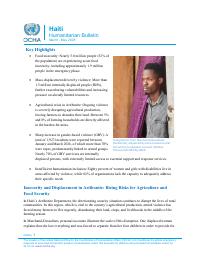
Ayiti, bilten imanitè, mas a me 2026
Rezime — Bilten imanitè OCHA pou Ayiti, mas a me 2026. Prèske 5,8 milyon moun, sa vle di 52 pousan popilasyon an, te nan ensekirite alimantè egi, ki gen ladan apeprè 1,9 milyon nan faz ijans. Plis pase 1,5 milyon moun te deplase entèn. Vyolans te deranje anpil pwodiksyon agrikòl nan Latibonit, ak 5 a 8 pousan fanmi agrikòl ki touche dirèkteman nan zòn ki pi frape yo, epi vyolans ki baze sou sèks te monte anpil.
Dekouve Enpotan
- Prèske 5,8 milyon moun, sa vle di 52 pousan popilasyon an, te nan ensekirite alimantè egi, ki gen ladan apeprè 1,9 milyon nan faz ijans.
- Plis pase 1,5 milyon moun te deplase entèn.
- Vyolans te deranje anpil pwodiksyon agrikòl nan Latibonit, ak 5 a 8 pousan fanmi agrikòl ki touche dirèkteman nan zòn ki pi frape yo, epi vyolans ki baze sou sèks te monte anpil.
Deskripsyon Konple
Bilten imanitè OCHA pou Ayiti, mas a me 2026. Prèske 5,8 milyon moun, sa vle di 52 pousan popilasyon an, te nan ensekirite alimantè egi, ki gen ladan apeprè 1,9 milyon nan faz ijans. Plis pase 1,5 milyon moun te deplase entèn. Vyolans te deranje anpil pwodiksyon agrikòl nan Latibonit, ak 5 a 8 pousan fanmi agrikòl ki touche dirèkteman nan zòn ki pi frape yo, epi vyolans ki baze sou sèks te monte anpil. Nimewo yo kouvri plizyè mwa olye yon sèl, se sa ki fè edisyon sa a klase sou dènye mwa li kouvri a.
Teks Konple Dokiman an
Teks ki soti nan dokiman orijinal la pou endeksasyon.
Haiti
Humanitarian Bulletin
March - May 2026
Key Highlights
•
Food insecurity: Nearly 5.8 million people (52% of
the population) are experiencing acute food
insecurity, including approximately 1.9 million
people in the emergency phase.
•
Mass displacement driven by violence: More than
1.5 million internally displaced people (IDPs),
further exacerbating vulnerabilities and increasing
pressure on already limited resources.
•
Agricultural crisis in Artibonite: Ongoing violence
is severely disrupting agricultural production,
forcing farmers to abandon their land. Between 5%
and 8% of farming households are directly affected
in the hardest-hit areas.
•
Sharp increase in gender-based violence (GBV): A
total of 1,927 incidents were reported between
Young farmer from Marchand-Dessalines
January and March 2026, of which more than 70% (Artibonite), displaced by armed violence that
forced him to abandon his land. ©Claire
were rapes, predominantly linked to armed groups. Pressoir/OCHA/May 2026
Nearly 70% of GBV survivors are internally
displaced persons, with extremely limited access to essential support and response services.
•
Insufficient humanitarian inclusion: Eighty percent of women and girls with disabilities live in
areas affected by violence, while 82% of organizations lack the capacity to adequately address
their specific needs
Insecurity and Displacement in Artibonite: Rising Risks for Agriculture and
Food Security
In Haiti’s Artibonite Department, the deteriorating security situation continues to disrupt the lives of rural
communities. In this region, which is vital to the country’s agricultural production, armed violence has
forced many farmers to flee urgently, abandoning their land, crops, and livelihoods in the middle of the
farming season.
In Marchand-Dessalines, personal accounts illustrate the scale of this disruption. One displaced woman
explains that she lost everything and was forced to separate from her four children in order to provide for
OCHA | 1
The mission of the United Nations Office for the Coordination of Humanitarian Affairs (OCHA) is to Coordinate the global emergency
response to save lives and protect people in humanitarian crises. We advocate for effective and principled humanitarian action by
all, for all. www.unocha.org
them. “I am sometimes forced to beg just to find something to send them, even though I could be
supporting myself,” she says. Before the crisis, she produced nearly 100 barrels of rice, in addition to
other crops. Today, she is unable to access her land.
Violence has also left deep scars on local communities. One farmer recalls witnessing a particularly tragic
event in which a mother and her twelve children were killed while she was trying to find a way to save
them. He, too, was forced to flee Marchand-Dessalines, leaving behind his garden, crops, and livestock—
assets that once generated tens of thousands of gourdes in income.
Like him, many farmers have seen their livelihoods collapse. The violence has created a climate of fear
that prevents people from returning to their fields and has severely disrupted local agricultural production
systems.
Repeated displacement is further worsening the situation. A resident of Marmont, in the commune of
Saint-Michel, explains that he first fled from Petite Rivière de l’Artibonite and later from MarchandDessalines following another attack. Like many others, his family has been displaced multiple times in an
effort to survive.
Host communities are also coming under increasing strain. A member of the Communal Section
Administrative Council (CASEC) - the executive body responsible for administering a communal section
- in Saint-Michel notes that local residents, who were already vulnerable, are now facing the growing
pressure of accommodating displaced populations. He explains that the public markets in MarchandDessalines, which are essential for selling agricultural produce and finding farm-related employment, are
no longer accessible. “It is not only displaced people who are facing difficulties; host communities are
suffering as well,” he emphasizes.
This reality is part of a broader national crisis. Between March and June 2026, nearly 5.8 million people
(52% of the population) faced acute food insecurity, including approximately 1.9 million people in the
emergency phase, while nearly 1.5 million people had been displaced, according to the International
Organization for Migration (IOM, Round 13).
In Artibonite, insecurity is reducing access to farmland, disrupting markets, and undermining livelihoods.
Between 5% and 8% of agricultural households in the most affected areas have seen their production
directly compromised.
Beyond the statistics, the situation demonstrates how violence is profoundly transforming livelihoods and
weakening food security, affecting both displaced populations and the communities that host them
Advocating for Inclusive Humanitarian Assistance in Haiti: The Situation of Persons with
Disabilities1
In Haiti, persons with disabilities remain among the most excluded populations, facing significant barriers
to accessing essential services and humanitarian assistance. Despite Haiti’s ratification of the Convention
on the Rights of Persons with Disabilities and the Inter-Agency Standing Committee (IASC) Guidelines on
1
Article written by Emmanuel Allaramadji of Humanity & Inclusion (HI).
OCHA | 2
The mission of the United Nations Office for the Coordination of Humanitarian Affairs (OCHA) is to Coordinate the global emergency
response to save lives and protect people in humanitarian crises. We advocate for effective and principled humanitarian action by
all, for all. www.unocha.org
Inclusion of Persons with Disabilities in Humanitarian Action, their meaningful participation continues to
be hindered by persistent environmental, attitudinal, and institutional barriers.
Recent data confirms the scale of these challenges. A Handicap International (2023) report found that 80%
of women and girls with disabilities in Port-au-Prince live
in areas affected by violence, where they are particularly
vulnerable to abuse and deprived of their fundamental
rights. They face numerous barriers to accessing
humanitarian assistance, including unsafe transportation,
inaccessible distribution sites, inadequate shelter facilities,
and the lack of inclusive policies within humanitarian
responses. These physical constraints are compounded by
attitudinal and communication barriers. Information about
available assistance is not always accessible in terms of
language, format, or communication channels, while After fleeing his home under gunfire, Wadson
persistent social stigma and discrimination continue to limit Augustin now lives in a displacement site for
their access to available services. A capacity needs internally displaced persons in Port-au-Prince. | © T.
assessment conducted in October 2025 in collaboration Noreille / HI/May 2026
with the CCCM Cluster in Haiti highlights the extent of the challenges. The findings reveal that 82% of
surveyed organizations acknowledge a lack of knowledge and experience regarding the inclusion of persons
with disabilities. This gap represents a major obstacle to the implementation of appropriate and inclusive
humanitarian responses. Furthermore, 82% of these organizations report lacking the technical and financial
resources required to address the barriers identified within their programs. According to recent data from
the Office of the Secretary of State for the Integration of Persons with Disabilities (BSEIPH), more than
500 persons with disabilities living outside displacement sites in the Port-au-Prince metropolitan area were
in urgent need of food assistance (May 2026).
Facing this situation, urgent action is needed. The inclusion of persons with disabilities must become a
cross-cutting priority across all humanitarian interventions. This requires:
•
Genuinely inclusive emergency preparedness and response strategies;
•
The revision of targeting and needs assessment tools to promote the meaningful participation of
persons with disabilities;
•
Strengthened capacity among humanitarian actors to identify and remove the barriers that prevent
persons with disabilities from accessing and participating in humanitarian assistance on an equal
basis with others;
•
The adoption of a twin-track approach to humanitarian response to reach individuals with specific
needs who are often overlooked during general distributions.
In a crisis context, where persons with disabilities can be up to four times more likely to die during
emergencies, ensuring their inclusion is an urgent humanitarian imperative. It is both a legal, moral, and
strategic obligation.
Effectively addressing their needs and ensuring their meaningful participation contributes to the quality and
effectiveness of the humanitarian response in Haiti and supports the achievement of the Sustainable
Development Goals’ « No one left behind » !
OCHA | 3
The mission of the United Nations Office for the Coordination of Humanitarian Affairs (OCHA) is to Coordinate the global emergency
response to save lives and protect people in humanitarian crises. We advocate for effective and principled humanitarian action by
all, for all. www.unocha.org
In Saint-Michel de l’Attalaye, a Dedicated Voice for the Protection of Women
In the commune of Saint-Michel de l’Attalaye, gender-based violence (GBV) remains a major concern. In
a context marked by insecurity and hardship, women and girls continue to face violence that often goes
unseen and unreported, while access to appropriate services - including healthcare, psychosocial support,
and legal assistance - remains extremely limited.
Within the community, Isalène, a dedicated advocate, works through the Saint-Michel de l’Attalaye
Women’s Platform to address these needs. Despite limited resources, she and her team play a critical role
by providing listening services, referrals, psychosocial support,
and, whenever possible, assistance with legal procedures.
“Most of the cases we receive today are linked to the armed
violence spreading across Artibonite. Saint-Michel de l’Attalaye
was already a challenging area, but the situation has now
become extremely serious [...],” she explains.
Over the months, the situation has become increasingly
complex. The center now supports not only survivors from the
commune itself, but also displaced women and girls, particularly
those arriving from the Central Plateau and other areas affected
by violence. This shift reflects the widening scope of the crisis
and the growing movement of populations in search of safety
Isalène Méus, Head of Plateforme des
femmes de Sait-Michel de l’Attalaye, speaking
with a young displaced mother.
©Claire Pressoir/OCHA/May 2026
“...the situation is currently overwhelming us because the number of cases keeps increasing, with at least
three to four new survivors arriving every day, and sometimes even more.”
Behind these numbers are real people. A 16-year-old girl, raped and beaten while fleeing violence, far from
her parents. A three-year-old child, whose body bears the irreversible scars of an exceptionally brutal rape.
And a woman who died in silence, consumed by shame after being raped, unable even to share her trauma
with her own husband.
These stories are not isolated incidents. They reflect a reality that is worsening every day.
The center, originally designed to accommodate around twenty people, is now overwhelmed. “Sometimes
they arrive covered in blood, without clothes, hungry... some with their sick children,” the coordinator
recounts, her voice heavy with emotion. Some flee violence only to fall back into the hands of their abusers.
As recently as this year, two young girls were assaulted by the very individuals who claimed they were
helping them escape.
What is happening in Saint-Michel de l’Attalaye is part of a deeply alarming national crisis. According to
the latest Gender-Based Violence (GBV) report, 1,927 cases of GBV were recorded in Haiti between
January and March 2026, representing more than 20 cases per day. More than 70% of these incidents were
rapes, primarily targeting women and girls and often perpetrated by members of armed groups.
OCHA | 4
The mission of the United Nations Office for the Coordination of Humanitarian Affairs (OCHA) is to Coordinate the global emergency
response to save lives and protect people in humanitarian crises. We advocate for effective and principled humanitarian action by
all, for all. www.unocha.org
Displaced persons, already stripped of their livelihoods and support systems, are among the most
vulnerable. They account for nearly seven out of ten survivors, often with little or no access to healthcare,
psychosocial support, or justice services.
And yet, despite the urgency of the situation, resources remain critically insufficient. At the national level,
only 5.5% of the funding required to address gender-based violence (GBV) has been secured. On the
ground, this translates into overwhelmed centers, disrupted services, and survivors being left without the
assistance they urgently need.
In Saint-Michel de l’Attalaye, the Women’s Platform reflects both the resilience of local communities and
the limitations of the current response. Once supported by humanitarian partners, the organization now
operates with very limited assistance, even as needs continue to rise.
“We need support to keep the center operating. The number of cases is increasing, but we lack the
resources necessary to assist survivors in the way they deserve [...].”
In this context, strengthening access to protection services, healthcare, and psychosocial support is
essential. The commitment of this community leader represents a vital first line of response, but it cannot,
on its own, meet the scale of the needs.
In Saint-Michel de l’Attalaye, as in many other communities across Haiti, this local mobilization
underscores the importance of increased support to ensure adequate assistance for survivors and to
strengthen protection mechanisms in the context of a protracted crisis.
Return of Haitian Nationals: Strengthened Humanitarian Response to Address Needs Upon Arrival
In Haiti, forcibly returned migrants face growing vulnerability in a context marked by increasing flows
and limited reception and protection capacities. Upon arrival, many have extremely limited resources and
face immediate difficulties in accessing shelter, food, water, and basic services. In this context, the
International Organization for Migration (IOM), in coordination with authorities and humanitarian
partners, plays a key role in ensuring reception,
registration, and immediate assistance at points of entry.
This heightened pressure at the border is largely driven by
the continuous rise in forced returns: from nearly 200,000
returnees in 2024 to more than 270,000 by the end of
2025, which represents a 36% increase compared to the
previous year. As of June 2026, over 117,000 Haitians
have already been repatriated since January 2026. The
vast majority (98%) come from the Dominican Republic.
The main entry points (Belladère, Ouanaminthe, Anse-àPitres, and Malpasse) are facing growing pressure,
particularly Ouanaminthe, where peaks of 500 to 600
arrivals per day have been observed. These flows are
placing significant strain on reception and assistance
mechanisms.
Deported migrants gather outside the Border
Reception Center (CRF) in Belladère, awaiting
assistance from IOM and the National Migration
Office (ONM). This safe space provides essential
services to returnees, including food, water, and
basic relief items, helping them regain a measure of
stability as they begin the process of reintegration.
© Antoine Lemonnier /OIM/ 2024
OCHA | 5
The mission of the United Nations Office for the Coordination of Humanitarian Affairs (OCHA) is to Coordinate the global emergency
response to save lives and protect people in humanitarian crises. We advocate for effective and principled humanitarian action by
all, for all. www.unocha.org
Beyond the sheer volume of forced returns, the nature of needs is also evolving, reflecting increasingly
vulnerable profiles. In 2025, 25% of returned migrants were women and nearly 10% were children. IOM
has also observed an increase in the number of forcibly returned pregnant women, breastfeeding mothers,
and young children. As of March 2026, in Belladère and Ouanaminthe alone, IOM registered over 2,900
postpartum women and more than 5,000 children under five years of age, underscoring the importance of
strengthening health and protection services upon arrival.
These trends are accompanied by heightened protection risks, particularly for children and other
vulnerable groups. In 2025, 2,230 unaccompanied children were recorded among returnees – 87%
between the ages of 13 and 17. In a context of persistent insecurity, they face increased risks, including
recruitment by armed groups.
According to IOM data, conditions of return further exacerbate these vulnerabilities. Reports indicate that
47% of migrants are arrested on the road and 25% at their workplace, often without prior notice and
without their personal belongings. In addition, 87% left Haiti for economic reasons, while 20% were
already internally displaced prior to migration and 26% consider leaving again. These compounding
factors intensify the need for immediate assistance and support upon arrival.
Humanitarian efforts remain essential but insufficient. In 2025, IOM provided transportation assistance to
more than 33,000 returnees and mental health services to over 19,000 people. While these interventions
provide crucial support, needs far exceed current capacities.
In this context, strengthening reception, protection, and reintegration mechanisms remains essential. IOM
and its partners' efforts – while providing vital aid upon arrival and gradually building local capacities –
require sustained support to keep pace with rising needs.
A Presence That Matters: Edem Wosornu’s Visit Highlights the Urgency of the Humanitarian
Crisis in Haiti
In March 2026, against the backdrop of a deepening crisis in Haiti, Ms. Edem Wosornu, Director of
OCHA’s Crisis Response Division, visited the country to meet with communities affected by the crisis as
well as the humanitarian actors working alongside them.
Her mission had a clear objective: to gain a deeper
understanding of realities on the ground and advocate for
strengthened international mobilization in response to an
increasingly challenging situation.
In Port-au-Prince, Ms. Wosornu met directly with people
affected by the crisis. At the Community Resource Center
(CRC) in Delmas, the Pierre Labitrie Municipal School,
and the Foundation for Reproductive Health and Family
Edem Wosornu meeting with a young mother
Education (FOSREF) in Pétion-Ville, she engaged with
displaced by armed violence. ©Wilbert
women, children, and displaced families living in
Georges/OCHA/Mars 2026
extremely precarious conditions. These visits helped put
faces to the statistics and provided a tangible understanding of the impact that violence and displacement
are having on the most vulnerable populations.
OCHA | 6
The mission of the United Nations Office for the Coordination of Humanitarian Affairs (OCHA) is to Coordinate the global emergency
response to save lives and protect people in humanitarian crises. We advocate for effective and principled humanitarian action by
all, for all. www.unocha.org
The mission also extended to the Centre and North-East departments. In these regions, Ms. Wosornu
listened to the testimonies of crisis-affected people and humanitarian teams who face hardship every day,
as well as challenges in maintaining essential services. These exchanges highlighted a shared reality:
despite ongoing efforts, humanitarian needs continue to grow faster than the response capacity.
During her visit, the Director met with national authorities, United Nations agencies, NGOs, and
humanitarian partners. Together, they discussed challenges related to coordination, humanitarian access,
and funding shortfalls. All emphasized the urgent need to scale up efforts in a context where available
resources remain insufficient to match the magnitude of the crisis.
In her remarks, Ms. Wosornu expressed her gratitude to the partners supporting the humanitarian response
while issuing a strong appeal to the international community. Above all, she conveyed the voices of the
people she met during her field visits:
“What people want above all else is for the violence to stop, so they can return home and live with
dignity, and live in peace.”
This statement encapsulates the primary aspiration of crisis-affected communities: to regain a normal life
in safety and dignity.
Finally, Ms. Wosornu underscored the importance of strengthening a humanitarian response that is more
closely connected to communities, by increasing support for local actors and remaining firmly guided by
humanitarian principles. Her visit helped shed light on both the severity of the crisis and the commitment
of those working on the front lines.
Faced with a crisis that continues to endure, she emphasized a critical message: without stronger and
sustained engagement from the international community, it will be difficult not only to meet immediate
humanitarian needs but also to support Haiti in advancing toward more durable solutions.
Contacts:
Modibo Traoré, Head of office, OCHA : traorem@un.org
Claire-Emmanuelle Pressoir, Public information officer, OCHA : Claire.pressoir@un.org
For more informations www.unocha.org, www.reliefweb.int,
https://www.humanitarianresponse.info/en/operations/haiti
Humanitarian news is also available on the WhatsApp channel.:
https://whatsapp.com/channel/0029Va9ta4865yDKzOB9wI37
OCHA | 7
The mission of the United Nations Office for the Coordination of Humanitarian Affairs (OCHA) is to Coordinate the global emergency
response to save lives and protect people in humanitarian crises. We advocate for effective and principled humanitarian action by
all, for all. www.unocha.org
Kijan pou site
United Nations Office for the Coordination of Humanitarian Affairs (OCHA), Ayiti, bilten imanitè, mas a me 2026, https://www.unocha.org/haiti
- Moun oswa enstitisyon ki gen dwa yo
- United Nations Office for the Coordination of Humanitarian Affairs (OCHA)