
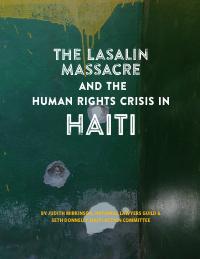
Masak Lasalin nan ak kriz dwa moun an Ayiti
Rezime — Masak Lasalin nan ak kriz dwa moun an Ayiti. Dokiman an gen 16 paj.
Dekouve Enpotan
- Masak Lasalin nan ak kriz dwa moun an Ayiti.
- Rapò delegasyon Judith Mirkinson ak Seth Donnelly, 8 jiyè 2019, sou atak 13 novanm 2018 la.
Deskripsyon Konple
Masak Lasalin nan ak kriz dwa moun an Ayiti. Dokiman an gen 16 paj. Rapò delegasyon Judith Mirkinson ak Seth Donnelly, 8 jiyè 2019, sou atak 13 novanm 2018 la.
Teks Konple Dokiman an
Teks ki soti nan dokiman orijinal la pou endeksasyon.
The Lasalin
Massacre
and the
Human Rights Crisis in
HAITI
By Judith Mirkinson, National Lawyers Guild &
Seth Donnelly, Haiti Action Committee
2
National Lawyers Guild and Haiti Action Committee
The Lasalin Massacre and the
Human Rights Crisis in Haiti
July 8, 2019
Introduction
On November 13, 2018, police and other
paramilitary personnel entered the neighborhood
of Lasalin in Port-au-Prince, Haiti. What followed
was a massacre of the civilian population.
Buildings, including schools, were fired upon
and destroyed, people were injured and killed,
with some burned alive, women were sexually
assaulted and raped and hundreds were forcibly
displaced from homes. Bodies were either burned,
taken away to be disappeared, buried, never to be
found, or in some cases left to be eaten by dogs
and pigs.
There has been widespread acknowledgement
from the Haitian government, mainstream
human rights groups and even the United
Nations occupiers in Haiti, known by the acronym
MINUJUSTH, that something terrible took place in
Lasalin. However, in every case, there has been an
attempt to downplay and obscure what actually
happened. The numbers of the dead and wounded
have been minimized, the extent of destruction to
communities and displacement downplayed, and
the violence has been primarily blamed on “gangs
fighting over territory.”
The Lasalin massacre was designed to punish
and destroy a neighborhood long known as a
stronghold of the grassroots Lavalas movement
and center of opposition. Our investigation
determined that the narrative of “gang warfare”
obscures the reality that the attack on Lasalin
was government-orchestrated and supported,
with police collaborating with and weaponizing
criminal elements. According to many Lasalin
residents and survivors, the coordinator of the
massacre was Pierre Richard Duplan, alias Pierrot,
of the PHTK (Parti Haïtien Tèt Kale, the ruling party
of Jovenel Moise). Duplan had failed in his bid to
become the mayor of Port-au-Prince and was now
the government delegate for the West Department
of Haiti.1 A UN human rights report released on
June 21st, 2019, also implicates Duplan.2 The Miami
Herald disclosed in a May 15th article that a police
investigation had confirmed the involvement in
the massacre of high-level government officials
in the government of Jovenel Moise, tracing an
assault rifle assigned to the National Palace to the
massacre.3 These are just some of the examples of
government involvement in the massacre.
On April 1, 2019, members of the Haiti Action
Committee (HAC) and the National Lawyers
Guild (NLG) went to Haiti to investigate the
November 13th massacre in Lasalin as well as the
ongoing pattern of repression and extrajudicial
killings targeting the people of Lasalin and other
neighborhoods known for their activism against
the government. We found a clear pattern of
paramilitaries/death squads being armed and
abetted by the government in order to terrorize
the population and prevent opposition. This level
of violence and repression has not been seen since
the 2004 coup against President Aristide which,
according to a study published in the medical
journal The Lancet, resulted in an estimated 8,000
deaths in the Port-au-Prince area alone.4
Our team included Judith Mirkinson, President
of the San Francisco Chapter of the National
Lawyers’ Guild; Margaret Prescod, producer of
the “Sojourner Truth” radio program nationally
syndicated on Pacifica Radio and member of
Women of Color/ Global Women’s Strike; Ramiro
Funez, assistant producer of “Sojourner Truth”, and
Seth Donnelly, member of Haiti Action Committee
3
The Lasalin Massacre and the Human Rights Crisis in Haiti
and the California Teachers Association. Margaret
Prescod provided coverage of our delegation’s
findings on “Sojourner Truth” and on “The Real
News Network” television program.5
Report Methodology
On April 1, 2019, our team went to Lasalin and
conducted interviews with residents who had
witnessed the killings and/or who had lost loved
ones in the massacre. We also gathered physical
evidence of the killings. That same afternoon, we
went to an abandoned market in Waf Jeremy and
interviewed some of those residents who had been
forced to flee from their homes in Lasalin.
We followed up these direct interviews on
April 2nd by speaking to Haitian investigative
journalists who had been closely following the
situation in Lasalin, from before the massacre to
the present day. We also met with Haitian human
rights workers.
After our visit, another U.S. human rights
delegation went to Haiti between April 24th and
April 27th to follow up on our investigation. This
second delegation included U.S. Representative
Maxine Waters, investigative journalist Margaret
Prescod, Haiti Action Committee co-founder Pierre
Labossiere, actor Danny Glover, and NLG human
rights attorneys Walter Riley and Brian Cocannon.
The additional evidence gathered by this second
delegation confirms the findings of this report.
As Walter Riley expressed: “We have eyewitness
reports that these attacks are not simply gangs as
they are being referred to by the press and the US
Embassy, but part of militias backed by some in the
Moïse administration. The murder and brutality
is a policy of the Haitian government which is
backed by the United States.” Similarly, Brian
Concannon stated: “I have worked on political
violence cases in Haiti for 24 years and the witness
reports from Lasalin, Tokyo and Site Vincent are
all too similar to other notorious acts of statesponsored oppression ... With the Duvaliers’ TonTon Macoutes, the FRAPH death squads and now
the violent groups under the Moïse administration,
Street scene in Lasalin
4
National Lawyers Guild and Haiti Action Committee
the motive for each has been silencing calls for
justice and democracy and terrorizing government
opponents, while disguising government
participation.”6 Congresswoman Waters said
she was ‘appalled and shocked’ at the killings
and promised to engage with her colleagues in
Congress to use ‘whatever leverage and power we
have to help make the violence cease because this
is not conscionable and not tolerable.’ ”7
In addition to the information collected from
these steps and sources, we have also read
and analyzed reports by Haitian human rights
organizations on the November 13th massacre.
Furthermore, we have extracted corroborating
evidence for our findings from investigative
Haitian journalists and from a public interview
with one of the key perpetrators of the massacre,
former police officer Jimmy Cherizier, aka
“Barbecue”.
Why Lasalin?
Lasalin is a neighborhood with a population
of about 5,000 in the downtown section of Portau-Prince. It is part of the West Department of
Haiti and borders the infamous port of Croix
des Bossales where enslaved Africans were first
brought to Haiti by the French. The port is still
heavily used for commercial traffic. Lasalin has
been known as a stronghold of Lavalas—the
mass popular grassroots party of President JeanBertrand Aristide—ever since President Aristide
was a parish priest there in the St. Jean Bosco
Church. During the Aristide period, hospitals,
housing and schools were all built there in
accordance with policies enacted throughout the
country. These buildings were particularly targeted
during the massacre.
The attack on Lasalin comes at a time of
increasing violence and repression. Starting in
July 2018, there have been massive demonstrations
protesting the theft of 4.2 billion dollars of PetroCaribe money: oil lent by Venezuela to Haiti
which could then be sold for a profit. The extra
money could then be used to fund social programs
in Haiti. Instead, this money simply vanished.
Over three days in July 2018, tens of thousands
protested in the streets demanding an end to gas
price hikes, an accounting for the missing funds
and the resignation of President Jovenel Moise.
The demonstrations brought Port-au-Prince to a
virtual standstill and resulted in the resignation
of Prime Minister Jacques Guy Lafontant. The
demonstrations, which are met with tear gas,
rubber bullets, and live ammunition continue to
the present day.
Timeline of Events
Based upon extensive interviews with Haitian
human rights workers, journalists, and the
residents of Lasalin, we have constructed the
following timeline of events leading up to and
following the November 13th massacre.
n On October 13, 2017, a government delegation
including Haitian First Lady Martine
Moise and then Minister of the Interior
Roudolphe Saint Albin went to Lasalin and
met with Herve Bonnet Barthelemy, known
as “Bout Jan Jan”, and other community
leaders. Among other matters discussed, the
government delegation asked these leaders
not to allow anti-government, opposition
demonstrations within and through Lasalin,
as well as in Saint Jean Bosco, an area in front
of the nearby Tokyo neighborhood, close to an
intersection frequently used for protests.8
n On October 15, 2018, representatives of the
political opposition held a press conference
in Lasalin, supporting the PetroCaribe
movement and demanding the end of the
government of Jovenel Moise.9
n On October 17, 2018, a national holiday
commemorating the death of Haitian
revolutionary leader Jean Jacques Dessalines,
people in Lasalin refused to welcome
President Jovenel Moise who came to the
neighborhood in order to lay the traditional
wreath at a monument for Dessalines.
The Lasalin Massacre and the Human Rights Crisis in Haiti
Instead, Moise’s presence was protested
vigorously by the community. Police
responded with gun fire. Moreover, there was
a massive Petro Caribe protest that occurred
within and passed through Lasalin that day.10
n According to Lasalin residents, First Lady
Martine Moise visited Lasalin in October, 2018
days before the killings started in November.
She reportedly tried bribing the community
with offers of money. Her attempt to secure
their loyalty was unsuccessful.
n On November 1, 2018, a holiday known
as “All Saints Day”, Serge Alectis aka “Ti
Junior,” leader of Chabon—a paramilitary
force working with the government—led an
attack on Bout Jan Jan and Julio Pyram, aka
“Kiki” in Lasalin, killing Kiki along with four
others, and wounding Bout Jan Jan.11 Police
subsequently arrested Bout Jan Jan in the
hospital despite community opposition
and he remains imprisoned to this day.
According to community members who
met with us, Chabon was the only group
in the larger area that had wanted former
President Michel Martelly (who had
picked Jovenel Moise to be his successor)
to come to the neighborhood to perform
during the past Mardi Gras festivities.
n On November 13, 2018, Ti Junior and
his group Chabon returned to Lasalin—
heavily armed—and carried out the
massacre. They were accompanied by
other government-backed paramilitary
elements, including the police officer
Jimmy Cherizier, alias “Barbecue,” police
officer Gregory Antoine, alias “Ti Greg,”
and other police officers. The perpetrators
used several vehicles, including an
armored truck given to them by the
Brigade of Operation and of Departmental
Intervention (BOID), and several public
transport vans. The residents reported
that several police units, including
5
one from BOID and Departmental Unit to
Maintain Order (UDMO), involving officer
Gustave Jouspite, were heavily involved in
supporting Chabon, including providing them
with munitions. The massacre, which started
on November 13, continued intermittently
for the following several days.12 On June
21, the UN finally issued a report on the
massacre that implicated Pierre Duplan as
a coordinator, just as Lasalin eyewitness
survivors had been doing since November.
According to the UN report, Duplan reportedly
admitted to direct communication with
perpetrators of the massacre on the ground in
Lasalin.13
Lasalin residents and Haitian journalists with
Radio Timoun reported that there were as many as
eight attacks by government-backed paramilitary
Aristide era housing
with bullet holes.
6
National Lawyers Guild and Haiti Action Committee
forces on the people of Lasalin between the
November 13th massacre and our arrival in Lasalin.
In an interview with a Radio Timoun journalist
who has reported consistently from Lasalin, we
were told that over the last week in March one
paramilitary attack burned down a popular
market and killed 13 people. While in Lasalin, this
reporter saw the remains of people who had tires
put around their necks and were then burned to
death.14
The Police and Right Wing
Activists Boast of Their
Roles in the Massacre
Former Police leader Jimmy Cherizier (Barbecue)
publicly stated that he had a number of police
officers in his group block escape routes from
Lasalin during the November operation. This
statement corroborates the testimony given by
survivors in Lasalin accusing him and other police
officers of participating in the massacre. Cherizier
has denied support from the government for his
organization, correctly identified as a death squad
They also took us to a small school riddled by bullets. We were told
that five students and two teachers had been killed there.
by survivors. Yet, this denial is to be expected given
Barbecue’s high profile status as a member of the
PHTK and as someone who remains uncharged and
at large. Significantly, Barbecue does publicly thank
Reginald Boulos—widely regarded by the Haitian
public as a right-wing oligarch—for his financial
support. Boulos had been integral in financing the
2004 coup against the democratically elected and
popular President Jean-Bertrand Aristide. During
a radio interview, Boulos admitted that he was
financially supporting paramilitary elements,
claiming that they were providing social programs
when the state was absent.15
Counting the Victims
Due to the fact that so many bodies were taken
away and so many people displaced, it has been
difficult to get an accurate number of those killed,
injured and/or sexually assaulted The ages of
those attacked on November 13th and the days
following, ranged from 10 months to 72 years.
One Haitian human rights organization, RNDDH
(Réseau National de Défense des Droits Humains),
did interview many residents, and was able to
identify 71 murdered. However,
residents and local human rights
defenders maintain that this
number is deplorably low, based
only on the number of bodies
actually left on the ground and
not taking into account either
those buried or taken away.16 The
RNDDH report lists the names
of the victims and describes in
detail how each victim was killed,
some being hacked to death
with machetes with their body
parts fed to pigs, some being
burned alive, others being riddled
with bullets.17 The methodology
employed by the RNDDH to reach
these findings involved, among
other steps, interviewing four
hundred and thirty-nine (439)
7
The Lasalin Massacre and the Human Rights Crisis in Haiti
community members of Lasalin including victims
and victims’ relatives. The December 1, 2018 report
concludes with a decisive classification of the
November 1st killings as a “state massacre” and
categorically states that the killings could not
have occurred without the current government’s
support—on all levels—for the perpetrators.
French journalist Amelie Baron, reporting for
Agence France-Presse from Haiti, initially placed
the number at 283 in an article that no longer
seems to be available online.
Journalists and human rights workers who
visited the scene shortly after the massacre told
us: “We will never know how many were killed”:
many bodies were not identified, their surviving
family members having been forced to leave
the area. Other bodies and remains were soon
disposed of; religious leaders claimed some, while
many others, including those burned beyond
recognition, were simply taken away by garbage
trucks and dumped somewhere. Many people
were also brought to hospitals: it’s estimated that
hundreds were wounded in the attacks. Then
there are tho se who were simply jailed, no records
being taken. None of these additional numbers
are accounted for in any issued reports. Since the
PetroCaribe protests which began in the summer
of 2018, hundreds have randomly been thrown in
jail, without charges, never having seen a judge.
Women were assaulted and raped—some left
pregnant. One 14-year old girl raped by Ti Junior
actually went to radio stations to report the crime,
but could not get help. Due to the continuing
stigma surrounding rape and because many were
forced to flee, the true numbers of those sexually
assaulted is not known.
teeming with people, was eerily empty. No one
was on the streets, and the houses—many of
which were shot up, burned and/or completely
destroyed—were abandoned. Upon our arrival we
were told that the situation was still precarious
and that people had to be off the streets completely
by 4 PM. We were met by a group of about 15 to
20 community members, consisting mostly of
women of different ages who were anxious to give
testimony about the massacre. They guided us
down a main street, showing us housing, including
affordable housing units built during Aristide’s
presidency, that had been shot up by heavy
munitions with bullet holes measuring 2-3 inches
across.
One person after another described how
their relatives were killed, many hacked and/
or burnt to death. People we interviewed said,
“This neighborhood has been made a mausoleum.
There is no water, no hospital and no school.”
They repeatedly told us, “This is a humanitarian
crisis. People are not living as human beings.”
Photographs of the aftermath document bodies
being left to rot, to be eaten by pigs or dogs. Others
Interviews with Residents
of Lasalin: Conducted
on April 1, 2019
Our human rights delegation visited Lasalin
on Monday, April 1st, during the late morning
and early afternoon. The neighborhood, usually
Bullet hole in
the chalkboard
of the school.
8
National Lawyers Guild and Haiti Action Committee
show bodies that had been hacked and then
burned.
What follows is testimony we gathered from
community members during our visit to Lasalin.
Translation was provided on the ground during
our meeting in Lasalin by a Haitian professional
translator. The names of the people who provided
testimony have been altered for their protection.
From Mildred, a young pregnant woman:
“On November 15, my husband was in the house
with me and they grabbed him and used the
machetes to kill him… I lost my husband while I’m
pregnant.”
She thinks she’s due next month and has no
access to healthcare. She pointed to her shoeless,
swollen feet. She’s sleeping now by the ocean
where there’s “bad breeze” and no proper food.
From Jeanne:
“I lost my 28 year-old son. He was burned and I
also lost my husband. Why?”
“This community, Lasalin, has a reputation of
revolution. We don’t stand with dictatorship since
the Macoutes and Duvalier. And still now. Children,
youth, and adults here have the blood of revolution.
That’s why the government doesn’t like this
community...So what’s happening is that the death
squad involved in these killings has been living
in a [nearby] neighborhood ‘Na Chabon’. They’ve
been involved in sexual assaults, they’ve been
involved in raping women, and because of this, the
community [Lasalin] decided that they would keep
them away. But because of this, they [the death
squad named ‘Chabon’] got together with Martine
Moise, the First Lady of Haiti, who helped them
to come back after 6 years to really terrorize the
population and kill people.”
“One thing that is very important for us—you
can see these houses—they were houses that
President Aristide built… People who were
living there had to leave and go into a displaced
community because they can’t live here.”
“On March 13, 2019, there was a huge incident
where they murdered some people in this
community and even burned them. Right now the
place where this happened… you can see some
of the skeletons that were burned. But also this
community is using the place as a mausoleum in
memory of all the people who died. It is the house
where the people were living and we decided to
keep it as a mausoleum.”
“So the whole community...is essentially living
through the women being vendors on the street,
selling whatever they can find. Like a young child
here in Lasalin is selling something. It can be a
small fish, it can be a little bit of fried food, street
food. But since this happened, if the children can
no longer be involved in these kind of vending
activities, it can be worse. This makes the situation
of hunger really awful in this community. I have
not had anything to eat since Saturday.” [she was
speaking to us on Monday]
“So right now people in Lasalin aren’t living as
human beings should be living. They [the death
squad] steal everything that people own in this
community. Now the people have no resources
to take care of themselves. And during the day
you can see that there’s still a lot of people in
the community, but when it gets to be 4 or 5, you
will see that people will be spreading, looking for
places under bridges, next to the water, to leave the
neighborhood, because it will be dark and anything
can happen with the same group coming back just
to attack…”
“Yesterday there was shooting going on, but
today not yet. But at any time, around 2 PM, they
might come back…”
The Lasalin Massacre and the Human Rights Crisis in Haiti
From Daniel:
“I lost my son.”
“Right now the community of Lasalin has lost
everything. Over there you can see the building
without the window. It’s a building that used to be
a well-known hospital. Now it’s gone…”
“Lasalin used to have water access. Now we
don’t have it anymore. The people in Lasalin used
to find their own ways to survive, but after the
incidents, things got worse. That’s why the people
of Lasalin aren’t just calling for legal assistance for
what happened, but also calling for humanitarian
assistance….”
“Most of the people in this community have
escaped and fled because they fear so much from
new attacks... I’m under threat because I’ve been
involved in reporting to human rights organizations. We’ve heard threats…. Since the massacre, no
one from the government comes here to really talk
with us. The prime minister at the time [Ceant]
said that all of the pictures [of the massacre] that
were in the media and the social media were not
real pictures from November, but that these were
pictures from 2004 [the year of the coup].”
“... we need to find justice for what happened,
for people who’ve lost loved ones, for people who
didn’t even find the bodies of their close friends
and relatives to even have a decent funeral. For all
of this, the people of Lasalin want justice. And they
know justice won’t come from this government.”
From Annette:
“I had a child who was 24. And he was not
someone involved in any trouble activity. He was
an artist and a DJ who helped with music. He was
inside, the group came in, killed him, cut him up
with machetes, and burned him. Many others have
lost loved ones like this. My house was ransacked.
I’m now dealing with hunger. After all of these
massacres have happened here, it’s nonsense that
people have to escape from the community they
were born in and have to go live by the ocean
where there’s bad breeze [toxic air]...The President
should have someone sent here, maybe a minister
9
or maybe a director of somewhere, to talk to the
victims, but the President is actually working with
the death squad. They become his entourage. They
become his people and this way the people of
Lasalin constantly live under fear, the threat that
something can happen.”
From Paulette, an older woman with a skin rash:
As explained by a man next to her—“Her son
was cut up in front of her and because of this
trauma was so bad that she had all of this [rash].
In her words—“They shot him, then cut him up,
and burned him.”
He was 32 years old.
Jeanne went on to say:
“The people you see here are the fearless. They
want to come here [to talk with you] because they
have no fear. There are people who… don’t want
to come back to this community. They’ve seen too
much. They stay by the water...
“The group that perpetrated this is Chabon.
They are connected with the government and are
working with the government in the Ministry of
the Interior. This group [Chabon] was supportive
of Martelly during the election. They [the people
of Lasalin] did not want Martelly to come into
Lasalin, but this group was very supportive of
Martelly… What they [Chabon] claim is that
they have to control this community because
this way they would really control the situation.
And they want this community to become PHTK
10
National Lawyers Guild and Haiti Action Committee
[ruling government party]. But this will remain
opposition.”
From Jean, a young man:
“I want to see more follow-up from this human
rights delegation because what’s going on in
Lasalin right now is something that needs to
stop, because what’s going on here in Lasalin is
political. It’s really orchestrated by the actual
government that pays these guys to perpetrate all
of these violations….And now they have all kinds
Photo at the “mausoleum;”
remains of a pregnant woman
burned alive and then left on
the floor.
of systems to torture people, like the burning of
people. They would set the person on fire while
alive. This has really traumatized the whole
community. All of this is being orchestrated by a
department delegate named Pierrot who is under
the PHTK [and] who wanted to become a mayor
under the party but couldn’t elected…. [so] he
assigned guys like Junior who used to live in the
community but who was kicked out because of his
involvement in sexual abuse…. All the people who
participate in the massacre, they have pictures.”
Jean further explained to us that community
members are also demanding that Bout Jan Jan, a
leader of the community who provided protection
be freed. “Martine Moise, the wife of President
Jovenel Moise, tried to bribe Bout Janan so that
he would discourage people to protest against
the government. Bout Janjan did not do this.
Consequently, he was arrested. While he was
arrested, the opportunity was created for Chabon—
armed with weapons from the government—to
attack the community.”
Another young man showed us a photo of his
brother who had been killed, knifed to death, and
then had his naked body put out on display.
The Conditions of
Lasalin Refugees Now
Living in Waf Jeremy
After leaving Lasalin, we travelled to Waf
Jeremy, an area next to the sea port. There, we
interviewed refugees from Lasalin who were
barely surviving in an abandoned market. Men,
women, children, and babies were all living
together below cold, damp concrete market stalls
draped with blankets or just cardboard on cement
floors. The floors were teeming with bugs that
would bite them on the cement floors where
they slept. There was no plumbing, no toilets, no
source of potable water and no food. The air was
thick with a toxic, burning plastic smell which
was making people sick. This was the place they
were forced to call home. Thus far, no one from the
government had visited them and/or attempted to
offer any relief or reparations
People explained that they had to flee Lasalin,
many of their relatives having been killed and their
homes destroyed. There were perhaps 50 people
living on the floor under the stalls in one large
room. Adjacent market rooms were also packed
with people. We estimated that hundreds were
living, with scant resources, in these conditions.
As one older woman put it: “This is the worst
situation in my life. I have nowhere to live as my
house was burned. I left with no clothes—someone
The Lasalin Massacre and the Human Rights Crisis in Haiti
11
told us she had delivered her daughter right there
on the concrete floor. Without food for herself,
she was unable to properly nurse the baby, who
appeared ill and despondent. There was no medical
care. To our delegation, it appeared that the baby
was on the verge of death.
The Killings and
Massacres Continue
n On April 2 we interviewed women active in
grassroots organizations. Betty, a founder
of the popular organization Conscious and
Devoted Women, told us: “ The repression
is reaching new heights and the country is
going deeper into chaos. We’re facing a wall.
There is a deep feeling of insecurity and
terror, even felt by those with money! Just on
my way to this interview, today, I saw three
bodies with bullet holes in their heads.”
had to give me a dress. I have no money and only
one person to help me at all.”
Below one stall we encountered a young mother
and her one month old baby daughter, The mother
n On April 24 and 25, there were attacks on the
nearby, popular neighborhoods of Tokyo and
Kafoufey. One Haitian reporter was trapped
in Kafoufey during the attack.
12
National Lawyers Guild and Haiti Action Committee
n Since then killing and massacres by the
police and paramilitary affiliates have been
reported in different parts of the country, tar-
geting popular neighborhoods and grassroots
activists. On June 18, Radio Timoun reported
a massacre in Village de Dieu. Since then,
multiple media and eyewitness reports have
documented that the perpetrators—including
the group led by Jimmy Cherizier, alias Barbe-
cue—burned some bodies and removed others,
making it difficult to determine the number
of victims. Though further investigation is
required to determine the number of victims,
preliminary reports indicate that dozens of
people were killed.One photograph shows
only the legs left of a victim after the remaining body had been burned. More recently, re-
ports are reaching us that between June 23–24,
police and paramilitary affiliates violence
and killings in both Akay (Les Cayes) and Kap
Ayisyen (Cap Haitien). The numbers of people
injured and killed are yet to be determined.
Street in Lasalin.
n On June 24, as reported by both Radio
Timoun, Vision 2000, and other Haitian radio
stations, Presidential security police units
CIMO and USGPN, working with paramilitary
affiliates, opened fire on demonstrators in
Port-au-Prince, killing perhaps as many as
30. Bodies were removed and it is hard to
determine the exact number of those killed
without further investigation. USGPN is
infamous in Haiti for human rights abuses.
Political Prisoners:
As a separate part of our investigation we also
met with human rights lawyers from the office of
Cabinet Masionneuve & Associes in order to hear
about further aspects of government repression.
Hundreds of people have been arrested since the
first anti-government demonstrations began in
August. Often, those arrested are summarily thrown
in jail with no paperwork or any charges. Families
are forced to wait for days in order to determine
where their relatives are being held. If they are
lucky, they can locate them, but then charges
must be filed and lawyers have to go through the
complicated process of even getting a hearing.
The Lasalin Massacre and the Human Rights Crisis in Haiti
Testimony of Madame Joseph
“There were protests on July 6–7, 2018. However,
my son, was not involved. He was not even in the
neighborhood in those days. In the aftermath of
the demonstrations, the police were still ‘cleaning
up.’ In the ensuing ‘sweep’ of Arimage, nine were
arrested, including my son. After three days, he
tried to get a hearing, but ironically the prosecutor’s
office was on strike and he was sent directly to
the penitentiary. I tried to find him for three days,
going from office to office and finally found him.
I ‘ve had to spend all my money and leave my
housing just to provide him with clothes and food.”
Testimony of Antoine
“I still don’t understand what happened. I was
in my house getting ready to go to church. The
police broke into the house and arrested me—I
was arrested with my Bible! I was beaten and
taken away. My mother didn’t know where I was,
she thought I had been killed. I was still in school
in the twelfth grade and missed my exams. I
was in a cell with 40 other people, many of them
criminals. The conditions are horrible, it’s dirty,
13
you can’t even lie down and there is no food and
it’s very violent. I was afraid all the time. I should
be compensated for what happened to me.”
Testimony of Pierre
“I was on November 22, 2018 at 6 AM. I’m a
mason and I was leaving home for a construction
job when I was arrested. I was beaten so bad that I
really thought I was going to die. I was kidnapped
and disappeared. There are 50–60 people in a cell
and usually there is a “boss” who often is armed.
So it is very dangerous.”
“Thank goodness for mothers. Without mine
I would have had no food or clothes because the
prison gives you nothing.”
These scenarios are repeated again and again.
One of the attorneys, Marc Antoine
Maisonneuve summed it up: “There is no paper
trail, no facts, no case, no record. Sometimes we
get lucky and get a sympathetic judge or halfway
decent prosecutor and we can get them out. But
the number of prisoners is overwhelming and we
don’t have enough attorneys to help them.”
Conclusion
It is our finding, based upon our investigation,
that the Lasalin massacre was directed and
facilitated by the Moise/ PHTK government.
Lasalin was chosen as the target for this massacre
because of its significance as a base of resistance
and a staging ground for anti-government
protests. This was certainly a reason why First
Lady Martine Moise went to Lasal in in October
2018 and attempted to convince community
leaders to stop the protests.
The massacres are continuing. Due to a lack of
systematic data collection, it is still unclear how
many have been killed, how many injured and how
many displaced. However, it is not overestimating
to say that these numbers may actually be in the
hundreds and perhaps more. It is essential that
complete data must be obtained and analyzed.
The evidence of government and paramilitary
collusion is clear. At first, the government and
others in the media claimed the killings were
horrific but that they were just the result of gangs
fighting over turf. However, it has been confirmed
that leaders of the killings arrived with the police
and the subsequent massacre had both police
protection and participation. Reginald Boulos has
also publicly admitted to financing paramilitary
leaders involved in the massacre. Pierre Duplan,
the PHTK delegate for the West Department of
Haiti, has also been implicated as a coordinator of
the massacre. While the government may support
his prosecution and try to paint the massacre as
one carried out by a “rogue” official and “rogue”
14
National Lawyers Guild and Haiti Action Committee
police officers in coordination with “gangs,” it is
clear that responsibility extends to the highest
level of the ruling party and government. A
thorough investigation must be held and those
responsible must face charges. The people injured
and displaced should receive reparations and be
guaranteed the right to return to Lasalin and their
homes with full security.
It is also imperative that there be an
investigation into the role of the US embassy and
government in both the election of Jovenal Moise
and the ensuing corruption and human rights
abuses. Jovenel Moise was placed into power
through a fraudulent November 2016 elections
held under UN occupation and aided by the U.S.
government. Despite overwhelming evidence
of fraud, the U.S State Department immediately
heralded the elections as legitimate and proceeded
to continue to provide the Haitian government
with financial and diplomatic support. At the
same time the United Nations, while announcing
preparations to leave Haiti, continued to train and
create a militarized police force.18 “Since 2010, the
United States has provided $259.9 million to train,
equip, and provide technical assistance to the
Haitian National Police.19 Clearly, without the U.S.
government’s active intervention in the domestic
affairs of Haiti, the Moise government would
never have come to power. As the toll mounts from
the atrocities committed in Lasalin, it is time for
both the United States and the United Nations to
be held to task for their continued support of the
repressive and illegitimate regime now in power
in Haiti. The people of Haiti deserve the right to
live without the daily threat of state-directed
violence. n
Report Authors
Seth Donnelly is a public high school teacher in the Bay Area of California, where he has taught social studies for
nearly two decades. He has been an activist with the Puerto Rican independence and Black liberation movements, doing
solidarity work with prisoners from those movements. He has also been involved in the Haiti Action Committee since
2004. He is the author of the 2005 report Growing Evidence of a Massacre by UN Occupation Forces in Port-au-Prince
Neighborhood of Cité Soleil: a Summary of Findings of the U.S. Labor and Human Rights Delegation to Haiti (Berkeley: U.S.
Labor and Human Rights Delegation to Haiti, July 12, 2005). Donnelly has also co-authored 2005 human rights petitions
filed with the Inter-American Commission on Human Rights censuring the U.S. and Brazilian governments for their roles
in the killings of Haitian civilians following the 2004 coup.
Judith Mirkinson is a long term women’s and human rights activist. She has spent decades doing international solidarity
work and is a co-author of the NLG 2007 report: Seeking Answers: Probing Political Persecution, Repression & Human
Rights Violations in The Philippines. Her most recent article is: We Are Seeing Ourselves Being Dragged Back Into a Time
When Women Were Dehumanized: Sexual Violence As a Tool of Repression in Haiti.
She is president of the SF/Bay Area Chapter of the NLG.
All photos by Judith Mirkinson for the delegation.
Cover image: Part of a wall within an elementary school that was shot up. Two teachers and five students were killed as a result.
The Lasalin Massacre and the Human Rights Crisis in Haiti
15
Endnotes
1.
RNDDH, The Events in La Saline: from Power Struggle between Armed
Gangs to State-Sanctioned Massacre, December 1, 2018, p.13. Lasalin
residents also told our delegation that Duplan was involved in coordinating the massacre.
The interview with Reginald Boulos was conducted by a reporter with Radio Sans Fin, a progressive media outlet, on April 25, 2018.
One journalist, Rospide Petion, with this radio station was subsequently assassinated on June 10, 2019.
2.
https://minujusth.unmissions.org/en/minujusth-and-ohchr-release-report-violent-events-13-and-14-november-la-saline, full report
in French: https://minujusth.unmissions.org/sites/default/files/minujusth_hcdh_rapport_la_saline.pdf
Translations provided upon request.
3.
“Dozens brutally killed, raped in Haiti massacre, police say. ‘Even
young children were not spared’”, Jacqueline Charles, Miami Herald,
May 15, 2019, updated May 17, 2019, https://www.miamiherald.com/
news/nation-world/world/americas/haiti/article230380739.html.
4.
Athena Kolbe and Royce Hutson, “UN Peacekeepers in Haiti,” The
Lancet vol.368/ issue 9538 (September 2, 2006). 8000 people were
killed within a one and half year period after the 2004 coup.
5.
For coverage on “Sojourner Truth”, see https://soundcloud.com/sojournertruthradio/sojourner-truth-radio-april-5. For coverage on the
“Real News Network,” see https://www.youtube.com/watch?v=k6kQH-_IrAg&=&t=529s and https://www.youtube.com/
watch?v=Vz64mWYpO9Q
6.
Margaret Prescod, “Human Rights Delegation Condemns Political
Massacres Tied to Haiti’s Government,” Press Release, May 8, 2019.
7.
Representative Maxine Waters, “Congresswoman Waters Leads Delegation to Haiti; Finds Both Inspiration and Evidence of Violence”,
Press Release, May 13, 2019.
8.
RNDDH, The Events in La Saline: from Power Struggle between
Armed Gangs to State-Sanctioned Massacre, December 1, 2018, p.5.
9.
Ibid, pp.5-6.
10.
Le Nouvelliste, “La Police Tire a Hauteur D’Homme au Pont-Rouge”
(October 17, 2018). Also, see Le Nouvelliste’s video coverage https://
youtu.be/UX-ac8kDFzM.
For additional video evidence of police shooting at demonstrators on demonstrators, see Kodinasyon Depatmantal Lwes Fanmi Lavalas https://www.facebook.com/1421526351403611/videos/2276771565875806/
11.
RNDDH, The Events in La Saline: from Power Struggle between Armed
Gangs to State-Sanctioned Massacre, December 1, 2018, p.6.
12.
Ibid, p. 7
13.
https://minujusth.unmissions.org/en/minujusth-and-ohchr-releasereport-violent-events-13-and-14-november-la-saline, full report in
French: https://minujusth.unmissions.org/sites/default/files/minujusth_hcdh_rapport_la_saline.pdf
14.
Interview with Radio Timoun staff, April 1-2, 2019
15.
The interview with Barbecue was published on Youtube on December 27, 2018 under the title “Massacre ‘La Saline’ Jimmy Cherizier
(Barbecue) Les Bandits ‘Legal’ dans la police Haïtienne.” The interview was conducted by Bob C, a Haitian radio host and well-known
PHTK supporter. https://www.youtube.com/watch?v=BILs2IflG-A
16.
RNDDH, Massacre d’Etat à La Saline: Révision à la hausse du bilan
des personnes tuées et violées le 13 novembre 2018, (December 20,
2018).
17.
RNDDH, The Events in Lasaline: from Power Struggle between Armed
Gangs to State Sanctioned Massacre, p.8.
18.
Here are but a few examples of the fraud uncovered:
• After Fanmi Lavalas, Haiti’s most popular political party successfully challenged the elections in Haitian court, Lavalas obtained a court
order to investigate the election results. Dr. Maryse Narcisse, the Lavalas candidate for president, then visited the Vote Tabulation Center
shortly after the elections, to investigate the results. She was joined
by election officials, observers, representatives of another contesting
smaller party Meksepa and of the ruling PHTK party.They examined
78 randomly selected vote tally sheets (proces verbaux), and all present agreed that every one of the 78 tally sheets was fraudulent, without exception. The US-backed CEP election commission then abruptly ended the legally-mandated verification process —invalidating
those 78 particular tally sheets, but failing to check the over 13,000
tally sheets remaining to be verified. With that, the CEP inexplicably
accepted the fraudulent election “results” as legitimate.
• Deputy A.R.Bien-Aime and 2 other PHTK candidates made a startling revelation about UNOPS, a U.N. agency assigned to transport
ballot boxes to the Tabulation Center. They charged that while in
U.N. custody, the ballot boxes were switched en route with boxes of
pre-filled-out ballots. In addition, a National Palace official was involved in a vehicle accident in which pre-filled-out ballots, marked
for the Presidential candidate of Martelly’s PHTK party, Jovenel
Moise, were spilled on the road.
• 15 prominent Haitian intellectuals, outraged by “clear involvement
of U.N. agencies in the fraud that marred the elections,” wrote an
Open Letter to the U.N. Mission stating, “the whole world is discovering, under pressure from the street …the truth of the biggest electoral fraud operation…for the last 30 years in Haiti.”
* Also, see: Board, The Editorial. “Opinion | Haiti Deserves a Legitimate Election.” The New York Times, The New York Times, 19
Jan. 2018, www.nytimes.com/2015/12/13/opinion/sunday/haiti-deserves-a-legitimate-election.html?_r=1.
19.
As quoted in a letter dated April 18, 2019, by Charles S. Faulkner,
United States Department of State, to Representative Anna Eshoo,
United States Congress.
Resources on Haiti
Articles
Books
We Will Not Forget: The Achievements of Lavalas, by
Haiti Action Committee <https://politicaleducation.
org/wp-content/uploads/2017/04/wwnf.pdf>
The Black Jacobins: Toussaint L’Ouverture and
the San Domingo Revolution by CLR James,
<https://politicaleducation.org/wp-content/
uploads/2017/04/CLR_James_The_Black_Jacobins.
pdf>
“The Haitian Revolution: A Past Forever Present”,
speech by Mildred Trouillot Aristide (March 31,
2017), <https://haitisolidarity.net/voices-from-haiti/
the-haitian-revolution-a-past-forever-present-bymildred-aristide/>
Eyes of the Heart: Seeking a Path for the Poor in the
Age of Globalization by Jean-Bertrand Aristide,
<https://www.powells.com/book/eyes-of-the-heartseeking-a-path-for-the-poor-in-the-age-of-globaliza
tion-9781567511871/2-6>
“Crisis and Resolution: Fanmi Lavalas Statement,
11/15/2018 <https://haitisolidarity.net/crisis-andresolution/>
An Unbroken Agony: Haiti, From Revolution to
the Kidnapping of a President, Randall Robinson,
<https://www.amazon.com/dp/B001AQJ2XO/ref=dpkindle-redirect?_encoding=UTF8&btkr=1>
Films
Haiti: Harvest of Hope by Kevin Pina
https://haitiinformationproject.net
We Must Kill the Bandits by Kevin Pina
https://haitiinformationproject.net
Massacres in Haiti by Margaret Prescod
available upon request.
Haiti Action Committee is a Bay-Area based network of activists who have
supported the Haitian struggle for democracy since 1991.
Learn more at haitisolidarity.net
National Lawyers Guild (NLG)
Dedicated to the principle that human and civil rights are more sacred than property rights,
the National Lawyers Guild seeks to unite lawyers, law students, legal workers and jailhouse
lawyers to function as an effective political and social force to protect and
defend communities, social justice movements, and political and grassroots
organizations and activists advocating and organizing for those rights.
For over 80 years, the National Lawyers Guild has served as the legal
arm of movements leading the fight for meaningful social change in the
United States. As a progressive and leftist legal organization, the NLG has
represented and defended activists in the courtrooms and on the streets.
Learn more at nlg.org or nlgsf.org
Kijan pou site
National Lawyers Guild; Haiti Action Committee, 2019, Masak Lasalin nan ak kriz dwa moun an Ayiti, https://nlg.org/wp-content/uploads/2019/07/The-Lasalin-Massacre-ONLINE-7-11-19-Nat-NLG.pdf