Teks ki soti nan dokiman orijinal la pou endeksasyon.
HAITI
Population
million
GDP contracted for an eighth consecutive year in FY2026
amid entrenched insecurity, which has displaced 1.5 million
people and contributed to rising poverty. Inflationary pressure has eased modestly, but a resumption in monetary financing of the deficit puts progress at risk. A gradual recovery
from FY2027 onwards will depend on security conditions, expansion of social assistance programs, progress towards elections, and resolution of trade and migration uncertainties.
Key conditions and challenges
Haiti is navigating a deepening crisis-fragility trap. Structural challenges include weak competition, an unconducive business environment, low human capital, and informal, low-productivity employment. A series of shocks have compounded these challenges.
In late October 2025, Hurricane Melissa hit Haiti's southern departments, disrupting agricultural output in a region where about onequarter of jobs are tied to the sector. Intensifying gang violence has
deepened an already severe humanitarian crisis, with 5.8 million
people facing acute food insecurity (IPC Phase 3 or above) by June
2026. The suspension of United States (US) commercial flights and
intermittent border closures with the Dominican Republic have further isolated Haiti, constraining domestic resource mobilization.
1
years
School enrollment
4
4.1
3
65.1
GDP
2
millions living on less than $3.00/day
11.9
Life expectancy at birth
Poverty
5
current US$, billion
32.1
primary (% gross)
184.0
GDP per capita
6
current US$
2694.2
Sources: WDI, MFMod, and official data. 1/ 2025. 2/ 2012 (2021 PPPs). 3/ 2024.
4/ 2016. 5/ 2025. 6/ 2025.
United Nations Security Council’s authorization of a 5,500-member
Gang Suppression Force (GSF) marked a potential turning point,
though its operationalization has been gradual.
Recent developments
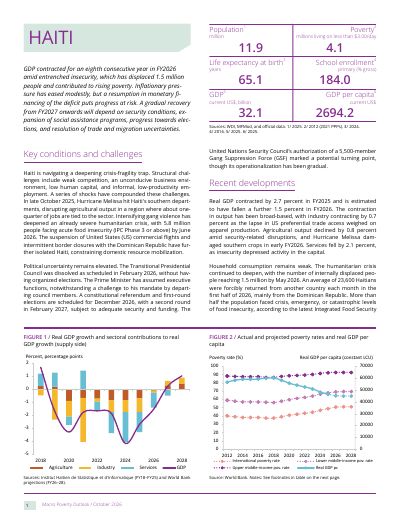
Real GDP contracted by 2.7 percent in FY2025 and is estimated
to have fallen a further 1.5 percent in FY2026. The contraction
in output has been broad-based, with industry contracting by 0.7
percent as the lapse in US preferential trade access weighed on
apparel production. Agricultural output declined by 0.8 percent
amid security-related disruptions, and Hurricane Melissa damaged southern crops in early FY2026. Services fell by 2.1 percent,
as insecurity depressed activity in the capital.
Political uncertainty remains elevated. The Transitional Presidential
Council was dissolved as scheduled in February 2026, without having organized elections. The Prime Minister has assumed executive
functions, notwithstanding a challenge to his mandate by departing council members. A constitutional referendum and first-round
elections are scheduled for December 2026, with a second round
in February 2027, subject to adequate security and funding. The
Household consumption remains weak. The humanitarian crisis
continued to deepen, with the number of internally displaced people reaching 1.5 million by May 2026. An average of 23,600 Haitians
were forcibly returned from another country each month in the
first half of 2026, mainly from the Dominican Republic. More than
half the population faced crisis, emergency, or catastrophic levels
of food insecurity, according to the latest Integrated Food Security
FIGURE 1 / Real GDP growth and sectoral contributions to real
GDP growth (supply side)
FIGURE 2 / Actual and projected poverty rates and real GDP per
capita
Percent, percentage points
2
Poverty rate (%)
Real GDP per capita (constant LCU)
100
70000
90
1
60000
80
0
70
50000
-1
60
40000
50
-2
-3
30000
30
20000
20
10000
10
-4
0
-5
2018
2020
Agriculture
2022
2024
Industry
2026
Services
2028
GDP
Sources: Institut Haïtien de Statistique et d'Informatique (FY18–FY25) and World Bank
projections (FY26–28).
1
40
Macro Poverty Outlook / October 2026
0
2012 2014 2016 2018 2020 2022 2024 2026 2028
International poverty rate
Upper middle-income pov. rate
Lower middle-income pov. rate
Real GDP pc
Source: World Bank. Notes: See footnotes in table on the next page.
�Phase Classification analysis. Social assistance programs reached
less than 1 in 10 Haitians in 2025. Remittance inflows remained
robust, rising by 15.4 percent (y-o-y) by June 2026, backstopping
household demand.
Weak economic activity weighed on fiscal revenues, as total revenue and grants declined from 6.0 to an estimated 5.1 percent
of GDP between FY2025 and FY2026. Wages and goods spending
broadly tracked inflation, while capital spending remained constrained by weak execution and insecurity. Interest costs were
contained, as most domestic debt carries deeply negative real
rates. The overall deficit widened to an estimated 1.0 percent of
GDP in FY2026, and monetary financing of the deficit, held at zero in FY2025, resumed. The gourde was broadly stable, supported by remittances of around 15 percent of GDP, and net international reserves rose further. Currency stability alongside high
inflation continued to erode export competitiveness.
Inflation averaged 28.3 percent in FY2025 and moderated to an estimated 21.5 percent in FY2026 as supply disruptions receded with
a gradual normalization of food flows to markets despite persistent
insecurity. Pass-through of higher fuel prices has also contributed
modestly to inflationary pressure. The overall level of inflation remains high, and the burden has fallen hardest on poorer households. Merchandise imports rose in FY2026 by around 13 percent
in nominal US dollar terms, reflecting higher fuel prices. The current account remained close to balance, as weak exports and higher imports were offset by rising remittances. The estimated share
of Haitians living on less than US$3.00/day in 2021 PPP rose from
42.2 percent in 2021 to 49.0 percent in 2025.
Recent history and projections
Outlook
Modest growth is expected in FY2027 (0.2 percent) and FY2028
(1.0 percent), as the expanded GSF supports gradual security
gains and elections. Private consumption will be supported by remittances, although changes in the migration status of Haitian
nationals in the United States are likely to weigh on remittance
flows over the medium term. Exports are expected to gradually
recover following the recent extension of US trade preferences to
the end of 2028.
Average inflation is expected to moderate from 21.5 percent in
FY2026 to 16.5 percent by FY2028 supported by further normalization of the food supply and exchange rate stability. The fiscal deficit
is expected to widen to 1.1 percent of GDP in FY2027 driven by a
rise in election-related and recurrent spending. Public debt is forecast to remain around 9 percent of GDP over the forecast horizon.
With population growth set to outpace economic growth, the share
of Haitians living on less than US$3.00/day 2021 PPP is projected to
rise from 49.0 percent in 2025 to 51.2 percent by 2028.
The outlook carries significant downside risks, foremost the feasibility of elections planned for December 2026 and February 2027
and the pace of deployment of the GSF. Higher oil and commodity prices and continued monetary financing could revive inflationary pressure. Over the medium term, a durable improvement in
security is needed to restore inclusive growth, alongside strengthening domestic revenue mobilization, social protection, and the
business environment.
2022/23
2023/24
2024/25
Real GDP growth, at constant market prices
Private consumption
Government consumption
Gross fixed capital investment
Exports, goods and services
Imports, goods and services
-1.9
0.1
3.3
-17.6
-9.6
-0.4
-4.2
-5.2
1.6
-36.8
-31.0
-16.2
-2.7
-2.3
9.4
-15.3
-2.0
1.5
-1.5
0.7
2.5
-5.0
-13.2
4.8
0.2
1.6
3.2
3.1
4.8
6.2
1.0
1.7
8.8
6.0
5.2
7.1
Real GDP growth, at constant factor prices
Agriculture
Industry
Services
-3.6
-5.6
-4.2
-2.8
-4.4
-5.6
-4.4
-4.1
-3.6
-4.8
-5.1
-2.7
-1.6
-0.8
-0.7
-2.1
0.1
2.0
1.6
-0.9
0.9
2.7
2.2
0.0
Employment rate (% of working-age population, 15 years+)
Inflation (consumer price index)
55.2
44.1
54.6
25.8
54.4
28.3
54.4
21.5
54.8
19.4
55.7
16.5
Current account balance (% of GDP)
Net foreign direct investment inflow (% of GDP)
-1.0
-0.1
1.5
-0.2
1.4
-0.2
0.9
0.0
1.0
0.0
-0.2
0.0
Fiscal balance (% of GDP)
Revenues (% of GDP)
Debt (% of GDP)
Primary balance (% of GDP)
0.8
7.3
22.4
1.1
0.8
6.3
13.0
1.1
-0.2
6.0
10.4
0.1
-1.0
5.1
9.6
-0.8
-1.1
5.2
9.0
-0.9
-1.2
5.4
8.7
-1.0
44.6
64.2
90.0
47.1
66.4
91.5
49.0
67.9
92.2
50.8
69.2
92.6
51.2
69.5
92.7
51.2
69.5
92.7
-8.5
-2.6
0.4
2.8
1.1
1.5
1,2
International poverty rate ($3.00 in 2021 PPP)
1,2
Lower middle-income poverty rate ($4.20 in 2021 PPP)
1,2
Upper middle-income poverty rate ($8.30 in 2021 PPP)
GHG emissions growth (mtCO2e)
2025/26e 2026/27f
2027/28f
Source: World Bank, Fiscal Policy & Growth Department. Emissions data sourced from CAIT and OECD.
Notes: e = estimate, f = forecast. Data in annual percent change unless indicated otherwise.
1/ Calculations based on CONLAC harmonization, using 2012-ECVMAS. Actual data: 2012. Nowcast: 2013-2025. Forecasts are from 2026 to 2028.
2/ Projection using neutral distribution (2012) with pass-through = 0.87 (Med (0.87)) based on GDP per capita in constant LCU.
Macro Poverty Outlook / October 2026
2
�