Teks Konple Dokiman an
Teks ki soti nan dokiman orijinal la pou endeksasyon.
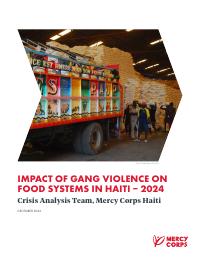
Photo Credit: Mercy Corps ©
IMPACT OF GANG VIOLENCE ON
FOOD SYSTEMS IN HAITI – 2024
Crisis Analysis Team, Mercy Corps Haiti
DECEMBER 2024
MERCY CORPS Impact of Gang Violence on Food Systems in Haiti – 2024 A 2
Contents
Introduction 3
F
our key impacts of gang violence on food security in Haiti in 2024
4
Supply chain disruption and inflation 4
Displacement and economic stress 4
Disruption of agricultur
e and land use
4
Unpr
edictable closure of airports and key port terminals
5
Gang contr
ol of supply routes and food insecurity
6
Mas
s displacement and stress on host communities
7
Disruption of agricultur
al systems and food distribution
8
Impac
t of limited cargo flights and port closures on food supply and food security
10
Limited cargo flights and airport capacity 10
Sporadic port closures and gang activity 11
Combined effects on the food supply chain 11
Top three indicators to track in 2025 12
Conclusion 13
List of Figures
Figure 1: Map of the area around Artibonite, showing conflict incidents and NDVI anomalies in May-November
2024 compared to 2019-2023.
Figure 2: Map of Haiti, showing conflict incidents and NDVI anomalies in May-November 2024 compared to
2019-2023.
MERCY CORPS Impact of Gang Violence on Food Systems in Haiti – 2024 A 3
Introduction
Haiti is enduring a multi-faceted crisis exacerbated by the unchecked expansion of gang violence. This has created
ripple effects across critical sectors, particularly food security. Gang activity has disrupted supply chains, displaced
populations, and heightened socio-economic stressors, worsening an already precarious situation.
A report published by the Famine Early Warning Systems Network (FEWS NET) in October 2024 predicts that
widespread food insecurity will persist in Haiti through May 2025, driven by ongoing violence, inflation (currently
at approximately 40%), and internal displacement. Most of the country is projected to experience Crisis (IPC
Phase 3) and Emergency (IPC Phase 4) food insecurity outcomes. The hardest-hit populations are poor households,
displaced individuals, and residents in conflict-prone areas such as Cité Soleil, which remains in Emergency (IPC
Phase 4).
While a minor improvement in the situation is expected in regions like the South, Southeast, North, and Center due
to seasonal harvests and cash inflows from migrants, these changes will not significantly alleviate the crisis for the
most vulnerable. Emergency food assistance remains inadequate, with coverage falling below 4% of the population
and leaving 2.0–2.5 million people in urgent need of aid.
A deeper understanding of food systems under stress in Haiti could inform strategies to strengthen resilience.
1
This
might include investing in alternative transportation routes, creating decentralized food hubs to reduce reliance
on gang-controlled urban centers, or implementing community-based security initiatives to protect agricultural
activities. International aid must also be tailored to support these efforts, prioritizing both immediate food relief and
long-term system improvements.
This report examines the dynamics of gang violence in Haiti and its implications for food systems, highlighting four
key challenges: the control of vital supply routes by gangs, population displacement and associated strain on host
economies, the disruption of agricultural systems and food distribution networks, and the unpredictable closure of
airports and key port terminals.
1 T food systems’ as the networks needed to produce and transform food, and ensure it reaches consumers.
Unless otherwise indicated, all images are the property of Mercy Corps ©
MERCY CORPS Impact of Gang Violence on Food Systems in Haiti – 2024 A 4
Four key impacts of gang violence on food
security systems in Haiti in 2024
1. Supply chain disruption and inflation
Gang control of key transportation routes and regions, including the Artibonite area and major access points into
and out of Port-au-Prince, has severely disrupted food supply chains. This has led to:
•
Increased transportation costs and limited market access.
• Increases in the price of staple goods, such as maize (up by 10% in areas like the Northwest and Southeast at
the start of 2024), as reported by WFP market monitoring.
• A shortage of essential commodities, particularly beans, in regions like Artibonite, Nippes, and the South,
exacerbating food insecurity.
2. Displacement and economic stress
Gang violence has caused mass internal displacement across Haiti, with thousands fleeing gang-controlled
territories. The surge of internally displaced persons (IDPs) has in turn:
•
Overburdened host communities and local markets already grappling with inflation and limited resources.
• Generated escalating levels of acute hunger, affecting nearly 50% of the population, as families struggle to
secure basic necessities.
Displaced populations are now in competition for scarce resources. This has driven up the cost of food staples like
vegetable oil (now up to 15% more expensive in Nippes and other regions), and red beans, placing additional
strain on vulnerable host economies.
3. Disruption of agricultural production and land use
Gang violence has severely impacted agricultural systems in Haiti:
•
Farmers in gang-controlled territories face
intimidation, restricted access, and land disputes, leading to wide-scale abandonment of vital arable lands.
•
The Artibonite region, a major agricultural
hub, has seen a reduction in farming activity, further
squeezing supplies of local produce.
• In response to limited production, dependency
on imports from the US and the Dominican Republic is
Haitian farmer, 2023. © FAO
MERCY CORPS Impact of Gang Violence on Food Systems in Haiti – 2024 A 5
increasing, but this fails to address the local shortfall. Imports are also threatened by the indefinite closure of the
main international airport in Port-au-Prince, Toussaint Louverture, to incoming flights from the US and the DR.
The concomitant issues of gang intimidation, poor road conditions, and limited market availability are undermining
Haiti’s ability to sustain its agricultural base, further threatening food security in the long term.
4. Unpredictable closure of airports and key port
terminals
•
Costly and limited air cargo impact the food supply chain: The high cost of air freight and reduced
flight frequencies have delayed the delivery of essential food supplies and agricultural inputs, inflating prices in urban markets like Port-au-Prince.
•
Port disruptions exacerbate food insecurity: Gang violence, extortion, and security risks at seaports,
especially in Port-au-Prince, have caused periodic closures and shipping delays, increasing costs and reducing the availability of imported staples such as rice, wheat, and cooking oil.
•
Infrastructure limitations strain alternative solutions: The redirection of shipments to smaller ports,
like Cap-Haïtien, a sign of infrastructural inadequacies in the capital, has created logistical challenges and further delayed food imports critical to Haiti’s supply chain.
•
Cascading effects deepen the crisis: The combined impacts of the violence on air and sea transport have
resulted in market shortages, inflated prices, and diminished access to agricultural inputs, straining both urban consumers and local farmers, while exacerbating the food insecurity crisis in Haiti as a whole.
MERCY CORPS Impact of Gang Violence on Food Systems in Haiti – 2024 A 6
Gang control of supply routes and food
insecurity
The expansion of gang-held territories has severely impacted food supply chains in Haiti. Gangs control several
critical areas, including the Artibonite region and routes into and out of Port-au-Prince. This has hampered the
movement of goods, driving up increased transportation costs and restricting access to essential commodities.
In October 2024, the average cost of a basic food basket rose to 26,385 gourdes, marking a 2% monthly increase.
This escalation is partly attributed to the disruption of supply routes by gang activities. The price of staple foods such
as maize also increased significantly, with the Northwest and Southeast departments seeing a 10% hike. Bean
shortages in regions including Artibonite, Nippes, and the South further underscore the impact of these disruptions.
Haiti’s Route Nationale 1 (RN1) is the primary
artery linking Port-au-Prince to the Artibonite Valley, the
country’s largest agricultural region and a critical supplier
of staples such as rice, maize, and beans. This route is
essential for transporting agricultural goods from rural
areas to the capital and beyond, ensuring market supply
and food availability. Since the start of 2024, however,
gangs have heavily infiltrated RN1, establishing multiple
checkpoints and toll booths, particularly near the entrance
to Port-au-Prince and in key areas like Croix-des-Bouquets
and Saint-Marc. Farmers and transporters attempting to
use this route are now forced to pay exorbitant fees for
passage or risk having their goods stolen. Extortion of
this kind significantly increases transportation costs, the
burden of which ultimately falls on consumers, contributing to rampant food inflation. Many transporters now avoid
the route entirely, leading to supply shortages in urban markets and exacerbating food insecurity.
Route Nationale 2 (RN2) connects Port-au-Prince to Haiti’s southern agricultural regions, including Les
Cayes and Jérémie, areas known for producing bananas, plantains, and other cash crops. This route is critical
for linking these productive regions to urban markets. However, gangs have asserted control of key segments of
RN2, particularly in Martissant, a neighborhood located at the southern exit of Port-au-Prince and notorious for its
high rates of gang-related violence. Armed groups operate improvised toll booths along the route and frequently
ambush vehicles to seize goods. These activities create immense challenges for farmers attempting to transport
produce to Port-au-Prince, leading to post-harvest losses and reduced income for rural communities. As a result,
urban markets in Port-au-Prince also face severe shortages of fruits and vegetables, rendering prices unaffordable
for many residents.
Route Nationale 3 (RN3) is a critical route connecting Port-au-Prince to the country’s Central Plateau, an
important region for bean, vegetable, and livestock production. Despite its strategic importance for food
transportation, RN3 has been heavily affected by gang activities. Gangs control key choke points near Croix-des-
Bouquets and other critical sections of the route. Farmers and vendors traveling along RN3 are frequently subject to
tolls, theft, and physical threats if they fail to comply. These disruptions significantly delay transportation, increase
the cost of goods in both the Central Plateau and Port-au-Prince, and discourage farmers from transporting goods
altogether. The resulting shortages in food supply further aggravate the food insecurity crisis in Haiti.
Truck loaded with goods to be transported to the Marché Dumarsais Estimé in Port-de-Paix,
September 2024. © Kervenson Martial for The Haitian Times
MERCY CORPS Impact of Gang Violence on Food Systems in Haiti – 2024 A 7
Route Nationale 8 (RN8) is a vital trade corridor between Haiti and the Dominican Republic, facilitating the
import of essential goods and agricultural inputs. Once again, gang activity along RN8, particularly near Croix-
des-Bouquets, has severely disrupted trade. Gangs impose fees on transporters traveling to and from the border,
and reports suggest that goods such as rice, sugar, and flour are frequently confiscated, further destabilizing local
markets. This disruption has significant repercussions for Haiti’s food supply as reduced imports worsen shortages
of staple items, for which the country relies heavily on cross-border trade. The compounded impact of these gang-
related disruptions intensifies food insecurity across the nation, particularly in urban areas largely dependent on
imported food.
The methods employed by gangs operating along these routes include setting up toll booths, charging fees that
range from 500 to 5,000 Haitian gourdes, ambushing vehicles to confiscate goods, and using intimidation to
deter transporters from taking the different roads. Such practices significantly inflate transportation costs, which then
fall to consumers, making staples like maize, beans, and rice unaffordable for many. The disruptions also result in
market shortages and post-harvest losses, with delayed or blocked shipments causing perishable goods to spoil.
Moreover, an increasing number of farmers are now abandoning their agricultural activities, as repeated threats
and losses erode their livelihoods and willingness to continue.
The cumulative effect of these disruptions in Haiti is devastating. Food insecurity in urban areas like Port-au-Prince,
which depend on rural produce, is worsening as prices skyrocket and availability declines. Gangs’ control of
transport routes not only drives up the cost of food but also exacerbates hunger for millions of Haitians. Without
targeted interventions to secure these critical routes and protect supply chains in Haiti, the country’s already dire
food crisis will worsen in 2025, trapping both urban consumers and rural farmers in a cycle of economic hardship
and insecurity.
Mass displacement and stress on host
economies
As of December 2024, over 700,000 individuals have been displaced due to gang-related violence in Haiti, with
37% of these residing in the Metropolitan Area of Port-au-Prince. This is a substantial increase from June 2024,
when the International Organization for Migration (IOM) reported 578,074 IDPs, itself a 60% increase from the
previous assessment.
Gang violence has generated an unprecedented wave of internal displacement in Haiti. Thousands of families are
now fleeing gang-controlled areas, seeking refuge in safer regions. This mass displacement places significant stress
on host communities and their local economies.
Impact on host communities and local economies
The majority of displaced individuals have fled from Port-au-Prince to other provinces, which are already strained
by inadequate infrastructure and social services. Many seek refuge with host families or in informal settlements,
including schools and public buildings, causing overcrowding.
Already grappling with inflation and limited resources, host markets in Haiti have been overwhelmed by the influx of
displaced individuals and the increased demand for essential commodities. This surge in demand has also generated
significant price hikes, with the cost of vegetable oil and red beans rising by up to 15% in certain regions.
MERCY CORPS Impact of Gang Violence on Food Systems in Haiti – 2024 A 8
The mutually compounding effects of displacement and economic strain are evident in escalating rates of food
insecurity in Haiti. Nearly half of Haiti’s population is facing acute hunger, affecting approximately 5 million people.
Supply chain disruptions due to gang control of critical areas has further limited access to food, causing shortages
and driving up the price of staple items.
Addressing the food insecurity crisis in Haiti requires coordinated efforts to restore security, provide humanitarian
assistance, and support displaced populations and host communities in rebuilding livelihoods and guaranteeing
access to essential services.
Disruption of agricultural systems and food
distribution
The agricultural sector in Haiti has not been spared from the impacts of gang violence. Farmers regularly face
threats, land disputes, and restricted access to their fields, particularly in gang-controlled territories. As a result,
large swathes of the country’s arable land are now lying fallow.
Escalating gang violence in Haiti’s Artibonite region throughout 2024 has forced many farmers to abandon their
agricultural land. The region, which is known as the agricultural heartland of Haiti, has been particularly impacted
by the rise in gang activity and extortion, forcing farmers to relinquish over 3,000 hectares of agricultural land
and significantly reducing local food production. This decline is further exacerbated by limited access to essential
agricultural inputs like seeds, fertilizers, and equipment, all increasingly difficult to obtain due to supply chain
disruptions and rising costs.
Figure 1. Map of the area around Artibonite, showing conflict incidents
and NDVI anomalies in May-November 2024 compared to 2019-2023.
(Source: ACLED conflict events/Mercy Corps NDVI analysis)
MERCY CORPS Impact of Gang Violence on Food Systems in Haiti – 2024 A 9
In addition, limited government support and a lack of effective agricultural policies have left the Haitian agricultural
sector ill-equipped to withstand the pressures. Programs that might have mitigated the impacts of gang violence,
such as land rights protection, subsidized agricultural inputs, or infrastructure improvements, have been in short
supply.
The reduction in agricultural output and distribution in Haiti has far-reaching economic and social consequences.
According to reports, shortages of locally produced goods, including maize, are becoming increasingly common.
For rural farming communities, agricultural land loss and limited market access translate to declining incomes and
increased poverty. Unable to sustain themselves, many farmers have joined the ranks of the rising number of IDPs
in the country, placing additional pressure on host communities and local economies. Meanwhile, for consumers,
particularly in urban areas, the shortages of locally produced goods drive up prices, exacerbating food insecurity.
With food inflation already nearing 40% in 2024, the decline in domestic production has forced Haiti into a greater
reliance on costly imports, all while draining its foreign exchange reserves.
Figure 2. Map of Haiti, showing conflict incidents and NDVI
anomalies in May-November 2024 compared to 2019-2023.
(Source: ACLED conflict events/Mercy Corps NDVI analysis)
Normalized Difference Vegetation Index (NDVI) anomalies: The NDVI measures plant leaves to
determine vegetative health. An NDVI anomaly is the difference between the average NDVI for a particular
month of a given year and the average NDVI for the same month over a specified number of years. Based
on these indicators, the maps above show a noticeable decline in vegetation quality in areas north of Port-
au-Prince and around Artibonite (red and orange areas on the map) in May-November 2024, indicating a
likelihood that harvests in these areas will be less productive than in previous years.
MERCY CORPS Impact of Gang Violence on Food Systems in Haiti – 2024 A 10
The crisis in Haiti’s agricultural sector is both a symptom and a driver of the country’s broader socio-economic
instability. Farmland in Artibonite and other regions reflects the devastating impact of unchecked gang violence,
which disrupts food production, inflates prices, and deepens poverty. Addressing this crisis requires a multi-faceted
approach addressing both the immediate security threats and the systemic weaknesses in Haiti’s agricultural
infrastructure and governance. Without decisive action, the agricultural sector will remain in decline, further
jeopardizing the nation’s food security and economic future.
Impact of limited cargo flights and port
closures on food supply and food security
On November 11, 2024, gangs in Haiti fired
upon multiple aircraft and brought about the
second closure of the country’s main international
airport in the space of a year. Toussaint Louverture
Airport had already been closed for a period of
three months following gang violence in March of
2024. The measures effectively halted commercial
air traffic into and out of Port-au-Prince, severely
restricting the country’s connectivity and hampering
humanitarian aid efforts.
Haiti’s reliance on imported food makes its
supply chain acutely vulnerable to disruptions in
transportation infrastructure, including air and sea routes. The limited cargo flight handling capacity at Toussaint
Louverture Airport, coupled with sporadic closures of Haitian seaports due to gang violence, have had an outsize
impact on the country’s ability to sustain a stable food supply. These disruptions further exacerbate food insecurity,
driving up prices and creating shortages of essential goods.
1. Limited cargo flights and airport capacity
Toussaint Louverture International Airport in Port-au-Prince is a critical gateway for bringing high-value and time-
sensitive food supplies into Haiti, particularly from the US and the Dominican Republic. Despite the strategic
importance of the airport, several factors limit its role in Haiti’s food supply chain:
•
High costs: Air freight is significantly more expensive than sea transport, making it an impractical solution for
bulk shipments of foodstuffs like rice, beans, and maize, all staples in the Haitian diet.
• Reduced flight frequency: The limited numbers of flights from the US and the Dominican Republic restrict
the availability of imported goods. Flight schedule disruptions, often due to security concerns or logistical
challenges, then exacerbate this problem.
Impact of limited air cargo capacity on the food supply chain
•
Deliveries of essential food items and agricultural inputs such as seeds and fertilizers are either infrequent or
delayed, further hampering local food production and distribution.
Haitian regional airline plane on the tarmac of Toussaint Louverture International Airport, October 2024.
© Jude Stanley Roy for the Haitian Times
MERCY CORPS Impact of Gang Violence on Food Systems in Haiti – 2024 A 11
• Sh
markets like Port-au-Prince, where reliance on imports is at its highest.
2. Sporadic port closures and gang activity
Haiti’s seaports, especially the Port-au-Prince terminal, are the primary entry points for large-scale food imports.
Gang violence has increasingly disrupted the ports’ operations, however, causing periodic closures and delays.
•
Gang control and extortion: Armed groups frequently assert control of areas surrounding the ports,
extorting fees from shipping companies and workers. This discourages cargo operations and slows the unloading
and distribution of goods.
• Periodic closures: The threat of violence has led to sporadic closures of Haiti’s ports, sometimes lasting days
or weeks. These interruptions delay deliveries of essential commodities and create bottlenecks in the supply chain.
•
Security risks: Ships are often reluctant to dock in Port-au-Prince due to safety concerns, redirecting their
cargo to smaller ports, which lack the infrastructure to handle large shipments efficiently.
Impact of closures on food security
•
Delay: Haiti imports more than half of its food, including staples like rice and wheat. Port
disruptions delay the arrival of these goods, exacerbating shortages in markets across the country.
• Increased costs: Each disruption adds to overall transportation and storage costs, the burden of which is then
passed on to consumers. For example, the price of rice, a dietary staple, has risen sharply during port closures.
• Dependency on smaller ports: As an alternative to docking in Port-au-Prince, some imports are redirected
to ports in Cap-Haïtien or other smaller facilities. Since these ports are not equipped to handle the same volume, redirection brings new logistical challenges and further delays.
3. Combined effects on the food supply chain
The combination of limited air cargo capacity and sporadic seaport closures creates a cascade of negative effects:
•
Market shortages: Delays in shipments mean that urban markets frequently experience shortages of staple
foods, leaving shelves empty and consumers scrambling for alternatives.
• Inflation and accessibility: The price of imported goods spikes, with some items becoming unaffordable
for the majority of Haitians. This further exacerbates food insecurity, particularly for low-income households.
• Local agricultural strain: The reduced availability of imported agricultural inputs, such as fertilizers and
machinery, undermines local food production. Farmers are unable to meet the increased demand, deepening
the supply gap.
MERCY CORPS Impact of Gang Violence on Food Systems in Haiti – 2024 A 12
Top three indicators to track in 2025
1. Food price inflation
2. Internally displaced persons (IDPs)
3. Agricultural output and land abandonment
Haiti’s food security outlook for 2025 has progressively worsened, and the escalating gang violence, mass
displacement, and agricultural decline are expected to drive hunger and poverty to unprecedented levels.
Tracking indicators like food price inflation, IDP trends, and agricultural output will be critical for understanding
and addressing the food security crisis in the country. To prevent a full-scale humanitarian catastrophe, immediate,
coordinated interventions are needed to restore security, stabilize food supply chains, and support vulnerable
populations.
Why it matters: Food prices are a direct indicator of market stress, supply chain
disruptions, and consumer access to essential goods. Continued inflation would signal
worsening accessibility and affordability of food for vulnerable populations.
What to monitor: Monthly changes in the cost of staple items (maize, rice, beans) and the basic food basket. Variation in prices between regions, particularly in urban areas like Port-au-Prince, can highlight localized impacts of gang activity.
Why it matters: The number and movement of IDPs reflect the scale of displacement
caused by gang violence and its impact on host communities and economies. Rising displacement correlates with increased strain on local markets and infrastructure.
What to monitor: Trends in the number of displaced individuals, locations of displacement,
and conditions in host communities, including access to food, housing, and services. The relationship between displacement and rural farming activity is also critical.
Why it matters: Abandonment of farmland and declining agricultural production directly affect Haiti’s ability to produce food locally, increasing reliance on imports and exacerbating food insecurity.
What to monitor: Hectares of farmland left uncultivated due to gang activity, availability of agricultural inputs (seeds, fertilizers, equipment), and output levels of key crops (rice, maize, beans). Regional disparities in production, especially in Artibonite, are a key focus.
MERCY CORPS Impact of Gang Violence on Food Systems in Haiti – 2024 A 13
Conclusion
The intersection of gang violence and food insecurity in Haiti is a complex challenge that demands immediate attention.
Food systems in Haiti i.e. the networks it needs to produce, transform, and distribute food, are experiencing acute
stress due to escalating gang violence. This violence disrupts every stage of the food supply chain, from agricultural
production and transportation to market access and consumer distribution. Understanding and analyzing such
impacts is essential for addressing ongoing food insecurity in Haiti and fostering sustainable solutions.
In rural areas, gang activity frequently restricts farmers’ access to their fields and ability to transport their harvests
to local markets. Armed groups control many of the key roads and trade routes in Haiti, imposing “tolls” or outright
blocking the transport of goods. This not only reduces the availability of food in urban centers but destabilizes rural
economies that depend on agriculture. Meanwhile, in urban areas, gang control of critical supply chains leads to
inflation in food prices, food shortages, and heightened vulnerability among low-income populations.
The violence has also exacerbated existing vulnerabilities within Haitian food systems. Many smallholder farmers
have limited financial resources or access to agricultural technologies, leaving them unable to adapt to disruptions.
The country’s fragile infrastructure, already weakened by political instability and natural disasters, cannot absorb
the shocks caused by widespread violence. This allows gaps in food supply chains to become more pronounced
and the risk of hunger and malnutrition to intensify.
A multidisciplinary approach is needed to analyze the influence of gang violence on food systems. Researchers must
not only examine the direct economic and logistical impacts of these intersecting challenges but also their social and
political dimensions. For instance, understanding how community-level responses, such as local food cooperatives,
can mitigate the disruptions caused by gang activity is imperative for developing sustainable solutions., Detailed
insights into the role of informal networks like these in maintaining food distribution despite insecurity can help
policymakers make informed decisions.
Ultimately, only with collaboration between local communities, government authorities, and international
organizations can the impact of gang violence on Haiti’s food systems be effectively addressed. A thorough
analysis of these systems, including their vulnerabilities and strengths, is not only necessary but morally imperative
to safeguard the food security and livelihoods of millions of Haitians.
Left to right © UNICEF and Mercy Corps
CONTACT
Crisis Analysis, Haiti
crisisanalysis@mercycorps.org
45 SW Ankeny Street
Portland, Oregon 97204
888.842.0842
mercycorps.org
About Mercy Corps
Mercy Corps is a leading global organization
powered by the belief that a better world is possible.
In disaster, in hardship, in more than 40 countries
around the world, we partner to put bold solutions into
action — helping people triumph over adversity and
build stronger communities from within.
Now, and for the future.
This document is intended for humanitarian
purposes only. Mercy Corps Crisis Analysis
provides impartial analysis that does not
necessarily reflect the opinion of Mercy Corps
as an organisation.