
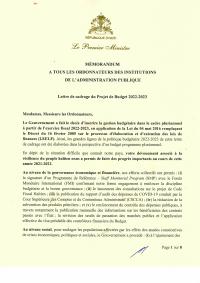
(2022-08) Prime Minister's Budget Framework Letter for FY2022-2023
Summary — A memorandum from Haiti's Prime Minister Ariel Henry to all public spending officers, setting the budget framework (lettre de cadrage) for the FY2022-2023 budget within a new multi-year (2023-2025) budget-programme approach. It reviews FY2021-2022 macro-fiscal performance and lays out growth, inflation, external-account, and fiscal-deficit targets plus spending priorities for the coming triennium.
Key Findings
- FY2021-2022 real GDP contracted 0.4% (vs. +0.3% initially projected), a fourth consecutive year of recession.
- Inflation reached 27.8% in May 2022, projected at 28.8% by end-September 2022.
- Tax-and-customs revenue at end-June 2022 was 83.4 billion gourdes, only 69% of the FY2021-2022 budgeted target, while net treasury-bill issuance rose to 11.2 billion gourdes (from 6.7 billion).
- FY2022-2023 targets: 0.4% GDP growth, 24.5% inflation, 5.8% fiscal pressure, 2.3%-of-GDP deficit ceiling.
- Fuel subsidies to be cut 15.7% in 2023 en route to elimination; budget to be accompanied by a 2022-2025 Medium-Term Budget Framework (CBMT).
Full Description
Signed by Prime Minister Dr. Ariel Henry on 2 August 2022, this circular memorandum instructs all ordonnateurs (spending authorities) of Haiti's public administration on the framework for preparing the FY2022-2023 budget, the first to be built on a multi-year budget-programme logic under the 4 May 2016 law replacing the 2005 LOLF decree. It reviews the difficult results of FY2021-2022: real GDP contracted by 0.4% (versus an initial projection of +0.3%), driven by gang violence, insecurity-related disruptions to agriculture and construction, and reduced execution of the 2021-2022 budget's flagship actions; headline inflation reached 27.8% in May 2022 and was projected to reach 28.8% by end-September 2022; and the fiscal-pressure ratio (tax take) stood at only about 6% of GDP against a 23% Latin America/Caribbean average. By end-June 2022, tax and customs administrations had collected 83.4 billion gourdes, 69% of the amount programmed for FY2021-2022, while net treasury-bill issuance reached 11.2 billion gourdes over the first three quarters (up from 6.7 billion in the prior year) and fuel subsidies continued to weigh heavily on execution.
For the FY2022-2023 to FY2024-2025 triennium, the memo sets targets of 0.4% real GDP growth in 2022-2023 (averaging 1.2% over three years), disinflation to 24.5% in 2022-2023 and 12.4% by 2024-2025, a fiscal-pressure ratio rising from 5.8% in 2022-2023 to 7% by 2024-2025, and a budget-deficit ceiling of 2.3% of GDP in 2022-2023 (2.6% average, stabilizing at 2.8% of GDP by 2024-2025 given anticipated increases in structural, pro-growth investment spending). Nine priority areas for budget credits are listed, including elections, the PNPPS social-protection policy, agricultural-campaign financing, the Peninsule Sud recovery plan (PRIPS) following the August 2021 earthquake, anti-smuggling and anti-money-laundering efforts, voluntary civil-service retirement, public-administration reform, gender mainstreaming, and anti-trafficking measures. It also commits to reducing fuel-product subsidies by 15.7% in 2023 toward eventual elimination, extending treasury-bill access to households, and publishing a Medium-Term Budget Framework (CBMT) covering FY2022-2023 through FY2024-2025 alongside the budget.
Notes
Issuer is the Primature (Cabinet of the Prime Minister), not MEF: the document is a memorandum signed by Prime Minister Dr. Ariel Henry on Primature letterhead dated Port-au-Prince, 02 Aout 2022, addressed to all ordonnateurs of public institutions; organization field set to Primature accordingly. This is version A of a sibling pair (version B covers the same FY2022-2023 cadrage exercise).