
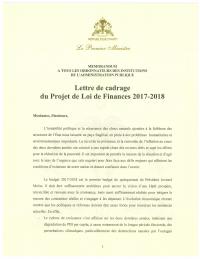
Prime Minister's Budget Framework Letter for FY2017-2018
- Growth projected at 2.2% was revised down to 1.1%, after the long electoral period, climatic disturbances and the destruction from Hurricane Matthew in October 2016.
- Inflation reached 14.6% in April 2017, after averaging around 5% between 2012 and 2015, and the annual average projection was revised from 10.5% to 15.1%.
- Food, beverages and tobacco carry 49% of the CPI and contribute far more to inflation than housing rent, energy and water, which showed the sharpest rise since 2004.
- Agricultural production fell in real terms over the previous ten years, raising the price of widely consumed food.
- FY2017-2018 assumptions: current revenue up 12%, external budget support near 3.2 billion gourdes, deficit not above 3.2% of GDP.
- Credit grew 13% year on year in gourdes and 1.7% in dollars.
The Prime Minister's framework letter for the FY2017-2018 draft finance law, addressed to all spending authorities of the public administration. It opens on political instability, recurrent natural shocks and weak state structures, and on the fall in growth and return of inflation over the preceding two years, which it says cut real incomes quickly and undermined poverty reduction.
This is the first budget of President Jovenel Moise's term, and the letter argues it must be ambitious enough to anchor the vision of a prosperous Haiti reconciled with growth, and realistic enough to take the measure of the real constraints and commit to overcoming them. On recent developments: growth had weakened over two years, degrading GDP per capita, because of the long electoral period, climatic disturbances and above all the destruction caused by Hurricane Matthew in October 2016, so growth initially projected at 2.2% was revised down to 1.1%. Agricultural production had fallen in real terms over the previous ten years, pushing up food prices, particularly for widely consumed products such as bananas, vegetables and meat, and the effects of natural events had cancelled out the positive effect of private investment in agriculture, though the letter holds that supply can be increased if policy addresses the structural constraints in infrastructure, land tenure and access to credit.
Inflation was rising after being brought to around 5% on average between 2012 and 2015, and reached 14.6% in April 2017. Housing rent, energy and water showed the sharpest rise since 2004, though food, beverages and tobacco, at 49% of the CPI, contributed far more. Inflation initially projected at 10.5% on annual average was revised to 15.1%. Credit continued to grow modestly, 13% year on year in gourdes and 1.7% in dollars, and fiscal revenue stagnated in the first half.
On the FY2017-2018 assumptions, current revenue was expected to rise 12%, external budget support was estimated at close to 3.2 billion gourdes, slightly below the previous year, and the budget deficit was not to exceed 3.2% of GDP.
How to cite
Ministry of Economy and Finance (MEF), Prime Minister's Budget Framework Letter for FY2017-2018, https://budget.gouv.ht/storage/app/uploads/public/5f3/f78/da4/5f3f78da4dff5710826782.pdf