Full Description
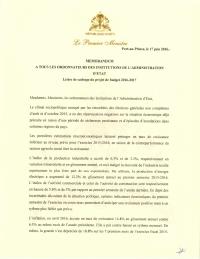
The Prime Minister's framework letter for the FY2016-2017 draft budget, addressed to all spending authorities of the state administration and dated Port-au-Prince, 17 June 2016. It sets the framing against a socio-political climate marked by the aftermath of the uncompleted general elections of August and October 2015, which the letter says worsened an economic situation already made precarious by a persistent drought and by flooding in several regions.
First macroeconomic estimates pointed to FY2015-2016 growth below the forecast, because of the underperformance of agriculture, the sector expected to carry it. The industrial production index rose 0.3% quarter on quarter and 3.3% year on year despite a subdued textile industry, which is the largest share of exports, and electricity production rose 12.2% year on year in the first half of FY2015-2016. Commercial activity rose 5.6% and construction activity 3% against the first half of the previous year, which the letter reads as positive growth at a weaker pace than planned.
Inflation reached 14.8% year on year in April 2016 against 6.3% in the same month a year earlier, though it fell month on month. The gourde depreciated 18.8% over the first seven months of FY2015-2016, with the first five months accounting for 92% of that, showing a deceleration from March. The cash-management agreement signed on 20 April 2016 between the monetary and fiscal authorities reinforced the trend, and BRH bond rates were cut by two percentage points across all maturities from 13 June 2016.
On execution, first-half data showed mobilised resources at only 30.44% of the initial budget forecast, of which 92% came from domestic resources, and the letter notes that several fiscal and non-fiscal measures written into the budget could not be applied.
Full Document Text
Extracted text from the original document for search indexing.
~ Pl>Y-enU&Jt (), (/,,',niJ{JI~
Port-au-Prince, le 17 juin 2016.-
MEMORANDUM
A TOUSLES ORDONNATEURS DES INSTITUTIONS DE L'ADMINISTRATION
D'ETAT
Lettre de cadrage du projet de budget 2016-2017
Mesdames, Messieurs, Jes ordonnateurs des institutions de I' Administration d'Etat,
Le climat sociopolitique marque par les retombees des elections generates non completees
d'aout et d'octobre 2015, a eu des repercussions negatives sur la situation economique deja
precaire en raison d'une periode de secheresse persistante et d'episodes d'inondations dans
certaines regions du pays.
Les premieres estimations macroeconomiques laissent presager un taux de croissance
inferieur au niveau prevu pour I 'exercice 20I5-2016, en raison de la contreperformance du
secteur agricole cense tirer la croissance.
L'indice de la production industrielle a accrut de 0.3% et de 3.3%, respectivement en
variation trimestrielle et en glissement annuel, et ceci malgre la morosite de l'industrie textile
representant la plus forte part de nos exportations. Par ailleurs, la production d'energie
electrique a augmente de 12.2% en glissement annuel au premier semestre 2015-2016.
L'indice de l'activite commerciale et celui de l'activite de construction sont respectivement
en hausse de 5.6% et de 3% par rapport au premier semestre de l'annee demiere. En depit des
incertitudes decoulant de la situation politique, certains indicateurs economiques du premier
semestre de l'exercice en cours nous permettent d'anticiper une croissance positive mais a un
rythme plus foible que prevu.
L'inflation, en avril 2016, accuse un taux de croissance 14.8% en glissement annuel contre
6.3% au meme mois de l'annee precedente. Elle a par contre baisse en rythme mensuel. De
meme, la gourde s'est depreciee de 18.8% sur Jes 7 premiers mois de l'exercice fiscal 2015-
Lettre de cadrage du projet de budget 2016-2017
20 I 6. Les cinq premiers mois de cette periode comptent pour 92% de cette depreciation, ce
qui montre une deceleration a partir de mars. L'accord de cash management signe le 20 avril
2016 entre les autorites monetaire et fiscale est venu renforcer cette tendance.
Cette situation nouvelle a favorise le desserrement des conditions monetaires par la baisse,
de 2 points de pourcentage, des taux d'interet sur ('ensemble des maturites des bons BRH, a
partir du 13 juin 2016. Elle augure ainsi de meilleures dispositions pour le financement de
l'economie apres le maintien jusqu'a recemment des mesures restrictives de l'exercice 2014-
2015 qui ont rendu peu favorable !'expansion du credit necessaire a la croissance et l'emploi.
L'execution du budget se deroule dans un contexte assez difficile. Suivant les donnees
disponibles au premier semestre 2015-2016, les ressources mobilisees representent seulement
30.44% des previsions du budget initial dont 92% proviennent des ressources domestiques.
Certaines mesures (fiscales et non fiscales) inscrites dans le budget n'ont pu etre
implementees ou sont difficiles d'application a cause du contexte socio-politique. A cela
viennent s'ajouter le tarissement des ressources Petro caribe et le non decaissement de l'appui
budgetaire.
Bien que les ressources mobilisees soient en deya des attentes, le taux d'execution des
depenses budgetaires n'a pas diminue de fayon significative, soit -0.9% en glissement annuel.
En effet, au premier semestre de l'exercice 2015-2016, 28.7% de previsions ant ete
consommees contre environ 28.9% a la meme periode de l'exercice precedent.
Les efforts pour maitriser le deficit ayant occasionne un financement monetaire de 5,9
milliards de gourdes au premier trimestre ont aboutit a un surplus en base engagement
d'environ 4,2 milliards au premier semestre 2015-2016 bien qu'il subsiste un solde negatifen
base caisse de I, I milliard de gourdes. Cela est du notamment au retard dans le decaissement
de l'appui budgetaire et aux paiements des engagements de l'EDH garantis par le Tresor. II
convient de noter que les depenses d'investissement financees par des ressources
domestiques ont connu une augmentation de +75%, en passant de 1,5 milliard de gourdes au
premier semestre 2014-2015 a 2,6 milliards de gourdes sur le premier semestre de l'exercice
2015-2016.
Les recettes collectees par !'ensemble des organismes de perception ont atteint 34,7 milliards
de gourdes au premier semestre de l'exercice, soit une hausse de 19% par rapport a la meme
periode de l'annee precedente et !'equivalent de 45% de l'objectif de 77,2 milliards de
11111
Lettre de cadrage du projet de budget 2016-2017
gourdes programmees dans le budget initial 2015-2016. Les efforts devront etre intensifies en
vue de realiser au moins 90% de l'objectif initialement prevu d'ici la fin de l'exercice fiscal
2015-2016.
Dans ce contexte, ii devient crucial pour le Gouvernement de conjuguer ses efforts et
mobiliser des ressources afin de reduire les desequilibres et inscrire l'economie dans un
processus de croissance soutenue.
La lec;on a tirer de !'evolution macroeconomique des deux derniers mois est la capacite de
l'Etat a arbitrer efficacement les choix entre la rationalisation de la gestion publique et la
minimisation des co0ts socio-economiques qui en decoulent. Cet exercice difficile est
d'autant plus riche d'enseignement qu'il se realise dans des conditions fortement adverses qui
forcent a une modulation continue des politiques publiques pour deboucher sur la
normalisation politique dans Jes meilleures conditions possibles de stabilite sociale et
economique.
La mise en reuvre du Programme d'Actions Prioritaires (PAP) repond a cette exigence. II a
fallu attendre la realisation de conditions budgetaires appropriees pour proceder a !'execution
des projets qui le composent. Le PAP est a cheval entre le dernier trimestre de l'exercice en
cours et le premier semestre du prochain exercice. D'ou la necessite d'en degager un double
objectif: la creation de travaux a haute intensite de main-d'ceuvre et /'inscription des
activites concernees dons une perspective de moyen terme. Voici done !'ensemble des
considerations qui devront orienter les propositions de depenses du projet de Loi de Finances
2016-2017.
Selon la Coordination Nationale pour la Securite Alimentaire (CNSA), ii faudrait une
croissance annuelle de plus de 7% pour reduire la proportion de personnes en insecurite
alimentaire de I 0% d'ici a 2020. Cependant, compte tenu des incertitudes liees au climat
sociopolitique, le taux de croissance attendu pour l'exercice 20I6-2017 ne devrait pas
depasser 2.2%.
Pour preserver la stabilite macroeconomique maintenue depuis 2005, des mesures drastiques
s'averent necessaires. Pour cela, le Gouvernement se propose d'agir en 2016-2017 sur les
facteurs controlables, d'une part en mobilisant le niveau de ressources optimal vers Jes
secteurs priori ta ires, notamment !'agriculture, I' infrastructure, I 'education, la sante, la justice,
la securite publique et le tourisme et d'autre part, par la rationalisation des depenses
Lettre de cadrage du projet de budget 2016-2017
publiques deja initiee par !'accord de cash management conclu entre le Ministere de
l'Economie et des Finances et la Banque de la Republique d'Harti.
Des orientations pour le budget 2016-2017
Mesdames, Messieurs !es ordonnateurs des institutions de !'Administration d'Etat,
En raison de la situation difficile, vos propositions de credits budgetaires devront etre
elaborees dans un souci de rationalisation des depenses publiques compte tenu des contraintes
financieres au regard des besoins illimites. La masse salariale est gelee dans les limites des
credits prevus dans le pro jet de loi de finances rectificative 2015-2016. Des restrictions sont
appliquees a certaines categories de depenses telles que: Subventions, acquisition de
materiel roulant,frais de voyage a l'exterieur,frais de reception, location de vehicule.
De plus, dans une /ogique de sincerite budgetaire, ii a ete decide d'imputer /es credits relatifs
aux programmes et projets aux secteurs concernes.
Le budget 2016-2017 s'inscrit dans une demarche visant a promouvoir les investissements et
faciliter la desserte des services de base a la population. Aussi, ii sera utilise comme
instrument pour :
• maintenir la stabilite macroeconomique ;
• assurer la poursuite du financement des elections;
• creer un environnement favorable a la generation de richesse et d'emplois ;
• supporter !'agriculture, l'elevage et la peche en maximisant leur impact dans
l'economie ;
• rechercher une meilleure coherence dans !'utilisation des ressources de
!'administration centrale d'Etat et des organismes autonomes de maniere a
maximiser leur impact;
• intensifier !es efforts dans les domaines de la securite publique ;
• poursuivre la reforrne des finances publiques ;
• promouvoir l'entreprenariat et Jes Partenariats Publics Prives.
• augmenter la resilience des territoires
• poursuivre et renforcer la politique d'acces a !'education ;
• renforcer la couverture sanitaire
Lettre de cadrage du pro jet de budget 2016-2017
• promouvoir la protection de l'environnement et reuvrer au renforcement de notre
resilience face aux catastrophes naturelles.
Le pro jet de loi de finances de l 'exercice 20I6-2017 table sur !es previsions
macroeconomiques suivantes :
• une croissance reelle de l'economie de 2.2%. Une inflation de 10.5% en moyenne
annuelle et de 13.5% de fin de periode sur Ia base d'une depreciation controlee de Ia
monnaie locale ;
• une pression fiscale autour de 13.5%;
• un taux de change relativement stable.
Compte tenu des hypotheses de croissance, d'inflation et de pression fiscale, les recettes
courantes atteindront 76.6 milliards de gourdes en 20 I 6-2017. L'appui budgetaire exteme
attendu ne devrait pas depasser celui de l'exercice precedent et le deficit budgetaire sera
contenu dans la limite de 2.3% du PIB ..
Dans cette perspective, !'action gouvemementale sera specifiquement orientee vers :
I. la contribution a l'elargissement et au renforcement des Micro, Petites et Moyennes
Entreprises (PME) evoluant surtout dans le secteur agricole et dans la construction en
leur offrant un accompagnement technique et en leur facilitant l'acces au
financement ;
2. la reduction de !'extreme pauvrete et de l'insecurite alimentaire par la mise en place
d'actions susceptibles de generer des revenus et des emplois dans les milieux
defavorises ;
3. la poursuite et la mise en ceuvre des travaux notamment dans le domaine du transport,
de l'electrification du territoire, de l'alimentation en eau potable, de la gestion des
dechets solides ;
4. le renforcement des institutions, la modernisation de l'Etat et la promotion de la
bonne gouvemance.
Dans cet ordre d' idees, je vous invite a soumettre vos propositions de depenses pour 2016-
2017 sur la base des priorites ci-dessus definies. A cet egard, ii convient de reexaminer les
moyens dont vous disposez afin d'envisager des possibilites de degager des economies de
-
Lettre de cadrage du projet de budget 2016-2017
credits qui pourraient etre affectes au financement d'investissements prioritaires et aux
nouvelles mesures que vous serez amenes a proposer.
Pour parvenir a !'evaluation des resultats de vos actions au regard des objectifs poursuivis, je
vous demande de:
• definir des indicateurs de performance pertinents en rapport a vos domaines
d'intervention ;
• preparer un expose justifiant Jes besoins, Jes objectifs et la logique des interventions
de votre institution;
• justifier les credits sollicites tout en indiquant les resultats attendus;
• soumettre Jes revenus non fiscaux eventuellement generes par votre institution ;
• preparer et transmettre le plan de passation de marches de votre secteur;
• elaborer et de soumettre une programmation des depenses de votre secteur de maniere
a faciliter la gestion de tresorerie.
Mesdames, Messieurs, les ordonnateurs des institutions de I' Administration d' Etat
II faudra s'evertuer a rester dans !es marges d'un budget sensible aux besoins de la population
mais aussi a la preservation de la stabilite des grands equilibres macroeconomiques que nous
travaillions a instaurer depuis la prise en charge de notre gouvernement. A l'instar des principes
qui gouvernent la mise en ceuvre du PAP, les lignes directrices du projet de Loi de Finances
2016-2017 emanent du lieu d'arbitrage entre Jes preoccupations de court terme et la conduite
de politiques a effets structurants.
Je vous enjoins done a faire votre ce souci d'equilibre dans Jes decisions sectorielles qui
justifieront vos propositions de depenses. Cette demarche devrait favoriser la mise en
coherence des politiques pour en degager la meilleure synergie a parti des effets directs et
croises des mesures envisagees. La coordination des politiques, a l'instar de !'experience du
cash management dans !es domaines budgetaire et monetaire, doit etre constamment presente
dans la conception et la conduite de nos actions. C'est a ce titre que notre gestion des premiers
mois de l'exercice fiscal 2016-2017 facilitera !'action du prochain gouvernement. C'est ace titre
que !'heritage que nous lui laisserons sera digne d'un gouvernement responsable mais aussi de
femmes et d'hommes responsables.