
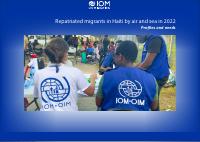
Migran yo rapatriye ann Ayiti pa avyon ak pa lanmè an 2022 : pwofil ak bezwen
Rezime — Ankèt OIM sou 22 444 migran yo te rapatriye ann Ayiti pa avyon ak pa lanmè an 2022, ak pwofil yo ak bezwen yo.
Dekouve Enpotan
- Youn sou senk migran rapatriye se te yon timoun, epi 14 pousan te gen ant zewo ak senk an.
- Estati chèf fwaye a gen anpil diferans ant sèks lakay moun ki tounen: 54 pousan gason kont 15 pousan fanm.
- Ankèt yo te kouvri 11 011 fwaye rapatriye, anviwon mwatye total moun rapatriye ane sa a.
Deskripsyon Konple
Pwofil OIM te fè sou migran yo rapatriye ann Ayiti pa avyon ak pa lanmè ant janvye ak desanm 2022, sou baz ankèt nan fwaye rapatriye nan pwen antre yo. Li bay konpozisyon demografik moun ki tounen yo ak bezwen yo di yo genyen. Pousantaj timoun nan moun rapatriye yo se rezilta ki pi enpòtan pou pwogramasyon, epi repartisyon chèf fwaye yo montre jan retou a afekte gason ak fanm yon lòt jan.
Teks Konple Dokiman an
Teks ki soti nan dokiman orijinal la pou endeksasyon.
REPATRIATED MIGRANTS PROFILES - JANUARY TO DECEMBER 2022
Repatriated migrants in Haiti by air and sea in 2022
Profiles and needs
NTERNATIONAL ORGANIZATION FOR MIGRATION When quoting, paraphrasing or in any way using the information mentioned in this report, the source needs to be stated appropriately as
Website: https://displacement.iom.int/haiti
Contact : dtmhaiti@iom.int
1 follows: “International Organization for Migration (IOM), February 2023, Repatriated migrants profiles by air and sea in Haiti" For more infor-
mation on the terms and conditions of DTM reports and information products, please consult: https://dtm.iom.int/terms-and-conditions
REPATRIATED MIGRANTS PROFILES - JANUARY TO DECEMBER 2022
The opinions expressed in this report are those of the au- TABLE OF CONTENT
thors and do not necessarily reflect the views of the Inter-
national Organization for Migration (IOM). The information
contained in this report is for general information purposes Introduction, Methodology and Key findings page 3
only. The designations employed and the presentation of ma-
terial throughout the report do not imply expression of any Profile of all repatriated migrants:
opinion whatsoever on the part of IOM concerning the
legal status of any country, territory, city or area, or of • Demographic profiles page 4
its authorities, or concerning its frontiers or boundaries.
• Education, Place of repatriation, Possession of identity
The maps in the report are for illustration purposes only. documents and members of repatriated migrants
The depiction and use of boundaries, geographic names
and related data shown on maps and included in this re- living abroad page 5
port are not warranted to be error free nor do they im-
ply judgment on the legal status of any territory, or any • Reasons for migration , time spent out of Haiti and future
endorsement or acceptance of such boundaries by IOM.
migration intentions page 6
• Origin of migrants and intended destinations after
The DTM activities are supported by:
repatriation page 7
• Employment profile page 8
• Primary needs page 9
Profile of repatriated migrants from the US page 10
For further details or information please get in touch: dtmhaiti@iom.int
Profiles of repatriated migrants from Cuba & Bahamas page 11
© 2023 International Organization for Migration (IOM)
When quoting, paraphrasing or in any way using the information mentioned in
this report, the source needs to be stated appropriately as follows: “Internation-
al Organization for Migration (IOM), February 2023, Repatriated migrants profiles
by air and sea in Haiti" For more information on the terms and conditions of DTM re-
ports and information products, please consult: https://dtm.iom.int/terms-and-conditions
INTERNATIONAL ORGANIZATION FOR MIGRATION When quoting, paraphrasing or in any way using the information mentioned in this report, the source needs to be stated appropriately as
Website: https://displacement.iom.int/haiti
Contact : dtmhaiti@iom.int
2 follows: “International Organization for Migration (IOM), February 2023, Repatriated migrants profiles by air and sea in Haiti" For more infor-
mation on the terms and conditions of DTM reports and information products, please consult: https://dtm.iom.int/terms-and-conditions
REPATRIATED MIGRANTS PROFILES - JANUARY TO DECEMBER 2022
OVERVIEW
Introduction
Since end of 2021, thousands of Haitian migrants have been repatriated in Haiti. From January to December 2022, a total of 22,444 migrants were repatried in Haiti by
air and sea1. IOM provides assistance to repatriated migrants upon their arrival and also conducts surveys in order to understand their profiles and needs and ultimately inform
migration governance strategies and policy making. In 2022, IOM conducted these surveys on 11,011 repatriated households. This report provides key results of
these surveys.
Key findings:
• 34% of migrants indicated the will to try again to leave Haiti in the following 6 months after data
• 46% of migrants were repatriated by the United States, 20% by Cuba and 18% by Bahamas collection, due to violence and insecurity in the country
• 65% of repatriated migrants were men and 35% were women. • 67% of migrants reported that they could not leave Haiti again if they found an employment
• 20% of migrants were children • The basic needs of interviewed repatriated migrants differed by their district of origin. However,
households tend to agree on three main needs which are firstly financial support (mentioned by 72% of
• Insufficient income (27%) and lack of employment (23%) were the main reasons
migrants) of, then employment (32%) and finally safety and security (32%).
for leaving Haiti
1 it should be noted that repatriations are also done by land from the Dominican Republic but this report only focuses on those done by air and sea as in 2022 IOM conducted surveys on migrants arriving
by these means only.
Repatriation countries Number of surveys
Total number of surveys conducted from January to December 2022
Households
11,011
Aeroport of Cap Haïtien
Port of Cap
Haïtien
Repatriations per month in 2022
Airport of Port-au-Prince
(Toussaint Louverture)
Total number of
repatriated migrants in
2022
This map is for illustration purposes only. The depiction and use of boundaries, geographic names and related data shown on maps and included in 22,444
this report are not warranted to be error free nor do they imply judgment on the legal status of any territory, or any endorsement or acceptance of
such boundaries by IOM.
NTERNATIONAL ORGANIZATION FOR MIGRATION When quoting, paraphrasing or in any way using the information mentioned in this report, the source needs to be stated appropriately as
Website:
Contact : dtmhaiti@iom.int
https://displacement.iom.int/haiti 3 follows: “International Organization for Migration (IOM), February 2023, Repatriated migrants profiles by air and sea in Haiti" For more infor-
mation on the terms and conditions of DTM reports and information products, please consult: https://dtm.iom.int/terms-and-conditions
REPATRIATED MIGRANTS PROFILES - JANUARY TO DECEMBER 2022
PROFILE OF MIGRANTS FROM ALL REPATRIATION COUNTRIES
Disaggregation per age and sex People with special needs
20+80I
Male (65 %, n =1 2, 70 9) Female (35 %, n =6 ,9 65 ) 20%
of repatriated migrants were Individuals with various health issues 29%
29+2+2+1 +1+1
60 + <>1% <>1%
children (of which 14% were
aged between 0 and 5 years) Pregnant women 2%
65+35I
Lactating women 2%
18 - 59 54% 25% 65% Individuals with chronic disease 1%
of repatriated migrants were
men Unaccompanied children <1%
6 - 17 3% 3% Separated children <1%
35+65I
35%
of repatriated migrants were
0-5 7% 7% women
• Most of the migrants were men (65%) and were between 18 and 59 years old
Repatriated migrants status in the household (79% of migrants were in this age group, of which 54% were men and 25% women). A
significant presence of children among repatriated migrants was noted: 20 per cent of mi-
Males Females grants were children, including 14 per cent who were between 0 and 5 years old.
• A greater proportion of men were heads of households compared to women.
54% 15% Indeed while 54 percent of men were heads of households, only 15 percent of women
of males were household heads of female were household
heads were.
• Different vulnerabilities were identified among repatriated migrants, especially
7% 7%
health issues (reported by 29% of repatriated migrants). Most heath issues were difficulties
to eat, getting clothed by oneself, taking a shower, walking and seeing. In addition, 2% of mi-
were their children were their children grants were pregnant women, 2% were lactating women and 1% was unaccompanied
or separated children.
1% 7%
were the partner of the were their partner of the
household head household head
9%
were from other cathegories
(friends, parents, borthers/sisters,
other family memebers)
INTERNATIONAL ORGANIZATION FOR MIGRATION When quoting, paraphrasing or in any way using the information mentioned in this report, the source needs to be stated appropriately as
Website: https://displacement.iom.int/haiti
Contact : dtmhaiti@iom.int
4 follows: “International Organization for Migration (IOM), February 2023, Repatriated migrants profiles by air and sea in Haiti" For more infor-
mation on the terms and conditions of DTM reports and information products, please consult: https://dtm.iom.int/terms-and-conditions
REPATRIATED MIGRANTS PROFILES - JANUARY TO DECEMBER 2022
Education Possession of Haitian identity documents
83+ I 17
3%
2% 83%
of repatriated migrants were born in Haiti. Another 10%
3% Some high school were born in Chile, and 4% in Brazil.
12% Full high school
of interviewed individuals had no Haitian
44%
Full primary school
A bit of primary school 28% documentation. 1
Full university
17% 1Data collected on the possession of identity documents is based on migrants’
Part of University declaration. For this data collection, IOM doesn’t ask migrants to provide proof of
possession of the documents they declared to have.
Nothing
Type of Haitian documents held by repatriated migrants
19% Some Postgrade Studies
Postgraduate studies completed
75% had a Haitian passport
• 63 % of households heads attended high school but only 19 % graduated.
Only 2% among them reported having no level of education 16% had a new electoral card
3%
had an old electoral card
Origin of repatriation
of repatriated migrants reported that they were intercepted on
2% had a Tax Registration Number
82% their way to a foreign country and 16% were intercepted while
already arrived in a foreign country
1% had a birth certificate
• The major-
Members of repatriated migrants living abroad
Other(s) 2.00%
ity of migrants was
Coast gards 6.00%
repatriated from 2% of households declared having at least one member living
abroad.
Turks & Caicos 8.00%
United States
(46%), Cuba
(20%) and Baha- of households who had family members abroad, mentioned
65%
Bahamas 18.00%
mas (18%). that these later were living in United States (34%), Mexico
Cuba 20.00%
(17%) and Chile (14%)
USA 46.00%
37% of these households declared that at least one member of their
0.00% 5.00% 10.00% 15.00% 20.00% 25.00% 30.00% 35.00% 40.00% 45.00% 50.00%
Number of individuals family living abroad was a child
NTERNATIONAL ORGANIZATION FOR MIGRATION When quoting, paraphrasing or in any way using the information mentioned in this report, the source needs to be stated appropriately as
Website: https://displacement.iom.int/haiti
Contact : dtmhaiti@iom.int
5 follows: “International Organization for Migration (IOM), February 2023, Repatriated migrants profiles by air and sea in Haiti" For more infor-
mation on the terms and conditions of DTM reports and information products, please consult: https://dtm.iom.int/terms-and-conditions
REPATRIATED MIGRANTS PROFILES - JANUARY TO DECEMBER 2022
Main reasons for migrating out of Haiti Migration in host countries
5 Years Average time that a migrant spent outside Haiti before being re-
patriated
Insufficient income in Haiti 27%
27+23 +12+ 11+9+6+ 6+ 6
Four main countries where respondents lived during most recent migration out
of Haiti
Lack of employment opportunities in Haiti 23% 1 24% in Brazil
Other reasons 12% 2 22% in Chile
Greater economical/employment opportunities abroad 11% 3 21% in Cuba
Search for better living conditions 9%
Search for possibilities to entry and settle legally in the destination 6%
4 12% in Bahamas
country
Main reasons to migration out of the host country
Impossibility of obtaining identification documents in Haiti 6%
28%
28+23 +11+9 +6
Insufficient funds
Lack of money to buy food 6% Lack of employment opportunities 23%
Better employment/economical opportunities 11%
abroad
Future migration intention
Search for better living conditions 9%
34% Search for possibilities to entry and settle legally in the 6%
of repatriated migrants planned to migrate again to a foreign country in the
following 6 months after the repatriation. The main reported reasons were:
destination country
Insufficient income (27%) and lack of employment opportunities in Haiti (23%) were the reasons
for leaving the country for most of repatriated migrants. The average time spent outside of Haiti was
1 27% - violence and insecurity approximately 5 years, with the majority spending more time in Brazil (24%), Chile (22%) and Cuba
(21%). Many migrants tried to leave their initial host countries towards others and the main reasons for
leaving the host country correspond more or less to those that initially prompted these people to leave
2 27% - lack of income Haiti, which were the lack of funds and lack of employment/economical opportunities. This result
indicates that migrants keep engaging in migration movements until finding a better economic situation.
3 18% - lack of employment opportunities It should be noted that violence and insecurity were not among the reasons that initially prompted
people to initially leave Haiti in the first place. However, this reason became the main one for people
4 8% - lack of funds to buy food who plan to migrate again out of Haiti as the security situation in Haiti keeps worsening. Indeed, repat-
riated migrants who reported the intention to leave again the country during the following 6 months
after data collection (34%), mentioned violence and security among the top reasons, in addition to
5
6% - lack of funds to meet other basic needs (Health, Education, socio-economic situations.
Clothes, etc.)
INTERNATIONAL ORGANIZATION FOR MIGRATION When quoting, paraphrasing or in any way using the information mentioned in this report, the source needs to be stated appropriately as
Website: https://displacement.iom.int/haiti
Contact : dtmhaiti@iom.int
6 follows: “International Organization for Migration (IOM), February 2023, Repatriated migrants profiles by air and sea in Haiti" For more infor-
mation on the terms and conditions of DTM reports and information products, please consult: https://dtm.iom.int/terms-and-conditions
REPATRIATED MIGRANTS PROFILES - JANUARY TO DECEMBER 2022
Origin in Haiti of repatriated migrants and intended destination in Violent events during 2022
Haiti after repatriation
922 violents events happened in Haiti in 2022 and most of them (79%)
in the Western district (ACLED).
95%
of the repatriated migrants planned to return to their district of
origin
57 - 147
147 - 186 38%
186 - 663
663 - 1522 Violence
1522 - 3305
against
civilians
28%
24%
19%
14%
10%
5%
31%
Battles
(inter-gang
clashes)
22%
This map is for illustration purposes only. The depiction and use of boundaries, geographic names and related data shown on maps and included This map is for illustration purposes only. The depiction and use of boundaries, geographic names and related data shown on maps
in this report are not warranted to be error free nor do they imply judgment on the legal status of any territory, or any endorsement or accept- Riots and included in this report are not warranted to be error free nor do they imply judgment on the legal status of any territory, or
ance of such boundaries by IOM. any endorsement or acceptance of such boundaries by IOM.
• The majority of repatriated migrants were from the North-West district (31% of migrants were from this district, especially from the municipalities of Port de Paix, La Tortue and
Saint-Louis du Nord), the Western district (27%, especially from Port-au-Prince, Croix-Des-Bouquets and Delmast), Artibonite (20%, particularly from Gonaives and Saint-Marc) and the
Northern district (12%, especially from Cap-Haitien).
• In the majority of cases (95%), repatriated migrants intended to return to their place of origin after their repatriation. However 4%1 of them were hoping to relocate to another place,
especially towards the Western and Northern district. it’s interesting to note that although most of violents events happened in the Western district (79% of violent events in 2022), it
remained the main destination of repatriated migrants after their repatriation, either because it was their origin, in the vast majority of cases, but also the majority of those who reported
the intention to go to a different place than their origin (4%) intended to go towards this district.
1 1% of respondents did not want to reply or did not know where they will go after their repatriation
NTERNATIONAL ORGANIZATION FOR MIGRATION When quoting, paraphrasing or in any way using the information mentioned in this report, the source needs to be stated appropriately as
Website: https://displacement.iom.int/haiti
Contact : dtmhaiti@iom.int
7 follows: “International Organization for Migration (IOM), February 2023, Repatriated migrants profiles by air and sea in Haiti" For more infor-
mation on the terms and conditions of DTM reports and information products, please consult: https://dtm.iom.int/terms-and-conditions
REPATRIATED MIGRANTS PROFILES - JANUARY TO DECEMBER 2022
Work situation in Haiti Work situation in the host country
49+51I
49%
67+33I
67% of repatriated migrants reported that the household head was
working to earn an income while living in the host country
of repatriated migrants reported that if they could find employment
in Haiti, it would impact their decision not to migrate again out
3+97I
of the country
3%
of repatriated migrants reported that another member other than
the household head was working to earn an income while
living in the host country
Main areas of work desired by repatriated migrants Main areas of work in host countries
33% in construction
36% in construction
20% 21%
in commerce in other sectors
21% 16%
in other sectors in commerce
14% in agriculture
12%
in agriculture
10% in transport
11%
in transport
3%
in car repairs and maintenance in service sector (restaurant and hotels)
4%
• Although 34 per cent of migrants reported that they intended to migrate again out of the country in the following 6 months after data collection (see page 6), the majority of them (64%)
reported that if they would find an employment in Haiti, it would impact their decision not to leave Haiti. The main areas of employment desired by them were construction (33%),
commerce (20%) and agriculture (14%). These were similar to areas of work they were employed in while outside of Haiti : (49% of households heads were employed when they were
outside Haiti and among them 36% were in construction, 16% in commerce and 12% in agriculture).
INTERNATIONAL ORGANIZATION FOR MIGRATION When quoting, paraphrasing or in any way using the information mentioned in this report, the source needs to be stated appropriately as
Website: https://displacement.iom.int/haiti
Contact : dtmhaiti@iom.int
8 follows: “International Organization for Migration (IOM), February 2023, Repatriated migrants profiles by air and sea in Haiti" For more infor-
mation on the terms and conditions of DTM reports and information products, please consult: https://dtm.iom.int/terms-and-conditions
REPATRIATED MIGRANTS PROFILES - JANUARY TO DECEMBER 2022
PRIMARY NEEDS
Priority number 1 Priority number 3
Financial
1
support 72% 1 Security/
Safety
32%
Security/ 8%
2
Employm-
Safety 2
ent
12%
3 Health 6%
3 Health
support
support 11%
4 Shelter 4%
4 Transport
to
commute
9%
5 Education 4%
5 Shelter 6%
This map is for illustration purposes only. The depiction and use of boundaries, geographic names and related data shown on maps and included
in this report are not warranted to be error free nor do they imply judgment on the legal status of any territory, or any endorsement or accept-
ance of such boundaries by IOM. This map is for illustration purposes only. The depiction and use of boundaries, geographic names and related data shown on maps and included
Priority number 2 Employe-
in this report are not warranted to be error free nor do they imply judgment on the legal status of any territory, or any endorsement or accept-
1 ance of such boundaries by IOM.
ment
32%
• Overall, first priority needs reported by migrants were financial support (mentioned
Transport
2 to
commute
13% by 72% of them), security and safety (8%) and health support (6%). Although some
variations were observed per district of origin, financial support and security/safety were
among the first main needs of repatriated migrants originating from almost every district
of the country.
3 Financial
support
9% In addition, Employment was the top need among the category of second priority needs
and Security/Safety was the top among the third ones.
4 Education 8%
5 Security/
Safety
8%
This map is for illustration purposes only. The depiction and use of boundaries, geographic names and related data shown on maps and included
in this report are not warranted to be error free nor do they imply judgment on the legal status of any territory, or any endorsement or accept-
ance of such boundaries by IOM.
NTERNATIONAL ORGANIZATION FOR MIGRATION When quoting, paraphrasing or in any way using the information mentioned in this report, the source needs to be stated appropriately as
Website: https://displacement.iom.int/haiti
Contact : dtmhaiti@iom.int
9 follows: “International Organization for Migration (IOM), February 2023, Repatriated migrants profiles by air and sea in Haiti" For more infor-
mation on the terms and conditions of DTM reports and information products, please consult: https://dtm.iom.int/terms-and-conditions
REPATRIATED MIGRANTS PROFILES - JANUARY TO DECEMBER 2022
PROFILE OF REPATRIATED MIGRANTS FROM THE USA
Repatriated migrants During migration
from January to December 2022
59 % of repatriated migrants from the US were intercepted in the
US and 41% of them on their way to the US.
46+54I
46%
of interviewed households were repatriated from the
United States 5 Average time spent in the USA before going back to Haiti
Years
Education level
Main areas of work in the USA
3%
2%1%
36% in construction
21%
Some high school in other sectors
9%
Full high school
44%
Full primary school
A bit of primary school
16% in commerce
13%
19% in agriculture
Full university
10%
Part of University
in transport
Nothing
4%
22% Some Postgrade Studies in service sector (restaurant and hotels)
Postgraduate studies completed
INTERNATIONAL ORGANIZATION FOR MIGRATION When quoting, paraphrasing or in any way using the information mentioned in this report, the source needs to be stated appropriately as
Website: https://displacement.iom.int/haiti
Contact : dtmhaiti@iom.int
10 follows: “International Organization for Migration (IOM), February 2023, Repatriated migrants profiles by air and sea in Haiti" For more infor-
mation on the terms and conditions of DTM reports and information products, please consult: https://dtm.iom.int/terms-and-conditions
REPATRIATED MIGRANTS PROFILES - JANUARY TO DECEMBER 2022
REPATRIATED MIGRANTS FROM CUBA REPATRIATED MIGRANTS FROM BAHAMAS
Number of surveys Number of surveys
from January to December 2022
from January to December 2022
20+80I
Education level
20%
of assessed households were repatriated from Cuba
18+82I
Education level
18%
of assessed households were repatriated from the
Bahamas
5
3%
2%
4%
Some high school 4 3%
4%
4%
Some high school Years
16%
39%
Full high school
Years 13%
Full high school
Full primary school
Full primary school
43%
Average time spent in A bit of primary school Average time spent in the
A bit of primary school
Cuba before going back to Full university Bahamas before going back to
Full university Haiti 14% Part of University Haiti
19%
Nothing
Part of University
17% 19% Some Postgrade Studies
Nothing Postgraduate studies completed
Main areas of work in Cuba Main areas of work in the Bahamas
36% in the service sector (restaurant and hotels)
30% in construction
16% in the health sector 24% in other sectors
13%
in other sectors 17% in commerce
14%
in agriculture
12%
did not know or did not want to reply
13%
in transport
11% in commerce
9% 2%
in fishing sector in the fishing sector
NTERNATIONAL ORGANIZATION FOR MIGRATION When quoting, paraphrasing or in any way using the information mentioned in this report, the source needs to be stated appropriately as
Website: https://displacement.iom.int/haiti
Contact : dtmhaiti@iom.int
11 follows: “International Organization for Migration (IOM), February 2023, Repatriated migrants profiles by air and sea in Haiti" For more infor-
mation on the terms and conditions of DTM reports and information products, please consult: https://dtm.iom.int/terms-and-conditions
REPATRIATED MIGRANTS PROFILES - JANUARY TO DECEMBER 2022
© 2023 Organisation Internationale pour les Migrations
You can contact International Organisation For Migration (IOM) in
Haiti by email:
📩
dtmhaiti@iom.int
💻 https://displacement.iom.int/haiti
INTERNATIONAL ORGANIZATION FOR MIGRATION When quoting, paraphrasing or in any way using the information mentioned in this report, the source needs to be stated appropriately as
Website: https://displacement.iom.int/haiti
Contact : dtmhaiti@iom.int
12 follows: “International Organization for Migration (IOM), February 2023, Repatriated migrants profiles by air and sea in Haiti" For more infor-
mation on the terms and conditions of DTM reports and information products, please consult: https://dtm.iom.int/terms-and-conditions
Kijan pou site
International Organization for Migration (IOM), 2023, Migran yo rapatriye ann Ayiti pa avyon ak pa lanmè an 2022 : pwofil ak bezwen, konsilte atravè HaitiDocs, https://www.haitidocs.org/doc/iom-2022-repatriated-migrants-profiles