Teks Konple Dokiman an
Teks ki soti nan dokiman orijinal la pou endeksasyon.
Litigating
Peacekeeper
Child Sexual Abuse
LITIGATING PEACEKEEPER CHILD SEXUAL ABUSE LITIGATING PEACEKEEPER CHILD SEXUAL ABUSE 3 2
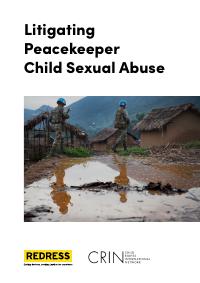
UN Photo/Sylvain Liecht
04/12/2013
MONUSCO Peacekeepers Patrol Town of Pinga, North Kivu
Contents
1. Introduction
2. The Legal Context
3. Case Studies
4. Obstacles to Accountability and Redress
5. Strategic Litigation of Peacekeeper Child Sexual Abuse
6. Avenues for Strategic Litigation
9
12
22
48
53
63
Executive summary
4
7. A Human Rights-Based Approach 73
Case Study 1: Criminal and Civil Proceedings in Uruguay for Events in Haiti
Case Study 2: Criminal and Civil Proceedings in France for Events in CAR
Case Study 3: Right to Information Proceedings in Sri Lanka
Case Study 4: Criminal Proceedings in DRC for Events in CAR
Case Study 5: Paternity Claims in Haiti
Case Study 6: Criminal Prosecution in Pakistan and Civil Proceedings
in Haiti for Events in Haiti
22
27
33
38
41
44
8. Recommendations
81
End Notes 85
REDRESS is an international human rights organisation that represents victims of torture
to obtain justice and reparations. We bring legal cases on behalf of individual survivors,
and advocate for better laws to provide effective reparations. Our cases respond to torture
as an individual crime in domestic and international law, as a civil wrong with individual
responsibility, and as a human rights violation with state responsibility.
CRIN is a global children’s rights advocacy network. Established in 1995, we press for
rights – not charity – and campaign for a genuine shift in how governments and societies
view and treat children.
REDRESS and CRIN would like to express their thanks for the contribution of various
individuals and organisations to this report. In particular they would like to thank the law
firm White & Case for providing invaluable pro bono support on research, interviews, case
study drafting and hosting events. The authors would like to thank those that provided
comments on draft portions of the report, including Roisin Burke, Eléonore Chiossone,
Larry Johnson, Sharanya Kanikkannan, Beatrice Lindstrom, Maxine Marcus, Sienna
Merope-Synge, Kaila Mintz and Emma Schwartz. They also thank all those others that
offered their time in being interviewed for the report: Eugène Bakama, Sylvestre Bisimwa,
Marie Deschamps, Arsène Dieujuste, Rémy Djamouss, Carla Ferstman, Rosa Freedman,
Peter Anthony Gallo, Charu Lata Hogg, Kathleen Jennings, Mario Joseph, Michel Kaboyi,
Alicia Luedke, Beaupaul Mupemba, Ramita Navai, Adrien Nifasha, Sofi Ospina, Magda
Pacholska, Homayra Sellier, Alvaro da Silva, Sarah Smith, Mark Snyder, Jasmine-Kim
Westendorf, and a number of others that preferred not to be named.
Design by Miriam Sugranyes.
First published in January 2020.
(c) REDRESS and CRIN 2019.
LITIGATING PEACEKEEPER CHILD SEXUAL ABUSE LITIGATING PEACEKEEPER CHILD SEXUAL ABUSE 5 4
Executive Summary
The widespread and enduring problem of sexual exploitation and abuse (SEA) by
peacekeepers has been well documented over recent years. Many of the most
disturbing cases have involved children, with peacekeepers from Sri Lanka, Uruguay,
France, Pakistan and other countries implicated in crimes in Haiti, the Central African
Republic, the Democratic Republic of Congo and elsewhere.
Troop-contributing countries (TCCs) have shown themselves largely unable to
prevent abuse, prosecute the perpetrators or provide redress to the victims. The UN’s
role has also been criticised, prompting extensive internal reforms.
Much of the analysis to date has focused on the shortcomings in the various
mechanisms that are meant to prevent, prosecute and remedy instances of abuse.
These include the control structures of peacekeeping missions; the safeguarding
functions of UN agencies; the investigative processes of TCCs and the UN Office of
Internal Oversight Services; the military or civilian criminal justice systems of TCCs
and host countries; and structures for providing support to victims.
When these mechanisms have broken down, the victims, their families, and the
NGOs and lawyers that represent them have on occasions turned to the courts. The
litigation undertaken by victims of peacekeeper child sexual abuse to date has,
however, received relatively little analysis. Its extent, its effectiveness, the obstacles
it faces, and the further opportunities available are the focus of this report. The key
findings are as follows.
Absence of litigation
Extensive desk-based analysis and interviews by a multi-lingual research team from
REDRESS and the law firm White & Case located only a small number of cases where
victims had used the courts to address peacekeeper child sexual abuse – fewer than ten.
While it is possible that there are cases the research did not locate, it appears clear that,
despite the prevalence of peacekeeper child sexual abuse and the focus on peacekeeper
SEA from an academic and policy perspective, litigation has been a relatively underused
tool so far by the lawyers and NGOs seeking to address the issue.
Obstacles to accountability and redress
The findings from the case studies in the report confirm the commonly held view that
peacekeeper child sexual abuse very often goes unpunished, and the victims are in
most cases left without any form of reparations. In each of the case studies suspected
perpetrators were not convicted or were subjected to lesser sanctions than their crimes
merited. In not one of the case studies did the victim receive the full reparations to
which they were entitled. The lawyers and NGOs interviewed repeatedly reported that
their clients did not feel they had obtained justice.
The case studies identify a number of main obstacles that prevent the perpetrators of child
sexual abuse from being held to account, and that prevent victims from obtaining redress.
A key factor was the quality of investigations, with fact finding by TCCs often being delayed
or limited by an absence of properly trained investigators, for example in Haiti. Interviewees
reported that in CAR French investigations were at times carried out without the presence
of specialists in crimes involving minors, mental health professionals, or any assurances that
the children would be placed in environments of personal security.
Immunities and the exclusive jurisdiction of TCCs posed another significant obstacle, for
example in the attempted prosecution of Pakistani peacekeepers for crimes committed
in Haiti. Throughout the case studies any attempted criminal proceedings in the host
countries were blocked by Status of Forces Agreements or by immunities, and any criminal
prosecutions that did take place happened in the TCCs. This opened the door for a range of
other difficulties, including the inability of the victims to participate in legal proceedings in
foreign countries (for example in the DRC), a lack of capacity in the legal systems of TCCs (for
example also in the DRC), difficulties in accessing and collecting evidence and an absence of
political will in TCCs to prosecute their own soldiers (for example in Sri Lanka).
A lack of transparency in prosecution processes, particularly in military court martial
processes, was another significant barrier to justice. In many of the case studies it was
impossible to determine whether and how the perpetrators were convicted and sanctioned.
Even when those seeking to determine the outcome of cases resorted to freedom of
information proceedings, they were unsuccessful.
A range of reforms to policies, practices and legislation in TCCs and the UN are required to
remove these obstacles to accountability and redress. These include improving the speed
and quality of investigations and adopting a more victim-centred approach; amending
TCCs’ laws and criminal procedures to make them suitable for prosecuting crimes overseas;
increasing transparency and victim participation in prosecutions; suspending the
deployment of peacekeeping troops from TCCs that are unable or unwilling to prosecute
child sexual abuse; and addressing commonly-held misunderstandings of the immunity of
those associated with the UN.
Strategic litigation of peacekeeper child sexual abuse
One avenue for seeking to bring about these necessary reforms is through strategic
litigation. The use of strategic litigation in the peacekeeping context, involving both efforts
to obtain reparations and ongoing advocacy for structural reform, could successfully
prompt shifts in policies and attitudes resulting in substantive accountability and
preventing future abuse.
Strategic litigation in the peacekeeper context would employ various civil society
techniques, including advocacy, community engagement, capacity building and
campaigning, alongside work on legal cases. It would seek to bring about a range
LITIGATING PEACEKEEPER CHILD SEXUAL ABUSE LITIGATING PEACEKEEPER CHILD SEXUAL ABUSE 7 6
of impacts beyond the immediate cases, including changing legal frameworks on
jurisdiction and immunities; deterring peacekeepers from future abuses; improving
internal policies on monitoring and training; working in partnership and alliance to
implement the strategies suggested; and reducing stigmatisation and encouraging
more victims to report abuse. These would also reinforce victims’ legal right to a remedy
and further UN Sustainable Development Goal 16 by increasing access to justice and
enhancing institutional accountability.
A number of viable legal avenues exist for seeking to address peacekeeper child sexual
abuse through litigation. These range from actions against the individual perpetrator,
such as instigating criminal prosecutions and bringing direct civil claims (including
paternity claims), to actions against the TCC, such as civil claims in domestic courts of the
TCC or claims against the TCC at regional and international human rights bodies. Cases
against the UN would be more challenging given the UN’s far-reaching immunities.
Techniques that have been developed in other areas, such as the domestic prosecution
of international crimes using universal jurisdiction or the international enforcement
of commercial civil judgments, could be employed in this area to seek justice for
victims. They would require increased coordination between lawyers and NGOs in host
countries and TCCs.
The regional and international human rights bodies in particular present as yet unused
avenues for holding States to account for their failures to prevent, prosecute and remedy
peacekeeper child sexual abuse. Key possible venues would include the UN Committee
on the Rights of the Child, the African Committee of Experts on the Rights and Welfare
of the Child, the UN Human Rights Committee, the Inter-American Commission on and
Court of Human Rights, the European Court of Human Rights, the African regional human
rights bodies and the Committee Against Torture, among others.
A human rights-based approach
While the human rights obligations of the UN to prevent and remedy peacekeeper child
sexual abuse have been identified in analyses such as the 2015 Independent Review on
Sexual Exploitation and Abuse by International Peacekeeping Forces in the Central African
Republic, the human rights obligations of TCCs in this context have received less attention.
Peacekeeper child sexual abuse and institutional failures to prevent, prosecute and
remedy it implicate a range of rights under treaties such as the Convention on the Rights
of the Child, the Convention on the Elimination of All Forms of Discrimination Against
Women, the International Covenant on Civil and Political Rights, the Convention Against
Torture and Other Cruel, Inhuman or Degrading Treatment or Punishment, and the
regional human rights treaties. Relevant rights include rights of children to be protected
from sexual abuse, rights of women to be protected from SEA, rights to privacy, the
prohibition on torture, rights to truth and rights to an effective remedy and reparations.
There also exists a wide range of soft law that is widely accepted by States and offers
guidance on how to investigate sexual violence, torture and other crimes. Legal hurdles
to such claims, including attribution and jurisdiction, exist, but existing jurisprudence
demonstrates they can be overcome.
Human rights standards provide a crucial framework for assessing the UN and particularly
TCCs’ successes or failures in preventing, prosecuting and remedying peacekeeper
child sexual abuse. More pressure needs to be put on policymakers to ensure that the
institutional structures responsible for preventing, prosecuting and remedying peacekeeper
child sexual abuse meet these human rights obligations. A key objective for lawyers and
NGOs engaging in strategic litigation should be to ensure that domestic and international
courts and tribunals hold individuals and States to these standards.
LITIGATING PEACEKEEPER CHILD SEXUAL ABUSE LITIGATING PEACEKEEPER CHILD SEXUAL ABUSE 9 8
1. Introduction
Allegations of sexual abuse of children
during peacekeeping operations and
impunity for the perpetrators is a long-
standing and much publicised problem.
Complaints first emerged in the 1990s
and have been made against military
contingents, police, humanitarian and
other civilian personnel in missions across
a range of countries.
Investigations into the issue suggest that
sexual abuse has been widespread and that
a range of organisations and individuals
have been implicated. It has been the
subject of a number of internal UN reviews
and resolutions over the last two decades.
1
This report focuses primarily on legal
avenues to combat impunity in cases of
child sexual abuse by peacekeepers in
UN operations.
2
In doing so, it does not
seek to undermine the important and
courageous work of the many people who
work for the UN with the greatest levels
of integrity in difficult and dangerous
circumstances. Neither does the report
ignore the broader, systemic issues of SEA
of adults by peacekeepers and within the
humanitarian sector more broadly.
3
The report’s focus reflects REDRESS’s
mandate to seek justice and reparations in
cases of torture (one of the many human
rights violations potentially implicated
by peacekeeper child sexual abuse
4
),
and CRIN’s expertise on children’s rights,
given the particularly tragic nature
of peacekeeper sexual abuse when
committed against children. However, it
is intended that the findings should also
have a broader application outside that
specific context.
The report identifies challenges and
lessons based on six case studies. These
primarily concern allegations against
UN military peacekeepers, as those are
the claims that were identified through
research for the report, and because, as
an organisation working across the globe
to uphold principles of international law,
the UN should be the standard bearer
for tackling impunity in this area. The
report focuses principally on actions of
the military personnel serving with TCCs,
as opposed to civilian peacekeepers.
However, the latter category is addressed
at times.
Although SEA in peacekeeping contexts
is recognised as pervasive, the exact
scale of the problem is hard to ascertain.
The UN has only issued detailed data on
allegations of SEA in its peacekeeping
operations since 2015. Some information
was held prior to that date but significant
changes in methodology took place in
2007 and 2010, and victims’ ages were only
recorded from 2008 onwards.
5
Concerns
have been raised about the way in which
data is gathered and recorded,
6
and that
statistics fail to capture nuance or account
for intersectional power dynamics in
exploitative relationships between local
inhabitants and peacekeepers.
7
Even so, the number of formal allegations
that have been raised is disturbing.
Between 2004 and 2016, the UN received
almost 2,000 formal allegations of SEA
by peacekeepers and other personnel
involved in UN missions, including more
than 300 complaints involving children.
8
The UN Secretary-General acknowledged
in his 2017 Special Measures report on
LITIGATING PEACEKEEPER CHILD SEXUAL ABUSE LITIGATING PEACEKEEPER CHILD SEXUAL ABUSE 11 10
SEA, “we feel certain that not all cases are
reported”
9
and practitioners suspect that
formal complaints made so far are only the
“tip of the iceberg”.
10
The UN has repeatedly asserted a “zero
tolerance” policy to SEA, stating its
prohibition amongst UN personnel and
affirming that every transgression will
be acted upon.
11
Despite this, only a very
small number of perpetrators have been
convicted, and accountability and redress
for victims is almost non-existent.
This is partly due to jurisdictional obstacles,
which prevent or limit the chances of
prosecution of both military and civilian
peacekeepers. Concerns have also been
raised about a lack of independence and
transparency in the UN’s handling of
complaints of SEA within its operations, an
unwillingness to confirm that functional
immunity does not apply, as well as a lack
of trained and experienced investigators.
These issues are compounded by the
contexts in which the abuse occurs – in
situations of conflict and humanitarian
crises where the local population is already
struggling and legal institutions may
be weak – and the difficulties in victims,
especially children, conceiving of and
accessing avenues for justice and redress.
Purpose of the report
REDRESS published a report in September
2017 on Sexual Exploitation and Abuse in
Peacekeeping Operations focusing on what
happens to the victims of such abuse, a
subject often overlooked and marginalised
in debates on accountability. It identified
the tendencies to situate liability solely
with the direct perpetrators, rather than
the organisations and TCCs under whose
mandate those individuals operated, and to
ignore victims’ right to redress in favour of
charity and benevolence.
The report encompassed cases in which
children were the victims of sexual
abuse by peacekeepers and highlighted
the particular gravity of these crimes
committed against already vulnerable
and marginalised individuals by the
very people tasked to protect them. It
identified the absence of legal redress
and adequate and effective reparation for
victims and noted the failure to address
the problem as an urgent concern of the
highest magnitude.
Several national and international
NGOs have tried to challenge the lack
of accountability for sexual violence by
peacekeepers by taking legal claims
through the courts. However, these are
often isolated examples and there has
so far been no comprehensive study
that identifies those cases, assesses their
impact and considers how attempts to
achieve accountability through litigation
could be improved.
The purpose of this report is to examine
the use of litigation as a means of
securing accountability and justice
for the sexual abuse of children by
peacekeepers. The report analyses a
number of cases that examine previous
attempts at accountability. These include
French domestic proceedings for crimes
committed in CAR, civil paternity claims in
Haiti, freedom of information proceedings
in Sri Lanka, domestic criminal proceedings
in DRC, and a civil claim in Uruguay. The
report identifies a number of obstacles
currently faced by the NGOs and lawyers
seeking accountability for child sexual
abuse by peacekeepers.
The report then goes on to examine
how strategic litigation could be used
to address the underlying causes of
peacekeeper child sexual abuse and
impunity. It outlines potential legal
avenues that NGOs and lawyers acting
on behalf of victims could use and
concludes by setting out a human rights-
based approach that could provide
new substantive bases for seeking
accountability in this area.
The report concludes by setting out
certain recommendations for reform that
find new or further support in the findings
of the research undertaken. They include
reforms for addressing particular hurdles
identified in the case studies, methods
necessary for overcoming the challenges
posed by sexual abuse against children
specifically, and proposals for human
rights-based strategic litigation to address
existing failings.
Methodology
The process of preparing the report
combined desk-based research with
detailed interviews of individuals to
identify relevant cases and assess their
impact. A multi-lingual team from REDRESS
and White & Case contacted over 70 key
lawyers, activists, academics, journalists
and former UN staff members that have
worked on issues relevant to peacekeeper
litigation across the world. Based on
those contacts the team conducted
over 30 interviews with individuals with
particular knowledge of litigation relating
to peacekeeper child sexual abuse.
12
Alongside this REDRESS convened a
roundtable meeting with CRIN and other
organisations to seek expert input on the
direction of the study.
In some of the cases featured a large
amount of information was available
publicly, and several individuals involved
in the case were contactable and available
for interview. In other cases, only a small
amount of information was publicly
available, and individuals involved were
difficult to locate. This is reflected in the
varying levels of detail in the case studies,
and further underscores one of the key
challenges to accountability being the lack
of transparency in proceedings.
LITIGATING PEACEKEEPER CHILD SEXUAL ABUSE LITIGATING PEACEKEEPER CHILD SEXUAL ABUSE 13 12
Victims defined
The UN defines victims in the context
of SEA as “a person who is, or has been,
sexually exploited or abused by United
Nations staff or related personnel and
the allegation has been established
through a United Nations administrative
process or Member States’ processes as
appropriate”.
17
This requires establishing
proof of the allegation to a very high
standard within a system in which
UN personnel investigate possible
misconduct by other members of the
same organisation.
The UN recognises that there may be
a variety of reasons why the available
evidence is insufficient to substantiate a
complaint and that such a finding does
not necessarily mean the allegation was
false.
18
Nonetheless, its narrow definition
of a victim, which is only conferred
to those who have their complaint
substantiated, risks being at odds with
the principle that an individual’s status
as a victim is not contingent on the
apprehension of a perpetrator, which
was affirmed in the UN Basic Principles
and Guidelines on the Right to a Remedy
and Reparation
19
and the 1985 Declaration
of Basic Principles of Justice for Victims
of Crime and Abuse of Power.
20
This is an
important principle which recognises that
victim status and the rights that flow from
that are not contingent on the variables
of a legal process over which the victim
has little or no control.
REDRESS’s previous report on SEA in
peacekeeping operations noted this
2. The Legal Context
Sexual abuse and
SEA defined
A wide range of acts with respect to
children are covered by the term “sexual
exploitation and abuse”, which include
rape and sexual abuse, trafficking,
exploitative relationships in which sex is
required in exchange for things such as
money, food, medicine and security. It is
well established that rape and other forms
of sexual violence frequently amount to
torture and ill-treatment, and the gravity of
these forms of criminal behaviour against
children is often masked by the often-used
acronym “SEA”.
The UN defines sexual exploitation as “any
actual or attempted abuse of a position of
vulnerability, differential power, or trust,
for sexual purposes, including, but not
limited to, profiting monetarily, socially or
politically from the sexual exploitation of
another” and sexual abuse as “the actual or
threatened physical intrusion of a sexual
nature, whether by force or under unequal
or coercive conditions”.
13
These definitions
are endorsed by CRIN
14
and REDRESS.
The UN Secretary-General’s 2017 report,
Special measures for protection from sexual
exploitation and abuse: a new approach,
identifies different forms of sexual abuse
against children as including: child
rape, sexual assault, solicitation of child
prostitution, trafficking for SEA, and other
forms of sexual violence against children.
15
All sexual activity with individuals under 18
years of age is defined as sexual abuse by
the UN.
16
narrow framing of the issue within UN
reports. It highlighted that precisely who
is a victim remains unclear, with references
made in reports to “alleged victims” and
systems for assistance distinguishing
between complainants and victims, with
more support provided to the latter.
21
As
observed in the report, this is invariably
an artificial distinction as processes to
determine who is a victim are beset by the
same problems that plague the criminal
accountability process. Many individuals
who were victimised are never recognised
as victims due to difficulties in providing
sufficient proof and the trauma involved in
having to explain and be judged by people
the victims perceive as being aligned to
the perpetrators.
22
The UN data on SEA in field locations
distinguishes between allegations
involving one or more victims under
the age of 18, those that do not involve
a victim under that age, and those
where the age of the victim(s) is
currently unknown.
23
Applicable legal frameworks
Although the UN has clearly defined—and
prohibited—child sexual abuse, efforts
to seek accountability for cases of child
sexual abuse by peacekeepers have been
largely unsuccessful due to a combination
of factors, including (i) the absence of a
single legal framework designed to cover
peacekeeping troops and (ii) immunity
protections for UN personnel, as the
following sections now discuss.
The Charter of the United Nations, which
grants the UN Security Council the primary
responsibility for the maintenance of
international peace and security, does
not explicitly envisage the creation of
peacekeeping operations.
24
Perhaps
consequently, the laws and policies
governing peacekeeping personnel have
developed in an ad hoc manner, resulting in
a complex system of laws that have proven
difficult to operationalize and provide only
weak protections for victims of grave harms
perpetrated by peacekeepers.
In addition to the UN’s internal standards of
conduct dealing with SEA—including the
UN Secretary-General’s Bulletin adopting
a zero-tolerance policy to SEA
25
(discussed
above)— peacekeepers are subject to
customary international humanitarian
law (IHL), whether they are performing
duties of an enforcement or peacekeeping
nature.
26
Whether peacekeepers can be
considered “parties” to an armed conflict
within the meaning of IHL remains a subject
of debate;
27
however, the UN has agreed
that its troops are obligated to “respect and
ensure respect” for the Geneva Conventions
and its Protocols.
28
The extent to which the UN is bound by
international human rights law (IHRL)
obligations is also contested. However,
many scholars agree that the broad
protections enshrined by IHRL are
incompatible with a doctrine of absolute
immunity for international organisations,
including the UN; similarly, courts have
recently found that human rights-based
challenges to UN immunity frameworks
might succeed if an individual’s human
rights have been violated by such
immunity.
29
Accordingly, the UN (and
TCCs) can likely be viewed as being
bound by IHRL, including, for example,
the duty to respect and ensure respect
for the right to life and the prohibition
against torture and ill-treatment, both
of which are non-derogable, even in the
context of armed conflict.
Additionally, as this report highlights,
many of the abuses committed by
peacekeepers—such as SEA—can be
considered “ordinary crimes” under
domestic law, though they may also rise to
LITIGATING PEACEKEEPER CHILD SEXUAL ABUSE LITIGATING PEACEKEEPER CHILD SEXUAL ABUSE 15 14
the level of war crimes or other IHL or IHRL
violations. As such, peacekeepers are in
theory subject as individuals to the criminal,
civil and, in some cases, administrative laws
of their home States (including military
disciplinary procedures as per national
military criminal codes or regulations).
30
However, as the following section discusses,
immunities and jurisdictional challenges
often frustrate efforts to seek accountability
for abuses committed by peacekeepers in
their home States.
Immunity and jurisdictional
challenges
The UN’s founding treaties provide that
it has the status of a legal person under
the domestic law of its Member States. It
enjoys on their territory such privileges
and immunities as are necessary for it
to fulfil its purposes,
31
and it “shall enjoy
immunity from every form of legal process”
in all its operations unless it expressly
waives its immunity.
32
The UN and its entities, including
peacekeeping missions, are immune from
legal process on any subject and in
any country.
Routes to criminal accountability are also
affected by UN immunities rules and the
process that applies to an investigation
depends on the status of the alleged
perpetrator.
33
Peacekeeping troops
Members of military contingents
deployed in UN operations, as well as
some police and civilian staff sent by
their governments to fulfil military roles
on those operations, remain under the
exclusive criminal jurisdiction of their
national government.
According to the UN Model Status
of Forces Agreement (SOFA), which
governs the legal relationship between
a peacekeeping operation and the host
country, the exclusive responsibility to
discipline and criminally sanction military
contingents rests with TCCs.
34
Under the
Memorandum of Understanding agreed
between TCCs and the UN, those countries
retain primary authority to investigate
allegations of misconduct, including of
SEA, and jurisdiction to impose criminal or
disciplinary sanctions.
35
This provides protection from the
jurisdiction of the host country, which
is prevented from investigating or
prosecuting any crimes except where
a soldier is court-martialled in situ
and transferred to local authorities for
prosecution.
36
But even in those cases, the
TCC holds the responsibility to determine
how to respond to the matter. It is possible
for a TCC to waive the jurisdictional bar that
prevents investigation and prosecution by a
host country, but this rarely happens.
The UN must notify TCCs of any reports
of SEA that implicate their military
personnel and the sending State then
has ten days within which to indicate if
it intends to investigate the allegations
(five days in the case of situations deemed
to be of heightened risk).
37
The TCC can
choose to investigate allegations of SEA
in collaboration with the UN’s Office of
Internal Oversight Services (“OIOS”). The
UN can also initiate an administrative
investigation where the TCC is unwilling
or unable to do so,
38
and can start
a preliminary fact-finding inquiry if
necessary to preserve evidence if the
government of the TCC does not start,
or until it starts, its own investigation (at
which point the fact-finding report will be
transferred to the TCC).
39
Where the TCC
conducts its own investigation, it must
update the UN of progress on a regular
basis, including the outcome of the case.
40
The UN has committed to repatriating
military or police personnel “where there
is credible evidence of widespread or
systematic [SEA].”
41
The government of the
TCC is obliged to ensure that the case is
forwarded to the appropriate authorities
for action.
42
TCCs can initiate court-martial or criminal
prosecution proceedings against alleged
perpetrators. However, this is only possible
if they have legal authority to prosecute
domestic crimes extraterritorially. Many
States do not have this and those that
do may face domestic pressures that
limit the chances of bringing successful
prosecutions (see further Chapter 4). In
both circumstances, the result is impunity.
Civilian peacekeeping personnel
UN civilian staff are immune from any
legal process for all acts performed in
their official capacity.
43
Criminal acts of
SEA do not constitute official acts of a UN
employee, and are therefore not covered
by this functional immunity.
44
However, the
UN asserts the right to determine whether
allegations constitute criminal behaviour
and whether functional immunity applies
to an alleged perpetrator. The effect of this
is that UN personnel are shielded from
legal processes in the host country while
the UN evaluates the circumstances of the
allegation and assesses whether immunity
applies, meaning immunity applies until
that assessment is completed.
Additional protections are provided for
experts on mission. They are deemed
inviolable while on mission,
45
meaning
they are immune from legal processes and
afforded protection from any interference
with their integrity during the mission.
The highest levels of UN staff (this
generally includes heads of peacekeeping
missions) also have ‘personal’ immunity,
46
which accords them the same status as
diplomats and means they cannot be
charged with a crime or subjected to most
civil proceedings.
Where immunity does apply, the Secretary-
General of the UN has the right to waive
that immunity where it would “impede the
course of justice”,
47
but this power is rarely
used and prosecutions of UN civilian staff
for crimes committed on overseas missions
are extremely rare. Both the 2005 landmark
report of Prince Zeid Ra’ad Zeid Al-Hussein
into SEA on peacekeeping missions
48
and the subsequent report of the Group
of Experts tasked to advise how best to
overcome remaining legal barriers
to criminal accountability of
peacekeepers
49
recommended that
immunity be waived to allow the
host country to investigate and prosecute
where appropriate.
50
LITIGATING PEACEKEEPER CHILD SEXUAL ABUSE LITIGATING PEACEKEEPER CHILD SEXUAL ABUSE 17 16
UN processes for handling allegations of SEA.
51
Member State
does not respond
or declines
to investigate
REPORT
RECEIVEDSOURCES OF
REPORTS
INCLUDE
Outcome
Reported to
Sources of
Reports
ONGOING
VICTIM
ASSISTANCE
1
ALLEGATION
RECORDED AS
SEXUAL EXPLOITATION
AND ABUSE
SEXUAL EXPLOITATION AND A BUSE
Management of Reports and Allegations Involving UN Personnel
In Peacekeeping and Special Political Missions
VICTIM
WITNESS
COMMUNITY-BASED
COMPLAINT MECHANISM
NGO
MISSION STAFF
MEDIA
UN
5
investigates Civilian, Police,
and Military Experts on Mission
personnel, as well as Military personnel
not investigated by Member State
UN to complete investigation
in 6 months, where possible
6
UN completes investigation
UN takes disciplinary action
against civilians; UN may refer
to Home State for criminal
accountability
Member State reports to UN
on action taken
Suspended payments are
transferred to the Trust Fund
in support of victims of sexual
exploitation and abuse
For Military/Police personnel issues
UN reports to Member State
UN repatriates Military and
Police personnel, barring them
from future service
Unsubstantiated Allegation
Disciplinary action may still
result for other breaches of rules
Substantiated Allegation
Member State has 10 days to notify UN
whether it will investigate Military personnel
3
Member State investigates
2
Member State completes investigation
Member State reports to UN
on conclusion and action taken
Substantiated Allegation
Unsubstantiated Allegation
Disciplinary action may still
result for other breaches of rules
UN repatriates Military and
Police personnel, barring them
from future service
Suspended payments are
transferred to the Trust Fund
in support of victims of sexual
exploitation and abuse
FACT FINDING
ASSESSMENT
EVIDENCE
PRESERVATION
Victim
Assistance
Initiated
1
Interim action, e.g., administrative leave without pay
Public
Announcement
by Mission
UN CONCLUDES
DISCIPLINARY
CASE
UN Notifes Member State of Military
or Police contingent personnel
Interim action, e.g., UN suspends payments
Outcome Reported to Sources
Public Reporting
on UN Website
4
Information assessed
as not being sexual
exploitation and abuse
Possible investigations
for other breaches
of rules
DECISION
POINT
Member State
United Nations
1. Victims assistance includes medical and psychosocial services, as well as legal services
to assist with paternity cases
2. Secretary General requests Member States to adopt six month timeframe for investigations (A/70/729 para 50)
shortened to three months when circumstances suggest the need for urgency
3. Ten days timeframe for notification can be shortened to five days when circumstances suggest the need for urgency
4. www.conduct.unmissions.org
5. OIOS and/or Mission
6. Six month timeframe for UN investigations for SEA will be shortened
to three months when circumstances suggest the need for urgency (A/70/729 para 51)
LITIGATING PEACEKEEPER CHILD SEXUAL ABUSE LITIGATING PEACEKEEPER CHILD SEXUAL ABUSE 19 18
their home State and civilians should be
transferred to local authorities. However,
the practice differs from the theory
and there has been persistent failure to
appropriately apply the rules relating to
SEA in peacekeeping missions, resulting in
an almost complete lack of accountability.
The case studies within this report provide
detailed examples of how the system
operates in practice, and the challenges
this poses are summarised in Chapter 4.
Non-UN peacekeeping personnel
Allegations of SEA have implicated non-
UN personnel, such as staff of NGOs
who implement UN programmes on the
ground
52
or peacekeepers operating under
mandates of regional organisations.
53
The
UN has established an internal system
to follow up allegations involving non-
UN personnel with the relevant Member
State and includes prevention and
response measures in Security Council
resolutions on country-specific situations.
54
Nonetheless, the extent to which UN
doctrine and guidance applies to non-
UN personnel operating within a UN-
mandated mission is unclear. The failure
of the UN to address child sexual abuse
by French troops in Operation Sangaris,
a Security Council- authorised mission in
the Central African Republic that deployed
alongside the UN operation MINUSCA, is
discussed at Case Study 2 (French Sangaris
peacekeepers in CAR). This case illustrates
the lack of clarity and legal protection in
this area.
UN Security Council Resolution 2272 on
Sexual Exploitation and Abuse (adopted in
March 2016) “urges all non-United Nations
forces authorised under a Security Council
mandate to take adequate measures
to prevent and combat impunity for
sexual exploitation and abuse by their
personnel.” It calls on UN Member States
to repatriate their own units from non-UN
missions where there is credible evidence
of widespread or systemic SEA by those
units, and to appropriately investigate
allegations and hold perpetrators to
account.
55
Ultimately, this merely “urges”
non-UN forces to hold themselves to
account and provides even weaker
accountability measures than apply in full
UN missions.
Under the above frameworks, soldiers
accused of SEA should be prosecuted by
LITIGATING PEACEKEEPER CHILD SEXUAL ABUSE LITIGATING PEACEKEEPER CHILD SEXUAL ABUSE 21 20
CASE STUDY 6
PakistaniP
peacekeeperspeacekeepers
iin Haiti
CASE STUDY 5
Paternity
claims
in Haiti
CASE STUDY 11
Uruguayan
peacekeepers
in Haiti
CASE STUDY 3
Sri Lankan
peacekeepersp
in Haitin
CASE STUDY 2
French Sangaris
peacekeepersacekeepers
in CAR
CASE STUDY 4
DRCRC
peacekeeperse
in CAR
LITIGATING PEACEKEEPER CHILD SEXUAL ABUSE - CASE STUDIES
LITIGATING PEACEKEEPER CHILD SEXUAL ABUSE LITIGATING PEACEKEEPER CHILD SEXUAL ABUSE 23 22
rights. MINUSTAH ended in October 2017
and was replaced by a smaller follow-
up peacekeeping Mission, the United
Nations Mission for Justice Support in
Haiti (MINUJUSTH).
56
At its peak, nearly
7,000 soldiers and 2,000 police officers as
well as civilians, served in Haiti;
57
the first
peacekeeping mission to have a majority
of troops from Latin America, with Brazil
providing the largest contingent as
well as the military commander of the
peacekeeping forces.
58
Facts
The United Nations Stabilization Mission
in Haiti (MINUSTAH) was established
by UNSC Resolution 1542 on 1 June
2004, following instability generated by
the 2004 coup d’état against President
Jean-Bertrand Aristide. MINUSTAH’s
mandate was to restore a secure and
stable environment, support the
electoral process, and support the
promotion and protection of human
3. Case Studies
Case Study 1: Criminal and Civil
Proceedings in Uruguay for Events in HaitiUN Photo/ Logan Abassi
MINUSTAH’s record between 2004 and
2017 has been dogged by controversy.
59
MINUSTAH introduced a deadly cholera
epidemic to Haiti through improper waste
management that has killed over 10,000
people since 2010.
60
Its troops have also
been accused of committing a number of
other human rights abuses and crimes,
including extensive SEA.
61
A 2013 UN
investigation declared this particular
form of violence the ‘most significant
risk to UN peacekeeping missions’ and
suggested that MINUSTAH experienced
amongst the highest rates of SEA
62
despite the UN’s ‘zero tolerance’ policy.
In July 2011, five marines from Uruguay
stationed in the southern town of Port-
Salut in a peacekeeping capacity sexually
assaulted a local teenage boy named
Johnny Jean, who at the time was still a
child.
63
Jean was reportedly abducted on
his way home from a football match and
taken to the barracks of MINUSTAH, where
he was beaten, and gang raped. The
assault was recorded on a mobile phone
by the peacekeepers, and the footage
was leaked a month later,
64
resulting in
protests in Haiti outside the UN base.
65
Shortly after the assault, the victim and
his mother told Haitian radio stations that
he was raped by the Uruguayan marines,
and they gave evidence to the Haitian
police and a local judge.
66
In response to the public outrage over
Jean’s assault, Uruguayan President
Jose Mujica wrote to Haitian president
Michel Martelly, assuring him that the
perpetrators would face the harshest
possible sanctions.
67
For his part,
President Martelly stated that he
“vigorously condemned” the actions
of those involved, and requested that
the relevant authorities meet with UN
officials to ensure that such acts did not
occur again.
68
Additionally, in the wake of public
outrage, the head of operations of the
Uruguayan Navy in Haiti was dismissed
from his position.
Legal proceedings
Several investigations into the alleged
assault were opened by the UN Mission in
Haiti, the Uruguayan Defence Ministry, and
the Haitian authorities. A UN spokesperson
stated that the five alleged attackers were
confined to their barracks pending the
outcome of three investigations and that,
if the allegations proved to be true, the
perpetrators “must be brought to justice.”
69
In its preliminary report, the UN stated that
Johnny Jean had not been raped but that
the troops were at fault for permitting a
civilian to enter a military camp.
70
In September 2011, the five soldiers and
their superior officer were repatriated
to Uruguay.
71
Under the SOFA entered
into by the Haitian government and the
United Nations in 2004, Uruguay retained
jurisdiction over its troops, granting the
soldiers immunity from the Haitian State
and placing the burden of prosecution
on Uruguay.
72
Three proceedings then occurred in
relation to Johnny Jean’s case: military,
criminal and civil proceedings.
Military procedure
Under Uruguayan law, members of the
military may be disciplined under both
military and civilian law.
73
In this case,
the accused soldiers were placed in jail
during the initial investigations by the
authorities.
74
At the time, a spokesman
for the Uruguayan Defence Ministry said
in a statement that “the Navy wants to go
beyond the simple fact of the video [to
determine] if there are other violations
of conduct”. He added that the “suspects
LITIGATING PEACEKEEPER CHILD SEXUAL ABUSE LITIGATING PEACEKEEPER CHILD SEXUAL ABUSE 25 24
The victim faced several difficulties over
the course of the proceedings, including
that the victim’s court-appointed translator
could not speak Haitian Creole fluently,
despite the victim’s testimony being
central to the case. Mr Espérance expressed
concerns about the Uruguayan lawyer who
was appointed to the victim, stating that he
did not believe the lawyer was defending
the victim’s interests. Mr Espérance also
voiced uncertainty about the UN, Uruguay
and Haiti’s involvement in the case, and
concern that the Haitian government
appeared to fade into the background and
was not involved in the judicial process.
84
He argued that the whole case appeared
to be focused on how best to acquit the
defendants instead of seeking justice and
reparation for the victim.
Following the victim’s testimony against
the defendants, Mr Charles voiced
frustration at the Haitian government’s
indifference and lack of engagement in
the case, which he argued amounted to
an interference with Mr. Jean’s right to
redress and access to justice. He stated
that if necessary, they would launch a case
against the Haitian government.
85
Following the victim’s May 2012 testimony,
four defendants were charged with “private
violence” (or “coercion”) rather than sexual
assault, in late August 2012. The prosecutor
in the case reportedly stated that the “the
evidence on record does not support
findings of sexual assault . . . [but that]
force was used to oblige another person
to tolerate an action against their will”.
86
In particular, the prosecutor determined
that the evidence available did not
demonstrate penetration sufficient for a
criminal charge of rape.
87
Private violence is a lesser offence than
rape or sexual assault under Uruguayan
law,
88
and carries a penalty of between
three months to three years in prison—
will be tried and sentenced appropriately”.
75
Possible punishments included the possibility
of a dishonourable discharge from military
service or loss of retirement benefits.
76
On 19 September 2011, the five
peacekeepers were charged by the military
court for the “crimes of disobedience and
omissions in the services,” and required
to serve pretrial detention.
77
They were
provisionally released in December 2011
pending the decision of the Uruguayan
criminal court (see section below).
78
It is
not clear whether the perpetrators faced
any additional consequences as a result of
the military procedure.
Criminal procedure
In January 2012, a UN official confirmed
that the accused soldiers had been
released from jail in Uruguay. According
to the Uruguayan prosecutor in charge of
the case, the inability to locate the victim
for his testimony had effectively stalled
the case. This argument was refuted by the
victim, who stated in a telephone interview
that no one had ever asked him to provide
a testimony. He stated: “They know where
to find me, if they take me, I will go.”
79
In May 2012, the victim travelled to
Montevideo in Uruguay to testify against
the defendants, although he received only
partial financial support to do so.
80
He was
accompanied by two American lawyers
(Edwin Marger and Mike Pugliese),
81
Haitian lawyer Gervais Charles, and Pierre
Espérance, director of the Haitian National
Network for the Defence of Human Rights
(RNNDH). Jean completed an additional
series of medical exams upon his arrival in
Uruguay.
82
During his testimony, the victim
was asked to identify his abusers from a
line-up of fourteen uniformed men.
83
Mr
Espérance also confirmed that Johnny Jean
testified against the soldiers on 10 May
2012 during a three-hour hearing.
significantly less than for a rape charge
89
which carries a minimum of two years and
a maximum of twelve years in prison.
In March 2013, the defendants were
convicted of the private violence charges,
90
and were sentenced to two years and
one month in prison. The sentences were
suspended and they did not spend any
time in prison.
91
After the sentencing, the
defence attorney claimed that Johnny
Jean was lying about the abuse and
requested an appeal of the conviction and
an investigation against him for slander
and defamation.
92
It is unclear whether the
investigation against Johnny Jean was ever
initiated, and the outcome of any appeals
process is also unknown.
Civil procedure
In Uruguay, victims may claim damages
in civil tribunals. Johnny Jean’s legal team
brought a case against the Government
of Uruguay before the Tribunal de lo
Contencioso Administrativo, which handles
claims against the State for the acts or
omissions of State agents where potential
damages exceed USD 17,000.
93
Johnny Jean faced several key challenges
in bringing his civil case. Under
Uruguayan law, the statute of limitations
is not interrupted or suspended by
ongoing criminal procedures, though
some acts (such as an investigation)
may suspend the limitation period.
94
Consequently, by the time his legal team
sought to initiate civil proceedings,
the limitation period—four years in
Uruguay—had nearly run out.
95
Evidentiary challenges, stemming both
from the location of the crime in Haiti
and Johnny Jean’s present location
in the United States, and language
differences further complicated the civil
proceedings.
96
Though Uruguay was required to respond
to Jean’s claim within 30 days of its
presentation (which occurred in July 2015),
the government argued that the limitation
period had run out, despite a prior
administrative investigation that set 28
July 2015 as the deadline for submission.
To settle this statute of limitations dispute,
both parties were ordered to present all
relevant evidence, including the date of
the attack in question; reports from the
prior criminal and military procedures;
witness testimonies; and time-stamp
information from the video of the attack.
97
This procedure has not been resolved
yet.
98
Witnesses have testified, including
the victim’s stepfather, who was among
the first people aware of the event. The
court has yet to analyse the memory card
containing the video of the attack, which it
received in December 2018.
99
Impact
The unsatisfactory conviction of “private
violence” in this case diminishes the
severity of the assault and does not impose
an adequate sanction on the perpetrators.
The failure to recognize Johnny Jean’s legal
status as a survivor of rape denies him an
official apology, and amplifies the stigma
associated with sexual assault.
States are bound by international human
rights obligations to provide adequate
compensation for harms suffered.
However, beyond the minimal financial
assistance provided to defray the cost of
Jean’s travel to Uruguay to testify, he has
received no financial compensation or any
other form of reparation to date.
Today, despite ongoing support from
his family, Jean continues to face serious
mental health problems as a result of the
assault and is unable to peacefully think
of or plan for his future. Following the
LITIGATING PEACEKEEPER CHILD SEXUAL ABUSE LITIGATING PEACEKEEPER CHILD SEXUAL ABUSE 27 26
rape, he felt obliged to leave his home of
Port-Salut and seek refuge in the country’s
capital Port-au-Prince, before moving to
the United States.
100
Although this case caused public outrage
both in Haiti and abroad, there is little
evidence that it has had an enduring
impact on how peacekeepers are regulated
or policed outside of their own jurisdiction
for criminal conduct that took place in the
host country. Rather, Johnny Jean’s case
highlights how UN soldiers committing
human rights abuses while deployed on
missions benefit from the existing legal
and practical obstacles present in this case.
Challenges/lessons learned
Though the Uruguayan criminal justice
system provided some measure of
accountability for the abuses committed
by the peacekeepers in question,
significant evidentiary and logistical
challenges impeded all three proceedings
in this case. Most significantly, though
defendants were sentenced through a
domestic criminal procedure, the sanctions
imposed were not proportionate to the
gravity of the facts, making their deterrent
effect doubtful.
As noted, gathering evidence was
difficult, both because the facts occurred
in a second country (Haiti), and because
the perpetrators were no longer in
that country. Over the course of the
multi-country investigation, the victim
was examined by doctors and testified
to judicial officers in both Haiti and
Uruguay, reportedly resulting in his re-
traumatization without any concomitant
psychosocial support.
101
Further, it is
understood that Johnny Jean’s case was
not handled by investigators specialised
in proceedings involving sexual violence,
exacerbating the victim’s sense of shame
in testifying about the events that had
occurred. Johnny Jean would have
benefited from both psychosocial support
and access to a victims’ rights liaison
familiar with similar cases of abuse at the
hands of peacekeepers.
102
In this regard,
Johnny’s situation as a child at the time of
the events does not seem to have been
considered during the proceedings.
The geographical distance also placed
a significant financial burden on the
investigation—without pro bono support,
the victim would not have been able to
pursue the litigation. That Johnny Jean
was in the United States at the time of the
proceedings also complicated the case,
due to time differences and the language
barriers inherent in the case.
Individuals working on the case expressed
frustration that the UN and Haiti
government’s involvement was limited,
making the gathering of evidence more
difficult and potentially frustrating any
efforts to obtain reparations or redress
for harms suffered. Despite initial public
outrage when the Uruguayan media
published Johnny Jean’s story, as the legal
proceedings dragged on, interest faded. In
this context, NGOs and lawyers involved
in these cases could consider engaging
with the relevant local communities
through ongoing advocacy and activism, to
encourage governments to participate fully
in similar proceedings, though they also
face challenges due to limited resources.
Facts
Operation Sangaris was a French military
mission that operated in Central African
Republic (CAR) from 2013 until 2016.
The mission was sent to support the
African Union Mission to the Central
African Republic (MISCA) to prevent
religious cleansing and potential genocide
between the Muslim Séléka rebels in the
north of CAR and the Catholic majority
population in the south of CAR. The
French government warned that the
CAR was on the verge of genocide
103
and
advocated at the UN Security Council for
an intervention, resulting in the adoption
of Resolution 2127. The tipping point is
widely considered to have been when a
leader of the Séléka rebel group, Michel
Djotodia, declared himself President of
CAR after his forces took control of the
capital Bangui and forced President Bozizé
to flee the country.
Operation Sangaris officially began
overnight on 5 to 6 December 2013
following the adoption of UN Security
Council Resolution 2127. While France was
authorized to engage in a peacekeeping
mission by the Security Council, the
Operation Sangaris troops were not UN
peacekeepers per se. French forces first
entered CAR in November 2013 after
the request of the African Union Peace
Case Study 2: Criminal Prosecution in
France for Events in CARUN Photo/Catianne Tijerina
LITIGATING PEACEKEEPER CHILD SEXUAL ABUSE LITIGATING PEACEKEEPER CHILD SEXUAL ABUSE 29 28
and Security Council (AUPSC) to provide
support to the MISCA, and carried out
peacekeeping, disarmament, and security
restoration missions until 30 October 2016.
The French intervention in CAR is widely
believed to have prevented a rapidly
destabilizing situation from descending into
a violent genocide. Nonetheless, the French
intervention was not without problems.
Multiple allegations began to emerge that
French troops in CAR had sexually abused
children in internal displacement camps in
exchange for food.
104
Legal proceedings
French legal proceedings
The UN was informed of the child sexual
abuse allegations against French troops
in the spring of 2014.
105
However, the case
was only brought to the attention of the
French authorities in late July 2014, when
a confidential UN report was provided to
France’s Defence Ministry by a whistle-
blower, Anders Kompass, a relatively high-
ranking official in the Office of the UN High
Commissioner for Human Rights (OHCHR)
in Geneva.
106
The six-page report had been
drafted by Gallianne Palayret, a UN Human
Rights Officer who conducted interviews
with six young boys who said they had
been lured into oral sex by French soldiers
in Bangui, in return for food and sometimes
money.
107
The report also mentioned
peacekeepers from Chad and Guinea.
These investigations were confirmed
publicly in an April 2015 Guardian
article,
108
after Aids Free World provided
the newspaper with a copy of the report.
The Paris Prosecutor’s office opened a
preliminary investigation in July 2014.
109
Following the first investigations, a judicial
investigation (“information judiciaire”) was
opened in May 2015 led by three judges
(“juges d’instruction”).
110
The judges focused
on fourteen French soldiers.
111
French
investigators were sent to CAR in 2015 and
2016 to question children that had come
forward. It is understood that there were
forty-one potential child victims.
112
Issues of reliability arose with some of the
claims in the testimonies gathered by the
investigators in CAR.
113
Presented with
a number of pictures, a child claimed to
recognize their aggressor despite the pictured
person not having been in the military.
Another was said to have conceded to having
lied, and one child claimed to remember
the name written on the alleged assaulter’s
uniform but was unable to read the word
“maman” (mother).
114
The assertion was that
some children, given the lack of personal
security in CAR, were using the process as
an opportunity to receive aid and thus were
fabricating accusations.
115
The teacher who
had played the role of an intermediary in
collecting victim’s testimonies and continued
to be in touch with some children was also
accused of corruption by the judges and
excluded from the process.
116
However, interviewees have raised doubts
about the quality of the investigations
carried out, by both the UN and French
investigators. Some children were
interviewed several times, including
shortly after the abuse, while others were
only interviewed almost two years after
the occurrence of the incidents.
117
It also
remains unclear whether the UNICEF
evidence-gathering mission took all
the necessary precautions to fulfil the
standards of proof for upcoming criminal
proceedings.
118
The children involved
did not receive any adequate assistance,
especially medical care, which could have
helped prove the sexual abuse given the
lack of other evidence.
119
By the time French investigators
arrived some children had already been
interviewed a number of times and
had not received the required trauma
care.
120
Some of the French investigations
were reportedly conducted without the
presence of specialists in crimes involving
minors, mental health professionals, or
any assurances that the children would
be placed in environments of personal
security.
121
It is understood that a specialist
in interviewing children was only included
on one of the French investigative
missions.
122
As a result, too little regard was
given to the young age of, and the trauma
suffered by, the victims.
123
In August 2015, four members of
Operation Sangaris were interviewed
by French investigators. It is understood
that only one of them was placed under
“garde à vue” or custody during the
investigation.
124
Furthermore, despite
the nature of the alleged violations, the
judges preferred to use for the others
the “audition libre”, the least demanding
way of hearing suspects’ statements.
125
Whist members of the Operation Sangaris
(adults and alleged perpetrators), who
could have been interviewed several
times without affecting the relevance of
their depositions, were only interviewed
once, children and alleged victims, for
whom multiple testimonies were likely to
weaken the administration of justice, were
interviewed multiple times.
126
In March 2017, the prosecutors
recommended that no charges be issued in
the case as they were not able to “materially
corroborate” the allegations.
127
With the
investigators’ reports, the Prosecutor’s office
decided there was insufficient evidence and
in March 2017 requested for the case to be
dismissed.
128
Almost a year later, in January
2018, the French magistrates dismissed the
case against French soldiers.
129
Several civil parties (“parties civiles”)
have participated in the case on behalf
of the victims: ECPAT France, Enfance
et Partage and Innocence en Danger.
They intervened at the investigation
stage by asking for further points
to be investigated in CAR. However,
their requests were rejected by the
investigating judges.
130
Some have now
appealed the decision not to prosecute,
and the case is pending before the Court
of Cassation.
131
If the Court quashes the
decision, the case will go back to the
lower court.
132
UN investigation
On the orders of the UN Secretary-General
at the time, Ban Ki-moon, following
public outcry, a call for an independent
investigation by the Code Blue Campaign,
and demarches by UN Member States,
the UN commissioned an independent
review into the allegations and the UN
response. The investigation was chaired
by Canadian Justice Marie Deschamps.
The Independent Report issued in 2015
found that the allegations of sexual abuse
had been “passed from desk to desk,
inbox to inbox, across multiple UN offices”
without action.
133
The report stated that
“the violations were likely not isolated
incidents” and that “they could potentially
indicate the existence of a pattern of
sexual violence against children by some
peacekeeping forces in CAR.”
134
The report found that at its source there
was a misconception amongst UN
staff about when they were supposed
to report sexual assault. Two competing
policies on sexual abuse seem to be at
the source of this misconception. The first
is a policy for UN officials to respond to
instances of SEA by UN actors. The second
is an obligation to protect vulnerable
members of the local population, as rooted
in the UN’s human rights mandate. In
its conclusion, the report found that UN
agents at times would see SEA perpetrated
LITIGATING PEACEKEEPER CHILD SEXUAL ABUSE LITIGATING PEACEKEEPER CHILD SEXUAL ABUSE 31 30
by individuals not under UN auspices,
such as the French forces in Operations
Sangaris, and believe they had no need
to report those crimes to their superiors.
However, the human rights mandate in
fact applies whenever the UN learns of
a human rights violation. As such, even
though the French presence was separate
from the later “blue helmet” peacekeepers,
the report reiterated that UN officials
should still report when they witness
human rights violations.
A more contentious action taken by
the UN was investigating the conduct
of Anders Kompass, the UN official
who first provided the report to French
authorities.
135
At the time Anders Kompass
was the Director of Foreign Operations
and Technical Assistance for the Office of
the High Commissioner for Human Rights
in Geneva. Following his providing the
report to the French authorities, Kompass
was suspended for nine months and was
faced with dismissal for his decision. It
was reported that Kompass was driven by
his belief that the UN had failed to take
sufficient action to stop the abuse.
136
After
a nine-month suspension Anders Kompass
was exonerated by the independent
review into the sexual exploitation by
peacekeepers and an investigation by the
Office of Internal Oversight Services.
137
Impact
Victims
To date, the French legal proceedings
have not resulted in reparations for any of
the victims.
In 2017, the Guardian reported that
children who had allegedly been abused
by peacekeeping soldiers had not received
support, despite assurances from the
UN that they would be protected.
138
Civil
parties involved in the French legal
proceedings also stated that, to their
knowledge, children had not received any
compensation or support.
139
In March 2017, an investigation by Swedish
television revealed that, while UNICEF
was supposed to support the victims of
abuse by peacekeepers, many of these
children were homeless, living in the
streets without protection.
140
UNICEF
then acknowledged that it had failed in
its duty to help the victims but that new
steps were taken to locate and support the
children featured in the programme.
141
One
interviewee reported that UNICEF brought
a psychologist from Senegal to examine
the children, but that his recommendation
they receive psycho-social support was
never fulfilled.
142
Public opinion
The case brought significant media
attention in France and abroad to the
issue of peacekeeper child sexual abuse.
International newspapers, such the
Guardian and The New York Times covered
the Sangaris case from the initial news
about the abuse to the decision to dismiss
the case.
143
In France, newspapers of record
such as Le Monde published a number of
articles following the case.
144
The Sangaris case also raised awareness
about the issue among the French legal
community and mobilised NGOs to work
on the issue, as attested by the number
of civil parties that participated in the
case. Even if the Court of Cassation were
to uphold the decision to dismiss the
case, the associations involved as civil
parties have expressed their interest
in continuing their advocacy and legal
engagement to support child victims of
similar acts of sexual violence.
145
The Sangaris case also had an impact on
the African public opinion, particularly
in CAR. Local newspapers covered the
case and criticized the impunity of the
soldiers, as well as the failure of the CAR
government to protect its citizens.
146
While the authorities of CAR were not
involved in the French legal proceedings,
they publicly expressed their regret at the
lack of consideration for the child victims
after the dismissal of the case.
147
In fact,
one investigation was opened by the
Prosecutor in Bangui in April 2015, but it
was closed and forwarded to the French
authorities in June 2015.
148
French military
The French army conducted a disciplinary
investigation into the case and, according
to a lawyer involved, the Sangaris case
led the military to review and amend its
policies on troop conduct when operating
abroad.
149
However, as cautioned by other
interviewees,
150
it is very difficult to access
the internal policies and procedures of
any military justice system. As a result,
it is difficult to establish what effect
any changes adopted by the French
military have had. The lack of in-depth
investigation into the acts of the main
suspects and the dismissal of the case
risk strengthening the feeling of impunity
among members of the armed forces.
151
It is necessary for the French military
authorities to put in place the appropriate
policies to prevent these alleged crimes
from taking place to preserve evidence
in the event of future litigation. It is also
important for them to state publicly the
reforms implemented and the impact
they have in preventing these types of
violations in future operations.
UN reporting
Following the public attention on the UN’s
inaction prior to the April 2015 publicity,
there has been increased pressure on
the UN to be more transparent about
its reporting on SEA by peacekeepers.
Following the Sangaris allegations, the UN
took a number of steps. In February 2016,
the UN appointed Ms. Jane Holl Lute as
the Special Coordinator on improving the
UN response to SEA.
152
Secretary-General
António Guterres committed to a renewed
zero tolerance policy in December 2016.
153
In August 2017, the UN appointed Ms.
Jane Connors as the UN-wide Victims’
Rights Advocate at the UN headquarters.
154
Her role is to work with governmental,
civil society, and legal and human rights
organizations to build support networks
to ensure remedies for victims are
implemented. Some NGOs have, however,
raised questions about the role’s lack
of independence.
155
Challenges and lessons learned
French legal system
The French justice system appears to
have failed to respond adequately to
the multiple challenges raised by the
case. The investigators sent to CAR were
not specialised in complex crimes and
did not have the expertise required to
work with child victims of sexual abuse.
Special guidelines and procedures are
needed to ensure the independence and
effectiveness of such kinds of complex
overseas investigations in conflict and
post-conflict areas. France has war crimes
investigators who are gaining expertise
in conducting these kinds of complex
investigations involving vulnerable
victims. But that expertise was used for this
investigation as it was siloed into a military
internal disciplinary matter.
156
In addition,
the investigating judges did not take
into account the recommendations and
demands of the civil parties, despite their
expertise in dealing with child victims and
sexual violence.
157
LITIGATING PEACEKEEPER CHILD SEXUAL ABUSE LITIGATING PEACEKEEPER CHILD SEXUAL ABUSE 33 32
UN response
While the Sangaris troops were not UN
peacekeepers, the UN’s knowledge of their
conduct still implicated the UN’s human
rights obligations. The UN’s lack of effective
response and undue delay in reporting to
the French authorities posed significant
obstacles to secure the evidence needed
subsequently by the French authorities
to investigate and prosecute. As with the
French investigation, the UN investigation
did not appear to follow best practices in
interviewing child victims and failed to be
accompanied by appropriate safeguards
and psychosocial support.
Whereas the UN system has developed
advanced expertise in responding to
and documenting conflict related sexual
violence, peacekeeper SEA is siloed
into a separate category of disciplinary
infractions. As such, it appeared from
the situation in CAR that the expertise
from the human rights sector had not
filtered into situations where the alleged
perpetrators of the sexual abuse were
foreign military forces. This was one of the
core recommendations of the
independent review: that acts of SEA must
be addressed as part of the overall human
rights and accountability framework, in
addition to within the internal framework
of UN disciplinary procedures. Victims
of conflict related sexual violence at the
hands of international peacekeepers
whether UN or not should not have less
access to justice than victims of conflict
related sexual violence at the hands of
national authorities, simply because of the
affiliation of the alleged perpetrator.
158
While the publication of the independent
review shows that the UN has taken
some steps to correct past mistakes, the
effectiveness of the new policies is not
yet known and needs monitoring by civil
society and other relevant stakeholders.
Case Study 3: Right to Information Proceedings
in Sri Lanka
Facts
An introduction to MINUSTAH is set out in
Case Study 1 (Uruguayan peacekeepers in
Haiti). The following case involved sexual
abuse of at least nine Haitian children by
more than 134 Sri Lankan peacekeepers
from 2004 until 2007. At the time 950 Sri
Lankans served with MINUSTAH.
159
News of the allegations against the
Sri Lankan peacekeepers broke in
November 2007, when Michèle Montas,
the UNSG Spokesperson, announced
that MINUSTAH had received allegations
of SEA committed by the Sri Lankan
contingent. According to a leaked
OIOS report from 19 November 2007,
160
MINUSTAH requested that the OIOS
initiate an investigation in August
2007, following a complaint by non-
UN personnel that they had witnessed
suspicious interactions between Sri
Lankan soldiers and Haitian children.
UN investigation
In addition to OIOS investigators, a Sri
Lankan team was sent from Colombo to
assist with the examination, including a
female officer. MINUSTAH and Sri Lankan
authorities reportedly investigated the
allegations of abuse and any possible
command accountability.
161UN Photo/Pasqual Gorriz
The Sangaris case also highlighted
the failure of UNICEF in assisting and
protecting child victims of sexual abuse
by peacekeepers. The case illustrates the
need for a holistic approach to these cases,
involving the relevant UN bodies in the
best interests of the child victims, to secure
them adequate reparations and guarantee
non-repetition.
LITIGATING PEACEKEEPER CHILD SEXUAL ABUSE LITIGATING PEACEKEEPER CHILD SEXUAL ABUSE 35 34
Lankan forces are alleged to have been
implicated in sexual abuse of children in
Haiti, Sri Lankan investigations appear to
have focused solely on 134 members of
one contingent.
170
Although Sri Lanka, in
its 2015 submission to the CAT, claimed
that 23 individuals have been convicted,
it remains unclear whether there have
ever been sanctions following these
convictions.
171
It appears that none of the
perpetrators was imprisoned following
their conviction.
172
An Associated Press (AP) investigation
stated that the Sri Lankan government
declined to respond to their questions,
but eventually told them in early 2017 that
they had conducted inquiries into just 18
of the 134 soldiers implicated. Sri Lanka’s
submission to the Committee Against
Torture (CAT) states that in June 2015
the UN Secretariat noted the outcome of
its military court process and confirmed
the matter closed. Sri Lanka’s High
Commissioner to Canada later said that the
UN Secretariat wrote to the government to
say that it considered the matter closed as
of 29 September 2014.
173
It is not clear why
different dates were given. No statement
has been issued by the UN to contradict the
Sri Lankan assertion that the issue is closed.
Legal Proceedings
A Sri Lankan journalist seeking to find out
more information about the outcome of
the investigation against the soldiers, and
whether they were held accountable for
their crimes, filed a Right to Information
(RTI) request with the Sri Lankan Right to
Information Commission on 28 September
2017,
174
following repeated refusals by the
Army to provide him with information.
He asked to be given access to the
names of the peacekeepers involved,
the findings of the Court of Inquiry (e.g.,
reports or investigative notations), a
Three months after initiating the
investigation, the OIOS issued a
preliminary report which found that at
least 134 Sri Lankan military members
(past and current members at the time of
the report) sexually exploited and abused
at least nine Haitian children.
162
The acts
mostly occurred at night and at a variety
of locations where the Sri Lankan military
were deployed. Victims interviewed for
the report include girls and boys as young
as twelve years old. Some victims were
sexually abused by more than 30 soldiers
over the three-year period in exchange for
food and money.
163
Immediately after the conclusion of the
OIOS’s preliminary investigation, 114 of
the 134 accused Sri Lankan soldiers were
repatriated on disciplinary grounds.
164
In 2015, in the additional information to
its fifth periodic report to the CAT,
165
the
Sri Lankan Government released some
details of how the peacekeepers were
dealt with.
166
The Government said that it
had established a military court of inquiry
to investigate allegations against some
members of the sixth contingent deployed
to Haiti.
167
The High Commissioner to
Canada, Ahmed A. Jawad, in a 2017 article
stated that there were two courts of
inquiry conducted, by the Sri Lankan army
and the navy respectively, to investigate
crimes committed in 2006 and 2007.
168
The
OIOS inquiry report, however, made it clear
that violations had been going on since
2004 from the arrival of the first contingent
of Sri Lankans in Haiti.
169
It remains unclear exactly what the legal
consequences have been in Sri Lanka
following these allegations. There are
significant discrepancies in this regard
between the numbers given in various
reports. Whilst the OIOS report finds that
a minimum of 134 military members
from different contingents of the Sri
list of the allegations made by Haitian
citizens (including the nature of the crimes
committed, names of the victims, and any
other relevant information) and details
regarding the disciplinary action taken
against eleven soldiers and three officers,
such as: whether they were brought before
a Court Martial, and if so, the outcome of
this process and the names of the officers
presiding the Court Martial; the list of the
allegations/crimes; disciplinary measures
taken against the persons accused; and
case numbers of criminal actions before Sri
Lankan courts if there were any.
175
In subsequent proceedings before the Sri
Lankan RTI Commission, which commenced
on 23 December 2017, the Sri Lankan Army
challenged the RTI request on the basis that
“it related to internal disciplinary measures”;
that “the incidents took place in 2007 and
republishing the details about this issue
would tarnish the name of the SLA [Sri Lankan
Army]”; that “only 3 peacekeepers had been
involved … the number of those who were
recalled did not necessarily correspond to
those who had allegations against them”; and
that “the actions taken by the SLA with regard
to these allegations were already in the public
domain”. Furthermore, the SLA Information
Officer submitted that “revealing details
about the Court of Inquiry proceedings would
involve privacy concerns”.
176
The RTI Commission responded that “an
information request can only be declined by
citing one of the exemptions in Section 5(1)
(a) of the RTI Act”. It stated that “claiming
the SLA could not provide details of the
result of an inquiry that has been concluded
would amount to claiming a privilege,
which is not provided for in the RTI Act”. The
RTI Commission further stated that “in
assessing the public interest in such matters
… if there has been a process of inquiry, it
is in the Public Authority (SLA)’s benefit to
establish what concrete action it has taken
regarding allegations made thereto”.
177
The RTI Commission ordered the SLA to
prepare a summary of the findings of the
Court of Inquiry for submission to the RTI
Commission and adjourned the Appeal.
178
On 15 May 2018, the Appeal procedure
resumed. The SLA submitted advice it
received from the Attorney General’s
(AG) Department, which stated that an
exemption under Section 5(1) of the
RTI Act would apply to the request. The
RTI Commission highlighted that the
exemption the AG had invoked was
applicable only when the requested
information was given or obtained in
confidence and where it could be seriously
prejudicial to Sri Lanka’s relations with
any State, or in relation to international
agreements or obligations under
international law. The RTI Commission
therefore asked the SLA to clarify “what
international agreement or obligation under
international law is at issue; the precise terms
of the serious prejudice than can be caused;
what information was given or obtained in
confidence”. The appeal was adjourned until
3 July 2018.
179
On 3 July 2018, the SLA submitted that
“all the allegations were duly investigated
and awarded punishments through military
procedure”, and that the UN investigation
report was submitted to the SLA under “the
security clarification of strictly confidential”,
therefore the SLA could not disclose it
to third parties, because to do so would
“tarnish the image of the Army and affect the
relations of Sri Lanka with friendly States”.
180
The RTI Commission stated that it would
examine the report and make a decision on
whether it should be disclosed. It adjourned
the hearing until 07 August 2018.
It appears that the RTI Commission has
not taken a decision since July 2018. It
has therefore not been possible to obtain
any information about the outcome
LITIGATING PEACEKEEPER CHILD SEXUAL ABUSE LITIGATING PEACEKEEPER CHILD SEXUAL ABUSE 37 36
their own troops. Various factors may
be at the root of this unwillingness to
take action. In the Sri Lankan case, it is
understood that internal political factors
and the position of the Army in Sri
Lanka are likely to have played a role. An
interviewee reported that mainstream
political parties in Sri Lanka are unwilling
to criticise the Army, for fear of being
criticised by opposition parties, leading to
a lack of political will for disciplining and
punishing accused peacekeepers.
185
A Sri
Lankan lawyer, K.S. Ratnavale, told the AP
that prosecuting members of Sri Lanka’s
popular military was often impossible due
to victim intimidation, a lack of witnesses
and poor evidence collection.
186
The lack of accountability for sexual abuse
by Sri Lankan peacekeepers echoes the
wider failure to redress sexual violence
and other serious human rights violations
committed by Sri Lankan security services
in Sri Lanka over recent decades.
187
Human
rights groups have repeatedly objected
to Sri Lankan troops’ participation as
peacekeepers while these domestic
violations remain unaddressed.
188
Another challenge to litigating child
sexual abuse by peacekeepers is
highlighted in this case: the lack of
public access to information regarding
military accountability processes.
In many cases it is difficult to access
information on disciplinary measures
and other internal military information.
Even if the national authorities are
willing to take action against the accused
peacekeepers, and soldiers face a court
martial, these procedures often lack
transparency and victims are not able
to access any information regarding the
outcome. This does not allow victims
to participate in the justice process and
makes it even harder for the victims to
obtain reparations.
of the disciplinary measures taken
against the more than 100 peacekeepers
accused. It understood that some actions
were taken against a handful of soldiers
but nothing more.
181
Impact
The lack of a decision from the RTI
Commission precluded any possibility of
the case having a legal impact. It has not set
any new judicial precedent or changed any
laws regarding access to information about
peacekeeper child sexual abuse in Sri Lanka.
From a victims’ perspective, the various
challenges in the case also meant that
little impact was achieved. The victims
did not obtain justice, the truth was only
partially revealed (and that was only from
the leaked OIOS investigation report), and
as far as can be determined no reparations
were awarded.
182
It might be hoped that the public nature
of the allegations and scandal that ensued
would have led to a change in the Sri Lankan
Army’s policies and attitudes in dealing with
child sexual abuse. However, it would appear
that given the lack of disciplinary action
taken against the soldiers, little has changed.
Further allegations of child sexual abuse by
Sri Lankan peacekeepers in Haiti surfaced
in 2013.
183
However, an interviewee did acknowledge
that, whereas before this case came to
light, the public was not aware of SEA
committed by Sri Lankan soldiers outside
Sri Lanka, now public awareness in Sri
Lanka of the issue of SEA by peacekeepers
seems to have grown, and it is generally
considered to be unacceptable.
184
Challenges and lessons learned
This case highlights the common problem
of TCCs not being willing to act against
Although freedom of information
legislation can sometimes be used to try
to access this information, the Case Study
demonstrates the difficulties in doing so.
The bases on which the Sri Lankan Army
has so far sought to refuse the RTI request
in this case have been wholly inadequate
and have not met the criteria set down
in the Sri Lankan legislation. This was
confirmed in the initially robust responses
from the RTI Commission. Despite this,
the Sri Lankan Army was able to avoid
providing the information sought. This lack
of transparency and access to information
impedes the public (journalists, NGOs,
civil society, etc.) from demanding
accountability. It also hinders the ability of
victims and their lawyers to bring further
legal claims seeking justice.
The lack of transparency by the UN in its
response to the abuses committed in Haiti
further compounded the difficulties faced
by victims in seeking justice, both in Sri
Lanka and from the UN. The UN has yet to
publicly release its preliminary report and
does not appear to have advocated for or
directly provided any form of reparations
to victims. By continuing to treat cases
of SEA as merely internal matters or
disciplinary offenses, rather than criminal
or civil law violations, the UN contributes
to the perpetuation of a culture of
impunity for the abuses discussed in this
Case Study.
LITIGATING PEACEKEEPER CHILD SEXUAL ABUSE LITIGATING PEACEKEEPER CHILD SEXUAL ABUSE 39 38
Facts
MINUSCA (United Nations
Multidimensional Integrated Stabilization
Mission in the CAR) is a UN peacekeeping
mission set up on 10 April 2014 by UNSC
Resolution 2149 (2014).
189
It was set
up to protect civilians and support the
transition process (such as facilitating
humanitarian assistance, protecting
human rights, support for justice and
the rule of law) in CAR amidst ongoing
tensions between the rebel Muslim Seleka
group and the Christian Anti Balaka
group.
190
It is one of the UN’s biggest
peacekeeping missions. It has a total
personnel of 15,054.
191
The UN Conduct and Discipline Unit
(CDU) has logged 129 allegations of SEA
by MINUSCA peacekeepers since 2015.
Of these, eight are alleged to have been
committed by civilian staff, eight by
police and 113 by military. 58 of these
allegations involve child victims.
192
Following the public scandal involving
the French-led Sangaris peacekeeping
operation, MINUSCA itself has faced
multiple public scandals involving SEA by
peacekeepers. One of the most well-known
cases involves military peacekeepers from
DRC. During 2015 and early 2016, many
allegations of rape and sexual abuse by
DRC peacekeepers in CAR came to light.
193
Case Study 4: Criminal Proceedings
in DRC for Events in CARUN Photo/Herve Serefio
The UN made the decision to repatriate the
DRC contingents involved.
194
Legal proceedings
On 4 April 2016, a trial began before
a military tribunal in Ndolo, a military
prison north of Kinshasa.
195
Three of the 21
alleged perpetrators appeared before the
court: Sergeant Jackson Kikola, charged
with raping a young girl of 17 and for not
following orders; Sergeant Major Kibeka
Mulamba Djuma (on similar charges) and
Sergeant Major Nsasi Ndazu, charged
for attempted rape and disobeying
orders.
196
The other 18 were due to be tried
following the first three.
National civil society groups, such as ACAJ
– l’Association congolaise pour l’accès à la
justice –monitored the trial by sending an
observer to the hearings.
197
However, on 5 May 2016, the trial
before the Ndolo military tribunal was
suspended.
198
The defence team had asked
that the alleged victims appear in person
before the tribunal, and that they provide
medical records proving that they were
indeed raped. The tribunal accepted the
defence’s requests and declared that the
hearings would resume once the public
prosecutor fulfilled this request.
Since then, the hearings have not resumed,
and the accused remain in prison to this
day.
199
The hearings have not resumed
because of the difficulties in providing
what the defence team requested. It has
not yet been possible to get the victims
from CAR to DRC. The local government
does not have the funds to fly and
accommodate all the victims in DRC. Other
solutions, such as using videoconference
systems or sending a “commission
rogatoire”
200
to CAR were not accepted,
because they were not valid under
Congolese law and criminal procedures.
201
An NGO working closely with the UN in
the DRC reported a perceived reluctance
on the part of the UN when trying to
advance the proceedings and help the
gathering of evidence. Communication
between the United Nations Organisation
Stabilisation Mission in the DRC
(MONUSCO) and MINUSCA in the CAR was
perceived to be difficult.
202
Impact
The DRC justice system’s inability to
overcome the evidential challenges in
this case limited the possibility of any
positive impact. No legal change has been
evident, given the suspension of the trial
with no indication that it will continue in
the near future. The victims were not able
to obtain justice, investigation of the facts
and determination of the truth was not
possible, and no reparations appear to
have been awarded.
No changes in national policies or the
relevant authorities’ attitudes were
identified. The absence of a conviction
means that the case is unlikely to have
applied pressure on the Congolese military
to change their policies or behaviour.
It is difficult to determine whether this
particular case has had any impact on the
attitudes of the Congolese population as
a whole. SEA by soldiers, police, armed
groups and others is already a widespread
issue in the national context. A lack of
accountability for sexual violence and other
crimes within the national context in DRC
is equally common.
203
However, it appears
that the case may have had some impact in
creating awareness and initiating dialogue
as a result of work by national civil society
groups, such as ACAJ, to monitor and
publicise the events at the trial.
204
It remains to be seen whether the
national prosecuting authorities will find
a way to continue the trial and ensure
LITIGATING PEACEKEEPER CHILD SEXUAL ABUSE LITIGATING PEACEKEEPER CHILD SEXUAL ABUSE 41 40
accountability for the crimes committed.
It also remains to be seen whether DRC’s
steps in commencing proceedings and
detaining the suspects in custody in this
case will be repeated for other allegations.
Challenges and lessons learned
This case highlights a significant
challenge faced when trying to litigate
SEA committed by peacekeepers.
Because of the exclusive jurisdiction of
the TCC to prosecute its military troops,
the trial of peacekeepers often happens
far away from the country in which the
alleged crimes actually took place. This
can lead to various issues and challenges
for both the prosecuting authority and
for victim participation.
For the prosecuting authority, as seen
in this case, there can be issues linked
to procedural rules regarding testimony
and evidence. The investigation itself can
be difficult to carry out given that most
of the people and material evidence
involved are not in the same country as
the investigating authorities. This can
pose challenges for the preservation
of material evidence and where legal
systems require in-person testimony from
victims and witnesses.
From a victims’ point of view, even if the
TCC’s legal system allows them to take
part in the trial, when the trials are taking
place in a different country, sometimes
thousands of miles away, and the victims
are from conflict affected countries with
limited resources, it is nearly impossible
for them to participate in the process,
unless they receive assistance from the
TCC, the UN, their own State or
civil society.
This case highlights the challenge posed
by a lack of resources in the TCC’s justice
system. In this particular case, the trial
came to a standstill because the Congolese
authorities did not have the resources
needed to bring the victims and witnesses
from CAR to the DRC. When a TCC itself
has internal political, security and human
rights challenges, it may lack the necessary
ability, resources or political will to seek
accountability and provide justice for
SEA by peacekeepers. In the DRC’s case,
the country is facing internal issues that
include armed conflict, extreme poverty,
widespread corruption and political
instability, issues that are so serious that
it is host to its own UN peacekeeping
mission, the MONUSCO.
205
The case highlights a further issue.
National human rights violations by the
Congolese armed forces, the FARDC (Forces
armées de la République démocratique du
Congo) have been well documented by the
UN itself, through the UNJHRO’s monthly
reports on human rights violations in the
DRC.
206
The question therefore arises as
to whether it is appropriate for the UN to
employ peacekeepers from armed forces
that are known to have committed human
rights violations and have demonstrated
an inability to act in accordance with
international human rights standards.
Case Study 5: Paternity Claims in Haiti
Facts
An introduction to MINUSTAH is set out in
Case Study 1 (Uruguayan peacekeepers
in Haiti). One legacy of MINUSTAH’s
time in Haiti has been ‘peacekeeper
babies’: children raised by single mothers
who have been abandoned by their
peacekeeper fathers. These children
often occupy precarious socio-economic
positions, lacking the resources for
adequate healthcare and/or education.
207
Many of these single mothers have been
engaged in “long and largely fruitless”
legal battles to force peacekeepers who
fathered their children to acknowledge
paternity and contribute child support.
208
Shortly before publication of this
report new findings emerged reporting
hundreds of peacekeeper babies in
Haiti, including born to children as
young as eleven.
209
Ten of these women – with twelve
children in total - are supported by
lawyers at the Institute for Justice and
Democracy in Haiti (IJDH) and Bureau des
Avocats Internationaux (BAI).
210
Some of
the claimants have children born from
consensual relations within personal
relationships, while others were in
transactional relationships involving the
exchange of money. One was a child, aged
17, at the time of her relationship with the UN Photo/Albert Gonz