Teks Konple Dokiman an
Teks ki soti nan dokiman orijinal la pou endeksasyon.
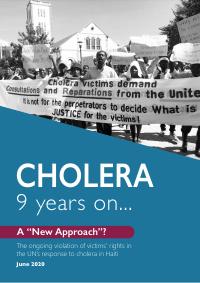
CHOLERA
The ongoing violation of victims’ rights in
the UN’s response to cholera in Haiti
A “New Approach”?
9 years on...
June 2020
Institute for Justice & Democracy in Haiti
867 Boylston Street, 5th Floor
Boston, MA 02116
USA
Telephone: 857-201-0991
General Inquiries: info@ijdh.org
Media Inquiries: media@ijdh.org
Bureau des Avocats Internationaux
#3, 2eme Impasse Lavaud, Lalue
B.P. 19048. Port-au-Prince, Haïti
Telephone: +509-2943-2106/07
Email: avokahaiti@aol.com
CONTENTS
4 of 28
I
n October 2010, the United Nations (UN) introduced cholera
to Haiti, sparking one of the world’s worst modern cholera
epidemics. The epidemic resulted in more than 2,500 deaths
within the first three months;
1
and to date has killed over
9,700 people and infected more than 819,000.
2
For six years, the UN denied responsibility for the outbreak in
the face of overwhelming evidence. Investigations consistently
pointed to the UN base in Meye, that was staffed by a
contingent deployed from Nepal – a country with an active
cholera outbreak – whose sewage had contaminated Haiti’s
main river way.
3
Following significant legal and advocacy
efforts by the Institute for Justice & Democracy in Haiti (IJDH)
together with its Haiti-based partner the Bureau des Avocats
Internationaux (BAI), extraordinary mobilization by victims,
and global public outcry, former UN Secretary-General Ban
Ki-moon finally bowed to public pressure and apologized to
the Haitian people in 2016. The UN launched a US$400 million
plan (the “New Approach to Cholera in Haiti”) to address what
it termed its “moral responsibility” to the people of Haiti.
Three years after the UN’s apology, its response to cholera in
Haiti remains deeply inadequate and continues to violate the
rights of victims. The lack of progress towards a just response
lays bare fundamental shortcomings in the New Approach
plan: the UN failed to ground its response in an acceptance
of legal responsibility or victims’ right to remedies, victims
were not consulted in the plan’s design, no safeguards were
put in place to ensure adequate funding or follow-through,
and no mechanism was established to allow an independent
assessment of victims’ claims. As a result, those directly
affected by the epidemic are no closer to obtaining justice.
Moreover, Haiti remains extremely vulnerable to cholera as
the UN has failed to make systemic improvements to water
and sanitation systems. As of 2017, 42% of Haitians still lacked
adequate access to safe water.
4
Since 2011, IJDH and BAI have worked alongside cholera
victims to seek justice, accountability and remedies from the
UN, in line with the organization’s
5
own legal obligations.
More than nine years after the beginning of the epidemic,
victims remain mobilized and the work continues.
INTRODUCTION
Cholera survivors at a protest
calling for reparations
5 of 28
October
• On October 9th, UN peacekeepers from Nepal arrive in Haiti to staff UN
Stabilization Mission in Haiti (MINUSTAH) base near the rural town of
Mirebalais. Despite an active cholera outbreak in Nepal, peacekeepers
are not screened for cholera before arrival.
6
• On October 14th, the first documented victim of cholera, from
Mirebalais, shows symptoms and dies within 24 hours.
7
135 Haitians
die of cholera within the first week of the outbreak.
8
• In late October, despite early calls for a vaccination campaign to
attempt to stem the spread of the epidemic, the Pan-American Health
Organization recommends against using globally available vaccines due
to logistical difficulties, costs, and competing priorities.
9
Other public
health experts later categorize this decision as “morally questionable, if
not to say revolting.”
10
November
• Within one month of arriving in Haiti, cholera kills approximately 2,000
people.
11
Beyond Port-au-Prince, the Artibonite and Centre regions are
among the hardest hit.
12
• From November 7 to 27, the Haitian government commissions a team of
epidemiologists to investigate the source of the outbreak. They conclude
that the Nepali peacekeeping contingent is the most likely source.
13
• The UN commissions an internal assessment of MINUSTAH’s sanitation
practices, which concludes that same month that there are gravely
inadequate sanitation practices at peacekeeping bases across Haiti.
The UN does not disclose this assessment; it was not reported to the
media until 2016.
14
• The Chief of MINUSTAH states that “it’s really unfair to accuse the UN
of bringing cholera into Haiti”.
15
Despite increasingly overwhelming
evidence, the UN ccontinues to deny its responsibility for the outbreak
until 2016.
May
A panel of experts appointed
by the Secretary-General
confirms that “the evidence
overwhelmingly supports” that
“the outbreak was caused by
bacteria introduced into Haiti as
a result of human activity; more
specifically the contamination of
the Meye Tributary System” with
a South Asian strain of cholera.
16
November
With the support of BAI and
IJDH, 5,000 victims file claims
through the UN’s internal claims
process, seeking remedies in
line with the organization’s legal
obligations.
How we got here »
20112010
6 of 28
June
Audits by the UN Office of
Internal Oversight Services
(OIOS) reveal that the UN
continued to put local
populations at risk through
improper waste management
at peacekeeping bases in Haiti
until 2015 – a full five years into
the epidemic.
20
August
• U.S. Federal Court holds that
the UN’s immunity means it
cannot hear victims’ lawsuit.
21
• In the face of growing public
pressure, the UN for the first
time admits its role in the
outbreak.
22
February
The UN rejects victims’ claims
as “not receivable” because
they touch on a “political
and policy matter.”
18
The UN’s
position generates significant
international outcry.
October
IJDH files a lawsuit on behalf of
cholera victims in U.S. Federal
Court in New York. The UN
asserts immunity from suit, and
the U.S. Government steps in to
defend the UN’s position.
19
April
After significant advocacy and
collaboration with the Ministry
of Public Health and Population
(MSPP), initial distribution of the
oral cholera vaccine begins in
Bocozel, Haiti, one of the hardest
hit communities; with more than
90% of the community fully
vaccinated.
17
2012 2013 2016
7 of 28
The UN’s public admission of its role in the cholera outbreak was the product
of six years of sustained litigation and advocacy efforts by cholera victims,
IJDH, BAI, and allies globally.
Movement for justice »
In November 2011, 5,000 victims filed claims with the
UN with the support of BAI and IJDH, in line with the
Organization’s legal obligations under the Convention on
Privileges and Immunities of the United Nations (CPIUN).
They requested remedies in the form of:
1. a public apology and admission of responsibility;
2. just compensation; and
3. investment in water, sanitation, and health
infrastructure to eliminate cholera from Haiti.
They also requested the establishment of the standing claims
commission mandated by the Status of Forces Agreement
between the UN and Haiti.
In February 2013, the UN rejected victims’ claims as “not
receivable”
23
because they “would necessarily include a
review of political and policy matters.”
24
The UN refused
subsequent requests for clarification or reconsideration of
its decision and for a meeting or mediation with victims.
In 2013, IJDH filed a class action lawsuit on behalf of
cholera victims against the UN in U.S. Federal Court
in New York. IJDH’s argument centered on the UN’s
obligation to provide an out-of-court mechanism for
the settlement of private law claims. On the question of
immunity, IJDH presented two main arguments for why
the UN was not entitled to immunity in the cholera case
(further details can be found in
Georges v. UN
25
):
a. The text of the CPIUN and its drafting history support
the argument that immunity is conditioned upon the
UN providing access to an out-of-court settlement
mechanism. Thus, when the UN does not provide
that out of court settlement mechanism, its immunity
under the same treaty may no longer be enforced;
b. This condition is also integral to the object and
purpose of the CPIUN as a whole, meaning that when
the UN fails to uphold that obligation, it violates the
entire treaty and is no longer entitled to the immunity
protections provided by it.
The UN did not respond formally but asked the U.S.
Government to seek dismissal on its behalf, citing the
U.S.’ obligation as the UN’s host nation. In March 2014,
the U.S. Attorney stepped in to assert the UN’s absolute
immunity from suit in U.S. court.
On January 9, 2015, the U.S. District Court, Southern
District of New York held that the UN’s immunity prevented
it from hearing the case.
26
On February 12, 2015, IJDH
appealed to the Second Circuit Court of Appeal. In
August 2015, the U.S. Government filed a brief opposing
IJDH’s appeal.
27
On August 18, 2016, the Second Circuit
Court of Appeals upheld the lower court’s decision and
dismissed the case.
28
The UN’s legal position on immunity
was widely criticized in Haiti and internationally, including
by legal scholars, former UN officials, Haitian American
community leaders, and human rights organizations,
who stepped in to file nine legal briefs in the court case,
supporting IJDH’s position in its litigation on behalf of
victims.
29
Alongside our litigation efforts, between 2011 and 2016,
IJDH and BAI helped build a global movement for cholera
justice outside of court. In Haiti, affected communities
consistently mobilized by awareness-building and
peaceful demonstrations.
30
On Human Rights Day
in 2015, victims delivered over 2,000 handwritten
letters to the UN’s peacekeeping headquarters in
Port-au-Prince.
31
Internationally, hundreds of Haitian-
American groups,
32
non-governmental organizations,
33
and other human rights organizations,
34
as well as legal
scholars,
35
U.S. Congressional members,
36
and media
37
consistently urged the UN to respect victims’ rights.
8 of 28
November 2011
February 2013
October 2013
August 2016
August 2016
December 2016
The UN rejects
victims’ claims as
“not receivable”.
UN acknowledges
role in cholera
epidemic in Haiti.
UN issues
apology for
its role in
the epidemic
and announces the
launch of the New
Approach.
5,000
victims file claims
with the UN.
IJDH appeals to the
Second Circuit Court
of Appeals.
February 2015
U.S. District Court
holds that the UN’s
immunity prevents
it from hearing
the case.
January 2015
U.S. Attorney asserts
the UN’s absolute
immunity from suit in
U.S. court.
March 2014IJDH
files a class action
lawsuit on behalf
of cholera victims
against the UN.
Second Circuit
Court of Appeals
upholds the lower
court’s decision
and dismisses
the case.
9 of 28
S
ection 29 of the Convention on Privileges & Immunities of
the United Nations (CPIUN) requires the UN to provide an
appropriate mode of settlement for “disputes arising out of
contracts or other disputes of a private law character to which
the United Nations is a party” (such as personal injury or
breach-of-contract claims).
38
This obligation exists to ensure
that civilian victims have access to damages for harms the UN
causes, even in the face of the UN’s immunity from national
court lawsuits during peacekeeping operations.
39
The Status of Forces Agreement (SOFA) between the UN and
Haiti, which regulates the presence of peacekeeper troops
in Haiti, further specifies that a ‘standing claims commission’
must be established to provide an independent hearing on
claims for “personal injury, illness, or death attributable to
MINUSTAH.”
Despite these obligations, the UN dismissed all victim claims
and failed to establish the required standing claims commission
in Haiti. While MINUSTAH is no longer in Haiti, the UN has
maintained a presence in Haiti through the United Nations
Mission for Justice Support in Haiti (MINUJUSTH), which
replaced MINUSTAH from October 2017 to October 2019,
and subsequently through the United Nations Integrated
Office in Haiti (BINUH), which is currently operational.
40
The UN’s dismissal of victims’ claims has been widely
condemned by international legal experts as a breach of its
legal obligations.
41
The UN’s response in Haiti reflects a systemic failure of
accountability in the UN system. The UN has never established
a standing claims commission in any country where it has
had a peacekeeping mission,
42
despite signing agreements
- like the SOFA - that provide for commissions in the event
of a dispute. It additionally has not successfully established
any accountability mechanism based upon its legal liability to
remedy victims adversely affected by its missions.
43
THE UN’S LEGAL
OBLIGATIONS
71st session of the United Nations General
Assembly in New York, Conference Room
(Drop of Light/Shutterstock) 10 of 28
In Haiti, no standing claims commission was established
during the UN’s peacekeeping presence in Haiti over
15 years, a period marked by significant abuses and
scandals. The failure to establish an SCC is not unique to
Haiti, however. Rather, the UN has never established an
SCC in any country where it has deployed a peacekeeping
mission,(46) despite signing agreements - like the SOFA -
that provide for commissions in the event of a dispute.
46
In
1996, following the Rwandan Genocide, the government
of Rwanda made a concerted attempt to prompt the
establishment of a mandated SCC. In response, the UN
declined to create an SCC on the basis that the claims
being asserted were not private law claims.
47
While the Government of Haiti has made periodic
statements calling for further UN action to eliminate
cholera and supporting victim compensation - including
a September 2019 Statement before the Inter-American
Commission for Human Rights
48
, and statements at the
2016 and 2017 UN General Assemblies
49
- there is no
public record of the Government of Haiti (GOH) taking
action to establish a SCC. Additionally, to date GOH has
neither sought legal action against the UN, put forward
any public proposal for an out of court settlement,
nor sought to assess or quantify the harm the UN’s
introduction of cholera has had on victims and Haitian
society at large.
In peacekeeping contexts, structurally unequal power
relationships with the international community can create
obstacles to accountability.
50
In the case of Haiti, these include:
• Significant dependency by the Haitian government
on foreign assistance, with approximately 20% of the
national budget being financed through foreign aid;
51
• A credible record of problematic international
intervention in Haitian elections;
52
• The presence of an ongoing UN Chapter VII
peacekeeping presence in the country until October
2019, with a significant mandate to maintain security
and support the Haitian police.
In a 2017 address, the UN Special Rapporteur on
Extreme Poverty, Philip Alston noted that member
states “should be key actors in terms of exacting
external accountability when the UN has screwed
up and is not prepared to admit such.” However,
with few exceptions, many member states have not stood
in support for Haiti to hold the UN to its legal obligations;
a response that Alston notes reflects a structural
marginalization of Haiti in the inter-state system,
and a perspective he characterizes as “who cares about
a small, irrelevant, black population in the middle of
nowhere?”
53
The Status of Forces Agreement (SOFA)
and the role of Haiti’s government »
At the international level, states remain the primary actors empowered to protect
the rights and interests of their populations. In the peacekeeping context, the Status
of Forces Agreement (SOFA) regulates a UN peacekeeping presence in a host
government country. Under the SOFA, both the UN and a host country can take steps
to establish a standing claims commission (SCC) to provide an independent hearing
on claims for “personal injury, illness, or death” attributable to UN peacekeepers. Three
Commissioners are to be appointed: one by the UN, one by the host government, and
the chair jointly chosen.
44
If the host country appoints one Commissioner, and the UN
does not cooperate in appointing the chair, the host government could apply to the
International Court of Justice to make the appointment.
45
11 of 28
I
n 2016, in the face of significant international criticism, the UN
finally admitted its role in introducing cholera in Haiti. In September
2016, then-Secretary-General Ban Ki-moon stood before the General
Assembly and named the cholera epidemic in Haiti as one of the
central regrets of his time in office. The epidemic had “tarnished the
Organization’s reputation,” he said, “and still worse, traumatized the
numerous populations we serve.”
54
Shortly afterwards, the UN issued a public apology and launched its
“New Approach to Cholera in Haiti”.
The New Approach is, in the UN’s words, a “genuine effort to concretely
demonstrate deep regret”, eliminate cholera from Haiti and “liv[e] up
to our moral duty to those who have been most directly affected”. It is
a US$400 million two-track plan to eradicate the disease and provide
material assistance to the most affected victims.
While incomplete, if fully and effectively implemented, the New
Approach presented an opportunity to reduce the harm of the cholera
epidemic, help rebuild the lives of tens of thousands of cholera victims,
and begin repairing the damage to the UN’s standing and the credibility
of UN peacekeeping.
From the outset, however, there were structural flaws in the plan. The
UN continued to deny any legal responsibility for cholera’s introduction,
recognize victims’ right to remedies, or establish a mechanism through
which victims’ claims could be assessed. The commitments in the New
Approach were unenforceable and the UN did not identify a reliable
source of funding, leaving implementation of the plan vulnerable to
the whims and pressures of political decision making. Victims were
marginalized from the design of the plan, with the UN failing to consult
with or assess their perspectives before launching the New Approach.
Three years later, there has been minimal progress under the New
Approach, laying bare these fundamental shortcomings. Haiti’s population
remains extremely vulnerable to cholera, communities most affected by
the epidemic are still unable to access safe water and sanitation, and
direct victims are no closer to obtaining meaningful redress.
THE UN’S NEW
APPROACH
Words are powerful – yes.
Words are necessary – yes. But
words cannot replace action
and material support.
Ban Ki-moon, December 2016
12 of 28
US$400 million in funding, split equally
across the two tracks described below.
2016: The launch of
a “New Approach”
for cholera »
Track 1
US$200 million to support intensified efforts to reduce the
incidence of cholera and advance eradication:
• Track 1A: to intensify the immediate efforts to decrease
the transmission of cholera and improve access to care
and treatment, including support for rapid response
teams, epidemiological surveillance, vaccinations, and
emergency medical care.
• Track 1B: to address the longer-term issues of access to
clean water, sanitation and health-care systems. Track
1B was expected to last for 10 to 15 years and required
further investments beyond the promised $200 million.
55
Track 2
US$200 million to support the development and delivery of a
“package of material assistance and support to those Haitians
most directly affected by cholera, centered on the victims and
their families and communities,” along with a UN commitment
to “consult with victims and their families and communities
in developing... [the material assistance] package” and put
“victims at the centre of the work.”
56
Two approaches envisaged:
• Community Approach: funding development projects in
the most affected communities.
• Individual Approach: making direct payments to the
families of those who died from cholera.
Survivors protest after 5,000 file
legal claims against the United
Nations for the cholera epidemic 13 of 28
Abandonment of assessed contributions:
The voluntary nature of funding for the New Approach
has undermined its effectiveness as an accountable
response. When launching the New Approach plan, the
UN proposed funding the initiative through assessed
contributions in the case that a voluntary approach would
be insufficient. Under an assessed contribution model,
designated funding by Member States would have been
mandatorily applied to the UN budget, consistent with
the UN’s legal obligations had it accepted its legal liability
to cholera victims. Canada supported drawing from
assessed contributions.
58
However, following opposition
from influential member states, including the U.S., the
U.K. and France, the UN has not taken any steps towards
implementing this assessed contribution proposal.
59
Even excess peacekeeping funds were withheld:
After the UN ended its UN Stabilization Mission in
Haiti (MINUSTAH) in October 2017, Secretary-General
Guterres asked member states to allow him to redirect
the US$40.5 million left over in the mission’s budget
to the cholera fund, but the U.S and France reportedly
opposed an automatic transfer of those funds.
61
The U.S.
Administration claimed it had no role in the outbreak
of cholera and already provided enough aid to Haiti
through other channels.
62
Faced with such opposition,
the Secretary-General abandoned the proposal and
member states were instead allowed to voluntarily waive
their shares of the leftover funds. Collectively, member
states only waived US$3.3 million into the fund through
this process.
63
By contrast, in 2018, the UN allocated US$121.5 million
for its new UN peacekeeping mission, the United Nations
Mission for Justice Support in Haiti (MINUJUSTH),
adding to billions spent on peacekeeping in Haiti.
64
This
underscores that underfunding of the New Approach is
not the result of net lack of finances, but of political will;
the UN system prioritizes the presence of international
security forces in Haiti over addressing the harm those
forces cause and protecting Haitians’ fundamental rights
to health, water, and remedies.
Funds allocated to MINUSTAH
between the cholera outbreak
and the end of mission
(2010-2017): ~ $4.2 billion.
60
Mr. Guterres has not stated
publicly whether he intends to
push for a mandatory assessment
in the budget negotiations now
underway at the United Nations.
Privately, however, diplomats
and United Nations officials said
he had shelved the idea, partly
because of strong resistance
by some powerful members,
including the United States.
The New York Times, March 2017
Breach of duty to fund reparations
The UN’s legal obligation would have required mandatory contributions to fund
the New Approach. The Organization instead established a voluntary Multi Partner
Trust Fund (MPTF) to fund the plan, which has compromised all aspects of the New
Approach, particularly victim assistance. To date, the voluntary approach has been
insufficient in ensuring an adequate response under the New Approach: only US$20.5
million (5%) of the promised US$400 million has been raised, and of the $20.5 million,
the UN has only earmarked $6.7 million for victim assistance to date.
57
14 of 28
Breach of victims’ right to compensation
The UN precluded victim compensation through its own internal legal claims process,
through an independent standing claims commission, and through the court system.
Now, under Secretary-General Guterres’ tenure, the UN has backed further and further
away from its pledge to consider making direct payments to the families of people
who died of cholera
65
as part of its victim material assistance package (Track 2) under
the New Approach. The victim assistance package was intended to “concretely express
the Organization’s regret” and alleviate victims’ ongoing suffering.
66
Failure to assess feasibility: When launching the
New Approach, the Secretary-General explained that
the feasibility of providing direct payments to cholera
victims required further assessment and committed to
conducting a feasibility analysis and reporting to the
General Assembly on the issue.
67
To date, no feasibility
analysis has been provided to the General Assembly.
Meanwhile, in June 2019 Avocats Sans Frontiers-Canada
(ASFC), in partnership with the Interuniversity Institute for
Research and Development (INURED) and with support
from the Jacob Blaustein Institute and contributions from
IJDH, published an extensive independent feasibility
assessment that demonstrates that payments for families
who have lost loved ones is both possible and necessary
to address victims’ needs.
68
No progress on individual approach: In the spring
of 2019, the UN took its first concrete steps toward
implementing Track 2 by completing five modest
community projects in the Mirebalais community, the
area closest to where peacekeepers initially introduced
cholera. Budgeted at approximately US$1.2 million overall,
the projects include a renovated marketplace, installation
of a drinking water supply system, and rehabilitation of
existing water systems.
69
However, they failed to address
the ongoing individualized harms suffered by the most
affected victims, including the lasting financial losses
of losing breadwinners and incurring debts from burial
costs and other expenses, as well as the personal trauma
of losing loved ones.
70
The UN’s plans for Track 2 show no current plan
nor funding beyond an additional US$5.5 million
million for 20 projects in Haiti’s north
71
: The UN has
not piloted an individual approach, and UN documents,
including the latest annual reports on the New Approach
(2017, 2018) and the MPTF’s latest annual report, no
longer mention direct payments.
72
The UN has neither made a definitive statement
explaining the lack of progress on direct payments to
victims, nor outlined the plan to fulfill its commitment
to material assistance under Track 2, but instead refers
to resource constraints and realities on the ground in
justifying its modest community project approach.
73
The
UN seemingly relies on its own failure to secure funding
as a justification for abandoning its promises to victims.
74
My family needed to take out
a loan while I was recovering from
cholera. I couldn’t work for three
months. Five years later, these loan
repayments are still burying us.
Georges Benira
15 of 28
Why victim
compensation
matters »
Cholera victims have been calling for their
rights to be respected by the UN for over
9 years
Cholera has caused severe and individualized losses and
disproportionately impacted Haiti’s most vulnerable and
marginalized populations.
75
Following the outbreak, costs
for burials, transportation, and in some cases medical care
increased.
76
Victims have reported incurring crushing debts
to pay for funerals of loved ones, medical treatment, and
basic household expenses during the weeks or months when
they were too sick to work. A longitudinal study of urban
households conducted by researcher Athena Kolbe between
2011-2016 found that interest rates for cholera-related loans
were on average 83.9%.
77
Cholera has had particularly devastating consequences on
children and young people who lost caregivers.
78
Victims
consistently identify children as having suffered particular
harms: the economic shock of cholera deaths often resulted
in children being pulled out of school, undermining the long-
term future of thousands of Haiti’s youth.
Compensation is a fundamental element of the human right
to effective remedy.
79
There is wide agreement among human
rights scholars and practitioners that, while community
projects can play an important part of a response to large-
scale harms, they are not of themselves an adequate response
to serious violations of human rights.
The UN’s own legal framework also mandates compensation as
the appropriate remedy for civilians harmed by peacekeeper
action.
80
Direct payments are good policy: cash transfers are recognized
as a best practice intervention to support recovery from
infectious diseases and are shown to reduce poverty and
improve livelihoods in the long term.
81
16 of 28
Avocats Sans Frontières Canada (ASFC)’s
independent feasibility study was
developed through focus groups with 96
victims, extensive desk research, and expert
interviews.
82
Feasibility of victim
compensation »
Direct monetary payments are feasible in cases of deaths,
through an identification and claims system drawing on both
existing data and community-based mechanisms.
86
Victims nearly unanimously prioritized families who had lost
a breadwinner to cholera, with an emphasis on minors and
young adults who lost parents, as needing direct economic
assistance.
85
Victims consider direct assistance to the most severely affected
families an integral part of a just response.
83
The study found
that victims viewed compensation as necessary to “take into
account the specific and personal suffering of those who have
been and continue to be disproportionately affected by the
cholera epidemic, the economic impact as a central element of
their suffering and the existing disparities between the different
categories of victims.”
84
Key findings include:
Portraits from the Face Justice
Campaign launched in 2015
17 of 28
Exclusion of victims
The people directly affected by cholera are not just victims of this terrible epidemic, but
ultimately the actors of change on the ground. Victims’ tenacious mobilization over
years played a central role in pushing the UN to finally shift position and accept its role
in the outbreak in 2016.
87
The New Approach correctly identified that cholera victims
deserve a consultative process that puts them at the “center of the work”.
88
As victims
themselves note, “it is not for the wrongdoer to decide what is justice for the
victim”. Under human rights law, victims have the right to participate in the creation
and implementation of remedies, in order to ensure the remedy’s effectiveness and to
provide “recognition to, and empowerment of, victims.”
89
Yet, prior to the launch of its New Approach, the
UN failed to engage victims in its overall design or
meaningfully assess the harms they had suffered and
their priorities. As a result, a budget was allocated to the
New Approach absent substantive engagement of those
most affected, and without analysis of whether the New
Approach aligned with the particular needs of victims,
thus hamstringing an effective response from the outset.
Moreover, in implementing the New Approach, the UN
failed to fulfill its commitments to carry out a consultation
process that engaged victims in determining the contours
and content of the Track 2 material assistance package,
including the appropriate combination of the individual
and community approaches. Instead, in the context of its
pilot Track 2 efforts in Mirebalais, the UN pre-determined
that it would implement assistance through small
community development projects only.
90
Even in its community engagement around the planning
and implementing of these projects, the UN has acted in
an opaque and exclusionary way:
• Available public documents indicate the UN
primarily engaged with local government
leaders in Mirebalais, not victims themselves.
91
• The UN has not published its consultation
methodology: Additional guidance on the
methodology used for community engagement in the
Mirebalais projects has been repeatedly requested by
BAI and IJDH, but the UN has still not published or
disclosed the details.
• The UN excluded the victims in and around
Mirebalais who were most prepared to
participate: After the New Approach was launched,
BAI worked with thousands of affected community
members around Mirebalais to prepare them to
meaningfully participate in the UN’s promised
consultations. Instead of welcoming the perspective
of these representatives, the United Nations
Development Programme (UNDP), which has led
implementation of Track 2 pilot projects on the
ground, excluded them and publicly declared that
measures had been put in place to “mitigate” the
BAI’s interventions in communities.
92
The UN’s failure to implement a genuine victim
consultation process under the New Approach and
instead forge ahead with only community projects to date
is particularly concerning because existing information,
including the findings of ASFC’s feasibility study outlined
above, suggests that victims prioritize a mixed individual
and community approach.
93
The UN failed to fulfill its commitments to carry
out a consultation process that engaged victims.
18 of 28
After the New Approach was launched,
BAI worked with thousands of affected
community members in rural Haiti who
had been mobilizing for cholera justice, to
provide them with the information needed
to meaningfully participate in the UN’s
promised consultations and weigh the
options proposed by the UN under the New
Approach.
Community trainings were held to discuss:
BAI’s civic education
in Mirebalais »
The pros and cons of a community
versus individual approach
The legal right to effective remedy
The contents of the New Approach,
including screening of the Secretary-
General’s apology
At each community training, participants elected
representative committees to participate in consultations
with the UN and facilitate broader engagement between
communities and the UN.
Cholera justice training outside
Haiti’s capital city of Port-au-Prince
19 of 28
The risk remains
The UN’s MPTF states that the first
sixteen weeks of 2019 saw 308
suspected cholera cases versus 1,257
in the same period for 2018, a nearly
75% reduction,
94
and the MSPP has
seen zero confirmed cases of cholera
since the fourth week of 2019.
95
While there has undoubtedly been important
progress towards cholera control, Haiti remains
vulnerable to the disease. Effective cholera control
and elimination relies on sustained diagnostic and
surveillance capacity through the national system,
and a strong water, sanitation, and hygiene (WASH)
infrastructure. The UN’s introduction of cholera has
been especially damaging because of deficiencies
in WASH systems, deficiencies of which the UN was
aware when it overlooked basic sanitation practices
in its peacekeeping camps and failed to screen
troops deployed from a country known to be in the
midst of a cholera outbreak. The New Approach
itself recognizes WASH investment as “the best
long-term defence against cholera.”
However, surveillance and WASH investments
planned under the New Approach are significantly
underfunded and progress has been stagnant. In
2017, the latest data from the
Direction Nationale
de l’Eau Potable et de l’Assainissement
(DINEPA)
showed that 72% of the Haitian population did not
have access to adequate sanitation and 42% did
not yet have adequate access to safe water.
96
In this
context of ongoing extreme vulnerability, the risk of
a new cholera outbreak remains real.
A tributary of the Artibonite
River, the longest river in Haiti
20 of 28
WHAT DOES THE UN’S
BREACH OF LEGAL OBLIGATIONS
MEAN FOR HAITI NOW?
T
he UN’s introduction of cholera to Haiti violated
numerous human rights, including the right to life,
health, water, sanitation, an adequate standard of living,
and to be free from degrading treatment.
97
Victims of such
human rights violations have a right to effective remedy,
as enshrined in all major human rights instruments. Yet,
the UN’s response to date continues to violate victims’
right to a remedy and its own legal obligations. In turn,
this perpetuates the harms to victims’ rights caused by
the UN’s negligent actions.
The voluntary nature of funding the New Approach,
which fails to equate to an accountable response or to
comply with the UN’s legal obligations, creates ongoing
risks from the continuation of the epidemic. While critical
progress has been made towards eliminating cholera,
in the context of funding shortfalls and the absence
of transformative investments in water and sanitation
infrastructure, a renewed cholera outbreak remains a real
risk.
The UN has failed to undertake sufficient reforms to ensure
similar harms do not re-occur in the future; widespread
waste mismanagement continues throughout numerous
UN bases internationally.
98
Thousands of Haitian families continue to suffer from the
devastating impacts of the epidemic, including serious
economic and social harms, while the continued risk of
cholera leaves marginalized communities vulnerable to
further harm.
Results of victim focus groups suggest that women,
children, and families who lost their primary breadwinner
have been particularly hard hit.
99
With youth under 15
representing 35% of Haiti’s population, and considering
the known impact of acute watery diarrheal infections
on children’s health, access to education, and household
well-being, cholera further increases vulnerability of
millions of young people.
100
The UN’s exclusion of victims has further compounded
the dignitary harm the UN has caused. In Mirebalais,
victims who had organized with BAI in anticipation of
consultations and learned of the UN’s pilot community
projects after the fact rejected the UN’s process,
characterizing it as undemocratic and not in the interest
of victims.
101
I ask them to come and sit with
us and not decide for us because we
aren’t asking for charity.
102
Local victim who lost his mother to cholera, 2016
21 of 28
A
dvancing cholera justice has always faced immense
odds, yet victims, supported by a global network
of community leaders, activists, legal and public health
experts, scientists, journalists, human rights advocates,
and others have made incremental but important
changes over the past 9 years including:
• Obtaining the UN’s historic apology for its role in the
outbreak;
• Changing the UN’s practices for screening
peacekeepers for cholera, with the UN’s introduction
of new rules in 2015 that identify cholera as a medical
condition precluding participation in peacekeeping
operations and that require a cholera vaccination for
all peacekeepers before deployment.
103
More work
remains needed, however: a study by the Global
Health & Justice Partnership at Yale University found
that prophylaxis antibiotics and screening are 90%
effective, whereas vaccinations are only 60% likely to
be effective in halting transmission;
104
• Spurring the development of an environmental
mandate within peacekeeping operations: the UN’s
“Environment Strategy,” launched in November 2016,
seeks to address some of the problems that led to
the cholera outbreak in Haiti, for example “reduc[ing]
the level of risk to personnel local communities, and
ecosystems from wastewater management practices
within peacekeeping.”
105
However, the UN’s efforts in
this field remain worryingly incomplete. Even as of
August 27, 2019, UN audits found that untreated
wastewater from the UN peacekeeping mission in
South Sudan was overflowing “into the surrounding
environment”;
106
• Propelling the development of a global cholera
vaccine stockpile.
Ultimately, three years after the UN’s apology, its
response to cholera remains fundamentally inadequate
and continues to violate the rights of victims.
As the cholera epidemic enters its 10th year in Haiti
and we mark the 75th anniversary of the UN and the
conclusion of 15 years of UN peace operations in Haiti,
IJDH and BAI continue to organize with people in Haiti
and globally, to urge the UN to fully respond to the harms
it has caused, and address the rights violations of victims.
Over the past months, we submitted a formal complaint
to the UN Special Procedures of the Human Rights Council
asking them to investigate the UN’s continuing violation
of victims’ right to effective remedy,
108
and contributed
to international conferences on cholera justice
109
and
MINUSTAH’s legacy in Haiti.
110
Our complaint prompted
14 UN human rights experts to call on the Organization
to respect cholera survivors’ rights.
111
The experts called
the UN’s efforts in funding “disappointing” and heralded
their promises to cholera victims as “illusory.” Meanwhile,
Haitian
112
and international media continue to draw
attention to the UN’s violations and unfulfilled promises
in Haiti,
113
while in Haiti victims continue to courageously
mobilize for their rights.
114
The UN’s failure to ground its response in an acceptance
of legal responsibility or victims’ right to remedies has
meant that those directly affected by the epidemic are
no closer to obtaining justice. It also perpetuates the
false notion that the UN’s remedying of human rights
violations is discretionary.
115
The UN must re-envisage its response to victims
and assure that it successfully models the
acceptance of accountability and respect for the
rule of law that it promotes throughout the world.
THE ONGOING
MOVEMENT FOR JUSTICE
If the UN truly stands
for the rule of law, then it
must hold itself to the same
standards of accountability,
transparency and respect
for human rights that it
demands of others.
107
William O’Neill, ASFC Feasibility Study
22 of 28
Seven years after the cholera outbreak, survivors
lead a protest urging the United Nations to
consult them in their cholera response
23 of 28
Page 5
1. Daniela Ceccarelli et al., Origin of Vibrio cholerae in Haiti, 11 The
Lancet 262 (2011), available at https://www.thelancet.com/jour-
nals/laninf/article/PIIS1473-3099(11)70078-0/fulltext.
2. OCHA, Haiti Cholera Figures (Jan. 30, 2019), https://reliefweb.
int/sites/reliefweb.int/files/resources/ocha-hti-cholera-fig-
ures-20190131_en.pdf; Francisco J. Luquero et al., Mortality Rates
During Cholera Epidemic, Haiti, 2010-2011, 22 Emerging Infectious
Diseases 410 (2016); see also Rick Gladstone, Cholera Deaths in
Haiti Could Far Exceed Official Count, The New York Times (Mar. 18,
2016), https://www.nytimes.com/2016/03/19/world/americas/chol-
era-deaths-in-haiti-could-far-exceed-official-count.html.
3. Renaud Piarroux et al., Understanding the cholera epidemic, Haiti, 17
Emerging Infectious Diseases 1161–68 (2011); Alejandro Cravioto
et al., Final Report of the Independent Panel of Experts on the
Cholera Outbreak in Haiti (2011), at 29; R.R. Frerichs et al., Nepalese
origin of cholera epidemic in Haiti, 18 Clinical Microbiology & Infec-
tion E158, E162 (2012).
4. Haiti and the United Nations Stand Together to Achieve Zero Transmis-
sion of Cholera and to Improve Access to Water, Sanitation and Health-
care, MINUJUSTH (Nov. 8 2017), https://minujusth.unmissions.org/
en/haiti-and-united-nations-stand-together-achieve-zero-transmis-
sion-cholera-and-improve-access-water.
5. Lisa Schnirring, Protests Rattle Haiti as Cholera Cases Near 50,000,
University of Minnesota Center for Infectious Disease Research
and Policy (Nov 19, 2010), http://www.cidrap.umn.edu/news-per-
spective/2010/11/protests-rattle-haiti-cholera-cases-near-50000;
Letters available at http://www.ijdh.org/2015/12/topics/health/
thousands-of-cholera-victims-write-letters-to-the-un/; Institute for
Justice & Democracy in Haiti, Fight the Outbreak 6 Minute Video
(2012), https://www.youtube.com/watch?v=tnmYlcDFlm8.
Page 6
6. Piarroux R, Barrais R, Faucher B et al. Understanding the cholera
epidemic, Haiti. Emerg Infect Dis 2011; 17: 1161–1168 (citing
Laxmi Maharjan, Nepal: Cholera Outbreak Looms Over Capital, The
Himalayan Times (2010)).
7. Louise Ivers & David Watson, The “First” Case of Cholera in Haiti:
Lessons for Global Health, 86(1) AM. J. TROP. MED. HYG. 36 (2012).
8. 135 Dead and 1,000 sick in Haiti Cholera Outbreak, REUTERS, Oct.
22, 2010, http://www.rfi.fr/en/americas/20101022-135-dead-and-
1500-sick-haiti-cholera-outbreak.
9. See Haiti health workers to give cholera vaccine, Fox News (Apr. 13,
2012) https://www.foxnews.com/world/haiti-health-workers-to-
give-cholera-vaccine; Date et al. Considerations for Oral Cholera
Vaccine Use during Outbreak after Earthquake in Haiti, 2 EMERGING
INFECTIOUS DISEASES 2105–2112 (Nov. 2011) https://www.ncbi.
nlm.nih.gov/pmc/articles/PMC3310586/#!po=63.3333; Cholera
Vaccine Isn’t The Answer For Haiti, NPR (Oct. 28, 2010), https://www.
npr.org/sections/health-shots/2010/10/28/130884642/why-the-
cholera-vaccine-isn-t-the-answer-for-haiti.
10. See e.g., L. von Seidlen & J. L. Deen. Considerations for Oral Cholera
Vaccine Use during Outbreak after Earthquake in Haiti, 2010−2011,
18:7 Emerging Infectious Diseases 1211-14 (Nov. 2012), https://
www.ncbi.nlm.nih.gov/pubmed/22709425.
11. Barzilay EJ, Schaad N, Magloire R, et al. Cholera surveillance during the
Haiti epidemic--the first 2 years. N Engl J Med 2013; 368:599–609.
12. Haiti Continues to Battle Cholera Outbreak, Partners in Health (June
11, 2015), https://www.pih.org/article/haiti-continues-to-bat-
tle-cholera-outbreaks.
13. R. Piarroux et al., Understanding the cholera epidemic, Haiti. 17
Emerging Infectious Diseases 1161–68 (2011).
14. Melva Crouch et al., MINUSTAH Environmental Health Assessment
Report (on file). The assessment was reported in the media in 2016.
See Joe Sandler Clarke and Ed Pilkington, Leaked UN Report Faults
Sanitation at Haiti Bases at Time of Cholera Outbreak, The Guardian
(Apr. 5, 2016), https://www.theguardian.com/world/2016/apr/05/
leaked-un-report-sanitation-haiti-bases-cholera-outbreak?C-
MP=share_btn_link (describing findings of the assessment).
15. Haiti Cholera Response ‘Inadequate’, Says MSF, BBC (Nov. 20. 2010),
https://www.bbc.com/news/world-latin-america-11802488.
16. Cravioto, Lanata, Lantagne & Nair, Final Report of the Independent
Panel of Experts on the Outbreak of Cholera in Haiti (2011), https://
reliefweb.int/sites/reliefweb.int/files/resources/Full_Report_525.pdf.
Page 7
17. Louise C Ivers et al., Lancet Glob Health. 2015 Mar; 3(3): e162–
e168, https://www.ncbi.nlm.nih.gov/pmc/articles/PMC4384694/.
18. Spokesperson for UN Secretary-General Ban Ki-moon, Claims ‘Not Re-
ceivable’ under Immunities and Privileges Convention, United Nations
Tells Their Representatives, United Nations (Feb. 21, 2013), https://
www.un.org/press/en/2013/sgsm14828.doc.htm.
19. Brief for the United States of America as Amicus Curiae in Support
of Affirmance, Georges v. United Nations, 84 F. Supp. 3d 246
(S.D.N.Y. 2015), aff’d 834 F.3d 88 (2nd Cir. 2016, http://www.ijdh.
org/wp-content/uploads/2011/11/Georges-v.-UN-Amicus-Brief.pdf.
20. UN Office of Internal Oversight Services (OIOS), Audit of waste
management in the United Nations Stabilization Mission in Haiti,
Report 2015/068, June 30, 2015, https://oios.un.org/file/5633/down-
load?token=FBWLeHQb; See Also: George Russell, Amid Haiti cholera
epidemic, UN peacekeepers spill sewage and ignore water treatment,
says internal report, Fox News (Aug. 11, 2016), https://www.foxnews.
com/world/amid-haiti-cholera-epidemic-un-peacekeepers-spill-sew-
age-and-ignorewater-treatment-says-internal-report.
21. Georges v. United Nations, 84 F. Supp. 3d 246 (S.D.N.Y. 2015), aff’d
834 F.3d 88 (2nd Cir. 2016).
22. Jonathan Katz, U.N. Admits Role in Haiti Cholera Outbreak, Aug.
17, 2016, N.Y. TIMES, https://www.nytimes.com/2016/08/18/world/
americas/united-nations-haiti-cholera.html (quoting Secre-
tary-General’s spokesperson).
Page 8
23. Spokesperson for UN Secretary-General Ban Ki-moon, Claims ‘Not Re-
ceivable’ under Immunities and Privileges Convention, United Nations
Tells Their Representatives, United Nations (Feb. 21, 2013), https://
www.un.org/press/en/2013/sgsm14828.doc.htm.
24. Letter from the UN Under-Secretary-General for Legal Affairs to
Brian Concannon. Feb 21 2013; http://www.ijdh.org/wp-content/
uploads/2011/11/UN-Dismissal-2013-02-21.pdf.
25. Georges v. United Nations, 84 F. Supp. 3d 246 (S.D.N.Y. 2015), aff’d
834 F.3d 88 (2nd Cir. 2016).
26. Georges v. United Nations, 84 F. Supp. 3d 246 (S.D.N.Y. 2015), aff’d
834 F.3d 88 (2nd Cir. 2016).
27. Georges v. United Nations, Brief for the United States of America As
Amicus Curiae in Support of Affirmance, https://fdocuments.us/
document/15-to-be-argued-by-ellen-blain-united-states-court-of-
appeals-for-the-second-circuit.html.
28. Georges v. United Nations, 84 F. Supp. 3d 246 (S.D.N.Y. 2015), aff’d
834 F.3d 88 (2nd Cir. 2016).
29. Institute for Justice & Democracy in Haiti, Everyone Tells UN to Ful-
fill its Legal Obligations to Haiti Cholera Victims (Jun. 4, 2015) http://
www.ijdh.org/2015/06/topics/health/everyone-tells-un-to-fulfill-its-
legal-obligations-to-haiti-cholera-victims/.
30. See e.g., Mario Joseph, The Fight Against UN Impunity and Immuni-
ty in Haiti: The Cholera Scandal, CIVICUS, https://www.civicus.org/
images/The%20fight%20against%20UN%20impunity%20and%20
immunity%20in%20Haiti.pdf; Haitian cholera victims tell UN to
‘Face Justice’, Mennonite Central Committee, Oct. 15, 2015, https://
mcc.org/stories/haitian-cholera-victims-tell-un-face-justice.
31. Institute for Justice & Democracy in Haiti, Thousands of Cholera
Victims Write Letters to the UN, http://www.ijdh.org/2015/12/top-
ics/health/thousands-of-cholera-victims-write-letters-to-the-un/.
32. Open Letter from the Haitian-American Community to UN
Secretary-General Ban and U.S. Secretary of State John Kerry on
Cholera in Haiti (July 8, 2015), http://www.ijdh.org/wp-content/
uploads/2015/07/Letter-from-Haitian-Diaspora-Cholera-8-Ju-
ly-2015-final.pdf.
33. Letter addressed to the Secretary-General (May 29, 2015).
34. Over 30 civil society organizations endorsed an accountability
pledge addressed to candidates for UN Secretary-General. The
pledge enumerated several commitments, including ensuring
that victims of cholera be provided access to fair remedies.
See UN Accountability Pledge, http://static1.squarespace.com/
static/514a0127e4b04d7440e8045d/t/5798c674e4fcb59f61af-
ddfc/1469630069787/UN+Accountability+Pledge.pdf.
35. Jeremy Waldron, Keynote Address at New York University Law
School: The UN Charter and the Rule of Law (Nov. 1, 2015), https://
www.youtube.com/watch?v=N6Lv3LorWJM.
36. Letter addressed to the Secretary-General from Members of
the United States Congress (Dec. 18, 2014), http://www.ijdh.
org/wp-content/uploads/2014/12/Letter-UN-Haiti-Cholera-Vic-
tims-12.19.14.pdf.
References
24 of 28
37. See, e.g., Lauren Carasik, Opinion, The UN is Not Above the Law, Al
Jazeera (Mar. 6, 2014), http://america.aljazeera.com/opinions/2014/3/
the-un-is-not-abovethelaw.html; Joe Sandler Clarke & Ed Pilkington,
Leaked UN Report Faults Sanitation at Haiti Bases at Time of Cholera
Outbreak, The Guardian (Apr.5, 2016), https://www.theguardian.com/
world/2016/apr/05/leaked-un-report-sanitation-haiti-bases-cholera-out-
break; Editorial Board, United Nations Must Admit its Role in Haiti’s Cholera
Outbreak, Washington Post (Aug. 16, 2013), https://www.washington-
post.com/opinions/united-nations-must-admit-its-role-in-haitis-cholera-
outbreak/2013/08/16/e8411912-05d9-11e3-a07f-49ddc7417125_story.
html.
Page 10
38. Convention on the Privileges and Immunities of the United Na-
tions, adopted 13 February 1946, https://treaties.un.org/doc/Trea-
ties/1946/12/19461214%2010-17%20PM/Ch_III_1p.pdf.
39. Consistent with its obligation to provide redress for private law claims,
the CPIUN also imposes a “right and duty” on the Secretary-General to
waive immunity of staff where immunity would “impede the course of
justice and can be waived without prejudice to the interests of the Unit-
ed Nations.” Convention on the Privileges and Immunities of the United
Nations, adopted 13 February 1946, section 5, https://treaties.un.org/
doc/Treaties/1946/12/19461214%2010-17%20PM/Ch_III_1p.pdf.
40. Resolution 2350 (2017), U.N. Doc. S/RES/2350 (2017), Resolution 2466
(2019), U.N. Doc. S/RES/2466 (2019), Resolution 2476 (2019), U.N. Doc.
S/RES/2476 (2019).
41. Rosa Freedman, UN Immunity or Impunity? A Human Rights Based
Challenge, European Journal of International Law, Volume 25, Issue 1,
February 2014, Pages 239–254, https://doi.org/10.1093/ejil/cht082;
Georges v. United Nations, Memorandum of Law of Amici Curiae Interna-
tional Law Scholars and Practitioners in Support of Plaintiffs’ Opposition
to the Government’s Statement of Interest http://www.ijdh.org/wp-con-
tent/uploads/2018/03/Dkt31-1_Amicus-Brief-Intl-Law-Scholars1.pdf.
42. Adam Houston et al., Responsibility and Accountability: The Haitian
Epidemic and the United Nations Focus on Haiti Initiative (Aug. 9, 2013),
https://fohinitiative.wordpress.com/2013/08/09/responsibility-and-ac-
countability-the-haitian-epidemic-and-the-united-nations/#more-682;
Transnational Development Clinic, Yale Law School et. al., Peacekeeping
Without Accountability (2013), 57, https://law.yale.edu/sites/default/
files/documents/pdf/Clinics/Haiti_TDC_Final_Report.pdf.
43. Carla Ferstman, International Organizations Accountability Symposi-
um: Reparations for Mass Torts Involving the United Nations–Misguided
Exceptionalism in Peacekeeping Operations, OpinioJuris (Oct. 16, 2019),
http://opiniojuris.org/2019/10/16/international-organizations-account-
ability-symposium-reparations-for-mass-torts-involving-the-united-na-
tions-misguided-exceptionalism-in-peacekeeping-operations/.
Page 11
44. Agreement between the United Nations and the Government of Haiti
concerning the Status of Forces of the United Nations Operation in
Haiti (“SOFA”), Art. 55, which operationalizes the obligation to provide
‘alternative modes of settlement’ in the peacekeeping context, by
requiring the establishment of a standing claims commission for the
settlement of disputes or claims of a private-law character, http://www.
ijdh.org/wp-content/uploads/2014/03/MINUSTAH-SOFA-English.pdf.
45. SOFA, Art. 57, http://www.ijdh.org/wp-content/uploads/2014/03/MI-
NUSTAH-SOFA-English.pdf.
46. Adam Houston et al., Responsibility and Accountability: The Haitian
Epidemic and the United Nations Focus on Haiti Initiative (Aug. 9, 2013),
https://fohinitiative.wordpress.com/2013/08/09/responsibility-and-ac-
countability-the-haitian-epidemic-and-the-united-nations/#more-682;
Transnational Development Clinic, Yale Law School et. al., Peacekeeping
Without Accountability (2013), 57, https://law.yale.edu/sites/default/
files/documents/pdf/Clinics/Haiti_TDC_Final_Report.pdf.
47. Letter from Pedro Medrano, Assistant U.N. Secretary-General, Senior
Coordinator for Cholera Response, to Ms. Farha, Mr. Gallon, Mr. Pura
and Ms. De Albuquerque, para. 91 (Nov. 25, 2014).
48. See Comisión Interamericana de Derechos Humanos, Haití: violen-
cia en protestas sociales (Sep. 23, 2019), https://www.youtube.com/
watch?v=Jj26yROwEEc, at time mark 32:33 (Statement of Government of
Haiti at the Inter-American Commission on Human Rights).
49. See Haitian President at General Assembly Calls for Essential Development
Aid as UN Mission Shifts Away from Peacekeeping, UN News (Sep. 27,
2018), https://news.un.org/en/story/2018/09/1021102 (Statement of
President Jovenel Moise).
50. Jonathon Katz, The U.N. Caused Haiti’s Cholera Epidemic. Now the Obama
Administration Is Fighting the Victims, (Oct. 24, 2014), https://newrepublic.
com/article/119976/haiti-cholera-case-begins-us-defends-un-against-
victims.
51. Rocio Cara Labrador, Haiti’s Troubled Path to Development , Council on
Foreign Relations (Mar. 12, 2018), https://www.cfr.org/backgrounder/
haitis-troubled-path-development.
52. Institute for Justice & Democracy in Haiti, Haiti at a Crossroads: An
Analysis of the Drivers Behind Haiti’s Political Crisis (2019), http://www.
ijdh.org/wp-content/uploads/2019/05/IJDH-Report-Haiti-at-a-Cross-
roads-May-2019.pdf.
53. Seton Hall Law School, UN Accountability and International Law Experts
Workshop (Oct. 19, 2017), https://youtu.be/pDNxTBKM0bw (Philip
Alston, Opening Address: The Strengths and Weaknesses of External
Accountability.
Page 12
54. Ban Ki Moon, United Nations Secretary-General, Address to the General
Assembly (Sept. 20, 2016), https://www.un.org/sg/en/content/sg/
speeches/2016-09-20.
Page 13
55. U.N. Secretary-General, A new approach to cholera in Haiti, U.N. Doc.
A/71/620 (Nov. 25, 2016), https://undocs.org/A/71/620, paras. 27-35.
56. U.N. Secretary-General, A new approach to cholera in Haiti, U.N. Doc.
A/71/620 (Nov. 25, 2016), https://undocs.org/A/71/620, paras. 6, 26, 37.
Page 14
57. UN Haiti Cholera Response Multi-Partner Trust Fund, Project Quarterly
Progress Report (2019), http://mptf.undp.org/document/down-
load/22371.
58. Gabrielle Duchaine, Haïti: Ottawa Versera 6 Millions pour Lutter Contre le
Choléra, LaPresse.ca (Jan. 10, 2017), https://www.lapresse.ca/actualites/
politique/politique-canadienne/201701/09/01-5058039-haiti-ottawa-
versera-6-millions-pour-lutter-contre-le-cholera.php.
59. Colum Lynch, Trump Won’t Give a Penny to Haiti Cholera, Foreign Policy
(June 1, 2017), https://foreignpolicy.com/2017/06/01/trump-wont-pay-a-
penny-for-u-n-cholera-relief-fund-in-haiti/; Rick Gladstone, After Bringing
Cholera to Haiti, U.N. Can’t Raise Money to Fight It, The New York Times
(Mar. 19, 2017), https://www.nytimes.com/2017/03/19/world/americas/
cholera-haiti-united-nations.html.
60. Advisory Committee on Administrative and Budgetary Questions,
MINUSTAH financing resolutions, https://www.un.org/ga/acabq/docu-
ments/all/571?order=title&sort=asc. The Security Council closed down
MINUSTAH in 2017, and replaced it with another two-year $121.5
million dollar mission. The UN has now transitioned its presence to a
political mission, BINUH.
61. Karen McVeigh, ‘Shameful’: UK and US Under Fire Over Blocked Funds
for Haiti Cholera Victims, The Guardian (Nov. 2, 2017), https://www.
theguardian.com/global-development/2017/nov/02/shameful-uk-us-
blocked-funds-haiti-cholera-victims-un-donors-china-france-russia.
62. Colum Lynch, Trump Won’t Pay a Penny for U.N. Cholera Relief Fund in Hai-
ti, Foreign Policy (June 1, 2017) https://foreignpolicy.com/2017/06/01/
trump-wont-pay-a-penny-for-u-n-cholera-relief-fund-in-haiti/.
63. Report of the Secretary-General on the United Nations Mission for
Justice Support in Haiti (2018), U.N. Doc. S/2018/241, para. 18.
64. Fifth Committee Approves $6.69 Billion for 13 Peacekeeping Opera-
tions in 2018/19, Overhaul of Secretariat Management Structure, as
Resumed Session Concludes, United Nations (Jul. 5, 2018), https://
www.un.org/press/en/2018/gaab4287.doc.htm. Yearly allocations to
MINUSTAH available at https://www.un.org/ga/acabq/documents/
all/571?type%5Breport%5D=report&type%5Bdocument%5D=docu -
ment&&&keys=&order=field_post_date&sort=desc.
25 of 28
Page 15
65. A New Approach to Cholera in Haiti, Report by the Secretary-Gen-
eral (2016), U.N. Doc. A/71/620, para. 54.
66. A New Approach to Cholera in Haiti, Report by the Secretary-Gen-
eral (2016), U.N. Doc. A/71/620, section V.
67. A New Approach to Cholera in Haiti, Report by the Secretary-Gen-
eral (2016), U.N. Doc. A/71/620, paras. 58-59.
68. Id.
69. UN Haiti Cholera Response Multi-Partner Trust Fund, 2018 Annual
Report 4 (2018), http://mptf.undp.org/document/download/21688.
70. Lawyers without Borders Canada, Meeting the Needs of Victims
of Cholera in Haiti: Feasibility of an Individual Assistance Approach
for People Most Affected by the Disease (2019), https://www.
asfcanada.ca/site/assets/files/7636/etude_de_faisabilite_summa-
ry_web_vf.pdf.
71. UN Haiti Cholera Response Multi-Partner Trust Fund, Project
Quarterly Progress Report (2019), http://mptf.undp.org/document/
download/22371; the UN has allocated $5,579,934 to community
projects in total, and has spent $258,885 of this to date. See Pro-
ject Fact Sheet, Phase 2 Community Assistance, http://mptf.undp.
org/factsheet/project/00115476.
72. UN Haiti Cholera Response Multi-Partner Trust Fund, 2018 Annual
Report 4 (2018), http://mptf.undp.org/document/download/21688.
73. Letter of the UN Deputy Secretary-General to Institute for Justice
& Democracy in Haiti and Bureau des Avocats Internationaux (Jul.
27, 2018) (on file); New Approach to Cholera in Haiti, Report by the
Secretary-General (2017), U.N. Doc. A/71/895.
74. A New Approach to Cholera in Haiti, Report by the Secretary-Gen-
eral (2016), U.N. Doc. A/71/620, paras. 36-37.
Page 16
75. Athena R. Kolbe, The Crushing Economic Costs of Cholera: A Longitu-
dinal Survey of Urban Haitian Households (on file with author).
76. Athena R. Kolbe, The Crushing Economic Costs of Cholera: A Longitu-
dinal Survey of Urban Haitian Households (on file with author).
77. Athena R. Kolbe, The Crushing Economic Costs of Cholera: A Longitu-
dinal Survey of Urban Haitian Households (on file with author).
78. Lawyers without Borders Canada, Meeting the Needs of Victims
of Cholera in Haiti: Feasibility of an Individual Assistance Approach
for People Most Affected by the Disease (2019), https://www.
asfcanada.ca/site/assets/files/7636/etude_de_faisabilite_summa-
ry_web_vf.pdf.
79. See International Covenant on Civil and Political Rights, 19
December 1966, 999 UNTS 171, Can TS 1976 No 47 (entered
into force 23 March 1976), https://treaties.un.org/doc/Trea-
ties/1976/03/19760323%2006-17%20AM/Ch_IV_04.pdf; UN Human
Rights Committee, General comment no. 31 [80], The nature of the
general obligation imposed on State Parties to the Covenant, May
26, 2004, https://www.refworld.org/docid/478b26ae2.html; and
Redress, Responding to the Introduction of Cholera to Haiti: Policy
Options (2016), https://redress.org/wp-content/uploads/2017/12/
Responding-to-the-Introduction-of-Cholera-to-Haiti.pdf.
80. See Convention on the Privileges and Immunities of the United
Nations, adopted 13 February 1946, section 29, https://treaties.un-
.org/doc/Treaties/1946/12/19461214%2010-17%20PM/Ch_III_1p.
pdf.
81. Food and Agriculture Organization of the United Nations and the
United Nations Children’s Fund, From Evidence to Action: The Story
of Cash Transfers and Impact Evaluation in Sub-Saharan Africa
(2016), http://www.fao.org/3/a-i5157e.pdf.
Page 17
82. Lawyers without Borders Canada, Meeting the Needs of Victims
of Cholera in Haiti: Feasibility of an Individual Assistance Approach
for People Most Affected by the Disease (2019), https://www.
asfcanada.ca/site/assets/files/7636/etude_de_faisabilite_summa-
ry_web_vf.pdf.
83. Lawyers without Borders Canada, Meeting the Needs of Victims
of Cholera in Haiti: Feasibility of an Individual Assistance Approach
for People Most Affected by the Disease (2019), https://www.
asfcanada.ca/site/assets/files/7636/etude_de_faisabilite_summa-
ry_web_vf.pdf.
84. Lawyers without Borders Canada, Meeting the Needs of Victims
of Cholera in Haiti: Feasibility of an Individual Assistance Approach
for People Most Affected by the Disease (2019), 13, https://www.
asfcanada.ca/site/assets/files/7636/etude_de_faisabilite_summa-
ry_web_vf.pdf.
85. Lawyers without Borders Canada, Meeting the Needs of Victims
of Cholera in Haiti: Feasibility of an Individual Assistance Approach
for People Most Affected by the Disease (2019), https://www.
asfcanada.ca/site/assets/files/7636/etude_de_faisabilite_summa-
ry_web_vf.pdf.
86. Lawyers without Borders Canada, Meeting the Needs of Victims of
Cholera in Haiti: Feasibility of an Individual Assistance Approach for
People Most Affected by the Disease (2019), 31-34, https://www.
asfcanada.ca/site/assets/files/7636/etude_de_faisabilite_summa-
ry_web_vf.pdf.
Page 18
87. Jake Johnston, On Human Rights Day, Haitians Have A Message for the
UN, Haiti Relief and Reconstruction Watch (Dec. 10, 2015), http://
cepr.net/blogs/haiti-relief-and-reconstruction-watch/on-human-
rights-day-haitians-have-a-message-for-the-un.
88. A New Approach to Cholera in Haiti, Report by the Secretary-Gen-
eral (2016), U.N. Doc. A/71/620, paras. 36-37.
89. Pablo de Greiff (Special Rapporteur on the Promotion of Truth, Jus-
tice, Reparation, and Guarantees of nonrecurrence), Report of the
Special Rapporteur on the Promotion of Truth, Justice, Reparation,
and Guarantees of non-recurrence, paras. 53-4, U.N. DOC. A/69/518
(Oct. 14, 2014).
90. UN Haiti Cholera Response Multi-Partner Trust Fund, 2018 Annual
Report 1 (2018), http://mptf.undp.org/document/download/21688.
91. UN Haiti Cholera Response Multi-Partner Trust Fund, Project
Monthly Progress Report (2018), http://mptf.undp.org/document/
download/20587.
92. UN Haiti Cholera Multi-Partner Trust Fund, Project Narrative Re-
port 2017, http://mptf.undp.org/factsheet/fund/CLH00.
93. Lawyers without Borders Canada, Meeting the Needs of Victims
of Cholera in Haiti: Feasibility of an Individual Assistance Approach
for People Most Affected by the Disease (2019), https://www.
asfcanada.ca/site/assets/files/7636/etude_de_faisabilite_summa-
ry_web_vf.pdf.
Page 20
94. UN Haiti Cholera Response Multi-Partner Trust Fund, 2018 Annual
Report 4 (2018), http://mptf.undp.org/document/download/21688.
95. Edrid St Just, Le Choléra en Voie d’Elimination en Haïti, Le Nouvelliste
(Jul. 23, 2019), https://lenouvelliste.com/article/204919/le-chol-
era-en-voie-delimination-en-haiti.
96. Haiti and the United Nations Stand Together to Achieve Zero Transmis-
sion of Cholera and to Improve Access to Water, Sanitation and Health-
care, MINUJUSTH (Nov. 8 2017), https://minujusth.unmissions.org/
en/haiti-and-united-nations-stand-together-achieve-zero-transmis-
sion-cholera-and-improve-access-water.
Page 21
97. Harvard Law School International Human Rights Clinic, Institute for
Justice & Democracy in Haiti, Bureau des Avocats Internationaux,
Violations of the Right to Effective Remedy: The UN’s Responsibility
for Cholera in Haiti (2020), http://hrp.law.harvard.edu/wp-content/
uploads/2020/02/HLS-IHRC-IJDH-BAI-Submission-to-Special-Proce-
dures_Cholera.pdf.
98. See e.g., OIOS, Audit of implementation of the environmental action
plan in the United Nations Mission in the Republic of South Sudan,
Aug. 27, 2019, U.N. Doc. Assignment No. AP2018/633/10. Another
recent OIOS audit of peacekeepers serving in the Democratic
Republic of Congo found that military contingents “dumped
unsegregated waste on the ground instead of in garbage bins.
OIOS, Audit of implementation of the environmental action plan in the
United Nations Stabilization Mission in the Democratic Republic of the
Congo, Aug. 22, 2019, U.N. Docs Assignment No. AP2018/620/07.
AP2018/633/10. OIOS, Audit of waste management in the United
Nations Interim Force in Lebanon, Rep. No. 2015/181, Dec. 17,
2015, https://oios.un.org/file/5957/download?token=Kvlo9gC1
(finding failures to maintain septic tanks and remove sludge, unac-
ceptable mixing of hazardous and organic waste).
References
26 of 28
99. Lawyers without Borders Canada, Meeting the Needs of Victims of Chol-
era in Haiti: Feasibility of an Individual Assistance Approach for People
Most Affected by the Disease (2019), https://www.asfcanada.ca/site/
assets/files/7636/etude_de_faisabilite_summary_web_vf.pdf.
100. Ministère de la Santé Publique et de la Population (MSPP), Haïti En-
quête Mortalité, Morbidité et Utilisation des Services (EMMUS-VI 2016-
2017) (2018), https://dhsprogram.com/pubs/pdf/FR326/FR326.pdf.
101. Reprezantan Victim Kolera nan Seksyon Kominal Krèt Brile (Komin
Mibalè), http://www.ijdh.org/2019/04/projects/testimony-of-cholera-
victims-in-kret-brile/ (English transcript available at http://www.ijdh.org/
wp-content/uploads/2019/04/English-Translation-%E2%80%93-Tran-
script-Cholera-Victim-Kret-Brile-1.pdf).
102. Haitian Cholera Victims React to UN Apology, Institute for Justice &
Democracy in Haiti, http://www.ijdh.org/2016/12/topics/health/hai-
tian-cholera-victims-react-to-un-apology/; https://www.youtube.com/
watch?v=FMzV74jcFQQ&feature=youtu.be&app=desktop.
Page 22
103. United Nations Department of Peacekeeping Operations and Depart-
ment of Field Support, Medical Support Manual for United Nations
Field Missions, 3rd Edition (2015), http://dag.un.org/bitstream/han-
dle/11176/387299/2015.12%20Medical%20Support%20Manual%20
for%20UN%20Field%20Missions.pdf?sequence=4&isAllowed=y.
104. Lewnard et al, Strategies to Prevent Cholera Introduction During Interna-
tional Personnel Deployments: A Computational Modeling Analysis Based on
the 2010 Haiti Outbreak, PLOS, Jan. 26, 2016, https://journals.plos.org/
plosmedicine/article?id=10.1371/journal.pmed.1001947.
105. UN Launches New Strategy to Minimize Environmental Footprint of its
Peace Operations, UN News (Nov. 29, 2016), https://news.un.org/
en/story/2016/11/546562-un-launches-new-strategy-minimize-en-
vironmental-footprint-its-peace-operations.
106. OIOS, Audit of implementation of the environmental action plan in the
United Nations Mission in the Republic of South Sudan, Aug. 27, 2019,
U.N. Doc. Assignment No. AP2018/633/10.
107. Lawyers without Borders Canada, Meeting the Needs of Victims of Chol-
era in Haiti: Feasibility of an Individual Assistance Approach for People
Most Affected by the Disease (2019), https://www.asfcanada.ca/site/
assets/files/7636/etude_de_faisabilite_summary_web_vf.pdf.
108. Harvard Law School International Human Rights Clinic, Institute for
Justice & Democracy in Haiti, Bureau des Avocats Internationaux,
Violations of the Right to Effective Remedy: The UN’s Responsibility
for Cholera in Haiti (2020), http://hrp.law.harvard.edu/wp-content/
uploads/2020/02/HLS-IHRC-IJDH-BAI-Submission-to-Special-Proce-
dures_Cholera.pdf.
109. Press Release, Avocats sans frontières Canada, Cholera en Haïti : 10 Ans
Plus Tard les Victimes Réclament Toujours des Mesures d’Assistance (Jan. 15,
2020), https://www.asfcanada.ca/site/assets/files/7254/communique_
conference_cholera_2020-01-15.pdf; Lesly Succès, L’épidémie de choléra
en Haïti vue par Avocats sans frontières Canada (ASFC), Le National (Jan.
27, 2020), http://www.lenational.org/post_free.php?elif=1_CONTENUE/
actualitees&rebmun=6263.
110. AlterPressed, Haïti-Choléra/Onu : La Papda exige dédommagements
en faveur des victimes, lors d’un colloque international à Port-au-Prince
(Dec. 9, 2019), https://www.alterpresse.org/spip.php?article25041#.
XkRjoGhKg2w.
111. OHCHR, UN inaction denies justice for Haiti cholera victims, say UN experts
(Apr. 30, 2020), https://www.ohchr.org/EN/NewsEvents/Pages/Dis-
playNews.aspx?NewsID=25851&LangID=E.
112. Snayder Pierre Louis, Retour sur 15 années d’échecs de l’ONU en Haïti,
AyiboPost (Oct. 20, 2019). https://ayibopost.com/retour-sur-15-annees-
dechecs-de-lonu-en-haiti/; Snayder Pierre Louis, L’ONU refuse d’assister
les enfants abandonnés par les soldats de la MINUSTAH (Nov. 9, 2019),
https://ayibopost.com/lonu-refuse-dassister-les-enfants-abandonnes-
par-les-soldats-de-la-minustah/.
113. Editorial Board, The U.N.’s Tainted Legacy in Haiti, Ney York Times (Dec.
23, 2019), https://www.nytimes.com/2019/12/23/opinion/un-peace-
keepers-haiti.html; Colum Lynch, U.N. Chief Faces Internal Criticism
Over Human Rights, Foreign Policy (Feb. 4, 2020), https://foreignpolicy.
com/2020/02/04/un-chief-antonio-guterres-internal-criticism-hu-
man-rights/.
114. Avocats sans frontieres Canada, Les victimes du choléra ne veulent plus
être écartées des décisions qui les concernent (Jan. 17, 2020), https://www.
asfcanada.ca/medias/nouvelles/victimes-cholera-justice-asfc/.
115. Carla Ferstman, International Organizations Accountability Symposi-
um: Reparations for Mass Torts Involving the United Nations–Misguided
Exceptionalism in Peacekeeping Operations, OpinioJuris (Oct. 16, 2019),
http://opiniojuris.org/2019/10/16/international-organizations-account-
ability-symposium-reparations-for-mass-torts-involving-the-united-na-
tions-misguided-exceptionalism-in-peacekeeping-operations/.
27 of 28
Institute for Justice & Democracy in Haiti
867 Boylston Street, 5th Floor
Boston, MA 02116
USA
Telephone: 857-201-0991
General Inquiries: info@ijdh.org
Media Inquiries: media@ijdh.org
Bureau des Avocats Internationaux
#3, 2eme Impasse Lavaud, Lalue
B.P. 19048. Port-au-Prince, Haïti
Telephone: +509-2943-2106/07
Email: avokahaiti@aol.com