
Monitè sezonye: mwa youn dèyè lòt ak mwens lapli ak tanperati wo, 31 jiyè 2026
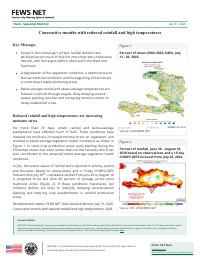
Rezime — Eksepte nan sant Ayiti, defisi lapli kontinye plis pase de mwa youn dèyè lòt jiska fen jiyè 2026, ak pi gwo defisi yo nan Lwès ak Sidès. Plis pase 70 jou lapli iregilye ak anba mwayèn redwi imidite tè a, ogmante estrès tèmik sou vejetasyon an epi kite sante vejetasyon an anba mwayèn. Kondisyon vejetasyon yo vin pi mal toujou lè rekòt yo kòmanse nan kèk gwo zòn pwodiksyon manje debaz. FEWS NET prevwa lapli anba mwayèn ak tanperati pi wo pase mwayèn pandan out, sa ta retade plantasyon dezyèm sezon an epi ogmante estrès imidite sou rekòt ki fèk plante.
Dekouve Enpotan
- Defisi lapli kontinye plis pase de mwa youn dèyè lòt jiska fen jiyè 2026, eksepte nan sant peyi a.
- Pi gwo defisi yo obsève nan Lwès ak Sidès.
- Plis pase 70 jou lapli iregilye ak anba mwayèn redwi imidite tè a epi kite sante vejetasyon an anba mwayèn.
- Kondisyon vejetasyon yo vin pi mal lè rekòt yo kòmanse nan kèk gwo zòn manje debaz.
- Yo te prevwa lapli anba mwayèn ak tanperati wo pandan out, sa retade plantasyon dezyèm sezon an.
Teks Konple Dokiman an
Teks ki soti nan dokiman orijinal la pou endeksasyon.
Haiti - Seasonal Monitor
July 31, 2026
Consecutive months with reduced rainfall and high temperatures
Key Messages
Figure 1
Except in the central part of Haiti, rainfall deficits have
persisted across much of Haiti for more than two consecutive
months, with the largest deficits observed in the West and
Southeast.
Percent of mean (2003-2022) NDVI, July
11 - 20, 2026.
A degradation of the vegetation conditions is observed due to
the low moisture conditions and the beginning of the harvest
in some major staple-producing areas.
Below-average rainfall and above-average temperatures are
forecast to persist through August, likely delaying secondseason planting activities and increasing moisture stress on
newly established crops.
Reduced rainfall and high temperatures are increasing
moisture stress
For more than 70 days, erratic rainfall and below-average
precipitation have affected much of Haiti. These conditions have
reduced soil moisture, increased thermal stress on vegetation, and
resulted in below-average vegetation health conditions as shown in
Figure 1. In some crop production areas, early planting during the
Printemps season has led to earlier-than-normal harvests, which has
also contributed to the observed below-average vegetation health
conditions.
Source: USGS/FEWS NET
Figure 2
Percent of rainfall, June 26 – August 10,
2026 based on observations and a 15-day
CHIRPS-GEFS forecast from July 26, 2026.
In July, the lowest values of rainfall were reported in Jeremy, Jacmel
and Gonaives. Based on observations and a 15-day CHIRPS-GEFS
forecast from July 26th, cumulative rainfall from June 26 to August 10
is projected to be less than 60 percent of average across most
livelihood zones (Figure 2). If these conditions materialize, soil
moisture deficits are likely to intensify, delaying second-season
planting and reducing crop establishment in rainfed production
areas.
Recommended citation: FEWS NET. Haiti Seasonal Monitor July 31, 2026:
Consecutive months with reduced rainfall and high temperatures, 2026.
Source: CHC-UCSB/FEWS NET
Seasonal Monitor
FEWS NET’s Seasonal Monitor reports are produced for Central America and the Caribbean, West Africa, East Africa, Central Asia, and Somalia every 10-to-30 days during the region’s
respective rainy season(s). Seasonal Monitors report updates on weather events (e.g., rainfall patterns) and associated impacts on ground conditions (e.g., cropping conditions,
pasture and water availability), as well as the short-term rainfall forecast. Find more remote sensing information here.
FEWS NET is a United States Government-funded activity. The content of this report does not
necessarily reflect the view of the United States Government.
FEWS NET Haiti
haiti@fews.net
fews.net/latin-america-and-caribbean/haiti
Kijan pou site
Famine Early Warning Systems Network (FEWS NET), Monitè sezonye: mwa youn dèyè lòt ak mwens lapli ak tanperati wo, 31 jiyè 2026, https://reliefweb.int/node/4224207
- Moun oswa enstitisyon ki gen dwa yo
- Famine Early Warning Systems Network (FEWS NET)