Repiblik Ayiti
Bibliyotèk Dokiman
4,677 dokiman 213,367 paj
Ayiti, monitè sezonye, jen 2024

Ayiti, monitè sezonye, jen 2024

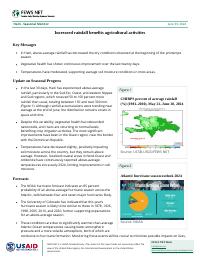
Rezime — Monitè sezonye FEWS NET pou Ayiti, jen 2024, ki gen dat June 30, 2024. Lapli pi wo pase mwayèn pandan 30 dènye jou yo te bese sechrès yo te wè nan kòmansman sezon prentan an, ak Sidès, Lwès ak lwès Nip ak Sid ki resevwa 50 a 100 pousan plis lapli pase mwayèn. Sante vejetasyon an te amelyore san rete pandan ven dènye jou yo epi tanperati yo te bese, sa ki sipòte yon imidite tè mwayèn nan pi fò zòn yo.
Dekouve Enpotan
Deskripsyon Konple

Monitè sezonye FEWS NET pou Ayiti, jen 2024, ki gen dat June 30, 2024. Lapli pi wo pase mwayèn pandan 30 dènye jou yo te bese sechrès yo te wè nan kòmansman sezon prentan an, ak Sidès, Lwès ak lwès Nip ak Sid ki resevwa 50 a 100 pousan plis lapli pase mwayèn. Sante vejetasyon an te amelyore san rete pandan ven dènye jou yo epi tanperati yo te bese, sa ki sipòte yon imidite tè mwayèn nan pi fò zòn yo. Monitè a swiv sezon k ap dewoule a: total lapli konpare ak mwayèn long tèm nan, kondisyon vejetasyon dapre NDVI satelit, ak sa toude vle di pou plantasyon, devlopman rekòt ak rekòt la. Dat kouvèti a fèmen fenèt 30 jou li kouvri a.

Teks Konple Dokiman an

Teks ki soti nan dokiman orijinal la pou endeksasyon.

Haiti - Seasonal Monitor June 30, 2024 Increased rainfall benefits agricultural activities Key Messages In Haiti, above-average rainfall has decreased the dry conditions observed at the beginning of the printemps season. Vegetative health has shown continuous improvement over the last twenty days. Temperatures have moderated, supporting average soil moisture conditions in most areas. Update on Seasonal Progress In the last 30 days, Haiti has experienced above-average rainfall, particularly in the Sud-Est, Ouest, and western Nippes and Sud regions, which received 50 to 100 percent more rainfall than usual, totaling between 150 and over 300 mm. (Figure 1). Although rainfall accumulations were trending near average at the end of June, the distribution remains erratic in space and time. Figure 1 CHIRPS percent of average rainfall (%) (1981–2010), May 21–June 20, 2024 Despite this variability, vegetative health has rebounded nationwide, and rivers are returning to normal levels, benefiting crop irrigation activities. The most significant improvements have been in the Ouest region, near the border with the Dominican Republic. Temperatures have decreased slightly, positively impacting soil moisture across the country, but they remain above average. However, localized coastal areas in Nord-Ouest and Artibonite have continuously reported above-average temperatures since early 2024, limiting improvements in soil moisture. Source: UCSB-USGS/FEWS NET Figure 2 Atlantic hurricane season outlook 2024 Forecasts The NOAA hurricane forecast indicates an 85 percent probability of an above-average hurricane season across the Atlantic, with between four and seven major hurricanes likely. The University of Colorado has indicated that this year’s hurricane season is likely to be similar to those in 1878, 1926, 1998, 2005, 2010, and 2020, further supporting expectations for an above-average season. Source: NOAA These conditions are due to significantly warmer-than-average Atlantic Ocean temperatures causing lower atmospheric pressure and a more volatile atmosphere, both of which are conducive to hurricane formation. Monitoring these events will be crucial to minimize possible impacts on lives, FEWS NET is a USAID-funded activity. The content of this report does not necessarily reflect the view of the United States Agency for International Development or the United States Government. FEWS NET Haiti haiti@fews.net fews.net/latin-america-and-caribbean/haiti Seasonal Monitor June 30, 2024 agricultural activities, and infrastructure. Recommended citation: FEWS NET. Haiti Seasonal Monitor June 30, 2024: Increased rainfall benefits agricultural activities, 2024. About Seasonal Monitor FEWS NET’s Seasonal Monitor reports are produced for Central America and the Caribbean, West Africa, East Africa, Central Asia, and Somalia every 10-to-30 days during the region’s respective rainy season(s). Seasonal Monitors report updates on weather events (e.g., rainfall patterns) and associated impacts on ground conditions (e.g., cropping conditions, pasture and water availability), as well as the short-term rainfall forecast. Find more remote sensing information here. Famine Early Warning Systems Network 2

Kijan pou site

Famine Early Warning Systems Network (FEWS NET), Ayiti, monitè sezonye, jen 2024, https://fews.net/latin-america-and-caribbean/haiti

Moun oswa enstitisyon ki gen dwa yo
Famine Early Warning Systems Network (FEWS NET)