
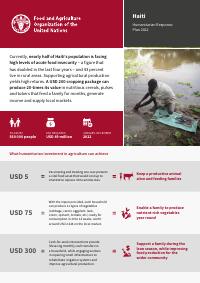
Ayiti: Plan repons imanitè 2022 (chapit FAO)
Rezime — Chapit FAO nan Plan repons imanitè 2022 pou Ayiti, k ap mande 49 milyon dola pou ede 560 000 moun soti janvye rive desanm 2022. Li note prèske mwatye popilasyon Ayiti a ap fè fas ak gwo nivo ensekirite alimantè egi, yon chif ki double nan kat dènye ane yo.
Teks Konple Dokiman an
Teks ki soti nan dokiman orijinal la pou endeksasyon.
Haiti
Humanitarian Response
Plan 2022
Currently, nearly half of Haiti’s population is facing
high levels of acute food insecurity – a figure that
has doubled in the last four years – and 43 percent
live in rural areas. Supporting agricultural production
yields high returns. A USD 200 cropping package can
produce 20-times its value in nutritious cereals, pulses
and tubers that feed a family for months, generate
income and supply local markets.
560 000 people
FAO REQUIRES
USD 49 million
JANUARY–DECEMBER
2022
©FAO
TO ASSIST
What humanitarian investment in agriculture can achieve
USD 5
Vaccinating and treating one cow protects
a vital food asset that would cost up to
USD 650 to replace if the animal dies.
Keep a productive animal
alive and feeding families
USD 75
With the inputs provided, each household
can produce 11 types of vegetables
(cabbage, carrot, eggplant, leek,
onion, spinach, tomato, etc.) ready for
consumption in 10 to 12 weeks, worth
around USD 2 224 on the local market.
Enable a family to produce
nutrient-rich vegetables
year round
USD 300
Cash-for-work interventions provide
lifesaving monthly cash transfers to
a household, while engaging workers
in repairing small infrastructure to
rehabilitate irrigation systems and
improve agricultural production.
Support a family during the
lean season, while improving
food production for the
wider community
Projected acute food insecurity situation (March–June 2022)
North Atlantic Ocea n
Nord-Ouest
Integrated Food Security
Phase Classification
1 – Minimal
Nord
Nord-Est
2 – Stressed
3 – Crisis
4 – Emergency
Artibonite
5 – Famine
Centre
Urban settlement
Grande-Anse
Ouest
Nippes
Sud
Not analysed
Ouest
Ca ribbea n S ea
T H E D O M IN ICAN
R EP U B L IC
At least 25% of households meet
over 50% of caloric needs from
humanitarian food assistance
Sud-Est
0
25 km
Source: IPC. 2022. Haiti: Integrated Food Security Phase Classification Snapshot, March–June 2022 [online]. Port-au-Prince,
Haiti. [Cited 17 March 2022]. https://www.ipcinfo.org/fileadmin/user_upload/ipcinfo/docs/IPC_Haiti_Acute_Food_Insec_
Update_2022MarJun_Snapshot_English.pdf Map conforms to United Nations Geospatial Haiti map, 2020.
Drivers of food insecurity
Urgency of humanitarian agricultural assistance
Haiti is the poorest country in the Caribbean and one of the most
food insecure in the world. The high levels of acute food insecurity are
mainly due to economic decline, political instability, poor production,
insecurity and frequent natural disasters. In 2021 alone, a 7.2-magnitude
earthquake in southern Haiti destroyed homes and displaced thousands
of families. Two days after, the island was hit by Tropical Storm Grace,
disrupting humanitarian activities and further damaging fields, homes
and infrastructure.
Even prior to the COVID-19 pandemic, Haiti’s economy was contracting.
The political situation in the country remains complex and unpredictable,
hindering any progress in terms of socio-economic development.
In July 2021, the assassination of President Jovenel Moïse plunged Haiti
into deeper crisis, leaving a power vacuum and inciting gang violence
which has displaced hundreds of families.
The use of sustainable agricultural practices in Haiti show an increase in
productivity up to five times compared with traditional techniques. Improved
means of production have enabled women to invest 30 to 50 percent more
in their income-generating activities. Support to fishers’ associations has
allowed them to double their catches and obtain an average monthly
income of about USD 120 per member.
Civil and political unrest
Low production
Natural disasters
COVID-19
Chronic poverty
Inflation
Key facts
Country population: 11.6 million
4.5 million projected to be
in high acute food insecurity
(March–June 2022)
60% of the population lives
in poverty
19 000 internally displaced
people (August 2021)
USD 23 out of 100 in
food security assistance went to
support rural livelihoods (2016–2020)
Coordination
As co-lead of the Food Security Sector in Haiti, the Food and Agriculture
Organization of the United Nations (FAO) works closely with 57 local and
international partners, in collaboration with institutional counterparts, to
ensure a needs-based, coordinated and effective response.
FAO priorities
Number of
beneficiaries
(people)*
Total cost
(USD)
10 kg of bean/pea seed; 5 kg of maize/
sorghum seed; 10 of kg rice seed; 10 kg of
groundnut seed; 600 sweet potato cuttings;
and 300 cassava cuttings
40
350 000
14 000 000
110 g of vegetable seeds (cabbage, carrot,
chili pepper, eggplant, green pepper, leek,
okra, onion, spinach, tomato, swiss chard)
and tools
15
350 000
5 250 000
Vaccination of livestock against anthrax,
internal and external parasites, and infectious
diseases of bacterial, viral and fungal nature
(5 heads of livestock per household)
5
100 000
500 000
Distribution of 5 laying hens or 2 goats
(one kit per household)
40
100 000
4 000 000
Restore affected fishers’
livelihoods
Fishing kits with materials lost following the
hurricanes (one kit per household)
170
25 000
4 250 000
Improve immediate access
to food through cash-based
transfers
Cash for work (USD 300/month/household)
to rehabilitate rural infrastructures (irrigation
systems, terracing, watershed protection)
126
166 665
21 000 000
Improve staple food and
vegetable production
(spring and winter 2022
seasons)
Protect livestock assets and
restore production
*Certain people may benefit from multiple types of assistance.
Some rights reserved. This work is available
under a CC BY-NC-SA 3.0 IGO licence
Jan
Funding required year round
REQUIRED CITATION: FAO. 2022. Haiti: Humanitarian Response Plan 2022. Rome.
https://doi.org/10.4060/cb9371en
The boundaries and names shown and the designations used on the map(s) in this information product do not
imply the expression of any opinion whatsoever on the part of FAO concerning the legal status of any country,
territory, city or area or of its authorities, or concerning the delimitation of its frontiers and boundaries. Dashed
lines on maps represent approximate border lines for which there may not yet be full agreement.
Calendar of funding deadlines and implementation
Feb
Mar
Apr
May
Jun
Jul
Month by which funding is required
for the implementation of priorities
Aug
Sep
Oct
Nov
Planned implementation timeframe
for priority activities
Contact
FAO Representation in Haiti
FAO-HT@fao.org | fao.org/haiti
Port-au-Prince, Haiti
FAO Office of Emergencies and Resilience
OER-Director@fao.org | fao.org/emergencies
Rome, Italy
Dec
Food and Agriculture Organization
of the United Nations
©FAO, 2022
CB9371EN/1/04.22
Cost per
beneficiary
(USD)
Type of assistance provided/
contents of assistance package
Priorities
Kijan pou site
Òganizasyon Nasyonzini pou Manje ak Agrikilti (FAO), Ayiti: Plan repons imanitè 2022 (chapit FAO), https://reliefweb.int/attachments/2145680b-9fc8-3ab2-af0a-5265fab215d5/Haiti%20-%20Humanitarian%20Response%20Plan%202022.pdf