
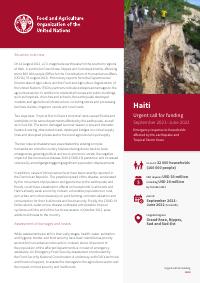
Ayiti: Apèl ijan pou finansman (septanm 2021-me 2022) - Repons ijans pou fanmi ki afekte pa tranblemanntè a ak tanpèt tropikal Grace
Rezime — Apèl finansman FAO pou 30 milyon dola pou ede 32 000 fanmi (160 000 moun) tranblemanntè 14 out 2021 la afekte nan sid Ayiti, epi de jou apre, inondasyon ak glisman tè tanpèt tropikal Grace lakòz nan menm depatman yo. Li dekri domaj nan mache, enfrastrikti agrikòl, kanal irigasyon ak wout riral.
Teks Konple Dokiman an
Teks ki soti nan dokiman orijinal la pou endeksasyon.
On 14 August 2021, a 7.2-magnitude earthquake hit the southern regions
of Haiti, in particular Grand’Anse, Nippes and Sud departments, affecting
some 800 000 people (Office for the Coordination of Humanitarian Affairs
[OCHA], 31 August 2021). Preliminary reports from the Departmental
Directorates of Agriculture and the Food and Agriculture Organization of
the United Nations’ (FAO’s) partners indicate widespread damages to the
agriculture sector. In addition to residential houses and public buildings,
such as hospitals, churches and schools, the earthquake destroyed
markets and agricultural infrastructure, including stores and processing
facilities, dairies, irrigation canals and rural roads.
Two days later, Tropical Storm Grace’s torrential rains caused floods and
landslides in the same departments affected by the earthquake, as well
as in Sud-Est. The storm damaged summer season crops and domestic
livestock rearing, obstructed roads, destroyed bridges on critical supply
lines and disrupted private-sector food and agricultural input supply.
The two natural disasters have exacerbated the existing complex
humanitarian crisis the country has been facing due to back-to-back
emergencies, growing political and socio-economic unrest, the negative
impact of the coronavirus disease 2019 (COVID-19) pandemic and increased
violence by armed gangs triggering significant population displacements.
In addition, cases of African swine fever have been recently reported in
the Dominican Republic. The possible spread of the disease, accelerated
by the movement of population and goods due to the earthquake and
floods, could have catastrophic effects on households’ livelihoods and
Haiti’s already weak economy. Indeed, vulnerable populations in rural,
peri-urban and urban areas rely on pork farming, commercialization and
consumption for their livelihoods and food security. Finally, the COVID‑19
Delta variant, water-prone disease outbreaks and possible tropical
cyclones until the end of the hurricane season in October 2021, pose
additional threats to the country.
Assessment of damages and losses
While assessments are still in their early stages, health, water, sanitation
and hygiene, shelter and food security have been identified as priority
sectors for humanitarian intervention. Indeed, about 40 percent of
the population of the affected departments is in need of emergency
assistance. An Emergency Food Security Assessment coordinated by
the Food Security National Coordination is underway, with FAO’s technical
and financial support, to assess the damages to the agriculture sector and
the impact on food security and livelihoods.
© FAO
Situation overview
Haiti
Urgent call for funding
September 2021–June 2022
Emergency response to households
affected by the earthquake and
Tropical Storm Grace
to assist 32 000 households
(160 000 people)
FAO requires USD 30 million,
including USD 20 million
by October 2021
period
September 2021–
June 2022 (9 months)
targeted regions
Grand’Anse, Nippes,
Sud and Sud-Est
Urgent call for funding
Haiti
FAO is also participating as a key sectorial member in the post-disaster
needs assessment, which is coordinated by the Government of Haiti and
supported by the international community, including the European Union,
the World Bank and the Inter-American Development Bank.
Strategic approach and objectives
FAO’s previous experience in responding to the 2010 earthquake and
2016 Hurricane Matthew demonstrated that ensuring an effective
humanitarian response to sustainably improve the food security of
vulnerable affected households requires a combination of life-saving food
assistance and emergency agricultural support to restore production
capacity and livelihoods. This two-fold approach allows to assist people
in a more dignified and efficient manner.
In the framework of OCHA’s Flash Appeal (USD 187.3 million required
to assist 500 000 people), FAO is urgently requesting USD 20 million to
assist households during the winter agricultural season (October 2021–
February 2022), in order to rehabilitate crop irrigation infrastructure and
provide veterinary services. An additional USD 10 million are required
to rehabilitate other community agricultural infrastructure and to assist
vulnerable households in time for the main spring agricultural season
(March–June 2022). If no emergency livelihoods support is provided to
affected populations, dependency on food aid will dramatically increase,
as well as financial needs, and the resilience of vulnerable households will
significantly deteriorate.
©FAO
FAO’s response strategy aims at protecting and restoring the livelihoods
of rural households affected by the earthquake and Tropical Storm Grace,
as well as rehabilitating community agricultural infrastructures, while
mitigating the negative impact of COVID-19 and preventing the possible
spread of African swine fever in the departments of Grand’Anse, Nippes,
Sud and Sud-Est.
Without adequate and
timely assistance to affected
households, their food
security, resilience and
livelihoods will continue to
significantly deteriorate.
Current acute food insecurity situation (September 2021–February 2022) in four departments of southern Haiti
Atl a n ti c Ocean
Integrated Food Security
Phase Classification (IPC)
Nord-Ouest
1 – Minimal
Nord
Nord-Est
980 000 people in high acute
food insecurity, expected to increase
2 – Stressed
3 – Crisis
4 – Emergency
Artibonite
5 – Famine
to 991 000 people in March–June 2022
Areas not analysed
Urban settlement
Centre
At least 25% of households meet 25–50% of
caloric needs from humanitarian food assistance
Grand’Anse
Ouest
Nippes
Sud
Sud-Est
C a r ibb ea n S ea
0
25 km
D O M INICA N
R E P UBL IC
Source: IPC. 2021. Haiti: IPC Acute Food Insecurity Analysis |
September 2021–June 2022 [online]. Rome, Italy.
[Cited 7 September 2021]. http://www.ipcinfo.org/
ipc-country-analysis/details-map/en/c/1155096/?iso3=HTI
Planned interventions
1. Emergency livelihood assistance
Agricultural support for the 2021 winter season
Starting in September and accounting for over 20 percent of national
production, the winter season is a crucial opportunity to restore the
productive capacity of 15 000 affected households (75 000 people) in rural
and peri-urban areas through the following main activities:
• Provision of vegetable and pulse seeds, along with agricultural tools.
• Distribution of cash transfers (USD 200/household) to cover basic
needs until crops are harvested.
• Provision of agricultural technical assistance.
targeted beneficiaries
30 000 households
budget
USD 20 million
period
September 2021–
February 2022
Livelihoods recovery
The income of 10 000 vulnerable affected households (50 000 people) in
urban and rural areas are improved by restocking and protecting livestock,
as well as recovering fishing activities, through the following activities:
• Distribution of small livestock (poultry and goats).
• Provision of emergency fodder and support to the establishment of
fodder banks, through the provision of inputs and technical support.
• Support to local veterinary services and deployment of veterinary
support teams, as well as the provision of mobile veterinary kits and
services for 25 000 domestic animals.
• Provision of fishing equipment and technical support for sea fishing
and fish farming.
Rehabilitation of agricultural infrastructure
A total of 5 000 households (25 000 people) to benefit from the
rehabilitation of agricultural infrastructure, especially of irrigation
systems damaged by the landslides and the earthquake, contributing to
protecting their assets and restoring their food production capacity, while
ensuring access to locally produced food. The main planned activities are
the following:
• Rehabilitation of irrigation canals through cash-for-work interventions.
• Provision of technical and material support for the rehabilitation
of post-harvest storage facilities (community granaries), and of
equipment for packaging and storage of seeds and food.
• Rehabilitation and supply of: (i) fruit, cassava, groundnut and maize
processing equipment; (ii) community infrastructure for milk collection
and processing; and (iii) community infrastructure for fish processing
and marketing.
• Provision of technical support to members of rural associations for
food processing and marketing.
Risk communication and community engagement
A communication and social mobilization strategy to be developed,
providing rural communities who have been displaced by the earthquake
with information to better cope with risks linked to COVID-19 and African
swine fever, as well as to prevent sexual exploitation and abuse and
gender-based violence (GBV). Planned activities are the following:
©FAO
Urgent call for funding
Haiti
against the spread of COVID-19 and promotion of social engagement
thanks to the transmission of messages through rural community
radios located in the three departments.
• Training and awareness-raising sessions of community actors (civil and
religious leaders) on prevention against the spread of COVID-19 and
distribution of hygiene and COVID-19 protection kits to displaced rural
communities.
• Dissemination of awareness-raising materials on GBV and protection
from sexual exploitation and abuse.
• Awareness-raising campaign on the African swine fever for people
living in bordering municipalities.
Humanitarian coordination and partnerships
Successful implementation of agricultural livelihood-related activities
will be based on strong operational partnerships between food security
partners and the Government of Haiti, other United Nations programmes
and specialized agencies, local and international non-governmental
organizations and other national and international partners.
©FAO/Addly Célestin
• Dissemination of information on preventive and hygiene measures
Strengthening the coordination of interventions within the Food Security
Sector, including the new actors arriving in the country to assist the
affected populations, is a priority guiding FAO’s intervention. Furthermore,
FAO will support the Food Security National Committee in planning and
coordinating of food security and nutrition assessments, IPC analysis and
dissemination of results to stakeholders.
2. Support to the 2022 spring agricultural season
To improve the food security of rural households, it is crucial to enable
them to resume their production activities during the main spring
season, which accounts for more than 50 percent of the country’s annual
production. The following activities will be implemented:
• Distribution of seeds (cereals, tubers, pulses) for spring crops to the
15 000 households who will have also benefited from agricultural
support during the winter season.
• Rehabilitation of an additional number of agricultural infrastructure
such as storage facilities, food processing infrastructure and dairies,
benefiting 2 000 additional households.
targeted beneficiaries
17 000 households
budget
USD 10 million
period
March–June 2022
Contact
FAO Representation in Haiti
FAO-HT@fao.org
Port-au-Prince, Haiti
Office of Emergencies and Resilience
OER-Director@fao.org | fao.org/emergencies
Rome, Italy
Some rights reserved. This work is available
under a CC BY-NC-SA 3.0 IGO licence
Food and Agriculture Organization
of the United Nations
©FAO, 2021
CB6680EN/1/09.21
The boundaries and names shown and the designations used on the map(s) in this information product
do not imply the expression of any opinion whatsoever on the part of FAO concerning the legal status of
any country, territory, city or area or of its authorities, or concerning the delimitation of its frontiers and
boundaries. Dashed lines on maps represent approximate border lines for which there may not yet be
full agreement.
Kijan pou site
Òganizasyon Nasyonzini pou Manje ak Agrikilti (FAO), Ayiti: Apèl ijan pou finansman (septanm 2021-me 2022) - Repons ijans pou fanmi ki afekte pa tranblemanntè a ak tanpèt tropikal Grace, https://reliefweb.int/attachments/de2ca3c3-ab2c-38ca-8cb6-2950bb041748/cb6680en.pdf