
Ayiti: Plan repons pou El Niño, septanm 2016
Rezime — Plan repons FAO devan enpak sekrès ki lye ak El Niño 2015-2016 sou agrikilti ayisyen, pibliye septanm 2016 jis anvan siklòn Matthew te frape peyi a. Li prezante entèvansyon agrikòl planifye pou restore mwayen egzistans sekrès afekte yo.
Teks Konple Dokiman an
Teks ki soti nan dokiman orijinal la pou endeksasyon.
EL NIÑO RESPONSE PLAN
Haiti
EL NIÑO RESPONSE PLAN
Haiti
Food and Agriculture Organization of the United Nations
Rome, 2016
The designations employed and the presentation of material in this information product do not imply the expression of any
opinion whatsoever on the part of the Food and Agriculture Organization of the United Nations (FAO) concerning the legal
or development status of any country, territory, city or area or of its authorities, or concerning the delimitation of its
frontiers or boundaries. The mention of specific companies or products of manufacturers, whether or not these have been
patented, does not imply that these have been endorsed or recommended by FAO in preference to others of a similar
nature that are not mentioned.
The views expressed in this information product are those of the author(s) and do not necessarily reflect the views or
policies of FAO.
© FAO, 2016
FAO encourages the use, reproduction and dissemination of material in this information product. Except where otherwise
indicated, material may be copied, downloaded and printed for private study, research and teaching purposes, or for use in
non-commercial products or services, provided that appropriate acknowledgement of FAO as the source and copyright
holder is given and that FAO’s endorsement of users’ views, products or services is not implied in any way.
All requests for translation and adaptation rights, and for resale and other commercial use rights should be made via
www.fao.org/contact-us/licence-request or addressed to copyright@fao.org.
FAO information products are available on the FAO website (www.fao.org/publications) and can be purchased through
publications-sales@fao.org.
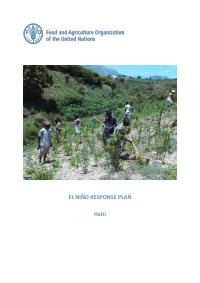
Cover photo: ©FAO
ii
CONTENTS
FOREWORD ..............................................................................................................................................v
EXECUTIVE SUMMARY............................................................................................................................ vii
SITUATION AND IMPACT ......................................................................................................................... 1
FAO HAITI EL NIÑO RESPONSE PLAN ....................................................................................................... 2
FAO’S RESPONSE CAPACITY..................................................................................................................... 7
iii
FOREWORD
Over the past three years, we have witnessed a gradual degradation of the already chronically
precarious food security and nutrition situation in the Republic of Haiti. This was due to drought and
irregular rains that to a certain extent are linked to the El Niño phenomenon and climate change. As
a result, agricultural production has sharply decreased and prices of locally grown food commodities
have risen significantly, while increasing the dependency on food imports. As the Haitian currency,
the Haitian gourde, has continued to lose value against the United States dollar, prices of imported
food have also risen sharply in local markets. This combination of factors has triggered the current
food insecurity and nutrition crisis.
The resilience of agricultural livelihoods is key to making sustainable development a reality. People
with resilient livelihoods are better able to prevent and reduce the impact of disasters on their lives.
Over the past years, the Food and Agriculture Organization of the United Nations (FAO) has
strengthened the resilience of farming families in Haiti through a range of programmes, including the
identification and multiplication of food crop varieties that are more resistant to drought and
irregular rains. This was possible by selecting and testing best practices together with local farmers to
develop more sustainable production systems. Though such programmes take time to have
widespread and deep impact, today FAO is better prepared to deal with crises in Haiti, and much of
the response needs ‒ seeds and planting material ‒ can be procured within the country. The
response will therefore be able to provide locally grown and tested varieties of crops that are more
resistant to drought and irregular rains, reducing the vulnerability of farming families to such
phenomena. Today, there is a much closer interaction between humanitarian emergency response
and medium-term development needs that will contribute to reduce the frequency and severity of
food insecurity and nutrition crises in Haiti.
Aloys Nizigiyimana
FAO Representative ad interim, Haiti
v
vi
EXECUTIVE SUMMARY
Haiti was severely hit by drought for three consecutive years, which was exacerbated by the El Niño
phenomenon in 2015. Food insecurity and malnutrition have worsened dramatically and according to
the National Coordination on Food Security there are about 300 000 households severely food
insecure (Phase 3 of the Integrated Food Security Phase Classification). Throughout 2015, agricultural
production was deeply affected and the harvest of the main agricultural season (spring) decreased by
over 50 percent. There is an urgent need to provide relief assistance to farming families of the
hardest hit municipalities in the North-West and South-East departments along with certain areas of
the Artibonite, Grand Anse, Nippes and South departments.
The purpose of the FAO Haiti El Niño Response Plan is to (i) contribute to improving the food security
and nutrition of vulnerable populations affected by drought, (ii) strengthen their resilience and
(iii) improve their livelihoods. FAO will follow a flexible and multidimensional operational strategy to
address immediate and medium-term needs in order to facilitate rapid increases in food availability
and access, and protect the overall food production capacity in the country as well as the livelihoods
of affected populations.
FAO requests USD 7.9 million to support 35 000 vulnerable households (175 000 people). Planned
activities will focus on the production and distribution of quality seeds, rehabilitation of water supply
and collection systems, support to animal production and fodder banks, capacity development and
trainings on good practices and technologies.
vii
SITUATION AND IMPACT
3.6 million people
food insecure
50 percent decrease in crop
production as a result of drought
The Republic of Haiti is one of the poorest and least developed countries in the western hemisphere,
with 59 percent of people living in poverty and close to 25 percent in extreme poverty. This is
exacerbated by the limited or lack of access to electricity, clean water, proper sanitation and
healthcare. The humanitarian context remains complex due to multiple inter-linked risk factors,
namely the: (i) persistence of cholera, (ii) aggravation of the food insecurity situation due to the
El Niño phenomenon, (iii) bi-national mixed migration crisis with the Dominican Republic,
(iv) remaining caseloads of internally displaced people from the 2010 earthquake and (v) the
country’s high vulnerability to natural disasters and climate change. Haiti, as part of the Small Islands
Developing States, remains a largely fragile environment from governance and development
perspectives. Given poverty, environmental degradation and limited capacity of authorities to
respond to a crisis, the country is highly vulnerable to even moderate climate shocks. Over the last
two decades, it has been repeatedly affected by severe natural disasters or emergencies, the most
recent of which has been the persistent drought that has affected the country with major
repercussions on food security and nutrition.
Food insecurity and malnutrition remain one of the heaviest burdens for the country, with one-third
of Haiti’s population unable to meet their basic food requirements. The number of people
experiencing severe acute food insecurity increased from approximately 65 000 in 2013 to 165 000 in
2014, and up to 560 000 in 2015. In February 2016, the National Coordination on Food Security
(Conseil national de sécurité alimentaire [CNSA]) and the World Food Programme presented the
Emergency Food Security Assessment. Results show that about 3.6 million people
(720 000 households) ‒ 34 percent of a population of 10 million ‒ are food insecure. This includes
1.5 million people (300 000 households) severely food insecure, of which it is estimated that at least
200 000 households live in rural areas and the livelihoods of 120 000 depend exclusively on
agricultural production. This particular category of people needs immediate agricultural assistance to
restore their production, improve their livelihoods and reduce dependency on food assistance. In an
effort to provide coordinated assistance to those most in need, FAO has identified 35 000 farming
families in the most drought-affected municipalities (38 of 145) from the departments of Artibonite,
Grande Anse, Nippes, Northwest, Southeast and South. Regarding youth, an estimated
130 000 children under five are suffering from acute malnutrition, of which approximately 56 000 are
in need of immediate therapeutic feeding.
During the last three years, Haiti has been hit by severe climatic disturbances characterized by
repeated episodes of drought followed by erratic rainfall. In 2015, the impact of the El Niño
phenomenon has worsened the food security and nutrition situation and it is expected that several
communes in the Northwest, Southeast and Central Plateau remain in Phase 3 (crisis) of the
Integrated Food Security Phase classification. Regarding the agriculture sector, prolonged drought
has led to a reduction of more than 50 percent of crop production for the 2015 main cropping season
(spring) and has affected the other cropping seasons (summer and winter). As a result, food imports
have increased and current food price levels remain high for imported staples such as maize meal
and beans. To cope with high prices, people are substituting the consumption of these staple
commodities for starchy roots and tubers, reducing purchases and/or increasing purchases on credit.
There is an urgent need for immediate relief-oriented assistance. Households facing acute food
insecurity, require support to survive the lean season, prevent negative coping mechanisms (e.g.
selling assets) and prepare for harvests. To increase the resilience of the population and ensure
1
proper food security and nutrition, it is crucial to (i) improve access to basic agricultural inputs,
(ii) safeguard animal production, support the recovery of degraded areas, (iii) increase access to
specific social programmes (e.g. school feeding programme), (iv) boost access to clean water,
improved hygiene and feeding practices, (v) increase access to preventive nutrition services, and
(vi) address micronutrient deficiencies.
The wider effects of the El Niño phenomenon further exposes the country to the risk of droughts,
hurricanes and flooding in the coming months. Considering the impact of drought on livelihoods and
the high number of food insecure households, monitoring the development of the upcoming
cropping season is important to assess the outlook for recovery. Vulnerable rural communities need
support to implement risk mitigation measures and strengthen emergency preparedness. In case of
no response and lack of rainfall, CNSA estimates that half of the population in Haiti could suffer
severe food insecurity this year. Therefore, preparedness and capacity development are critical
elements to mitigate drought impacts and empower the state to take over part of the burden.
FAO HAITI EL NIÑO RESPONSE PLAN
FAO requires
USD 7.9 million
To assist
35 000 households (172 000 people)
Objective: Contribute to protect and restore the livelihoods of vulnerable populations
affected by droughts in Haiti.
Outcome: The livelihoods of vulnerable farmers and breeders are restored and their food
security enhanced.
To address the consequences of the droughts that have affected Haiti during the past three years,
FAO has moved forward in developing a response plan, the FAO Haiti El Niño Response Plan,
integrating recovery and resilience building activities, and supporting the Humanitarian Response
Plan launched by the Office for the Coordination of Humanitarian Affairs (April 2016).
FAO will follow a flexible and multidimensional operational strategy to address immediate and
medium-term needs to allow for rapid increase of food availability and access, and protect the
overall food production capacity in the country.
FAO will implement three synergistic and complementary types of intervention, in line with the
drought plan developed by the Government of Haiti.
2
RESPONSE PLAN OVERVIEW
Reduce the food gap and enhance
nutrition through support to
agricultural production
Safeguard livestock-based
livelihoods to diversify income
sources as part of the
resilience-building strategy
Enhance the resilience of vulnerable
households affected by drought and
the El Niño phenomenon
30 000 households
5 000 households
30 000 households
• Emergency seed distribution
and organization of seed fairs in
the affected areas for the next
cropping seasons
• Quality seed production of
drought-tolerant crop varieties
at community level
• Backyard vegetable production
initiatives to reduce risk of
malnutrition
• Rehabilitation of water supply
systems and water collection
for household production
• Capacity development on
adoption and replication of
climate-resilient good practices
Provision of cash to
destock already weak
animals through sale and
slaughter
Increase fodder production
and banks at community
level
Support animal health
interventions and vector
control through GSBs
Restore livelihoods through
restocking with small
ruminants
Capacity building on good
practices throughout the
milk value chain (from
production to processing
and commercialization)
Risk reduction through
enhancement of integrated
farming
Capacity development and training
sessions of community-based
organizations and rural leaders on
climate-resilient practices and
technologies
Adoption of the caisses de
résilience approach that focuses on
engaging and empowering rural
smallholders to leverage their
existing capacities through
systematic actions, to better
manage risks and shocks during
crises and improve their
livelihoods; the main objective is to
diversify and accumulate assets
that are fundamental to improve
resilience
Cash-for-work and cash-for-asset
initiatives to protect and/or
rehabilitate critical infrastructure
for water access and supply
Development and follow up of
community-based disaster risk
management and climate-change
adaptation plans
May 2016 - April 2017
May 2016 - April 2017
May 2016 - December 2017
USD 3.9 million
50 % of the total
requested budget
USD 1.5 million
20 % of the total
requested budget
USD 2.5 million
30 % of the total requested
budget
3
Reduce the food gap and enhance nutrition through support to agricultural
production
Domestic food availability has declined significantly in 2015, from its already low level in 2014, due to
the drought conditions that predominated for most of the 2015 agricultural season. As a result, some
1.5 million people are severely food insecure and at least 200 000 people are in an extreme food
emergency situation. Currently, food availability is being sustained by a significant increase in
imports, particularly for rice and wheat.
The aim in the near to medium term is to increase food availability and reduce the high level of food
prices. This can be achieved through direct assistance to the most affected regions with necessary
inputs (seeds and basic agricultural tools) combined with resilience-building activities, such as
promoting water harvesting through the construction of micro-tanks at household level. In the more
productive regions of the country (Artibonite, Centre, Grande Anse and Nippes) a focus towards
recovering agricultural production will be prioritized. Activities such as reinforcing good agricultural
practices, improving or promoting high quality seed production, and facilitating access to extension
are envisaged (see also Output 3).
A first priority in the areas hardest hit by the El Niño phenomenon is immediate access to livelihood
support to food-insecure populations. FAO will provide direct and time-sensitive assistance through
the following two strategies to recapitalize farming families:
In municipalities where seeds are available, seed fairs will be organized and vulnerable
households will be allocated with subsidized vouchers.
Where seeds are not available, FAO will purchase and distribute quality seeds and planting
material to vulnerable households.
To improve seed security in the affected communes, FAO will also strengthen the operational
capacity of seed-grower groups on the production and conservation of quality seeds and planting
material as well as fodder production and conservation for livestock during the dry season.
To improve the availability of water for agricultural production, the strategy includes a component
for the construction of tanks for micro-irrigation of family gardens and pastures, and pasture fodder
banks for livestock (see also Output 2).
Target: 30 000 households
Implementation: June 2016 - May 2017
Activities:
• Emergency seed distribution and organization of seed fairs in the affected areas for the next
cropping seasons.
• Quality seed production of drought-tolerant crop varieties at community level.
• Backyard vegetable production initiatives to reduce risk of malnutrition.
• Rehabilitation of water supply systems and water collection for household production.
• Capacity development on adoption and replication of climate-resilient good practices.
4
Safeguard livestock-based livelihoods to diversify income sources as part of the
resilience-building strategy
Livestock production is an integral part of the range of activities that farming families engage in to
generate income, especially during lean periods. The role of livestock as a savings system is well
known. Livestock production in Haiti is mainly characterized by traditional breeding and almost 50
percent of Haiti’s agricultural smallholders practice dairy farming. In the selected departments and
surrounding areas, there are micro-dairy processing units, which were supplied by milk producers
that were severely affected by the droughts. Selling raw milk can be an alternative, a safer and more
sustainable/reliable source of income for smallholder producers. This would allow them to generate
income on a daily basis if good practices are integrated production systems.
The Groupement santé Bef (GSB) is the main service support system for the livestock producers at
the communal level. Each GSB has about 25 members of a certain commune, including one or two
veterinary agents trained by the Ministry of agriculture and assisted by international agencies such as
FAO, to become technical assistants to the producers. GSBs are found across the country, and can be
used as the foundation to address vulnerable households’ needs linked to the livestock sector. These
tight-knit communes, in addition to being effective means for raising awareness on a disease before
it spreads, are also promising centers for the existing small-scale milk production facilities, improved
breeding stock, animal marketing, vaccination clinics, de-worming centers and more.
The Response Plan will provide technical assistance to milk producers in identified areas in order to
help increase livestock productivity through the capacity building of GSBs, livestock producers and
employees for the use of dairy units.
In addition, the Plan will assist livestock producer communities to access water drinking facilities and
preserved fodder for off-seasons, which is much needed to increase and maintain livestock
productivity.
To improve food security in the affected communes, the Plan will also strengthen the operational
capacity of livestock producers on the production and conservation of quality seeds and planting
material for livestock feed during the dry months. Livestock producers will also be able to prepare
multinutrient blocks for highly needed minerals and vitamins.
Finally, the introduction and/or protection of small ruminants to smallholders will contribute to the
recovery strategy taking into account the scarcity of grazing lands in the country.
Target: 5 000 households
Implementation: June 2016 – May 2017
Activities:
Provision of cash to destock already weak animals through sale and slaughter.
Increase of fodder production and banks at community level.
Support animal health interventions and vector control through GSBs.
Restore livelihoods through restocking with small ruminants.
Capacity building on good practices throughout the milk value chain (from production to
processing and commercialization).
Risk reduction through enhancement of integrated farming.
5
Enhance the resilience of vulnerable households affected by drought and the El Niño
phenomenon
In Haiti, the agriculture and rural sectors are based on smallholder family farming. Over 1 million
Haitians living in rural areas are smallholders and they each have access to an average of just over
1 ha of cropland. In general, productivity is very low, land tenure insecure, agricultural services
absent, with very poor integration in value chains and lack of incentives to invest in a risk-prone
institutional and natural environment. This has resulted in heavy, generalized and continued
degradation of land and water resources across all ecosystems in the country that coupled with low
agricultural production, and severe food insecurity have exacerbated the country’s vulnerability to
natural disasters and climate change.
The vicious cycle of vulnerability affecting farming families in Haiti needs to be addressed: weak
institutions and lack of constructive incentives lead to environmental degradation of rural areas,
deepening the vulnerability of livelihoods to risks and disasters, and increased impact of climatic
events decrease food security and nutrition as well as rural incomes, leading to further
environmental degradation.
Resilience-strengthening activities seek to support Haiti in reversing the vicious cycle into a virtuous
cycle: improving productivity, capacity-building and incentives for family farming, leveraging climate
smart agriculture (including conservation farming), improved access to technologies, input and
output markets, lead to increased and stable incomes, building more resilient livelihoods. This leads
to improved food security and nutrition, as well as reduced pressure on, and rehabilitation of, natural
resources. Environmental rehabilitation in turn helps reduce vulnerability to extreme weather events
at the farm and landscape levels.
Target: 30 000 households
Implementation: June 2016 - January 2017
Activities:
Capacity development and training sessions of community-based organizations and rural leaders
on climate-resilient practices and technologies.
Adoption of the caisses de résilience approach that focuses on engaging and empowering rural
smallholders to leverage their existing capacities through systematic actions, to better manage
risks and shocks during crises and improve their livelihoods; the main objective is to diversify and
accumulate assets that are fundamental to improve resilience.
Cash-for-work and cash-for-asset initiatives to protect and/or rehabilitate critical infrastructure
for water access and supply.
Development and follow up of community-based disaster risk management and climate-change
adaptation plans.
6
FAO’S RESPONSE CAPACITY
Haiti is a founding member of the Organization and established a dynamic partnership with FAO that
has been present in the country since 1978. Interventions have been implemented to improve food
security and nutrition, with assistance ranging from support to policy formulation, agricultural
statistics – including the national agricultural census – and a wide range of development projects.
Emergency assistance has been a major feature of cooperation in recent years and acting together
with other partners, was able to avert a food security crisis situation despite prolonged drought and
poor food security outlook in the North Western communes in 2014.
In Haiti, FAO has an important experience in the implementation of emergency response projects
seeking to provide agricultural assistance to vulnerable households hit by natural disasters and
especially by drought. FAO has also contributed to a number of resilience-building initiatives in
various departments - South and South-East, North West, Nippes and Artibonite. In response to the
drought that affected the country in 2015, FAO is already providing agricultural support to more than
22 000 farming families to ensure a smooth recovery of their production. It is also providing technical
assistance to farmer producer associations specialized in seed multiplication, enabling them to
produce climate-resilient crops and varieties under the national quality declared seed scheme. In
addition, capacity-building and training to farm and community leaders on good practices for
sustainable agricultural production and improved nutrition are provided on a regular basis. Trained
people are expected to disseminate the acquired knowledge and technologies to neighbours to
leverage a broad adoption of practices that contribute to strengthening the resilience of local
farmers and their livelihoods.
7
8
I6072E/1/09.16
Kijan pou site
Òganizasyon Nasyonzini pou Manje ak Agrikilti (FAO), Ayiti: Plan repons pou El Niño, septanm 2016, https://reliefweb.int/attachments/aefb4ba6-1d39-3a37-aa45-1c12b95058b9/web_FAO%20El%20Nino%20Response%20Plan_final.pdf