
Demann enfòmasyon sou peyi orijin: fanm ki pa gen rezo sipò nan Pòtoprens
Rezime — Demann enfòmasyon sou peyi orijin. Dokiman an gen 9 paj.
Dekouve Enpotan
- Demann enfòmasyon sou peyi orijin.
- Gade rezime anglè a.
Deskripsyon Konple
Demann enfòmasyon sou peyi orijin. Dokiman an gen 9 paj. Gade rezime anglè a pou detay.
Teks Konple Dokiman an
Teks ki soti nan dokiman orijinal la pou endeksasyon.
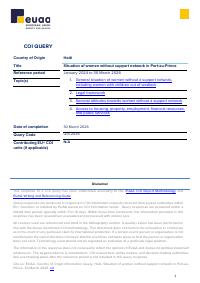
COI QUERY
Country of Origin
Haiti
Title
Situation of women without support network in Port-au-Prince
Reference period
January 2024 to 30 March 2026
Topic(s)
1. General situation of women without a support network,
including women with children out of wedlock
2. Legal framework
3. Societal attitudes towards women without a support network
4. Access to housing, property, employment, financial resources,
and public services
Date of completion
30 March 2026
Query Code
Q13-2026
Contributing EU+ COI
units (if applicable)
N/A
Disclaimer
This response to a COI query has been elaborated according to the EUAA COI Report Methodology and
EUAA Writing and Referencing Guide.
Query responses are produced in response to COI information requests received from asylum authorities within
EU+ countries or initiated by EUAA based on COI information needs. Query responses are produced within a
limited time period, typically within 5 to 10 days. Within these time constraints, the information provided in this
response has been researched, evaluated and processed with utmost care.
All sources used are referenced and cited in the bibliography section. A quality review has been performed in
line with the above mentioned COI methodology. This document does not claim to be exhaustive or conclusive
as to the merit of any particular claim to international protection. If a certain event, person or organisation is not
mentioned in the report, this does not mean that the event has not taken place or that the person or organisation
does not exist. Terminology used should not be regarded as indicative of a particular legal position.
The information in the response does not necessarily reflect the opinion of EUAA and makes no political statement
whatsoever. The target audience is caseworkers, COI researchers, policy makers, and decision-making authorities.
Any event taking place after the reference period is not included in this query response.
Cite as: EUAA, Country of Origin Information Query, Haiti, Situation of women without support network in Port-auPrince, 30 March 2026, url
1
COI QUERY RESPONSE – Haiti
Situation of women without support network in Port-au-Prince
1. General situation of women without a support network, including women
with children out of wedlock
Information on women without a support network, including women with children out of wedlock
in Port-au-Prince, was scarce among the sources consulted by EUAA within the time constraints.
However, the following information may be relevant.
Haiti is facing a ‘multidimensional political, economic, humanitarian, and human rights crisis’, 1
that has been described as one of the ‘world’s most severe’ humanitarian emergencies. 2
Criminal groups have carried out widespread violence and control large parts of Port-au-Prince, 3
where schools, churches and sports complexes have been converted into emergency shelters
for displaced people. 4 Information on the Security Situation in Port-au-Prince can be found in
the EUAA Query Security situation in Port-au-Prince, published on 1 April 2026.
Due to pre-existing inequalities and gender-based discrimination, 5 women and girls were
‘disproportionately’ affected. 6 In March 2026, Amnesty International reported that ‘gangs
controlling territories are using sexual violence as a weapon of control’. 7
Between January and September 2025, 1 270 incidents of sexual violence were documented,
in which most were reportedly linked to criminal groups. Victims had limited, and in many cases,
no access to protection or support services. 8 In June 2025, the United Nations Population Fund
(UNFPA) reported that around 1.2 million women and girls were in urgent need of protection
against gender-based violence (GBV) in Haiti. 9 Between March and June 2025, the United
Nations (UN) Integrated Office in Haiti reported that half of all female-headed households
nationwide were experiencing acute food insecurity and had been forced to incur debt in order
to survive. 10 According to a 2025 report by Freedom House, around 300 000 children in Haiti
HRW, World Report 2026; Haiti, 4 February 2026, url
International Rescue Committee, Haiti's gang violence crisis: What to know and how to help, 12 February 2026, url
3
HRW, World Report 2026; Haiti, 4 February 2026, url; OHCHR, Restoring dignity: A global call to end the violence
in Haiti, 7 April 2025, url
4
International Rescue Committee, Haiti's gang violence crisis: What to know and how to help, 12 February 2026, url
5
OHCHR, Women and girls bear the brunt of crisis ravaging Haiti, say UN experts, 6 May 2024, url
6
IOM, Over 1.4 Million Displaced in Haiti as Gang Violence Pushes Crisis to Unprecedented Levels, 6 March 2026,
url; OHCHR, Women and girls bear the brunt of crisis ravaging Haiti, say UN experts, 6 May 2024, url
7
Amnesty International, Fighting for the right to exist, 12 March 2026, url
8
HRW, World Report 2026; Haiti, 4 February 2026, url
9
UNFPA, “A point of no return”: An urgent call to support women and girls in Haiti, 27 June 2025, url
10
UN Security Council, United Nations Integrated Office in Haiti; Report of the Secretary-General, 14 April 2025, url,
para. 58
1
2
2
worked as domestic servants. 11 They were often unpaid, denied access to education, and
particularly vulnerable to physical and sexual abuse. 12
Children in female-headed households were reported to be ‘easy targets’ for gangs, as these
households often lacked sufficient support both to prevent child recruitment and to help
children disengage from gang involvement. 13 Gangs recruited children through a range of
methods, including the provision of in-kind benefits, regular pay, and drugs. 14 Children who
refused to join or attempted to leave were reportedly subjected to violence and threats,
particularly in the metropolitan area of Port-au-Prince. 15
2. Legal framework
The 1987 Constitution of Haiti, as amended in 2012, includes general equality and social-rights
provisions. Article 17 states that ‘[A]ll Haitians, regardless of sex or marital status, who have
attained twenty-one years of age may exercise their political and civil rights’. 16 Article 19
provides that ‘The State has the absolute obligation to guarantee the right to life, health, and
respect of the human person for all citizens without distinction, in conformity with the Universal
Declaration of the Rights of Man’. 17 Article 22 states that ‘The State recognizes the right of every
citizen to decent housing, education, food and social security’. 18
A 2025 joint submission to the Inter-American Commission on Human Rights indicated that
‘Haiti’s current legal, institutional, and public policy frameworks and practices for addressing
both GBV and discrimination against women and girls are inadequate, poorly resourced, and
largely unimplemented’. 19 On Implementation of the legal framework, an expert of the Human
Rights Committee explained that ‘the judiciary were not sensitive to cases of gender-based
violence and victims were hesitant to report cases’. 20 UN sources further reported that
accountability for human rights violations and abuses remained limited. 21 Courts continued to
suffer from inadequate funding and were often attacked or intimidated by gangs. 22
The Haiti World Bank Women, Business and the Law 2024 country report described the current
legal framework by reference to Haitian legislation. On sexual harassment and related
11
Freedom House, Freedom in the World 2025 - Haiti, 2025, url
Freedom House, Freedom in the World 2025 - Haiti, 2025, url
13
BINUH and OHCHR, Children trafficked by gangs in Haiti: Rethinking the responses, February 2026, url, p. 21
13
MSF, Sexual and gender-based violence in Port-au-Prince, Haiti , January 2026, url, pp. IV, 23
14
BINUH and OHCHR, Children trafficked by gangs in Haiti: Rethinking the responses, February 2026, url, p. 21
15
BINUH and OHCHR, Children trafficked by gangs in Haiti: Rethinking the responses, February 2026, url, p. 21
15
MSF, Sexual and gender-based violence in Port-au-Prince, Haiti , January 2026, url, p. V
16
Haiti, Haiti's Constitution of 1987 with Amendments through 2012, n.d., url, Art. 17
17
Haiti, Haiti's Constitution of 1987 with Amendments through 2012, n.d., url, Art. 17
18
Haiti, Haiti's Constitution of 1987 with Amendments through 2012, n.d., url, Art. 17
19
IJDH, IACHR: Study on Women’s Access to Justice in Cases of Violence and Discrimination in the Americas and
the Caribbean, 11 April 2025, url, p. 2
20
OHCHR, In Dialogue with Haiti, Experts of the Human Rights Committee Welcome Efforts to Establish a New
Constitution, Raise Questions on Measures to Combat Gang-Related Gender-Based Violence and Lynchings, 04
July 2025, url
21
OHCHR, Restoring dignity: A global call to end the violence in Haiti, 7 April 2025, url
22
OHCHR, Restoring dignity: A global call to end the violence in Haiti, 7 April 2025, url
12
3
legislation, the World Bank 2024 country note stated there is no comprehensive legislation on
sexual harassment. 23 It also mentioned that with respect to violence against women, it found no
comprehensive government mechanisms in the documents it reviewed. 24 Similarly, a 2025 joint
submission to the Inter-American Commission on Human Rights indicated that Haiti’s penal
code ‘does not acknowledge rape within a marriage’ and that ‘[t]here are no provisions on
domestic violence or sexual harassment’. 25 Sources mentioned that impunity for human rights
violations is widespread, 26 and that accountability for sexual violence ‘remains nearly nonexistent’. 27
For childcare and family-support measures, the same World Bank 2024 source reported that
under the legal framework reviewed for Haiti, there is no law establishing provision of childcare
services in centre-based settings, no law establishing support to families for childcare services,
no law establishing support to non-state childcare providers, and no law establishing quality
standards for centre-based childcare services. 28
3. Societal attitudes towards women without a support network
Information on societal attitudes towards women without a support network was scarce among
the sources consulted by EUAA within the time constraints.
According to a response on Haiti by the Immigration and Refugee Board of Canada (IRB), citing
information from a consultant at the Haitian Women’s Collective 29 interviewed on 8 December
2025, women who head households in many Haitian communities are respected and relied on
for care and income. 30 However, ‘harmful gender norms’ and stigma against them persist. 31
Sexual exploitation by gang members can also lead to stigma from relatives and the wider
community, especially for girls who become pregnant and are then left without support or
resources. 32 In Port-au-Prince, fear of stigma was reported to be a barrier that prevented victims
of sexual and gender-based violence (SGBV) from seeking ‘survivor care’. 33
23
World Bank Group, Women, Business and the Law 2024, 2024, url, p. 2
World Bank Group, Women, Business and the Law 2024, 2024, url, p. 2
25
IJDH, IACHR: Study on Women’s Access to Justice in Cases of Violence and Discrimination in the Americas and
the Caribbean, 11 April 2025, url, p. 3
26
HRW, World Report 2026; Haiti, 4 February 2026, url; OHCHR, Restoring dignity: A global call to end the violence
in Haiti, 7 April 2025, url
27
HRW, World Report 2026; Haiti, 4 February 2026, url
28
World Bank Group, Women, Business and the Law 2024, 2024, url, p.3
29
HWC, About the Haitian Women’s Collective, n.d., url
30
Canada, IRB, Haiti: The situation and treatment of single women and women who head their own household;
ability to access housing, employment, education, health, and support services, particularly in Cap-Haïtien (Nord)
and Jérémie (Grand'Anse), 13 January 2026, url
31
Canada, IRB, Haiti: The situation and treatment of single women and women who head their own household;
ability to access housing, employment, education, health, and support services, particularly in Cap-Haïtien (Nord)
and Jérémie (Grand'Anse), 13 January 2026, url
32
BINUH and OHCHR, Children trafficked by gangs in Haiti: Rethinking the responses, February 2026, url, p. 21
33
MSF, Sexual and gender-based violence in Port-au-Prince, Haiti , January 2026, url, p. 15
24
4
4. Access to housing, property, employment, financial resources, and public
services
Housing and property
According to the response on Haiti by the IRB, which cited information from UN Women
gathered on 25 June 2025 and a consultant at the Haitian Women’s Collective interviewed on
8 December 2025, women-headed households faced barriers affecting both their livelihoods
and their access to stable housing. 34
On property rights, the Haiti World Bank Women, Business and the Law 2024 country note,
using Port-au-Prince as the reference city, reported that men and women do not have equal
administrative power and ownership rights to immovable property, including land. The same
source says sons and daughters, and male and female surviving spouses, have equal
inheritance rights in law, but it also notes that Haiti lacked identified mechanisms to encourage
women to register immovable property and lacked awareness measures to improve women’s
access to information about marital and inheritance rights. 35
According to a Rapid Crisis Impact Assessment within the Port-au-Prince Metropolitan Area, as
of September 2024, violence ‘has rendered entire neighbourhoods uninhabitable’, with largescale displacement from the metropolitan area. 36 In May 2025, UNFPA further reported that
thousands of women and girls had fled their homes in the capital and were living in makeshift
shelters without access to basic services. 37 Médecins Sans Frontières (MSF) indicated that
shelters in Port-au-Prince do not accept pregnant women, women with children, or women with
medical conditions. 38
Employment and financial resources
Information on employment and financial resources for women without a support network was
scarce among the sources consulted by EUAA within the time constraints of this response.
The 2024 Bertelsmann Transformation Index (BTI) country report noted that women are
‘excluded from the bank credit system, government subsidy programs and public procurement’
and ‘dominate’ Haiti's informal economy. 39 On economic opportunities, the World Bank’s Haiti
Gender Scorecard 2025, based on 2022 data, found that women in Haiti were
disproportionately concentrated in insecure forms of work, with the rate of ‘vulnerable
employment (contributing family and own account)’ standing at 80.3 % for women, compared
with 68.6 % for men. 40
34
IRB, Haiti: The situation and treatment of single women and women who head their own household; ability to
access housing, employment, education, health, and support services, particularly in Cap-Haïtien (Nord) and
Jérémie (Grand'Anse), 13 January 2026, url
35
World Bank Group, Women, Business and the Law 2024, 2024, url, pp. 3, 4
36
Government of Haiti, EU, Inter-American Development Bank, UN, the World Bank, Rapid Crisis Impact
Assessment for Haiti, October 2024, url, p. 34
37
UNFPA, Situation Report #2, 13 May 2025, url, p. 12
38
MSF, Sexual and gender-based violence in Port-au-Prince, Haiti , January 2026, url, p. 2
39
Bertelsmann Stiftung, BTI 2024 Country Report Haiti, 19 March 2024, url, p. 7
40
World Bank, Haiti Gender Scorecard, 2025, url, p. 3
5
Access to public services
The 2024 BTI country report also indicated that Haiti had ‘almost no welfare regime’, the central
government allocated insufficient resources to drinking water, healthcare, education, and
electricity, and local authorities lacked the capacity to meet demand for these essential
services. 41
According to the coordinator of Nègès Mawon, a feminist organisation providing health services
and care for SGBV victims, women in Haiti ‘have reduced access to education, healthcare,
leadership spaces, and even safe public spaces’. 42
Regarding access to healthcare, sources from 2025 reported that only one medical provider in
Port-au-Prince was offering comprehensive SGBV care on a 24/7 basis, 43 while cuts to US
funding deprived about 750 000 women and girls of health services, psychosocial care, and
emergency assistance. 44 More generally, only one third of health facilities in Port-au-Prince were
fully operational in 2025, and insecurity made them even more difficult for women and girls to
access. 45
On access to education, UN Women interviewed by the IRB in August 2025 stated that single
women without a support network lack education and resources. 46 Gang violence caused the
closure of 1 606 schools across Haiti in 2025. 47 The United Nations Children’s Fund (UNICEF)
further noted in February 2025 that the situation in the capital had deteriorated, reporting that
armed groups destroyed 47 schools in January 2025 alone. 48
Bertelsmann Stiftung, BTI 2024 Country Report Haiti, 19 March 2024, url include p. 7
Amnesty International, Fighting for the right to exist, 12 March 2026, url
43
Cluster Protection Haiti, Protection Analysis Update, September 2025, url, p. 8
44
HRW, World Report 2026; Haiti, 4 February 2026, url
45
UNFPA, Situation Report #1, 22 January 2025, url p.2
46
IRB, Haiti: The situation and treatment of single women and women who head their own household; ability to
access housing, employment, education, health, and support services, particularly in Cap-Haïtien (Nord) and
Jérémie (Grand'Anse); state protection (2023–December 2025), 13 January 2026, url
47
BINUH and OHCHR, Children trafficked by gangs in Haiti: Rethinking the responses, February 2026, url, p. 11
48
UNICEF, Education under attack in Haiti, 28 February 2025, url
41
42
6
BIBLIOGRAPHY
Amnesty International, Fighting for the right to exist, 12 March
2026, https://www.amnesty.org/en/latest/news/2026/03/luchar-por-el-derecho-a-existirentrevista-con-pascale-solages-feminista-y-activista-haitiana/, accessed 20 March 2026
Bertelsmann Stiftung, BTI (Bertelsmann Transformation Index), 2024 Country Report Haiti, 19
March 2024, https://btiproject.org/fileadmin/api/content/en/downloads/reports/country_report_2024_HTI.pdf,
accessed 20 March 2026
BINUH (UN Integrated Office in Haiti) and OHCHR (UN Office of the High Commissioner for
Human Rights), Children trafficked by gangs in Haiti: Rethinking the responses, February
2026, https://www.ohchr.org/sites/default/files/documents/countries/haiti/children-traffickedby-gangs-rethinking-responses-en.pdf, accessed 24 March 2026
Canada, IRB (Immigration and Refugee Board of Canada), Haiti: The situation and treatment of
single women and women who head their own household; ability to access housing,
employment, education, health, and support services, particularly in Cap-Haïtien (Nord) and
Jérémie (Grand'Anse); state protection (2023–December 2025) [HTI202497.E], 13 January
2026, https://irb-cisr.gc.ca/en/country-information/rir/Pages/index.aspx?doc=459089&pls=1,
accessed 18 March 2026
Cluster Protection Haiti, Protection Analysis Update, September 2025,
https://globalprotectioncluster.org/sites/default/files/202509/pau25_20_protection_analysis_update_haiti_sept2025_final.pdf, accessed 24 March
2026
Freedom House, Freedom in the World 2025 - Haiti,
2025, https://freedomhouse.org/country/haiti/freedom-world/2025, accessed 25 March 2026
Government of Haiti, EU (European Union), Inter-American Development Bank, UN (United
Nations), the World Bank, Rapid Crisis Impact Assessment for Haiti, October 2024,
https://thedocs.worldbank.org/en/doc/aebfe0d6bc8d531600611abb53f1f5a50370012025/original/WB-RCIA-REP-ENG.pdf, accessed 24 March 2026
HRW (Human Rights Watch), World Report 2026; Haiti, 4 February
2026, https://www.hrw.org/world-report/2026/country-chapters/haiti, accessed 18 March 2026
HWC (Haitian Women's Collective), About the Haitian Women’s Collective, n.d.,
https://thehwc.org/about/, accessed 20 March 2026
International Rescue Committee, Haiti's gang violence crisis: What to know and how to help,
12 February 2026, https://www.rescue.org/article/haitis-gang-violence-crisis-what-know-andhow-help, accessed 25 March 2026
7
IJDH (Institute for Justice and Democracy in Haiti), IACHR: Study on Women’s Access to
Justice in Cases of Violence and Discrimination in the Americas and the Caribbean, 11 April
2025, https://www.ijdh.org/wp-content/uploads/11.04.2025-IACHR-Questionnaire-AsSubmitted.pdf, accessed 25 March 2026
IOM (International Organization for Migration), Over 1.4 Million Displaced in Haiti as Gang
Violence Pushes Crisis to Unprecedented Levels, 6 March 2026,
https://haiti.iom.int/news/over-14-million-displaced-haiti-gang-violence-pushes-crisisunprecedented-levels, accessed 25 March 2026
MSF (Médecins Sans Frontières), Sexual and gender-based violence in Port-au-Prince, Haiti ,
January 2026, https://www.msf.org/sites/default/files/2026-01/MSF356939(High).pdf,
accessed 24 March 2026
OHCHR (UN Office of the High Commissioner for Human Rights), Restoring dignity: A global
call to end the violence in Haiti, 7 April 2025,
https://www.ohchr.org/en/stories/2025/04/restoring-dignity-global-call-end-violence-haiti,
accessed 24 March 2026
OHCHR (UN Office of the High Commissioner for Human Rights), Women and girls bear the
brunt of crisis ravaging Haiti, say UN experts, 6 May 2024, https://www.ohchr.org/en/pressreleases/2024/05/women-and-girls-bear-brunt-crisis-ravaging-haiti-say-un-experts, accessed
25 March 2026
UNFPA (United Nations Population Fund), “A point of no return”: An urgent call to support
women and girls in Haiti, 27 June 2025, https://www.unfpa.org/news/%E2%80%9C-point-noreturn%E2%80%9D-urgent-call-support-women-and-girls-haiti, accessed 25 March 2026
UNFPA (United Nations Population Fund), Situation Report #1, 22 January 2025,
https://www.unfpa.org/sites/default/files/resourcepdf/UNFPA%20Haiti%20Situation%20Report%20%231%20%2822%20January%202025%29.p
df, accessed 25 March 2026
UNFPA (United Nations Population Fund), Situation Report #2, 13 May 2025,
https://www.unfpa.org/sites/default/files/resourcepdf/UNFPA%20Haiti%20Sitrep%202_2025.pdf, accessed 24 March 2026
UNICEF (United Nations Children’s Fund), Education under attack in Haiti, 28 February 2025,
https://www.unicef.org/press-releases/education-under-attack-haiti, accessed 24 March 2026
UN Security Council, United Nations Integrated Office in Haiti; Report of the Secretary-General
[S/2025/226], 14 April 2025, https://undocs.org/S/2025/226, accessed 25 March 2026
World Bank, Haiti Gender Scorecard, 2025,
https://documents1.worldbank.org/curated/en/099844002202574482/pdf/IDU14468a21e1aa4
814a421ab081cb22c2d07edb.pdf, accessed 24 March 2026
8
World Bank Group, Women, Business and the Law 2024, 2024,
https://wbl.worldbank.org/content/dam/documents/wbl/2024/pilot/WBL24-2-0-Haiti.pdf,
accessed 26 March 2026
ADDITIONAL SOURCES CONSULTED
Asylum Research Centre; Crisis24; ecoi.net; EUAA COI Portal; Fédération internationale pour
les droits humains (FIDH); Germany – Federal Office for Migration and Refugees (BAMF);
France – Office Français de Protection des Réfugiés et Apatrides (OFPRA); Norwegian
Refugee Council; Reporters Sans Frontières (RSF); The Guardian; UN Human Rights Council,
United Nations Educational, Scientific and Cultural Organization (UNESCO), United Nations
Entity for Gender Equality and the Empowerment of Women (UNWOMEN), United Nations
High Commissioner for Refugees (UNHCR), United Nations Security Council; Widows for
Peace through Democracy (WPD); World Health Organization (WHO)
9
Kijan pou site
European Union Agency for Asylum (EUAA), 2026, Demann enfòmasyon sou peyi orijin: fanm ki pa gen rezo sipò nan Pòtoprens, https://reliefweb.int/attachments/613c3312-265f-5bc5-90ff-52de219249c1/2026_03_EUAA_COI_Query_Response_Q13_Haiti_Situation_of_women_without_support_network_in_Port_au_Prince.pdf