Teks Konple Dokiman an
Teks ki soti nan dokiman orijinal la pou endeksasyon.
2025
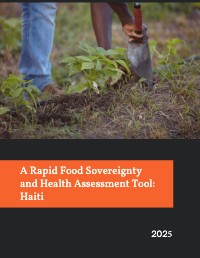
A Rapid Food Sovereignty
and Health Assessment Tool:
Haiti
All rights reserved. ©
Suggested citation: Steckley, M., Civil, M., Osna, W., Steckley, J., and S. Sider. (2025).
Haitian Food Sovereignty Assessment Tool.
Contributors and Acknowledgements
Funding to develop the Haitian Food Sovereignty Assessment Tool was provided by the
Canadian Institute for Health Research (CIHR). This document was developed and written
by Marylynn Steckley, Magalie Civil, Walner Osna, Joshua Steckley, and Steve Sider.
Contributions in workshops and interviews were also made by Renaud Jean Alain, Registre
Line Altagrace, Donald Andrè, Edmond Antoines, Wanel Jean Baptiste, Lynda Balthazard,
Bilanda Cadet, James Blanc, Francheska Cesar, Geraldine Cèsar Jeanne, Pierre Yves-
Claude, Despeignes Cruilon, Marie-Carmelle Danielle,Ilva Delva, Jelly Dollema,
Despeignes Cruilon, Daniel Ducasse, Beliazard Eugenie, Ewaldy E. Estil, Cerant Filton,
Steve Guerrier, Museau Herauld, Flormone Honreau, Bernardine Ifetena, Jimmy Imene,
Angeline Jean, Andre Jean-Pierre, Jean Kattie, Mesidor Loudlige, Tchessie Louis, Michel
Lumene, Naomi Millien, Israel Milieu, Florcie Monereau, Luckency Mompoint, Charles
Nadege, Francois Natty Mick-Anly, Ichemelle Benjamine Obas, Edeline Oswald, Nadel
Pierre, Mirlide Pierre Louis, Widley Presendieu, Doudou Pierre Festil, Jean Alain Renaud,
Prosper Remi, Domèus Renaud, Louis Roland, Sandro Pierre-Yves Claude, Dieunise
Senatus, Landy St. Ilus, Jean Adan Wislow.
This tool is based on interviews and workshops with leaders from community-based
organizations in Haiti, and we are thankful for their expertise, knowledge and
contributions to the development of this document. Their hard work informs the content
of this report.
INTRODUCTION 3
TOOL METHODOLOGY 10
PART I: DEMOGRAPHIC INFORMATION 12
PART II : FOOD SYSTEMS, LAND AND
RESOURCES ACCESS
14
PART III : COMMUNITY FOOD AND HEALTH 17
PART IV : FOOD & POWER 19
PART V: FOOD & ENVIRONMENT 23
PARTIE VI : HEALTH INVENTORY 25
PART VII : FOOD SECURITY QUESTIONS 31
PARTIE VIII: GENDER 28
PARTIE IX: FOOD CULTURE 32
PART X: FUTURE VISION
36
Tables des matières
Introduction
In 2018, the Haitian government introduced ‘food
sovereignty’ into Haiti’s policy landscapes with the
publication of the National Policy for Food Sovereignty,
Food Security and Nutrition (PNSSANH). The document is
novel in that it provides an inter-sectoral analysis of Haiti’s
food systems, and offers detailed recommendations for
change by connecting domains — land, nutrition, health,
gender, trade, and culture — that have previously been
siloed in the policy arena. The introduction of food
sovereignty is indeed emblematic of a paradigm shift in
Haitian national policy and opens up an opportunity for a
radical shift in service provisioning and research related to
Haiti. This policy is a call to move beyond discussions about
food security and assessments, which have narrowly tended
to focus on caloric sufficiency, access, and diversity, to
consider broader questions, including how land, gender,
traditional food cultures, and pro-peasant agriculture are
fundamental to creating healthy, economically and
environmentally sustainable, and culturally enriching food
systems in Haiti. Yet, the PNSSANH also presents a new
challenge, for scholars, practitioners and the state — how
do we evaluate and monitor progress towards the core goals
of food sovereignty?
Here we offer a Rapid Food Sovereignty Assessment Tool in
the hope of supporting the continued emergence of
alternative, pro-peasant food systems in Haiti and beyond.
03
Rapid Food Security Assessments and why we need Rapid Food Sovereignty
Assessments
Food security is typically defined as “when all people, at all times, have physical and
economic access to sufficient safe and nutritious food to meet their dietary needs and food
preferences for a healthy and active life” (FAO 1996). While is no standard metric to assess
food security, evaluators tend to rely on an assortment of data at multiple scales, often
collected through a variety of means including individual and household surveys, national
data sets and economic models. Rapid Food Security Assessments (RFSAs) have been used
since the 1980s as a way to quickly evaluate the state of food security in a given population.
RFSAs have tended to be used during or after extreme weather events, poor harvests, or
other dramatic events which affect food security in a given area. Early food security
methodologies and RFSAs tended to estimate caloric intake and food availability. Over
time, the scope of RFSAs has expanded to take account of the diverse socio-economic and
environmental contexts that impact a population’s food security.
The World Food Programme’s Consolidated Approach to Reporting Indicators of
Food Security (CARI), for example, is often used to measure household food security.
04
The CARI includes questions that seek to capture an individual’s demographic details,
caloric intake, dietary diversity, food market costs, and food insecurity adaptation
strategies (ie. reducing meals, selling animals or land, use of credit), as well as past and
projected harvests, and subjective well being. While this tool provides a much more
detailed picture of food security than past household surveys, there are some
shortcomings. First, the CARI categorizes households, and subsequently regions, into four
levels of food security. While this provides a necessary overview for intervening actions,
this broad-level data often lacks information or discussion about the structural factors
that impact food insecurity in a given community. Second, the tool tends to be carried out
by external actors, and the information produced is used to guide intervention by other
outside actors. Community groups and sampled individuals are rarely asked to engage in
collecting the data and have little control over the information contained within it. As
such, the RFSAs often result in a measure of food security in the absence of local
participation and without analyses of the structural forces that impact community food
security. For example, questions relating to land tenure, rural labour, agroecological
practices, the impacts of imported food on rural livelihoods, the gendered dynamics of
food production, marketing and consumption and the cultural value of traditional diets,
are largely absent. Documenting these dynamics not only has the potential to provide a
clearer and more nuanced picture of food security in a given region, but also allows
policymakers, Non-Governmental Organizations (NGOs), and community leaders, to
analyze how food insecurity emerged, and how it can be improved. In short, an inter-
sectoral and richer view of Haiti’s food systems, including but moving beyond traditional
food security metrics, requires a food sovereignty assessment.
05
The CARI
First, the CARI categorizes
households, and subsequently
regions, into four levels of food
security. While this provides a
necessary overview for
intervening actions, this broad-
level data often lacks
information or discussion about
the structural factors that impact
food insecurity in a given
community.
Documenting these dynamics not
only has the potential to provide a
clearer and more nuanced picture
of food security in a given region,
but also allows policymakers, Non-
Governmental Organizations
(NGOs), and community leaders, to
analyze how food insecurity
emerged, and how it can be
improved.
A richer, cross-sector vision of Haiti's food systems,
going beyond traditional measures of food security,
requires an assessment of food sovereignty.
06
More specifically, food sovereignty can be seen to cohere around a
number of key pillars, including calls for redistributive land
reform, increased transparency, democratic control, and gender
equity in all decision-making from farm households to
agricultural policy-making; support for agro-ecological research
and pro-poor agronomy; and recognition of the rights of nations
and peoples to support culturally appropriate and diverse food
systems, including autonomy in trade policies. Food sovereignty
challenges the neoliberal approach to food and agriculture and
calls for a range of alternative policies to foster more equitable and
sustainable farming systems. Advocates also stress that enhancing
smallholder livelihoods and the localization of agro-food systems
will tend to enhance access to healthy, culturally appropriate food,
which reflects the fact that diverse diets historically emerged out
of local agricultural conditions.
The Rapid Food Sovereignty Assessment in this document is a
community-developed tool designed to not only measure caloric
intake, food availability, and food costs, but to also collect
information on the relationships between food security, land,
gender, health, state policies, trade regimes, and food cultures.
What is food sovereignty?
More specifically, food sovereignty can be seen to cohere around a number of key pillars, including calls
for redistributive land reform, increased transparency, democratic control, and gender equity in all
decision-making from farm households to agricultural policy-making; support for agro-ecological
research and pro-poor agronomy; and recognition of the rights of nations and peoples to support
culturally appropriate and diverse food systems, including autonomy in trade policies.
Food Sovereignty is a conceptual
framework that was coined in
1996 by the global peasant
movement Via Campesina, and
it calls for “the right of
populations to define their
agricultural and food policy”
and recognizes “the right of
people to healthy and culturally
appropriate food produced
using sustainable methods
07
Via Campesina. (2007). Nyéléni Declaration. Forum
for Food Sovereignty, Sélingué, Mali.
There is much overlap between rapid food security assessment tools and this Rapid Food
Sovereignty Assessment tool. For example, this tool contines to collect demographic,
and individual health information, dietary diversity, and food sufficiency. What this tool
adds is attention to land tenure arrangements and environmental resources, food
storage facility access, access to transportation networks and markets, respondent
perceptions of healthy and accessible foods, security threats, and a gendered picture of
food culture, health indicators, land and labour practices, and participant perspectives
on how best food security could be addressed in households and communities.Our hope
is that this Rapid Food Sovereignty Assessment tool will allow for food systems
evaluations, moving beyond questions of hunger and dietary diversity, to include the
intersectional factors —health, environments, policies and trade, gender relations, and
culture— that bear on Haitian diets and livelihoods. The hope is that this tool will help
us all to better understand how to craft healthier, inclusive and environmentally
friendly food systems in Haiti.
Today, rapid food security assessments rarely address the interconnections between
land tenure, ecology, diets, health, culture and economies. Yet, food security data
informs national policies on food, agriculture and nutrition, rural development,
health, and the service provisioning of international NGOs and researchers. Moving
towards environmentally integrated, gender-inclusive, and pro-peasant food systems
in Haiti must begin with collecting comprehensive data on these critical aspects of food
sovereignty. Our hope is that this Rapid Food Sovereignty Assessment tool will
provide researchers, community leaders, and development practitioners a means of
discovering the dynamics that together create food systems, and, when used over time,
it will highlight the ongoing and structural factors that have been impeding food
security in Haiti for decades.
08
What is food sovereignty?
09
FOOD SOVEREIGNTY
Increased
transparency
Gender equity in all
decision-making
from farm
households to
agricultural policy-
making
Calls for
redistributive land
reform
Support for agro-
ecological
research and pro-
poor agronomy
Recognition of the
rights of nations
and peoples to
support culturally
appropriate and
diverse food
systems Democratic
control
Autonomy in trade
policies
Our team would like to stress that this tool is not designed to
provide a concrete measure of food sovereignty in the same
way that food security has been measured. Food sovereignty
is a fluid movement, and concept not a precise measurement.
Instead, this tool is designed to collect information on the
critical ‘pillars’ of food sovereignty. Primary among the food
sovereignty pillars is democratic control over food systems.
Indeed, this tool is the result of a collaborative research
project which engaged over thirty community-based
organizations in Haiti, and a team of Haitian and
international researchers and students. Our work took place
over 2-years, from 2021 to 2023, and was founded on a
community-based participatory methodology with the
intention to emphasize the importance of community-
defined problems and possibilities for change.
Our team, made up of Canadian and Haitian Scholars, as well
as Haitian community organizations, has been committed to
a community-grounded process and has included interviews
and workshops with Haitian partners with the goal to
establish a tool that is community-driven and relevant for
Haitian community-based organizations, non-governmental
organizations, and state institutions.This tool has been tested
in two case studies and tends to take between 35-90 minutes
to carry out with individuals. This is generally consistent with
the time required to conduct rapid food security assessments.
Tool Methodology
Our work took place over
2-years, from 2021 to 2023,
and was founded on a
community-based
participatory
methodology with the
intention to emphasize the
importance of community-
defined problems and
possibilities for change
10
Tool Methodology
We encourage practitioners and researchers you to conceptualize this tool as
a living document. The questions below, and the information they generate,
were developed in the context of Haiti’s North Department, which has its
own unique advantages, and challenges relating to inter alia food security,
diet, healthcare, land tenure, agricultural production, employment, and
environment. Still, we have tried to make the tool applicable to a variety of
contexts and hope it can serve as a guide to enhance community-engaged
data collection and community access to the information generated.
This tool has been tested in two case studies and
tends to take between 35-90 minutes to carry out
with individuals. This is generally consistent with
the time required to conduct rapid food security
assessments.
11
PART I: DEMOGRAPHIC INFORMATION
Name:
Year of Birth:
Sex: Male Female Others
.
12
5.
Other:
Finished a college or University Program
What level of school did you finish?
I never attended school or attended minimally
Finished Primary School
Finished Secondary School
1. In which department were you born?
2. Where do you live now?
3. Year you came to this area:
4.
Conjugal Status:
Married Common Law
Single
I have a boyfriend/girlfriend but live at home
PARTIE I : INFORMATIONS DÉMOGRAPHIQUES
During the past year, what was your main activity?
Paid Employment
Informal Commerce
6.
Going to School
13
7.
Caring for Children
Household Work
Does your activity (or work) change throughout the year/season?
If yes, describe how:
Other
If “Other”, Describe:
8.How many children do you have?
9.How many children are in your care?
10.How many people are in your household that eat from the same pot?
Children:
11. How many men/women are there in your household?
Women:
YES NO
Long term illness
Agriculture
Adults:
Men:
PART II : FOOD SYSTEMS, LAND AND RESOURCES ACCESS
14
1.
2.
3.
4.
5.
How easy or difficult is it for you to get to the closest market?
Easy Somewhat challenging
Do you have a reliable form of transportation?
How do you usually get to the market?
Difficult
Do you have access to a latrine at your home?
What is your relationship to land access? (Check all that apply)
YES NO
YES NO
Walk Public Transport Motorcycle Bicycle Own my own vehicle
Other
I don’t have access to land
My family has land that I help to cultivate
I own land and work it myself or with my family
Own my own land and rent it to others (Lwe/Fèmaj)
I own my own land and have someone on it through sharecropping (demwatye)
I lend my land to others as “jwisans” (for pleasure)
I own my own land but someone has it through "bay kenbe"
I rent land (lwe/fèmaj) from others
I cultivate land that I hold through a "bay kenbe" land relationship that is someone else's
I have land that I cultivate from “Jwisans” from others
I cultivate someone else’s land through “Demwatye” (Sharecropping)
Other: Describe:
15
7. What is the land used for? (For researchers: What do you grow? Do you [pasture])?
6. If you have land, describe/estimate for each category that you have selected, the amount of land that
you have (in kawo tè).
fè elvaj
9. If you have access to land, is it irrigated?
Some is a n d s o m e i s n o t
YES NO
8 Are you able to store food after harvesting (ie. do you have a depot)?
YES NO
16
9.
10. Do you do the following (Check all that apply):
Fè Jaden (work in agriculture/have a garden)
Gather Traditional Plants
Preserve Cultural Foods
Fish
Cook Traditional Foods
Has it ever happened that the planting time comes but you don’t have the means to plant?
8. If you work land, what problems do you have with your production? What limits your harvest?
PART III : COMMUNITY FOOD AND HEALTH
17
1.
2.
3.
What does nutritious food mean to members in your community and you?
How do you and people in your community learn how to make dietary choices for good health?
(Researchers can ask about doctors/medsin fèy [traditional
healers]/mothers/grandmothers/family/NGOs)?
Do you think people in your community receive adequate food on a daily basis? (Prompt: Do you
know or think people in your community are hungry?). Explain.
18
5.
6. Describe how men or women suffer more different health concerns?
Do you think health problems in your community caused, or exacerbated, by a lack of healthy,
nutritious foods?
I f so, explain:
4. What health issues do you most hear about in this area?
YES NO
PART IV : FOOD & POWER
19
1..
Are land rights, ownership, and access to land a problem in your community?
If so, explain:
Who controls the access to irrigation water in your community?
The state
Large land owners
Peasants
Corporations
CASECS (Conseil d’administration de la Section communale (Leader of Communal Section)
NGOs (Non-Governmental Organization) Gangs
Other: Describe
2.
YES NO
20
4.
5..
6..Is food provided by NGOs healthy, nutritious and suited to the people in your community?
Are foods needed for ceremonies more or less expensive than other options? (Researchers, probe
with the example of imported chicken, and chicken used in ceremonies “
glase).
More Expensive
Less Expensive
Roughly the Same
Do people in your community pay a fair price for healthy food?
poul peyi, poul pepe, poul
3.
Are foods needed for ceremonies available in your community?
If so, explain:
YES NO
YES NO
YES NO
21
7.. Has historic food aid programs helped your community?
If so, explain:
8.Have food programs disrupted local or traditional foods, or local control over land and resources?
If so, explain:
YES NO
YES NO
22
9.Describe examples in history that have disrupted or transformed your food systems/environment.
How has the food system changed over the years? How did this impact your community?
PARTIE V: FOOD & ENVIRONMENT
23
1.
2.. What connections do you see between food and environmental health?
3. What are the threats to peasant agriculture in your area?
Land Grabbing
Climate Change
Difficult to access land
Access to Water and Irrigation
Access to seeds and agricultural inputs
Gangs
Other. Describe:
Do you think environmental changes have impacted your community? How?
24
4.
5.
6. What environmental concerns do you have that impact the local food system?
Do you know of community planning preserve agricultural lands as agricultural lands. That is,
instead of changing them to commercial or other development land?
Are the environmental impacts of agricultural production considered by decision-makers in your
community?
(Researchers can probe by asking about the impacts of fertilizer/pesticide use)
YES NO
YES NO
PARTIE VI : HEALTH INVENTORY
25
1.
2.
3.
4.
5.
6.
In general, how is your health?
Excellent
Very Good
Good
Some persistent health challenges
Poor
What is your weight:
What is your height: _
Do you consider yourself overweight, underweight or just about right?
Overweight
Just about right
Underweight
In general, how is your mental health?
I am usually happy
I am sometimes happy
I am often discouraged
I am depressed
Thinking about the amount of stress in your life, how would you describe most of your days?
Not at all stressful
Not very stressful
A bit stressful
Extremely stressful
26
7.
8.
9.
How would you describe your sense of belonging in your community?
Strong
Somewhat strong
Neutral
Somewhat weak
Very weak
How do you feel about your life as a whole right now?
Very Satisfied
Somewhat satisfied
Neutral
Somewhat dissatisfied
Very dissatisfied
Describe any health problems that trouble you:
27
11. In the past 12 months, have you avoided going to a doctor because of cost?
12. Which of the following do you regularly consult with for your health:
Local Healer (Medsin Fèy)
Local Midwife (Fanm Saj )
Male Voudou Priest (Oungan )
Female Voudou Priestess (Mambo )
Medical Doctor (Western Medicine)
Voudou specialist (Bòkò)
Other. Describe:
YES NO
10. Do you have any of the following diet-related conditions? (Check all that apply)
Diabetes
Heart Disease
High blood pressure
Obesity/Overweight
Anemia
Fibroids
Fibroids Thyroid issues:
Other (describe):
PART VII : FOOD SECURITY QUESTIONS
28
1.
2.
3.
4.
5.
Describe your diet?
What does it mean to you to eat healthy?
Does the food that you eat address your health needs?
How easy is it for you to get food?
Easy
Somewhat easy
Somewhat difficult
Difficult
What does a typical day of eating look like for you? (Prompts: do you have coffee, a drink, a piece
of fruit?
YES NO
29
6.
7.
8.
Most often, how do you get food?
I grow it myself, or my family grows it
I buy it or my family buys it
Food Aid
I or my family buy on credit
Food Sharing
What are you most concerned about when you seek food:
Cost
Nutrition
That it will fill me and my family
That it is local, Haitian food
Are you concerned about any of the following in your food? (Check all that apply)
Chemicals
That it is imported
That it is processed
30
9.
In the past 12 months, state which were true, sometimes true or never true.
TRUE SOMETIMES NEVER
TRUE TRUE
You or a family member worried that food will run out before you
can access more.
You couldn’t afford, or have access to being able to eat balanced
meals.
You and others in your house rely on low-cost foods, or poorer
quality foods.
You couldn’t eat the foods you would choose (a balanced meal)
because you couldn’t afford it.
Your children weren’t eating enough because you couldn’t afford
it.
You cut your meal size or skip meals because there isn’t enough
food.
Did you ever not eat for a whole day because there is not enough
food.
10. Do you think access to different foods impact any of your health issues or concerns?
11. Are you comfortable with the quality of the food that you eat?
YES NO
YES NO
PARTIE VIII: GENDER
31
1.
2.
3.
4.
5.
How does your gender impact your health and diet?
How are inheritance rights in your house divided? Who had rights to inheritance?
Men inherit much more
Men inherit more
Both men and women inherit equally
Women inherent more
Women inherit much more
Are men in Haiti prioritized for land inheritance?
Who works more with chemical fertilizers and pesticides (men or women)?
Men
How is food divided in your house? (For researchers, you can probe with questions like, who eats
first, men or women? who gets the most meat? does gender impact food distribution?)
Women Both
6. Are there social gender preferences in terms of who is prioritize in other ways (ie. sending to
school?
If so, explain:
YES NO
YES NO
PARTIE IX: FOOD CULTURE
32
1.
2.
3.
4.
5.
What are some of your traditional foods?
What agriculture food traditions are still practiced in your community?
What three foods would you consider to be traditional foods for your area?
Does the food that you eat align with your cultural heritage and traditional food systems?
Does your community want to preserve its cultural food traditions?
YES NO
YES NO
33
6. Which of the foods that you just mentioned do you eat on a regular basis?
Do you eat traditional foods as much as you would like? 7.
8. If you don’t eat traditional foods as much as you like, why not? Check all that apply:
I don’t know where to get them
I don’t know how to get them
I don’t know how to prepare them
They are too expensive
The place I got them before has been developed/taken over
I’m not sure they are safe to eat (ie. pollution)
I currently eat them as much as I like
Other
9. Is there discrimination towards local foods/local people (ie. peyizan) that impact what people eat?
If so, explain: (Research can probe using examples of pitimi pa monte tab , or preferences for bonbon sell
because “bonbon siwo sanble kaka chwal”.
10. Have agriculture and food traditions been lost in your community?
YES NO
YES NO
YES NO
34
11. List as many traditional foods as you can think of. Which ones do you have access to? ( Researcher:
List foods in the left column & check the appropriate boxes to indicate access to these foods).
Participant Provided List of
Foods
I have access to
this and eat it
regularly
I sometimes
have access to
this
I don’t really have
access to this
FOODS
JE MANGE CECI:
Je veux en
manger
davantage
J’aimerais en
savoir plus
Je sais comment
les préparer
C’est trop
cher
Je sais
comment en
avoir
Je n’aime pas
cet aliment
PARFOIS
SOUVENT
JAMAIS
CASSAVA BREAD (KASAV)
Millet (Pitimi)
Okra (Kalalou/Gombo)
SWEET POTATO BREAD (PEN PATAT)
MOLASSES BREAD (BON BON SIWO)
JUTE LEAVES (LALOW)
MASHED BREADFRUIT (TOM TOM)
PUMPKIN SOUP (SOUP JOUMOU)
CORNMEAL PORRIDGE (AKASAN)
HOMINY /BEAN/PUMPKIN STEW (CHAKA)
CORN BREAD (PEN MAYI)
STEW (BOUYON)
SWEET POTATO (PATAT)
FRIED FOOD PLATTER. (FRIKASE)
CHAYOTE (TCHÒK MILITON)
HOT CHOCOLATE (CHOKOLA)
BREADFRUIT (LAM)
YAM (YANM)
SWEET (DOUS)
PLANTAIN (BANNANN)
PEANUT BRITTLE (TABLÈT)
OTHER THAT PARTICIPANT WOULD LIKE TO
ADD
12. Of the Following Foods check all the statements that apply to you
35
PARTIE X: FUTURE VISION
36
1.
2.
3.
4.Do you have anything else you would like to share with us?
What are some ways that we can protect traditional Haitian foods?
What would the community benefit most from to improve healthy food systems?
Who is currently working to solve food problems in your community, and what are they doing? (For
Researchers you can prompt about: the state; NGOs; community organizations. Try to learn who are the
big players in the local food movement).
Design by
Jean Nephetaly Michel
jeneph@gmail.com
Suggested citation:
Suggested citation : Steckley, M., Civil, M., Osna, W., Steckley, J. et S. Sider. (2025). Outil
d'évaluation de la souveraineté alimentaire haïtienne.
All rights reserved. ©