
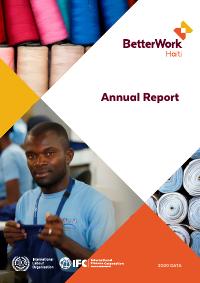
Rapò anyèl 2020 Better Work Ayiti
Rezime — Rapò anyèl 2020 Better Work Ayiti. Dokiman an gen 14 paj.
Dekouve Enpotan
- Rapò anyèl 2020 Better Work Ayiti.
- Gade rezime anglè a.
Deskripsyon Konple
Rapò anyèl 2020 Better Work Ayiti. Dokiman an gen 14 paj. Gade rezime anglè a pou detay.
Teks Konple Dokiman an
Teks ki soti nan dokiman orijinal la pou endeksasyon.
Annual Report
2020 DATA
FOREWORD
Haiti
The outbreak and rapid spread of the pandemic threatens the Haitian garment industry much
as it does across the globe and highlights gaps in national social protection systems. For
example, a survey of 3,300 workers carried out by Better Work Haiti in December 2020 showed
that 91 per cent had to reduce the number of meals because of food price inflation or a drop in
household income. Though the government acted to cover these gaps, challenges remain to reach
sufficient coverage and financial sustainability. Simultaneously, opportunities to consolidate
the path to universal and adequate coverage have emerged with the crisis, as
stakeholders have worked to create a shared set of urgent priorities for the future
*Funding is provided by the United States Department of Labor under cooperative agreement number IL-21187-10-75-K.
Note: This material does not necessarily reflect the views or policies of the United States Department of Labor, nor does
mention of trade names, commercial products, or organizations imply endorsement by the United States Government. 89%
of the total costs of the project or program is financed with Federal funds, for a total of US$ 11,295,840.
2 BETTER WORK ANNUAL REPORT 2020
COUNTRY CONTEXT
38
factories
enrolled in
the country
36,003
workers in Better Work
Haiti factories (55%
of the country’s total)
61%
of the
workers
are women
90%
10
of national exports compliance
assessment
were from the
reports
garment sector
Impact of COVID-19 on the garment sector
The initial impact of the pandemic on the Haitian garment sector was
severe. Most factories were closed for one month. The government initially
allowed some factories to work at 30 percent capacity to manufacture
personal protective equipment (PPE). Later, factories were allowed to
operate at 50 percent capacity. Initially, the sector lost approximately
20,000 jobs and four companies closed their doors permanently. The
government stepped in to support the workers by covering one quarter
of their salary for one month, but financial stress remains a primary
concern among workers (see survey in the following pages). Towards
the end of the third quarter of 2020, the sector started to recover some
lost jobs both through rehiring workers and creating new positions.
Partnerships
In 2020, Better Work collaborated with ILO and UNICEF specialists to
provide prenatal care services and awareness-raising sessions on the
prevention of COVID-19 and HIV to garment workers through the PROFAMIL
initiative. Better Work also collaborated with the World Health Organization
to provide COVID-19-related training to 48 medical personnel working in
the garment sector. In addition, together with apparel brands, Better Work
delivered Prevention of Sexual Harassment (POSH) training sessions.
Trade agreements
After approximately two years of negotiations, the United States
Congress renewed the Caribbean Basin Trade Partnership Act
(CBTPA), initially set to expire at the end of September 2020 for Haiti
and other Caribbean nations. The renewed trade deal guarantees
protections for Haitian/USA trade partners for the next ten years.
The Association des Industries ‘d’Haiti (ADIH) representatives hail
this news as a potential savior for the textile sector, particularly
during the struggle to stay afloat throughout the COVID-19 crisis.
“
190 100
advisory
services
delivered
training
sessions
carried out
GARMENT
SECTOR
STATISTICS
The outbreak
of COVID-19 had
a tremendous
impact on the
Haitian garment
sector in 2020,
as shown by a
considerable
decrease in
exports. According
to data published
by the USA’s Office
of Textiles and
Apparel (OTEXA),
in 2020, the
Haitian textile
industry exported
approximately
US$ 765 million
worth of
products to the
United States,
representing a
decrease of 23.5
per cent from the
previous year.
Although we had no physical visits from Better Work Haiti, the tools and guidelines
as well the virtual assistance provided by Better Work Haiti were very useful
in helping Hansae to address labour issues during these difficult times."
Michel Hwang, General Manager at Hansae, a South Korean fashion brand and manufacturer in Haiti
3 BETTER WORK ANNUAL REPORT 2020
ACHIEVEMENTS
Information to deal with
the impacts of COVID-19
Better Work Haiti, as one of the strategic partners supporting and
promoting growth in the sector, had to adjust its strategy to deal with
the many challenges resulting from the outbreak of COVID-19. The
programme provided support to the union federations, government,
and employers’ association, either individually or through the tripartite
committee that represents these three parties. The team had to start
delivering its core services remotely — often virtually or in a virtual/
in-person hybrid to the enrolled factories. Training sessions and
advisory services became more focused on helping stakeholders
to deal with the effects of the pandemic. The main goals were to
protect the workers’ health as well as their jobs. In order to align its
support with the needs of the sector, Better Work Haiti conducted
a series of surveys to gather information about the impact of the
pandemic on workers and employers (see case study for more info).
COVID-19
RESPONSE
A guideline to
protect workers
Better Work Haiti developed a
comprehensive set of guidelines
focused on Occupational
Safety and Health (OSH) to
help employers, workers, and
respective committee members
implement and maintain
safe and healthy workplaces.
The guide includes a selfassessment questionnaire
designed to help factories assess
their COVID-19 risk exposure
and find ways to mitigate
those risks. It was translated
into French and shared with all
factories, the Ministry of Social
Affairs and Labor (MAST), the
Association of Haitian Industries
(ADIH), and and leaders of
workers’ organizations.
A set of questions was included
in the factories’ improvement
plans in order to help
operationalize the guide and
monitor its implementation.
Several training sessions related
to the prevention of COVID-19,
emergency preparedness,
and responsible retrenchment
during the pandemic were
also provided to factories.
Joint work between the
ILO and UNICEF on HIV
and COVID-19 awarenessraising and prevention
enabled through Better
Work reached approximately
18,000 workers in 24
factories in the metropolitan
area of Port-au-Prince.
4 BETTER WORK ANNUAL REPORT 2020
ACHIEVEMENTS
WORKING WITH
GOVERNMENT
Preparing inspectors for
COVID-19 regulations
The Better Work Haiti team provided logistical support to
the Ministry of Social Affairs and Labor (MAST) to conduct
inspections and help monitor Better Work’s participating
factories during the pandemic. Public inspectors conducted
15 inspections in the garment sector between April
and September, slightly lower than average due to the
pandemic but more than they would have without the
Better Work partnership. Engagement was especially strong
with the Western Regional Office of MAST. Better Work also
conducted training sessions for the inspectors on labour
law in the context of COVID-19 to help them understand the
various new government decrees that were published and
their impact on the garment sector. The training materials
were translated into French and Creole and shared with
the participants as well as the MAST directorate.
PROMOTING
GENDER EQUALITY
Prenatal care services and HIV tests
The pandemic had a significant impact on women,
especially pregnant women. In order to overcome
these challenges, Better Work partnered with
specialists within the ILO and UNICEF through
the PROFAMIL initiative to offer a wide range
of prenatal services. They included medical
screening for HIV and syphilis as well as prenatal
ultrasounds. COVID-19-related disruptions in the
garment-manufacturing sector reverberate among
workers and their families. Analysis of economic
impact surveys among 107 female workers in the
48%
experienced
temporary
suspension
of work
in 2020
sector revealed risks to food security, health, and
livelihoods. Nine in ten respondents to a Better Work
Haiti survey reported trouble securing the usual
amount of food for their household due to
income shocks. Significant portions of workers
surveyed have concerns about the health of
themselves and their family members.
Better Work Haiti also shared the survey
information with government ministries to inform
the development of related public policies. The
main results of the survey are highlighted below:
56%
95%
94%
43%
said they were
worried about
their health and
44% about
their income
reported inability
to buy the amount of
food they usually buy
because their household
income has dropped
said they cannot buy
the amount of food
they usually buy
because the price of
food was too high
reduced the
number of meals
and/or portion of
each meal they
usually had
5 BETTER WORK ANNUAL REPORT 2020
ACHIEVEMENTS
WORKING WITH
TRADE UNION
WhatsApp to disseminate
health information
WORKING
WITH BRANDS
Training
on prevention of
sexual harassment
Despite the challenges brought about by
COVID-19, Better Work Haiti continued
to partner with brands in 2020 to
provide training sessions. Collaboration
included providing training sessions on
the prevention of sexual harassment to
factories that are part of the Better Work
programme. The team also received
the support of Better Work Nicaragua
to deliver a training session on sexual
harassment in Spanish to supervisors
and managers at factories.
A WhatsApp group was launched by Better Work Haiti to
engage with the trade unions in the garment sector and
facilitate the dissemination of critical information and
advice among workers. Better Work Haiti also established
a collaboration with workers’ organizations in the sector,
particularly national confederations such as Confederations
des Travailleurs Haitiens (CTH), Confederation des
Travailleurs du Secteur Public et Prive (CTSP), to train their
leaders at the factory level to then train other union members.
Training modules (Hygiene and Prevention during COVID-19,
Labour Law, OSH guidelines for COVID-19) were translated
into Creole, and printed documentation was shared with
the leaders to disseminate workers’ training more widely.
WORKING WITH
EMPLOYERS
A strategic plan for the sector
during and beyond COVID-19
Better Work Haiti provided support to establish an overall
strategic vision for the Haitian apparel sector with a
focus on the continuity of the sector’s activities during
the pandemic as well as the adaptations necessary for
growth post-pandemic. The team also helped develop an
engagement plan to tackle OSH issues that may affect the
level of compliance in the apparel sector, both in relation
to COVID-19 and more generally. This work was developed
with the support of the Association of Employers (ADIH).
16
18,000
292
48
15
factory managers
and supervisors
trained on the
prevention of sexual
harassment
workers received
HIV and COVID-19
prevention
awareness
workshops/seminars
pregnant
women
received
prenatal
services
doctors
and nurses
trained on the
prevention of
COVID-19
on-site inspections
carried out by
MAST inspectors as
a result of Better
Work Haiti support
6 BETTER WORK ANNUAL REPORT 2020
ACHIEVEMENTS
ON THE GROUND BENEFITS
“
Supporting 48 doctors to prevent COVID-19
In 2016, the factory S&H Global,
located in Caracol, hired the doctor
Rodlin Pierre to provide medical
care to its employees. After four
years, Pierre could not expect that
he would be dealing with the threat
of a dangerous virus in a worldwide
pandemic. The sudden arrival of the
COVID-19 in Haiti worried the doctor
because he had not yet acquired
the necessary knowledge to deal
with any possible cases, especially
in the factory setting where many
people are congregating daily.
To support Pierre and 47 other
doctors and nurses in participating
factories, Better Work Haiti
partnered with a number of
organizations, such as ILO and
WHO, to develop specific training
specially targeted to doctors
providing service to factories
to manage the COVID-19 crisis
internally. The four-day in-person
training provides information and
tools to recognize the disease
symptoms, deal with confirmed
cases and implement measures
to prevent the dissemination of
COVID-19 among garment workers.
After attending the workshop,
Pierre felt that he was equipped
to tackle the pandemic’s new
challenges. He has regained his
self-confidence because he was
now able to recognize the COVID-19
symptoms. “Currently, I am ready
to offer my help to anyone showing
signs and symptoms; because
helping others is my passion.”
Dr. Pierre was incredibly grateful
that the training was provided
by a seasoned professional who
is an epidemiology expert.
7 BETTER WORK ANNUAL REPORT 2020
I am ready to
offer my help to
anyone showing
COVID-19 signs
and symptoms.”
Rodlin Pierre, one
of the 48 doctors and
nurses who attended
new medical training on
COVID-19 provided by
Better Work Haiti
TACKLING CHALLENGES
Adjusting to the new reality
COVID-19 has brought a number of challenges for the
factories operating in the textile sector in Haiti as well as for
employees and Better Work. First, temporary job losses in
a country with little social security protection threaten an
already vulnerable population. Factories had to be agile in
implementing COVID-19 precautionary measures recommended
by Better Work and the Government of Haiti. The staff had
to adjust quickly to continue delivering training and advisory
services via virtual means. Technological challenges made
it difficult to accomplish all the tasks that were planned for
2020 with the factories and stakeholders, which were often
unable to join online platforms due to poor internet access.
ECONOMIC
IMPACT
Half of the factories
suspended workers
The textile sector lost a significant
number of jobs due to the impact
of COVID-19. A survey of 30 Haitian
manufacturers of varying sizes
showed that half of them suspended
at least a portion of the workforce.
Twelve factories in the sample
dismissed more than 500 workers
each (see the graphics below). This
happened despite countermeasures
to bolster the sector, such as
factories shifting to produce
government-procured PPE and
rotations for workers that ensured
some level of income for everyone.
These suspension had a huge
impact in the livelihoods of workers
(see case study on page 10).
WHAT IS THE AVERAGE NUMBER
OF WORKERS IN SUSPENSION?
(number of factories)
O-50
1
51-500
3
501-1001
6
1001 or
more
6
WHAT IS THE PERCENTAGE
OF WORKERS DISMISSED?
(number of factories)
1-10%
11-20%
2
1
3
21-30%
31-50%
51% or
more
8 BETTER WORK ANNUAL REPORT 2020
4
1
TACKLING CHALLENGES
SAFETY
PROTOCOLS
INDUSTRY
IMPACT
Preventive measures
against COVID-19
Enterprises face business
continuity challenges
Factories in the Better Work
programme had to redesign
their floor plans to comply
with the COVID-19 preventive
measures recommended by the
government. This meant fewer
workers on the factory floors.
Companies with more than one
building tried to redistribute the
employees in an attempt to
minimize the number of workers
that had to be laid off. They
also had to build additional
handwash stations, usually at
the factory entrance. Per Better
Work’s recommendations, the
workstations are disinfected daily.
Better Work Haiti, in collaboration with the Bureau for
Employers’ Activities (ACTEMP) from the ILO Office in
Costa Rica and ADIH, conducted a survey in mid-2020 with
representatives of all garment manufacturing enterprises
in Haiti to understand the business disruptions being faced
due to the on-going COVID-19 crisis. From 7 April to 9 May
2020, thirty responses were received. The firms that took part
in the survey vary in size. Below are the main highlights.
GOING
VIRTUAL
OPERATIONAL ISSUES
63%
57%
of the managers report that their
enterprises were only partially
operating in April 2020, while onethird reported they were not operating
at all at the time of the survey.
10%
NOT
OPERATING
PARTIALLY
OPERATING
Digital divide
impacted service
delivery
FULLY
ON SITE
33.3%
56.7%
Better Work had to adjust its
strategy to deliver its core services
virtually, which raised a number
of technological challenges
due to poor internet access.
Some factories found it difficult
to participate in meetings or
training sessions. To help mitigate
this, Better Work advisors used
different modes of communication
to reach the workers and
factory managers for advisory
services, such as messaging
platforms like WhatsApp or
regular conference calls.
report a high
level of negative
financial impact on
revenues and sales
30%
(nine factories)
reported having
insurance before
the COVID-19
crisis occurred,
seven were not
insured at all,
while the remaining
eleven were only
partially insured.
MAIN CHALLENGES FACING THEIR ENTERPRISES
Managers most
frequently cite an
overall poor business
environment as
the main challenge
they face, including
the following
other reasons.
89%
cited negative
effects on business
partners like buyers
81%
reported lower
demand
9 BETTER WORK ANNUAL REPORT 2020
◆ A majority
also report
issues
with cash
flow and
shortages
of inputs for
production
processes
TACKLING CHALLENGES
GROUND REPORT
A situational diagnostic of 3,330 workers
From 12 November to 1 December 2020, 3,330 workers were interviewed across 38
factories enrolled in the Better Work Haiti programme. Each interview took place onsite in workplaces, in areas removed from the production floor, and away from
management oversight. Key findings from a synthesis of the responses touch upon
three main themes: take-home pay, support networks, and safety and well-being.
TAKEHOME PAY
over 2/3
of workers say they
have experienced some
sort of work disruption.
20%
of workers reported
a pay decrease. in their
income from February to
November 2020.
60%
of workers reported “financial
stress” as a concern.
80%
of workers have spent
personal savings in the
past two months to cover
their living expenses,
while one third have
borrowed money to
fund living expenses.
“
SUPPORT
NETWORKS
50%
of workers regularly
remit money
(around 8% of their
income) to their
family members,
mainly for food.
50%
of workers report
expenses with health
care as well as paying
off debt and 25% to
support the education
of family members.
1/3
of workers relied
on support from
family members in
the past two months
to pay living expenses.
SAFETY AND
WELL-BEING
91%
of workers said they had
to reduce the number of
meals because of food
price inflation (87%) or
a drop in household
income (76%).
80%
of workers cited personal
safety concerns during
their commute to work.
6%
of workers would like to
envision themselves
working in their current
factory three years
from now — most
report wanting to run
their own business or to
work and live abroad
Few workers wish to see themselves in the medium-term future in the
sector, suggesting there is much room for improvement to ensure these
jobs constitute a viable livelihood and support the financial sustainability
of firms and the competitive position of the sector.”
10 BETTER WORK ANNUAL REPORT 2020
ISSUES AND ACTIONS
ISSUES
CORRECTIVE ACTIONS TAKEN
Protracted political
instability in Haiti has
had a negative impact
on labour relations,
due to a rise in
absenteeism caused
by violent street
demonstrations
preventing workers
from getting to work
on time, or at all.
Better Work Haiti provided several
training modules to factory
managers and workers to help
them improve labour relations and
responsible transitioning during
these difficult times. During these
sessions, Better Work advisors
provided workers and employers
with information and tools to help
resolve tensions. A training module
on workers’ rights was also
delivered, with adaptations relating
to issues caused by COVID-19.
In July, the Better Work
Haiti team created a
brochure called COVID-19
Management Guidance
in French, English,
and Spanish, to inform
managers on how to
implement COVID-19
protocols in the factories.
However, many of the
recommendations were
not implemented
after two months.
Because of the
pandemic, the
assessment plan
for 2020 had
to be adjusted.
Better Work Haiti worked on
two fronts. First, the team
prepared a questionnaire for the
factories to identify the missing
recommendations and provided
specific advisory services to
review the protocol in online
calls with the managers, clarify
their questions, identify missing
pieces, and develop a route to
solve the problems.
The team started to engage MAST
inspectors in assessing factories. In
order to prepare them, Better Work
Haiti developed guidelines for the
assessment process and thoroughly
reviewed them with MAST
representatives. Next year, the Better
Work Haiti team will join them in
some of the assessments to ensure
alignment with the Better Work Haiti
model and reporting standards.
The team invited labour inspectors to
participate in other training sessions
and workshops on ILO Conventions
alongside workers and managers to
enable a smooth transition process
to transfer more responsibilities
and ownership to the Ministry.
11 BETTER WORK ANNUAL REPORT 2020
OPPORTUNITIES AND LESSONS LEARNED
Embracing a hybrid service delivery model
Implemented during COVID-19 crisis, the hybrid service model
had been under discussion for some time prior to 2020. At the
beginning, some factories were reluctant to embrace the change
due to a lack of digital skills and poor internet connections. Soon
most factories saw the advantages of remote training sessions given
that more participants can take part. Also, more direct channels of
communication were created between Better Work Haiti and worker
representatives, MAST labour inspectors, and factory managers.
WhatsApp was the main platform for engagement, with various groups
set up to disseminate COVID-19 guidance and relevant information
from the government. These groups are now in place and will be a
valuable communication tool for Better Work Haiti in the future.
Challenging political situation
During 2020 the political as well as the security situation remained
a major concern in the country. The opposition parties met the
announcement of the formation of a new Electoral Council by the
executive branch of the government with skepticism. They claimed
that the creation of this new electoral council is unconstitutional and
called for several days of street demonstration. Towards the end of
the third quarter of 2020, the government injected approximately
$150 million dollars in the economy, in an attempt to slow down the
devaluation of the Haitian gourde. However, executives in the garment
sector complained that this unexplained increase in the value of the
gourde is negatively affecting them. They feared that it might result
in loss of employment for the garment sector in the near future.
“
New
partnerships
to tackle
health issues
During 2020, Better
Work Haiti developed
new partnerships to
help the programme
deliver training
and services to its
constituents in response
to COVID-19. The
programme engaged
this year with two new
partners, UNICEF and
PROFAMIL, to address
health questions.
They were instrumental
in raising awareness
about the prevention
of COVID-19 and HIV
to dozens of workers.
Another collaboration
with ILO/AIDS and an
independent consultant
allowed the programme
to provide training
to the medical staff
working in the factories
in the metropolitan area
and in the Northeast
to deal with COVID-19.
Better Work has also
invested in efforts
to increase labour
inspectors’ participation
in joint assessments of
its enrolled factories.
The material support and logistical support provided by Better Work Haiti
to the Confederation of Haitian Workers (CTH) and Confederation of Public
and Private Sector Workers (CTSP) was instrumental in helping the unions
in the fight to prevent the spread of COVID 19 among textile workers.”
Mr. Yvel Admettre, General Secretary of Confederation of Public and Private Sector Workers (CTSP)
12 BETTER WORK ANNUAL REPORT 2020
OUTLOOK 2021
GOVERNMENT
To ensure the program’s sustainability,
Better Work Haiti will be collaborating
more closely with different ministries of the Haitian
government. The team will increase MAST’s partnership
to train at least 12 labour inspectors to conduct joint
assessments with Better Work. On another front, Better
Work Haiti will join the technical secretariat of IFC’s
new project Creating Investment Opportunities in
Haiti (CIO Haiti), coordinated led by the Ministry
of Economic and Finance. The objective of the CIO
Haiti project is to help the garment sector navigate
the COVID-19 crisis through job retention and, in the
medium term, support investment generation and job
creation in Haiti. Better Work Haiti will support the IFC
team in engaging with international brand partners,
developing new industrial segments, and creating
a unique value proposition focused on nearshoring,
greater added value, agility, and productivity.
Closer collaboration
with labour
inspectors and
union leaders
In the coming year, Better Work Haiti will
continue to implement a hybrid service
model, with a blend of virtual and presential
services. We plan to collaborate more
closely with the government, in particular
the Ministry of Social Affairs and labour
inspection division, in the delivery of inperson inpections performed by the MAST’s
labour inspectors. In addition, Better Work
will join a group of public and private
representatives to create investment
opportunities in the textile sector. A series
of training sessions will be delivered to
trade union leaders at the factory level,
as well as training of trainer sessions to
federation leaders. Workshops are all
planned for MAST’s labour inspectors,
managers and workers on the various
ILO conventions ratified by Haiti.
UNION REPRESENTATIVES
Better work Haiti plans to host a series of
workshops for factory managers and worker
representatives on the various ILO Conventions relating to
the rights of workers and employers. The union committee
members will also receive training on topics such as
dialogue, conflict resolution, and effective communication.
Training of trainers will be provided to union leaders
along with financial support to help them deliver the
training sessions to their members at the factory level.
EMPLOYERS
New instruments and guidelines to identify
and address persistent non-compliance
issues will be developed by Better Work Haiti to
support employers in the garment sector in improving
working conditions. Training will be provided for factory
managers to help them tackle productivity as well
as labour relations issues. Better Work Haiti will also
continue to support employers in the implementation
of the National Call for Action — part of a global
initiative overseen by the International Organization
of Employers, International Trade Union Confederation,
and IndustriALL. The Call to Action was initiated last
year to support manufacturers to survive the economic
disruption caused by the pandemic and to protect
garment workers’ income, health and employment.
13 BETTER WORK ANNUAL REPORT 2020
betterwork.org
@Better_Work
BetterWorkProgramme
Kijan pou site
Rapò anyèl 2020 Better Work Ayiti, https://betterwork.org/wp-content/uploads/2020_AR_Haiti_31.05.pdf