Teks Konple Dokiman an
Teks ki soti nan dokiman orijinal la pou endeksasyon.
KEY PRIORITIES
Anticipatory note
03 October 2024 1 Any comments or questions? Please contact us at info@acaps.org
OVERVIEW
In 2024, Haiti has seen a 60% increase in the number of displaced people,
rising from 362,000 in March to 702,973 in September, primarily as a result
of deteriorating security conditions in the Port-au-Prince Metropolitan Zone
(ZMPAP). One-third of those displaced nationwide left their homes in the
first half of the year, marking this as a period with one of the highest levels
of displacement in Haiti’s recent history. More than 90% of all displaced
people originated from the Ouest department, particularly the ZMPAP, which
accounted for 85% of the national total. These areas also experienced the
highest violence-related incidents between 2023–2024
(IOM 09/06/2024; ACLED
07/08/2024; IOM accessed 27/09/2024)
.
Nearly half of those displaced (315,200) have sought refuge in the Grand Sud
region, in the departments of Grande’Anse, Nippes, Sud, and Sud-Est. The
arrival of an increasing number of IDPs in these departments could increase
pressure on already limited resources and services.
In 2023, over one million
people in the Grand Sud region required humanitarian assistance, including
food, healthcare, and WASH services
(IOM 22/09/2024; OCHA 17/04/2023; WFP
15/03/2024; STC 26/03/2024)
. The Grand Sud region was already sheltering over
116,000 IDPs – particularly in Sud (38,000) and Sud-Est (37,000) – by late
2023, mostly displaced from the ZMPAP as a result of violence in 2022–2023
(IOM 16/01/2024, and 09/06/2024; ACLED 07/08/2024; IOM/Shelter Cluster 10/10/2023).
Sud department has received the most IDPs in 2024 so far, with around
116,000 by September, a figure only surpassed by the displaced population in
the ZMPAP. Despite this, however, there are no official IDP sites in Sud, forcing
the displaced to stay with host communities, typically family members or
acquaintances. Food shortages remain the main issue for host communities
and the Grand Sud region in general
(IOM 22/09/2024 and 09/06/2024).
Food assistance is expected to be a priority need for IDPs and host
communities. Over 1,050,000 people are already projected to face severe acute
food insecurity in the Grand Sud region. With the growing population, more
people in the region are likely to need food assistance. Agricultural production
in 2024 has been below the seasonal average as a result of erratic rainfall and
overall insecurity affecting access to land, the availability of seeds, and the
cost of labour, among other effects. Since February 2024, gangs have also
attacked trucks transporting food and blocked roads used to move products
from farming areas or import zones to markets across the country, further
affecting food availability
(FEWS NET 13/09/2024 and 31/08/2024; FAO 10/9/2024; UN
22/04/2024)
.
In Grand Sud, the Grand’Anse and Sud-Est departments have been hit hardest
by rising household and transportation-related costs throughout 2024, putting
host communities and the broader population at increased risk of food
insecurity, as less locally produced and imported food is expected to reach the
departments’ local markets
(WFP 27/06/2024 and 19/01/2024; FEWS NET 13/09/2024;
WP 07/03/2024)
.
The already underfunded national healthcare system, which was further
weakened by the insecurity crisis, is likely unable to cope with the high number
of new arrivals. Anticipated above-average rainfall and temperature created by
La Niña, expected mainly in eastern Haiti near the border with the Dominican
Republic, could lead to a rise in waterborne diseases such as cholera, dysentery,
salmonellosis, hepatitis A, and typhoid fever, requiring increased medical care
for both displaced and host communities
(WMO accessed 14/09/2024; IRI accessed
14/09/2024; CDC 01/05/2023; FEWS NET 14/06/2024; Lifewater 23/05/2019)
.
Although violence against civilians has decreased in the ZMPAP in Mid-2024,
as gangs appear to be consolidating their positions, renewed clashes remain a
possibility. This could lead to further internal displacement, with more people
fleeing the ZMPAP for Grand Sud, as seen in recent weeks in Delmas, where
more than 2,000 people left their homes after gangs clashed in the Boston
neighbourhood on 11 September
(IOM 14/09/2024). If gangs continue to expand
their presence and increase activities in more areas of the country, food
could become even less available and accessible throughout the region, as
happened previously
(WFP 15/03/2024; STC 26/03/2024).
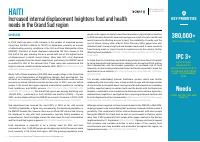
HAITI
Increased internal displacement heightens food and health
needs in the Grand Sud region
380,000+
IDPS IN GRAND SUD
IPC 3+
ACUTE FOOD
INSECURITY
PROJECTED IN PARTS
OF GRAND SUD FROM
JUNE TO NOVEMBER
2024
Needs
FOOD, NUTRITION AND
HEALTH’
Anticipatory note | 03 October 2024 2
KEY NEEDS IN THE GRAND SUD REGION
• 1,000,000 people were to face acute food insecurity by mid-2024, not including the
latest IDPs.
Access to food is the main humanitarian need of IDPs and host communities in the Grand
Sud region. The combination of insecurity, logistical limitations, and below-average local
food production increases the challenge of supplying local markets with affordable
food, especially in more remote areas of the Grand’Anse and Sud departments
(OCHA
19/01/2024; IPC 22/03/2024)
.
• 600,000 people required shelter in the Grand Sud region by late 2023.
Displaced people face barriers accessing shelter as a result of rising rental prices, a lack
of IDP sites in the region, and the limited capacity of host communities
(OCHA 19/01/2024).
HUMANITARIAN CONSTRAINTS
The deterioration of security conditions in Port-au-Prince has directly affected the work of
humanitarian responders across Haiti. Gang-imposed roadblocks have limited the ability to
cross and leave the ZMPAP, leading to the closure of major routes connecting the capital
with the rest of the country, including Grand Sud, and hindering humanitarian access to those
in need outside the ZMPAP
(OCHA 27/03/2024).
Port-au-Prince is the country’s main entry point for international aid. Logistical disruptions,
such as the airport closure between February–May and sporadic seaport closures, dependent
on security conditions, have translated into less humanitarian aid being distributed nationwide,
particularly healthcare supplies
(MSF 21/05/2024; UNICEF 16/03/2024; BBC 21/05/2024). At the end
of September, the port was closed by the Caribbean Port Services as a preventive measure
against gang attacks. This closure blocked the entry of humanitarian goods arriving by sea
and increased the overall cost of bringing supplies into the country
(Reuters 26/09/2024; Crisis24
27/09/2024)
.
Insecurity may also reduce the number of humanitarian personnel in the country, as the risk
of attack, kidnapping, or being caught up in clashes has increased since the beginning of
2024
(OCHA 19/08/2024; La Croix 27/05/2024).
CURRENT HUMANITARIAN NEEDS
Food and nutrition
An estimated 4.4 million people are facing Crisis (IPC Phase 3) or worse levels of food
insecurity in 2024, a 4% decrease from 2023, thanks partly to increased humanitarian aid. For
the Grand Sud region, more than one million people were to face acute food insecurity (IPC
3+) by mid-2024, including 61% of the population of Grand-Anse facing acute food insecurity
(OCHA 19/01/2024; IPC 22/03/2024).
Over one million people in Haiti will require treatment for malnutrition in 2024, a 35% increase
from 2023. Severe malnutrition remains the primary challenge across Haiti, particularly in
the Sud department, where displaced children can no longer engage with humanitarian
programmes aimed at combatting malnutrition. Such children had been attending
these programmes in their hometowns within or near the ZMPAP, but it is unclear if such
humanitarian responders are present in Grand Sud
(OCHA 19/01/2024; UNICEF 26/03/2024; IPC
08/03/2024)
.
Between June and November 2024, 277,000 children up to five years of age are expected
to face acute malnutrition across Haiti. Parts of the Nippes, Sud, and Sud-Est departments
are also expected to move from None (IPC Phase 1), the acceptable level on the IPC
acute malnutrition scale, to Stressed (IPC Phase 2) levels or IPC 3 by November 2024
(IPC
08/03/2024)
.
Food inflation is a major factor limiting displaced people’s access to food. Since the
beginning of 2024, food prices have risen by 40%, driven by supply chain disruptions caused
by insecurity and anticipated low production from the spring harvest. Road disruptions
affecting supply routes to markets in the Sud-Est and Nippes departments may further
reduce food availability in these areas
(FEWS NET 14/06/2024).
Access to food is particularly difficult for host communities in the Grand Sud region, as they
struggle to provide for more people while seeing further strain on incomes and diminishing
food availability
(FEWS NET 14/06/2024).
Health system
In 2024, an estimated 4.7 million people — 40% of Haiti’s population — are expected to
require assistance to access health services, as the fragile healthcare system is unable to
meet the population’s needs. Hospitals in departments such as Grand’Anse, Nippes, and Sud
Anticipatory note | 03 October 2024 3
are unable to meet growing healthcare needs, including for pregnant women and newborns,
as a result of inadequate infrastructure, limited funding, and a shortage of healthcare
professionals
(HOPE 09/05/2024; WB 06/04/2023; MSH 09/02/2023).
At the end of 2022, 73% of the country’s 22 major hospitals reported an inability to function
normally owing to road blockages, supply import issues, logistical challenges moving
supplies and staff across the country, and poor funding, which only worsened with rising
insecurity in the first half of 2024
(MSF 21/05/2024; UNICEF 16/03/2024; BBC 23/05/2024).
In the Grand Sud region, there is concern that supplies will be insufficient to aid the increasing
number of displaced people in need of health services, especially if import limitations
resulting from port closures in Port-au-Prince continue. In Nippes, there is a risk that poor
infrastructure will mean that IDPs in rural communities cannot access healthcare services
(HOPE 26/03/2024).
Education
52% of Haiti’s displaced population are children, whose access to education is severely
limited in the regions to which they fled. This is particularly evident in Grand Sud, where
some schools are still awaiting repair from the effects of natural hazards, including those
affected by the 2021 earthquake. Schools that are open are overwhelmed by the arrival of
new students
(IOM 09/06/2024; UNICEF 19/09/2023, 09/02/2022, and 11/09/2024).
Shelter and housing
In 2023, 4.6 million people required assistance accessing housing, particularly displaced
individuals unable to find shelter with host families and forced to reside in makeshift IDP
sites. Over 600,000 people required shelter in the Grand Sud region by the end of 2023, a
number that has likely increased with the arrival of new IDPs and the absence of formal IDP
sites
(OCHA 19/01/2024).
Rising rental prices, especially for rooms rented to IDPs, are worsening the housing crisis in
Grand Sud. Landlords are increasing rental prices as the displaced population grows, further
limiting access for those from lower socioeconomic backgrounds
(OCHA 19/01/2024).
Some people living in host communities in Sud department are likely to be living in crowded
conditions, in houses built with mud, sand, cane, and palm. These materials are less resistant
to strong winds and rainfall, making them more vulnerable to natural hazards
(USAID accessed
29/09/2024)
.
DRIVERS OF THE CRISIS AND AGGRAVATING FACTORS
Political instability
Political instability is a driver and aggravating factor of both displacement across Haiti
and the limited services for IDPs and host communities in Grand Sud. In 2021, President
Jovenel Moise was assassinated, leaving a power vacuum and political uncertainty, which
propelled Ariel Henry into the role of Interim Prime Minister. Despite promises, elections
were postponed and Henry was forced to step down in March 2024 as a result of the surge
in gang violence earlier in the year
(BBC 12/03/2024; IRC 07/04/2023 and 13/12/2023). Since 2023,
no elected officials have been in power in Haiti.
Currently, Garry Conille serves as Interim Prime Minister, appointed by a transitional council
comprising several Caribbean countries. It is unclear how much control Conille has over the
Government in the capital, however, as gangs have gained control of and cut off Port-au-
Prince from the rest of the country
(DW 12/06/2024; NYT 09/07/2024).
Limited law enforcement also contributes to insecurity, while the instability of the
administration and economic challenges diminish the State’s capacity to support those in
need.
Insecurity
Insecurity is the main driver of increased displacement in Grand Sud. Since March 2024,
gangs have launched attacks on government infrastructure, prisons, police stations, the
airport, and the seaport in the ZMPAP, effectively paralysing the Government and limiting the
work of humanitarian responders
(UNICEF 16/03/2024; HRW 08/03/2024).
In response, a Kenyan contingent was deployed to Port-au-Prince in June to support the
Haitian police attempt to regain control of the capital. By September, however, gangs still
controlled parts of the city
(HRW 28/05/2024; Africa News 13/08/2024; BBC 05/09/2024). Fighting,
extortion, road blockages, and attacks on public institutions have continued, leading to
further forced displacement
(BBC 05/09/2024; Ayibopost 29/07/2024; IOM 14/09/2024).
Anticipatory note | 03 October 2024 4
La Niña and related hazards
La Niña is expected to bring above-average rainfall to Haiti by the end of 2024, especially in
the Grand Sud region, and temperatures are expected to be above average from September
to early 2025. These conditions raise the risk of waterborne diseases such as cholera,
dysentery, and typhoid fever spreading in the region
(WMO accessed 19/09/2024, CDC 01/05/2023).
The consequences of La Niña may be worse in Grand’Anse and Sud, the two departments
whose location and lack of preparedness make them most vulnerable to hurricanes and
drought
(USAID accessed 29/09/2024).
Continuing obstacles to accessing WASH services further worsen the humanitarian crisis.
At least 26% of Haitians lack access to clean water, 75% have no soap for handwashing,
and about 70% have no access to improved sanitation systems — a situation only worsened
by increased displacement since early 2024. Such conditions also aggravate the spread of
waterborne diseases
(UNICEF 08/05/2024; OCHA 26/08/2024).
MAP AND TABLE 1. IDPS AND IPC FOOD INSECURITY PROJECTIONS IN THE GRAND SUD
Sources: ACAPS with data from IOM (22/09/2024); IPC (22/03/2024)
Note: IPC projections were published in March, at the beginning of increased number of IDP arrivals to Grand Sud. The new IDPs are not counted in the projections.