
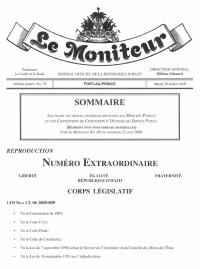
(2009-07) Law No. CL 06 2009-009 setting the general rules for public procurement and public-service works concession agreements (reproduction for material errors)
Summary — Haiti's foundational public procurement law, voted by the legislature and published in Le Moniteur, sets uniform rules for the award, execution and settlement of public contracts (works, supplies, services, intellectual services) above defined thresholds, and creates a parallel legal regime for public-service BOT concession agreements. This is a corrected reproduction of the law originally published on 12 June 2009 (No. 60).
Key Findings
- Establishes four founding principles for public procurement: free access, equal treatment/transparency, ethics, and efficiency of public spending (Art. 1).
- Repeals the 3 December 2004 decree on public markets, replacing it with a full statutory framework.
- Creates a new legal category, the Convention de Concession d'Ouvrage de Service Public (BOT-type concession), for privately financed public infrastructure.
- Extends coverage to externally financed contracts, requiring disclosure to the Commission Nationale des Marchés Publics even when donor agreements override domestic procedure.
- Defines 31 technical terms (Art. 4) that anchor Haiti's procurement vocabulary, including contracting/concession-granting authority, tender types, and the dispute-settlement committee attached to the CNMP.
Full Description
Voted by Haiti's Corps Législatif on the joint proposal of the Prime Minister and the Minister of Economy and Finance, Law No. CL 06 2009-009 replaces the 2004 procurement decree with a full legislative framework governing public procurement and public-service concession/BOT agreements. It applies to the State, territorial collectivities, autonomous administrative and financial public bodies, mixed enterprises with majority public capital, and to externally financed contracts whose financing agreements do not otherwise override the law (though such contracts must still be reported to the Commission Nationale des Marchés Publics). Title I sets out founding principles (free access to public procurement, equal treatment and transparency, ethics, efficiency of public spending), scope of application, and exemptions (national defense/security contracts, state-of-emergency procurement, small purchases below threshold). Chapter II provides an extensive glossary defining every key procurement actor and instrument (contracting authority, concession-granting authority, tender, works/supply/service/intellectual-service contracts, dispute-settlement committee, validation, etc.), establishing the technical vocabulary used throughout Haiti's public procurement system since 2009. This copy is an official reproduction issued to correct material errors in the version originally printed in Le Moniteur No. 60 of 12 June 2009.