
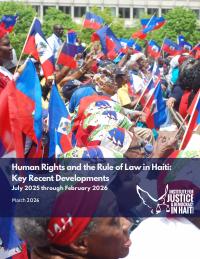
(2026-03) Human Rights and the Rule of Law in Haiti: Key Recent Developments, July 2025 through February 2026
Summary — IJDH periodic update documenting Haiti's deepening security, governance and humanitarian crisis from July 2025 to February 2026, including over 8,100 killings, 1.45 million displaced, the transition to the Gang Suppression Force and a new transitional government.
Key Findings
- At least 8,100 people were killed by armed group violence in 2025 and about 1.45 million were internally displaced as of January 2026, with 80 to 90 percent of metropolitan Port-au-Prince under armed group control; reports indicate over half of Haitians killed in 2025 died in government-linked security responses, including drone operations and abuses by civilian defense groups and private contractors. The April 2024 Accord government and the MSS ended without meeting benchmarks, replaced by a government consolidated under Prime Minister Fils-Aimé, criticized for a December 2025 decree shielding former officials, and by a barely deployed, underfunded Gang Suppression Force. Economic and social conditions deteriorated further: a seventh consecutive year of economic decline, 25 percent inflation, 35 percent extreme poverty, 5.7 million acutely food insecure, 12 percent of inpatient health facilities operating normally, over 1,600 schools closed, and a sharp cholera surge. The Dominican Republic expelled over 265,000 Haitians in 2025 while the United States suspended virtually all protection pathways.
Full Description
This periodic IJDH update covers July 2025 through February 2026, a period in which both the April 2024 Accord transitional government and the UN-authorized Multinational Security Support mission ended without meeting material benchmarks and were replaced by a government consolidated under Prime Minister Alix Didier Fils-Aimé and the new Gang Suppression Force. The report documents further violations of the right to life and security: at least 8,100 people killed by armed group violence in 2025, about 1.45 million internally displaced, 80 to 90 percent of metropolitan Port-au-Prince under armed group control, and reports that over half of Haitians killed in 2025 died in government-linked security responses, including drone strikes and abuses by civilian defense groups and private military contractors. It reviews corruption and collusion between state actors and armed groups, justice sector collapse and impunity, escalating sexual violence and child recruitment, and the deterioration of economic and social rights: 35 percent extreme poverty, 25 percent inflation, 5.7 million acutely food insecure, only 12 percent of inpatient health facilities functioning normally, and more than 1,600 schools closed. It also examines mass expulsions from the Dominican Republic, the shutdown of US protection pathways, and shortcomings of the international response.
Notes
IJDH periodic human rights and rule-of-law update (English PDF despite French catalog title); ayitistats wave B