
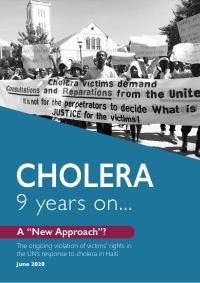
(2020-06) Cholera 9 Years On... A "New Approach"? The Ongoing Violation of Victims' Rights in the UN's Response to Cholera in Haiti
Summary — IJDH report assessing the UN's response nine years after peacekeepers introduced cholera to Haiti, finding the 400 million dollar New Approach underfunded, victims excluded, compensation denied, and legal obligations to remedy still breached.
Key Findings
- The cholera epidemic introduced by UN peacekeepers in October 2010 killed over 9,700 people and infected more than 819,000, including more than 2,500 deaths in the first three months. The UN denied responsibility for six years despite investigations pointing to its base at Meye staffed by a Nepalese contingent, and rejected claims filed by 5,000 victims in 2011 as not receivable. The 2016 apology and 400 million dollar New Approach lack acceptance of legal responsibility, victim consultation, funding safeguards and an independent claims mechanism. As of 2017, 42 percent of Haitians still lacked adequate access to safe water, leaving the country vulnerable to cholera.
Full Description
This IJDH report reviews the United Nations' response to the cholera epidemic that began in October 2010, when sewage from a UN peacekeeping base staffed by a contingent from Nepal contaminated Haiti's main river system. The epidemic killed more than 2,500 people in its first three months and, by publication, over 9,700 people, with more than 819,000 infected. The report traces six years of UN denial, the 2011 filing of claims by 5,000 victims with support from BAI and IJDH, litigation in US federal courts dismissed on immunity grounds, and the 2016 apology by Secretary-General Ban Ki-moon accompanied by the 400 million dollar New Approach to Cholera in Haiti. It concludes that the New Approach fails victims: it is not grounded in acceptance of legal responsibility, victims were not consulted in its design, funding safeguards are absent, and no independent claims assessment mechanism exists. It also notes Haiti's continuing vulnerability, with 42 percent of Haitians lacking adequate access to safe water as of 2017, and documents the ongoing victim mobilization for remedies.
Notes
IJDH thematic report, English original (catalog title in French); ayitistats wave B