
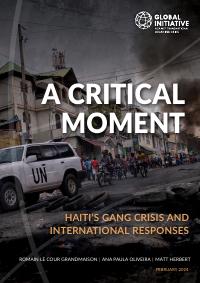
(2024-02) A Critical Moment: Haiti's Gang Crisis and International Responses (February 2024)
Summary — GI-TOC policy report, published in February 2024 ahead of the planned Kenyan-led Multinational Security Support deployment, analyzing how Haiti's roughly 200 gangs evolved from patronage-dependent groups into professionalized violent entrepreneurs exercising territorial and criminal governance over about 80 percent of Port-au-Prince and expanding into rural Artibonite. Based on 36 interviews and fieldwork in November 2023, it assesses the two main international tools, the UN sanctions regime and the MSS mission, and proposes ways to align them against Haiti's criminal ecosystem.
Key Findings
- In 2023 over 4 789 people were murdered, 1 698 injured and 2 490 kidnapped, with a homicide rate of 40.9 per 100 000, more than double the 2022 rate.
- Haiti's roughly 200 gangs have professionalized: the largest have grown to 1 500-2 500 members, adopted hierarchical structures and tactical training, and stockpiled trafficked assault rifles.
- Gangs control or substantially influence about 80 percent of Port-au-Prince and are expanding into rural areas, notably the Artibonite, where farmland invasions cut cultivated land from 5 800 hectares in 2018 to 2 400 in 2022.
- The Bwa Kale vigilante movement has produced more than 600 registered lynchings since April 2023, blurring the line between community self-defence and extrajudicial violence.
- The UN sanctions regime and the MSS mission mark a conceptual shift by treating profit-driven criminal groups as primary conflict actors, but their success depends on coordinated planning, expedited designations and targeting of the gangs' political and economic enablers.
Full Description
Written by Romain Le Cour Grandmaison, Ana Paula Oliveira and Matt Herbert, this report examines Haiti's security collapse through 2023 and early 2024 and the design of the international response. UN figures for 2023 record over 4 789 murders, 1 698 injured and 2 490 kidnapped, with a homicide rate of 40.9 per 100 000, more than double the 2022 rate. The report documents the professionalization of the gangs: an estimated 200 groups, the largest grown from 50-100 members in the MINUSTAH era to 1 500-2 500, organized into the rival G9 and G-Pep coalitions, run by 'young veterans' with hierarchical structures, division of labour, recruitment processes, tactical training by ex-soldiers, ex-police and deportees, and arsenals of trafficked AK-47, AR-15 and Galil rifles. It traces gang expansion from urban Port-au-Prince, roughly 80 percent of which is under gang control or influence, into the rural Artibonite, where farmland invasions cut cultivated land from 5 800 hectares in 2018 to 2 400 in 2022, and analyzes the wider ecosystem of violence, including the Bwa Kale vigilante movement and more than 600 lynchings registered since April 2023. The second half assesses the UN sanctions regime created in October 2022 and the non-UN MSS mission authorized in October 2023, arguing they represent a conceptual shift in UN treatment of profit-driven criminal actors as primary conflict actors. Recommendations, based on 36 interviews conducted in November 2023, include coordinated planning between the MSS, the Sanctions Committee and the Panel of Experts, targeting the broader criminal ecosystem including white-collar enablers, expedited sanctions designations, continuous mapping of criminal networks, centering human rights and communities, and consistent strategic messaging.