
(2023-06) ACAPS Briefing Note: Haiti - Humanitarian Impact of Gang Violence (2 June 2023)
Summary — This briefing note documents the humanitarian impact of Haiti's escalating gang violence as of June 2023, when gangs controlled an estimated 80 percent of Port-au-Prince and had displaced at least 160,000 people since 2021. Drawing on secondary sources, it quantifies the surge in homicides (rates tripled between 2018 and 2022), kidnappings (up 2,673 percent over the same period), and sexual violence, and maps effects on displacement, food security, health, education, and humanitarian access. It concludes that violence is unlikely to decline in the short term given a police force reduced by 40 percent over three years and unstable gang alliances.
Key Findings
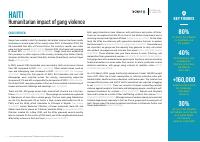
- Gang territorial control expanded rapidly, from about 60 percent of Port-au-Prince in December 2022 to about 80 percent by April 2023, with gangs also established in Cap Haïtien, Gonaïves, Jacmel, Jérémie, and Les Cayes.
- Violence escalated sharply: homicide rates tripled between 2018 (6.87 per 100,000) and 2022 (18.84 per 100,000), and kidnappings rose 2,673 percent over 2018-2022, with 637 abductions in the first quarter of 2023 alone.
- Security forces cannot contain the violence: the Haitian National Police shrank about 40 percent, from roughly 15,000 officers in 2020 to around 9,000 in 2023, against an estimated 20,000-30,000 gang members with political and police alliances.
- Gang violence displaced at least 160,000 people since 2021 and disrupted livelihoods, including market closures and the loss of about 2,400 hectares of farmland in Artibonite, deepening a food crisis affecting nearly half the population.
- Humanitarian space is shrinking, with 37 aid workers killed, injured, kidnapped, or arrested between 2020 and 2022, attacks on hospitals such as MSF's Cité Soleil facility, and response funding requirements nearly doubling since 2022 while access to the worst-affected areas remains blocked.
Full Description
This ACAPS briefing note, published on 2 June 2023 as a follow-up to its November 2022 report on the deteriorating situation in Port-au-Prince, extends the geographic scope to the whole country and isolates the humanitarian impact of gang violence. Gangs, numbering 200-300 nationwide and organised around the rival G9 and GPèp federations with documented alliances to politicians and police officials, controlled an estimated 80 percent of Port-au-Prince by April 2023 (up from 60 percent in December 2022) and had spread to Artibonite and other departments. The note quantifies the escalation: homicide rates tripled from 6.87 to 18.84 per 100,000 between 2018 and 2022; kidnappings grew 2,673 percent over the same period, with 637 abductions in the first quarter of 2023 alone; and an estimated 30 percent of Haitian women aged 15-30 had been victims of sexual violence. Vigilante mobs (the Bwa Kale movement) killed at least 75 suspected gang members between January and April 2023.
The analysis details consequences across sectors: at least 160,000 people forcibly displaced since 2021, over 38 percent of IDPs in 50 makeshift shelters mostly without basic services; market closures and the abandonment of farmland in Artibonite worsening a food crisis already affecting nearly half the population; attacks on hospitals and schools forcing closures, including MSF's Cité Soleil hospital; and severe humanitarian access constraints, with 37 aid workers killed, injured, kidnapped, or arrested between 2020 and 2022 and organisations negotiating with gangs to move. The note argues violence is unlikely to abate: the Haitian National Police shrank from about 15,000 officers in 2020 to around 9,000 in 2023 against an estimated 20,000-30,000 gang members, while weak intra- and inter-federation alliances, the 400 Mawozo, judicial paralysis (83 percent of 11,000-plus detainees unconvicted), a renewed cholera outbreak, UN sanctions, and recurrent fuel crises compound the emergency. Humanitarian funding requirements nearly doubled from 2022.
Notes
ACAPS thematic/anticipatory analysis